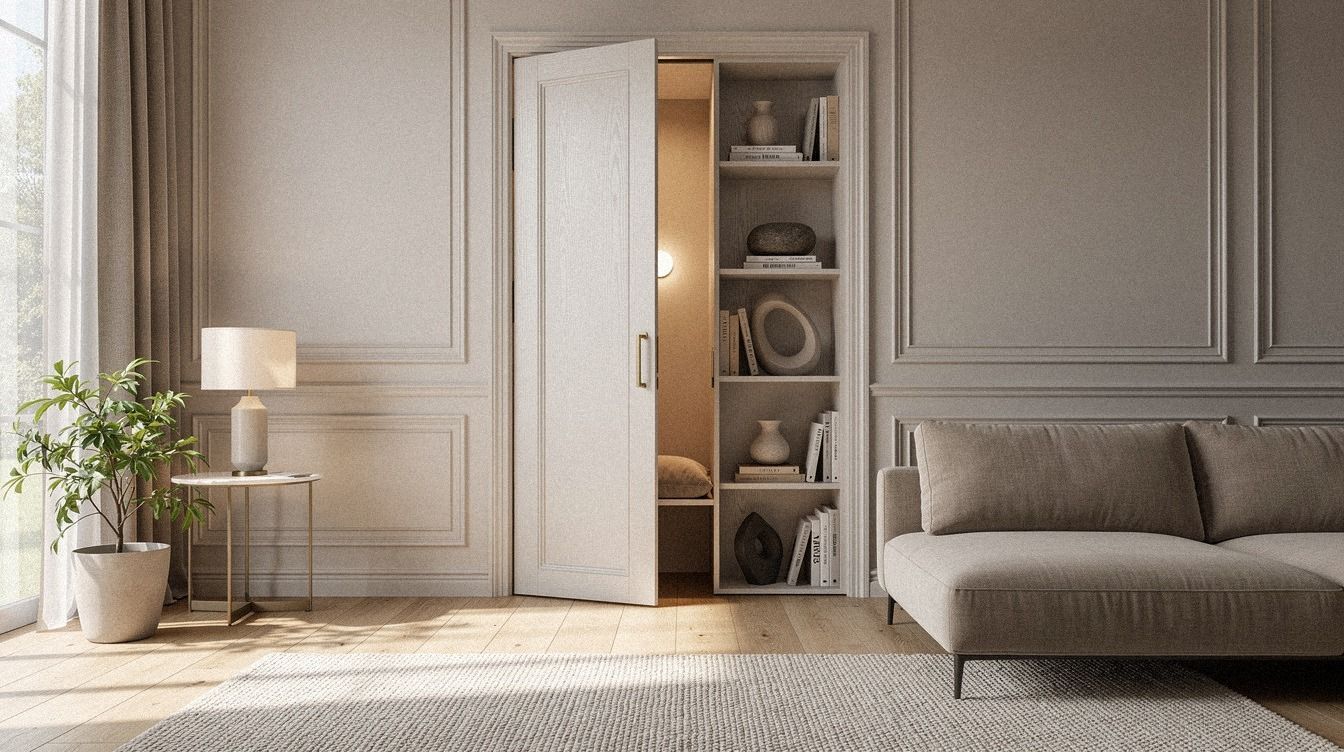
Small secret room ideas [Big Magic in Little Spaces] work best when you treat the opening like millwork, not like a novelty project. I learned that after trying to hide a reading nook behind a flimsy screen that shouted “extra room” from six feet away. You want the reveal to feel quiet, built-in, and a little surprising. That’s what makes a tight corner feel richer instead of busier.
- Start with a slim bookcase door
- Anchor the hideaway beside the fireplace
- Camouflage the entrance with picture-frame molding
- Layer art across a touch-latch wall
- Hang velvet drapes over the passage
- Build a reading pocket behind shelving
- Paint the reveal in moody aubergine
- Install a mirror panel near the sofa
- Start with a slim bookcase door
- Anchor the hideaway beside the fireplace
- Camouflage the entrance with picture-frame molding
- Layer art across a touch-latch wall
- Hang velvet drapes over the passage
- Build a reading pocket behind shelving
- Paint the reveal in moody aubergine
- Install a mirror panel near the sofa
- Why does brass picture lighting make the seam disappear?
- Conceal the handle inside sculptural trim
- Tuck a lounge behind paneled built-ins
- Wrap the doorway in linen wallpaper
- Add sconces inside the hidden threshold
- Style shelves to blur the door gap
- Finish with a candlelit mini library
1Start with a slim bookcase door
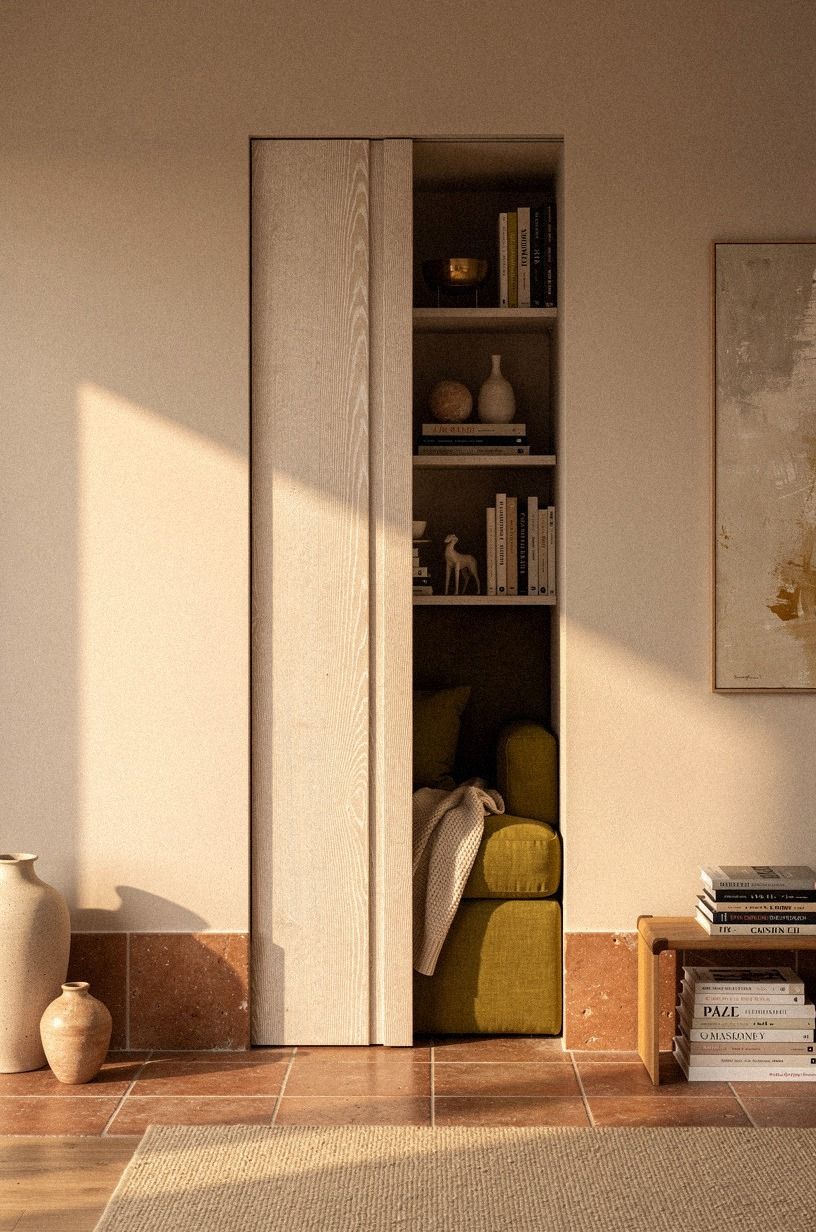
Start with a bookcase door that looks useful even when it’s closed, because that’s what keeps the wall believable. A shallow run in cerused white oak is the move I trust most in a small living room, especially if you keep the depth around 10 to 12 inches and let the shelves carry real books, a bowl, and one framed piece. If your room already feels pinched, read why a small living room can feel cold when the scale is off before you size the unit.
Storage honest truth: a bookcase door is the only moving wall in your house that justifies 12 inches of depth. Anything shallower and you’ve wasted the swing.
I wouldn’t make the shelf wall too thick. That’s the mistake.
You want enough storage to earn its keep, but not so much that the wall starts pushing your seating forward. An IKEA BILLY upgrade can work if you wrap it in trim and paint it to match, though custom millwork in three-quarter-inch white oak veneer will sit flatter and feel calmer.
And when the shelves part to show that olive cushion inside, you get the magic without losing the room you use every day.
2Anchor the hideaway beside the fireplace
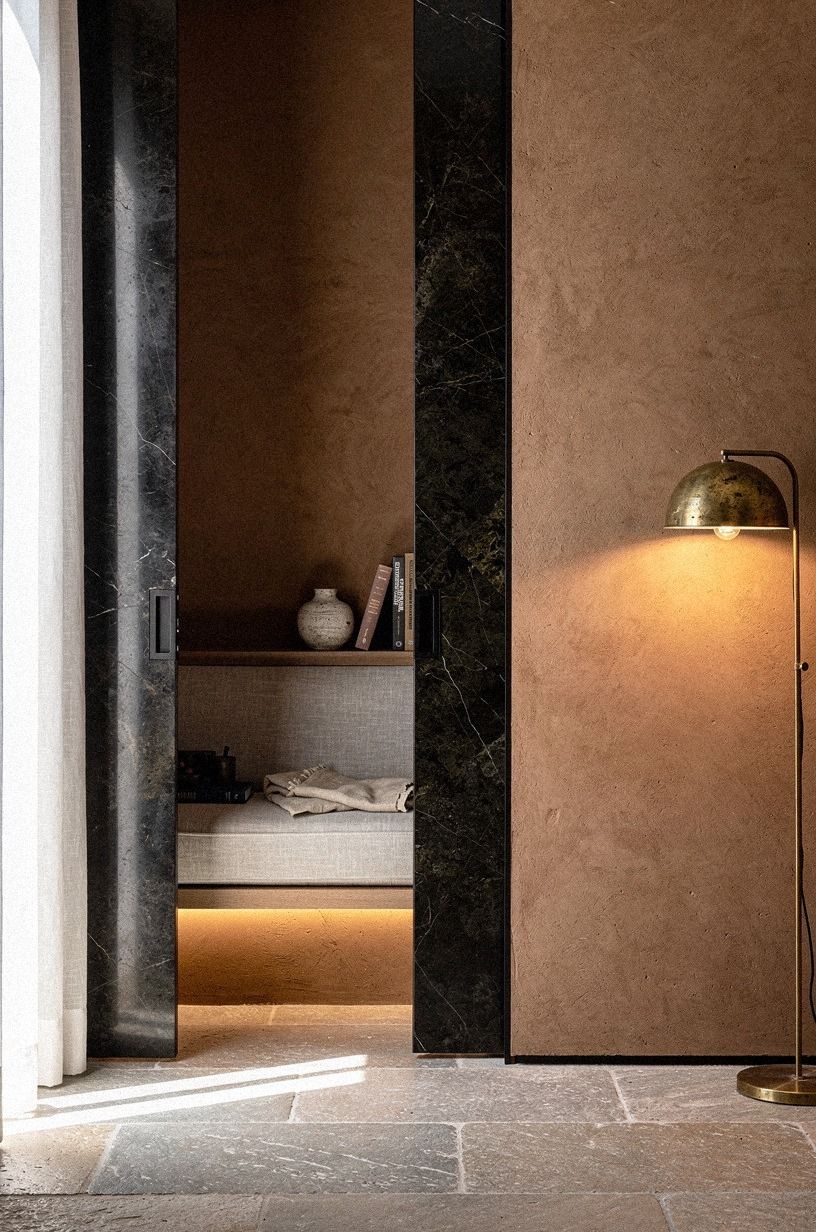
Put the opening near the fireplace if you want the hideaway to feel inevitable, not random.
3Camouflage the entrance with picture-frame molding
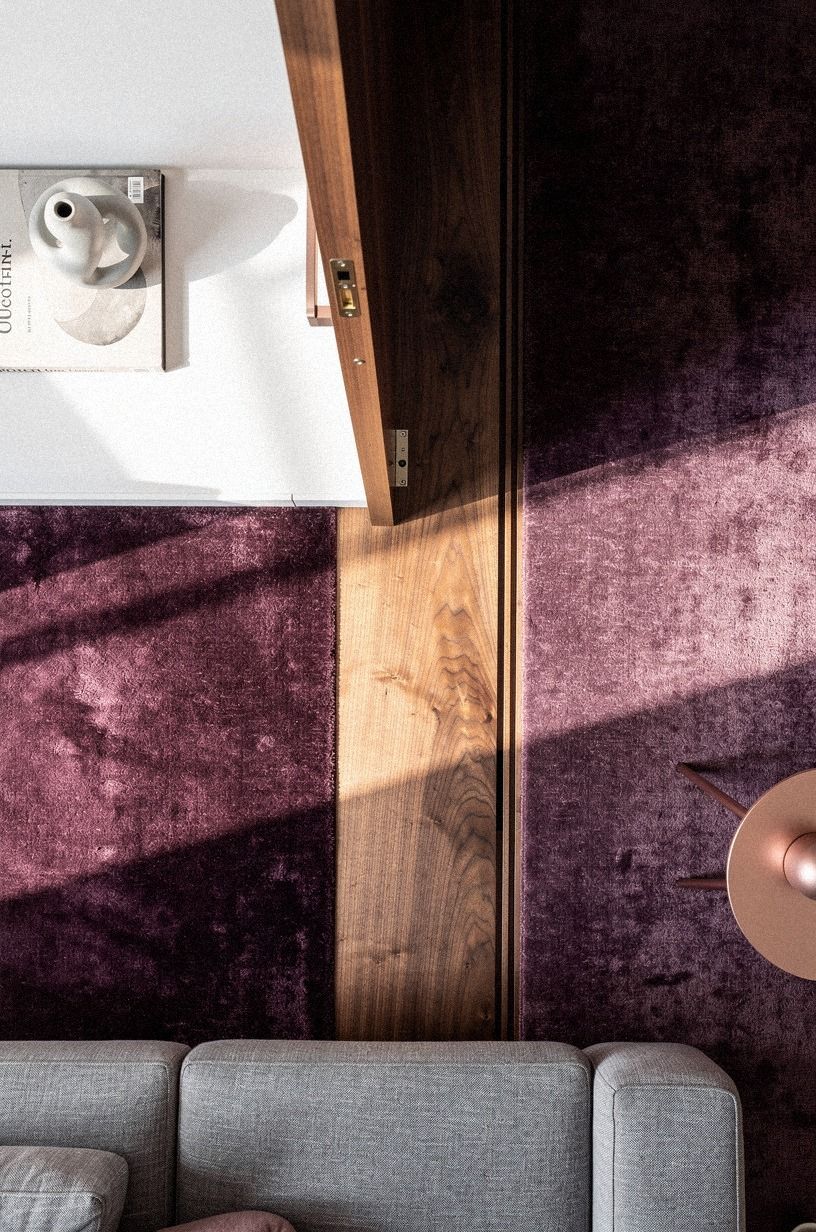
Use picture-frame molding when you need the door seam to disappear into a formal wall. The key is keeping the panel sizes consistent across the whole elevation, so your eye reads rhythm first and the hinge line second.
I like this most in living rooms that already have classic trim because the hidden edge just becomes one more shadow line. For proportion help, I still go back to these small living room furniture layout ideas when I need the wall to feel balanced from corner to corner.
Panel sizing rule: keep every rectangle within an inch of the same width. Variation reads as sloppiness, not charm.
Paint the whole composition one color and let the molding do the work. Benjamin Moore Revere Pewter HC-172 keeps the relief soft, and a push-latch means you don’t have a knob giving away the game. If you want one affordable shortcut, use primed MDF molding over a flush slab and spend your money on cleaner carpentry, not fancier ornament.
You only notice bad spacing here. You never regret clean reveals.
Push-latch brand: the Sugatsune touch latch is the one contractors quietly swear by, and it costs around $30 per door.
4Layer art across a touch-latch wall
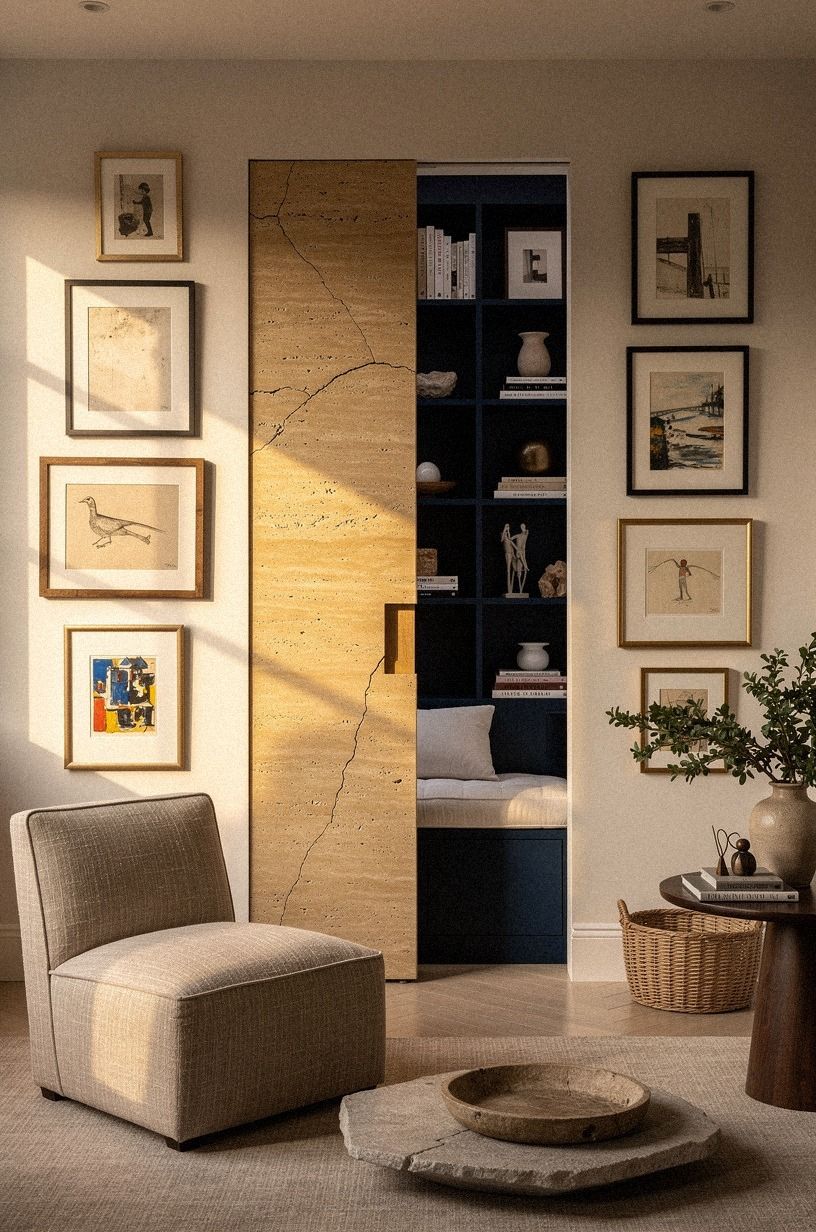
Layer art over the panel when the wall needs to feel lived in rather than engineered.
5Hang velvet drapes over the passage
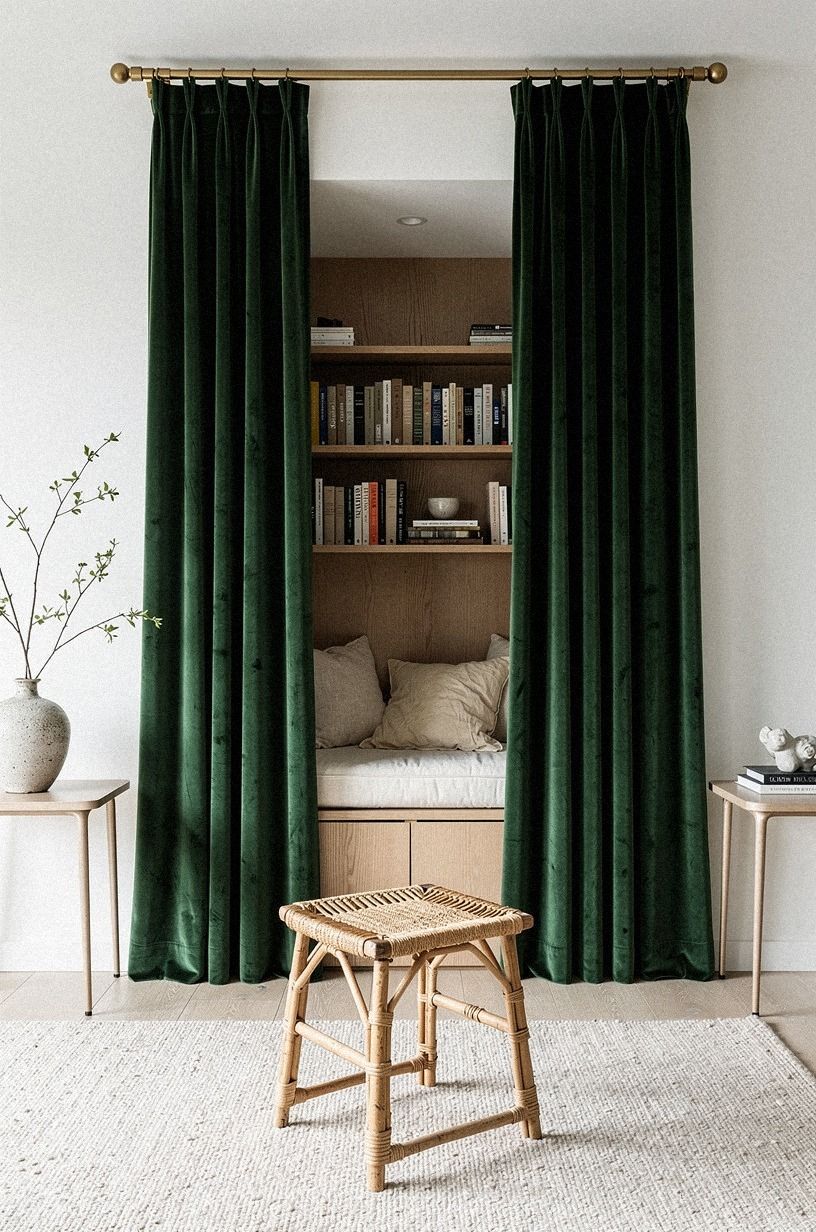
Hang drapes when you want softness first and architecture second. A hidden passage behind curtains feels a little theatrical in the best way, especially if the fabric is deep enough to hold folds and just barely parts around an unlacquered brass rod.
You get concealment, sound softness, and a warmer wall in one move. For rooms that need more mood, I often pair this with small speakeasy living room ideas that lean into low light and texture.
Skip skinny polyester panels. They don’t hide anything, and you can tell.
A pair of linen-lined cotton velvet drapes in emerald or oxblood will do far more, even if you only spend $120 to $400 on the pair. Mount the rod high, let the hem kiss the floor, and keep the stack back wide enough so you can walk through without fighting fabric.
And yes, you want the curtain slightly parted when you style the room. That whisper of rust velvet inside is what sells the whole idea.
Designer tell: the curtain stack should be at least 18 inches deep on each side, otherwise the panels bunch and break the illusion.
6Build a reading pocket behind shelving
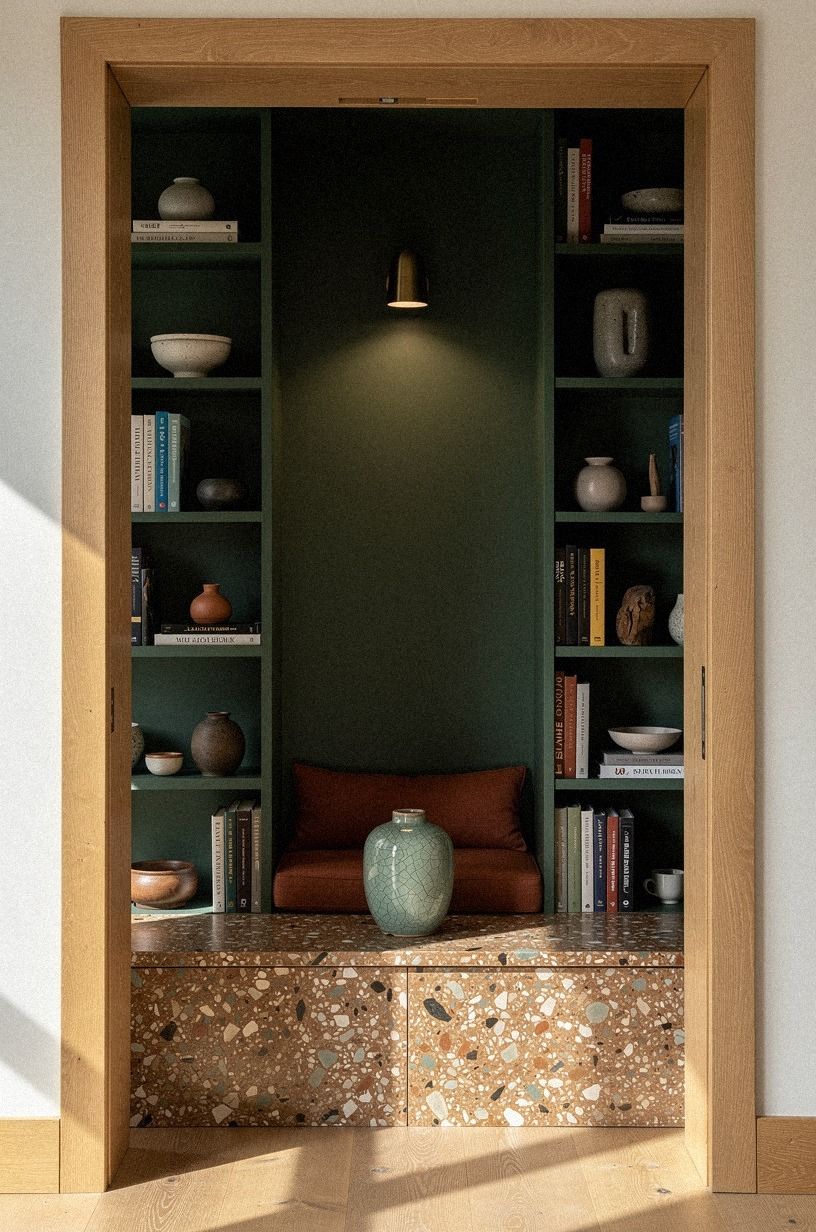
Build a reading pocket when you need the hidden room to earn a real daily habit, not just a wow moment for guests. Depth is what separates a habit from a gimmick: leave yourself at least 28 to 32 inches of clearance from the shelf face to the back wall so a grown adult can sit cross-legged with a paperback open. Anything tighter reads as a crawlspace, no matter how pretty the cushion is.
Pro move: keep one slim shelf above the seat at standing height for water, glasses, and the paperback you didn’t finish.
Light it warm and low, never bright. A single plug-in brass sconce above the seat does more than a can of overhead paint ever will, and you don’t need an electrician for it.
Toss in one wool throw and a Belgian linen floor cushion, then you’ve got a reading nook that earns its keep on a Tuesday night. For a similar mood in a tighter footprint, these speakeasy lounge ideas for a quiet cocktail-hour hangout follow the same playbook.
7Paint the reveal in moody aubergine
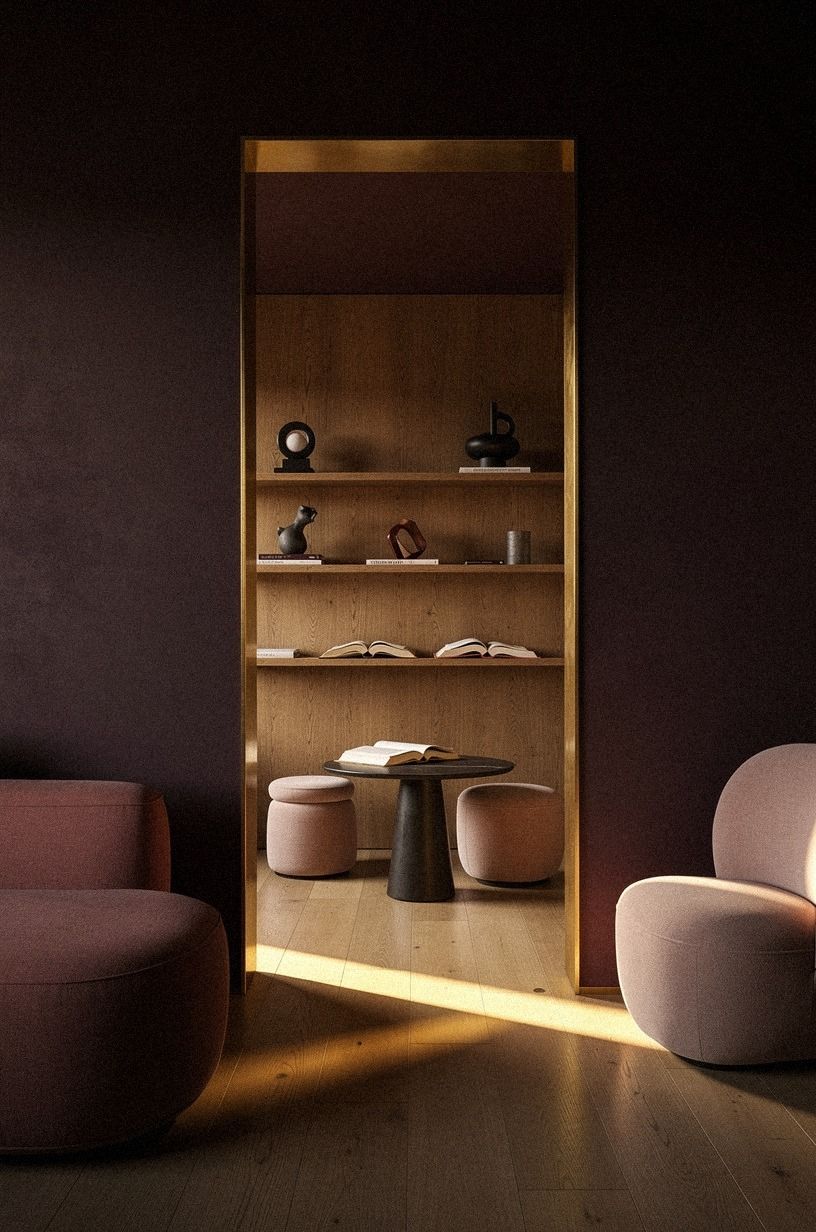
Paint the inside reveal darker than the main room if you want the opening to feel deeper than it is.
8Install a mirror panel near the sofa
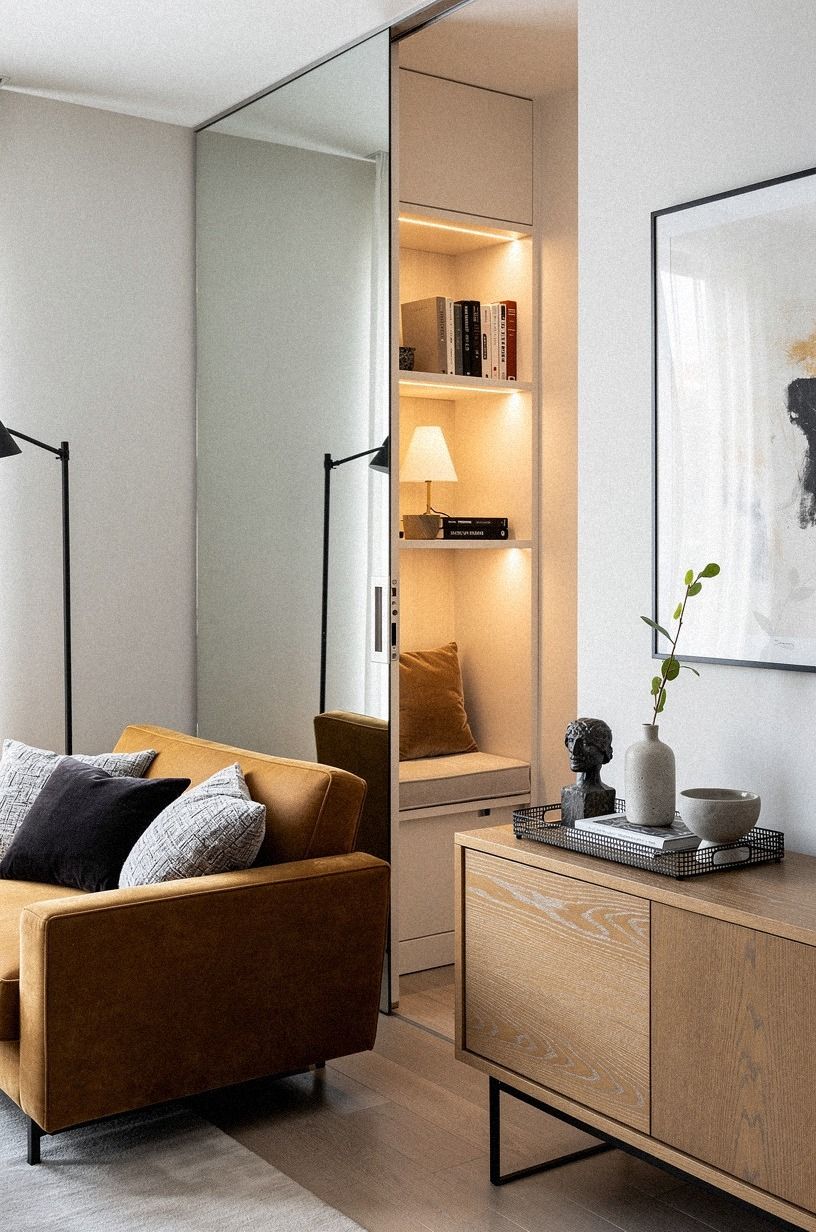
Install a mirror panel when the wall can’t spare visual weight. Reflection buys you breathing room, and that matters in a tight living room where every inch of wall has to work. A mirror door cracked open at one edge gives you the hint of another space without making the room feel chopped up.
For planning around a tight seating group, I like pairing this idea with these tighter-space living room furniture layouts so the panel doesn’t swing into a traffic lane.
Keep the mirror warm, not icy. Antique mirror glass or a lightly foxed finish feels much better than a sharp builder-grade reflection, especially near boucle or linen upholstery.
I wouldn’t place it directly across from the television either, because glare will make you hate it by day three. Put it near the sofa arm, keep your coffee table around 16 to 18 inches tall, and let the reflection pick up a lamp, a plant, or books. That softer image is what makes the opening disappear.
Foxing tip: a quick seal of paste wax over antique mirror keeps the mottling in place for years, no special skills needed.
9Why does brass picture lighting make the seam disappear?
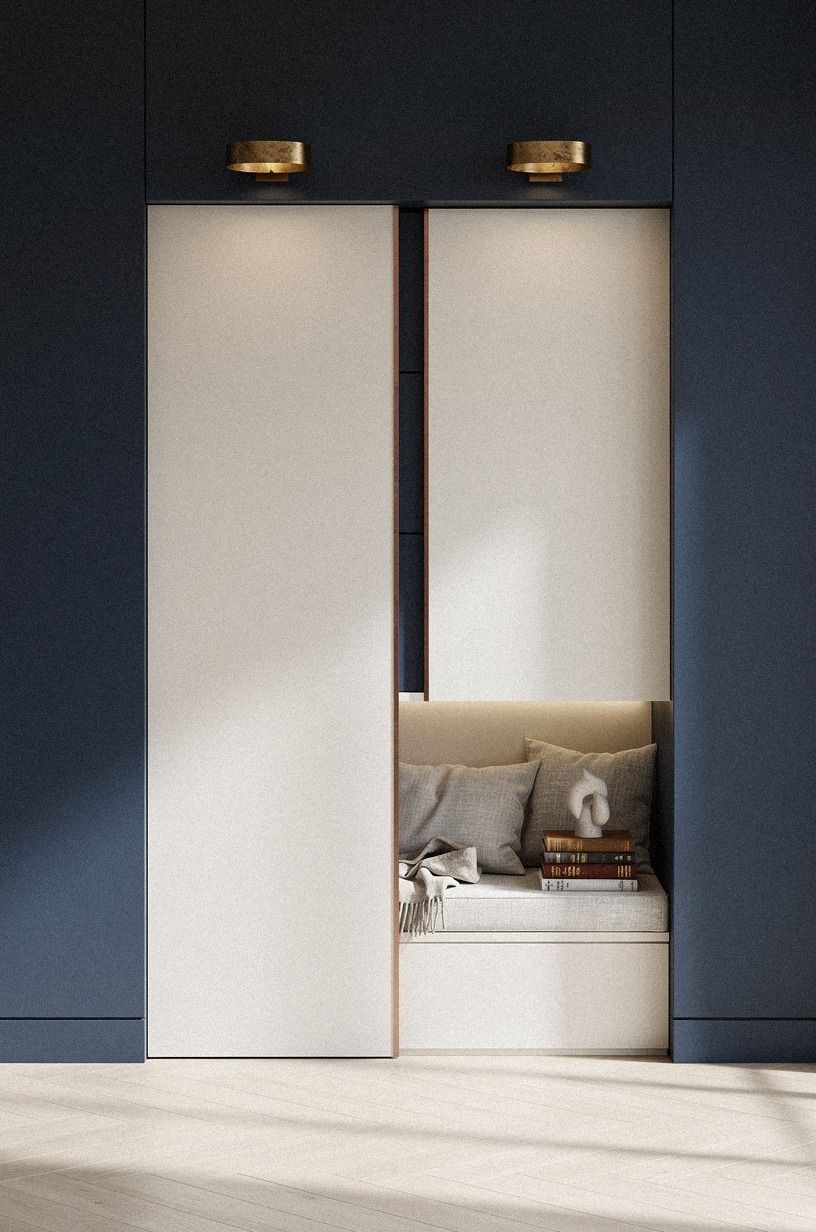
Picture lights pull your eye to the wash of glow, not the joinery, which is exactly why brass works here. Twin aged brass picture lights mounted 6 to 8 inches above the seam create a soft fall of light that hides any uneven reveal and warms the wall color at the same time. You’ll never stare at a hinge line that’s sitting under a pool of amber.
Visual Physics: warm light at low height makes a wall feel thicker than it is, which is the oldest designer move in the book.
Skip cool-tone LEDs for this move every single time. They make the brass look cheap and the wall look clinical, which is the opposite of what you want.
Stick to 2700K bulbs, dim them to about 40 to 60 percent when you’re in the room, and let the seam turn into one more shadow. For more on layering warm light at low heights, these speakeasy lighting ideas for a sultry glow cover the same logic beautifully.
10Conceal the handle inside sculptural trim
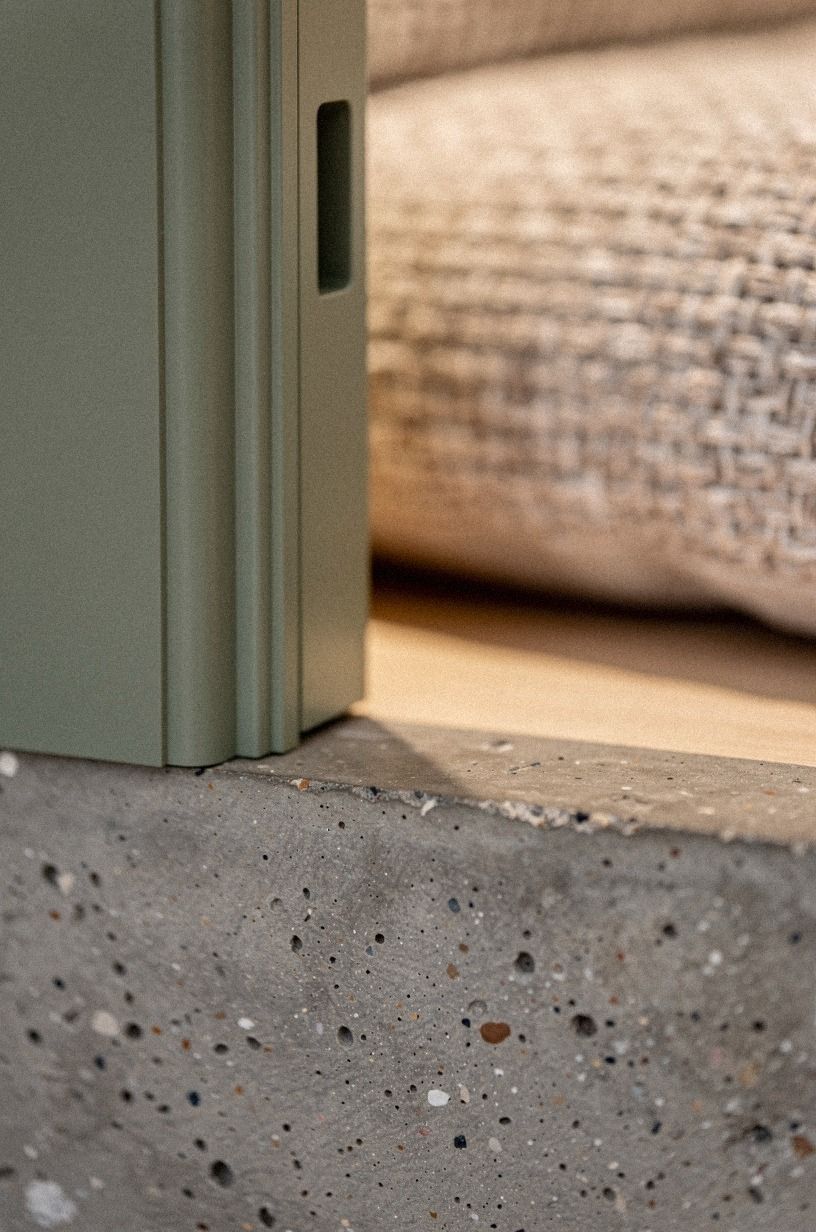
Hide the handle in trim when you want the wall to stay believable up close. A fingertip shadow gap inside layered molding is more elegant than almost any visible pull, and it lets you keep the reveal neat from every angle.
I like this most on painted joinery where you can shape the profile and let the grip vanish into the relief. If you want the room to read custom instead of improvised, this small sitting room guide has the same lesson all over it.
Use a profile with enough thickness to hide your fingers comfortably. Sage-painted poplar trim works well, and so does a routed pull behind a stepped panel edge.
I made one too shallow once, and every guest scraped a knuckle trying to open it. Never again.
That’s the kind of detail that quietly undoes a whole project.
Rule of thumb: aim for a 5/8-inch to 3/4-inch reveal. Anything thinner makes the grip awkward.
And that tiny comfort matters more than ornate trim. You want the movement to feel easy, almost automatic, because fussy hardware makes a hidden room feel like a gimmick fast.
Hardware spend: budget $40 to $80 on a quality touch-latch set. Cheap hardware is the one corner not worth cutting!
Run the same approach across the door jamb and head casing so the seam disappears from every angle, not just head-on.
11Tuck a lounge behind paneled built-ins
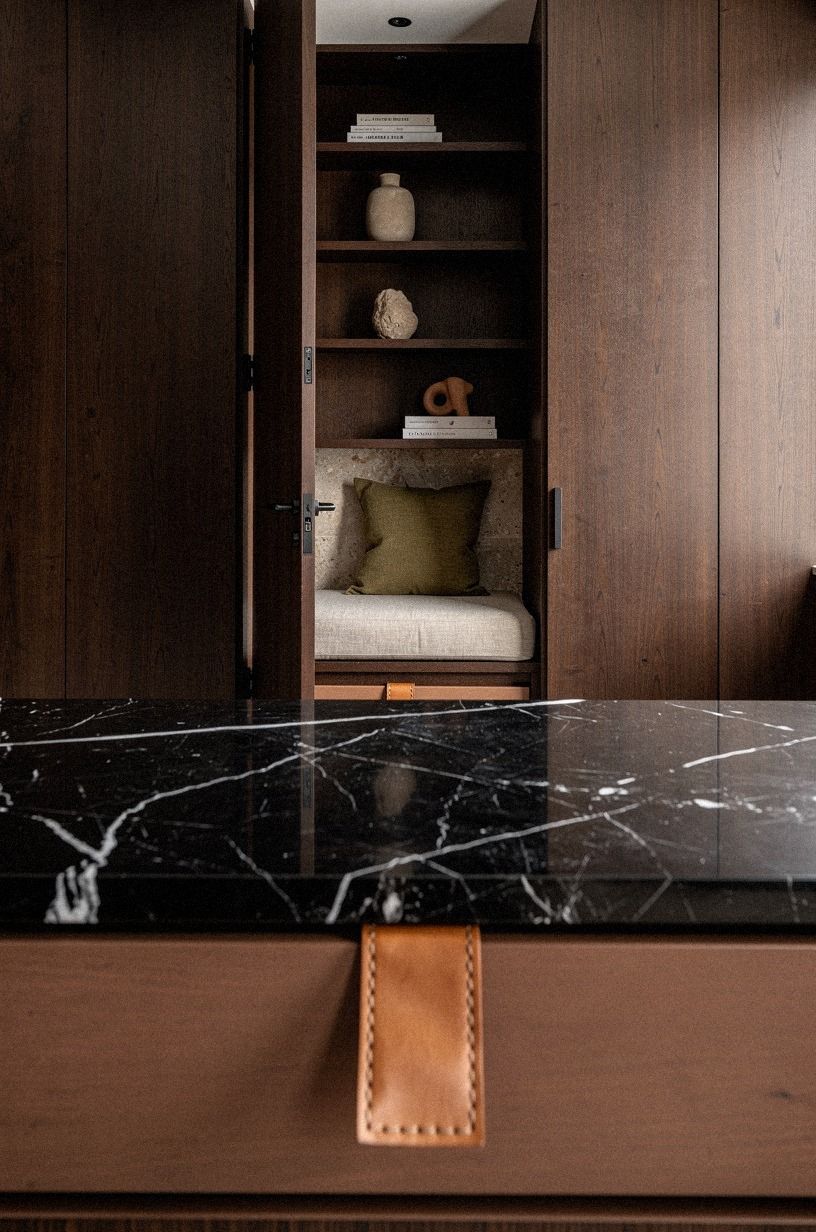
Tuck a tiny lounge behind paneled built-ins if you want the hidden room to feel like a reward at the end of the wall.
12Wrap the doorway in linen wallpaper
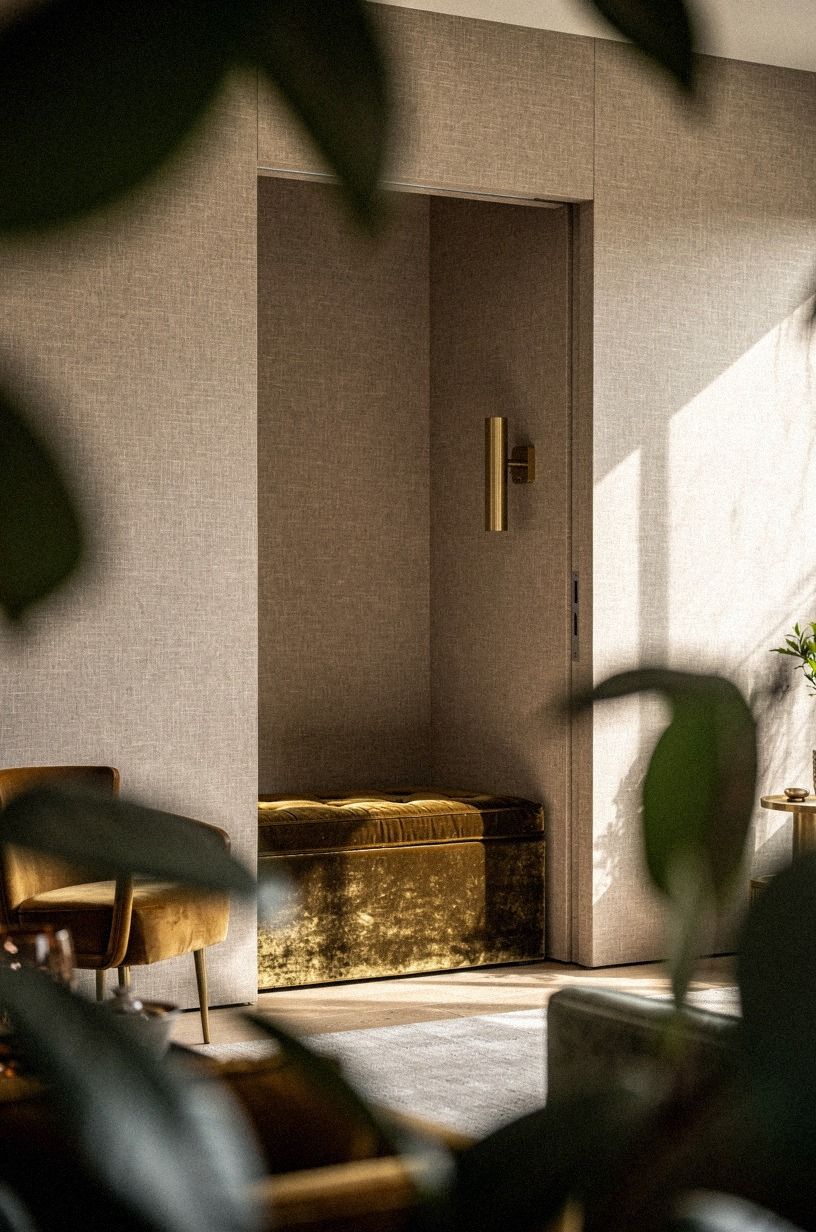
Wrap the opening in wallpaper when painted trim still feels too obvious, which it often will on a flat, modern elevation. A soft Belgian flax linen in oatmeal or fog gray gives the seam a quiet texture that catches light differently from every angle, so the eye never lands on a hard line. I’ve found this works especially well in rentals, where you can’t cut custom jambs.
Renter move: temporary linen wallpapers from York or Tempaper now come pre-pasted and peel off without residue, which is huge for apartments.
Pick a paper with a fabric-like weave rather than a print. Anything too patterned will give the millwork imitation away the moment you step close.
Run the pattern past the door frame onto the surrounding wall by about 12 inches, so the threshold reads as one continuous surface instead of a wrapped box. Pair it with a slim aged brass picture light overhead and the whole composition warms up without competing for attention. If you want a deeper visual pull behind the threshold, these moody speakeasy wallpaper ideas for dramatic walls will give you plenty of pattern inspiration.
13Add sconces inside the hidden threshold
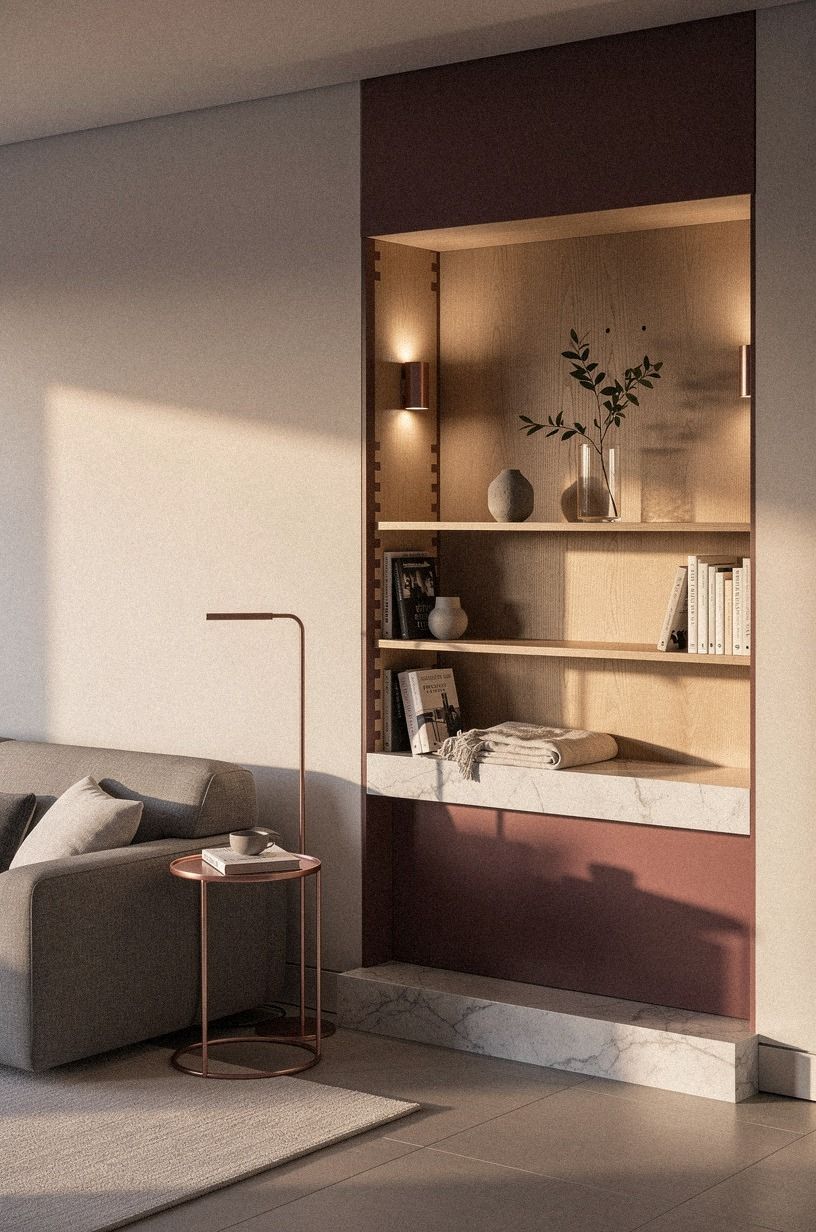
Add sconces just inside the threshold if you want the opening to pull you forward. Light placed inside the passage is always more inviting than light blasting at you from the main room, and it keeps the living room itself calmer. I use this when the hidden nook needs depth, because a glow set a few feet back makes the wall feel thicker than it is.
Dimmer tip: a Lutron Maestro on a separate switch costs about $25 and changes the whole experience, especially on a single sconce.
Pick compact fixtures with shades or opaque cups so you don’t see a bare bulb from the sofa. Aged brass sconces against plum paneling look rich, and a dimmer gives you way more control than brighter bulbs ever will.
Don’t center them by habit. An asymmetric opening often looks better if the lights sit a touch deeper on one side, because that slight imbalance feels more human (and less like a themed escape room). One 2700K bulb per side is plenty when you dim to dinner-glow.
14Style shelves to blur the door gap
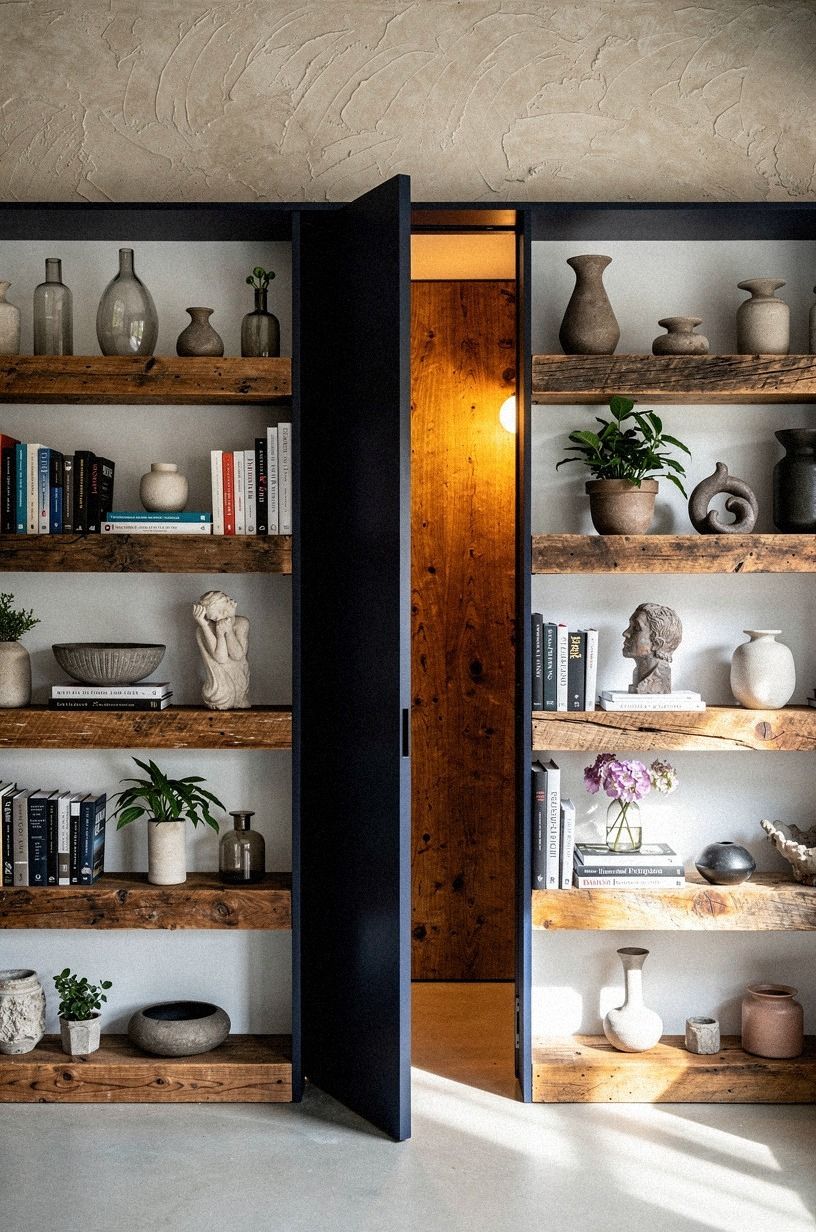
Style the shelves so the eye lands on objects first, because the shelf face is what hides the mechanics. I like a navy-and-white built-in with reclaimed teak shelves filled in layers: books, one ceramic bowl, a framed photo, then a small box that pushes the line of the display outward.
That little irregularity helps blur the gap. If you want more examples of controlled layering, this article on white trim making small living rooms feel smaller explains the same visual principle.
Object density rule: leave at least 30 percent of each shelf open. Crowded shelves fight for attention and the seam wins.
Don’t overload every shelf. That’s where people lose the plot.
Use some empty air, keep heavier objects low, and let one horizontal stack interrupt the vertical books. Reclaimed weathered teak has enough grain to feel relaxed, while slick laminate tends to show every seam.
And if the door opens from a push point, make sure your styling leaves that spot obvious to you, even if nobody else notices it. A small brass bookend sitting over the seam buys you grace every single visit.
15Finish with a candlelit mini library
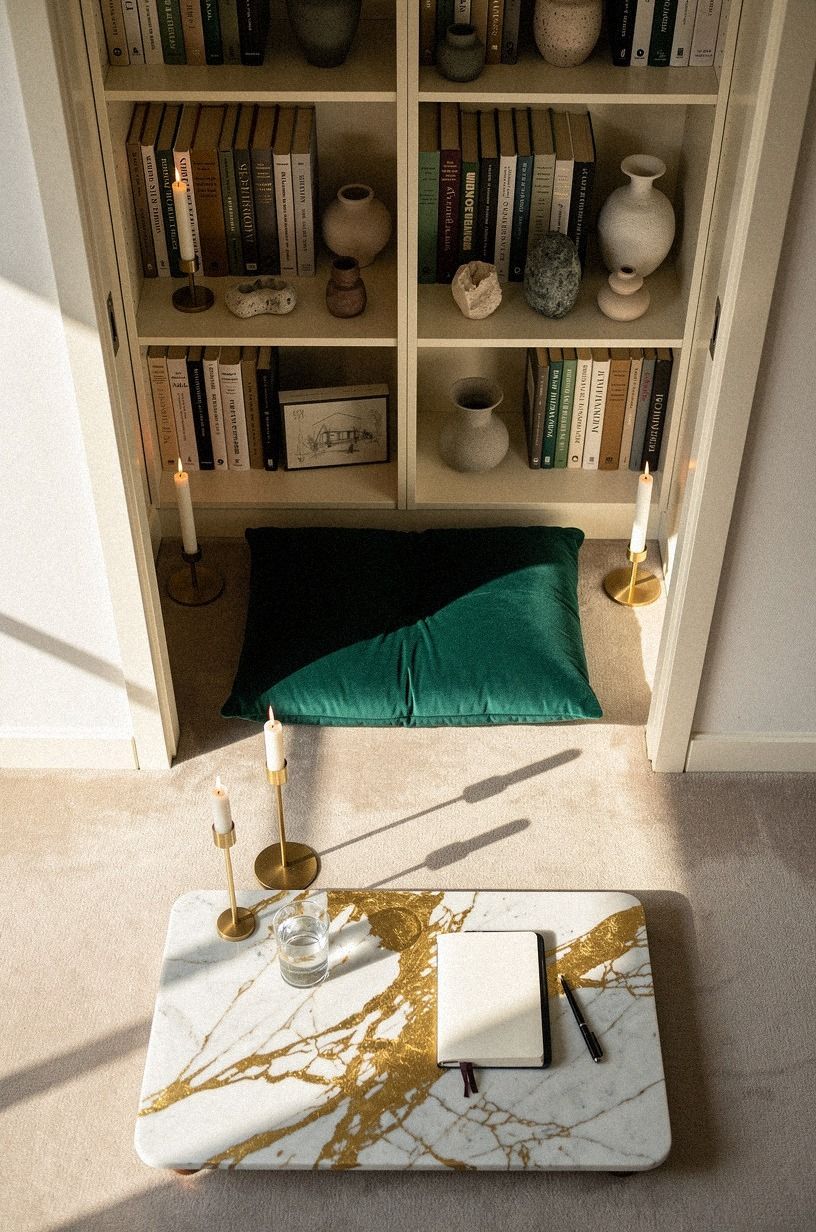
Finish with a tiny library if you want the hidden room to feel like a destination instead of a stunt.
The Borrowed-Depth Rule
If you’ve been wondering what this kind of project usually costs, the short answer is that the millwork look does most of the heavy lifting, not the square footage. You can fake a lot with paint, drapery, and smart lighting, which is why small hidden rooms often make more sense than trying to force a full addition. I think people overspend on the wrong layer first.
My honest order is simple: get the wall treatment right, then the light, then the seat. A wool rug in 8×10 or 9×12 can help the main room hold together, but it won’t rescue a clumsy opening.
A wool 9×12 rug often runs $600 to $2,500, while Belgian linen drapes can land around $120 to $400. Spend where your hand touches and your eye stops.
That’s the part you’ll notice every day. If you’d rather a quick shortcut, these speakeasy living room ideas skip the millwork and lean on layered lighting instead.
The Soft-Seam Rule
I’ve gone back and forth on why these little hidden rooms feel so special when they’re done well, and I keep landing on one answer: they give a living room a second speed. The main seating area handles talking, television, and everyday mess.
The tucked-away nook handles quiet. That’s a real luxury in a house where one room often has to do everything.
And it feels generous even when the footprint isn’t. Need more mood-building in a tight corner?
Start with dark speakeasy decor ideas that lean into cozy drama and pick one move from there.
But the hidden room only works when the seam is gentle. Not flashy.
Gentle. You want a wall that still reads like a wall from across the room, then rewards you when you get close.
That’s why I care so much about trim depth, fabric weight, paint finish, and low lighting.
Material hierarchy: trim before fabric, fabric before finish. Get the order right and the seam disappears on its own.
A wall can be beautiful and still feel too obvious. I don’t want obvious here.
The best versions also resist the urge to over-theme the little room. No fake vault doors. No novelty signs.
Just a scale shift, a darker color, a softer seat, and maybe books or art that you’d use anyway.
Anti-clutter rule: if a guest can name the room’s theme in under five seconds, you’ve themed too hard. Pull back before the magic wears off!
I made the mistake of styling one like a movie set once, and it got old in a week. The room that lasted was quieter: Belgian linen, plum paint, old books, one brass sconce, and a cushion that made you stay longer than you meant to.
That’s the point. You walk in, your shoulders drop, and the whole house suddenly feels like it has more depth than the floor plan promised.
But it still looks believable from the sofa, which is why you’ll keep loving it. If you want to go deeper on the velvet-and-plum mood, these speakeasy curtain and drapery ideas cover the same vocabulary with great examples.
The Questions I Get Asked Most
What is the best small secret room to start with in a living room?
A slim bookcase door is the best place to start because it gives you storage and concealment at once.
If you want a faster win, velvet drapes work too. I’d use IKEA BILLY as the budget shell, then trim and paint it so it disappears into the wall.
Where can I buy small secret room pieces on a budget?
Start with IKEA, Target Threshold, and Wayfair for shelf units, drapery, and sconces.
Then check Facebook Marketplace for older bookcases you can wrap in trim. Good bones. Better price.
You don’t need rare pieces, just calm shapes and finishes that can take paint. For the mood-building materials, these speakeasy brass and gold accent ideas will help you pick hardware that ages well.
How much does a small secret room makeover cost?
Most living-room versions cost about $300 to $1,200 if you’re using paint, fabric, art, and existing furniture. Add custom millwork and you’re into the mid range fast.
Free moves still matter: restyling shelves, moving the sofa, and darkening the inside reveal can change everything. If you need layout help first, this tighter-space living room guide is a smart starting point.
Can I create a small secret room on a budget?
Yes, and the cheapest wins are often the smartest because they keep the room lighter and easier to undo. Paint the inside reveal darker.
Hang drapes on a tension rod. Rework a secondhand shelf wall with trim, caulk, and better hardware.
Threshold budget: plan $200 to $500 for a fully reversible first pass. That’s enough to test the idea before you commit. For full inspiration on tighter conversions, this closet-into-speakeasy-bar guide shows how much magic fits in a 4×4 footprint.
Is a small secret room worth it in a tight space?
Yes, because a small room benefits most from double-duty walls. When the opening hides inside storage, art, or drapery, you gain function without losing floor area. Keep the main rug large enough for the front legs of the seating to sit on it, and the room will still feel connected.
Is a small secret room a good idea for a rental?
Yes, if you stick to low-damage layers. Tension-rod drapes.
Peel-and-stick wallpaper. Freestanding shelving with applied trim.
Battery sconces instead of hardwiring. I’d avoid cutting custom jambs unless you own the place, but you can still get plenty of mood with reversible pieces.
For inspiration on gentle, removable upgrades, these basement speakeasy ideas use a lot of freestanding pieces.
Start With the Wall, Then Everything Else
If I had to pick one move, I’d start with the wall treatment before you touch a single hinge. You can’t layer softness on top of a wall that still reads as a flat plane, and the seam is what gives the whole move away.
Get the paneling, paint, or wallpaper right first, then let the door and the trim follow. That’s the part you’ll feel every single day!