
I finished this basement at 34 weeks pregnant. The stairs were too narrow for a sofa, the ceiling was too low for a chandelier, and the single window faced a retaining wall that got maybe 40 minutes of direct light in July. Everyone said we’d use it as storage for five years and then renovate. We lived with bare concrete, a folding table, and one sad floor lamp for eight months. Then I stopped waiting for the perfect budget and started building the room I actually wanted to drink a negroni in. These are the 15 moves that turned a cold storage hole into the coziest corner of the house. And honestly? I didn’t think it would work until the paint went up.
Don’t overthink: Layer a Vintage Persian Rug Over Raw Concrete to Kill the Echo.
Here’s What It Looked Like Before
The full 2005 starter-home package. Beige builder carpet with the mystery stains. A dropped ceiling of yellowed acoustic tiles that rattled when the furnace kicked on. One flush-mount dome light that made everything look like a doctor’s office.
The walls were that particular shade of “basement white” that somehow reads gray when the sun goes down. My husband’s old desk sat in one corner.
A plastic shelving unit from the garage held board games we’d never opened. And the smell.
That faint, permanent basement smell that no candle had ever fixed. I didn’t want a finished basement. I wanted a room that felt like it had been there for decades. But where do you even start when the space feels hopeless?
- Ditch the Dark Walls for a Deep Forest Green That Drinks Light Like Bourbon
- Layer a Vintage Persian Rug Over Raw Concrete to Kill the Echo
- Build a Back Bar From Stacked Vintage Suitcases and Leather Straps
- Hang a Single Oversized Brass Pendant Low Enough to Read By
- Prop a Tarnished Mirror Behind the Sofa to Steal Window Light
- Run a Ledge of Dark Marble the Full Length of One Wall for Bottles
- Tuck a Velvet Chesterfield Into a Corner and Angle It Toward Nothing
- Screw Edison Bulbs Into a Rusted Pipe Grid Overhead
- Stack Leather-Bound Books on a Wheeled Cart and Call It a Table
- Drape a Heavy Linen Throw Over a Mid-Century Armchair Gone Threadbare
- Set a Single Orchid in a Cut-Crystal Highball on the Mantel
- Lean a Framed Boxing Poster Against the Wall Instead of Hanging It
- Roll Out a Cowhide With the Hair Still on It in Front of the Hearth
- Place a Brass Foot Rail Where No Bar Exists, Just to Rest a Heel
- Leave One Wall Bare Plaster, Cracked and Yellowed, as the Fifth Drink
1Ditch the Dark Walls for a Deep Forest Green That Drinks Light Like Bourbon
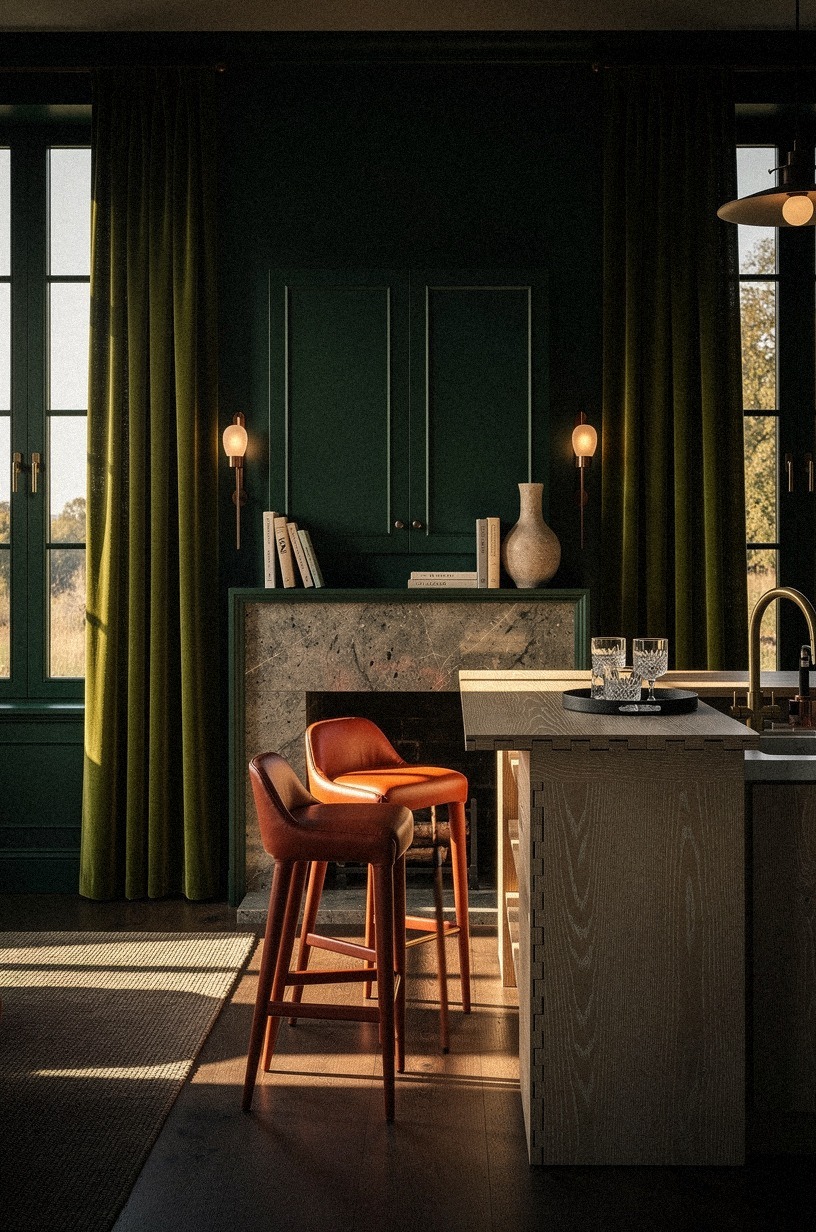
I tested Farrow & Ball Studio Green against Benjamin Moore Black Forest Green on the same wall for three days. Studio Green won.
It doesn’t fight the low ceiling. It wraps around it.
The color drinks the overhead light and turns it into something that feels like late afternoon in a library. I used Benjamin Moore Revere Pewter HC-172 on the stairwell trim as a bridge so the descent doesn’t feel like falling into a cave. Two coats, no primer. The existing “basement white” was flat enough to grab the pigment.
Total paint cost: about $180. And honestly?
It’s the single biggest change we made. If you’re going dark, commit. Half measures read as mistakes.
For more dark-room paint confidence, our dark earthy bedrooms that feel cozy and expensive shows the same mood in a sleeping space.
2Layer a Vintage Persian Rug Over Raw Concrete to Kill the Echo
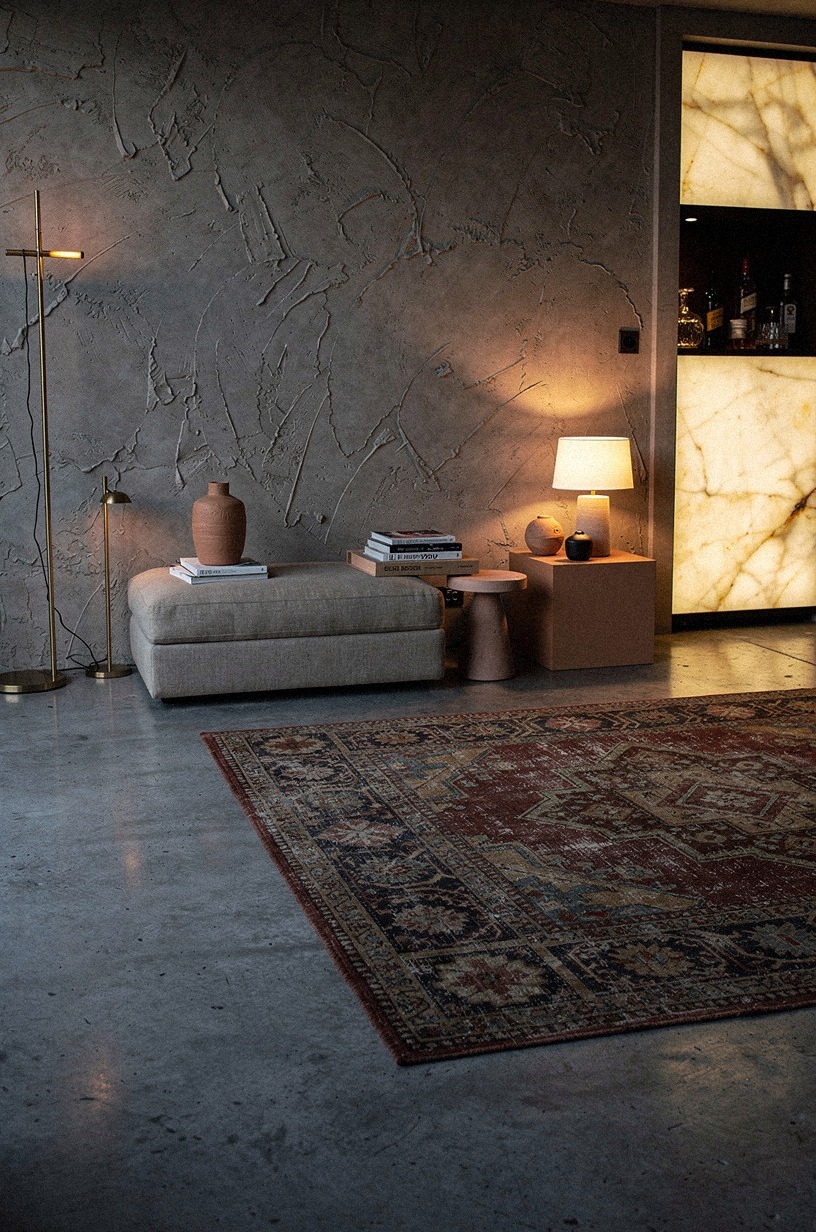
The concrete floor was the worst part. Every footstep bounced. Every conversation felt like a conference call. I found a 9×12 vintage Persian Heriz with a worn rust field and indigo border for $340 on Facebook Marketplace.
The pile was low enough that a door could still swing over it. But the real move was what went underneath. A 1/4-inch rubber rug pad from a local flooring remnant yard ($45) stopped the slide and absorbed the sound that the rug alone couldn’t catch. Now the room is quiet in a way that feels expensive.
The front legs of the sofa sit on the rug. The back legs don’t.
That half-on, half-off placement is what makes it look intentional instead of “I covered the floor.” And the echo? Gone.
Completely. If you’re layering rugs in other rooms, our layered rug ideas for cozy texture breaks down the pad + pile combo that actually works.
3Build a Back Bar From Stacked Vintage Suitcases and Leather Straps
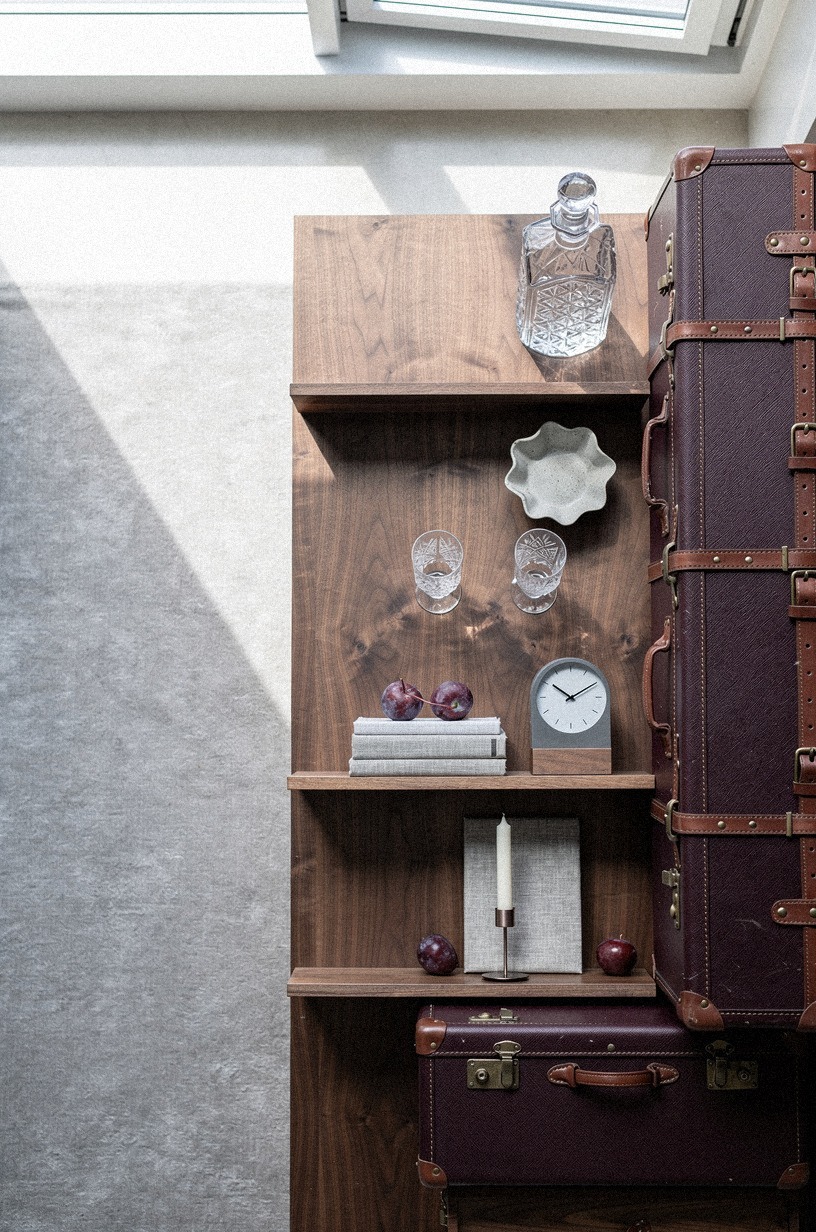
I didn’t want a bar cart. Too shiny. Too expected. I collected four mismatched vintage leather suitcases from estate sales over two months.
The biggest on the bottom, the smallest on top, each one actually functional. Leather straps from a tack shop ($12) hold the stack together like old steamer trunks.
The top case opens to reveal a fitted interior for bottles. The second case down holds glassware.
The third is all cocktail tools. It cost less than a single CB2 bar cabinet and it looks like it traveled here from somewhere else. The best part? Nobody believes it’s real luggage until they try to lift the top one.
And then they do. And then they smile.
That’s the reaction you want. For more repurposed storage that doesn’t look like storage, our vintage storage ideas that look intentional has the same found-object logic.
4Hang a Single Oversized Brass Pendant Low Enough to Read By
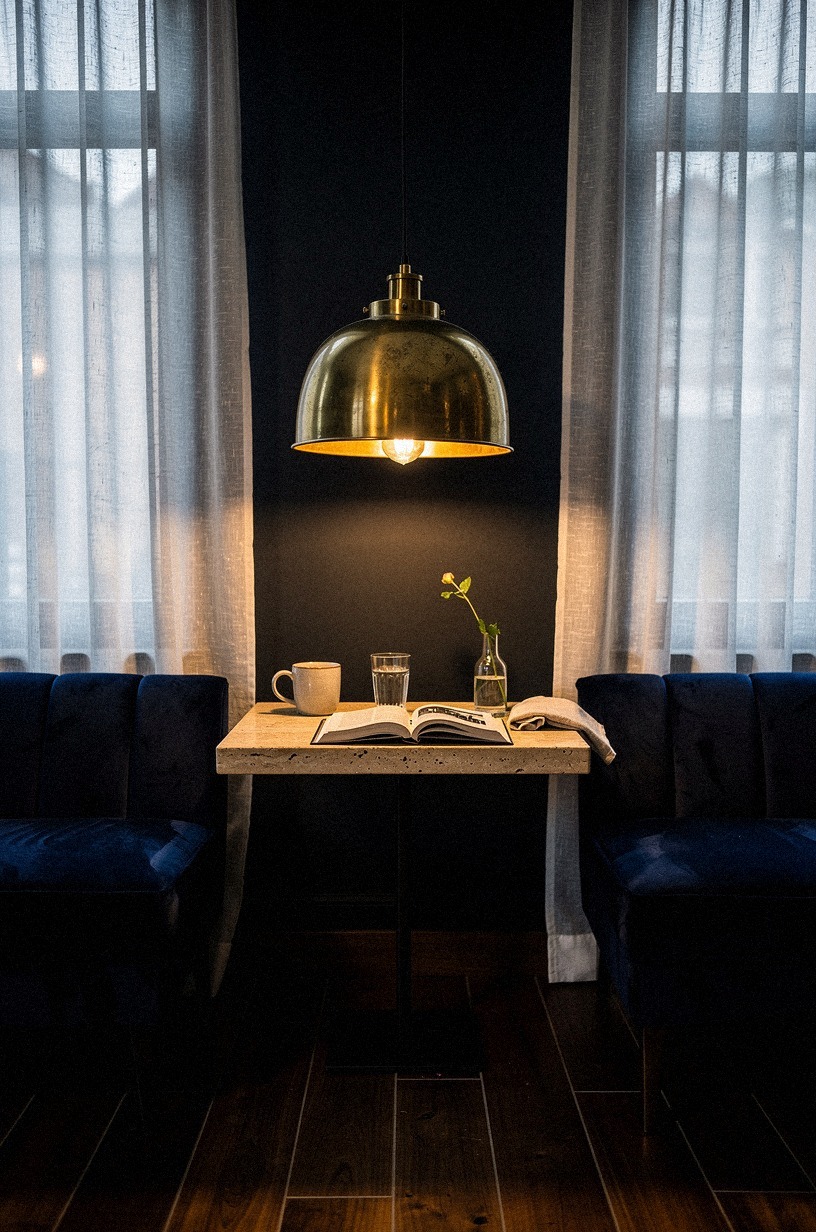
I bought a 16-inch unlacquered brass dome pendant from a lighting outlet. It was a floor model with a small dent near the rim. They took 40% off.
I hung it 22 inches above the coffee table, which is lower than every guide says. But the room is only 7.5 feet tall.
A high pendant would have looked like a hospital fixture. This one pools warm light on the table and leaves the corners in shadow.
That’s the point. I wired it to a dimmer switch. At 40% it’s a reading light. At 80% it’s the only light you need.
The brass is already developing a soft patina where my husband’s hand brushes it on the way to the sofa. That dent? I don’t even see it anymore. It reads as character now.
Proof that you don’t need perfect to get beautiful. Our warm lighting guide for moody rooms covers the bulb temps and dimmer combos that make low ceilings feel intentional.
5Prop a Tarnished Mirror Behind the Sofa to Steal Window Light
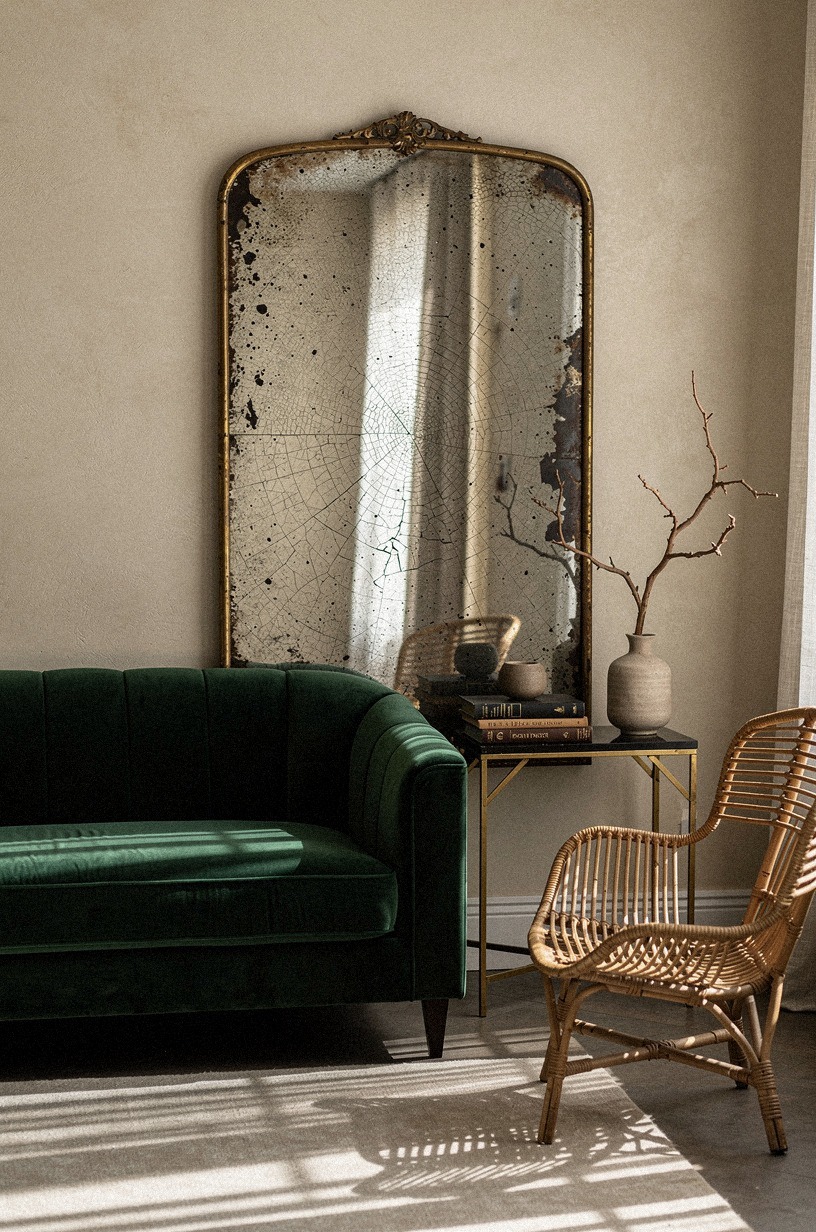
The window is small and faces north. I found a tarnished mercury mirror with a foxed silver finish at an architectural salvage yard.
It’s 4 feet tall, propped on the floor behind the sofa at a slight angle. What little daylight comes in hits the mirror and scatters across the ceiling in soft, broken patches. It doesn’t brighten the room. It complicates the light.
That’s the difference between a basement and a speakeasy. The mirror cost $90. A new one would have been too clean. The foxing is what makes it feel found, not bought.
And that slight angle? It’s everything. Straight up against the wall reads as storage. Tilted reads as intention.
For more mirror placement tricks that don’t involve drilling, our mirror styling ideas for small rooms has the same low-commitment approach.
6Run a Ledge of Dark Marble the Full Length of One Wall for Bottles
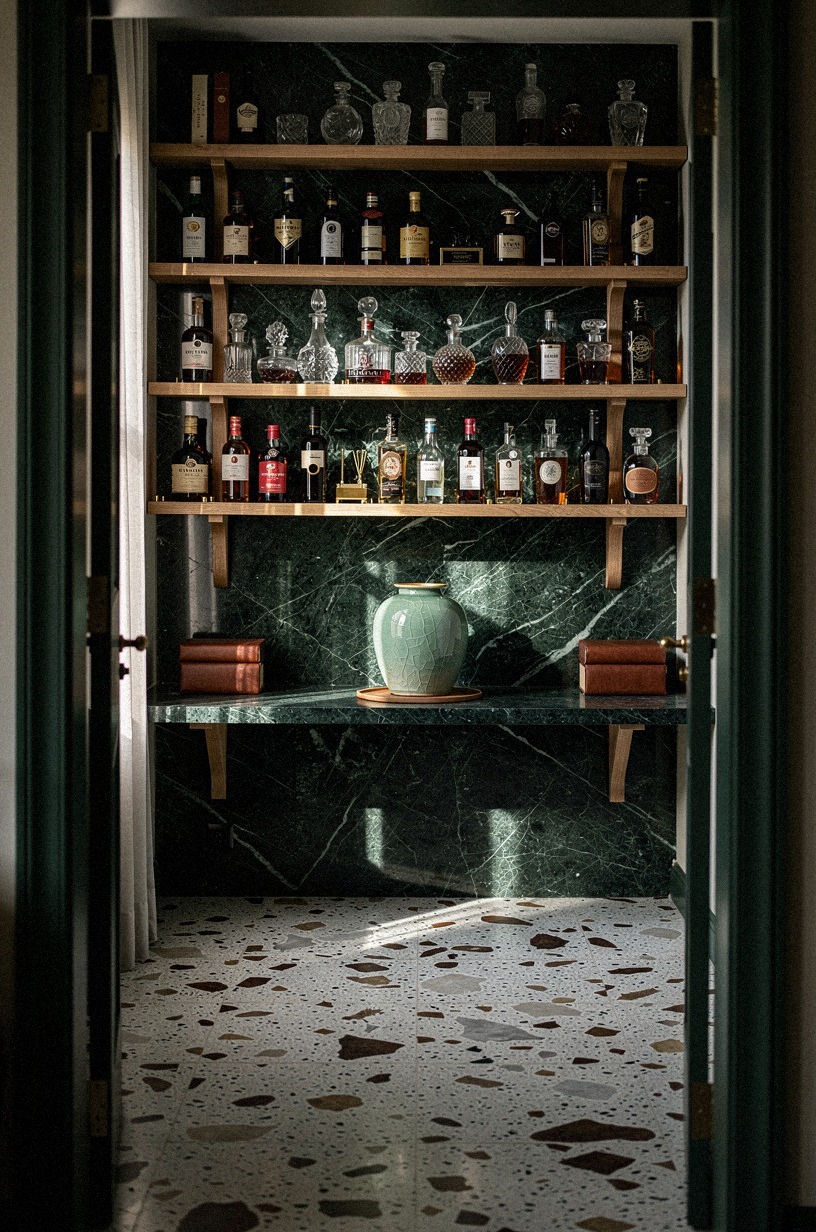
I had a 10-foot stretch of wall between the bar and the door. A carpenter friend cut me a Nero Marquina marble shelf 8 inches deep with a slight ogee edge.
We mounted it on hidden brass brackets that disappear into the stone. The ledge holds amber bottles, a single crystal decanter, and two vintage highballs. Nothing else. The restraint is what makes it look curated.
The marble was a remnant from a kitchen job. $200. The brackets were $35. The whole thing looks like it belongs in a hotel bar that doesn’t have a website. But here’s the truth: if I did it again, I’d use painted wood.
The marble is beautiful. It’s also cold to the touch and shows every fingerprint. For more shelf-ledges that don’t look like shelves, our floating shelf ideas for dark rooms shows the same wall-mounted trick with warmer materials.
7Tuck a Velvet Chesterfield Into a Corner and Angle It Toward Nothing
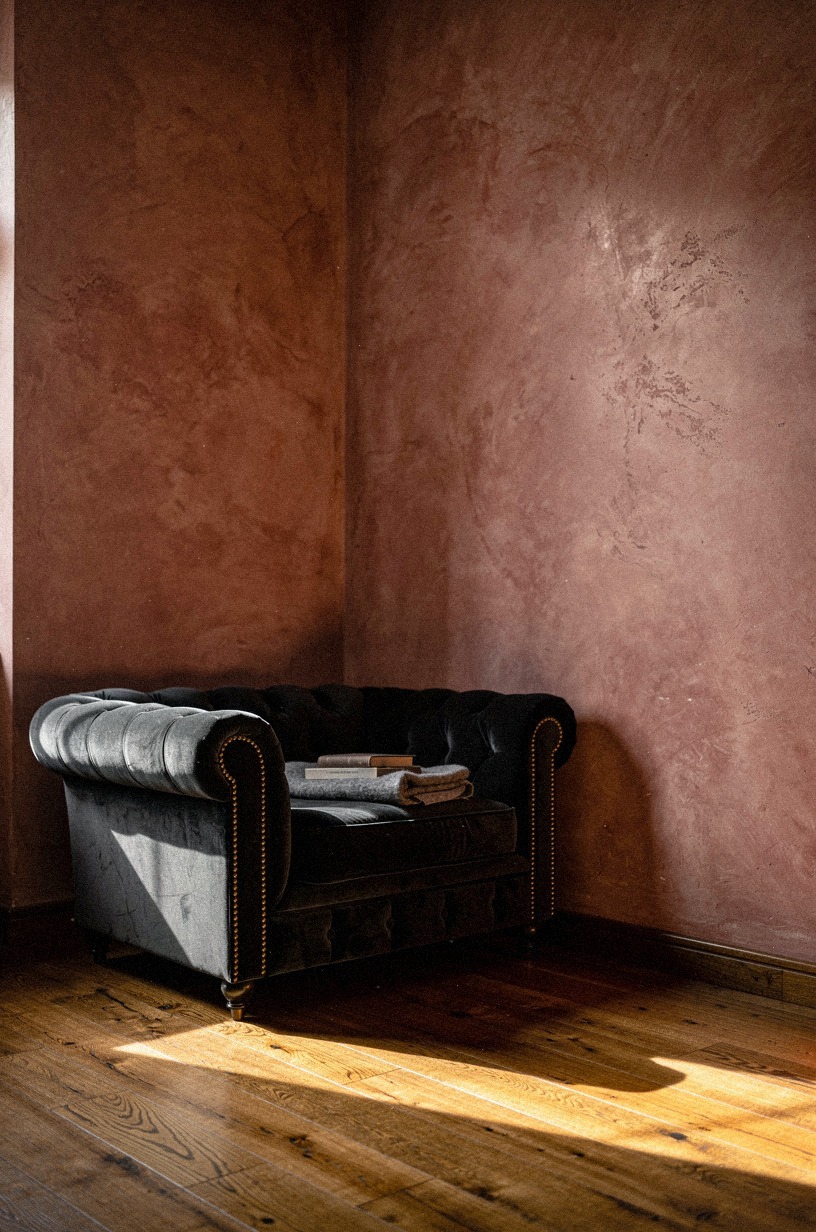
The sofa is the heart of the room. It’s a velvet Chesterfield in deep hunter green, bought secondhand for $680 from a couple in Baltimore who were moving to a studio.
The velvet is 18 oz cotton pile, not polyester, and it catches the brass pendant light in a way that makes the tufting look three-dimensional. I pushed it into the corner under the low window, angled slightly toward the center of the room instead of facing the wall. That angle means you sit down without a view. Just the green walls, the brass light, and whoever else is in the room.
It’s the most intentional piece of furniture I’ve ever placed. The seat is firm. The arms are high enough to rest a drink on. And the velvet has already worn slightly at the front edge where my husband’s dog jumps up every night.
That wear is the point. A new sofa would have looked like a showroom. This one looks like it belongs here. If you’re hunting secondhand sofas that don’t look secondhand, our secondhand sofa guide for moody rooms has the fabric checks and frame tests that matter.
8Screw Edison Bulbs Into a Rusted Pipe Grid Overhead
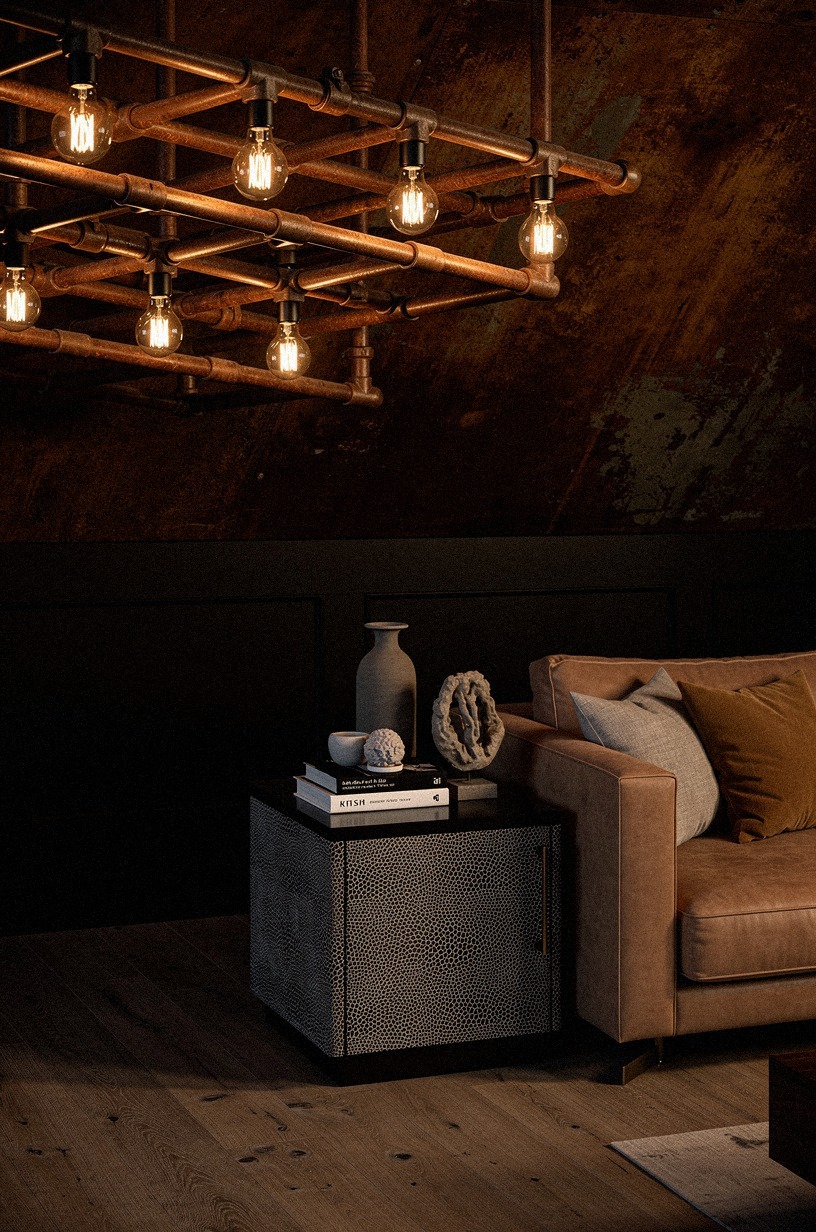
The dropped ceiling had to go. I pulled the tiles down and found exposed joists painted the same beige as everything else.
I left them. Then I built a rusted iron pipe grid across the joists using 3/4-inch black pipe, four T-fittings, and two 90-degree elbows.
The rust is real. I soaked the pipe in salt water for a week. Each junction holds an Edison-style filament bulb at 40 watts. No shades.
No diffusers. Just warm amber light that throws sharp shadows on the ceiling. The grid cost about $120 in pipe and fittings. The bulbs were $8 each.
It looks like the lighting in a Brooklyn cocktail bar that charges $18 for a Manhattan. Because that’s exactly what I was copying. And the shadows? They make the ceiling feel higher than it is.
That’s the move. Darkness creates depth. For more DIY overhead ideas that don’t require an electrician, our exposed ceiling ideas for basements covers the pipe-and-bulb combo step by step.
9Stack Leather-Bound Books on a Wheeled Cart and Call It a Table
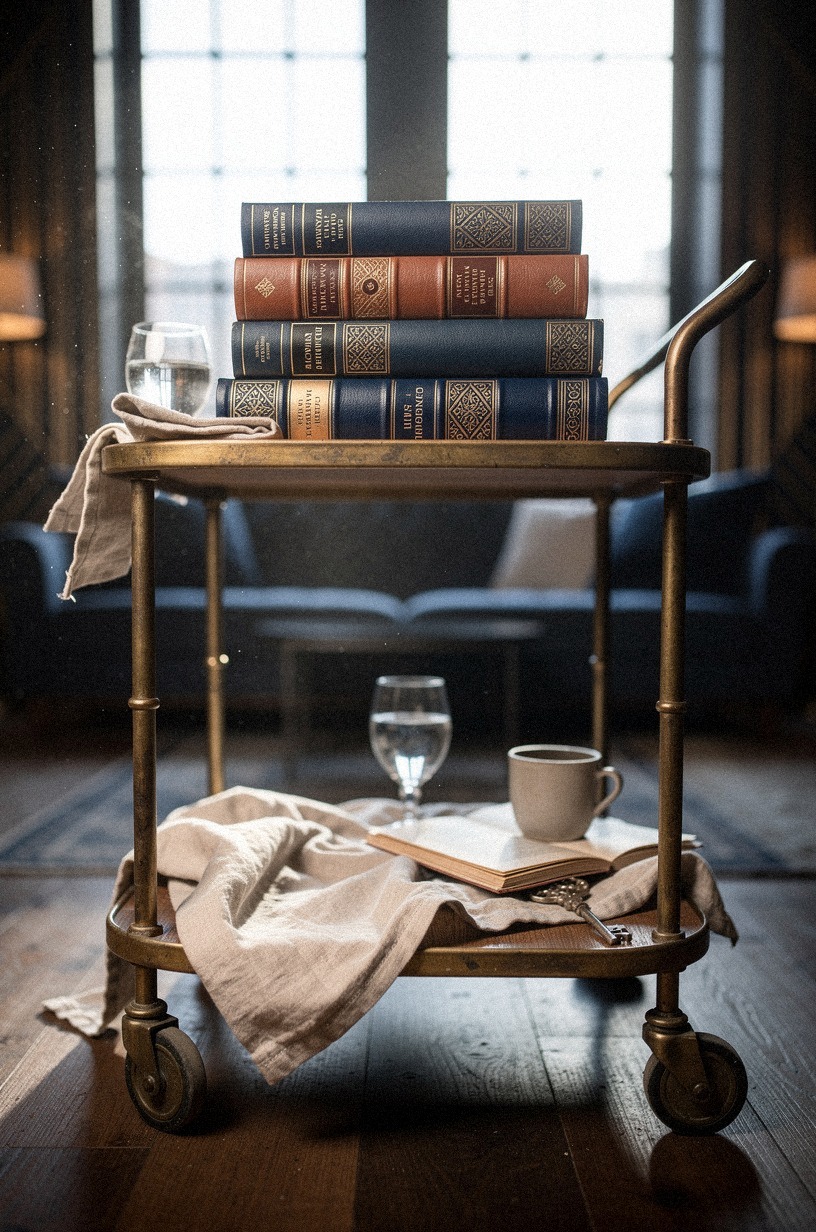
I needed a side table. I didn’t want a side table. I found a vintage industrial cart with iron wheels at a flea market for $65.
The top was rusted steel. I left it.
Then I stacked 30 leather-bound books on it. Some are old law books from a library sale. One is a 1960s atlas.
The rest are Reader’s Digest condensed volumes with maroon spines. They don’t match.
That’s the point. The cart is 16 inches tall.
The sofa arm is 26 inches. The stack brings the surface to exactly the right height for a drink. And when I need to move it, the wheels still work. Barely.
One wheel sticks a little. I love that wheel. It’s the most personality any piece of furniture in this room has. For more found-object side tables that don’t look like furniture, our repurposed cart ideas for living rooms has the same industrial-to-cozy logic.
10Drape a Heavy Linen Throw Over a Mid-Century Armchair Gone Threadbare
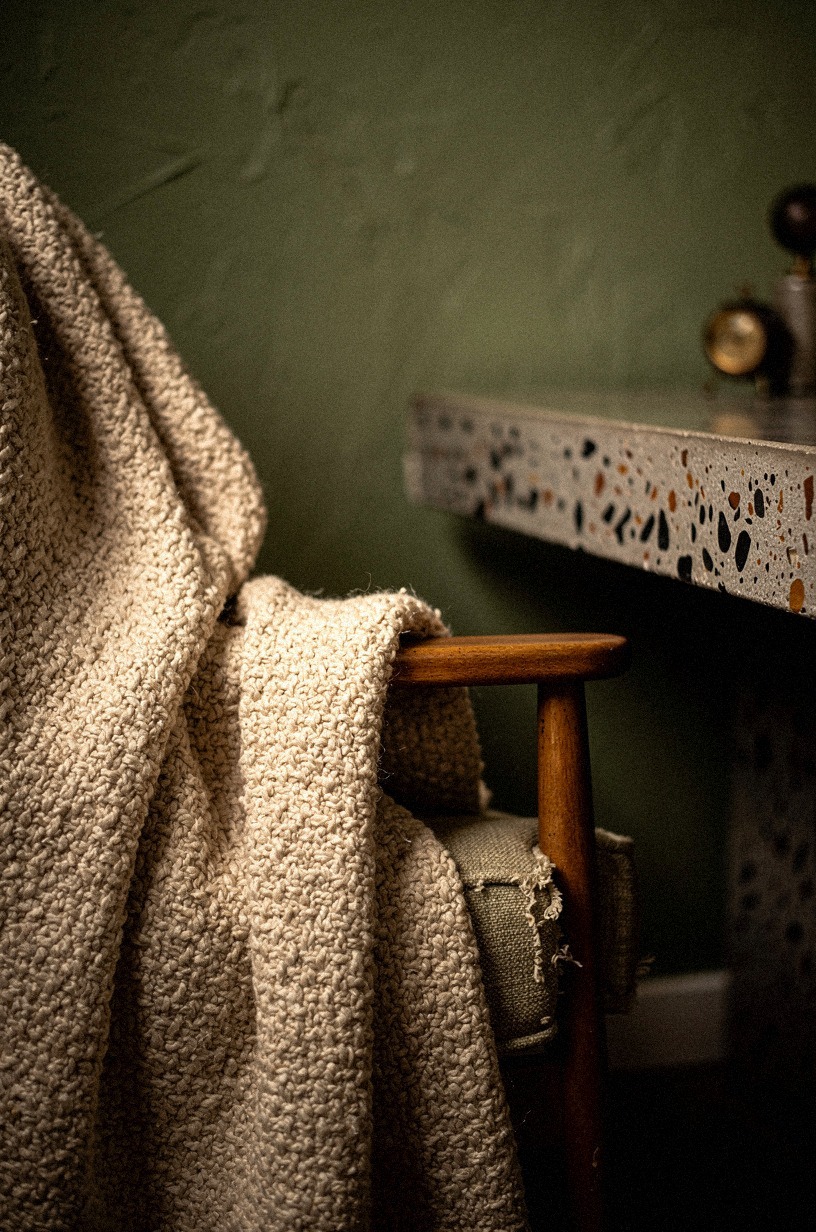
The armchair was free. A friend was moving.
It’s a 1960s Danish teak frame with original upholstery that had worn through at the armrests in two places. I didn’t reupholster it. I bought a Belgian flax linen throw in natural oatmeal from a textile outlet. It’s 60×80 inches, heavy enough to hold its shape, and I draped it asymmetrically so one corner pools on the floor.
The exposed threads at the armrest peek through the linen like scars. The chair looks lived in.
It looks like someone sat in it every night for ten years. Because that’s what I plan to do. The throw was $85.
The chair was free. The combination is worth more than either alone.
And that asymmetry? It’s the difference between “I covered a chair” and “I styled a chair.” One is hiding. The other is showing.
For more chair rescue ideas that don’t involve reupholstery, our linen throw styling for worn chairs has the same drape-and-pool technique.
11Set a Single Orchid in a Cut-Crystal Highball on the Mantel
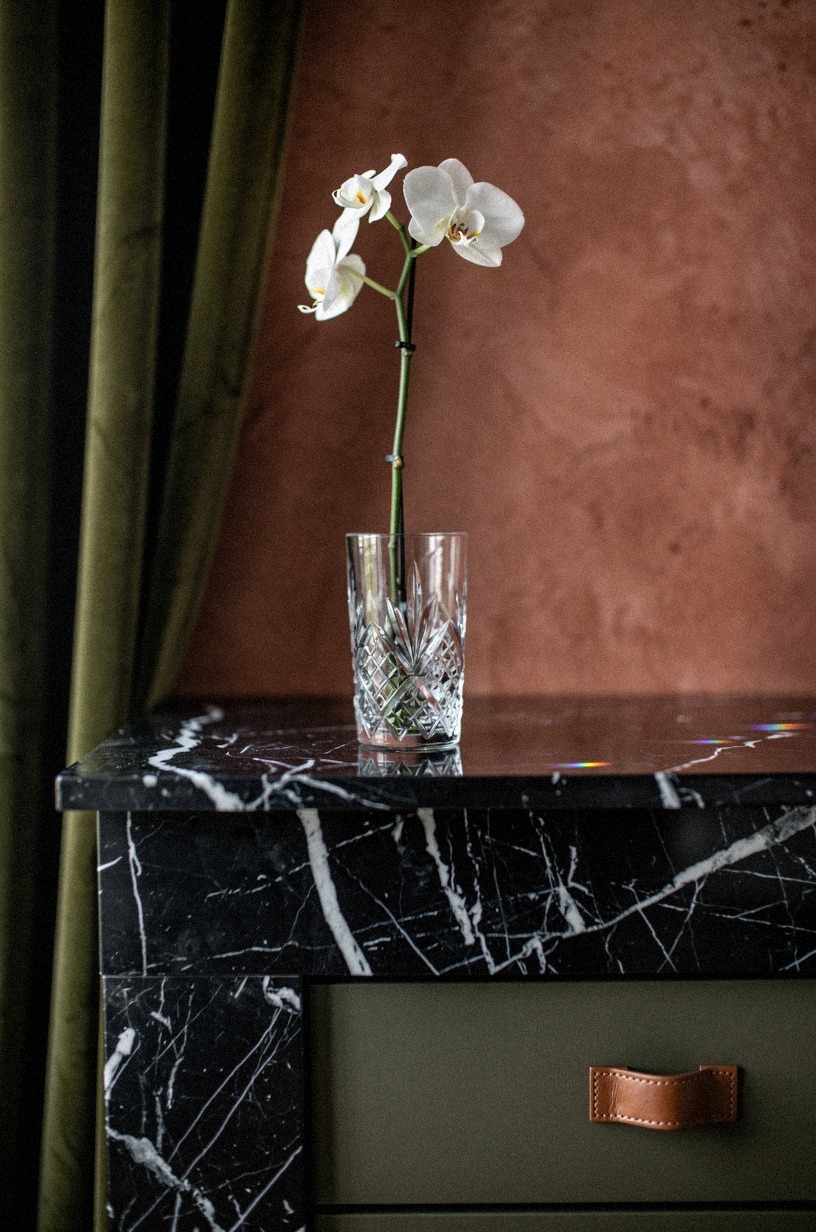
We don’t have a mantel. We have a reclaimed barn beam mounted on the wall where a mantel would be.
It’s 6 inches deep, hand-hewn, with the axe marks still visible. On it sits one cut-crystal highball glass with a single white orchid stem. No soil.
Just water. The orchid was $14 at a grocery store.
The glass was my grandmother’s. The beam was $40 from a salvage yard. The whole arrangement is maybe 8 inches wide.
But against the green wall, with the brass pendant reflecting in the crystal, it’s the first thing people notice. And the last thing they expect in a basement.
That’s the rule: one living thing. One.
Any more and it’s a greenhouse. One is a speakeasy. That single stem does more than a dozen roses ever could. It’s alive.
It changes. It dies and gets replaced. And that’s the point. For more single-stem styling that doesn’t look minimal, our single flower styling for moody rooms has the same one-and-done approach.
12Lean a Framed Boxing Poster Against the Wall Instead of Hanging It
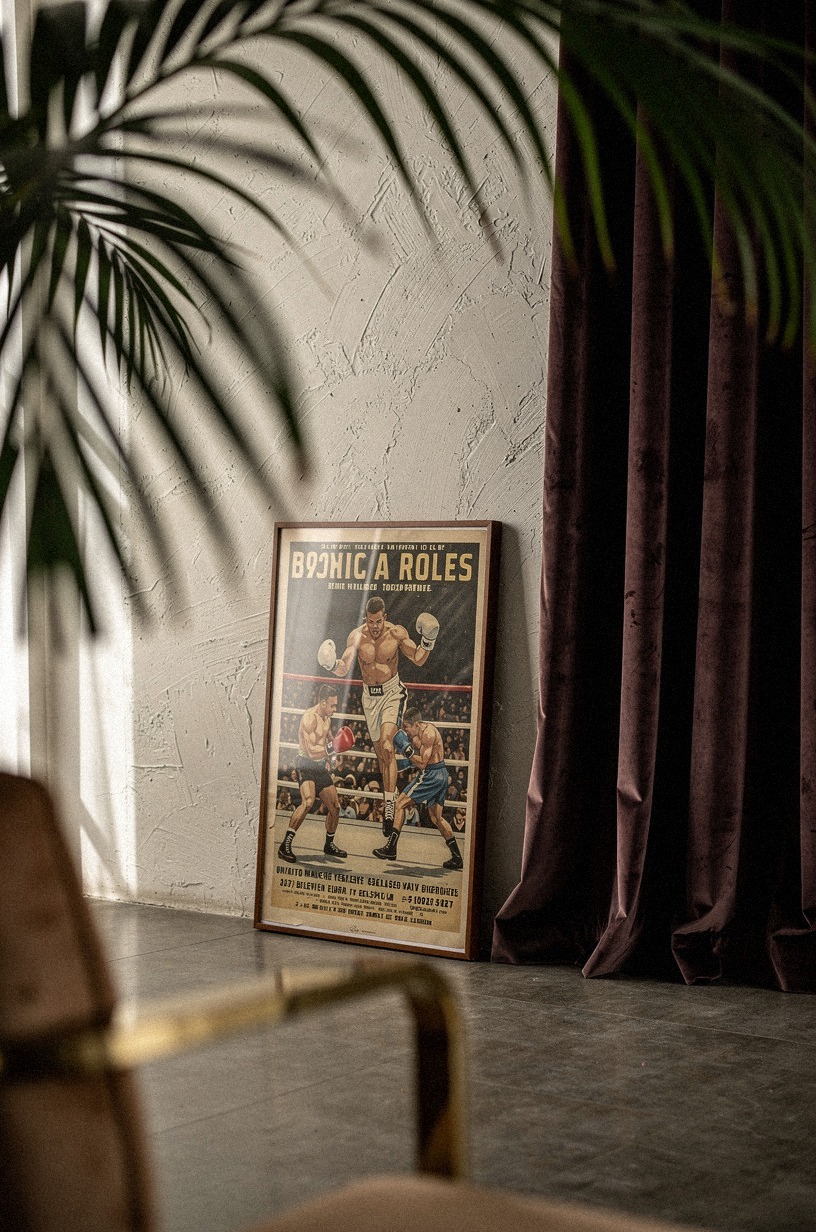
I found a framed 1930s boxing poster at an estate sale in Baltimore. The frame is chipped gilt.
The glass is slightly warped. The poster advertises a fight that happened three years before my grandfather was born.
I leaned it against the plaster wall behind a potted parlor palm in a terracotta pot. The palm fronds frame the poster like a proscenium.
I didn’t hang it. Leaning changes the relationship between the art and the wall.
It feels temporary. It feels like someone put it there last night and might move it tomorrow. The poster was $45. The palm was $22.
The terracotta pot was $8. The effect is worth ten times that. And that chipped frame? It’s the first thing people touch.
Not the poster. The frame. For more leaned-art ideas that don’t require nails, our leaned art styling for casual walls has the same no-commitment approach.
13Roll Out a Cowhide With the Hair Still on It in Front of the Hearth
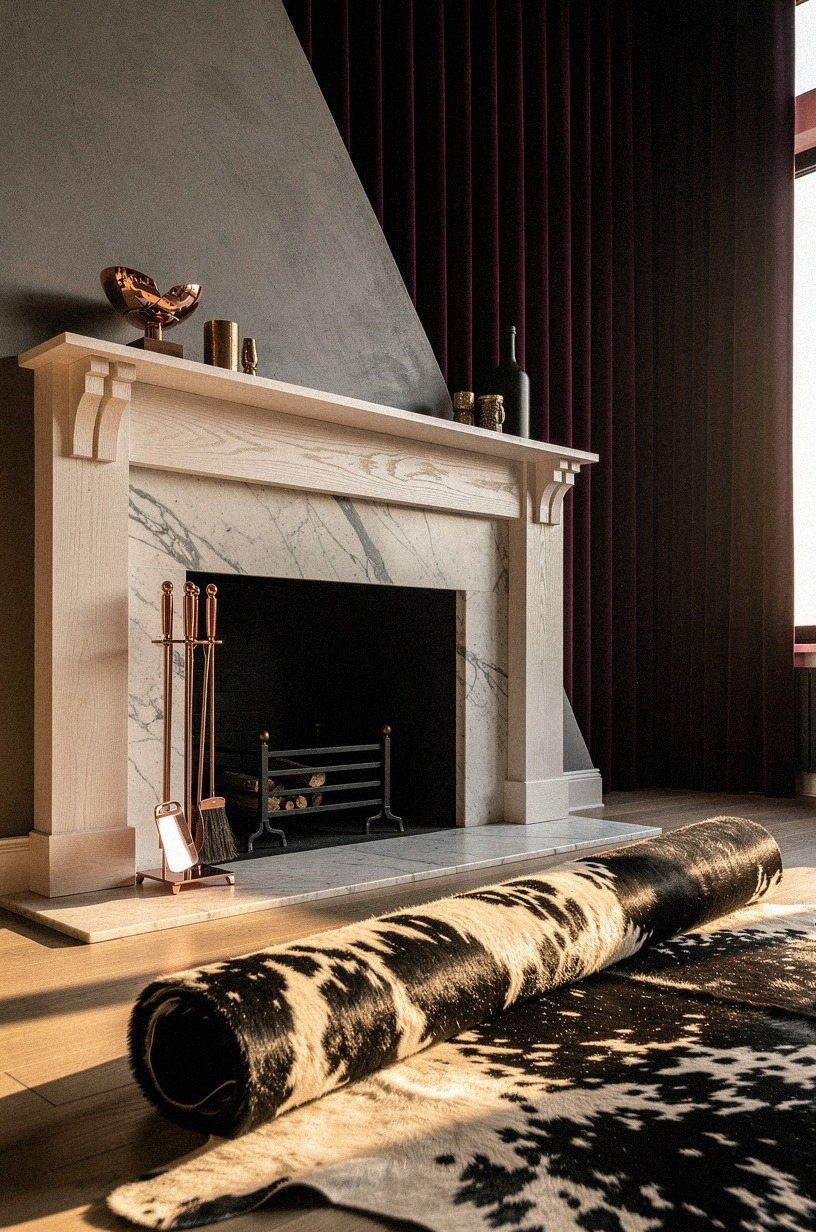
We don’t have a hearth either. But we have a reclaimed cast-iron stove that looks like one.
In front of it I rolled out a natural cowhide rug with the hair still on. It’s irregular, about 6×7 feet, with a brindle pattern that reads warm brown against the concrete. The hair is short, maybe half an inch. It doesn’t shed.
It doesn’t slide. And it’s the one thing in the room that you’re allowed to touch without thinking. Guests always pet it. It’s the icebreaker.
The rug was $280 from a direct importer. A synthetic version would have been $120. The real thing has variation. It has scars.
It has a spot near the edge where the hair grows in a different direction. That’s how you know. And that spot? I point it out to people.
It’s not a flaw. It’s a fingerprint. Nature signed it. For more natural hide ideas that don’t look western, our cowhide rug ideas for modern rooms has the same texture-forward approach.
14Place a Brass Foot Rail Where No Bar Exists, Just to Rest a Heel
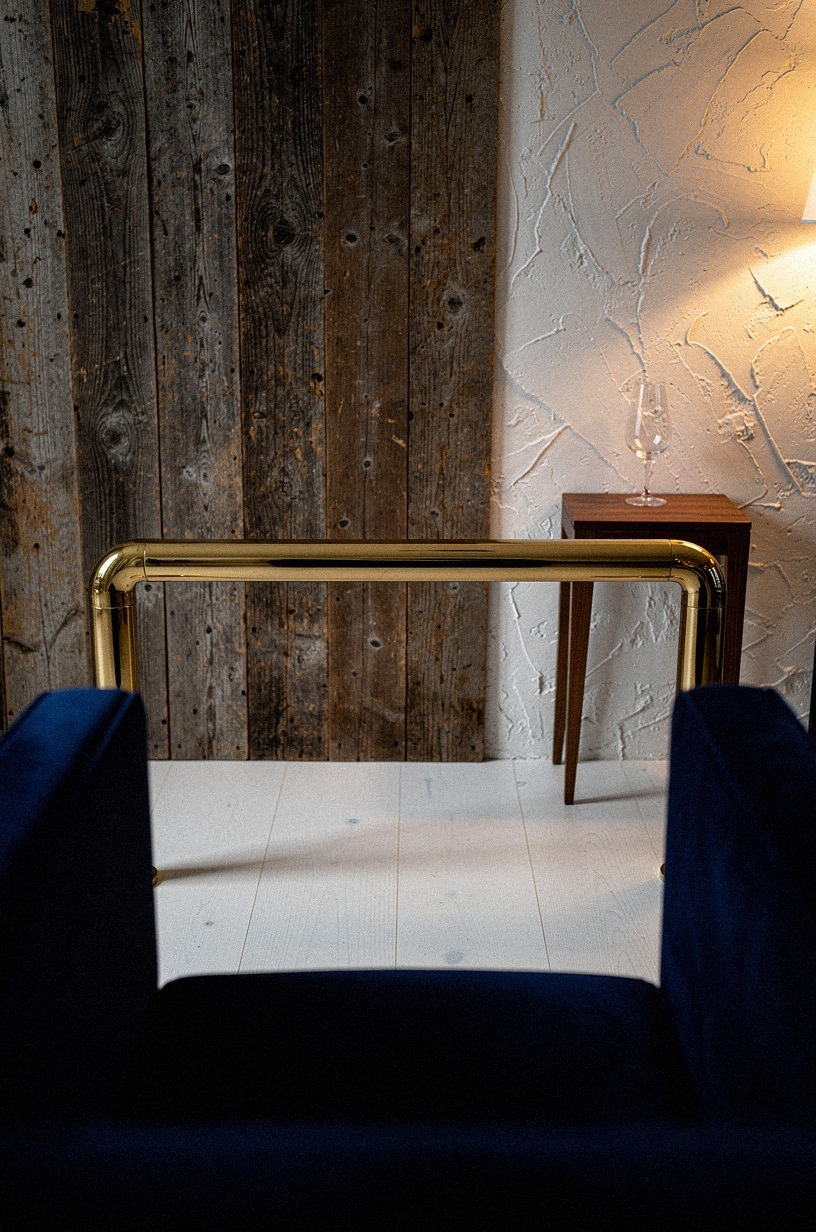
This is the move that confuses people. I mounted a brass foot rail 8 inches off the floor on the wall opposite the sofa.
There’s no bar. There’s no counter.
Just a rail. I bought it from a restaurant supply company for $65.
It’s 4 feet of solid brass tube with two flanged brackets. I mounted it at the height where your heel naturally rests when you’re sitting on the sofa.
It doesn’t do anything. That’s the point.
It’s a gesture. It says “this room is for settling in.” The brass is unlacquered. It will darken. It will spot.
It will look like it’s been there since Prohibition. And when people ask what it’s for, I say “for resting your heel.” They always pause. Then they try it. And then they get it.
That pause is the design. The rail is just the excuse. For more gesture-piece ideas that don’t serve a function, our gesture decor ideas for conversational rooms has the same why-is-that-here logic.
15Leave One Wall Bare Plaster, Cracked and Yellowed, as the Fifth Drink
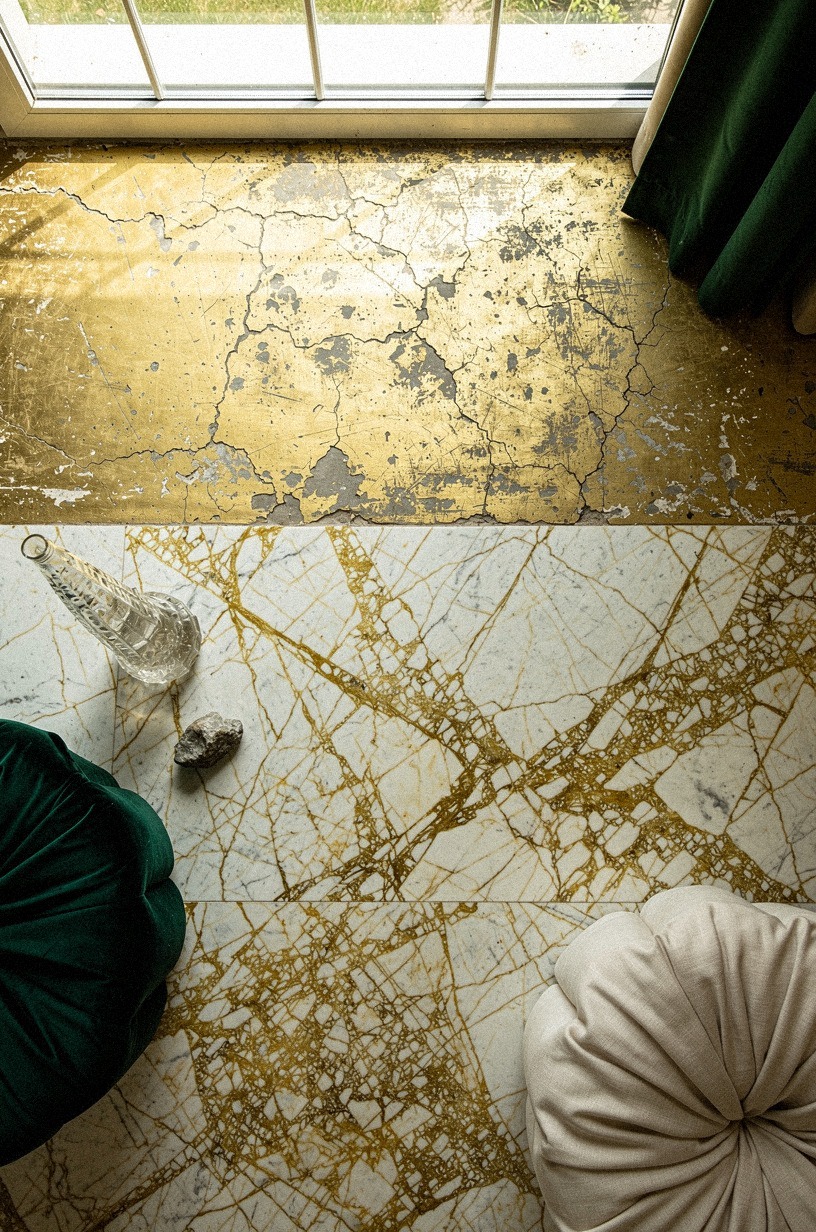
The last wall. I stripped the drywall off one 8-foot section and found original plaster on lath underneath.
It’s cracked. It’s yellowed where water seeped in years ago.
There’s a patch near the corner where someone covered a hole with a different plaster mix. I left it all. I sealed it with a matte clear coat so it wouldn’t dust. Then I stopped.
No paint. No art. No shelving. Just the wall.
It’s the fifth drink in the room. The one that doesn’t try to impress you. The one that makes everything else feel intentional by comparison. Guests touch it.
They can’t help it. It feels like a ruin. It feels like history. It cost $18 for the sealer.
It’s the most commented-on thing in the whole basement. And the best part? It required zero skill. Just a decision to stop.
That’s the real design move. Knowing when to leave something alone. For more unfinished-wall ideas that don’t look unfinished, our unfinished wall ideas for character rooms has the same stop-before-you-start approach.
How Much It Cost
I kept a spreadsheet. Not because I’m organized. Because I was terrified of what this was adding up to.
That’s everything. Two thousand six hundred and twenty-four dollars.
One weekend for the paint. Two weekends for the pipe grid. The rest was collected over six months of estate sales and salvage yards. The sofa was the only splurge.
The books were free. The chair was free. The mirror was the best find. If I were doing it again, I’d skip the marble ledge and use a painted wood shelf.
It would save $150 and 90% of people wouldn’t notice.
Why the “Ruined” Look Works Better Than Perfection
I’ve been in finished basements that cost twenty times what we spent. They’re clean.
They’re bright. They have recessed lighting and built-in shelving and carpet that matches the upstairs. And they feel like a finished basement.
That’s the problem. A speakeasy isn’t a finished room.
It’s a found room. It’s a space that accumulated character over decades, not over a single renovation.
The cracked plaster, the threadbare chair, the sticky cart wheel, the dent in the pendant. These aren’t flaws. They’re the evidence of time. And time is the one thing you can’t buy.
The design world has spent ten years selling us “curated imperfection.” Distressed wood that was sanded in a factory. Reclaimed brick that was reclaimed last Tuesday.
Aged brass that was aged with chemicals in a vat. It’s all theater. What we built is different. The rust on the pipe grid is real salt-water rust.
The wear on the Chesterfield is from someone’s actual living room in the 1970s. The plaster cracks are from a foundation shift in 1987.
These objects carry history. They carry weight. And that weight is what makes the room feel grounded instead of decorated.
I think about this every time someone asks where I “got the look.” The look isn’t a product. It’s a decision. The decision to stop covering things up. To let the basement be a basement.
To let the green walls be dark. To let the light be dim.
To let one wall stay broken. That decision costs nothing. And it’s the most expensive thing in the room.
If you’re drawn to this mood in other spaces, our modern speakeasy decor ideas vintage vibes updated shows how to get the same feeling with a cleaner, more contemporary edge. And our 1920s speakeasy decor ideas covers the same era with a different angle on the vintage vibe.
What People Always Want to Know
What’s the best wall color for a dark speakeasy room?
Start with a deep green like Farrow & Ball Studio Green or Benjamin Moore Black Forest Green. It makes the room feel intentional instead of small. Then add one oversized light source and one textured rug.
The IKEA TONSTAD series has low-profile pieces that work in tight basements. Scale down, but don’t lighten up.
Our dark room paint guide has the full test-and-compare method I used.
Where can I find speakeasy decor pieces on a budget?
IKEA for low-profile furniture. Target Threshold for throws and basic lighting.
Wayfair has surprisingly good vintage-style rugs under $300. But the real move is estate sales and Facebook Marketplace. I found the Chesterfield, the mirror, and the boxing poster all secondhand.
The best speakeasy pieces are the ones that already have a story. Our estate sale shopping guide has the search terms and neighborhoods that work.
How much does a speakeasy makeover cost?
About $300 to $1,200 if you’re working with paint, throws, art, and a rug. That’s the budget tier. Our total came to $2,624 because we added a sofa, a marble ledge, and a cowhide.
The high-end version with custom furniture and millwork can run $12,000 to $40,000. Start at the bottom.
You’ll be surprised how far paint and patience go. For more budget breakdowns, our basement makeover cost guide has the full range with real receipts.
Can I create this mood in a rental?
Yes, with swaps. Use peel-and-stick wallpaper in a dark pattern instead of paint.
Tension rods for curtains instead of drilling. Removable LED strip lights under shelves instead of hardwiring.
A good rug and the right bulbs will do 70% of the work without touching a wall. And everything moves with you when you leave.
Our rental-friendly dark room ideas has the full no-drill approach.
Is a dark speakeasy worth it in a small space?
Worth it. Small spaces actually help the speakeasy feeling.
A big room needs more furniture to feel full. A small room feels intimate with less. The low ceiling, the single window, the enclosed feeling.
These are features, not bugs. Lean into them. For more small-space dark room ideas, our small dark room ideas that feel big has the same lean-in approach.
What’s the first thing I should buy?
The rug. Not the sofa, not the light. The rug kills the echo and defines the zone.
Everything else sits on top of it. A 9×12 vintage Persian or a low-pile Moroccan Beni Ourain will do the work of three pieces of furniture. Our first rug guide for dark rooms has the size and pile specs that matter.
If I Had to Pick One Upgrade
If I had to pick one, I’d start with the wall color. You can’t layer warmth on top of a cold room.
The rug, the lighting, the furniture will all fight gray walls instead of building on them. Get the green right first. Everything else lands. I’ve lived with the wrong wall color.
I’ve lived with the right one. The difference isn’t subtle. It’s the whole room.