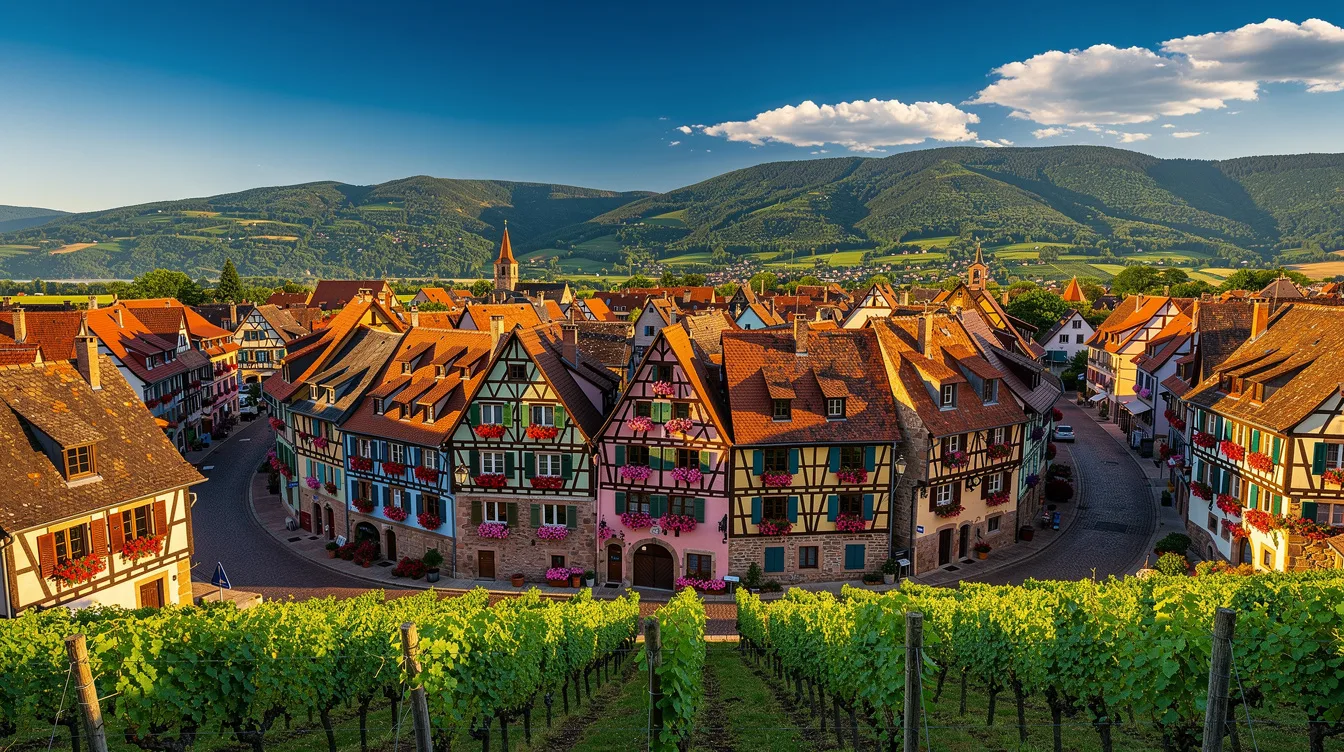
Eguisheim is where Pope Leo IX was born in 1002, a fact that gives this compact Alsace village more weight than its storybook lanes first suggest. You can reach it from Colmar, then find yourself walking in circles by design.
The streets loop around a medieval center, with colorful half-timbered houses pressing close beside them. It’s touristy in peak moments, but the circular plan makes the village feel less like a museum than a place you have to slowly decode.
Pope Leo IX is the reason to look past the shutters
Pope Leo IX was born here, when Eguisheim was part of the German world. That history changes the pace of a visit. You’re not only looking at old facades, you’re standing in the birthplace of a pope whose story began in this small wine village.
And that’s Eguisheim’s best trick: its scale stays intimate even when its history reaches far beyond Alsace. I’d come for the lanes, certainly, but the papal connection is what keeps the place from becoming merely decorative.
The village developed around a castle in the early Middle Ages, while the broader circular arrangement traces back to an earlier fortified core. You’ll notice how every turn seems to send you back toward the center, which is useful when wandering starts to feel like the point.
France chose it in 2013, and crowds followed
In May 2013, Eguisheim was voted “Village préféré des Français,” or France’s favorite village. The distinction is easy to understand once you see the tightly curved streets and painted timber framing. But it also means you shouldn’t expect solitude at the busiest times.
Roughly 700,000 visitors a year come through Eguisheim, especially around the Christmas market and autumn harvest. You can still enjoy it, but patience matters. The village is lively, not loud, and early hours give the shutters and cobbles room to breathe.
It has also held its designation among Les Plus Beaux Villages de France since 2003. That label can sound promotional, yet here it reflects a real visual coherence. The houses hold the street line so closely that even a short walk feels theatrical.
The wine route gives the village its working edge
Eguisheim sits on the Alsace Wine Route, surrounded by vineyard-covered hillsides. This is why the village feels connected to more than tourism. Wine production is part of the setting, and the slopes shift into stronger color during the harvest season.
But don’t treat the vineyards as scenery alone. You’re in a working wine village, with local wines including Edelzwicker and Gentil. I’d save time for the village itself first, then let the surrounding vines explain why it grew here.
The area includes wine zones, and the hills rise toward the edge of the Ballons des Vosges Nature Park. The terrain quickly becomes more serious beyond its easy streets.
Three ruined castles change the view above Eguisheim
Above the village stand three ruined castles: Dagsburg, Wahlenburg, and Weckmund. Their presence gives the vineyard hills a harder outline. From below, they’re a reminder that this gentle-looking corner of Alsace once needed defenses.
You can also find marked hiking and cycling routes around Eguisheim, including the local wine trail through the vineyards. The climb is a different experience from the village lanes. It’s more exposed, but it replaces painted facades with wide views across the plain.
And if you’re visiting in autumn, the harvest period is the right trade-off between color and activity. Christmas brings another kind of pull, with the market season drawing visitors into the narrow streets. By evening, the stone underfoot cools, and the village’s circles start to feel quiet again.