Eclectic Mid-Century Bathroom Ideas for Bold Personality work best when color, wood, and pattern have a clear order. I once mixed five finishes in one bathroom and called it collected; it looked like a yard sale with plumbing. You don’t need less personality. You need a few firm rules. These eleven looks show you where to push and where to stop.
- Layer an Eclectic Bathroom Color Story
- Paint with the Three-Color Tension Rule
- Float a Walnut Vanity for Small Bathroom Eclectic Decor
- Layer an Eclectic Bathroom Color Story
- Paint with the Three-Color Tension Rule
- Float a Walnut Vanity for Small Bathroom Eclectic Decor
- Swap Matchy Fixtures for the Two-Metal Rule
- Frame the Mirror with a Three-Height Light Stack
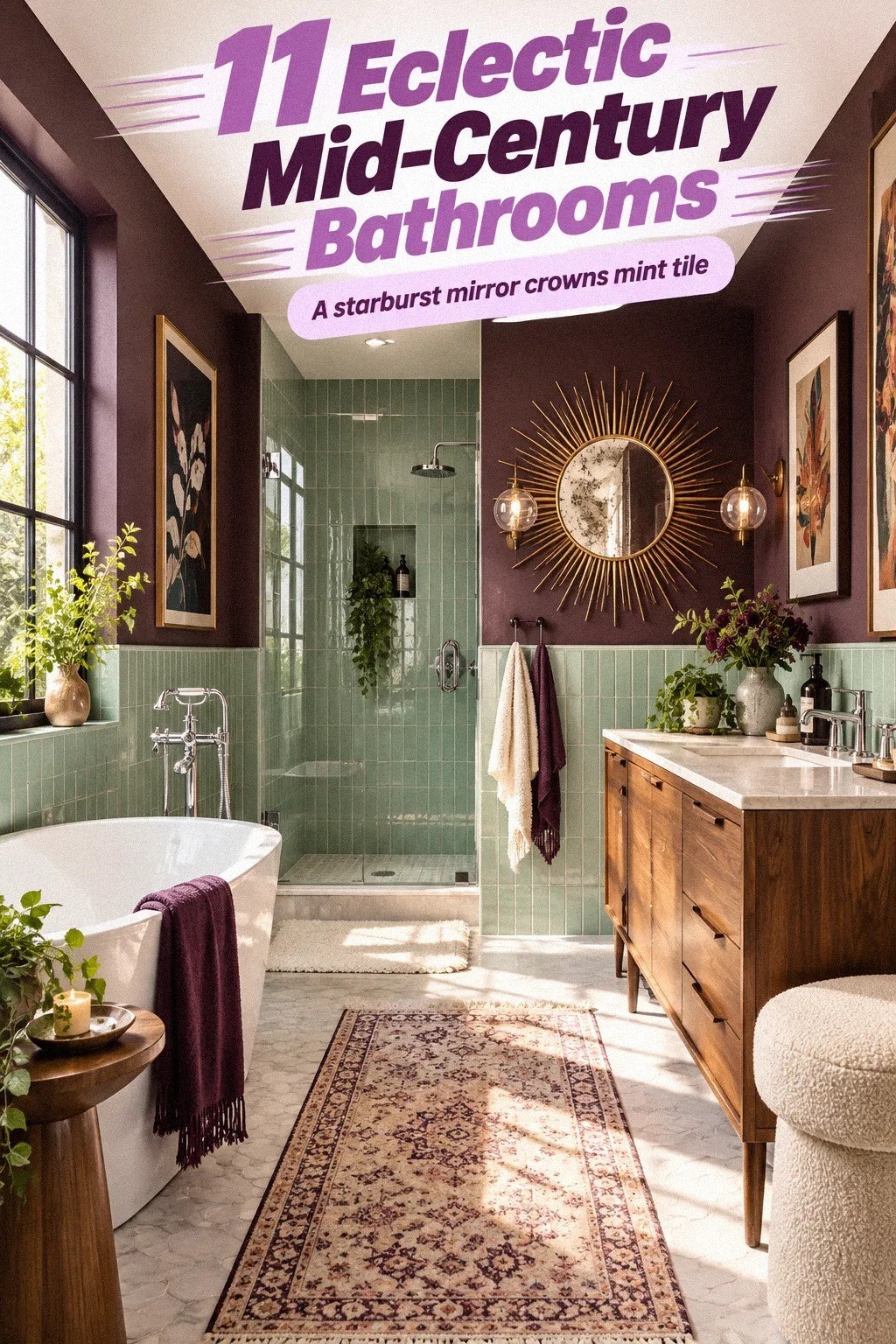
- Can Pattern Work in a Small Eclectic Bathroom?
- Anchor the Floor with Mid-Century Geometry
- Choose Walnut Over Blonde Wood for an Eclectic Bathroom
- Hang Art Above the Toilet with a Clear Frame Rule
- Build the Small-Space Storage Edit
- Paint the Ceiling Before You Add More Decor
1Layer an Eclectic Bathroom Color Story
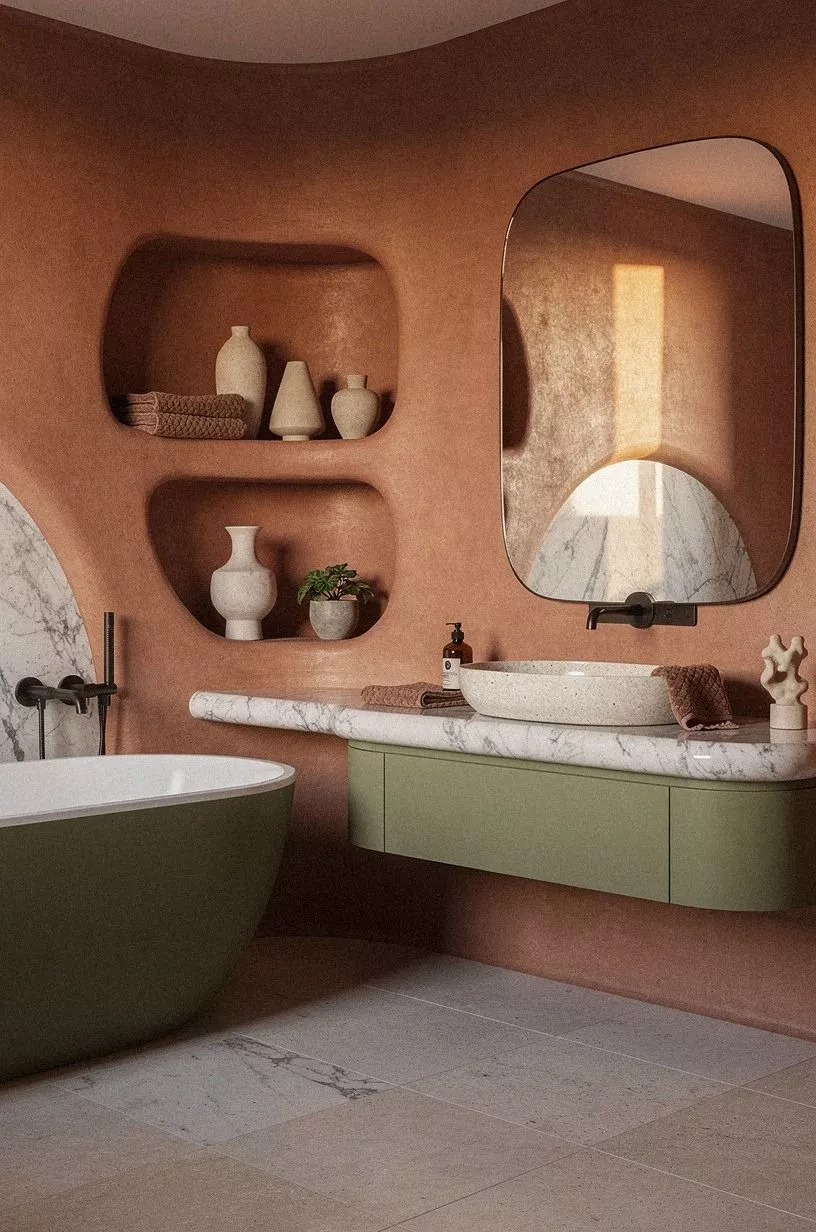
Start with one dominant color, one supporting shade, and one small surprise. Farrow & Ball Olive No.13 gives a bathroom grounded, moody weight, while stone-colored walls keep the room from feeling closed in. Add terracotta through a bath mat, artwork, or ceramic cup, and you’ll have contrast without visual shouting.
Olive should occupy the largest surface, not every surface.
I’d skip painting the ceiling the same dark shade in a bathroom with limited daylight. It’s dramatic, but the room can feel shorter than it is. You want your eye to travel upward, so leave the ceiling pale and use Carrara marble with subtle gray veining around the sink.
If you’re working with a narrow room, these small mid-century modern bathroom ideas will help you protect the walking path.
A few grounded details make the palette feel lived-in:
– An 18-ounce cotton velvet stool cushion in terracotta. – A framed print with cream, olive, and rust. – One low ceramic vessel, not a row of matching accessories.
And yes, your bathroom can be bold without becoming loud. The olive wall gives the warm materials somewhere to land.
Typical cost by tier:
2Paint with the Three-Color Tension Rule
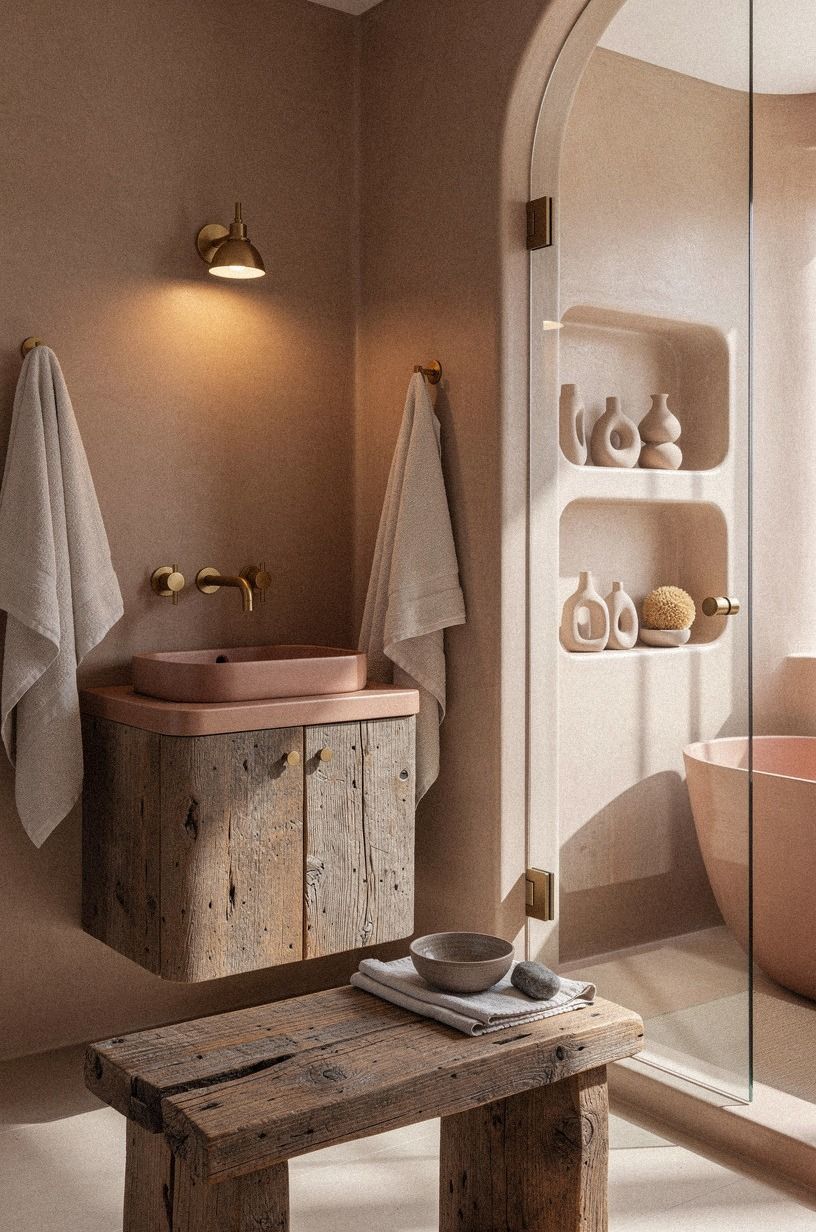
The Three-Color Tension Rule keeps an eclectic bathroom colorful without turning every object into a separate event. Benjamin Moore Potter’s Clay 1221 works as the background because its earthy tone connects naturally with linen, aged brass, and weathered wood. Add cream in small doses, then let the clay do the talking.
I made the mistake of adding emerald towels, coral art, blue tile, and yellow hardware to one guest bath. You’d think the colors would balance each other, but they competed from every angle.
Now I limit the strongest accent to about one visual zone, such as the shower curtain or the vanity wall. If you’re unsure, paint a sample board and move it around the room for a full day.
Your supporting pieces can stay quiet:
– Linen towels in soft cream. – A reclaimed weathered teak tray with an aged brass soap bottle. – A small framed clay-and-cream botanical print with a generous mat.
But don’t make every accent tiny. One larger color block will look more intentional than six scattered dots.
For a warmer reference, compare this approach with these organic mid-century modern bathroom ideas. That comparison can save you from buying accessories that don’t belong together.
3Float a Walnut Vanity for Small Bathroom Eclectic Decor
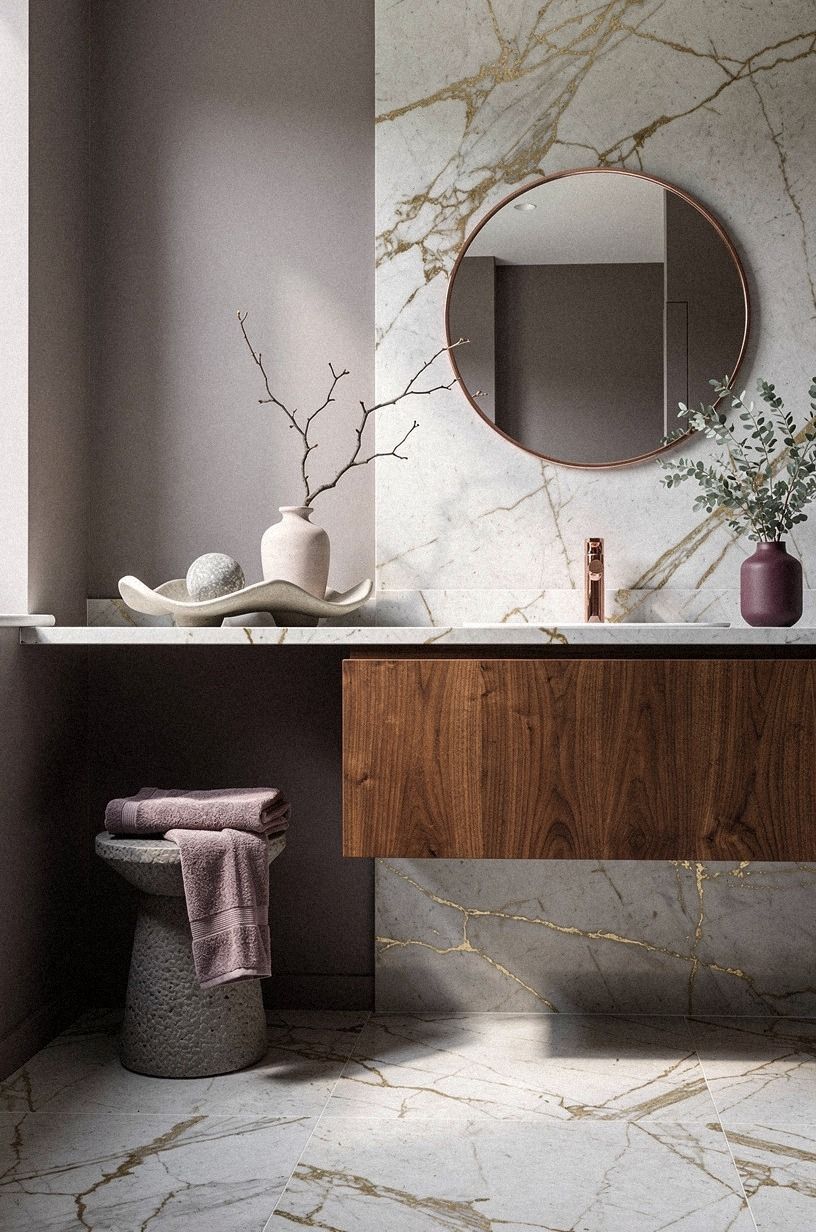
A floating vanity makes a compact bathroom feel more open because your eye can see the floor beneath it.
4Swap Matchy Fixtures for the Two-Metal Rule
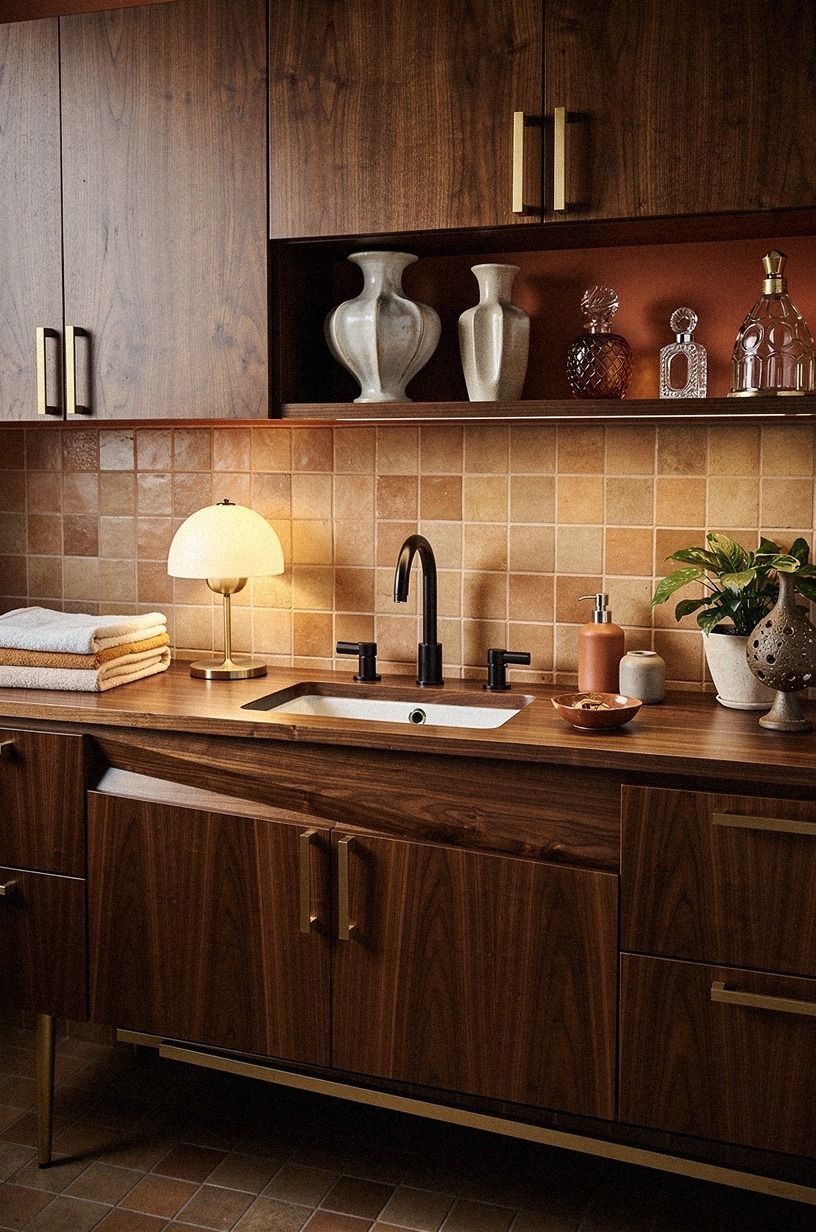
The Two-Metal Rule lets you mix finishes while keeping the room from looking accidental. Use one metal for the practical fixtures and another for the decorative accents. Against a navy wall, a white basin and cerused white oak vanity keep the room crisp, while walnut details add warmth without making the palette feel heavy.
The metals don’t need to match perfectly. In fact, a little difference gives an eclectic bathroom its character.
What matters is repetition. You’ll want each finish to appear at least twice, so your eye understands the choice rather than treating it as a leftover from another renovation.
And don’t pair three shiny finishes in one small room. Chrome, polished brass, and glossy black will bounce light in competing directions.
I’d choose satin surfaces instead, especially near a mirror where glare can become irritating before breakfast. These mid-century boho bathroom ideas show how layered finishes can still feel relaxed.
A few useful pairings:
– Cerused white oak vanity with a walnut stool. – Navy-painted walls with warm brass lighting. – Matte black hooks beside a white ceramic basin.
Your room doesn’t need a matching set. It needs a repeatable relationship between finishes.
5Frame the Mirror with a Three-Height Light Stack
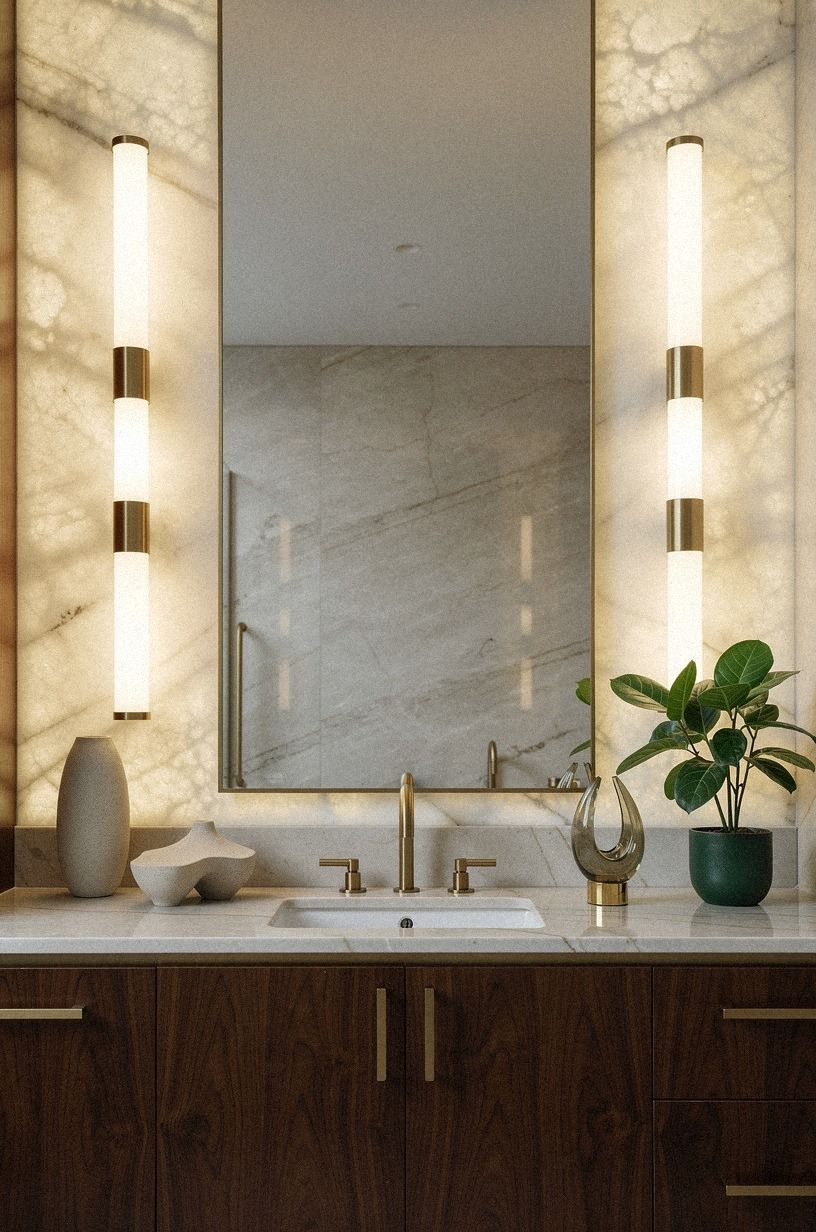
The Three-Height Light Stack gives your bathroom a more finished glow. Place light at the ceiling, beside the face, and near the floor or vanity base.
Gold sconces at eye level soften the contrast of emerald walls, while a ceiling fixture handles general light. A small plug-in lamp outside the splash zone can add the lowest point if your layout allows it.
I’ve lived with one overhead fixture above a mirror, and it made every morning look harsher than necessary. You’ll notice the difference when the light hits your face from the sides instead of cutting down from above. For a bathroom without rewiring, rechargeable sconces or a picture light can create the same layered feeling.
Use warm bulbs and keep the fixture shapes simple. A backlit translucent onyx panel, gold stem, or cream shade will give the room a rich glow without making it look themed. If you’re planning a broader lighting refresh, this Scandinavian mid-century bathroom guide has useful ideas for calm, diffused light.
Your mirror should stay large enough for daily use. A smaller decorative shape may look clever, but you’ll regret it when you’re trying to see the back of your hair. Function earns the right to be decorative.
6Can Pattern Work in a Small Eclectic Bathroom?
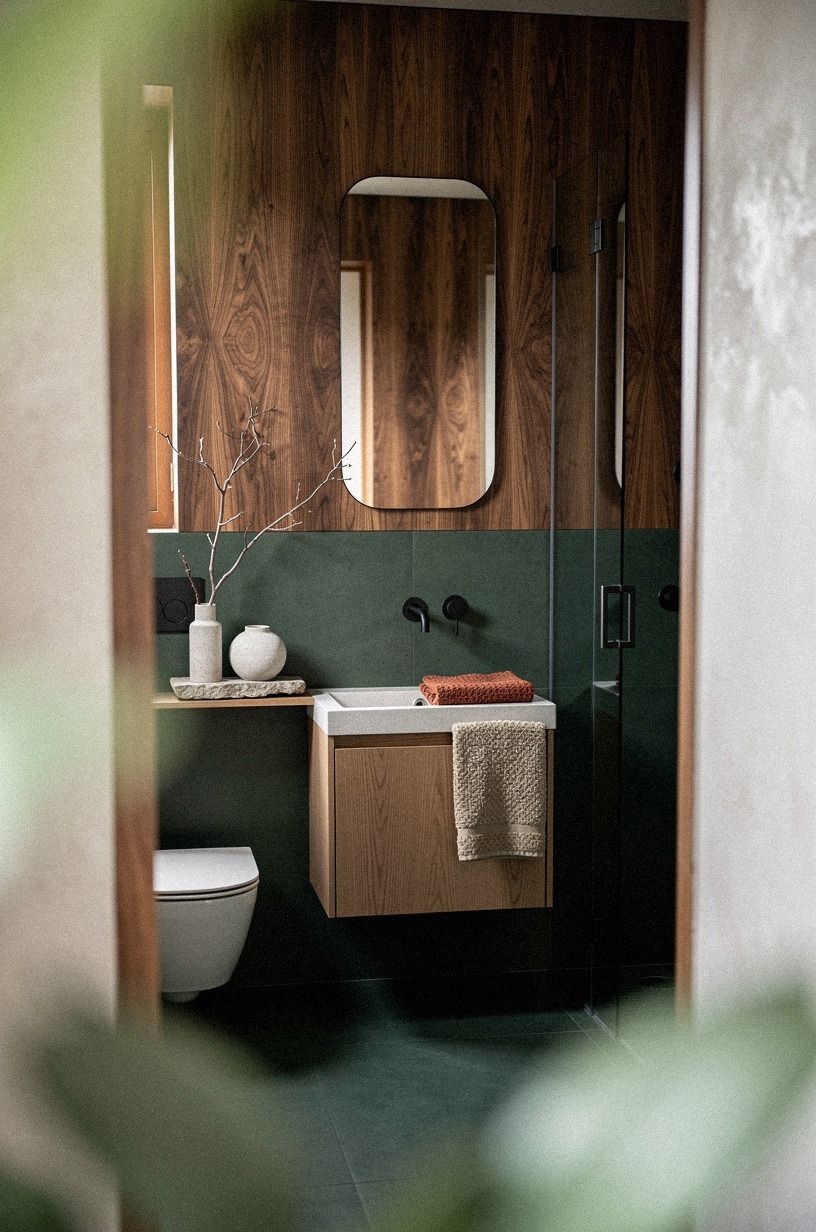
Yes, pattern works in a small bathroom when you give it one clear boundary.
7Anchor the Floor with Mid-Century Geometry
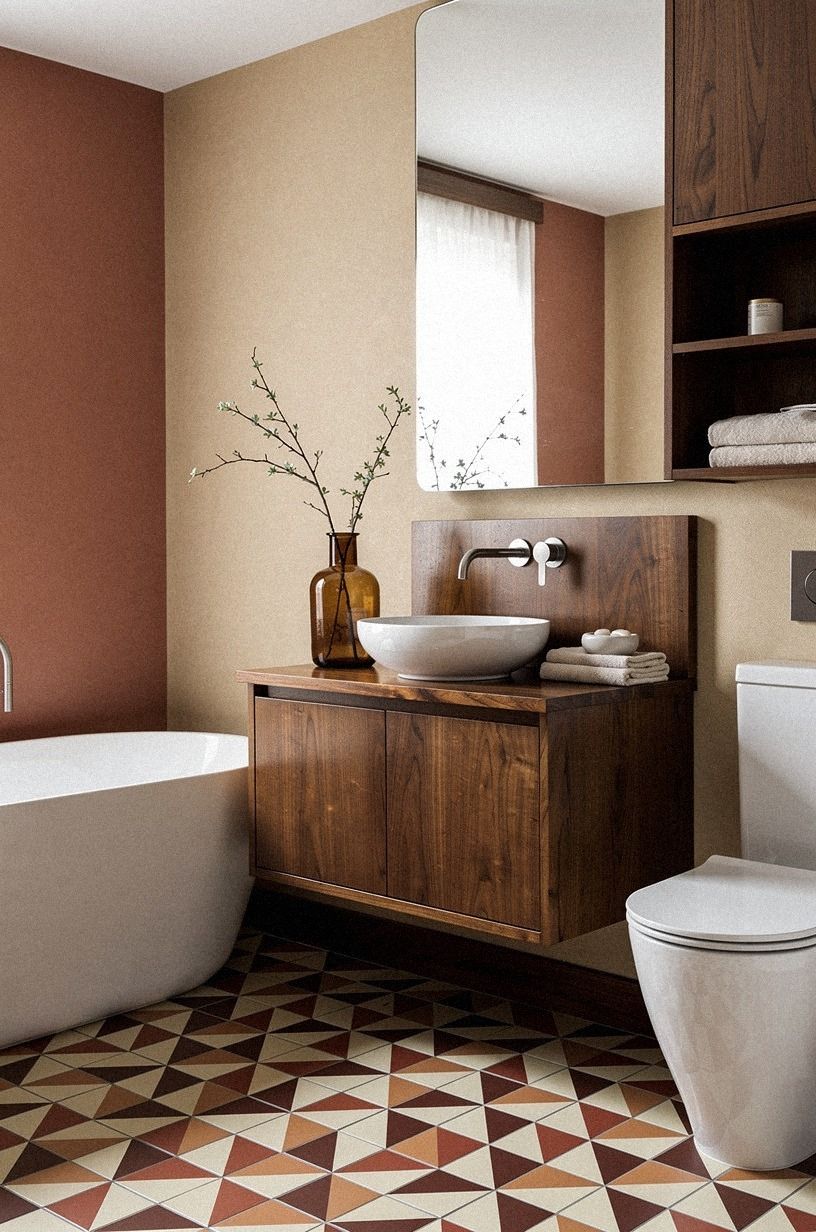
A geometric floor can make the whole bathroom feel considered, but the scale has to match the room. Warm travertine with its natural variation brings depth without the maintenance of delicate stone. Pair it with a dusty rose wall and charcoal accents so the floor has enough breathing room.
Choose one repeat shape, such as a small hexagon, checkerboard, or linear mosaic. I’d avoid mixing a strong floor pattern with a patterned shower wall unless one of them is nearly tonal.
You don’t want your floor and shower competing for the same glance. Your feet should feel grounded, not visually chased around the room.
A standard tub is 60 by 30 inches, so a tub surround often becomes the largest uninterrupted surface in the room. Use that scale to decide whether your floor can handle more movement.
If the tub wall is plain, a graphic floor earns its place. If the wall has zellige or wallpaper, a quiet floor is usually the better call.
Try these details:
– Honed travertine tile with a low sheen. – A flatwoven runner in dusty rose and cream. – Brass edging around a simple bath mat.
For more storage-minded layouts, browse these mid-century modern master bathroom ideas. Your floor can carry personality while still letting the room work hard.
8Choose Walnut Over Blonde Wood for an Eclectic Bathroom
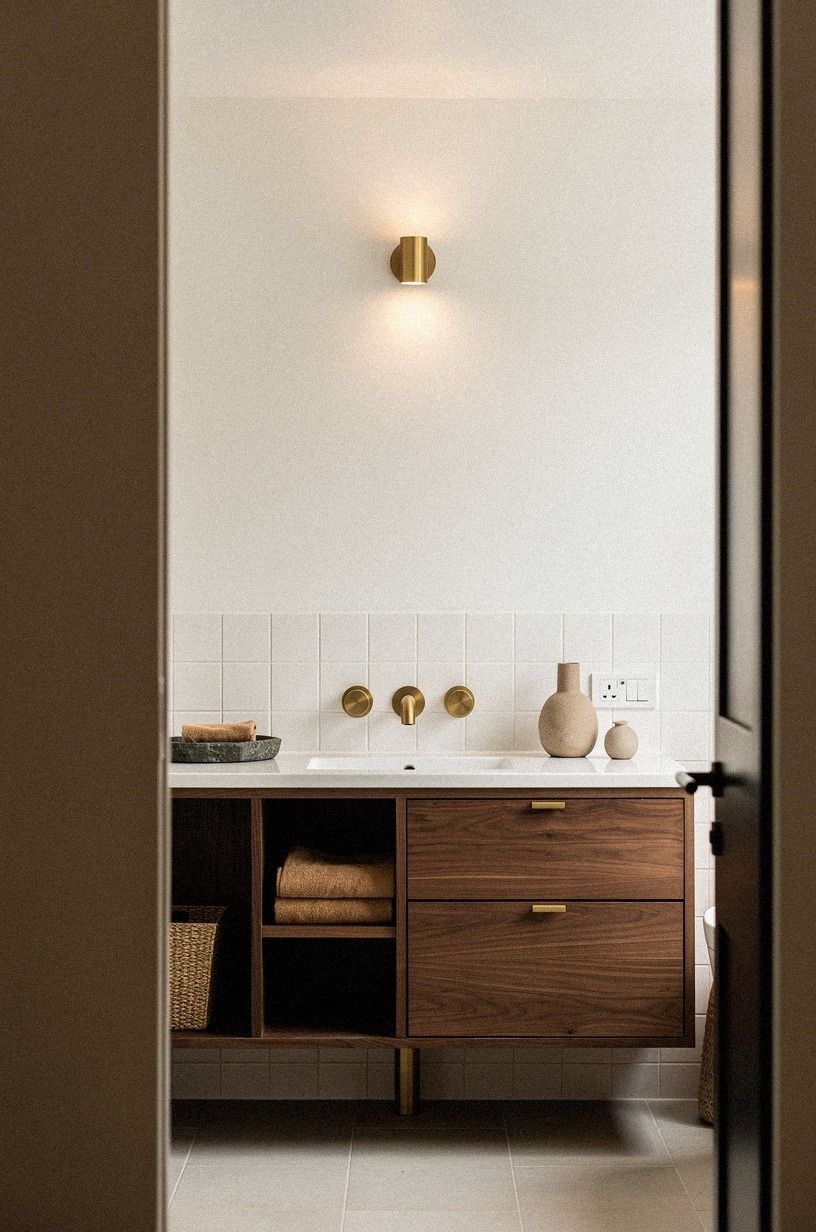
Warm white, camel, and black accents create a quieter foundation for an eclectic bathroom, while unlacquered brass adds a finish that will develop character over time.
9Hang Art Above the Toilet with a Clear Frame Rule
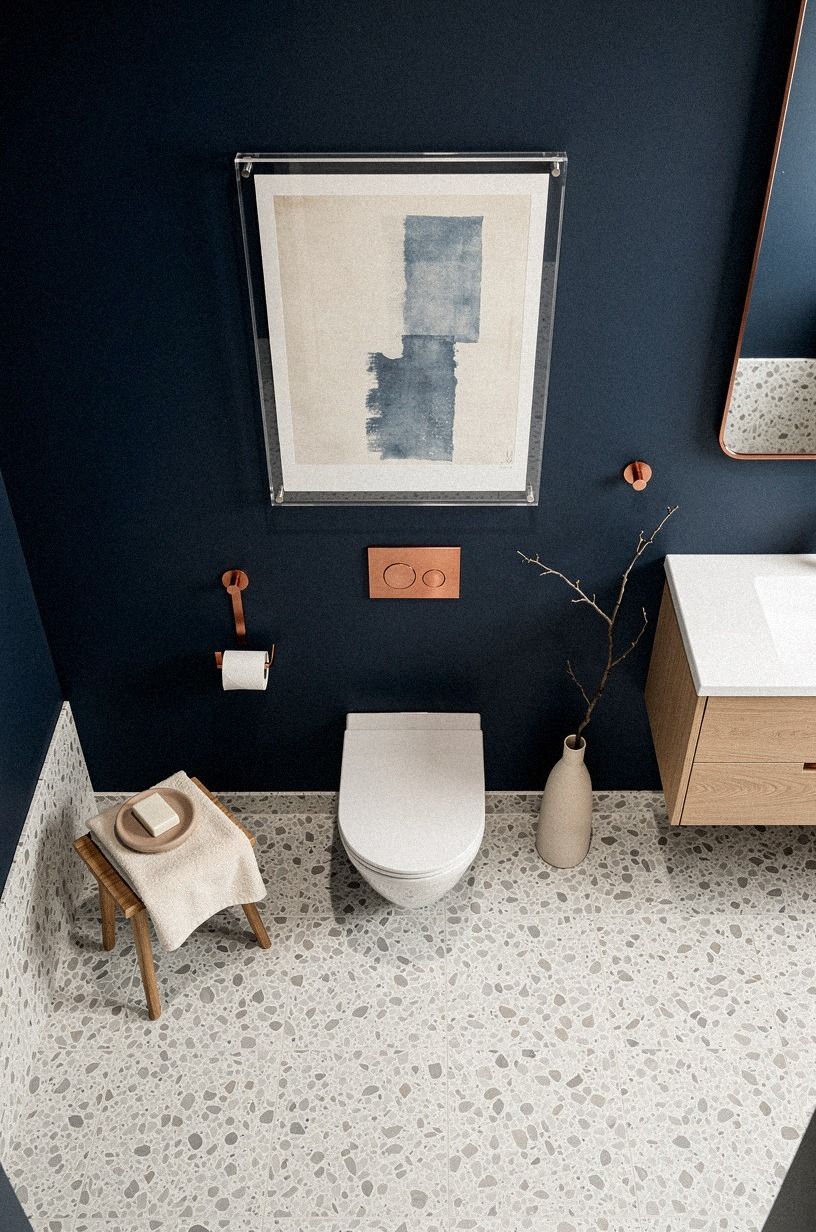
The Clear Frame Rule says bathroom art needs one strong anchor and enough space around it. Hang a midnight blue abstract print above the toilet, then frame it under glass or acrylic suited to humidity. A wide ivory mat can make a small print feel collected rather than lost on the wall.
Leave enough clearance for cleaning and daily use. You’ll want the bottom edge high enough that it doesn’t feel crowded by the tank, yet low enough to connect with the vanity and mirror. If your toilet sits beneath a shelf, a narrow vertical print often works better than a wide gallery wall.
And don’t use every wall for art. I made that mistake in a powder room, and the room began to feel like a hallway with a sink.
One large print plus one small object gives your eye a place to rest. Copper framing can connect with warm hardware, while an ivory mat will soften a dark wall and oversized-chip terrazzo.
For a guest bathroom, these mid-century modern guest bathroom ideas offer useful ways to make art feel welcoming without crowding the essentials.
Your art doesn’t have to explain the entire room. It only needs to add one opinion.
10Build the Small-Space Storage Edit
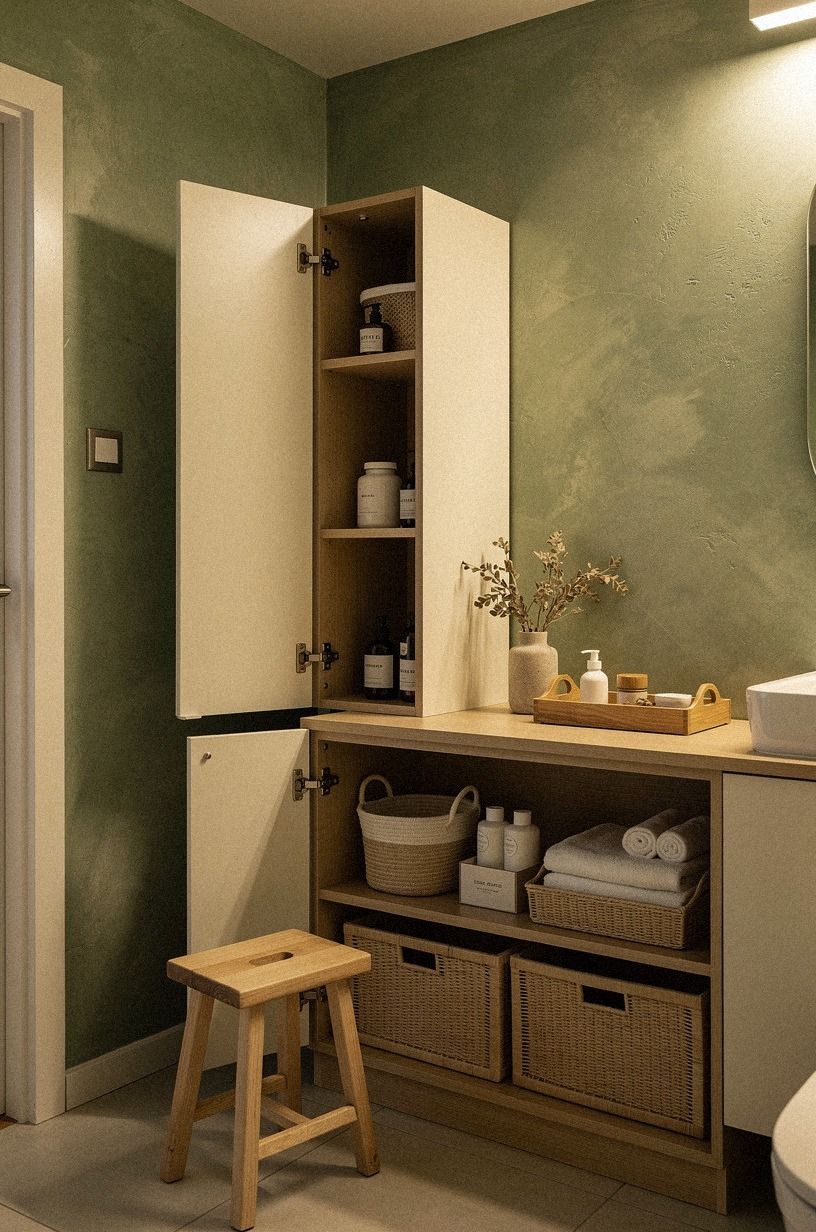
Storage should disappear into the architecture when your bathroom is small.
11Paint the Ceiling Before You Add More Decor
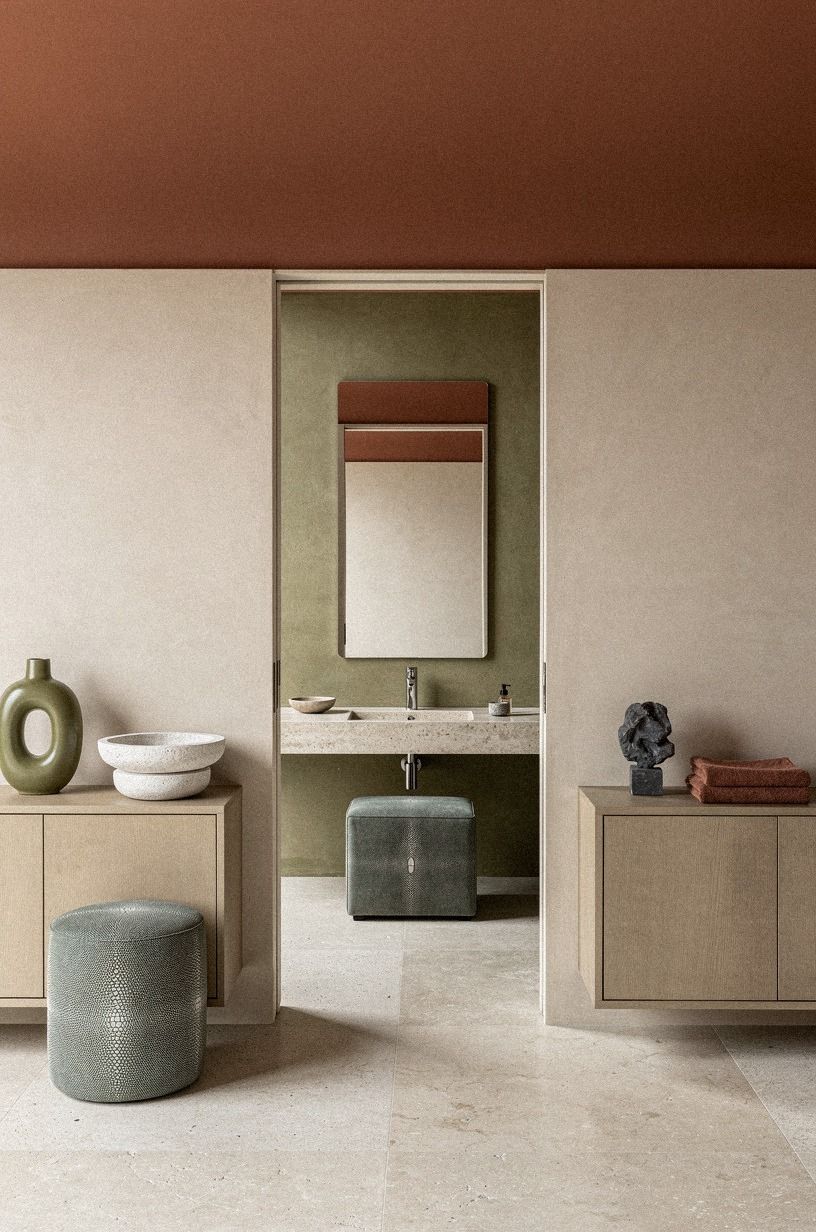
A painted ceiling can finish an eclectic bathroom more effectively than another basket or framed print. Terracotta adds warmth above stone surfaces, while olive details keep the room connected to the rest of the palette. Use the combination when you want a deeper shift in atmosphere without filling the room with more accessories.
I’d keep the ceiling lighter than the walls in a compact bathroom unless you’re deliberately creating a jewel-box effect. You’ll want the color transition to feel intentional, so carry the terracotta shade into one towel, small artwork detail, or shagreen accent. That repetition creates harmony without making the room look coordinated by a catalog.
The best ceiling colors respond to the light you already have. Test a painted board in the morning and evening because terracotta shades can become richer after sunset. If the room faces north, warm stone and olive will help prevent the color from feeling chilly.
And don’t forget the fan grille. A white plastic grille can interrupt an otherwise thoughtful palette, so choose a paintable grille or keep the surrounding ceiling pale. Your final detail should support the room’s personality, not announce the ventilation system!
How to Choose the Supporting Materials
Once the large decisions are made, choose materials by touch and maintenance. A bathroom needs surfaces that can handle water, steam, cleaning products, and hurried mornings. Honed porcelain usually offers better everyday value than delicate stone because it gives you the look without demanding constant caution.
I’d combine one smooth material, one textured material, and one naturally irregular material. For example, pair a satin-painted wall with ribbed glass and handmade ceramic. That mix keeps the room interesting even when the color palette stays restrained.
Your metal finish should also suit your cleaning habits. Polished brass shows fingerprints quickly, while brushed brass and aged bronze are more forgiving. If you don’t want to wipe the faucet every day, choose a finish that can age gracefully.
For more ideas about balancing warmth and texture, compare these organic mid-century modern bathroom ideas. You’ll see how a small number of honest materials can create more atmosphere than a crowded accessory shelf.
Where Should Storage Work Hardest?
The most valuable storage is close to the action. Keep daily skincare near the sink, towels within reach of the shower, and cleaning supplies behind a closed door. You shouldn’t have to cross the room with wet hands to find a towel.
If your vanity has drawers, reserve the shallow top drawer for small items. Use deeper drawers for hair tools and backup toiletries. Oak dividers or simple trays can prevent the usual bathroom avalanche.
A recessed medicine cabinet is often worth the installation cost because it returns wall space without stealing floor area. In a rental, a slim over-toilet cabinet or freestanding cane unit can provide similar value. Just keep the depth modest so you can still clean around it.
Storage works best when it looks like part of the room’s design. A walnut cabinet, woven basket, or painted shelf can support the eclectic direction while quietly handling the practical mess.
Before You Order: Measure These Five Points
Measure the vanity wall, door swing, toilet projection, shower clearance, and distance between the sink and the nearest wall. These numbers will tell you what can fit before you spend money. You’ll also avoid the expensive mistake of ordering a cabinet that makes the room impossible to move through.
Check the rough-in location for the toilet and plumbing supply lines. Moving them can change a cosmetic makeover into a major renovation. If your budget is limited, keep the plumbing where it is and direct the visual investment toward paint, lighting, tile, and hardware.
I’d tape the proposed vanity and shower footprint on the floor with painter’s tape. Walk through the room at different times of day. If you keep bumping into the tape, the layout isn’t ready to buy.
For especially tight rooms, these small mid-century modern bathroom ideas can help you compare proportion before you commit to a cabinet or tub.
What Will the Makeover Cost?
A cosmetic update can cost between $200 and $1,200 when you’re painting, changing textiles, replacing a mirror, and updating small hardware. That range gives you a useful starting point if the vanity, tile, plumbing, and lighting are still in good shape.
A partial renovation usually lands closer to $3,000-$9,000. You might replace the vanity, add a new light, repaint, install a mirror, and retile one surface. The value is strongest when you improve the features you see and touch every day.
A full bathroom renovation can move beyond $12,000, especially when waterproofing, electrical work, tile removal, and plumbing changes are involved. Get several labor estimates and ask what each quote includes. A low price can become expensive when demolition, disposal, or finish work is excluded.
I’d spend first on waterproofing, ventilation, and lighting. Then I’d choose the vanity and floor. Decorative accessories can wait.
This order protects your investment and gives the room a better daily experience.
Which Vintage Details Are Worth Keeping?
Keep vintage pieces that add proportion, texture, or a story. A sturdy teak stool, a brass-framed mirror, or a small abstract print can give the room personality without requiring a full period recreation.
Inspect anything that will live near water. A secondhand wood stool may need sealing, and an old frame may need new glazing. You’ll want to know whether restoration costs more than the item itself.
I’d skip vintage plumbing unless a professional confirms that it’s safe and compatible. The character may be wonderful, but a leaking vintage faucet can erase the savings quickly. Use vintage pieces for the visual layer and modern fixtures for reliability.
A good secondhand find should make you want to rearrange the room around it. If you’re buying something only because it’s cheap, leave it behind. The best value is the piece you’ll still enjoy after the novelty fades.
How I’d Edit the Room in One Afternoon
Remove every loose accessory first. Put towels, art, baskets, trays, and containers on the floor so you can see what the room is actually carrying. You’ll probably find that several items repeat the same color or function.
Choose the first-glance feature. It might be the painted wall, the geometric floor, the vanity, or the mirror. Everything else should support that decision.
If three objects are competing for attention, keep the strongest one and move the others elsewhere.
I’d then return only the pieces that solve a problem or add a clear texture. One woven basket can soften tile.
One framed print can add history. One ceramic vessel can make the counter feel finished.
You don’t need a collection on every surface.
Step back from the doorway before you buy anything else. The doorway view is the best test because it shows whether the room has a readable composition. If the space feels busy from there, editing will help more than shopping.
My Eclectic Bathroom Rulebook
I’ve learned that bold bathrooms rarely become memorable because they contain more things. They work because the owner decides which detail deserves the first glance.
In my own rooms, that decision has changed. I used to start with accessories, then wonder why the vanity, tile, and lighting felt disconnected.
Now I choose the largest visual move first, usually the wall color or the floor, and let everything else answer it.
The most useful question is simple: what do you want to notice from the doorway? If it’s walnut, keep the tile quieter.
If it’s a patterned wall, let the vanity become a calm block. If it’s a vintage print, give it enough wall around it to feel intentional.
You don’t need every finish to be from the same decade. You need a reason for each finish to stay.
I also think eclectic style works best when it leaves one imperfect note. A slightly uneven zellige glaze, a secondhand frame, or a brass finish that’s beginning to patina gives the room a human edge. I wouldn’t replace that character with a perfectly matched set.
The bathroom should feel assembled over time, even if you planned it in one weekend.
And there’s a practical reason to edit. Bathrooms are small, bright, and full of hard surfaces, so clutter becomes louder than it would in a living room.
Keep the pieces you touch, the colors you want to live with, and the materials that age well. Your personality will show more clearly when the background isn’t competing for attention.
If you want a calmer version of this approach, this Scandinavian mid-century bathroom guide is a useful reference. It shows how restraint can still feel warm and personal.
The Questions Worth Answering First
What is the best Eclectic Mid-Century Bathroom Ideas for Bold Personality for a small bathroom?
A floating walnut vanity and one saturated wall color are the strongest picks for a small bathroom. IKEA storage can keep the footprint practical, while a framed print adds personality without using floor space.
Choose one focal surface, then keep the remaining fixtures quiet. That balance gives you style without sacrificing movement.
Where can I buy Eclectic Mid-Century Bathroom Ideas for Bold Personality pieces on a budget?
Look at IKEA, Wayfair, and Target for simple vanities, lighting, and textiles. Facebook Marketplace and thrift shops can provide better vintage frames and stools for less. You’ll often find stronger character secondhand than in a matching new set.
Browse these mid-century modern bathroom floor tile ideas for sourcing direction.
How much does an Eclectic Mid-Century Bathroom Ideas for Bold Personality makeover cost?
A cosmetic project can fall within the $200-$1,200 budget range for paint, a mirror, a faucet, and textiles. A mid-range update with a new vanity, partial wall tile, and lighting typically runs $3,000-$9,000.
Labor and plumbing changes can move the total higher. Ask for a detailed quote before deciding whether the renovation is worth it.
Can I create an Eclectic Mid-Century Bathroom Ideas for Bold Personality look on a budget?
Yes, and you can start with paint, a secondhand frame, and new textiles. Benjamin Moore Chestertown Buff HC-9 can shift the room without demolition.
Reuse your mirror, change the hardware, and shop Facebook Marketplace for a wood stool or ceramic vessel. These organic mid-century modern bathroom ideas can help you prioritize high-impact changes.
Is an Eclectic Mid-Century Bathroom Ideas for Bold Personality style worth it in a small space?
Yes, because a small room gives you a manageable place to use color and pattern. Keep the vanity between 32 and 36 inches high, protect the 21-inch toilet clearance, and choose one focal wall.
The limited footprint helps your bold details feel concentrated. You’ll spend less on materials than you would in a large bathroom.
Is an Eclectic Mid-Century Bathroom Ideas for Bold Personality style a good idea for a rental?
Yes, especially with removable swaps. Try peel-and-stick wallpaper, a tension shelf, removable hooks, and a freestanding cane cabinet.
You can also change the shower curtain, mirror, and lighting shade without touching tile or plumbing. These renter-friendly ideas keep the original room intact and let you take the best pieces with you.
Where I’d Start First
If I had to pick one, I’d start with the walnut vanity. It anchors bold tile, softens bright paint, and gives chrome or brass somewhere to belong. Pin the vanity idea for later and compare it with this mid-century modern powder room guide before you buy anything.
Then I’d choose the wall color, measure the storage, and decide whether the floor needs to carry the pattern. Your bathroom doesn’t need every idea at once. It needs one strong decision, a few supporting materials, and enough empty space for the personality to read.