Coastal Mid-Century Bathroom Ideas for a Breezy Retro Feel can work with $200 to $1,200 for paint, a mirror, a faucet, and textiles. I learned that the hard way after pairing pale blue with shiny chrome. The room looked flat, not relaxed. These ideas mix warm wood, vintage shapes, and sea-washed color with enough contrast to feel lived-in.
- Layer the Three-Texture Rule for a Soft Modern Bathroom
- Paint Sea Salt Above a Walnut Vanity
- Float the Sunlit Shelf Strategy
- Swap Chrome for Unlacquered Brass That Ages Well
- Build the Two-Wood Rule for a Bathroom With Personality
- Frame the Mirror With a Rounded Walnut Shape
- Hang the Three-Height Light Stack
- Choose Zellige Over a Perfect Tile Grid
- Mix Coastal Stripes With Earthy Geometry
- Anchor the Room With a Terrazzo Counter
- Paint One Moody Wall Instead of Everything Dark
- Use a Tapered Leg Vanity for a Breezy Retro Feel
- Style the Vanity With One Sculptural Object
- Compare What to Spend Before You Tile
- Arrange a Calm Coastal Gallery Wall
- Keep a Warm White Base Over Nautical Blue
- Add Plants That Can Handle the Steam
1Layer the Three-Texture Rule for a Soft Modern Bathroom
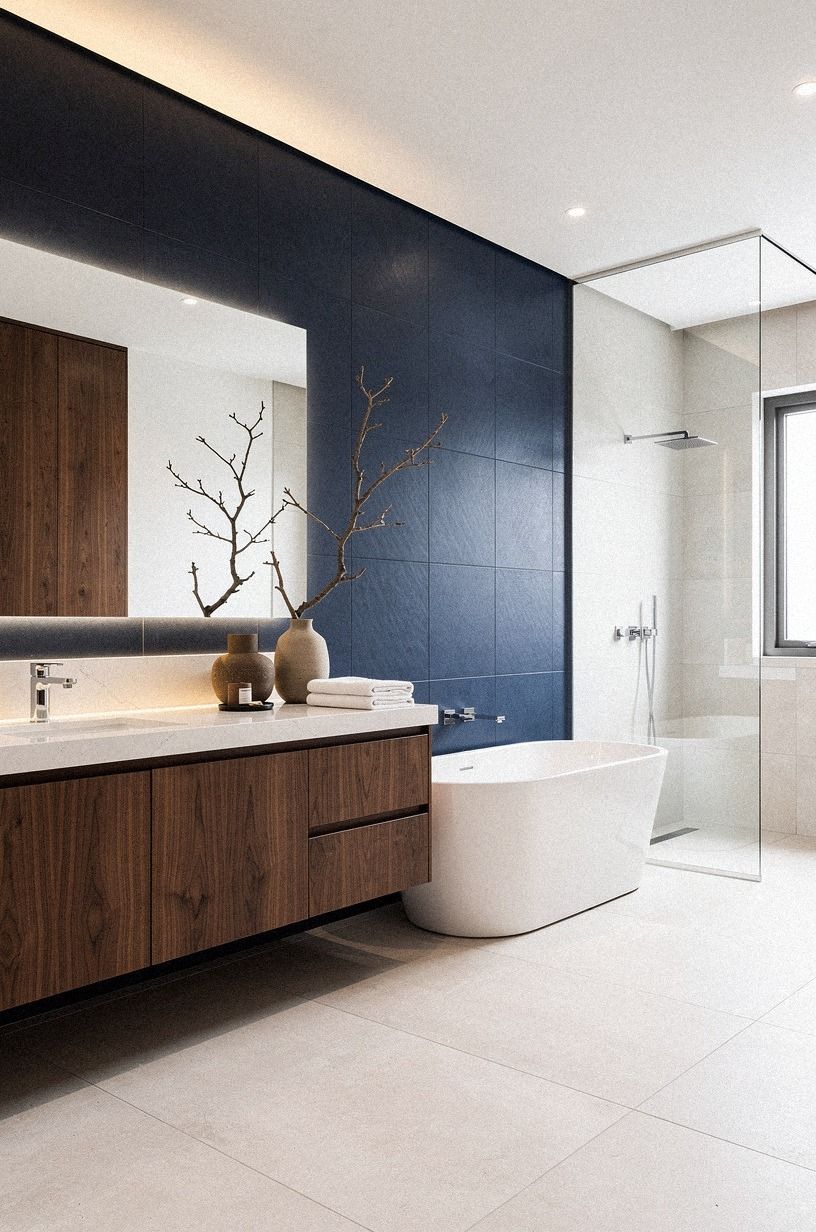
Start with three textures you can feel from the doorway: book-matched walnut, nubby cotton, and a smooth ceramic surface. Your bathroom needs that contrast because flat white walls and one glossy vanity can read more like a rental showroom than a breezy retreat.
I like a walnut stool, a ribbed bath mat, and a hand-thrown tray near the sink. Each catches light differently, so your eye keeps moving.
Keep the palette narrow. Benjamin Moore Hale Navy HC-154 brings a deep coastal note, while a 600gsm Turkish cotton towel adds weight without looking fussy.
If you’re styling a small room, use the wood on one visible piece only. Too much matching walnut can make your room feel themed, and you don’t need a full beach-house set to get the mood.
See these organic mid-century bathroom ideas for another way to warm up pale surfaces.
2Paint Sea Salt Above a Walnut Vanity
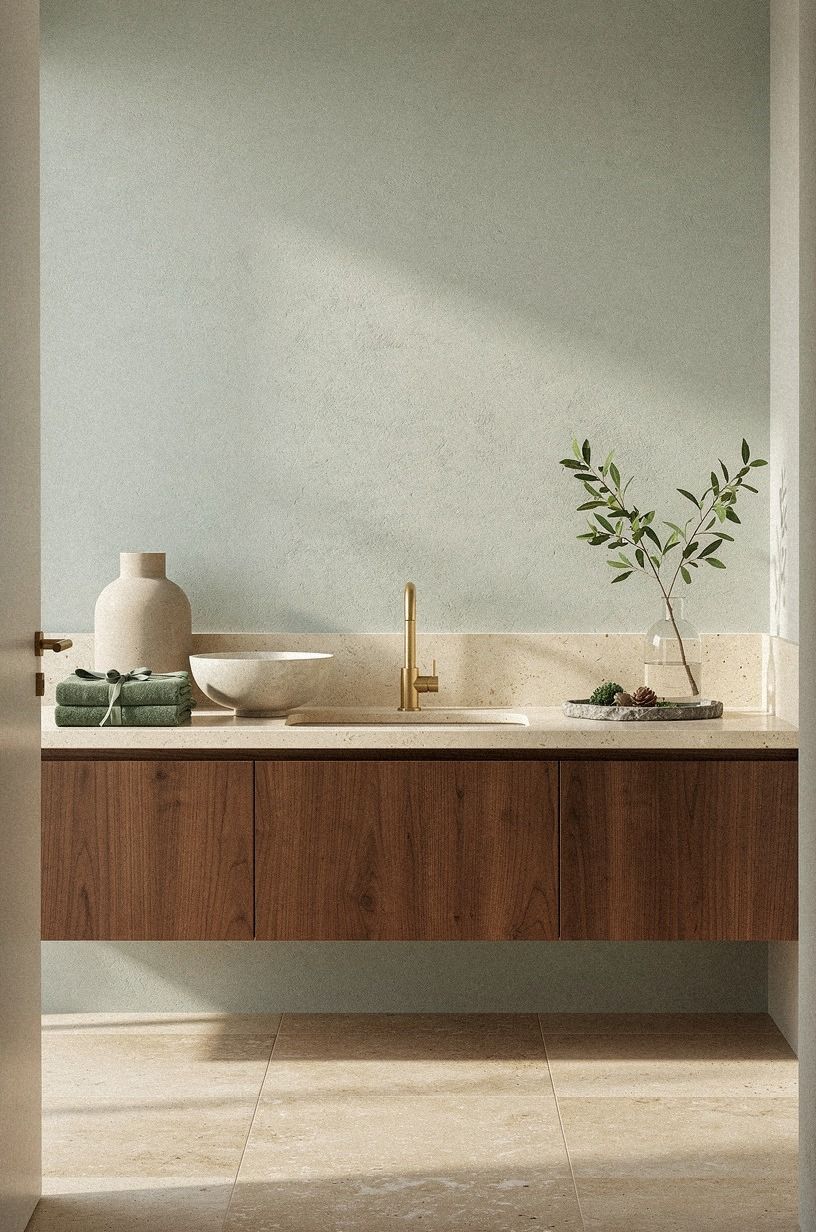
An emerald green wall is my favorite starting point for a coastal mid-century bathroom because it shifts in depth as daylight moves across the room. It isn’t sugary.
Against warm travertine, the color feels calm in the morning and slightly deeper after sunset. You’ll want to test it beside your tile first, since cool bulbs can pull the gray forward.
Choose a vanity between 32 and 36 inches high so your sink feels comfortable without crowding the mirror. A cream-painted cabinet with simple pulls can give you the right period shape without competing with the travertine.
I’d skip a high-gloss white cabinet here. It reflects every bulb and loses the earthy depth that makes the room feel inviting.
For more color direction, browse these mid-century blue bathroom ideas.
3Float the Sunlit Shelf Strategy
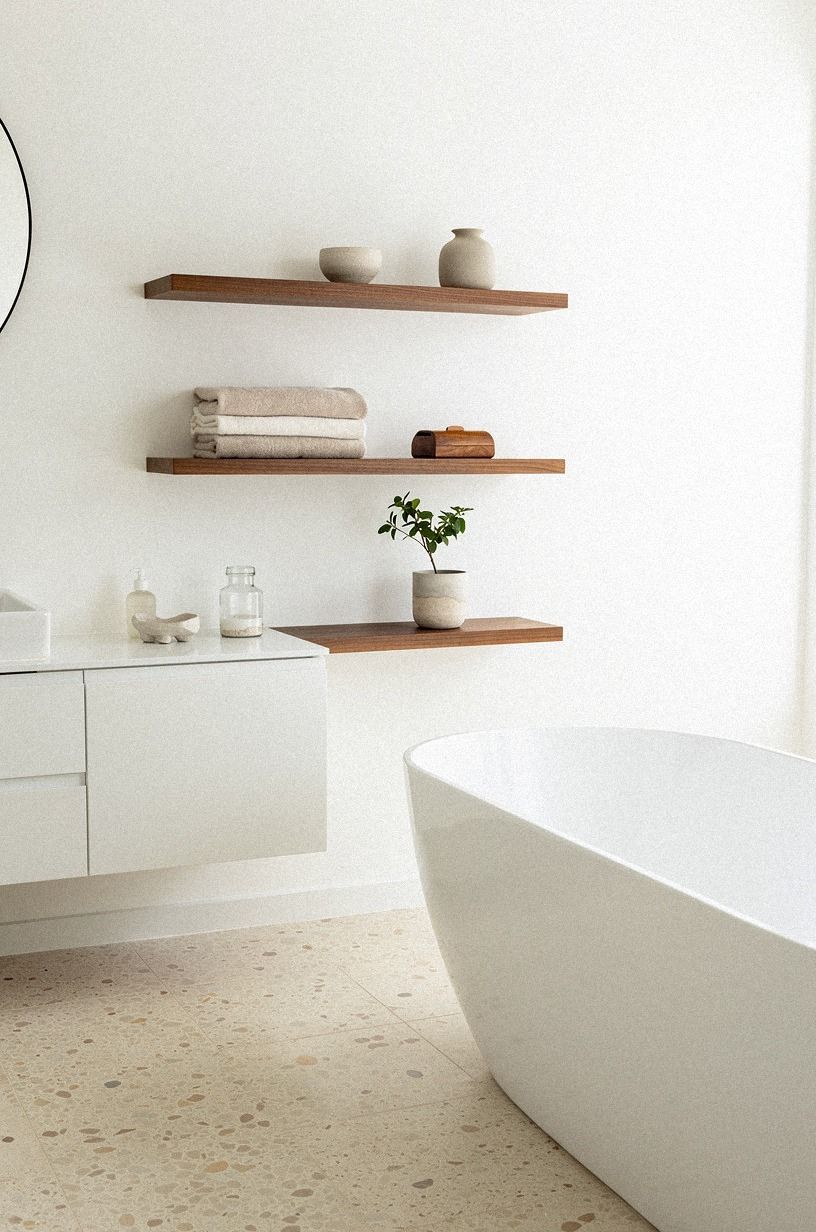
A floating shelf gives your bathroom storage without dropping a bulky cabinet into the walking path.
4Swap Chrome for Unlacquered Brass That Ages Well
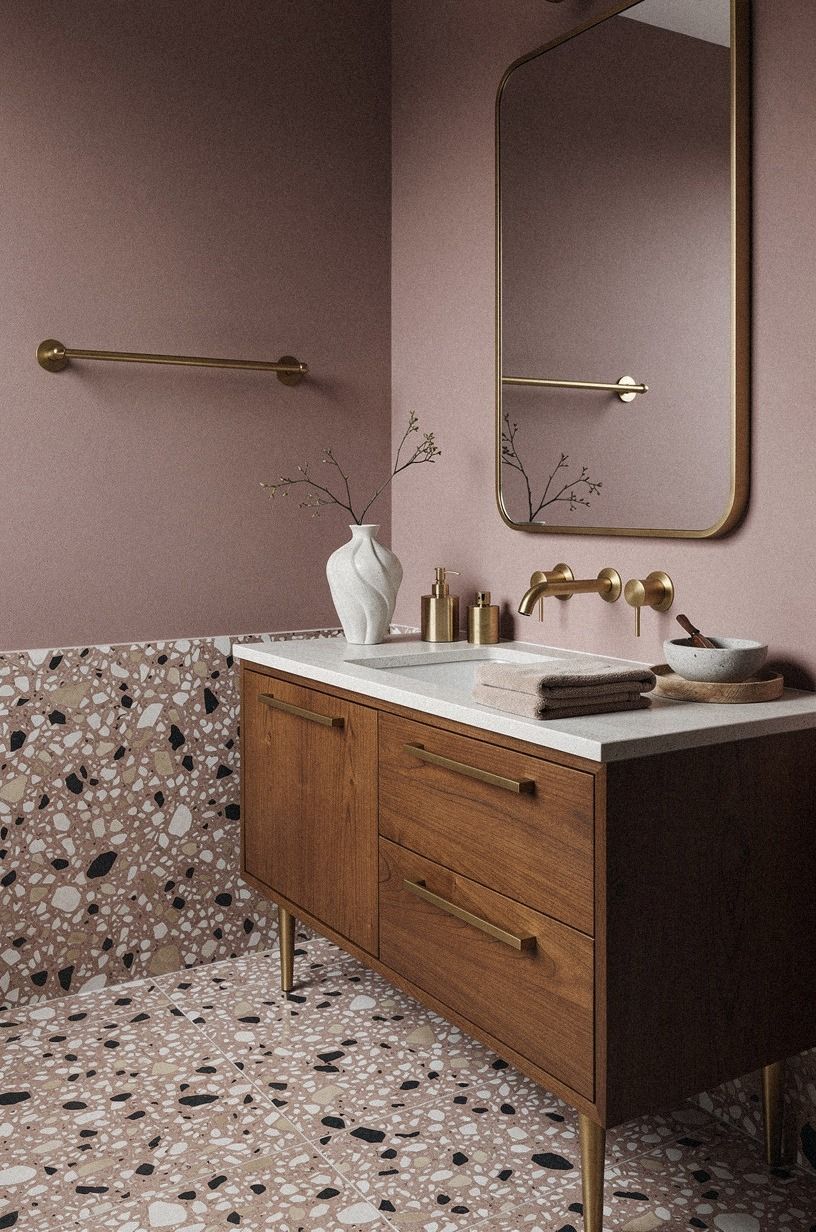
Warm metal changes the temperature of a coastal bathroom faster than another blue accessory. Replace a cold chrome faucet with unlacquered brass, then let the finish develop its soft patina.
You’ll see fingerprints at first, and that’s fine. The small marks make your bathroom feel handled and human rather than sealed inside plastic.
Choose one main metal and repeat it twice. A brass faucet with a brass mirror frame is enough for most rooms.
I’d pass on mixing polished brass, matte black, and chrome in one small space because the fixtures start competing for attention. If you’re renting, a brass-toned cabinet pull is an easier swap than a faucet, and you can store the original hardware in a labeled bag.
The result is subtle but warm, especially beside oversized-chip terrazzo in dusty rose, charcoal, and brass tones.
5Build the Two-Wood Rule for a Bathroom With Personality
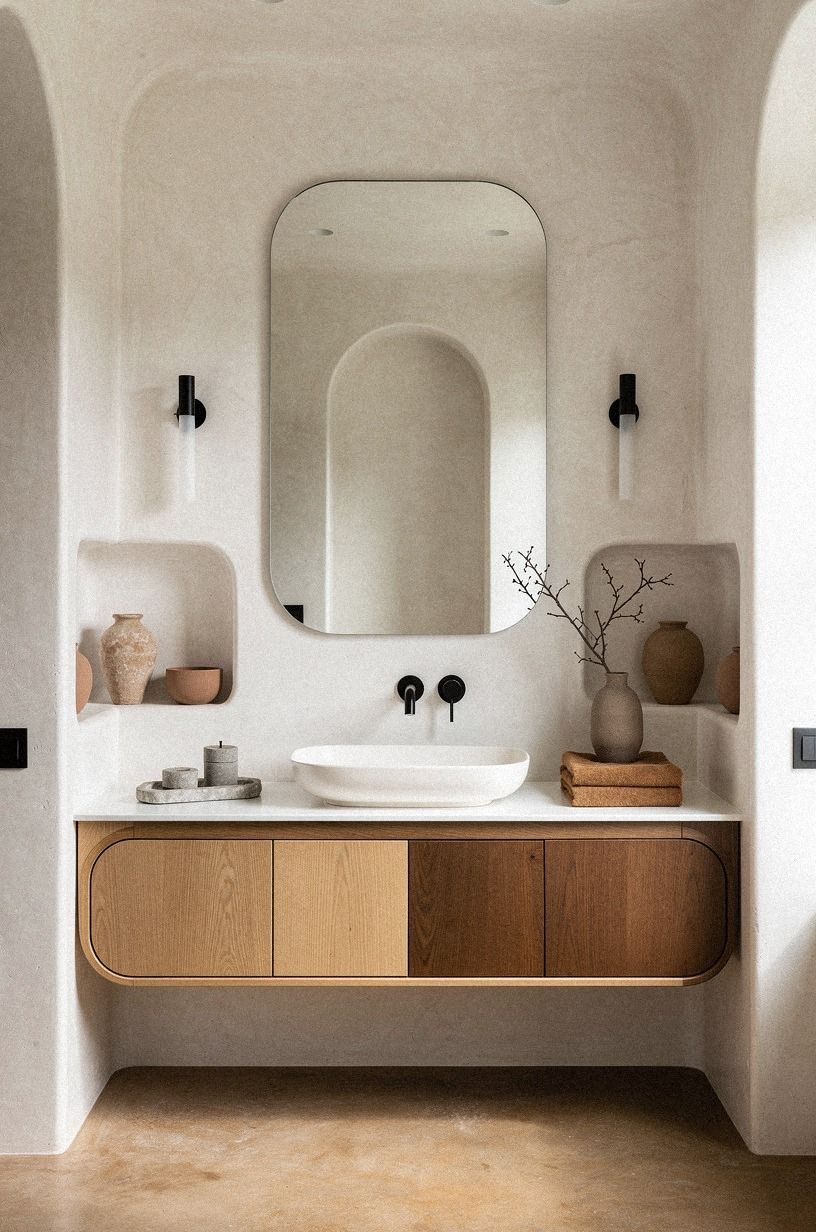
Use two wood tones, not five. The first should be your anchor, such as camel-toned oak against hand-applied Venetian plaster. The second can be lighter, like natural oak on a stool, mirror, or framed print.
That contrast creates the easy, collected look associated with mid-century rooms without making your bathroom feel like a furniture catalog.
Your woods should share either a warm undertone or a visible grain pattern. I’ve found that camel-toned oak and natural oak work better together than red-stained pine, which can turn muddy beside warm white plaster.
Add a woven basket in natural seagrass, but don’t repeat the basket in three sizes. And if you’re working with a tiny floor plan, one stool and one framed wood detail will be enough.
These small mid-century modern bathroom ideas show how much character a small footprint can hold.
6Frame the Mirror With a Rounded Walnut Shape
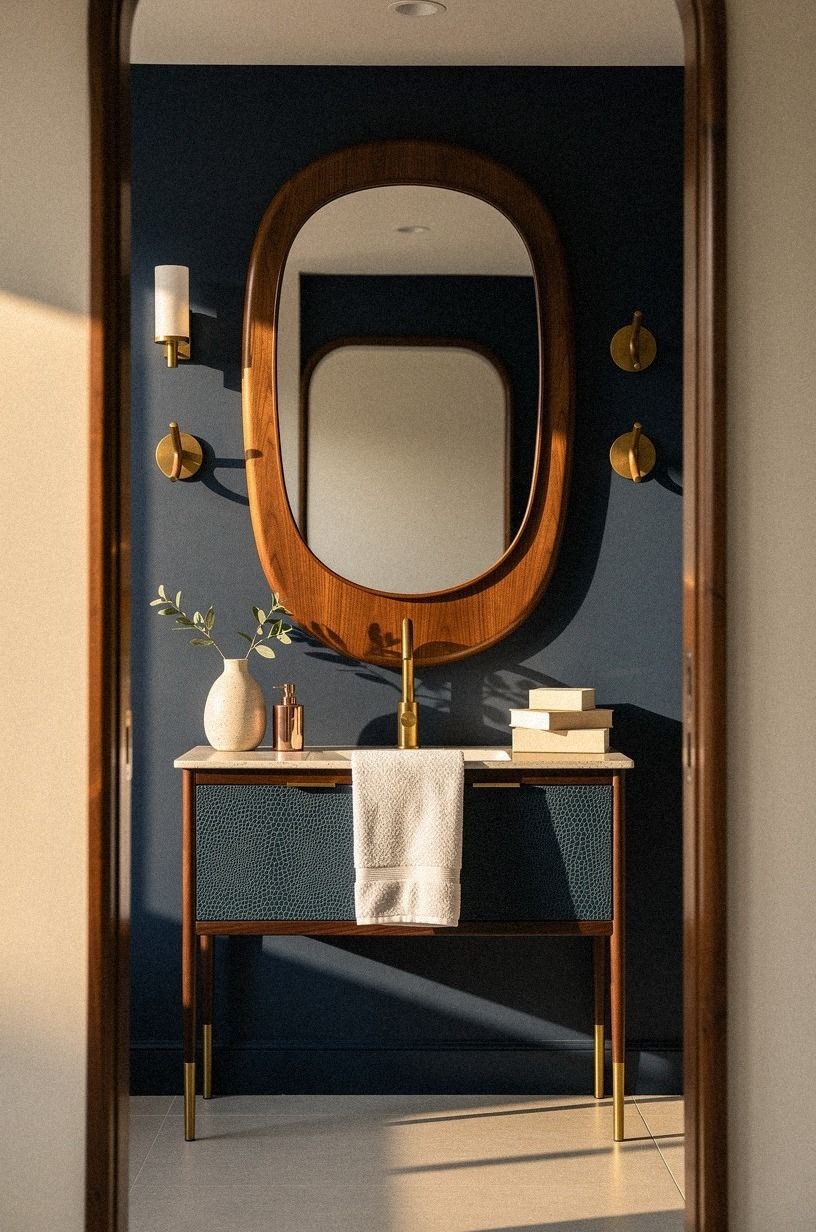
A rounded mirror with subtle shagreen accents softens the straight lines of a vanity, tile grid, and shower enclosure.
7Hang the Three-Height Light Stack
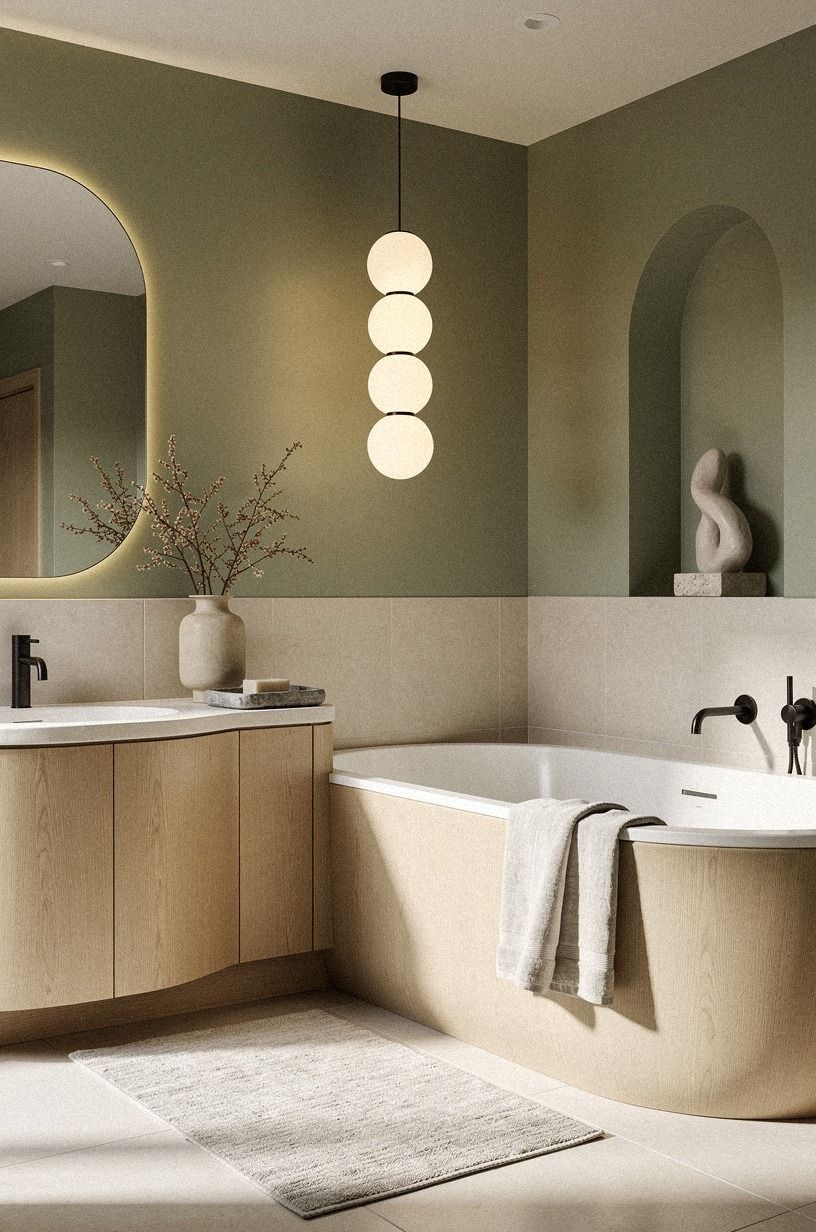
Layer lighting at three heights: ceiling, mirror, and low accent. A globe pendant near the vanity gives you a soft pool of light, while a flush fixture handles the practical work.
Add a small lamp-like night-light or low wall glow if your wiring allows it. Your bathroom will feel more serene when every bulb isn’t aimed straight down.
Use warm bulbs and keep the color temperature consistent. I’d choose a simple opal globe over a dramatic black fixture because the glass spreads light across the wall and flatters the wood.
If you’re replacing a vanity light, measure the mirror first so the fixture doesn’t extend past its edges. The soft glow on washed Belgian linen towels is a small pleasure, but it changes how your whole room feels after dark!
8Choose Zellige Over a Perfect Tile Grid
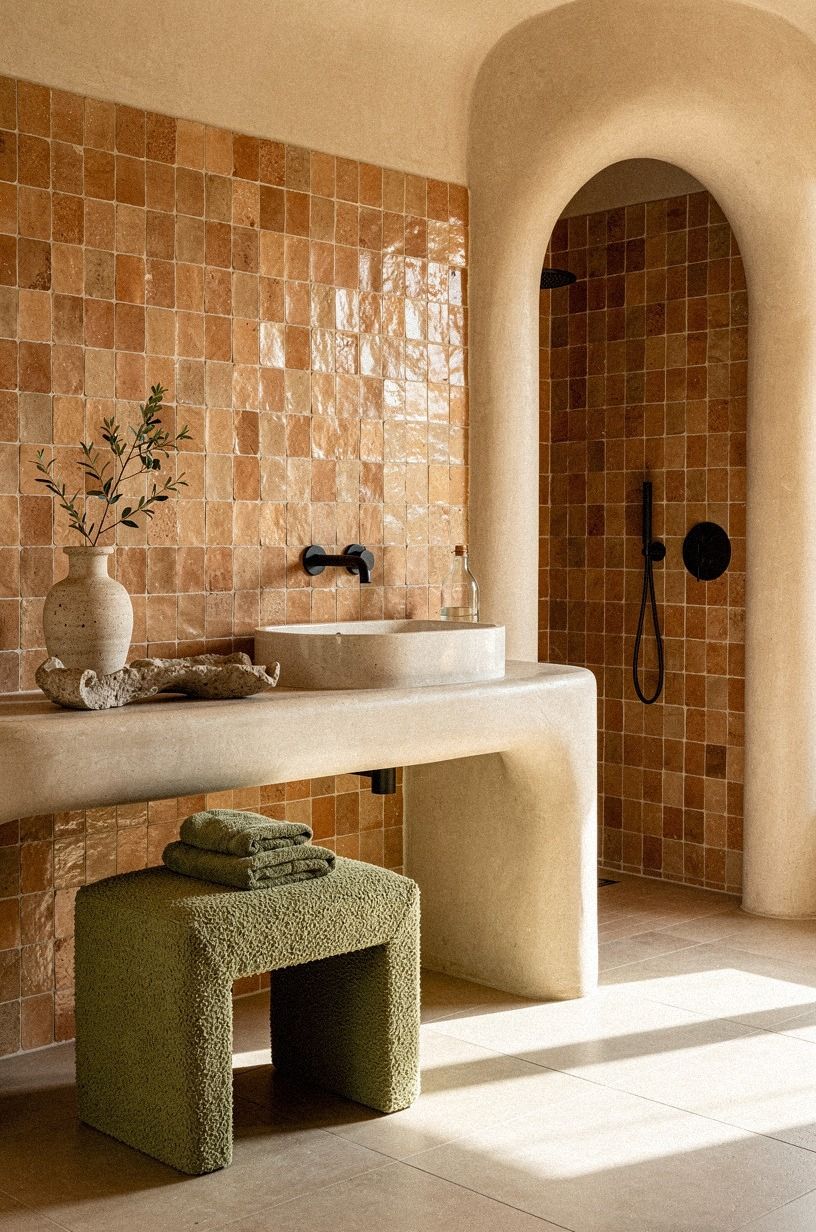
Hand-glazed zellige brings little shifts in color that make a coastal bathroom feel airy without relying on shells or nautical signs. Use hand-glazed terracotta zellige behind the vanity or in a narrow shower band, then let stone grout and olive accents keep the scheme grounded. You’re getting movement from the tile itself, so your accessories can stay quiet.
Zellige can cost $15 to $35 per square foot, which makes a full wall a serious choice. I’d use it on one focused surface instead of spreading it everywhere.
Pair the tile with a simple grout color and a warm vanity so the room doesn’t become visually busy. If you’re choosing between a highly patterned mosaic and handmade tile, I’d pick the zellige.
The slight variation feels more grown-up and less tied to one decorating trend. See these mid-century modern bathroom tile ideas for ways to use tile with restraint.
9Mix Coastal Stripes With Earthy Geometry
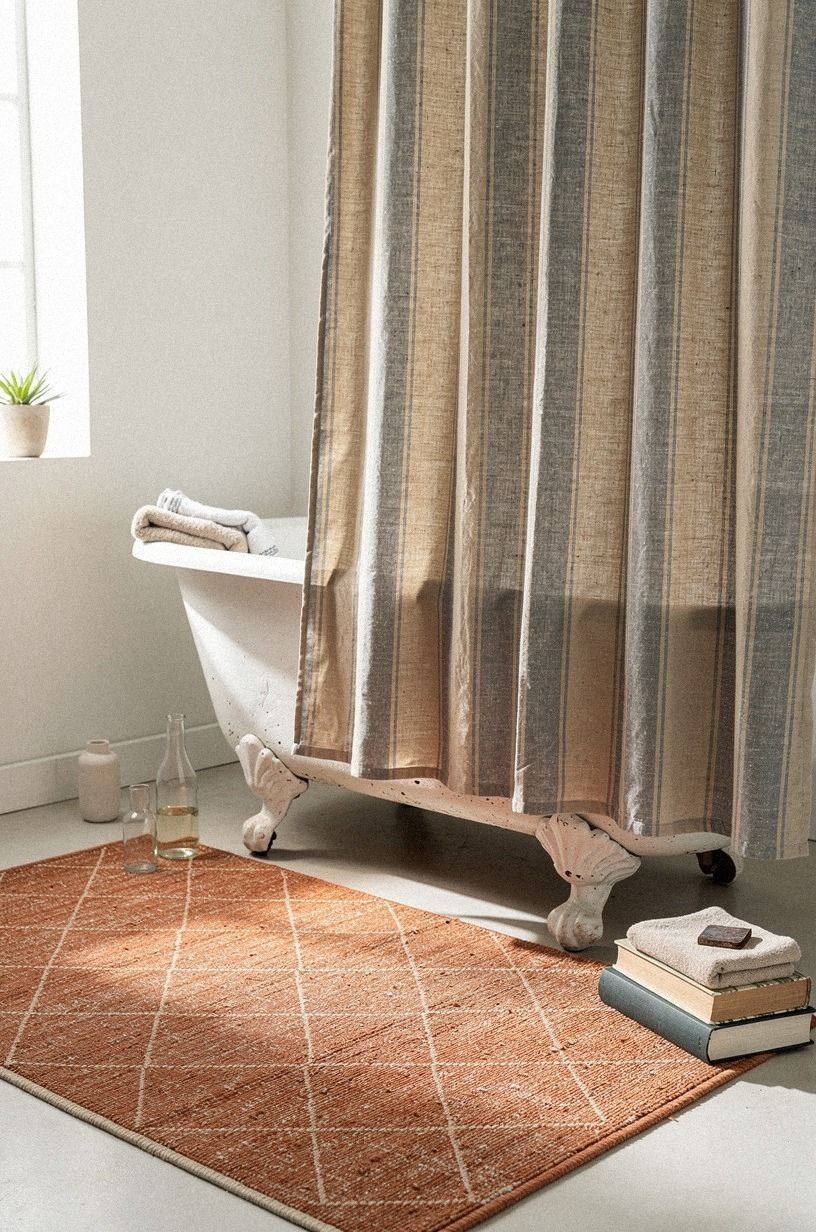
Stripes can bring the coast in, but thin blue-and-white lines alone can make your bathroom feel like a rental near a marina.
10Anchor the Room With a Terrazzo Counter
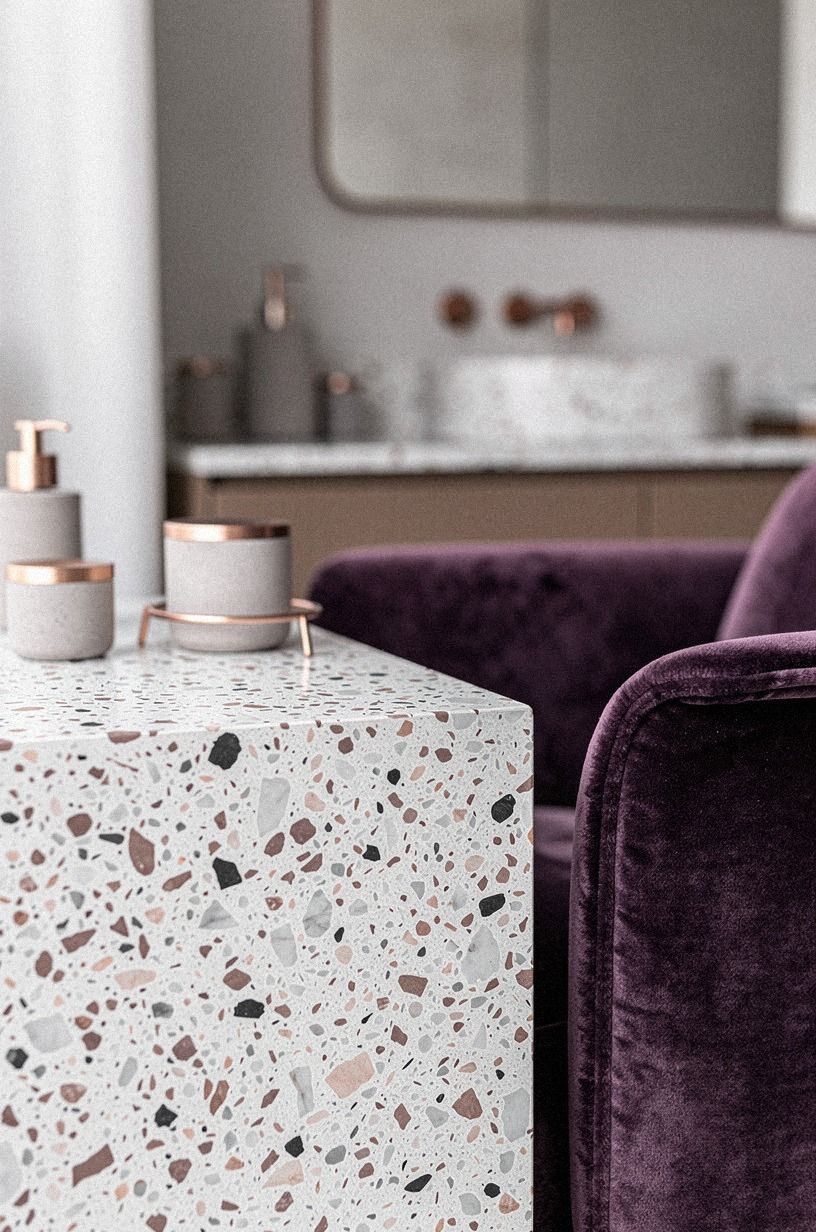
Terrazzo works beautifully with coastal light because its small stone chips echo sand, shell, and pebble without becoming literal. Choose a counter with a plum-toned base and restrained grey flecks, then pair it with rose gold and charcoal. Your vanity will feel substantial, but the surface won’t overpower a compact bathroom.
If a new counter isn’t in your budget, keep your existing top and introduce terrazzo through a tray, soap dish, or small stool. A marble top typically costs $50 to $100 per square foot, so you’ll want to compare the surface cost with the vanity itself.
I’d skip a harsh, high-contrast terrazzo in this scheme. It can make your plum and grey colors look severe, while a softer base keeps the room welcoming.
11Paint One Moody Wall Instead of Everything Dark
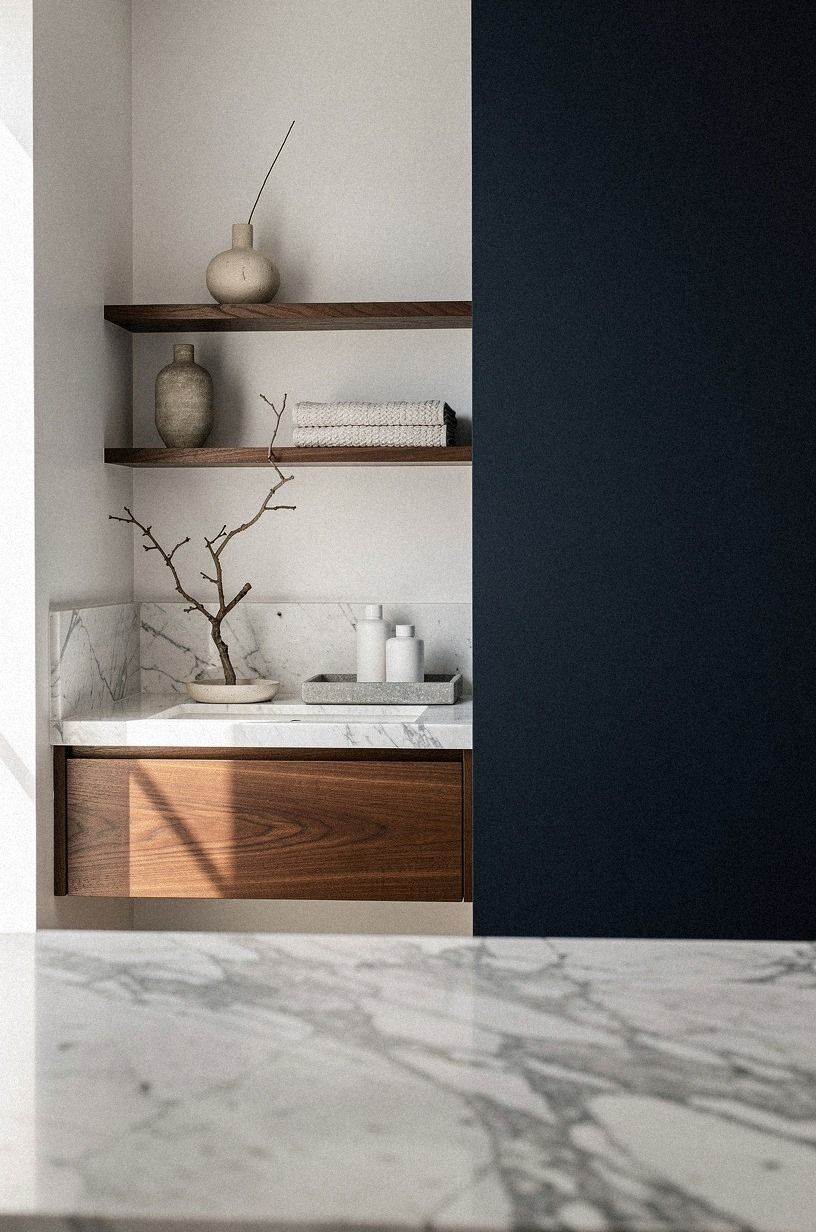
A single wall in Farrow & Ball Hague Blue No.30 can give your bathroom the depth that pale coastal palettes often lack. Pair it with Carrara marble and warm walnut so the navy feels rich rather than heavy.
12Use a Tapered Leg Vanity for a Breezy Retro Feel
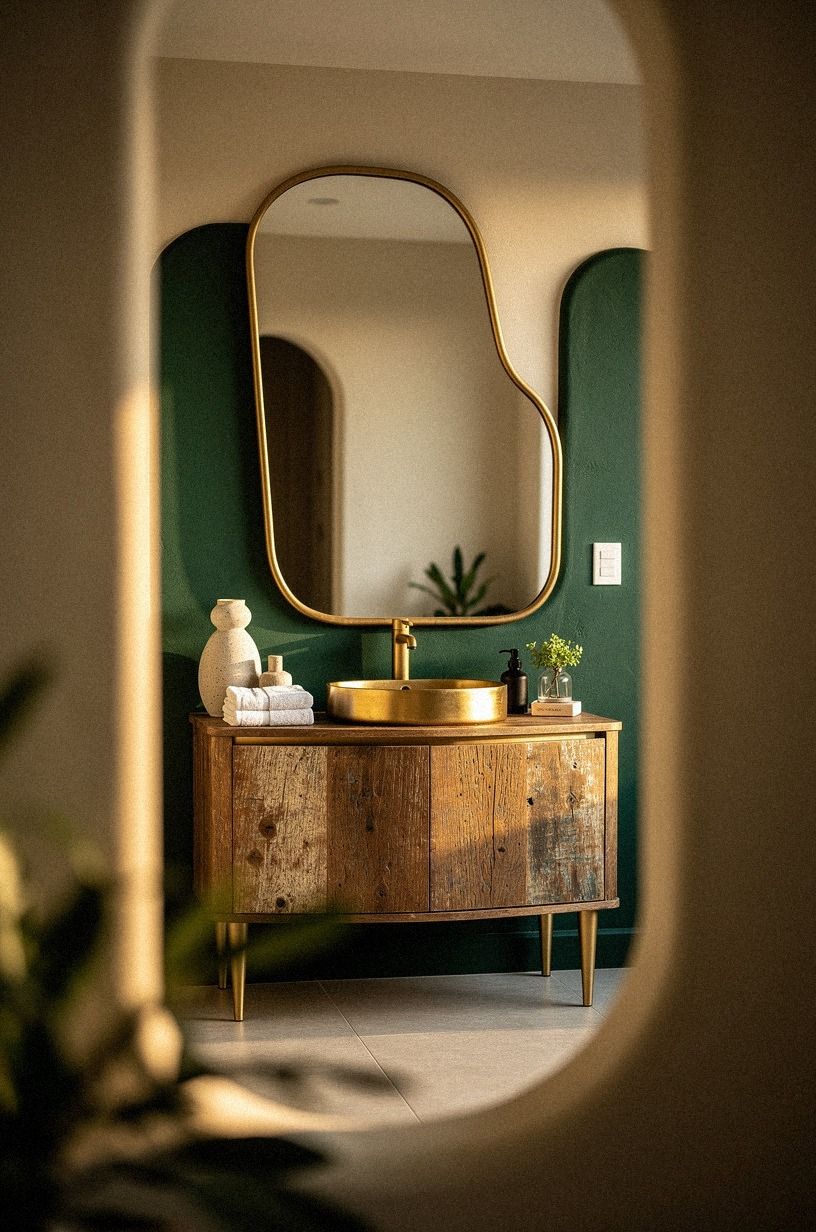
Tapered legs instantly make a vanity look lighter because you can see the floor beneath it. That open strip matters in a small bathroom. Choose a cabinet in reclaimed weathered teak with rounded corners, a recessed toe area, or simple splayed legs, then keep the hardware clean.
An IKEA TONSTAD silhouette can provide the shape, while cream walls and gold pulls keep the room bright.
Your vanity still needs to work hard. Look for drawers that hold toiletries without requiring a deep plastic bin, and check that the plumbing leaves enough room for storage.
A comfortable shower needs 36 by 36 inches at minimum, so don’t sacrifice circulation for a larger cabinet. I’d rather have a 30-inch vanity with clear floor space than a 48-inch box that makes your room hard to use.
The legs should support the room, not announce themselves.
13Style the Vanity With One Sculptural Object
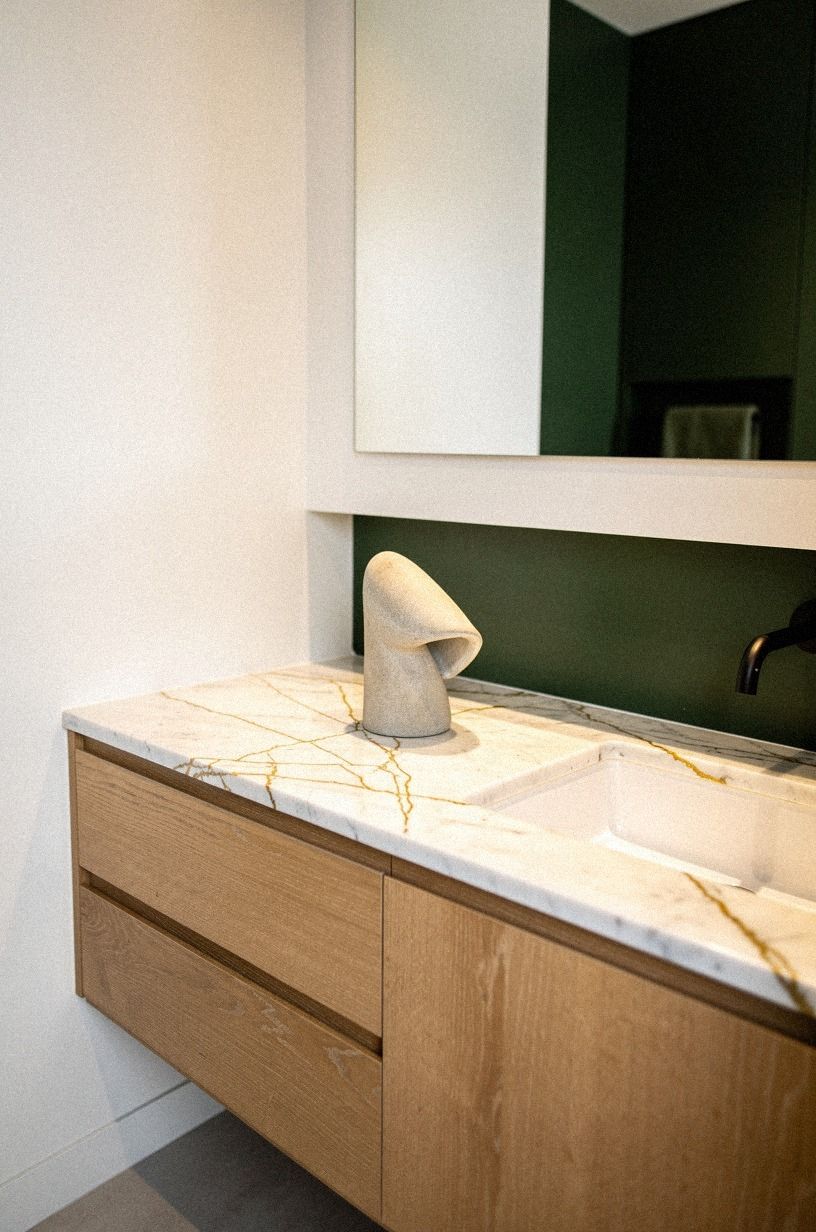
Choose one object with a strong silhouette, such as a white ceramic mushroom lamp, a carved natural-oak bowl, or a low amber vase. Put it beside the sink where you can enjoy it, then leave the rest of the counter available for daily life. Your bathroom should look ready to use, not frozen in place.
A small object works best when it has a different surface from the vanity. Smooth ceramic against Calacatta marble with gold veining feels crisp, while natural oak against zellige feels more organic.
I’d avoid filling the counter with shells, coral, and blue glass together. That combination says theme before it says personality.
If you’re styling for guests, add a folded 600gsm Turkish cotton hand towel and one plant clipping in a narrow vessel. Simple, useful, warm!
14Compare What to Spend Before You Tile
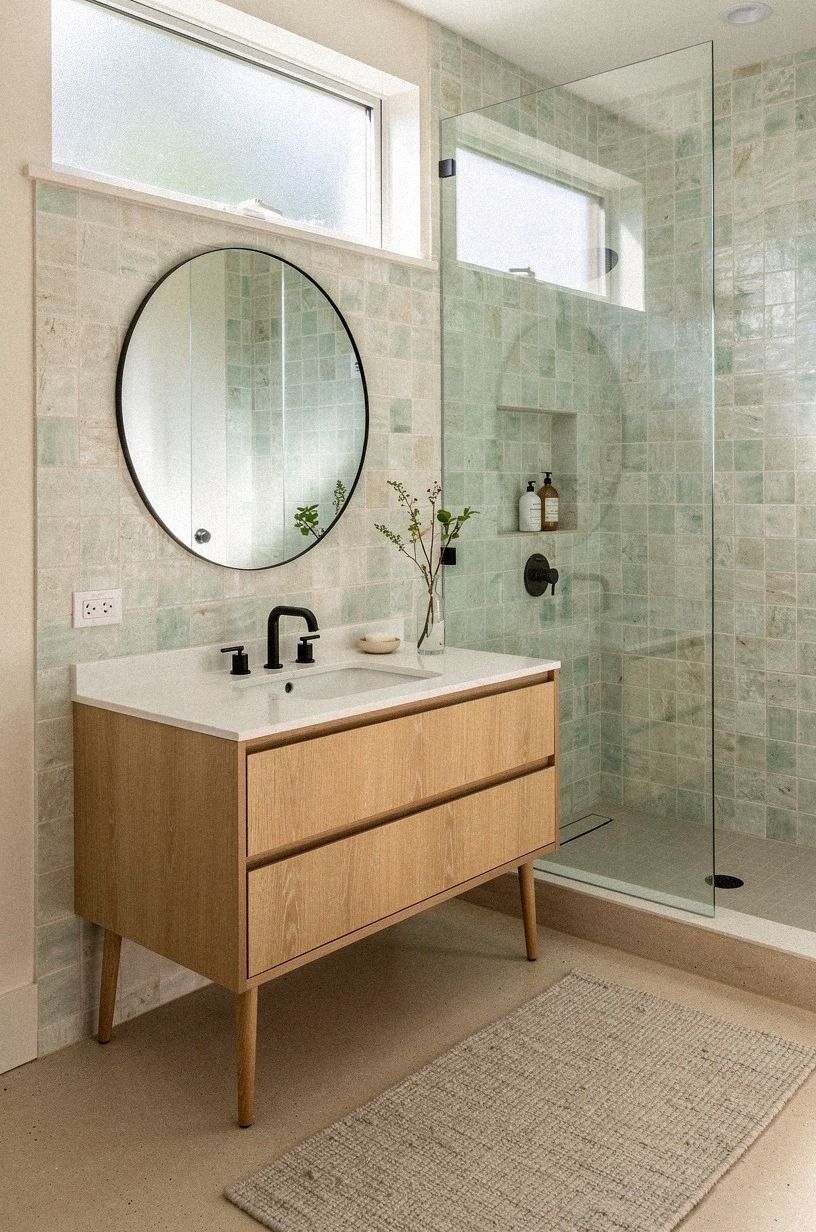
Your budget should follow the part of the bathroom that stays with you every day. Paint, a mirror, a faucet, and textiles can refresh the room for the budget tier, while a new vanity and partial tile move you into a larger project. The figures below are typical US ranges, so use them as planning markers rather than a promise.
If you’re spending under $500, put your money toward the surface you see first: paint, mirror, or lighting. A dusty rose paint can brighten a dark room, but don’t use it automatically if your tile is cool grey or blue.
I’d skip expensive floor tile before fixing bad lighting. You’ll notice the shadow at the mirror every morning, while the floor often fades into the background.
15Arrange a Calm Coastal Gallery Wall
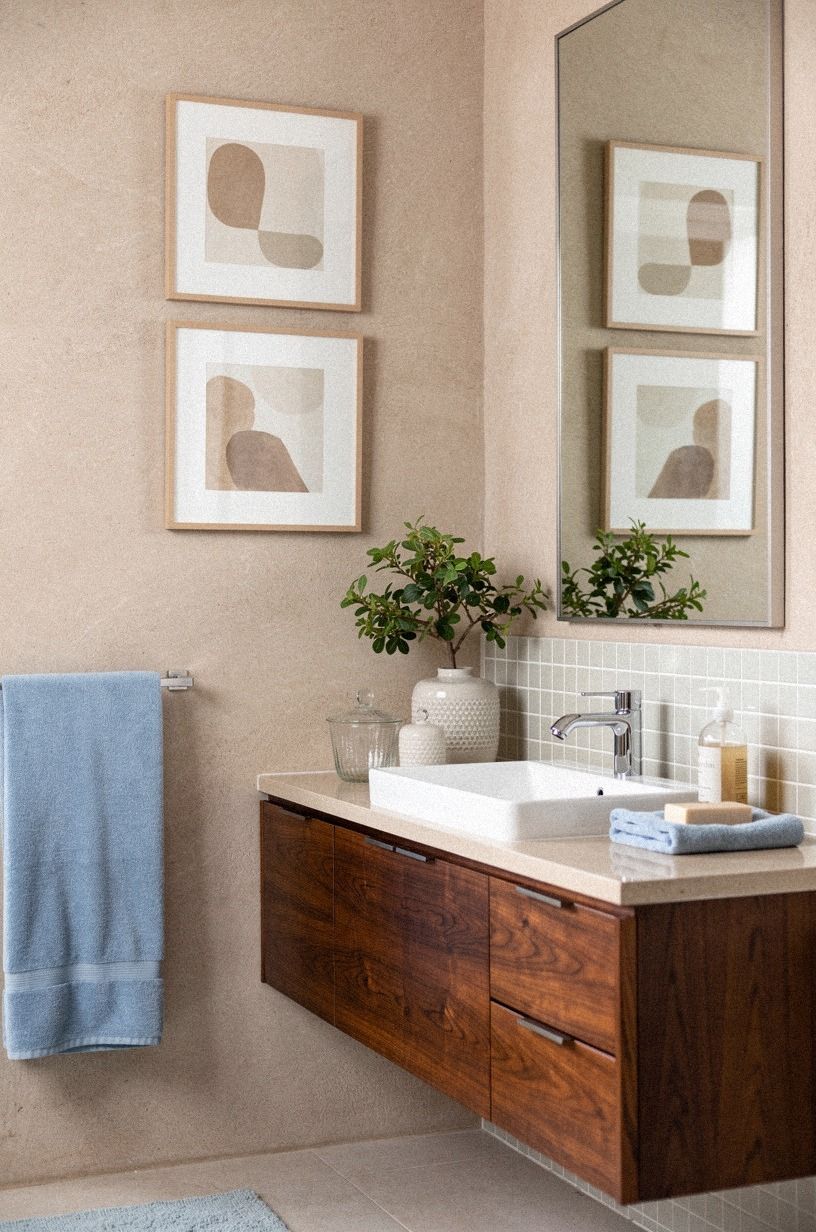
A small gallery wall gives your bathroom a collected feeling without adding visual weight. Mix a vintage beach print, a simple abstract print, one line drawing, and a small backlit translucent onyx accent in black, camel, or warm white frames. Your arrangement should feel slightly irregular, with the largest piece near eye level and the smaller pieces stepping outward.
Protect paper from steam with acrylic glazing and keep the frames away from direct water. I’d choose warm white, camel, and black rather than a wall of ocean images.
One shell print is enough. If you’re working above a toilet, leave practical clearance so you can open the tank lid without bumping the frame.
The best gallery walls look like your taste wandered into the bathroom over time, not like you ordered a matching set yesterday.
16Keep a Warm White Base Over Nautical Blue
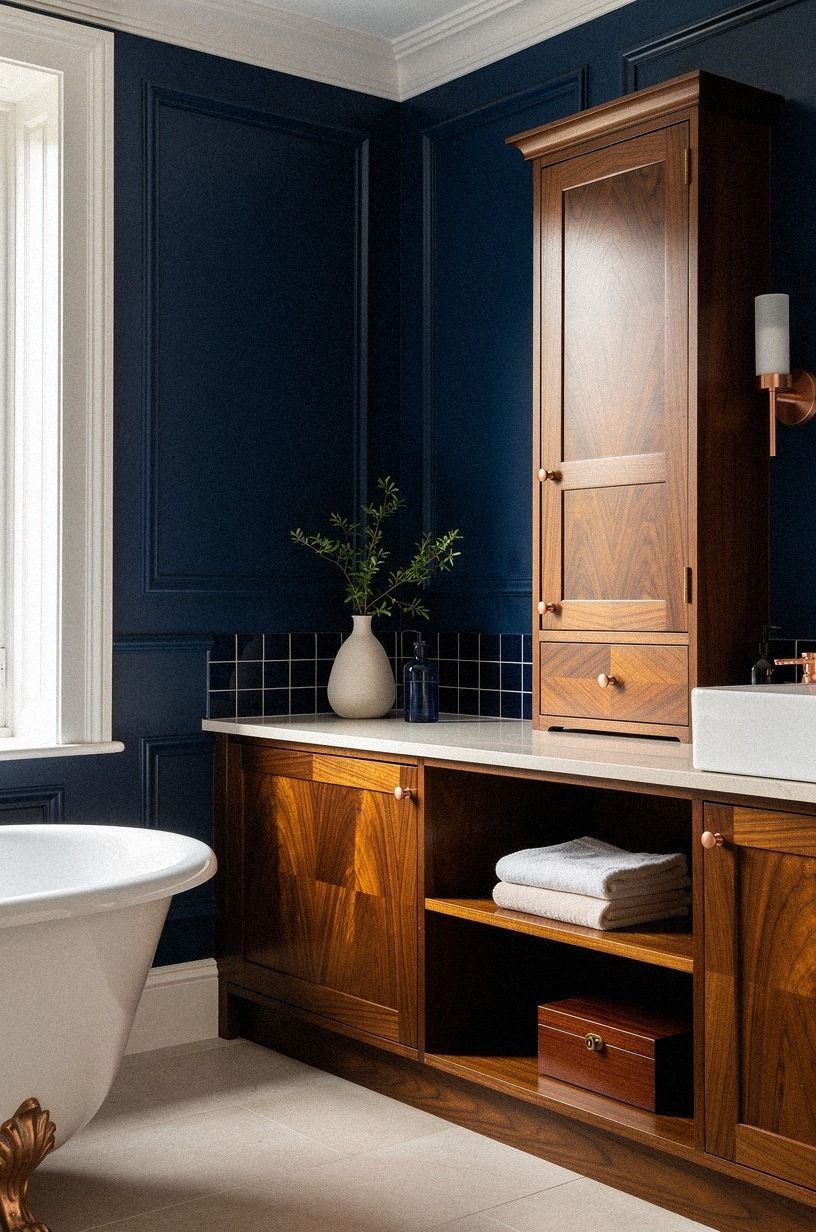
A warm ivory base is often the stronger choice when your bathroom has limited daylight. Add midnight blue, copper hardware, and book-matched walnut for contrast without making the room feel cold.
17Add Plants That Can Handle the Steam
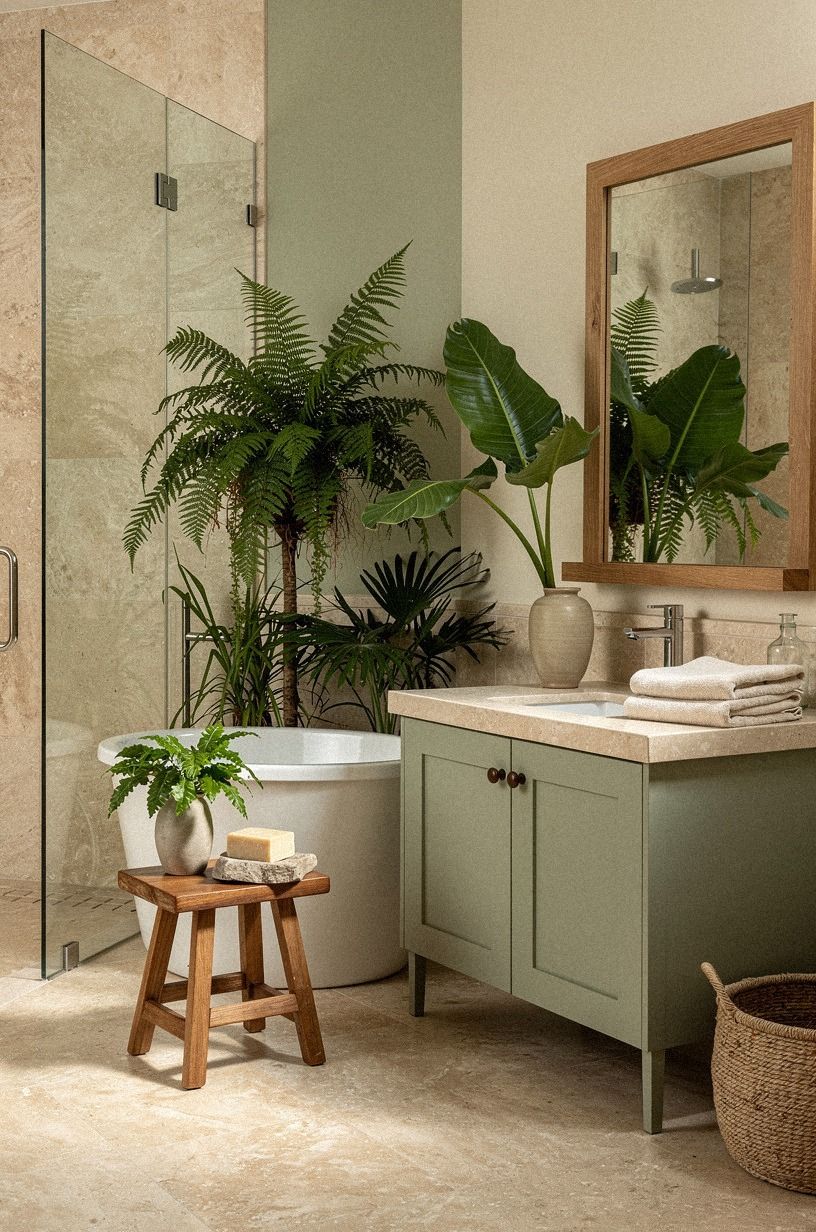
Plants bring the organic side of coastal mid-century design into a bathroom, but choose varieties that suit the light you have. A snake plant, pothos, or small fern can handle many bathroom conditions, while a dry, dark room may need a realistic faux stem. Your plant should have a visible shape, not disappear behind the faucet.
Use a warm travertine planter or a simple natural wood pot to connect the greenery with the rest of the room. Keep leaves clear of the mirror and away from wet electrical areas. I’d rather see one healthy plant than six struggling ones on every shelf.
If you’re styling a guest bath, place a small fern on a stool or floating shelf and leave the floor open. The room will feel softer without becoming crowded. A little green goes a long way!
Why This Look Still Feels Fresh
Coastal and mid-century design work together because both value light, clean lines, and materials that show their character. The mistake is treating coastal style as a collection of objects.
I don’t want a bathroom full of anchors, driftwood signs, or matching seashells. I want the room to suggest the coast through color, reflected light, and a few surfaces that feel good under your hand.
The mid-century layer adds the discipline. Tapered legs, rounded mirrors, walnut, and brass keep the pale palette from floating away.
Your bathroom needs that grounding, especially if the walls are soft blue or sandy white. I’ve learned that one dark note often does more than ten decorative pieces.
A deep blue wall, an aged brass faucet, or a walnut frame can give the room its spine.
The best version also respects how you use the space. A 21-inch toilet clearance in front keeps the room comfortable, and a vanity between 32 and 36 inches high keeps the sink practical.
Those details won’t show up in a mood board, but you’ll feel them every day. Why sacrifice comfort for appearance?
I’d also leave room for imperfection. Handmade tile varies.
Brass marks. Wood has knots.
Your bathroom will feel warmer when the materials can age instead of demanding constant correction. That’s where the breezy part comes from, not from adding more pale accessories. The room should look calm because the decisions are clear, not because everything is bland.
The Questions I Get Asked Most
What is the best Coastal Mid-Century Bathroom Ideas for a Breezy Retro Feel for a small bathroom?
A rounded walnut mirror and a tapered-leg vanity are the strongest picks for a small room because they open the sightline and add warmth. An IKEA HEMNES cabinet can give you useful storage without a heavy profile. Keep one wall light and use brass for a small, welcoming glow.
Where can I buy Coastal Mid-Century Bathroom Ideas for a Breezy Retro Feel pieces on a budget?
Look at IKEA, Target, and Wayfair for vanities, mirrors, and textiles, then check Facebook Marketplace or local thrift shops for wood stools and framed art. Your best low-cost finds may need new pulls or a fresh finish. These mid-century modern guest bathroom ideas can help you shop with a clearer plan.
How much does a Coastal Mid-Century Bathroom Ideas for a Breezy Retro Feel makeover cost?
A light refresh typically falls around $200 to $1,200 for paint, a mirror, a faucet, and textiles. New vanities, lighting, and partial tile can move the project to $3,000 to $9,000. You can spend nothing on styling by rearranging what you own first.
Can I create a Coastal Mid-Century Bathroom Ideas for a Breezy Retro Feel on a budget?
Yes, and you can start with three low-cost changes: repaint one wall, replace the cabinet pulls, and add one warm textile. A secondhand walnut stool or framed print can bring more character than a full matching accessory set. Your room needs editing before it needs more purchases.
Is a Coastal Mid-Century Bathroom Ideas for a Breezy Retro Feel worth it in a small space?
Yes, because a small room benefits from the style’s tapered furniture, rounded shapes, and limited palette. Choose a 30-inch vanity, keep at least 21 inches in front of the toilet, and use one mirror that reflects light. Your room will feel more open when the floor remains visible.
Is a Coastal Mid-Century Bathroom Ideas for a Breezy Retro Feel a good idea for a rental?
Yes. Use removable wallpaper on one dry wall, a tension rod for textiles, peel-and-stick hooks, and cabinet pulls that can be swapped back later. Your landlord-approved changes can still include a rounded mirror, woven basket, and warm towels without permanent work.
Where I’d Start First
If I had to pick one, I’d start with the rounded walnut mirror. It softens hard tile, reflects daylight, and makes basic fixtures feel intentional. Pin this idea for later and compare it with our mid-century modern master bathroom guide before you buy anything.