
Yes, you can make an organic mid-century modern bathroom feel warm and natural without moving plumbing, replacing tile, or opening a wall. I started with a cold rental bathroom, a harsh ceiling fixture, and one sad towel bar. I kept the shell, changed the layers, and got a soft modern bathroom that finally felt like mine.
Here’s what it looked like before
The before photo tells the story better than I can. White walls, glossy chrome, a builder-grade mirror, and a vanity with no visual weight made the room feel bright but strangely chilly. Every surface reflected the ceiling light, so your face looked gray at night and the floor felt harder than it was.
I wasn’t willing to renovate. You might be in the same position, especially if you’re renting or saving for a larger project.
The tub stayed, the toilet stayed, and the plumbing stayed. My job was to give your eye somewhere warmer to land, starting with color, wood, and light.
If your bathroom has the same problem, these small mid-century modern bathroom ideas for big style are a useful place to begin.
Warmth versus renovation
The best decision was treating the bathroom as a layering problem instead of a construction problem. I didn’t need new tile to make it feel considered. I needed fewer competing reflections, warmer materials, and a reason for each visible object to be there.
That distinction matters if you can’t change the shell. A cosmetic refresh can still feel substantial when the biggest visual surfaces work together. The room didn’t become larger, but it became calmer, which was the change I wanted.
A warm bathroom can borrow ideas from an organic modern travertine bathroom with warm stone and wood without copying the entire look.
The palette I kept
I limited the palette to warm cream, walnut, pale oak, muted olive, and aged brass. That gave the room an organic direction without turning it into a themed cabin. The muted olive appeared only in the runner and plant pot, so it felt like a thread rather than a declaration.
I also kept the metals quiet. Bright chrome remained where I couldn’t replace it, but I stopped adding more shine. Aged brass gave the room a softer point of contrast and worked better with the wood than polished gold would have.
For a darker interpretation of the same principle, these dark moody mid-century modern bathroom ideas show how restraint can make strong colors feel livable.
- Paint for the soft modern bathroom effect
- Build the Two-Wood Rule with restraint
- Choose wood over another white cabinet
- How can layered light soften the room?
- Frame the mirror with the Mirror Halo Rule
- Why do earthy textiles change the mood?
- Mix mid-century materials around one focal point
- Which plant earns the counter space?
- Swap clutter for the Quiet Vanity Test
- Paint the ceiling before adding more decor
- Let the floor carry the green and wood home style
1Paint for the soft modern bathroom effect
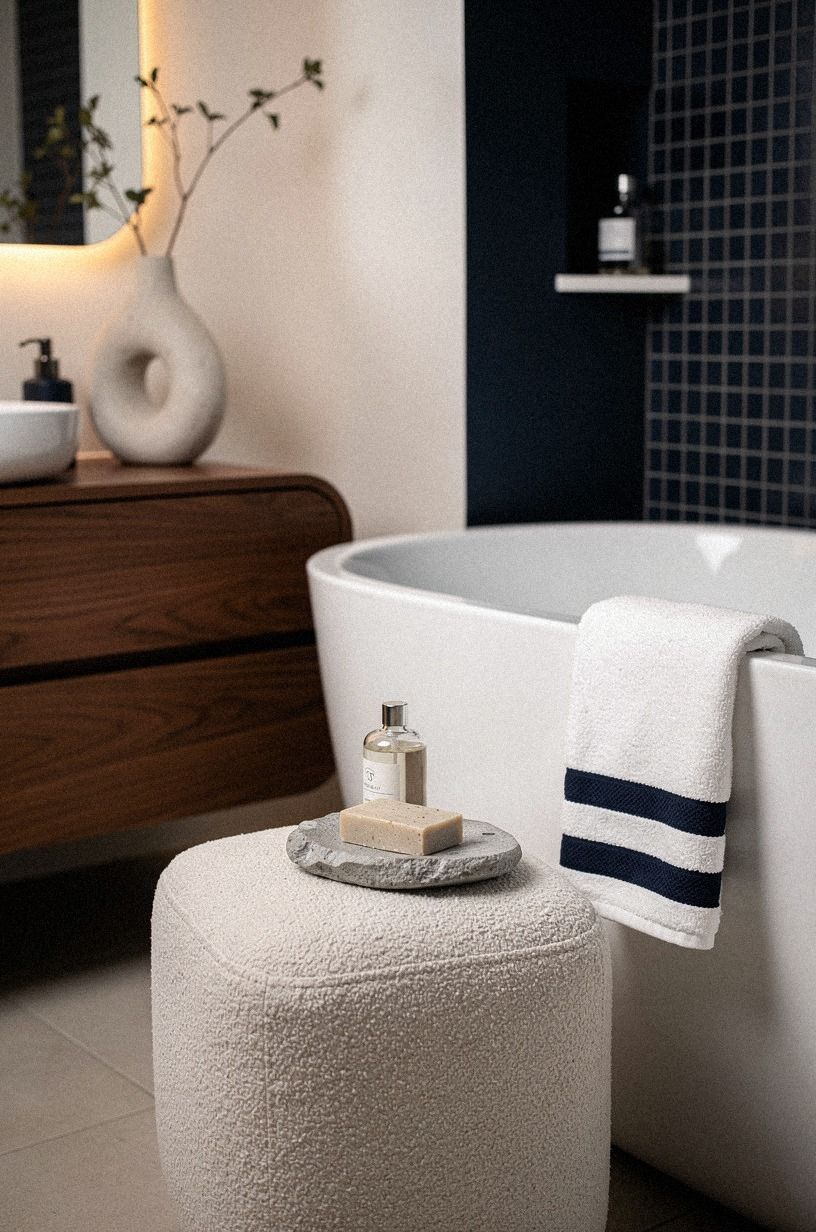
I began with Farrow & Ball Hague Blue No.30 because the bathroom needed depth without feeling cold. The navy tone made the existing white tile look cleaner and gave the walnut details more weight. A small organic bouclé mat softened the darker color and kept the room from feeling severe.
The decision was simple: paint the walls and leave the trim white. I don’t love painting every surface in a small bathroom because it can flatten the edges.
Your eye needs one crisp break, and white trim gives the room a quiet frame. If you’re working with very little money, this is the move that changes the mood fastest.
A gallon of paint can shift the whole room before you’ve bought a single accessory.
I also kept the finish practical. A washable eggshell finish made sense near the sink, while the ceiling stayed matte. You won’t need a dramatic color if your towels, mirror, and wood tones are doing their share.
For another small-space direction, compare these small mid-century modern bathroom ideas for big style.
The paint worked because it gave the white tile and walnut something calmer to sit against. When I walked in at night, the walls stopped bouncing the fixture’s blue-white glare around the room. That was the first real win.
2Build the Two-Wood Rule with restraint
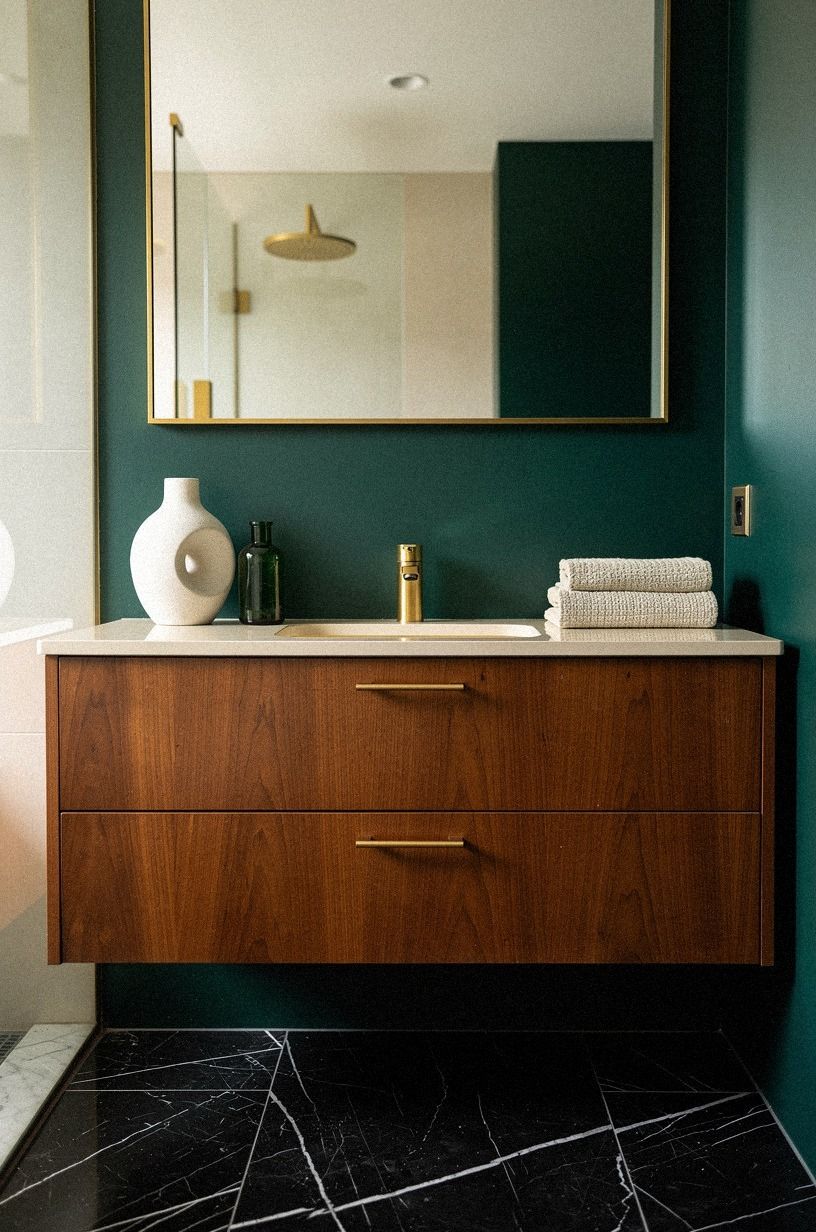
My first instinct was to add wood everywhere. That would’ve been a mistake. Instead, I kept the palette to emerald, cream, and restrained gold, then used Nero Marquina black marble with white veins as the anchor.
The Two-Wood Rule became an editing exercise rather than a reason to add more timber. The marble carried enough visual weight on its own, while the emerald and cream kept the room from feeling too dark. Gold appeared in small touches, not across every fixture.
And I skipped matching gold accessories. Repeating every finish would’ve made the room feel staged.
Your bathroom needs a little friction between finishes, but not visual noise. If you’re unsure where to begin, this guide to an organic modern travertine bathroom with warm stone and wood helped me see how much texture can come from a restrained palette.
The rule also kept me from buying impulsively. Before bringing in a new basket or stool, I asked whether it supported the emerald, cream, gold, or Nero Marquina marble. If it was none of those, it had to earn its place through function.
3Choose wood over another white cabinet
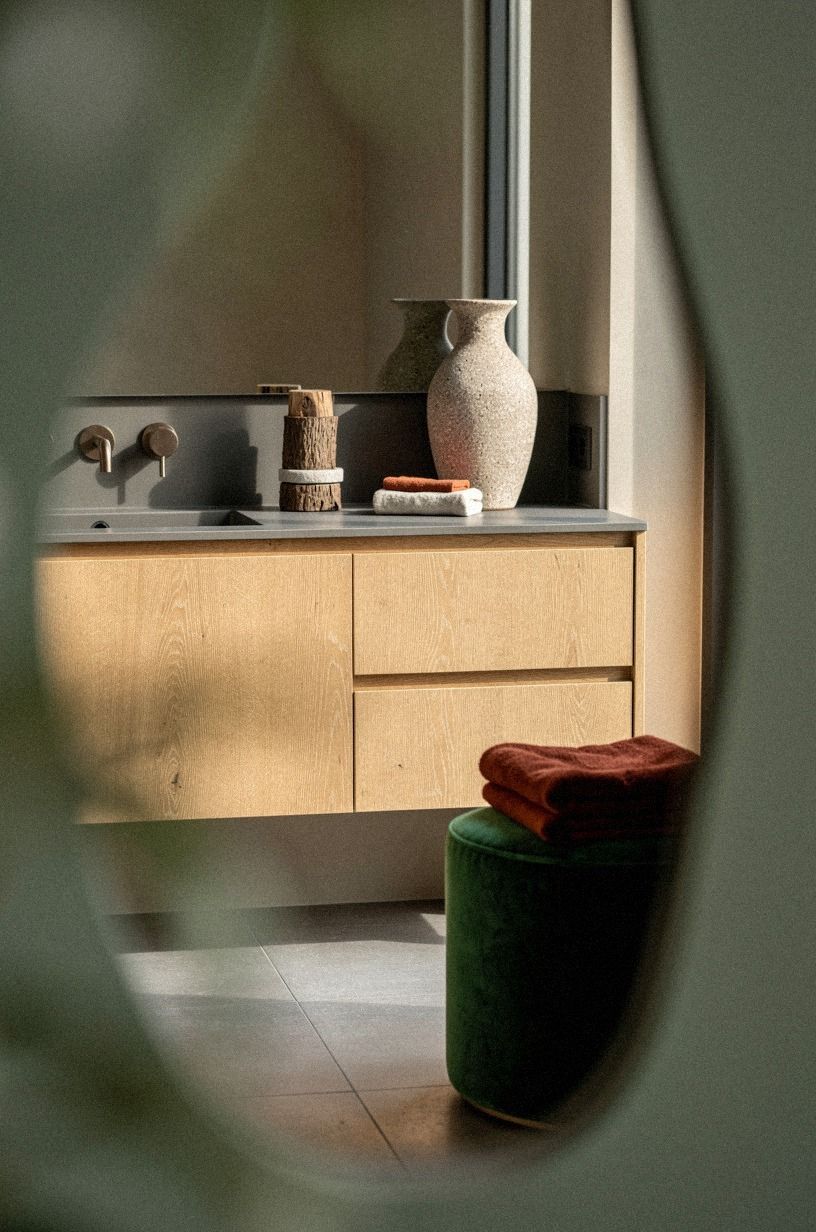
The vanity was the largest flat surface in the room, so I stopped treating it like background. I chose a modern bathroom with natural oak vanity styling instead of adding another white storage unit.
The cabinet didn’t need to be expensive or custom. It needed visible grain, simple legs, and enough clearance to keep your floor from feeling crowded.
I went back and forth between a dark finish and natural oak. Natural oak won because it kept the forest green and rust accents from becoming heavy.
A deep-pile mohair velvet stool added softness without introducing another hard surface. Your room may need the opposite, but one honest wood tone usually does more than several decorative finishes.
The practical detail mattered too. I kept the vanity height within the standard 32 to 36 inches, so your sink would feel comfortable rather than low and furniture-like.
Don’t chase a tiny cabinet if it leaves your toiletries scattered everywhere. A warm room still needs a place for toothpaste.
For a more polished reference, compare your layout with these mid-century modern master bathroom ideas for a retro-luxe feel. The best option isn’t always the prettiest one. It’s the one that lets you keep the counter clear.
I also measured the door swing before choosing the cabinet. A beautiful vanity that blocks the door or narrows the walking path isn’t a solution. Clearance became part of the design, not an afterthought.
4How can layered light soften the room?
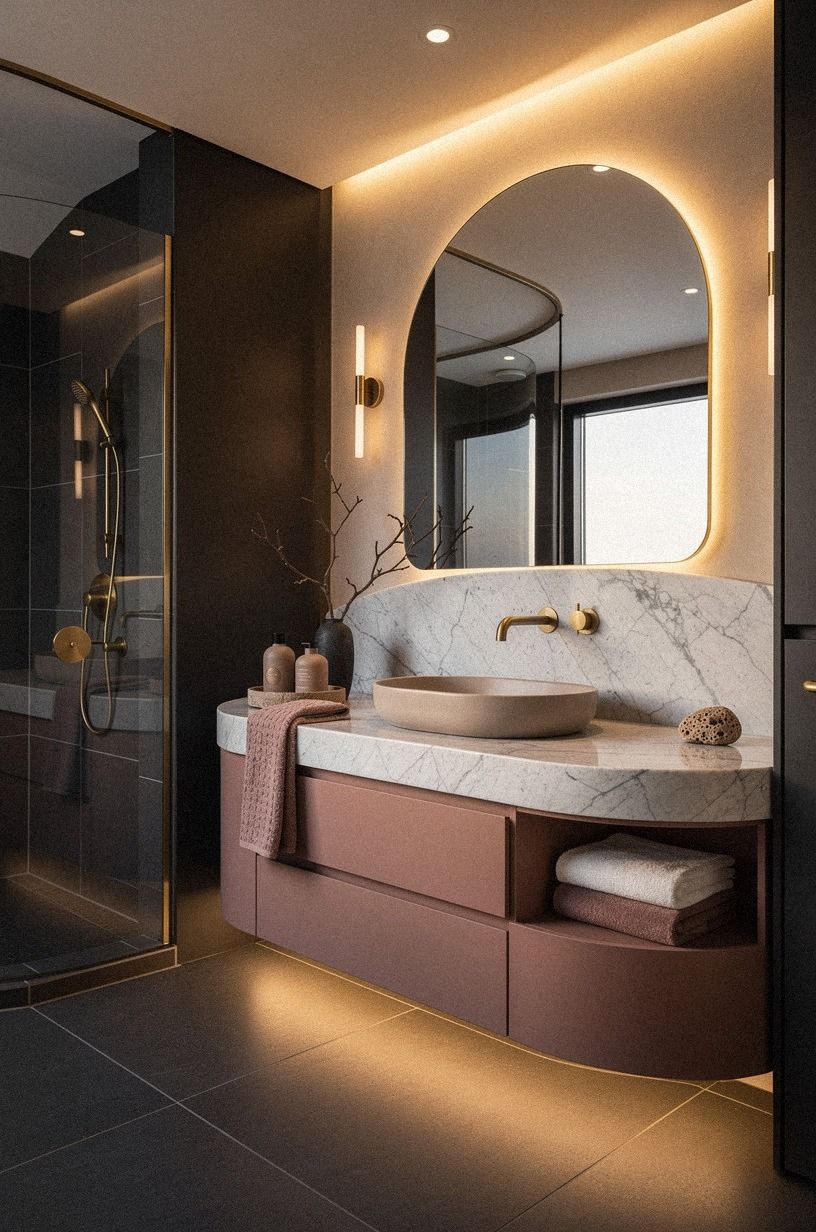
The ceiling fixture was the least inviting thing in the room.
5Frame the mirror with the Mirror Halo Rule
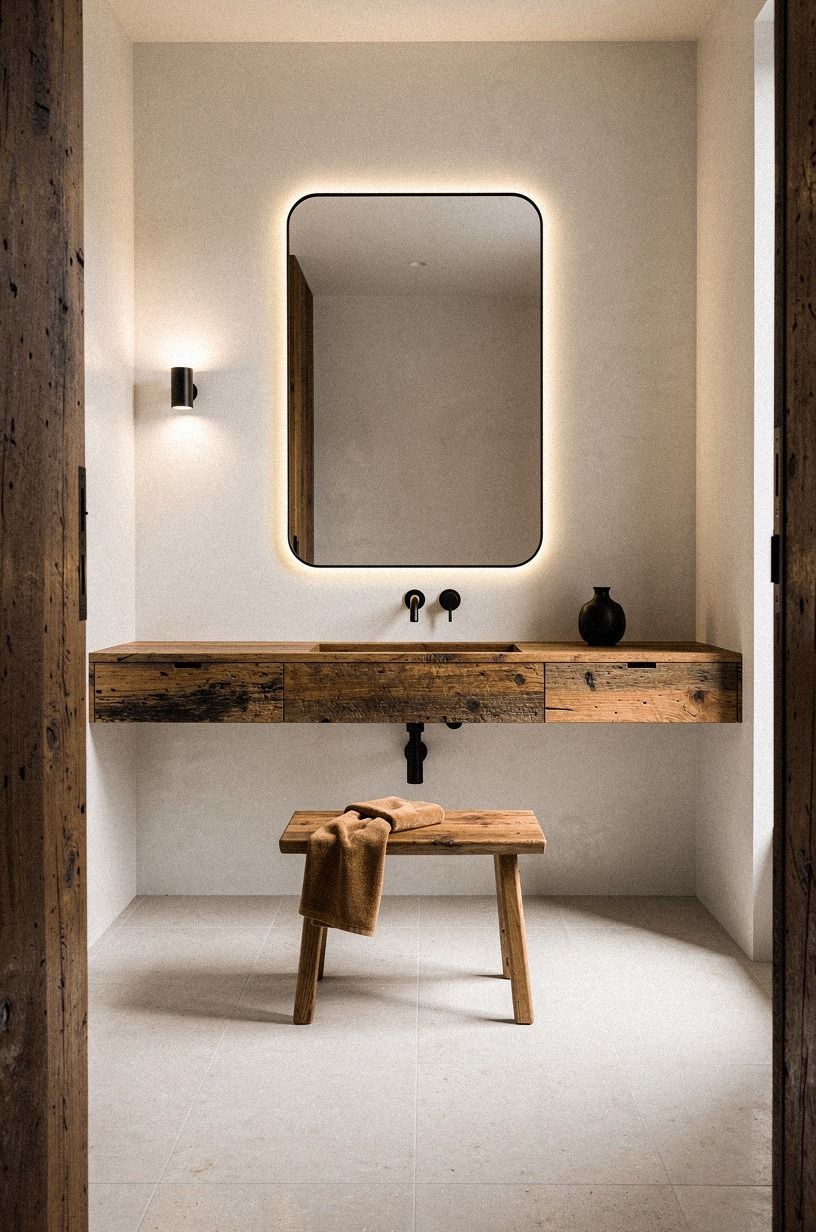
The original mirror was a wide rectangle with a thin chrome edge. It worked, but it had no personality. I kept the size and added a reclaimed weathered teak mirror frame, which made the sink wall feel finished without requiring a new medicine cabinet.
The Mirror Halo Rule is simple: let the frame repeat one material from below, then give the mirror enough breathing room around it. Your frame doesn’t need to be thick. Even a slim weathered teak edge can connect a vanity, tray, and stool when the same texture appears in three places.
I avoided a round mirror because the room already had a curved faucet and a soft-edge light. Too many curves would’ve made the mid-century influence feel decorative instead of structural. You can use a round mirror if your vanity is angular, but choose one strong curve, not five competing ones.
The right frame made my small bathroom feel intentional, not busy. It also gave the eye a strong stopping point, which mattered more than adding another decorative object.
If your room is tighter, study these mid-century modern bathroom ideas for apartments and renters. You might only need a removable frame and better spacing around the sink.
6Why do earthy textiles change the mood?
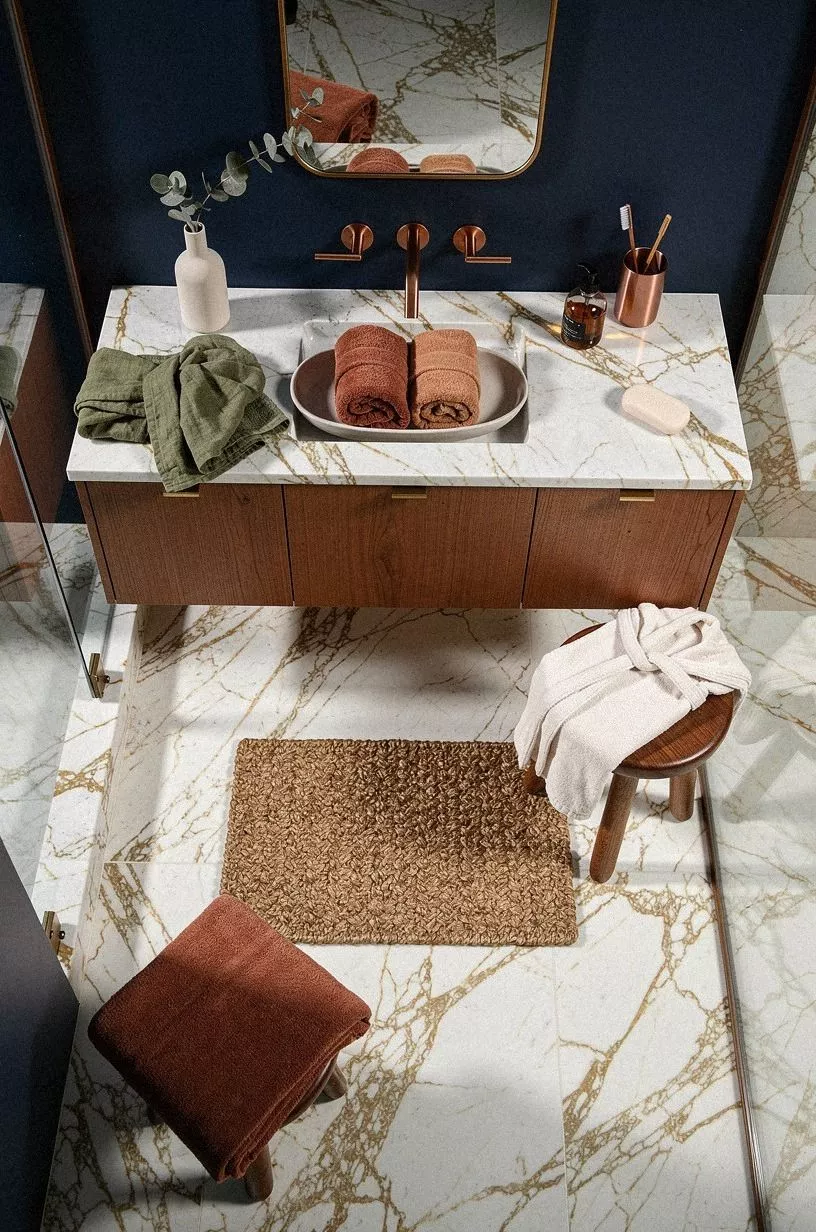
The towels were all white, thin, and aggressively practical.
7Mix mid-century materials around one focal point
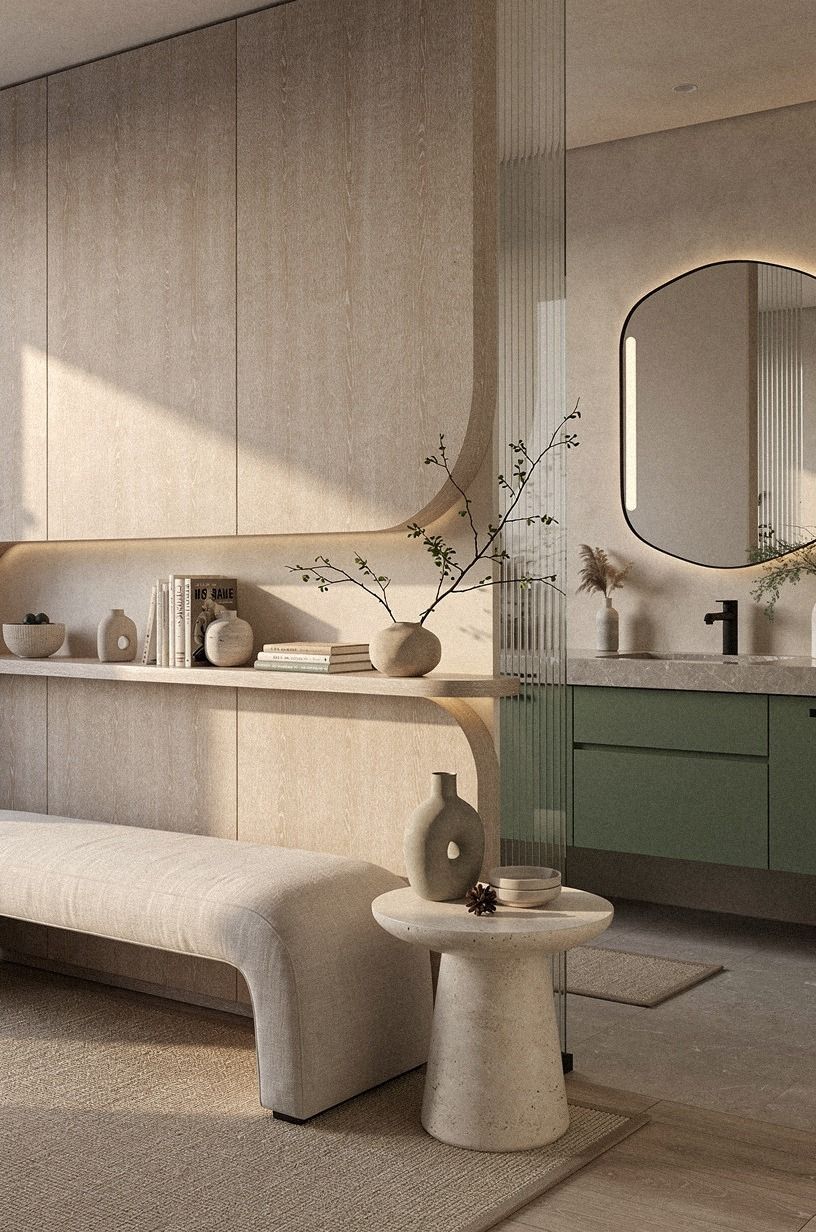
I wanted the bathroom to feel organic, but I didn’t want to cover every surface in cane, rattan, and stone. The result would’ve looked themed. Instead, I selected the vanity wall as the focal point and let cerused white oak carry the mid-century character, with sage green and warm cream around it.
The open grain of the cerused white oak added texture without making the room busy. Warm metal appeared at the sconces and faucet, while the wood grounded the vanity.
Your eye could travel across the wall without stopping at one shiny object. The grain felt more charming than a perfectly smooth finish.
And I left the shower wall alone. That decision saved time and money, but it also kept the room from becoming overdesigned. You don’t have to repeat every finish in every corner.
If your tile is already strong, let it be the loudest surface. These mid-century modern bathroom tile ideas that define the look show how one material can carry the whole room.
The focal point also gave me permission to keep the other walls quiet. Material contrast works best when the eye knows where to begin.
8Which plant earns the counter space?
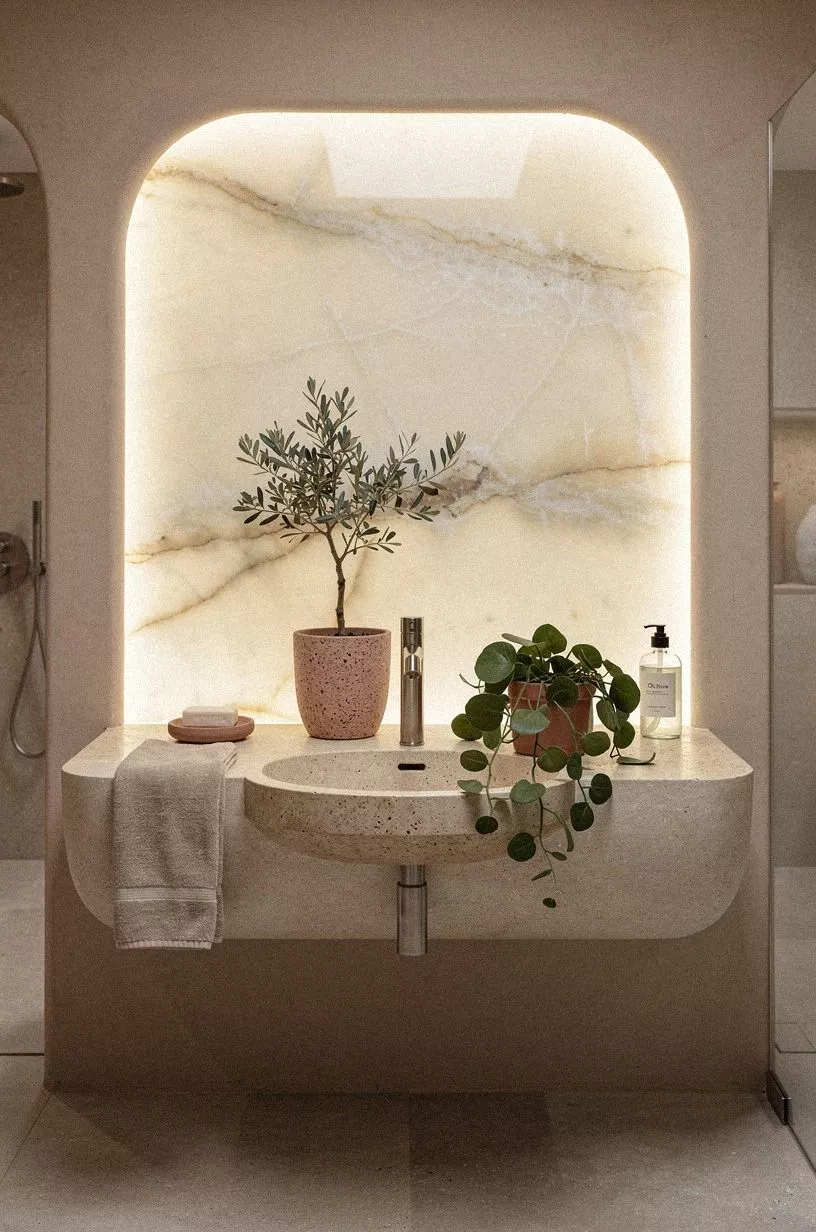
The bathroom needed something alive, but I didn’t want a jungle beside the toilet.
9Swap clutter for the Quiet Vanity Test
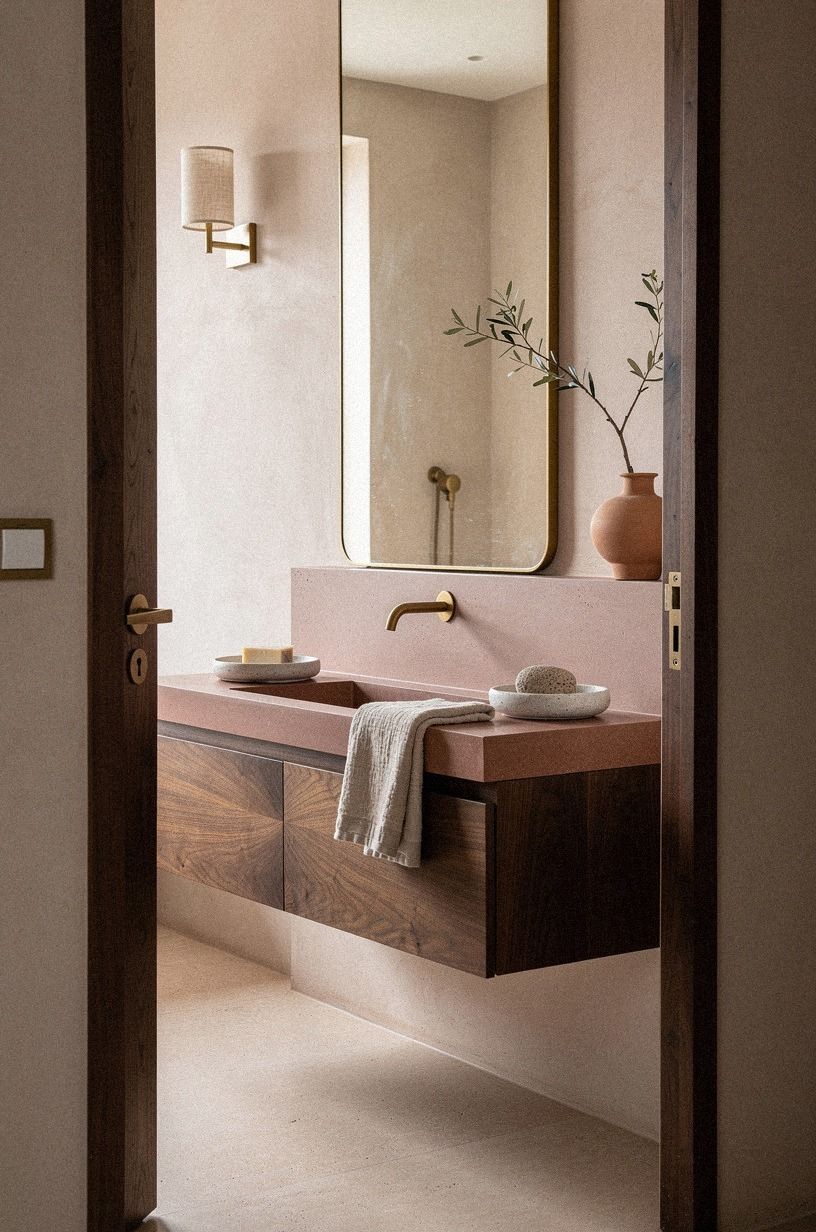
The counter was the final problem. I had soap, skincare, hair tools, and a collection of half-used bottles fighting for space. The vanity looked warm in theory, but your eye couldn’t see any of that warmth through the clutter.
I created the Quiet Vanity Test: keep only what you use every day, then give each visible item a material reason to stay. The soap went into a stoneware dispenser, the cotton rounds moved into a small lidded jar, and the hair tools disappeared into the cabinet. One amber bottle stayed because its color worked with the book-matched walnut and aged brass.
This wasn’t about owning fewer things. It was about giving your eye a pause. You can keep your routines and still make the sink feel calm.
I wouldn’t decant every product into matching bottles. That creates another chore, and your bathroom should support your life instead of performing for it.
The room looked more refined after I removed three objects than it did after I bought six. That’s the part I didn’t expect.
If you’re working on a small space, these small mid-century modern bathroom ideas for big style are useful even if you choose a lighter palette. They understand the value of visual rest.
I left one shallow tray on the counter so the remaining objects had a boundary. Daily essentials looked intentional once they stopped spreading across the whole vanity.
10Paint the ceiling before adding more decor
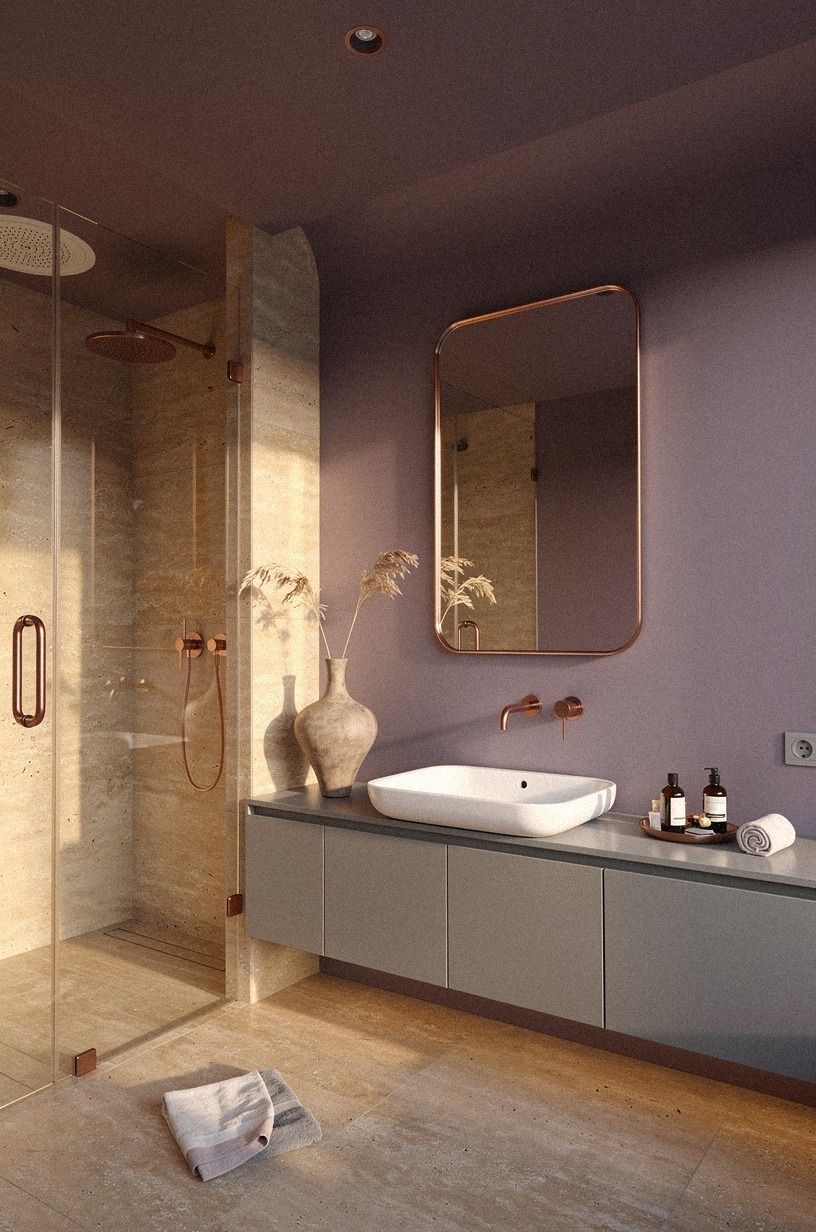
The ceiling had been ignored because I assumed the walls were the whole project. Once the wall color was warm, the bright ceiling looked disconnected. I painted it a softened version of the wall shade, stopping short of a full color-drenched effect.
Your ceiling doesn’t need to match exactly. A lighter wash can make the room feel airy, while a deeper tone can create an intimate, calming envelope. I used the wall color mixed lighter by eye, which softened the transition without making the bathroom feel dark.
If you’re using a muted plum, test it carefully because the color can become dramatic in a room with limited daylight. I paired it with grey and a small rose-gold accent, while warm travertine kept the contrast grounded. I wouldn’t use a deep plum on both walls and ceiling here, but a small ceiling sample helped me understand how much contrast the room could take.
The ceiling took one afternoon, including drying time. It was more work than hanging a print, but less work than replacing a vanity. And it changed the way your room felt from the doorway.
I wouldn’t add more decor before looking up. A blank ceiling can undo a carefully layered wall. Matte ceiling paint kept the surface quiet and prevented another hard reflection.
If you’re still deciding whether the walls or ceiling should lead, these small mid-century modern bathroom ideas for big style are useful for comparing compact color choices.
11Let the floor carry the green and wood home style
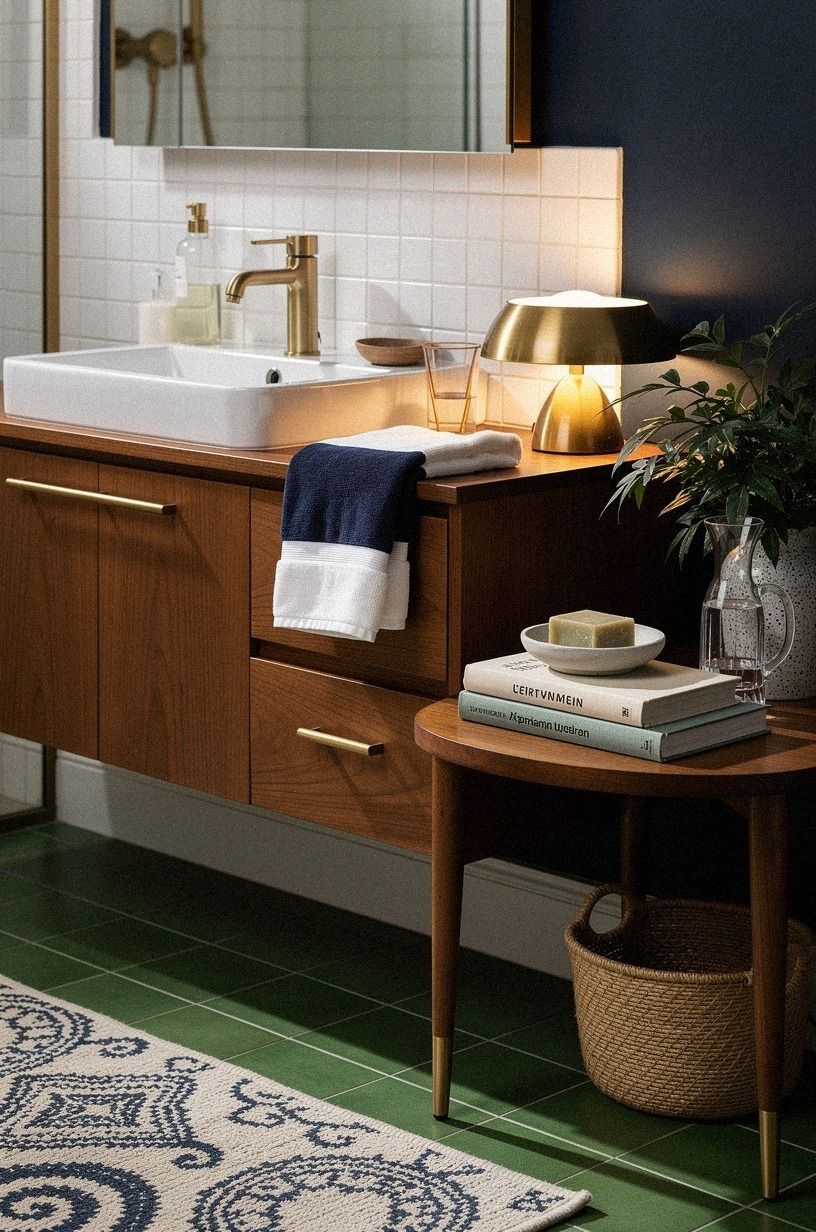
The floor stayed exactly as it was, but I changed how it participated in the room. I chose a flatwoven runner with navy, white, and walnut, then repeated the walnut in a small accessory. The result connected the bathroom to a navy and wood home style without painting every wall dark.
You can use Sherwin-Williams Naval SW 6244 as a gentle reference if your existing tile is cool. I didn’t repaint the floor because bathroom coatings need careful preparation and can fail under constant moisture.
A runner gives you color, softness, and a reversible decision. An unlacquered brass accent can add warmth as it develops a natural patina.
The standard tub footprint is about 60 by 30 inches, so your runner needs to leave enough clearance to open doors and step safely. A comfortable shower is generally 36 by 36 inches minimum, and toilet clearance needs at least 21 inches in front. Measure before you buy anything.
Your bathroom may look spacious in a photo and feel tight once a mat is down. Door clearance mattered more than a perfect color match, so I taped the runner dimensions on the floor before ordering it.
These mid-century modern bathroom tile ideas that define the look helped me think about the existing floor as part of the palette rather than a problem to hide.
How much did this cost?
I treated this as a budget refresh, not a renovation. My working cap was $1,200, and I kept the plumbing, tub, toilet, and existing tile in place. The table below shows typical US ranges for bathroom work, so your total will depend on the room, labor, and materials you choose.
For my version, the priority was paint, lighting, textiles, and one wood note. I didn’t touch plumbing or tile because those choices push a project into a different cost category. If you’re deciding where your money should go, start with the surface you see first and the light you use most.
The honest answer is that a bathroom can look warmer for a few hundred dollars, but a full renovation can move past $12,000 quickly. You don’t need to chase the high tier to get an organic mid-century feeling. You need a clear palette and the discipline to stop adding once the room feels settled.
For comparison, these mid-century modern master bathroom ideas for a retro-luxe feel show where a larger budget changes the result.
The maintenance test
A bathroom only works if the materials survive ordinary life. I chose washable paint, quick-drying towels, and a runner that could go in the washing machine. The washable runner mattered because I didn’t want beauty to create another weekly task.
I also avoided open storage near the toilet. Dust and humidity collect quickly in that spot, and a basket that looks charming on day one can become annoying by week three. Closed storage kept the visual field cleaner.
Before buying anything, I asked whether I could clean around it with one hand. That sounds unromantic, but easy cleaning protects the calm feeling longer than another accessory does.
If you’re planning a rental-friendly update, these mid-century modern bathroom ideas for apartments and renters are helpful because they keep maintenance and reversibility in view.
What I learned from keeping the shell
I thought the vanity would be the hero. It wasn’t.
The biggest shift came from controlling reflection, color, and clutter at the same time. The walls stopped shouting, the mirror stopped floating, and the low light gave the room a gentle evening mood.
I also learned that organic design isn’t a shopping list of wood, plants, and woven baskets. It depends on how your materials meet.
Smooth ceramic beside rough cotton feels richer than five versions of the same texture. Rough cotton beside aged brass feels more refined than bright brass beside every other shiny finish.
My biggest mistake was buying accessories before deciding where your eye should rest. I returned a sculptural vase because it competed with the mirror, and I stopped trying to make the room look more special. The better choice was quieter.
If you’re tempted to keep adding, remove one piece first and see what the room says.
The best part is that the bathroom now feels connected to the rest of the home. It isn’t precious.
Your towel can be used, your soap can sit out, and the room still looks calm. That balance is why I prefer a soft modern bathroom to a highly styled one.
The shell stayed ordinary, but the visual hierarchy changed completely. That was the real lesson.
You don’t always need a more beautiful room. Sometimes you need to let the best existing feature speak first.
These dark moody mid-century modern bathroom ideas reinforced the same lesson for me: atmosphere comes from decisions working together, not from filling every surface.
The Questions Worth Answering First
What is the best Organic Mid-Century Modern Bathroom Ideas (Warm & Natural) for a small bathroom?
I’d start with a deep navy wall color, a reclaimed weathered teak mirror, and one organic bouclé mat or natural oak note. These choices give a small bathroom texture without stealing floor space. I’d keep the vanity clear, use one low-profile mat, and let the walls do more of the visual work.
Where can I buy Organic Mid-Century Modern Bathroom Ideas (Warm & Natural) pieces on a budget?
I’d look at IKEA, Wayfair, and Target for furniture, mirrors, and textiles. I’d also check Facebook Marketplace or a local thrift store for walnut stools and brass lighting. My best budget finds often had scratched finishes that needed gentle cleaning, not replacement.
How much does a Organic Mid-Century Modern Bathroom Ideas (Warm & Natural) makeover cost?
I’d expect a cosmetic refresh to fall within the $200-$1,200 range for paint, a mirror, a faucet, and textiles. I’d start with free changes such as removing clutter, rearranging existing pieces, and warming the light. Plumbing, tile, and a new vanity move the project into higher tiers.
Can I create a Organic Mid-Century Modern Bathroom Ideas (Warm & Natural) on a budget?
Yes, and I’d start without buying anything. I’d paint one wall, group existing wood pieces, and replace harsh bulbs with warmer light. A thrifted tray, one substantial towel, and a small plant can give the room an earthy direction for far less than a renovation.
Is a Organic Mid-Century Modern Bathroom Ideas (Warm & Natural) worth it in a small space?
I think it is, because a small room gives you fewer surfaces to solve. I’d focus the budget on the mirror, vanity wall, and lighting instead of spreading it across a large floor plan. I’d keep at least 21 inches of clearance in front of the toilet and choose narrow storage.
Is Organic Mid-Century Modern Bathroom Ideas (Warm & Natural) a good idea for a rental?
I think it works especially well in a rental. I’d use removable hooks, a tension rod, peel-and-stick art, and a freestanding stool instead of permanent changes. Wood, cotton, plants, and warm lamps can shift the atmosphere without touching the tile or plumbing.
Where I’d Start First
If I had to pick one, I’d start with the wall color. Farrow & Ball Hague Blue No.30 gives white tile something richer to reflect, so every towel, mirror, and lamp has an easier job. Test the paint beside your bathroom light before committing.
Then I’d add one wood element and one substantial textile. Those two changes give the room warmth quickly, and they leave enough restraint for the original tile to remain part of the story. For another way to balance classic shapes with warmer materials, compare these mid-century modern master bathroom ideas for a retro-luxe feel.