
Small mid-century modern bathroom ideas work best when you treat the room like a tight floor plan, not a tiny version of a big bath. I’ve made this mistake myself: you bring in a chunky vanity, one trendy sconce, a cute rug, and somehow the room still feels pinched. The fix isn’t more stuff. It’s choosing the right moves in the right order so your square footage starts pulling its weight.
- Start with a walnut vanity on slim legs
- Anchor the floor with tiny terrazzo tile
- Paint the vanity a warm avocado green
- Start with a walnut vanity on slim legs
- Anchor the floor with tiny terrazzo tile
- Paint the vanity a warm avocado green
- Swap bulky sconces for globe lights
- Why does a rounded teak mirror hold the whole wall together?
- Use Benjamin Moore Chestertown Buff HC-9 to anchor the tile
- Add brass pulls with tapered midcentury lines
- Build a recessed shelf for amber glass bottles
- Floating sink vs. floor vanity: which one earns the space?
- Layer color with mustard towels and art
- Frame the shower with thin black trim
- Use a patterned curtain in muted geometrics
- Finish with one sculptural ceramic stool
- Swap overhead cans for a single warm flush-mount
- Choose a wall-mounted faucet to free the counter
- Lay a low-pile wool rug for warmth underfoot
- Hide the toilet with a slatted wood screen
- Anchor the ceiling with a warm tongue-and-groove plank
1Start with a walnut vanity on slim legs
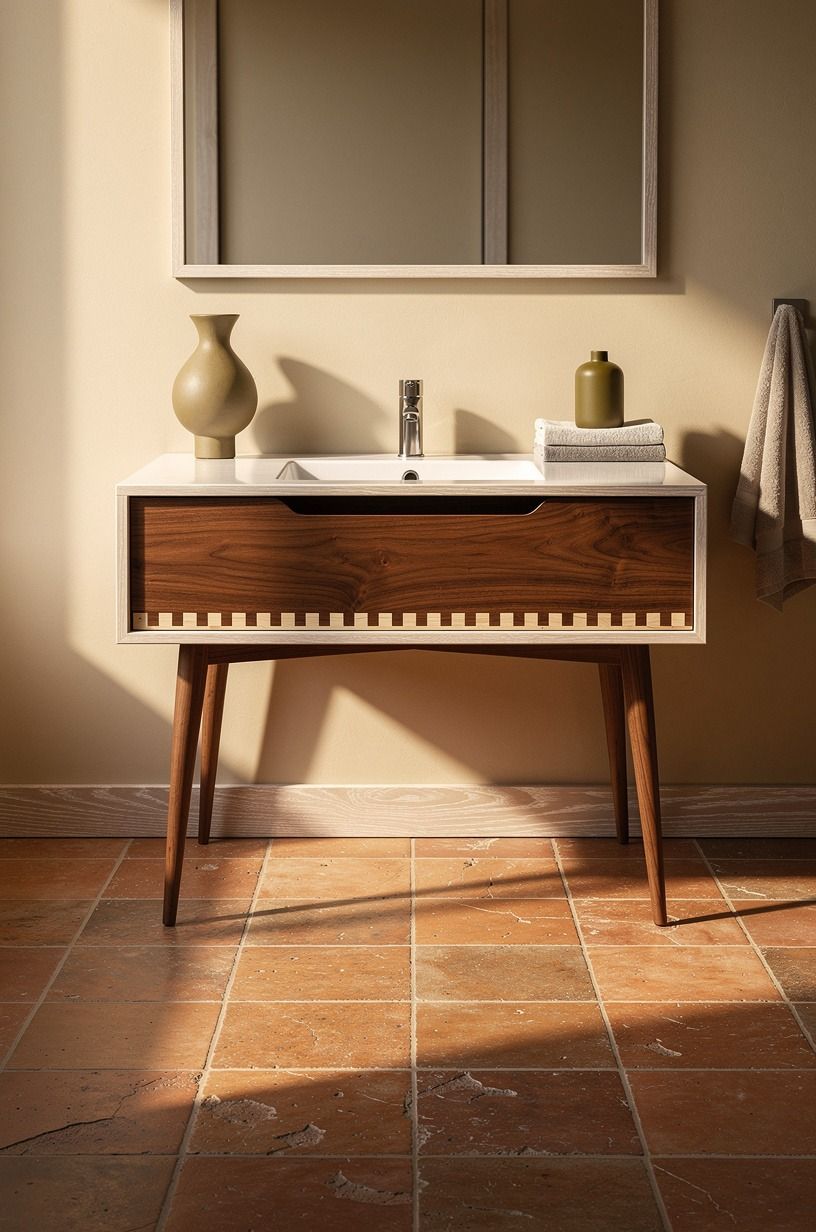
Start here, because your vanity takes up the most visual mass in a midcentury modern small bathroom. If you pick a blocky cabinet that sits flat on the floor, you lose the air gap that makes a little room breathe.
I would look for a walnut vanity with tapered or slim dowel legs, something in the 24 to 30 inch range if your layout is tight. You’ll see why the photo works: the leggy shape lets the terracotta stone floor keep showing, and that exposed white-oak dovetail at the drawer edge adds the hand-built detail that makes the whole room feel more considered.
You also want the height right. A vanity that lands between 32 and 36 in usually feels comfortable, and if you’ve got a compact toilet nearby you still need at least 21 in of clearance in front of it so the room doesn’t start fighting you.
I would skip fake-rustic distressing here. Clean grain looks sharper.
If you don’t want to source a vintage piece, the IKEA GODMORGON oak-effect cabinet with custom slim legs reads convincingly midcentury and costs a fraction of a salvage find. If you want more inspiration for silhouettes that stay light, this roundup of mid-century bathroom ideas that keep the room visually open is worth a look.
2Anchor the floor with tiny terrazzo tile
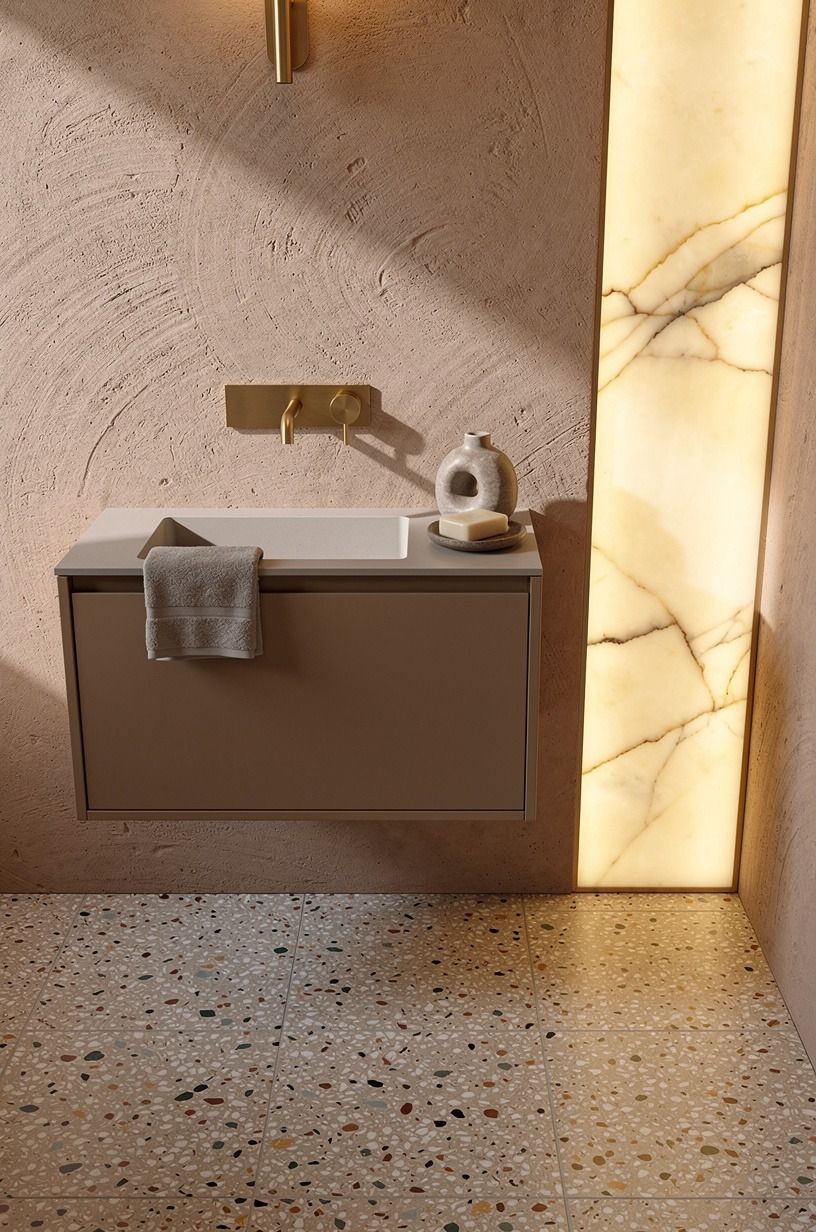
Floor pattern does more work in a small bathroom ideas mid century modern plan than people think.
3Paint the vanity a warm avocado green
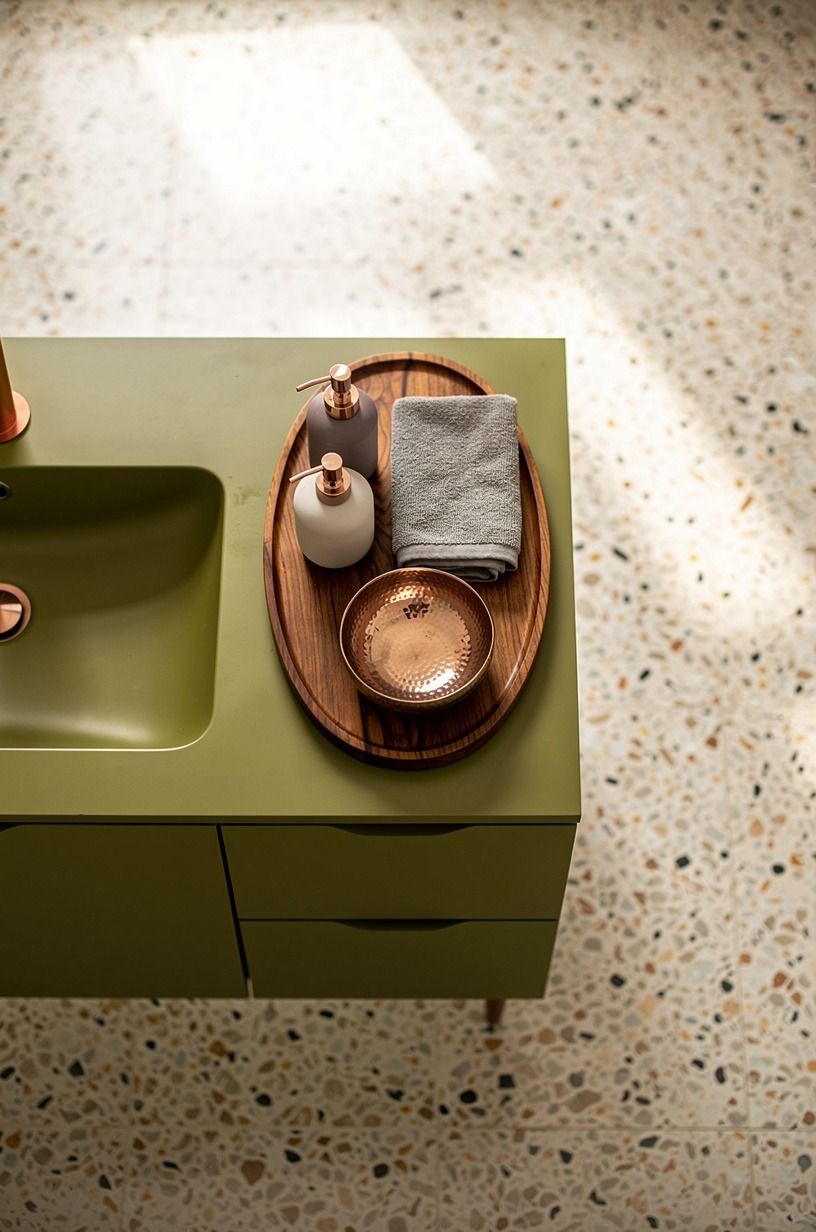
This is where colorful small bathrooms usually either get charming or go muddy. A warm avocado green works because it picks up the wood tone instead of fighting it, and in a bird’s-eye view like the photo you can really see that harmony.
I would start with Benjamin Moore Chestertown Buff HC-9 if you want the room warmer overall, then move greener with a custom avocado tone once you know how much yellow your floor is already bringing. The book-matched walnut tray matters too, because the grain keeps the color from feeling flat.
And don’t stop at the cabinet front. You want the accessories to back up the color story so it looks intentional from above: plum glass, a gray hand towel, maybe one soap dish with a smoky glaze. I painted a vanity too green once and the room turned sickly by dinner.
Lesson learned! In a small bathroom remodel colorful scheme, muted and earthy wins over loud every time.
If you want a deeper, more confident avocado that holds up under cool bathroom light, Farrow & Ball Card Room Green lands closer to olive-forest and reads beautifully against warm walnut. For another darker route, this guide to small dark bathrooms with depth instead of gloom shows how far color can go when the undertones are right.
4Swap bulky sconces for globe lights
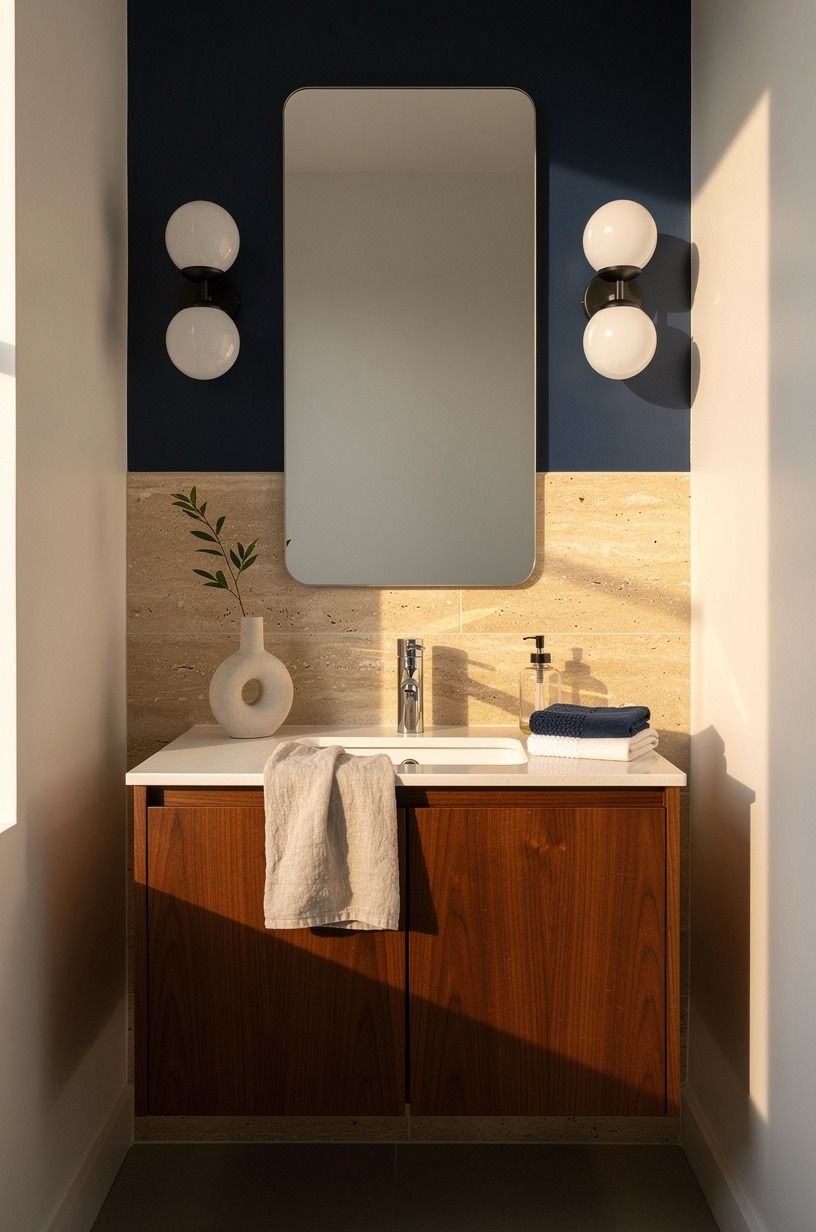
Bulky lighting is a space thief. If your mirror already fills most of the wall, heavy metal sconces with deep shades will crowd it fast.
Globe lights fix that because they give you light volume without visual weight, and that front-on navy, white, and walnut composition in the photo proves the point. I would use Schoolhouse Luna globes or a similar milk-glass style with dimmable 2700K bulbs so the room stays warm on skin, tile, and wood.
You’ll want symmetry here, but not stiffness. Set the centers of the globes roughly at eye level beside the mirror, then let the round shapes soften the straight vanity lines. The part that worked for me was choosing smaller globes than I first wanted.
Bigger sounded dramatic. Smaller looked right.
If your sconces need to plug in rather than hardwire, the Schoolhouse cord kit in white keeps the look clean and renter-friendly at around $40 a side. If you’re mixing lighting moods through a home, this article on moody mid-century bedrooms that still feel inviting is a smart reference for getting warmth without heaviness.
5Why does a rounded teak mirror hold the whole wall together?
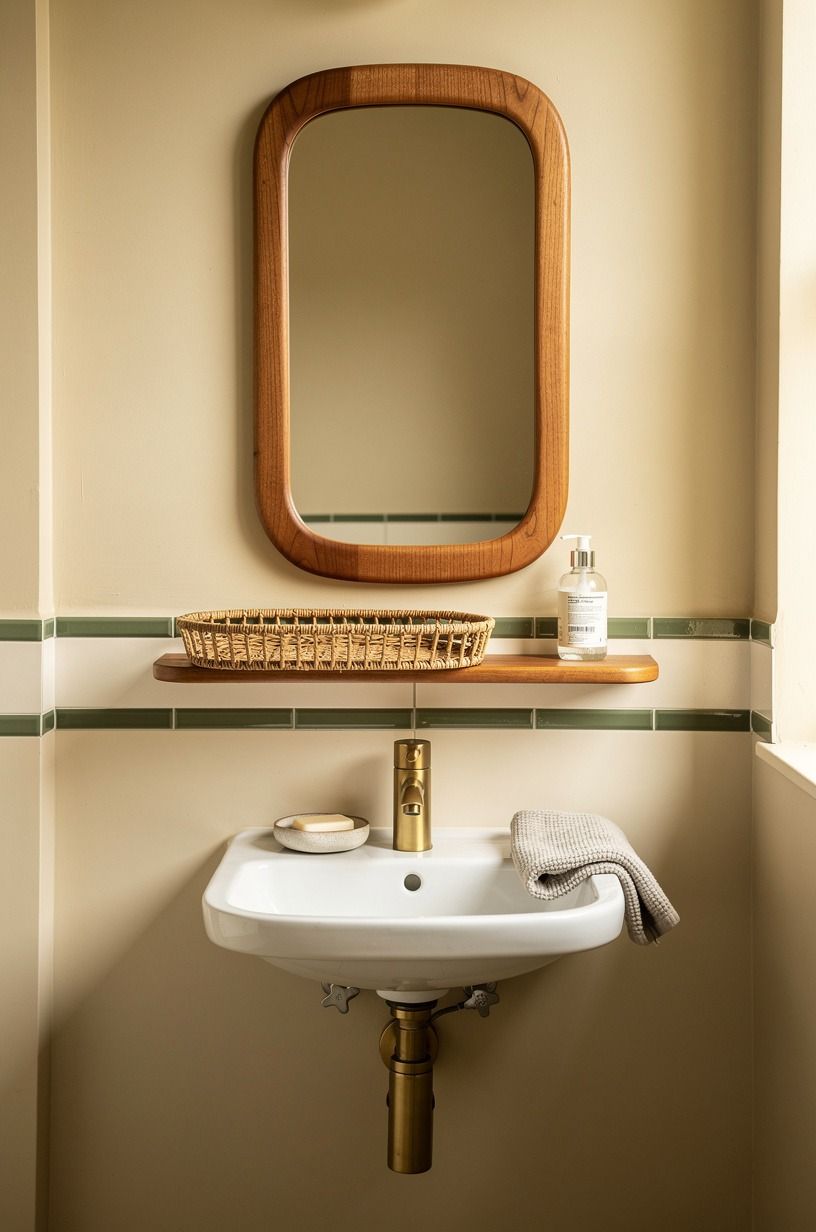
A rounded mirror is one of those moves you notice in good midcentury baths even when you can’t explain why it works. The shape breaks up the boxy architecture without shouting, and that’s exactly what a small bathroom needs.
Sharp-cornered mirrors make the room feel like a waiting room. A soft circle makes it feel like a calm, intentional retreat.
I would look for teak with visible grain, not painted MDF. A solid teak frame in the 24 to 30 inch range brings the warmth of the vanity up the wall, and you don’t need to match the wood tone exactly.
Just stay in the same family. If teak runs over budget, West Elm’s organic-shaped wood mirrors use walnut and ash at a friendlier price, and the silhouette still does the visual softening you want.
Placement matters more than people think. Hang it so the bottom edge sits 4 to 6 inches above the backsplash line, with the center about 62 to 65 inches off the floor.
That height keeps eye contact natural and gives the wall a moment of lightness between the vanity and the sconces. It also stops the mirror from competing with any art above.
The result feels edited, not crowded.
6Use Benjamin Moore Chestertown Buff HC-9 to anchor the tile
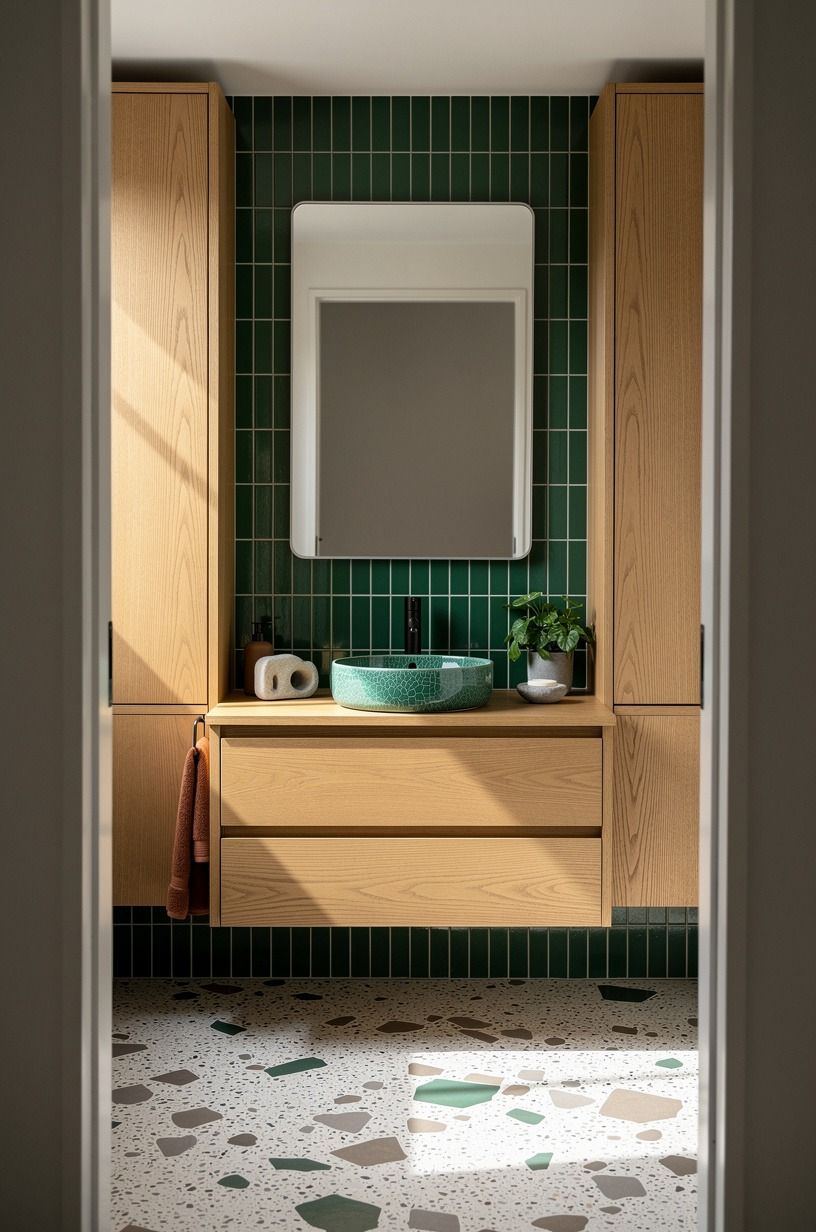
This is the first proprietary rule I would use: The Height-First Tile Rule.
7Add brass pulls with tapered midcentury lines
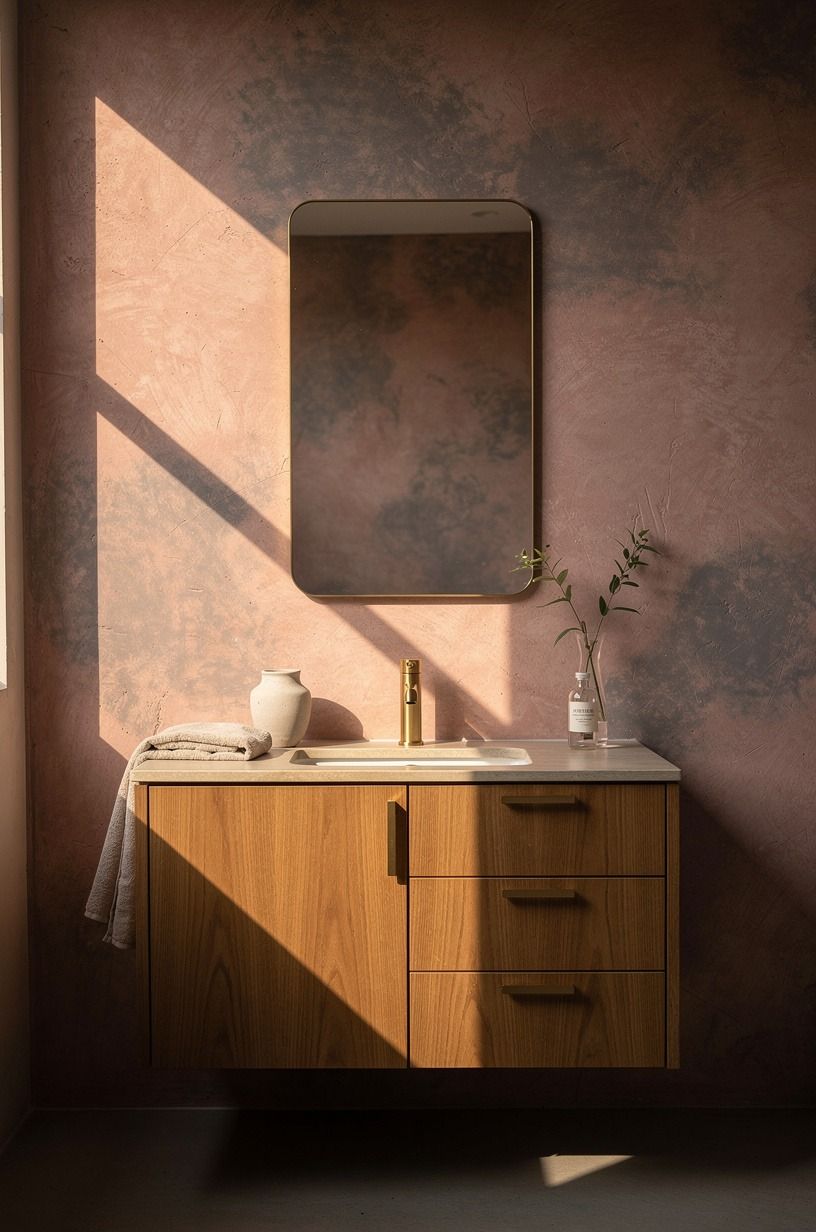
Hardware is tiny, but it’s never minor. In a corner-to-corner view like the photo, the vanity, mirror, plaster wall, and sink all need a small hit of precision to feel finished, and tapered brass pulls do exactly that.
I would look for Rejuvenation Blair pulls or another slim shape with a slight flare, nothing chunky and nothing too industrial. You want the brass to read tailored, not loud.
On an oak vanity, that narrow line gives the eye a clean stopping point.
This is also where I would use the Two-Metal Limit. Keep the pulls and faucet in the same warm family, then let black live elsewhere only if it’s thin and structural.
Once you start mixing brass, chrome, matte black, and brushed nickel in one tiny room, your eye has nowhere to rest. Been there.
Regretted it.
For pulls on a tighter budget, the IKEA BILLSBRO handles in brass finish read surprisingly sharp at 1/5 the price, and the slim profile keeps that midcentury line intact. If you like that edited feeling, these mid-century bathroom ideas with cleaner lines show how restraint reads richer than piling on details.
8Build a recessed shelf for amber glass bottles
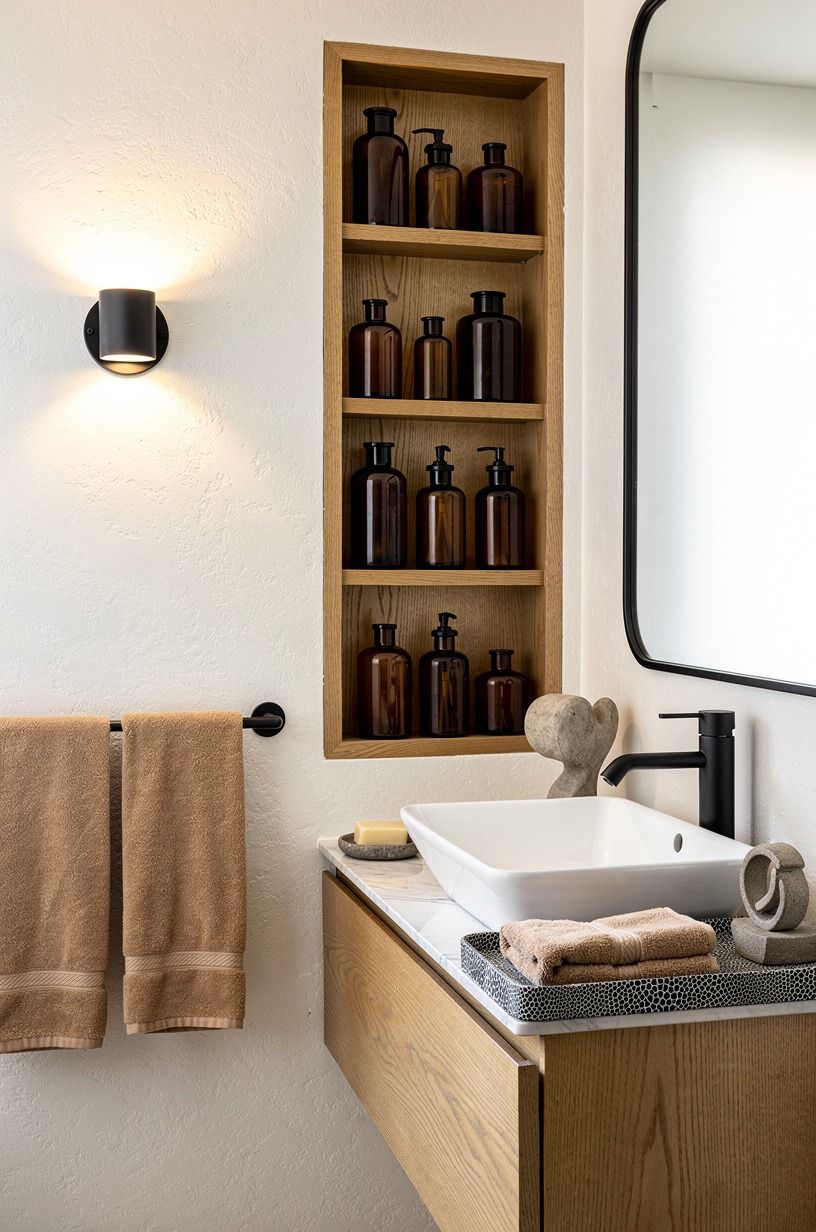
Storage looks best in a small bathroom when it disappears into the wall. A recessed shelf beside the vanity gives you that extra function without eating depth, and the relaxed three-quarter view in the photo shows why it’s such a strong move: you still see the sink and mirror, but the amber bottles add glow and repetition instead of clutter. I would line the niche in the same finish as the wall tile or a slightly darker stone so the bottles stand out without the shelf turning into a separate event.
And please edit what goes in there. Three amber glass bottles with matching heights will always beat a dozen labels in different colors. If you rent and can’t cut into the wall, a shallow surface shelf painted to match the wall can get close, though the built-in version is better if you can swing it.
For a smart surface alternative, the West Elm Narrow Wall Shelf in walnut-mounts-white can fake a built-in look for around $80, and you can flip the brackets against the wall for a clean shadow line. Need more proof that hidden storage changes everything in a tight footprint? This guide to small bathroom storage ideas that earn every inch is full of good steals.
9Floating sink vs. floor vanity: which one earns the space?
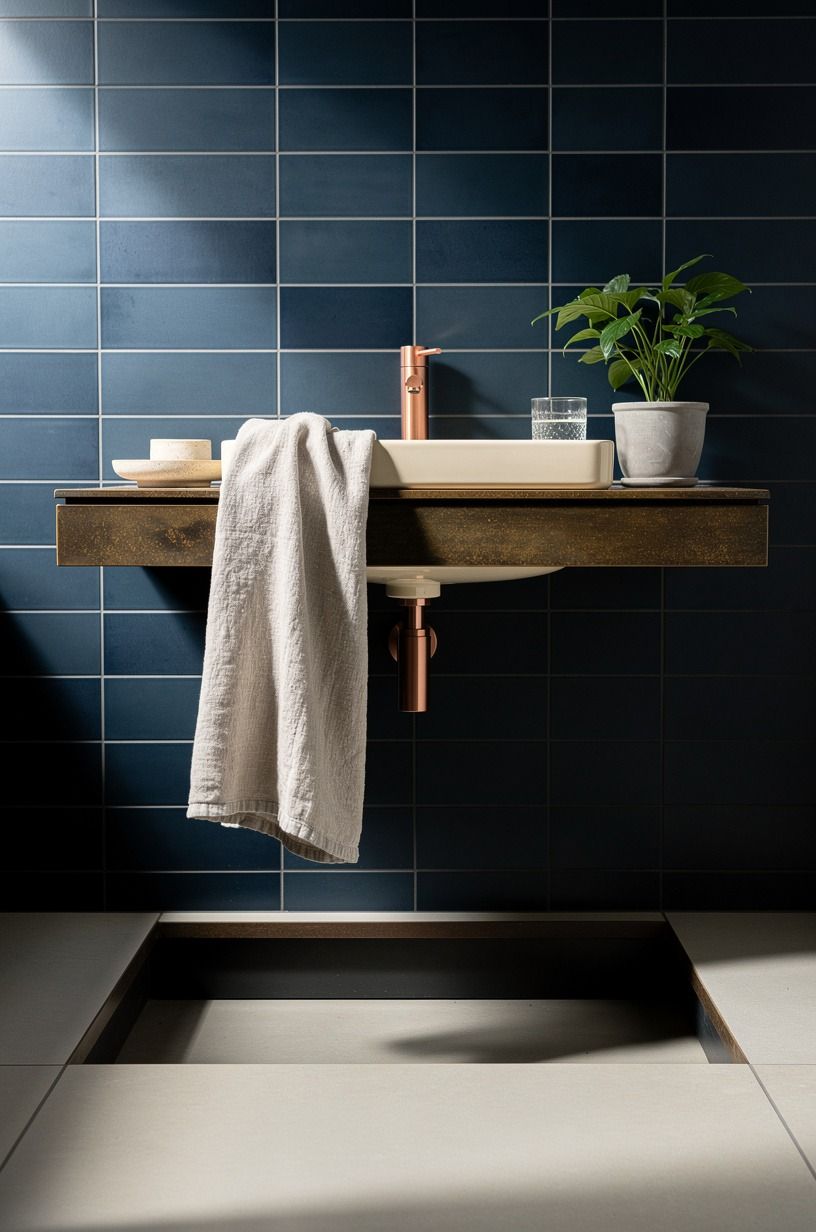
If your bathroom is genuinely tiny, a floating sink can do more for the room than a bigger mirror or a better shower curtain. But it isn’t always the right move. The decision comes down to two things: how much floor you need to show, and how much storage you actually use every day.
A floating vanity wins when your bathroom is under 40 square feet and you want the floor to read as one continuous surface. The exposed floor below the sink makes the whole room feel taller and easier to clean.
I’ve installed them in 5×8 bathrooms where the difference was dramatic. The trade-off: storage is usually shallower, sometimes as little as 8 inches deep.
If you store tall bottles, hair tools, or backstock toilet paper behind a door, you’ll fight that depth fast.
A floor vanity wins when storage matters more than visible floor. The extra depth gives you real drawer space, and the visual weight can ground a room that feels too light or scattered. The midcentury way to keep it from feeling blocky is to pick a piece with slim dowel legs, so the floor still shows around the edges even if the cabinet sits on the ground.
For most of my projects, that’s the call I make. If your layout is so tight that even a slim-leg vanity feels heavy, these compact powder-room layouts give a good middle path.
10Layer color with mustard towels and art
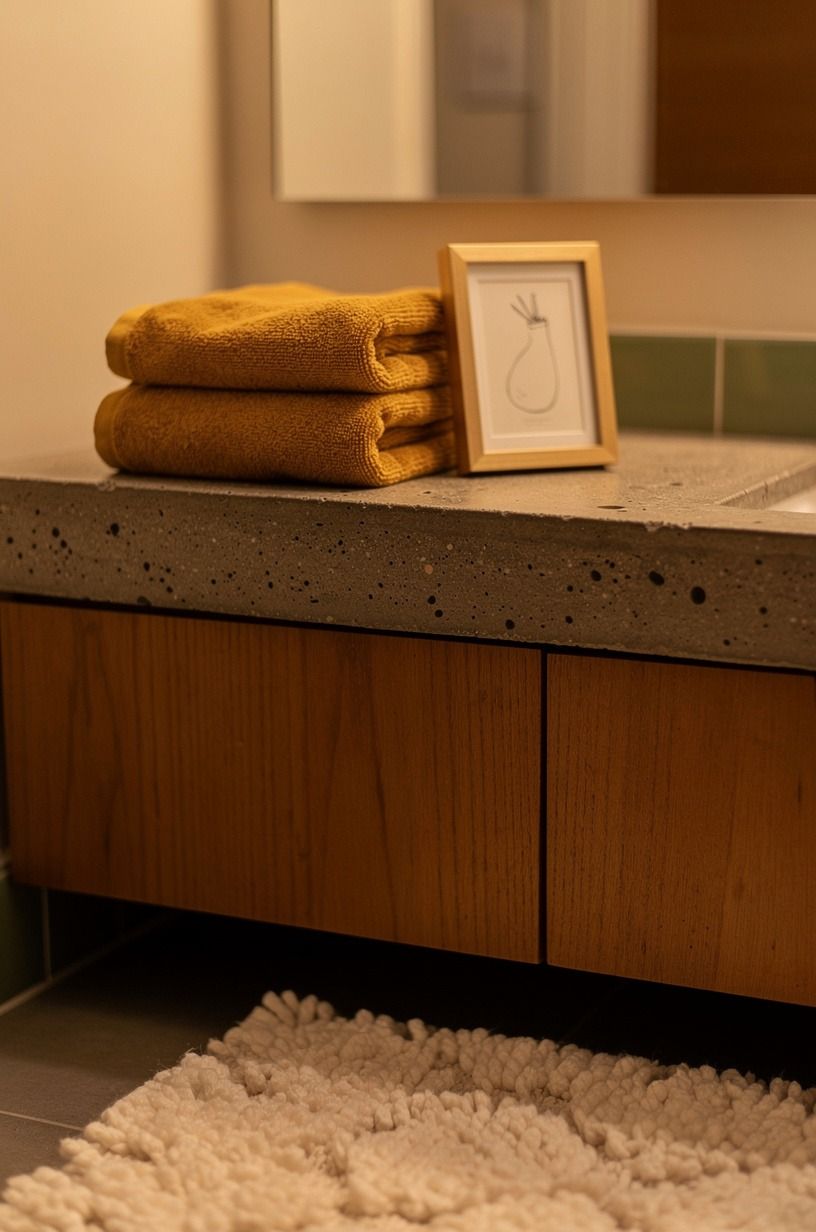
This is my Color Echo Rule, and it saves little bathrooms from that unfinished, one-note look. You need one warm accent repeated at least twice so it feels deliberate.
In the macro photo, the mustard towels and small framed art do exactly that against the poured concrete countertop. The visible aggregate in the concrete keeps the surface from feeling cold, while the mustard adds heat you can spot in two seconds.
You don’t need ten accessories. You need one color with follow-through.
I would use mustard towels in a heavier cotton, around 600gsm if you want them to drape well, then pull a dusty ochre or rust tone into the art beside them. But keep the frame thin. Thick frames look fussy on compact counters.
For a quick textile swap that costs under $30, Target Threshold’s waffle mustard towels have the right yellow-ochre weight and wash better than most. And if the rest of your palette already leans strong, let this be the only punch.
Every small bath needs one note of energy, not a whole marching band! For more ideas on adding atmosphere without clutter, small dark bathrooms with edited color are helpful to study.
11Frame the shower with thin black trim
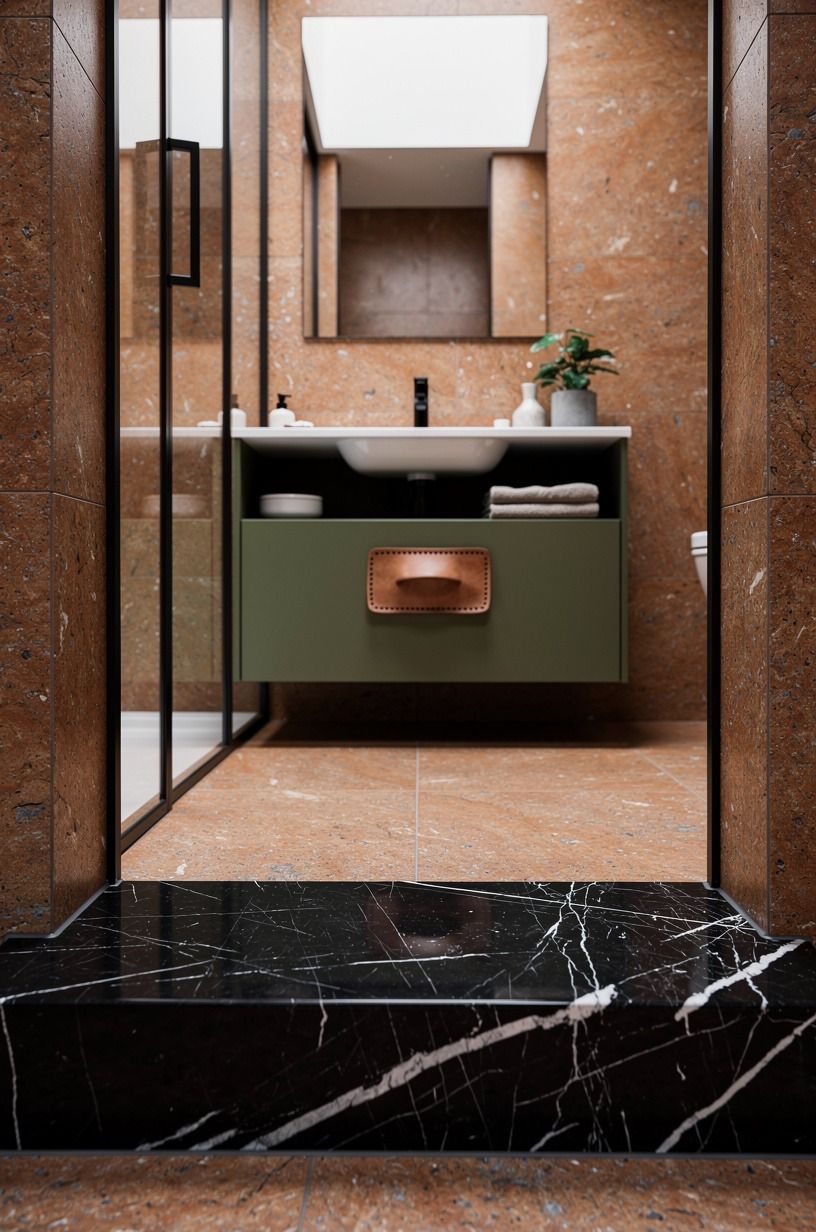
Thin black trim works in a midcentury bath because it defines the architecture without taking over the room. In the photo, that dark line around the shower pulls your eye forward from the Nero Marquina marble threshold, across the white veining, and back to the compact vanity beyond it. It feels crisp, not harsh.
I would use this when you need contrast and shape, especially if the rest of the bathroom is wood, plaster, and warm stone.
But thin is the whole point. Thick black framing can start reading industrial loft, and that’s a different language from warm midcentury.
If your shower sits beside a standard tub, remember a typical tub is 60 x 30 in, so every extra visual inch around it matters. I would rather put money into slimmer trim and a better threshold than oversized statement hardware.
For a budget way to get the same look, Schluter Systems makes a 3/8-inch black anodized profile that reads as architectural trim at $20 a stick. If you like strong outlines used with more restraint, this bathroom roundup with darker contrast is a useful comparison.
12Use a patterned curtain in muted geometrics
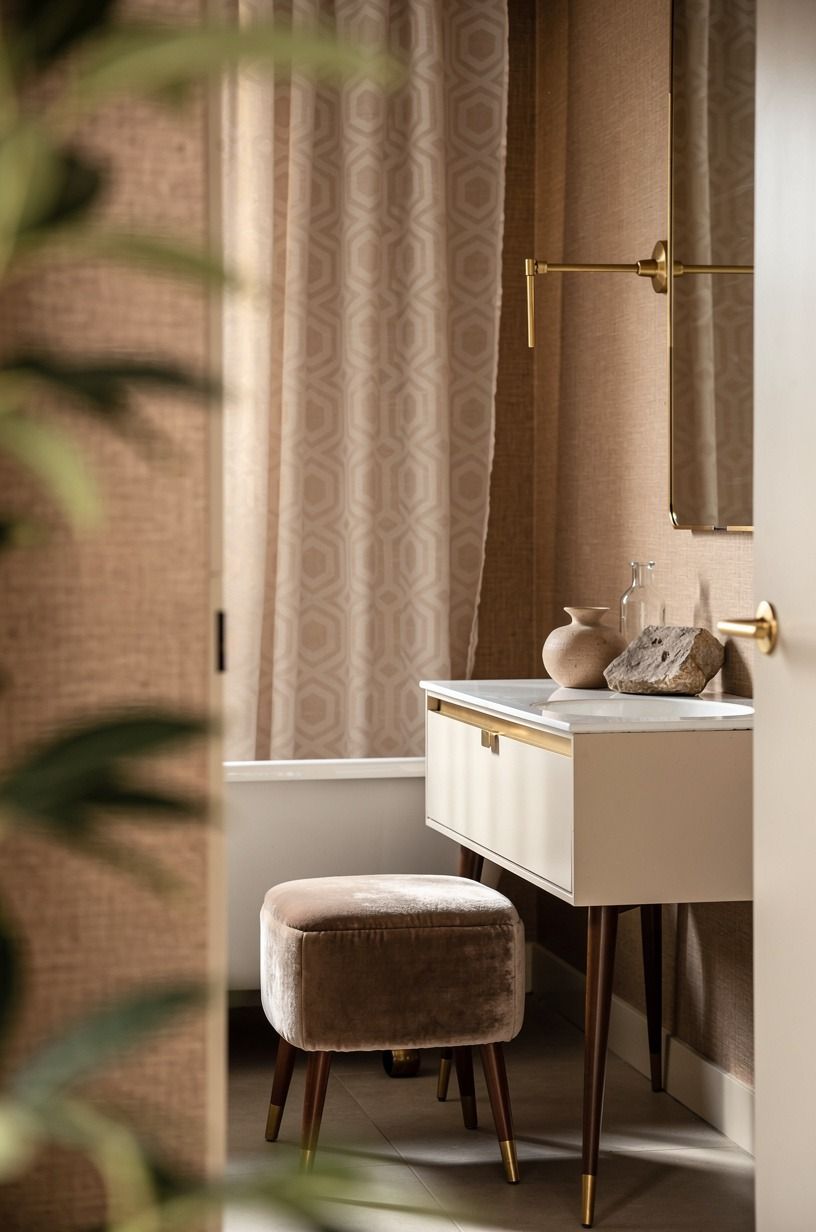
Pattern is where many midcentury bathrooms get too loud.
13Finish with one sculptural ceramic stool
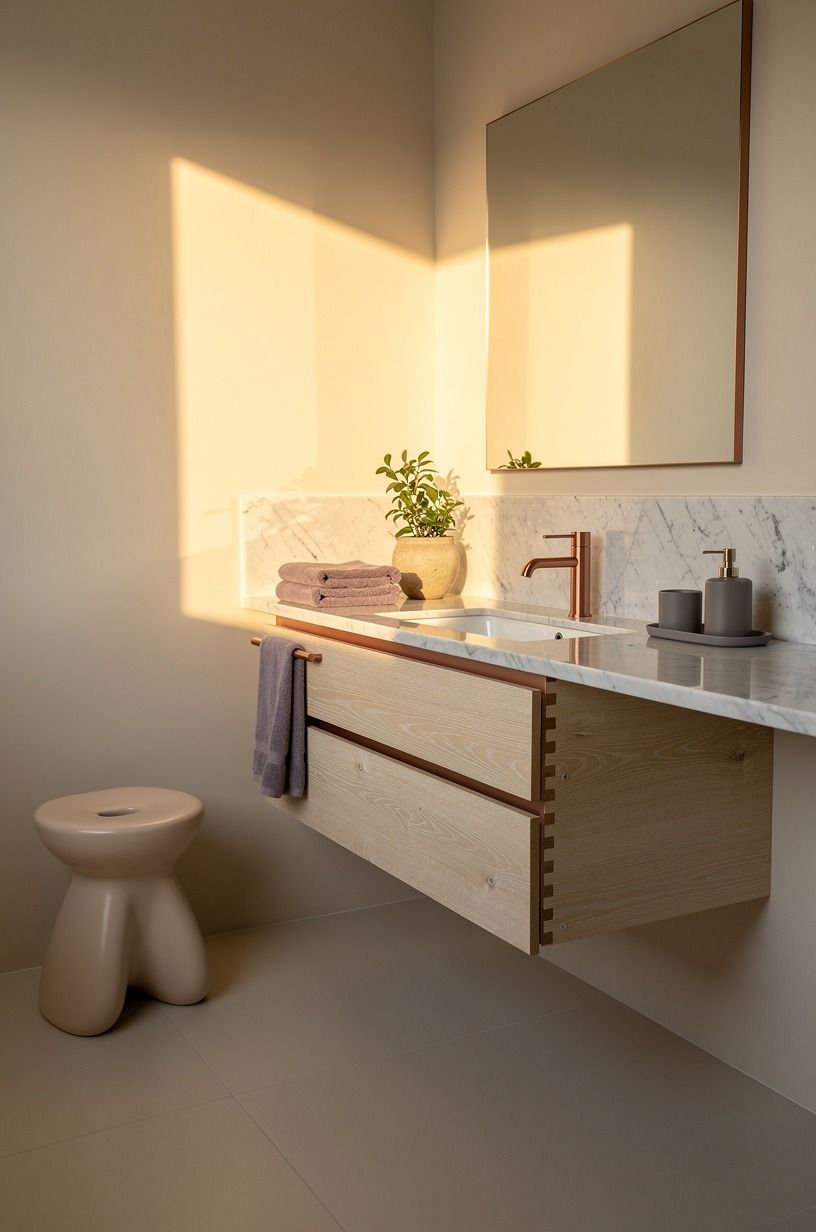
Every small bathroom needs one object that feels a little unnecessary in the best possible way. That’s what the stool does in the photo.
Set beside the compact vanity in that wide diagonal view, the ceramic stool makes the room feel styled, but it also gives you a landing spot for a folded hand towel, a book, or your clothes when you’re showering. I would look for an off-white, sand, or pale tobacco glaze so it plays well with the Carrara around it instead of stealing focus.
This is also the last step for a reason. Don’t buy the stool first and build a room around it.
Finish your hard surfaces, get your lighting right, then add one sculptural note to loosen the room up. I’ve seen people cram in baskets, leaning art, trays, and a stool all at once.
Too much. One strong object beats four filler ones every single time!
If you want the stool to feel genuinely handmade rather than mass-produced, CB2’s small ceramic garden stools come in a chalky matte finish at around $100 and read like a found object. If you like rooms that feel layered without feeling busy, this small-space mood guide shows the same principle in another setting.
14Swap overhead cans for a single warm flush-mount
Recessed cans are the default in a small bath, and they’re usually the wrong call.
15Choose a wall-mounted faucet to free the counter
A wall-mounted faucet is one of those midcentury moves that solves a real problem in a tight bathroom. It pulls the spout off the counter, which means the vanity top is free for a soap dish, a tray, a small plant, or nothing at all. That’s how a small bath starts reading as designed rather than crowded.
I’ve used them in 5×8 baths where the difference was about 6 inches of cleared counter, and that 6 inches changed how the whole sink wall felt.
The catch is plumbing. A wall-mounted faucet needs the supply lines in the wall, not the floor, so it’s an easier call in a remodel than a swap.
If you’re already opening the wall for tile or backsplash, add the rough-in valve at the same time and it’s barely extra labor. If you’re not opening the wall, skip it.
The retrofit kits look janky and leak within five years. Done that.
Lived with the slow drip.
For a finish that pairs with walnut and warm brass, WatermarkFixtures’ Brooklyn Collection wall-mounted faucets run $400 to $650 and hold up like cast iron. These small bath remodels with edited fixtures cover the trade-offs in detail.
16Lay a low-pile wool rug for warmth underfoot
Cold tile underfoot is the thing nobody warns you about in a small bath. You can heat the air all you want, but the first step out of the shower onto icy porcelain is what makes a bathroom feel like a punishment room. A low-pile wool rug fixes that without ever raising the thermostat, and wool handles the wet-dry cycle better than cotton.
The “low-pile” part matters more than people think. High-pile bath mats get soggy, hold mildew, and slide around on hard floors.
A flat wool weave at half an inch or less dries fast, grips better, and reads as part of the room rather than a beach towel that wandered in. I run a Dash & Albert wool runner in the guest bath at home, and after three winters it’s still holding its shape.
For scale, target a 2×3 in a tight bath and a 3×5 if you have room to step out of both the tub and the shower. Skip anything with a rubber backing that claims non-slip. Those break down in two summers and leave black marks on the tile.
A wool rug on a thin rug pad is the better call every single time.
17Hide the toilet with a slatted wood screen
In a tight bathroom, the toilet is almost always the visual problem.
18Anchor the ceiling with a warm tongue-and-groove plank
Most small bathrooms get a flat painted ceiling and call it a day. That’s the missed opportunity.
A warm tongue-and-groove plank ceiling pulls the eye up and gives the room a fifth surface that ties into the vanity and the mirror instead of disappearing. In a 7×7 bath with 8-foot ceilings, that change makes the whole room read as a designed box, not just four walls and a white lid.
I would run clear pine in a 4-inch profile, lightly stained in a warm oak tone, and seal it with two coats of marine-grade polyurethane so humidity doesn’t lift the grain. If you want a darker, more architectural read, a Farrow & Ball Studio Green ceiling in flat finish does the same visual job and costs less labor.
The one rule: don’t run the planks perpendicular to the longest wall in a narrow room. It chops the length and makes the space feel like a hallway.
Parallel to the long axis pulls the room forward and reads as intentional. Done right, this is one of the cheapest upgrades per square foot in any small bath, and it’s the kind of detail that makes people ask what you did to the room.
Why this style works in real life
What I like about a small mid-century modern bathroom is that it doesn’t ask you to fake luxury with a pile of extras. It asks you to get disciplined.
You choose a vanity that lets the floor show. You pick one wood tone that feels warm in morning light.
You let a rounded mirror soften the boxy architecture. And you stop before the room gets too clever.
That edit is the whole game.
I’ve worked on little bathrooms where I thought the answer was more personality, more pattern, more contrast, more shelves, more brass. It usually wasn’t.
The rooms that held up were the ones where every move had a job. The walnut vanity warmed the room.
The vertical tile added height. The globe lights cleaned up the wall. The geometric curtain gave the room some motion without turning it loud.
That’s why this style keeps landing so well in small spaces: you’re using shape, material, and proportion to do the heavy lifting instead of square footage.
Budget matters too, and this is where people often overspend in the wrong place. I would put money into the vanity silhouette, the faucet, and the lighting before I would blow it on expensive décor.
A good brushed brass faucet in the $120 to $450 range changes how the whole sink wall reads. Better lighting changes how your paint and wood look every night. And a slimmer vanity footprint can solve a layout problem that no accessory ever will.
The rooms that feel expensive usually aren’t the ones with the highest spend. They’re the ones where you can tell someone made decisions in the right order. That’s the part you feel when you walk in, and it’s the same edited restraint that makes small dark bathrooms feel richer instead of smaller when the proportions are right.
The Questions I Get Asked Most
What is the best Small Mid-Century Modern Bathroom Ideas [Big Style, Little Space] for a small bathroom?
The best one is usually a slim walnut vanity on legs or a floating sink, because both keep more floor in view. If you want the fastest style shift, start there, then study these small bathroom-friendly mid-century layouts before you buy anything else.
Where can I buy Small Mid-Century Modern Bathroom Ideas [Big Style, Little Space] pieces on a budget?
You can find good options at IKEA, Target Threshold, and Wayfair, especially for mirrors, towels, and simple lighting. For the warmer, less showroom look, I would also check Facebook Marketplace for teak mirrors and stools. Old pieces often have better proportions than new cheap ones.
How much does a Small Mid-Century Modern Bathroom Ideas [Big Style, Little Space] makeover cost?
A typical makeover can run from $200 to $30,000+, depending on whether you’re swapping finishes or moving plumbing. Here’s the quick budget picture you’ll want before you start.
If you’re doing only one paid upgrade, I would put it into the vanity or lighting first because that’s where you’ll see the shift fastest.
Can I create a Small Mid-Century Modern Bathroom Ideas [Big Style, Little Space] on a budget?
Yes, and the cheap wins are real. Start with paint, swap the mirror, and bring in warmer towels or a curtain before you touch plumbing. A renter-safe curtain, secondhand teak mirror, and better bulbs can change the room for a few hundred dollars instead of a full remodel.
Is a Small Mid-Century Modern Bathroom Ideas [Big Style, Little Space] worth it in a small space?
Yes, because small rooms respond fast when you improve scale and storage. You don’t need as many materials, and one smart move like a floating sink or recessed shelf can change the whole footprint. If storage is your issue, these small bathroom storage ideas are a strong next read.
Is Small Mid-Century Modern Bathroom Ideas [Big Style, Little Space] a good idea for a rental?
Yes, especially if you focus on no-damage swaps. Think tension-rod curtains, removable lighting if your fixture allows it, thrifted mirrors, and better textiles. I would also lean on art, color, and edited accessories first, because those bring the mood without a fight with your landlord.
Where I would Start First
If I had to pick one step, I would start with the walnut vanity on slim legs. You can’t fake good proportions in a tiny bathroom, and that one move gives you warmth, storage, and visible floor at the same time. Everything else stacks better after that.