
Guitar room ideas for the ultimate player’s space start with one honest answer: mine needed a $200 to $800 reset, not a full studio build. I was sharing a small, dim room with cases, cables, and one very sad chair. A weekend later, it felt warm enough to stay in after the last chord.
Here’s what it looked like before
Before, it had the full starter-room package: beige walls, a black plastic stand, tangled leads, and three guitars leaning where they absolutely shouldn’t have been. I kept telling myself I needed more space, but you could see the real problem in five seconds. Nothing had a job.
The room was also trying too hard to be neutral. My amp sat against a bare wall, the desk faced the wrong way, and every surface collected picks, receipts, and half-empty coffee mugs.
You know that slightly guilty feeling when you avoid opening a door because the room behind it isn’t ready for company? That was this room.
I didn’t buy a pile of matching gear furniture. I gave the guitars a visible place, gave my feet a soft landing spot, and made the room feel like mine.
- Anchor your home guitar room with a real rug
- Hang guitars where you can see them
- Paint one wall in Farrow & Ball Pigeon
- Build the Three-Height Light Stack
- Float the desk instead of crowding the amp
- Use the Two-Wood Rule for warmth
- Can a small guitar room hold a lounge chair?
- Frame the practice corner with linen drapes
- Swap plastic storage for one honest cabinet
- Layer records into the Listening-Ledge Method
- Put a recording nook beside, not under, the guitars
- Choose a guitar room inspiration wall with one big image
- Add a low shelf for cases and cables
- Borrow mood from a moody powder room
- Make the last corner useful for people
1Anchor your home guitar room with a real rug
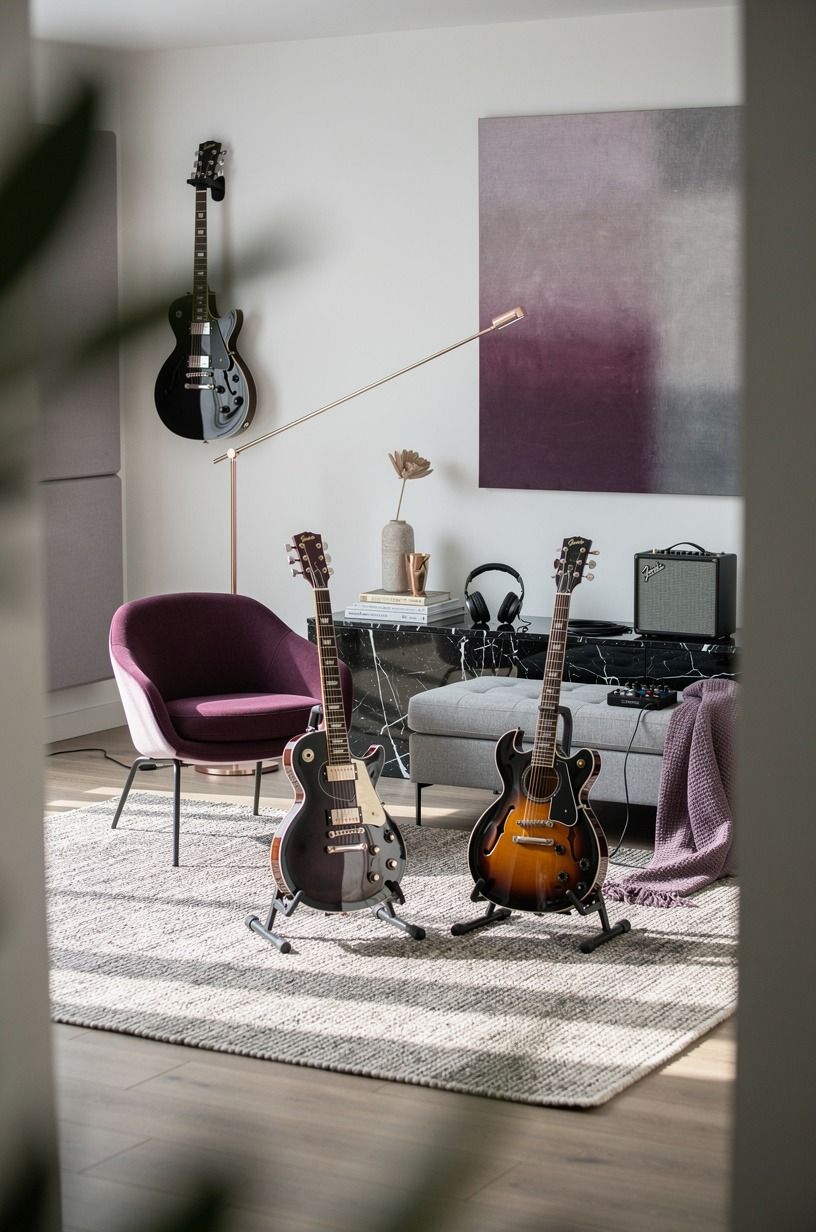
The first thing I changed was the floor, because your guitar room can’t feel settled while every piece floats on bare laminate. I chose a wool rug large enough for the chair legs and guitar stand to overlap it, rather than a tiny rectangle stranded in the center.
You don’t need a patterned carnival underfoot. I went with a muted plum-and-grey weave with rose-gold notes that softened the cables and made the black amp disappear a little.
Article makes good-looking rugs, but I’d skip an expensive pale boucle option here. A dropped capo and a dusty pedal will win that fight by Tuesday.
The rug also changed how I used the room. You can sit on it with a guitar in your lap, and the room feels more inviting before you’ve even turned on an amp. For proportion help, I kept the guidance in this small-room furniture breakdown in mind.
2Hang guitars where you can see them
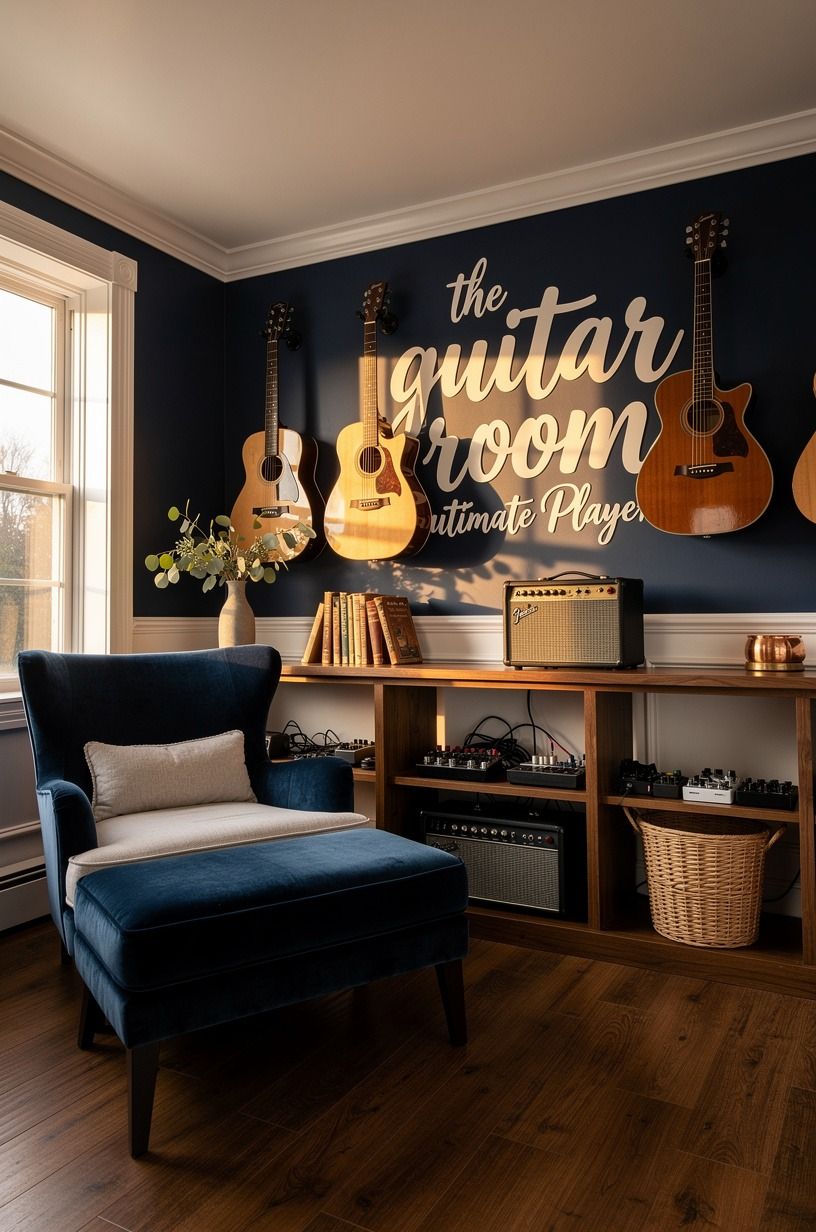
Wall-hanging the guitars was the moment the room stopped reading as storage.
3Paint one wall in Farrow & Ball Pigeon
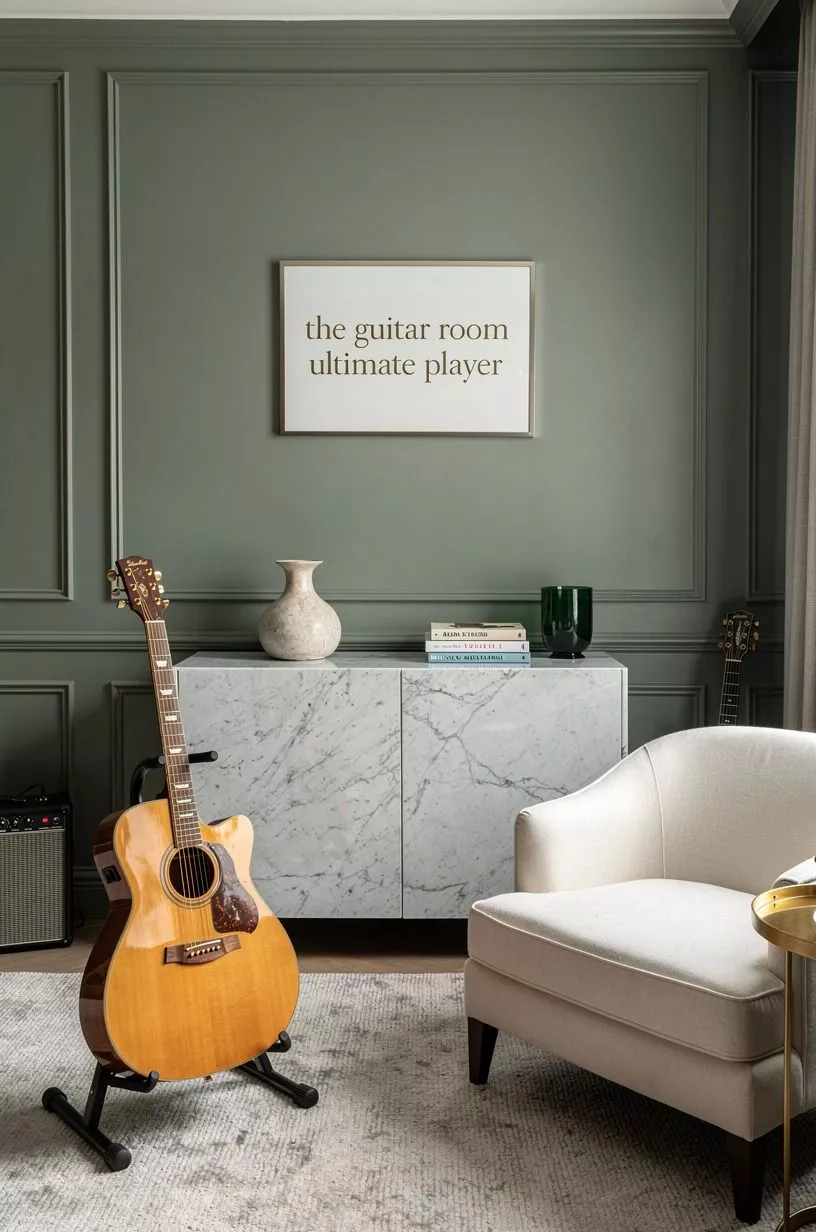
I painted only the wall behind the guitars in Farrow & Ball Pigeon No. 25, a grey-green that shifts softer once the lamp comes on. You don’t need four dark walls to get a moody guitar room aesthetic. One backdrop is enough.
The old beige made every instrument look like it had been left in a rental office. Pigeon gave the maple necks and brass hardware a quiet contrast without making the room feel cave-like.
If your room gets little daylight, I’d choose Benjamin Moore White Dove OC-17 on the other walls instead of reaching for charcoal. Dark paint is dramatic, sure, but darkness isn’t automatically atmosphere.
I used the same restraint I learned from painting one wall to make a room feel bigger. The edge of color makes the room feel intentional, not boxed in.
4Build the Three-Height Light Stack
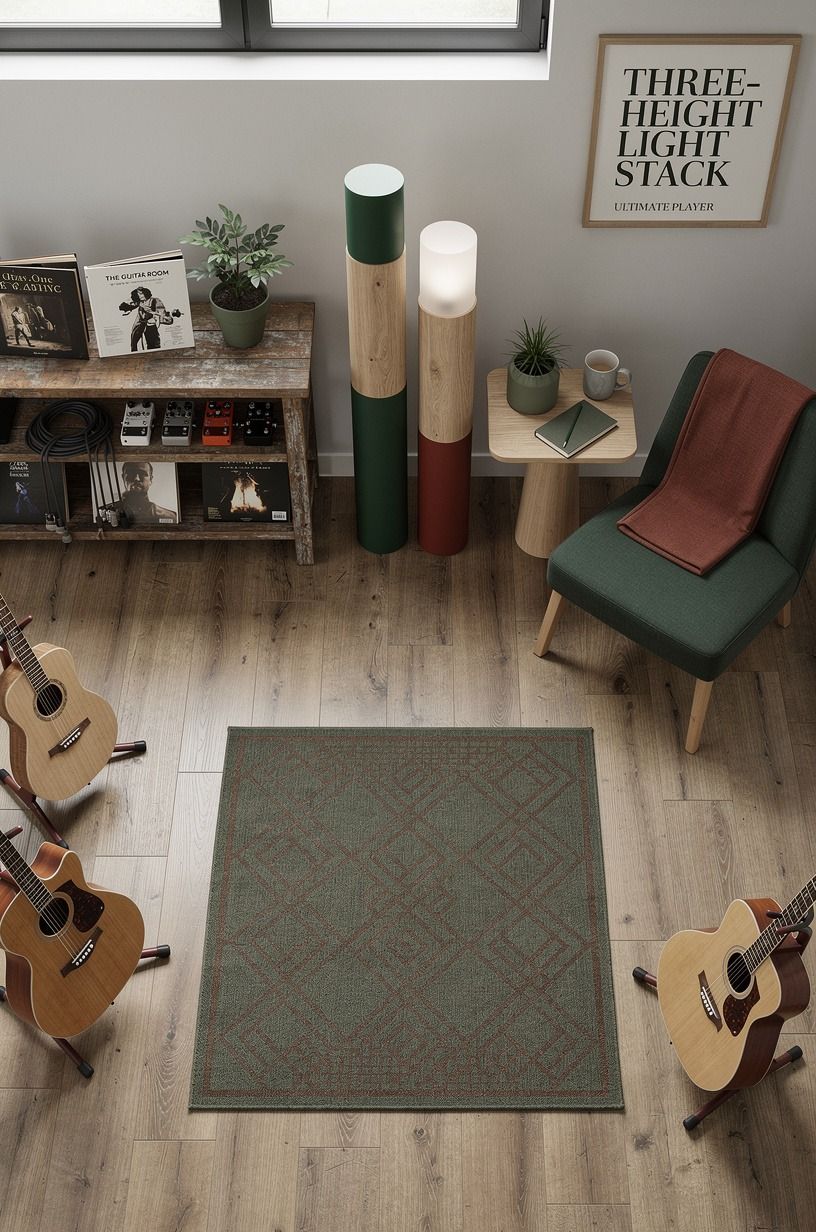
Overhead lighting was the worst part of my old setup. It flattened the guitars and made late-night practice feel like I was waiting for a dentist. So I built a three-source plan: overhead, task, and ambient light.
A matte black swing-arm lamp handles charts and tuning. A low amber glass table lamp warms the shelf. The ceiling fixture stays on a dimmer for cleaning or recording video.
Three sources per room sounds fussy until you try it, then you wonder why you accepted one harsh bulb for so long.
But don’t buy a blue-white LED strip and call it done. That light makes lacquer look cold and your room look like a gaming aisle. I wanted a gentle pool of light over reclaimed weathered teak, not a glowing border around the ceiling.
5Float the desk instead of crowding the amp
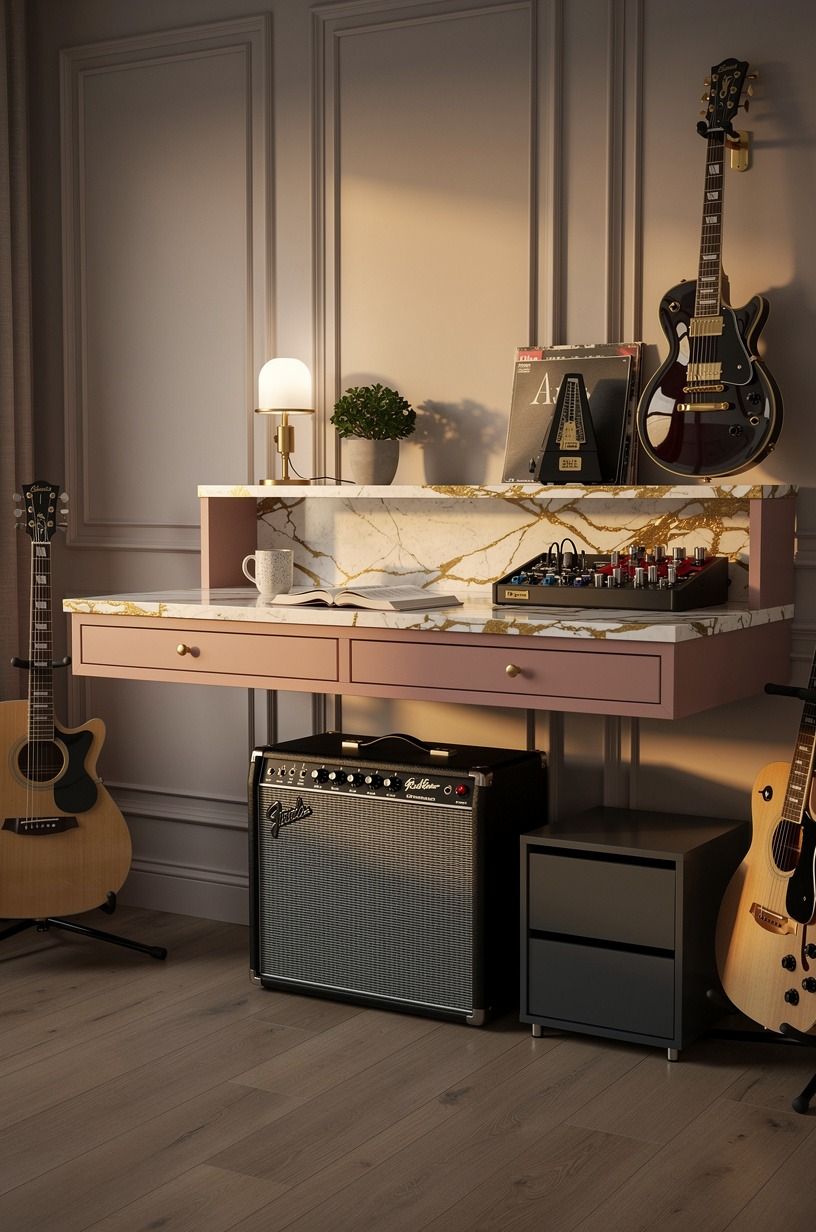
My desk had been pressed against the longest wall because that seemed logical.

6Use the Two-Wood Rule for warmth
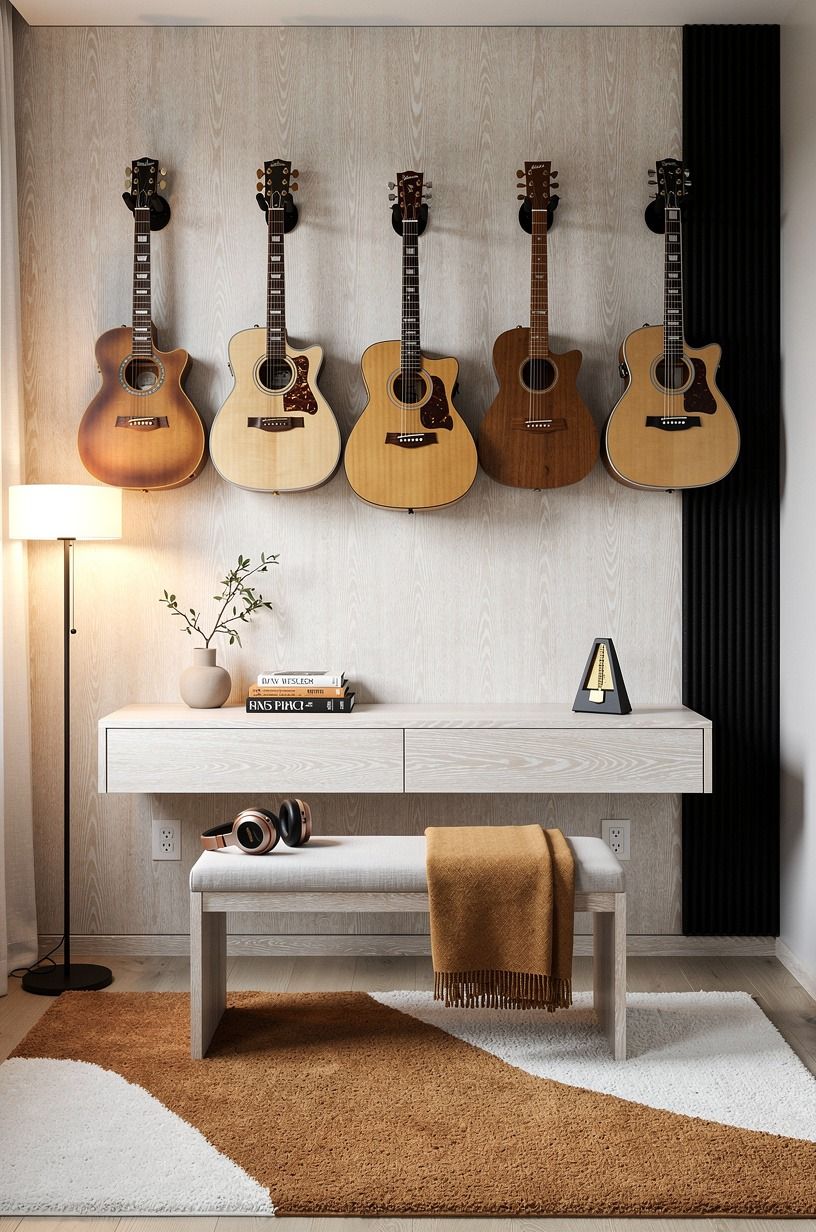
I limited the room to two wood tones: the existing medium oak floor and cerused white oak on the shelf and stool. That rule saved me from buying three more “almost matching” finishes, which always look accidental together.
You can mix wood, obviously. But you need a reason for each one to be there.
The pale shelf catches afternoon light, while the darker guitar bodies keep the wall from looking washed out. A black faux-wood cabinet would’ve been cheaper, but it would’ve made the room feel more corporate than personal.
Short version: let the instruments supply some visual noise. Your furniture can be calmer.
7Can a small guitar room hold a lounge chair?
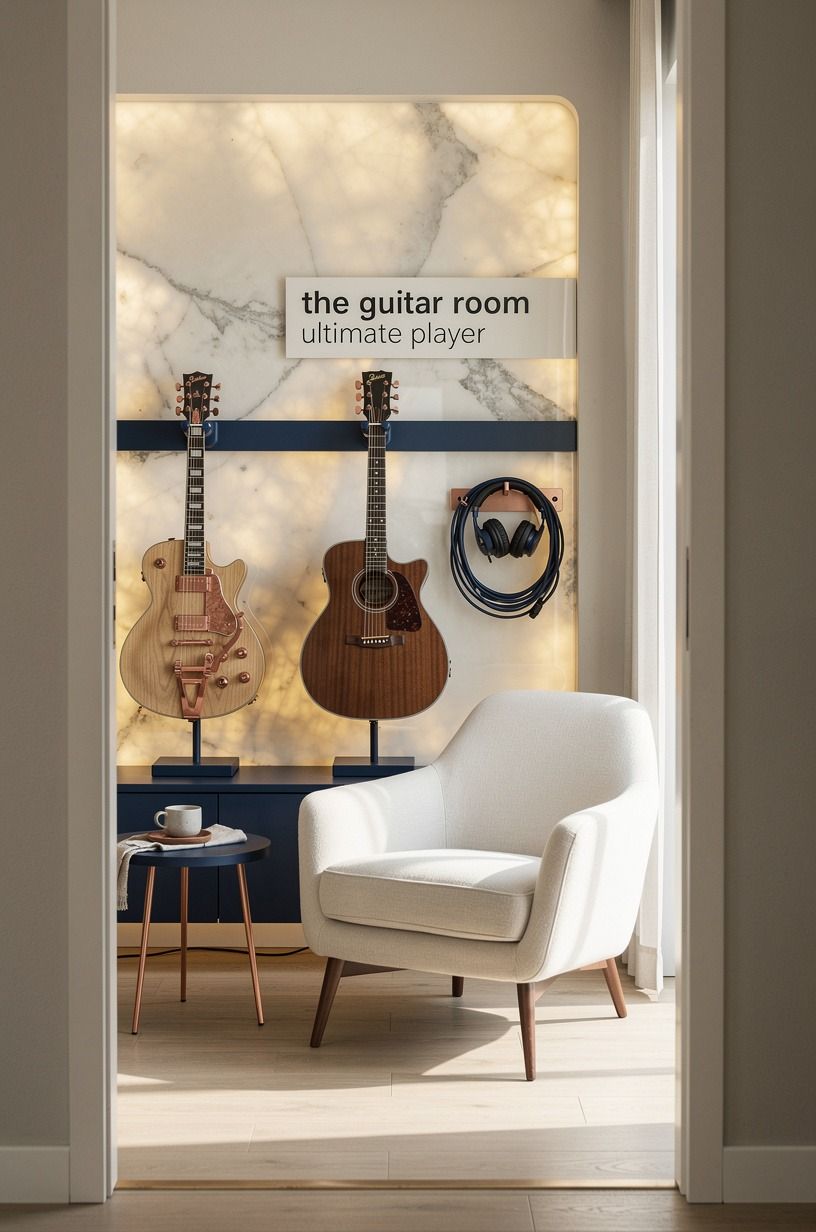
Yes, if you choose the chair before you choose the giant side table. I used a compact CB2 bouclé accent chair with a narrow profile and placed it at the rug corner, angled toward the guitar wall.
You don’t need seating for six in a guitar-themed music room. You need one place where a friend can sit while you play them something, and one place where you can listen back without rolling over to the desk. That little chair became the room’s most-used non-musical object.
I almost bought a deep leather recliner. Honestly, it would’ve swallowed the room whole. A smaller chair leaves an airy path from door to desk, which matters more than a chair that looks good in a product photo.
8Frame the practice corner with linen drapes
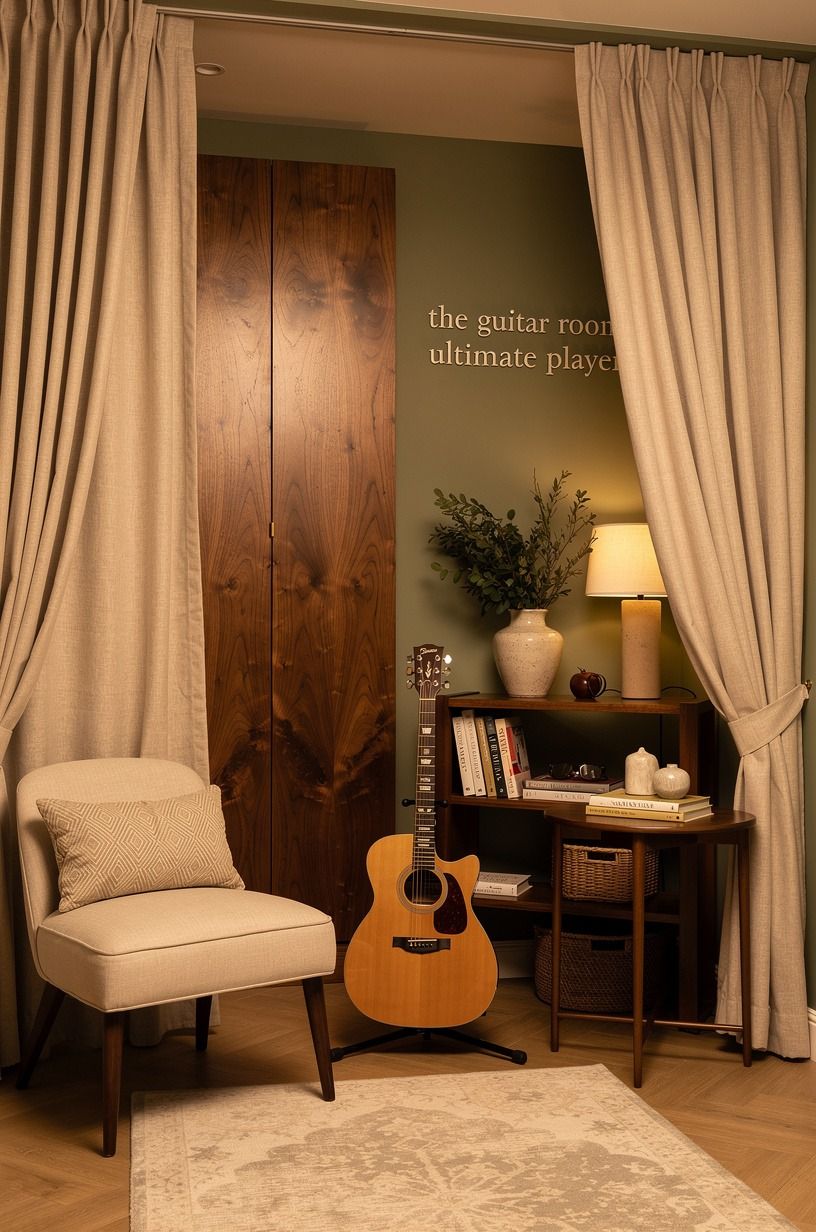
The window needed softness, not blackout theater curtains. I mounted the rod 4 to 6 inches above the frame and used floor-length Belgian flax linen panels in oatmeal.
That extra height makes your ceiling look less apologetic. The fabric moves when the window is open, which gave the room a relaxed, lived-in quality I didn’t expect. I skipped grommets because the shiny rings looked too busy against the instruments; simple pleats felt more refined.
And you don’t have to cover every wall in acoustic foam. Curtains, rug, books, and upholstered seating take the sharp edge off a room while still looking like a room. For a similarly intimate setup, see these small speakeasy room ideas.
9Swap plastic storage for one honest cabinet
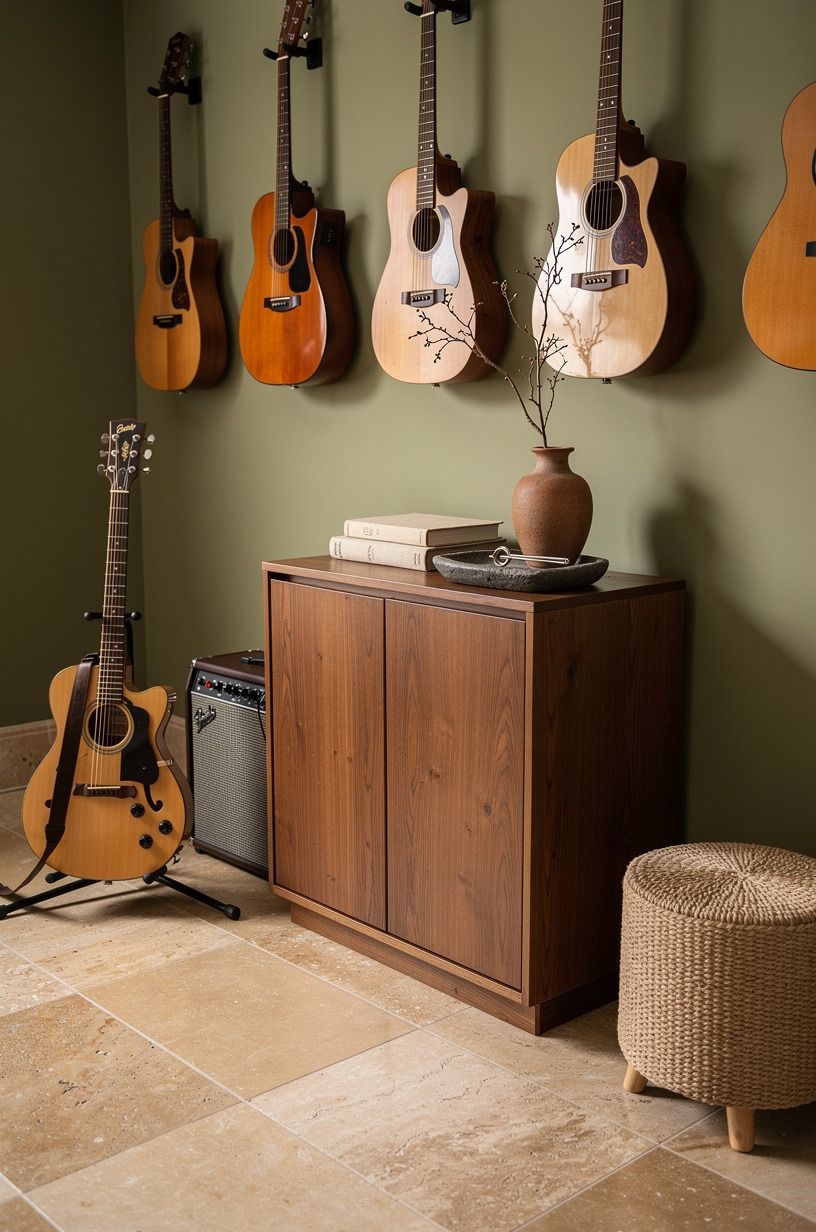
I replaced a stack of plastic drawers with a IKEA HEMNES cabinet in white stain.
10Layer records into the Listening-Ledge Method
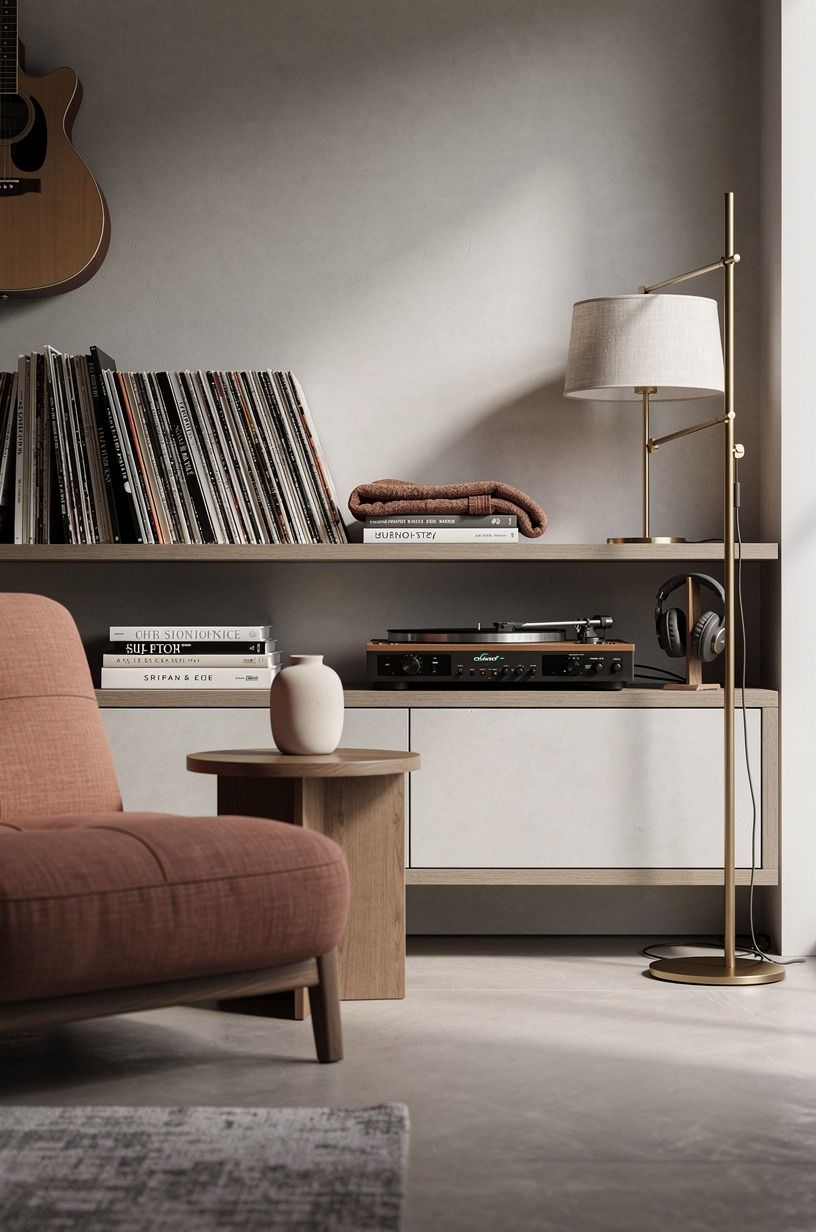
The listening shelf was my favorite low-cost move. I leaned a few records against the wall, added a solid oak picture ledge, and left enough blank space that it didn’t resemble a merch table.
Your taste should show up here, but don’t display every album you own. Pick six covers with color, texture, or a memory attached. A faded blue record sleeve, a black-and-white show photograph, and one small speaker gave me more personality than a wall of generic music prints ever could.
I went back and forth on framed posters versus raw sleeves. Raw sleeves won because they can change with your mood. The room isn’t a museum, and you shouldn’t have to commit to the same image for five years.
11Put a recording nook beside, not under, the guitars
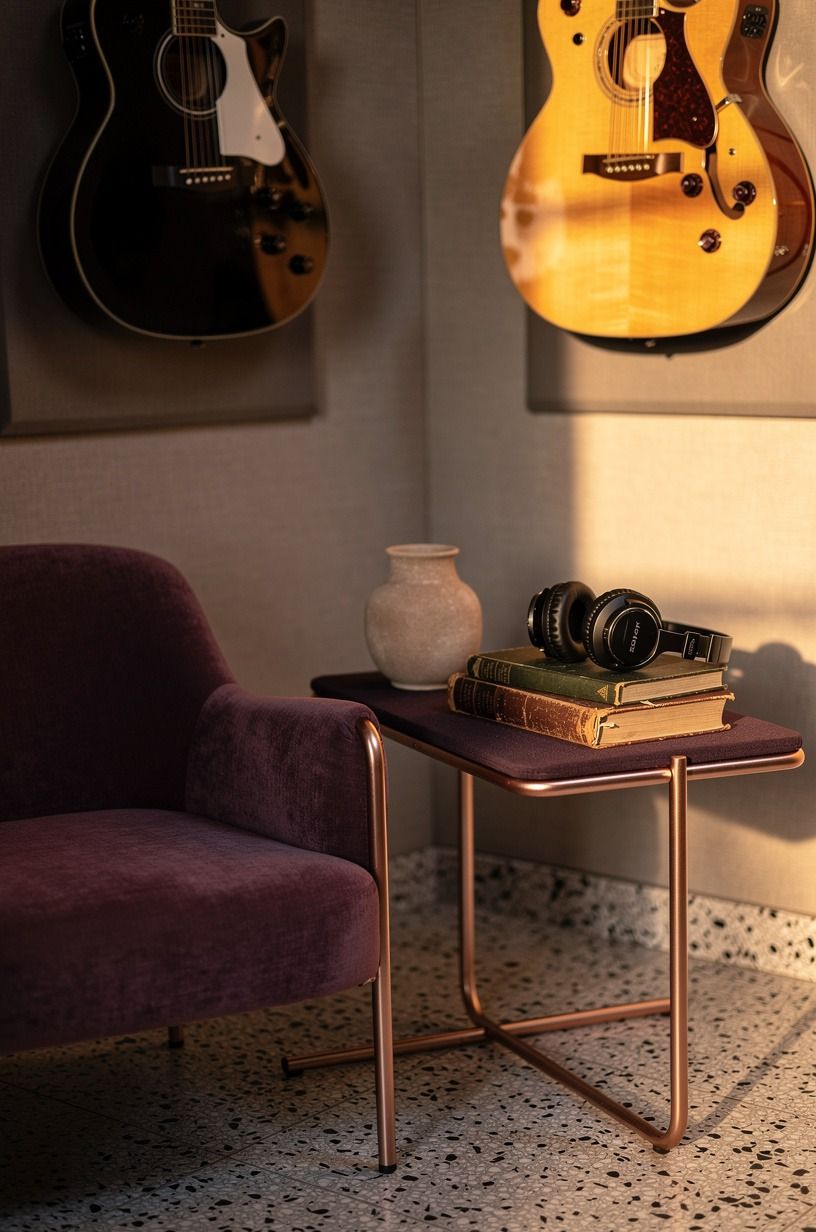
I kept the interface and microphone on the desk side of the room, not directly beneath the hanging guitars. It sounds minor, but separating the zones stopped me from treating practice and recording as the same messy activity.
A Focusrite Scarlett-style interface fits in a shallow drawer, while a black metal boom arm stays clamped to the desk. You can pull it out when an idea hits and push it away when you’re done. No permanent tangle.
But make the recording corner quiet visually. My first setup had too many blinking chargers, and it made me avoid sitting down. One power strip hidden behind the cabinet fixed more than I expected.
Less glare, less friction.
12Choose a guitar room inspiration wall with one big image
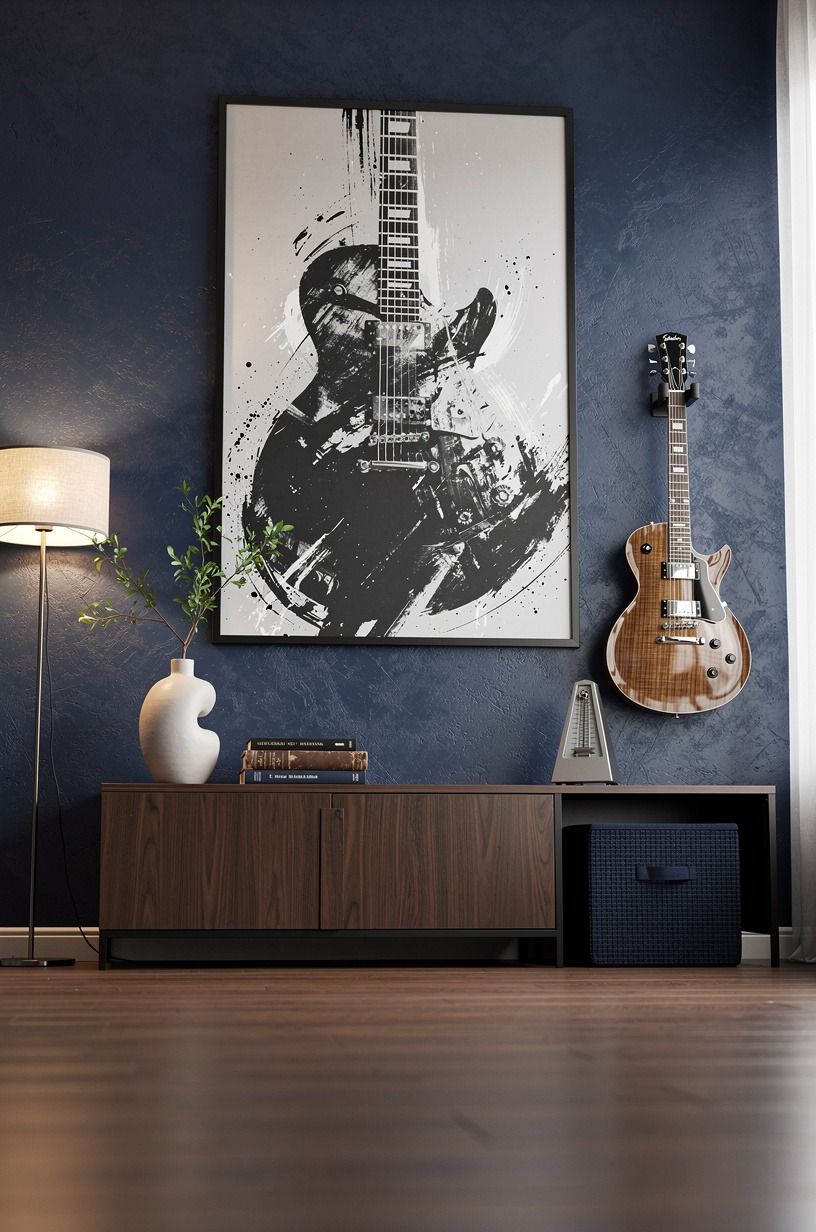
I hung one large black-and-white concert print rather than twelve small pieces of wall filler. Its center sits near 57 inches high, and the wide mat gives the guitars room to remain the stars.
Your art doesn’t have to be a guitar photo. Mine is a grainy crowd shot because it reminds me that music is supposed to be shared, not optimized. A framed lyric sheet, a vintage venue map, or a portrait of someone you love works better than a mass-market sign that says “Rock On.”
I learned this from looking at music room ideas for a creative haven: one strong story beats a scattered wall every time.
13Add a low shelf for cases and cables
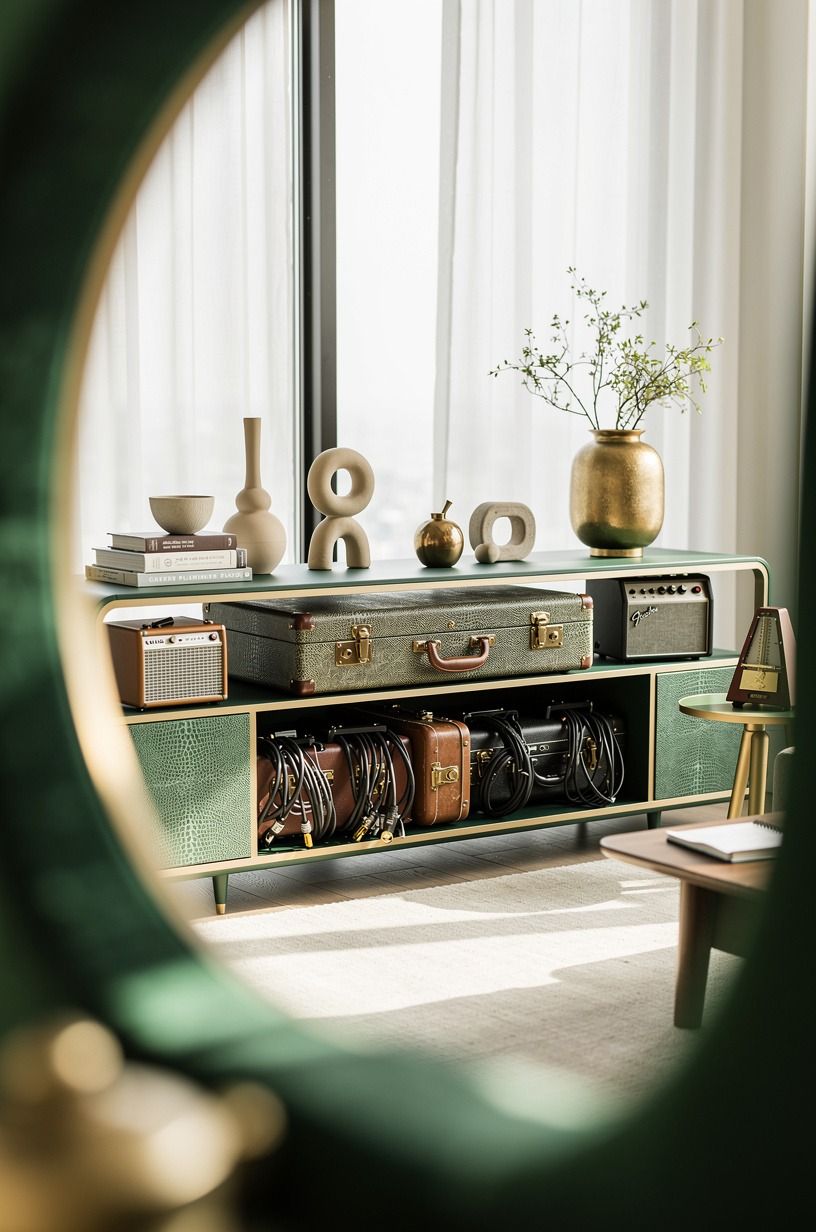
Cases are ugly only when they don’t have a designated landing spot. I used a low powder-coated steel bench beneath the window, with soft felt pads so the hard cases wouldn’t scrape the floor.
You can slide a case beneath it, keep a gig bag beside it, and still have a surface for a record sleeve or a cup of tea. The bench is doing several jobs, which is why it earned its place. A tall shelving tower would’ve given me more storage, but it would’ve cut the room in half.
This is the part people skip when copying a photo. Your room needs a place for the unphotogenic gear, or it won’t stay serene after the first practice session.
14Borrow mood from a moody powder room
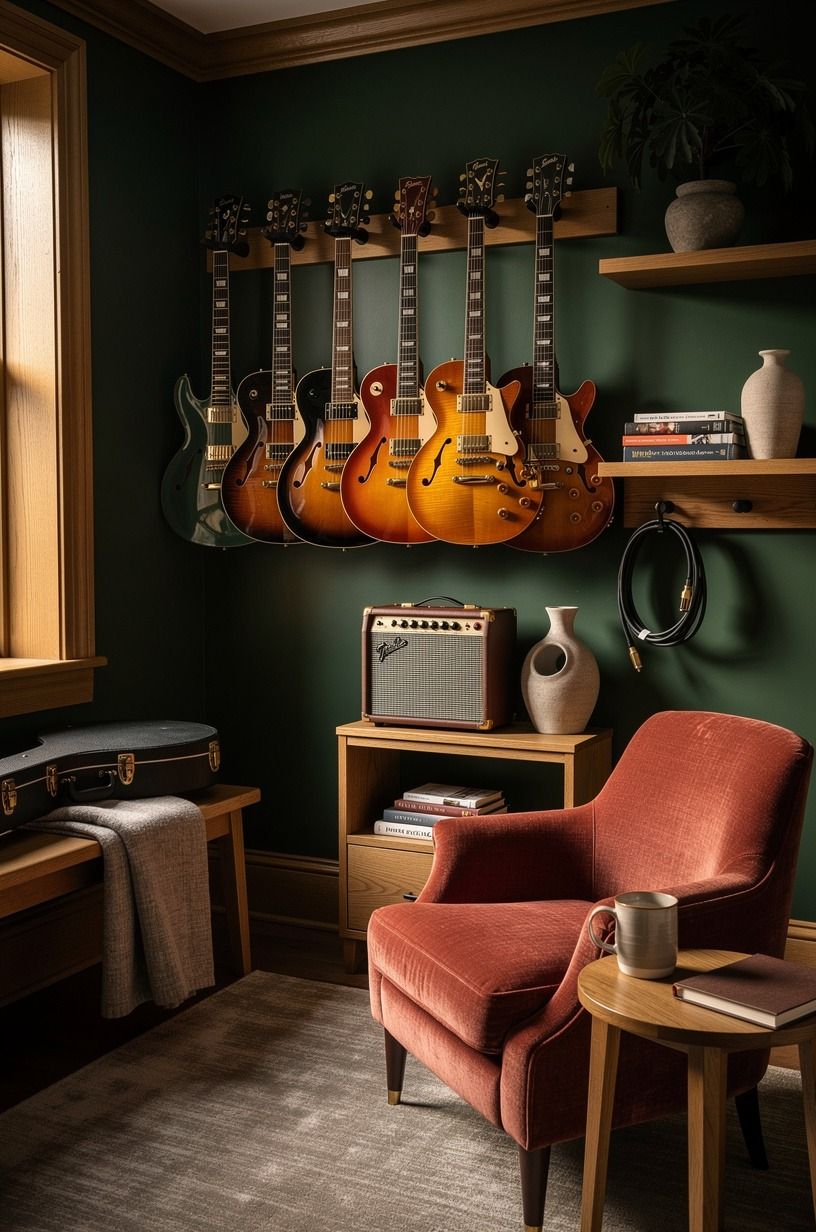
I used tiny dark notes instead of covering the room in black: an aged bronze lamp base, charcoal frames, and a deep burgundy cushion.
15Make the last corner useful for people
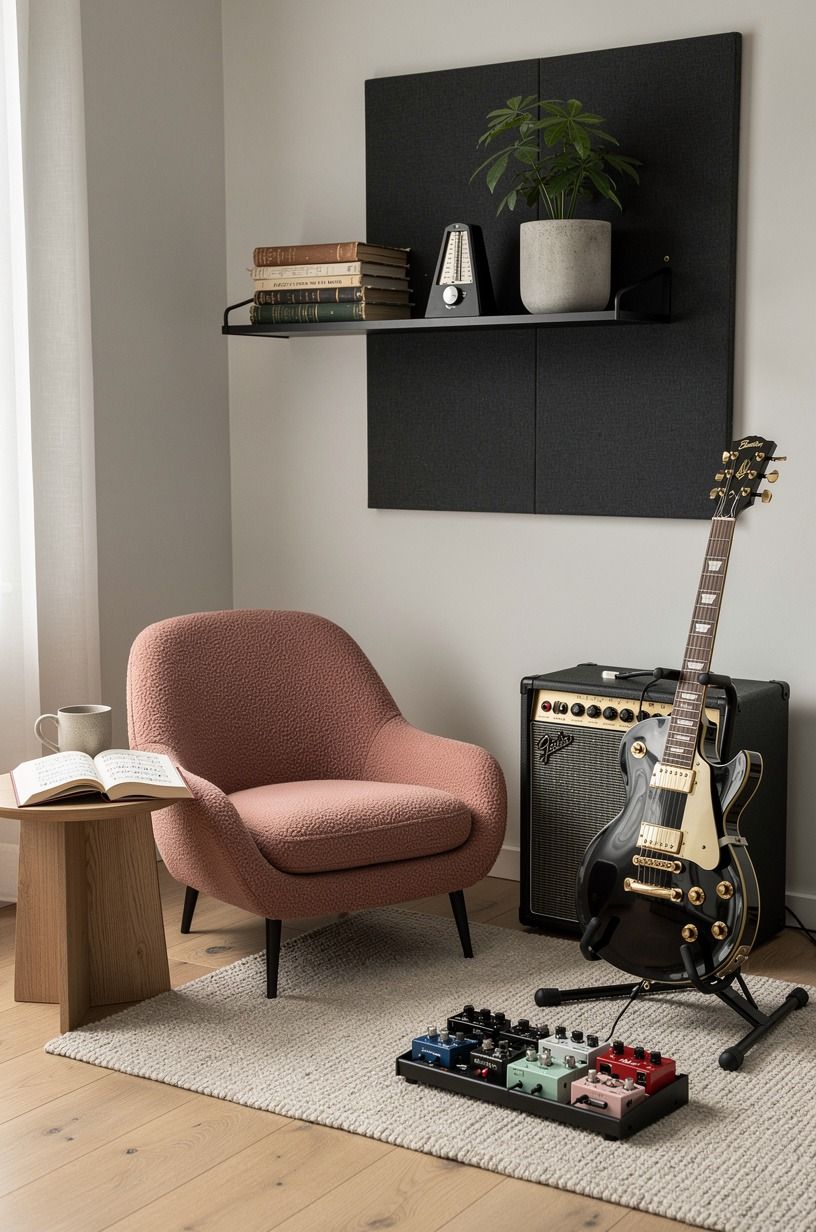
The final corner got a small round Target Threshold side table, a paper-shade lamp, and a basket for blankets. Not another guitar stand. Not a tower of pedals.
That corner tells you that the room is for lingering, not just storing expensive objects. When someone visits, they have somewhere to put a drink.
When you’re playing alone, you can set down a notebook without balancing it on an amp. Basic, but useful.
And that’s the difference. A player’s room should feel like it welcomes the person holding the guitar, not only the guitar itself!
How much it cost
My version landed in the Budget tier because I painted, reused a desk, and bought slowly. The typical US ranges below are useful guardrails, not a demand to spend all at once. You can build this room over a few paychecks, and I think that usually produces a more personal result.
My spend went first to paint, the rug, hardware, and lighting. A typical wool rug runs $400 to $1,500, linen drapes run $120 to $400 a pair, and a statement fixture can range from $150 to $800. You don’t need all of that on day one.
Why I stopped treating this room like a gear closet
I used to believe a guitar room had to prove how serious I was about playing. More stands.
More visible pedals. More black boxes with tiny lights. I thought the evidence of the hobby was the hobby itself.
It wasn’t. The room looked busy, and busy made it oddly hard to begin.
I’d walk in, see the cables, and decide I could practice later.
What changed was admitting that I wanted a room for the person behind the instrument. I wanted somewhere comfortable enough to play badly, start again, leave a song unfinished, and sit with it. That means there should be softness under your feet, a lamp that doesn’t punish your eyes, and storage that lets you put things away without making the room bland.
A guitar is already a sculptural object. You don’t need to decorate around it like it’s a fragile trophy.
I also learned that “music room” can become a costume. There are lots of rooms online that look impressive and feel unusable, filled with signs, neon, and equipment placed for a camera angle.
I’d skip that version. It asks you to perform being a musician before you’ve played a note.
My room is quieter now, a little imperfect, and far more comforting. The scratched stool stays.
So does the old poster with the bent corner.
That shift made practice easier. Not because the room is luxurious, but because it gives me fewer excuses to leave.
What People Always Want to Know
What is the best guitar room setup for a small player space?
A wall-hung guitar display plus a narrow IKEA KALLAX is the best small-space start because it protects floor area. Keep your chair on a rug edge, not in the middle of the path, and let one lamp make the corner feel warm.
Where can I buy guitar room pieces on a budget?
Start with IKEA, Target, and Wayfair, then check Facebook Marketplace for chairs and framed art. Your best buys are usually plain pieces with good bones: a wood stool, a wool-blend rug, and a lamp with a soft shade.
How much does a guitar room makeover cost?
A guitar room makeover can cost about $200 to $800 if you paint, reorganize, and reuse what you own. Free changes include moving furniture, editing wall art, and routing cables into one concealed basket.
Can I create a guitar room on a budget?
Yes, and you don’t need a custom studio to make it work. Focus on visible guitars, one used rug, and warm lighting. A painted accent wall, existing books, and a thrifted side table can carry the room.
Is a guitar room worth it in a small space?
Yes, a small guitar room is worth it because the compact layout keeps everything within reach. Use vertical storage and leave one clear route through the room. Your setup will feel more intimate, not cramped.
Is a guitar room a good idea for a rental?
Yes, rentals can handle a guitar room with removable choices. Use removable picture strips, tension-rod curtains, and freestanding storage. For wall hangers, get landlord approval or use a sturdy floor rack that doesn’t crowd the doorway.
Where I’d Start First
If I had to pick one, I’d start with wall-hanging the guitars. You can’t make a room feel personal while its best objects are hiding in cases or leaning dangerously in corners. Pin that move for later, then let the rest of your room grow around what you play.