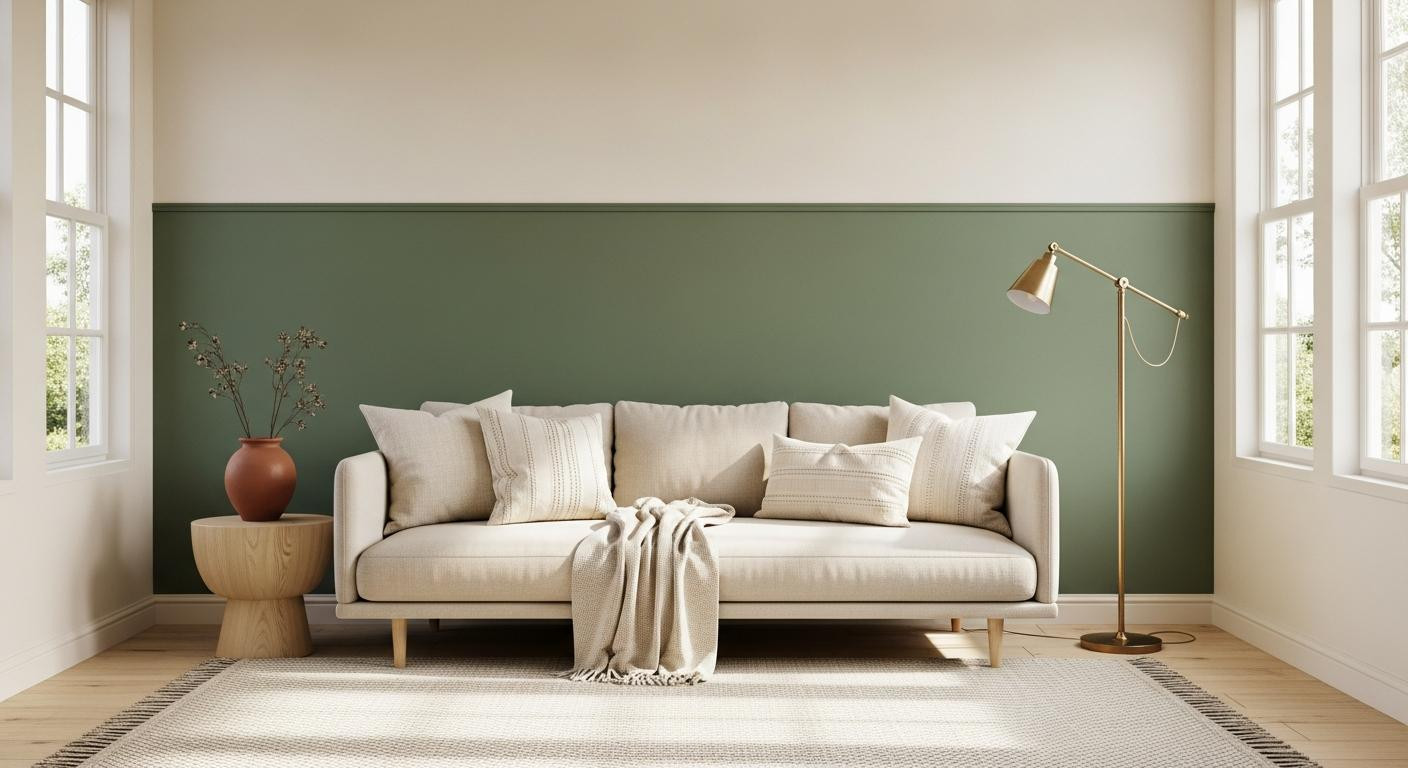
Your living room measures 14 feet by 16 feet with beige builder-grade paint on all four walls. You’ve saved $240 since January for a refresh but can’t commit to painting the entire space because you chose the wrong gray in your bedroom two years ago and repainted twice. One wall painted in 90 minutes Saturday morning changes how the room photographs without the risk of four-wall regret. The accent wall creates a focal point that makes furniture arrangement obvious, gives your eye somewhere to rest, and costs $60 in paint instead of $180 for the full room.
Why painting one wall works when four walls overwhelm
Your brain processes a single painted wall as intentional design rather than incomplete work. The contrast between three neutral walls and one saturated wall creates depth, making 14-foot rooms feel either more intimate or more spacious depending on color temperature. Interior designers with residential portfolios explain that accent walls solve the “where do I look” problem in rectangular rooms where no architectural feature naturally draws attention.
The technique works because it creates hierarchy without requiring you to commit to a color in every sightline. If you hate it, you repaint one wall, not four. And that’s exactly the point for anyone who’s lived with paint regret for 18 months.
The wall that creates impact versus the wall you’re staring at
Your accent wall needs 8 feet of continuous surface without windows, doors, or major furniture blocking the view. The wall behind your sofa measures 12 feet corner to corner but the sofa covers 7 feet, leaving fragmented sections on each side that won’t create impact. The wall opposite the entry where your eye lands first when you walk in, that’s your accent wall.
Count furniture that sits against the wall as obstruction. Dressers, bookcases, floor-to-ceiling storage all disqualify a surface. The rule professionals follow: paint the wall you see when entering a room or the wall that appears in photos taken from the doorway, not the wall you face while seated.
But here’s where most people get it wrong. Your neighbor painted the wall behind her TV, the surface she stares at 3 hours nightly. Accent walls work when you see them in your peripheral vision, not when they’re your constant focal point. By month two, that wall creates fatigue instead of interest.
What one gallon actually covers in your living room
Sherwin-Williams Emerald Interior covers 300 to 350 square feet per gallon in real conditions, not the 400 claimed on the label. A 9-foot-wide by 8-foot-high accent wall measures 72 square feet, requiring roughly a quarter gallon for two coats. At current pricing with April promotions, that’s $60 for your accent wall versus $180 for all four walls in a standard room.
The math changes fast when you add a second wall. Two accent walls in different rooms cost $120, still cheaper than one full room. And that’s how the trick spreads through your house over six months instead of one panicked weekend.
Finish matters more than most people think. Flat paint looks sophisticated in photos but shows every handprint in living rooms where people lean against walls during parties. Eggshell finish at 10 to 25 percent sheen hides minor scuffs while maintaining the matte look Instagram prefers.
The ceiling height problem nobody mentions until month three
Rooms with 8-foot ceilings need paint 2 to 3 shades lighter than the swatch looks in-store. The compressed vertical space intensifies color saturation in a way that catches you off guard two weeks after the paint dries. Navy reads almost black. Sage reads like forest green. Terracotta reads like rust.
Test your paint on a 2-foot by 2-foot board, prop it against the target wall, and photograph it at 10am, 3pm, and 7pm. The 7pm test reveals how artificial light will render the color 60 percent of the time you’re actually in the room. Warm overhead bulbs shift cool grays toward beige, and that’s the version you’ll see most nights.
Design professionals with ASID certification recommend living with sample boards for two weeks minimum, not the 48 hours most people give themselves. That’s long enough to see the color in rain, direct sun, and the flat gray light of February afternoons.
What happens when the accent wall actually works
You stopped noticing the accent wall by week six, which means it integrated into the room instead of screaming for attention. Guests mention “something different” without identifying the single painted wall specifically. Your furniture arrangement hasn’t changed but the room photographs better because the painted wall creates depth in flat iPhone images.
At month three, you’re considering a second accent wall in the bedroom. But slower this time, living with paint samples for two weeks instead of choosing from the fan deck in the parking lot. That’s the learning curve this trick creates without the stakes of a full room.
The painted wall catches morning light differently than the three beige walls. It holds shadows in the texture where your roller missed a spot near the baseboard. And that variation, the proof of your hand in it, makes the room feel less like a rental and more like a space you actually decided to shape.
Your questions about the one-wall paint trick answered
Should I paint the longest wall or the most visible wall?
Most visible wins. The longest wall often includes windows or doors that break up the surface. Paint the wall you see first when entering the room or the wall that appears in photos taken from the doorway. In L-shaped rooms, paint the wall that defines the primary seating area, not the one that wraps around the corner.
Can I use the same color in multiple rooms?
Yes, if you’re painting different wall positions in each room. The same deep color works as an accent wall behind your bed, behind your dining table, and in your entry. The repeated color creates cohesion while the different applications keep it from feeling like a formula. But avoid painting every accent wall in the same position, it reads more like a template than intention.
Does this work in rentals?
Most landlords allow single accent walls if you return the wall to original color before moving out. Save a quarter of the original paint for touchups, beige builder paint fades over 2 to 3 years and won’t match new paint from the store. Cost: $60 for accent color, $15 to return it to beige. That’s still cheaper than most multi-room transformations you’ll regret removing.
Saturday morning, 11:47am, the accent wall behind your sofa catches diagonal sunlight through west-facing windows, paint still slightly tacky where the roller missed a spot near the baseboard. The room already feels different, taller somehow, the three beige walls receding into background while the single painted surface holds your attention without demanding it.