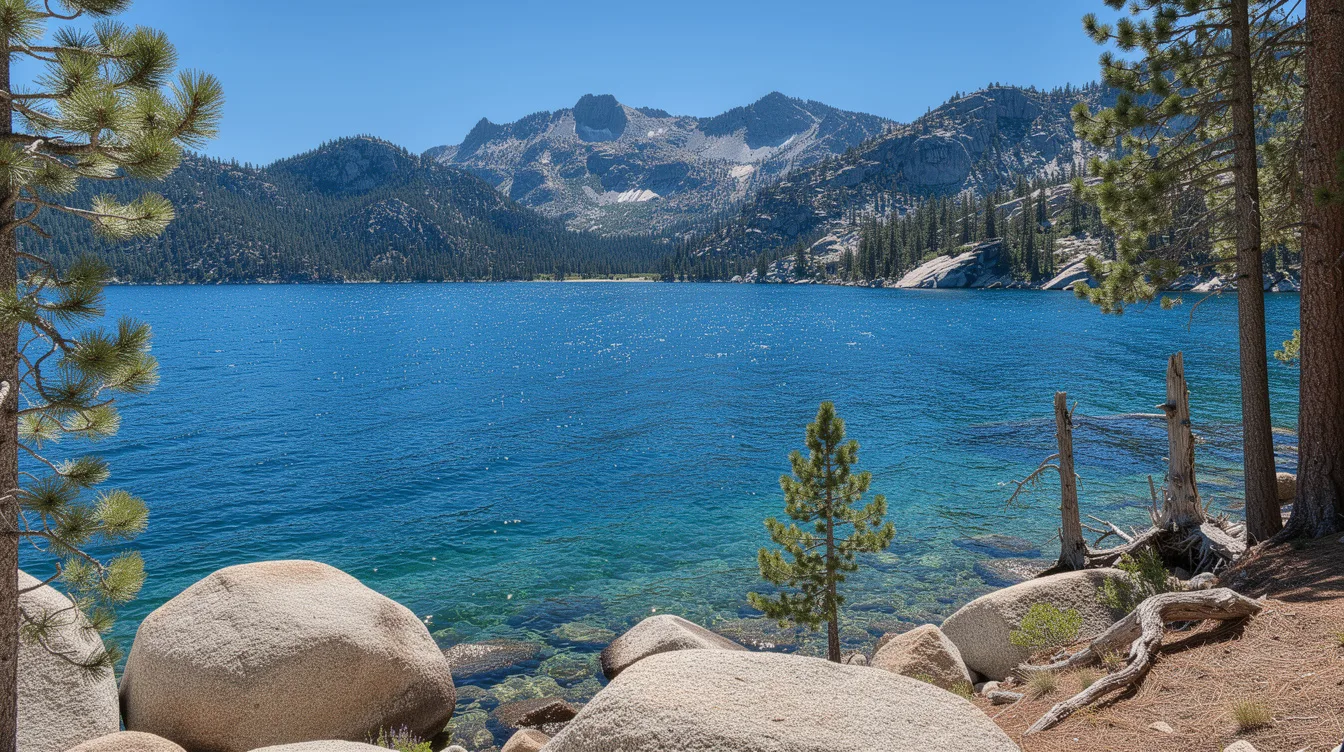
Lake Tahoe reaches a maximum depth of 1,644 feet, making it the second-deepest lake in the United States after Crater Lake in Oregon. That number matters because Tahoe is not a small mountain pond with a dramatic backstory. It is a vast freshwater lake whose blue surface can make the far shore feel farther away than it is.
And it sits high in the Sierra Nevada, on the California-Nevada border near South Lake Tahoe. The lake is busy in summer and snowy in winter, but its depth gives the place a seriousness that beach photos rarely capture.
Why 1,644 feet changes the view
At 6,225 feet above sea level, Tahoe already feels elevated before you get near the water. Then you learn the lake drops 1,644 feet at its deepest point, and the wide blue expanse starts to read less like a lake and more like an inland sea.
But Tahoe is broad as well as deep. It runs about 22 miles long and 12 miles wide, so wind, light, and weather have room to change the mood from shore to shore. You may see a calm morning turn silver under a shifting sky.
The comparison with Crater Lake is precise, not promotional. Crater Lake reaches 1,949 feet, while Tahoe follows behind as the country’s second-deepest lake. Tahoe’s appeal is different, though: you can experience its scale from towns, beaches, state parks, and a highway that stays near the shoreline for much of the route.
South Lake Tahoe gives you the easiest start
South Lake Tahoe is the main California-side base for hotels, restaurants, lake activities, and access to Heavenly Mountain Resort. That makes it practical if you want a full day without spending it arranging logistics. It is also the busiest part of the California shore.
And that trade-off is real. You get more choices close at hand, but you also share the lake with plenty of other visitors during the warm season. If you like your mountain trips quiet, use town as a base rather than the whole experience.
The California side holds about two-thirds of Tahoe’s shoreline. Because much of the surrounding area is state parkland or protected by the U.S. Forest Service, you can move beyond the hotel corridors without leaving the basin’s defining mix of forest, rock, and water behind.
Emerald Bay is famous for a reason
Emerald Bay State Park is Tahoe’s best-known bay, and it earns the attention. Fannette Island sits offshore, while Vikingsholm gives the inlet a built landmark among the surrounding slopes. You will find a place made for looking outward, then looking again.
But fame brings company, especially from June through September. Go with patience, and let the bay’s shape do the work. The shoreline pulls your eye inward, while the lake beyond it keeps the scene from feeling enclosed.
For a different California-side stop, D. L. Bliss State Park has coves, rocky shoreline, beaches, and hiking.
It is a better fit when you want your Tahoe day to involve water at your feet, not only a viewpoint through a windshield.
Can you swim in Lake Tahoe?
Yes. June through September is the recommended period for swimming, boating, beaches, and hiking. The concession is simple: this is also when crowds rise and accommodation costs more, so you should expect the lake to feel popular rather than private.
And the setting stays high-country even in summer. Tahoe’s altitude keeps the place from reading like a conventional California beach break. Pack for the lake, but also for mountain conditions that can change the feel of an afternoon.
The northwest shore slows the pace
Tahoe City sits on the northwest shore near the lake’s outlet and the Truckee River. It feels less like a resort hub than South Lake Tahoe, which is exactly why it works for travelers who want room to wander between meals and waterfront views.
The Truckee River carries Tahoe’s water northeast toward Pyramid Lake in Nevada. That outlet is a useful reminder that the lake is part of a larger watershed, not simply a scenic backdrop. Development-related sediment and nutrients have affected its water clarity over time.
Farther along the north shore, Kings Beach is a popular beach area. You will not have it to yourself in peak summer, but it gives visitors a straightforward way into Tahoe’s water-and-sand side without treating the lake as something to admire only from above.
Pick the season that fits your tolerance for crowds
Summer is Tahoe at full volume. The beaches fill, boats appear, and hiking becomes part of the daily rhythm. If you can accept higher prices and more people, June through September offers the broadest range of lake-centered days.
But October has a persuasive argument: quieter trails and scenic drives, with variable weather and some seasonal closures. April and May also bring lower crowds, waterfalls, and late-season skiing, though mountain weather can be unpredictable.
From December through March, skiing and snowboarding take over at Heavenly, Palisades Tahoe, and Northstar. Snow driving conditions are the cost of entry, and the lake weather is cold. By the time evening settles over the shore, Tahoe’s dark water still holds the mountains in silence.