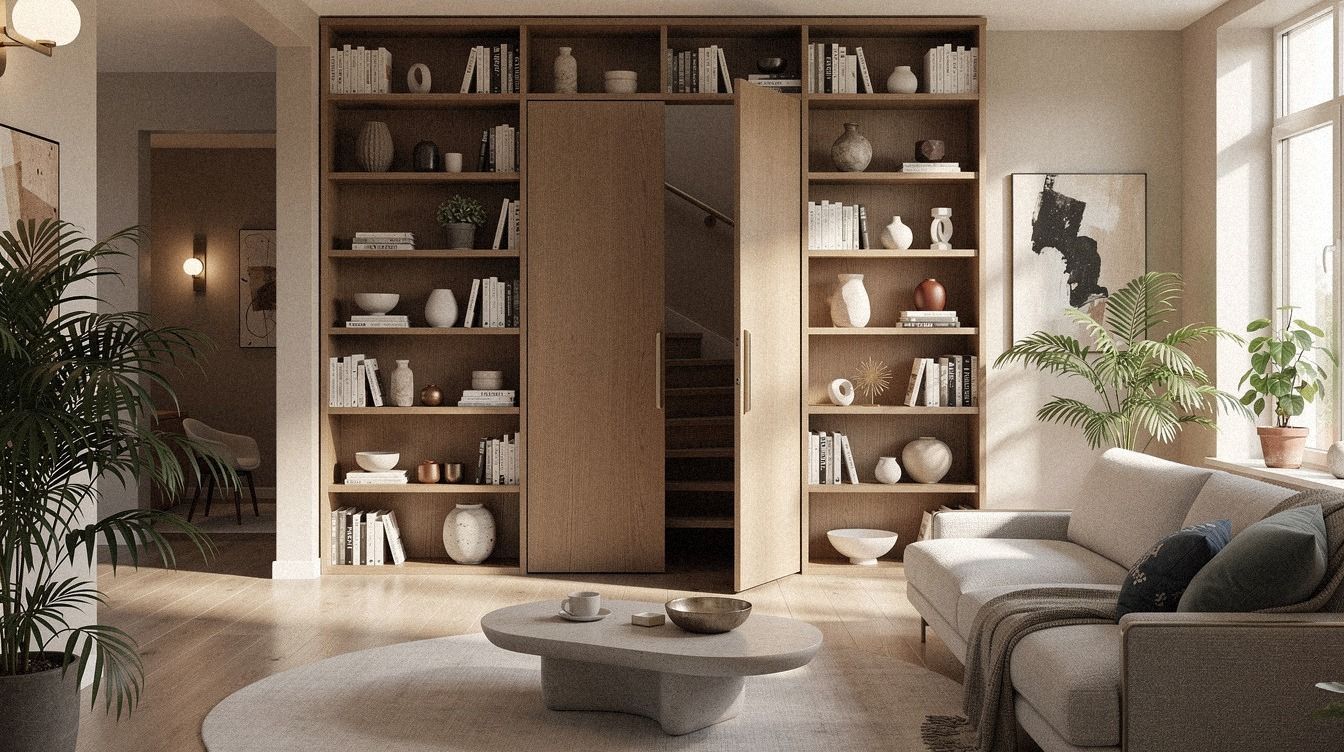
Underground & basement secret room ideas work best when they answer one simple question fast: where do you hide access without making your living room feel staged? I learned that the hard way after treating one lower-level entry like a novelty instead of part of the room. It looked clever for a week. Then it just looked fussy. If you want your wasted space back, the move isn’t more drama. It’s better disguise. Much better! And the payoff isn’t just storage. It’s a quieter main floor and a second room you actually want to walk down into. So much better than I expected!
- Disguise the stair wall with bookcase panels
- Install a floor hatch beside the sectional
- Wrap the entrance in stone veneer
- Sink a speakeasy lounge below the sofa
- Camouflage the door with fluted wood slats
- Build a trapdoor coffee table landing
- Hide storage behind a fireplace surround
- Panel the basement wall in dark walnut
- Create a sunken reading pit downstairs
- Frame a concealed bar with arched millwork
- Blend a vault door into gallery walls
- Light the stairwell with bunker-style sconces
- Why does a basement entrance need its own color story?
- Should you build the hidden panel before or after the basement is finished?
- Is the Benjamin Moore White Dove basement wall worth the upgrade?
- Build a slim wine cellar behind a false closet door
- Hide the laundry behind a rolling barn-style panel
- Tuck a podcast booth into the smallest dead corner
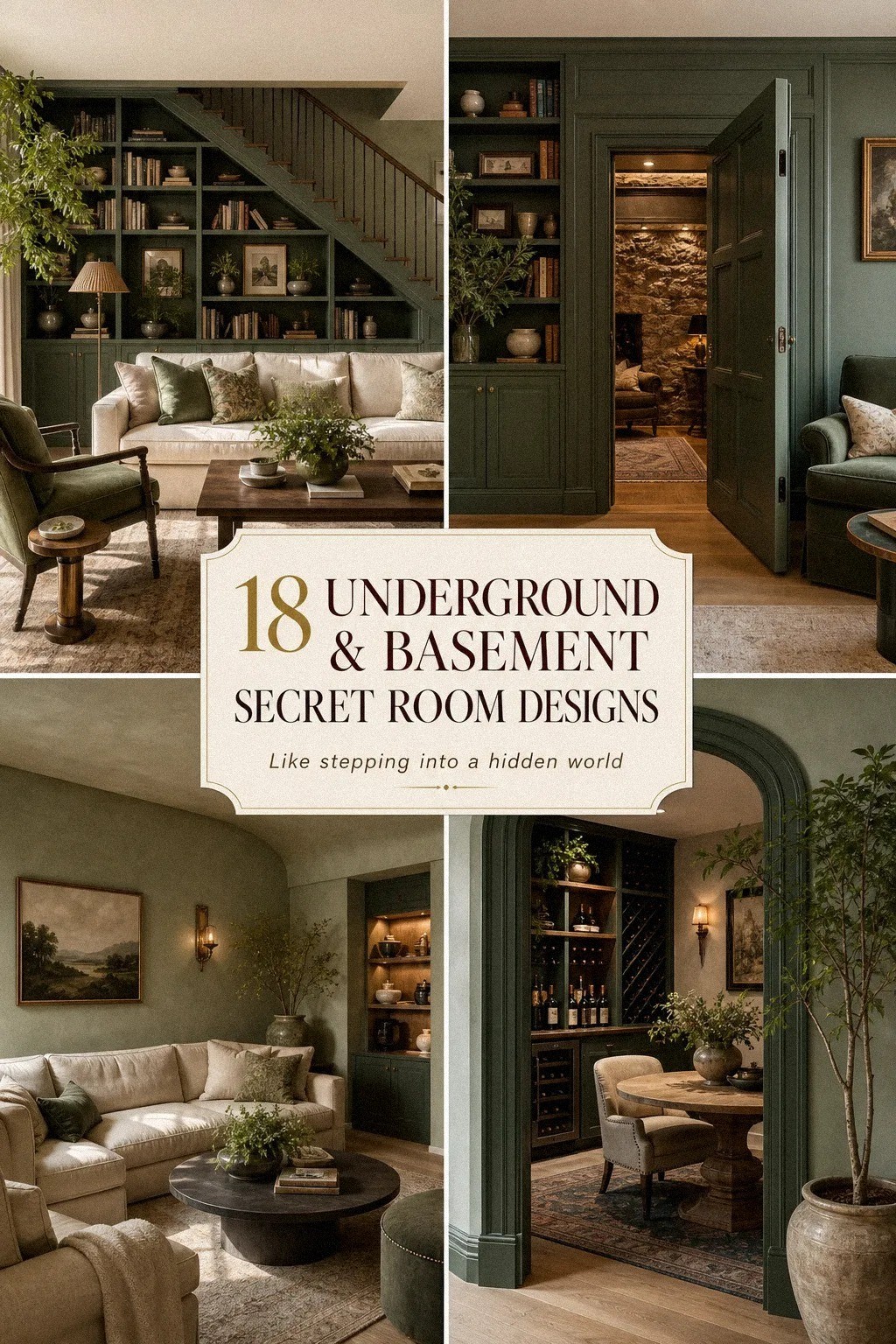
1Disguise the stair wall with bookcase panels
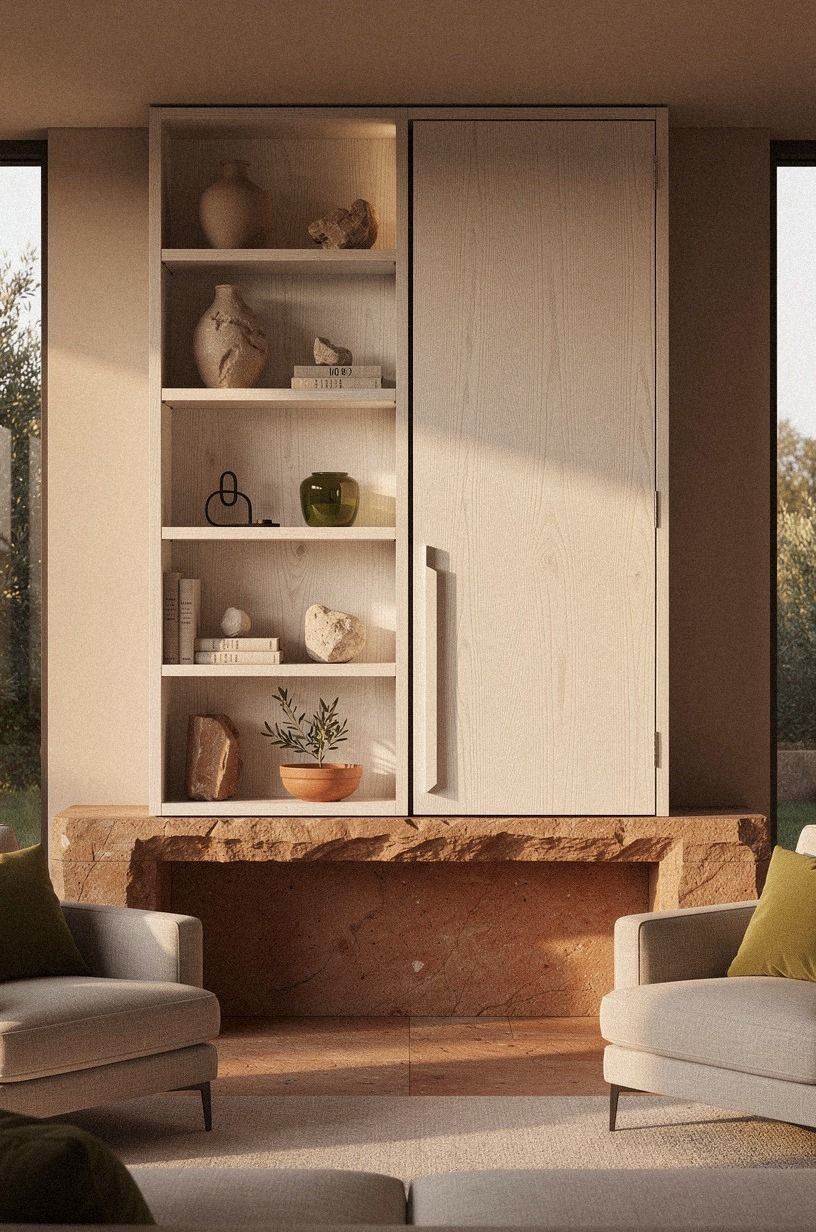
Start with the stair wall if your living room already needs storage, because that’s where a hidden basement ideas plan looks least forced. When you wrap the opening in cerused white oak bookcase panels, the entry reads like built-in millwork first and a passage second. I like a 3/4-inch solid white oak face frame here, not veneered MDF, because the edge detail matters when the door line gets close to eye level.
You want the shelves to earn their keep. A row of art books, a low ceramic bowl, one IKEA KALLAX birch-effect basket insert for messy cords, then stop. Too much decor gives the panel away.
And let one dovetail joint stay visible on a middle shelf, because that tiny construction clue makes the whole wall feel custom instead of theatrical.
If your room already has awkward dead space near the stairs, these under-stairs hideaway ideas help you think through shelf depth before you build. I’d keep the finish warmer than your drywall trim. You want the bookcase to feel collected, not invisible.
Same warm-pale philosophy applies when you go one layer deeper into this hidden closet hideout guide, because the small-room versions live or die on the same trim detail.
2Install a floor hatch beside the sectional
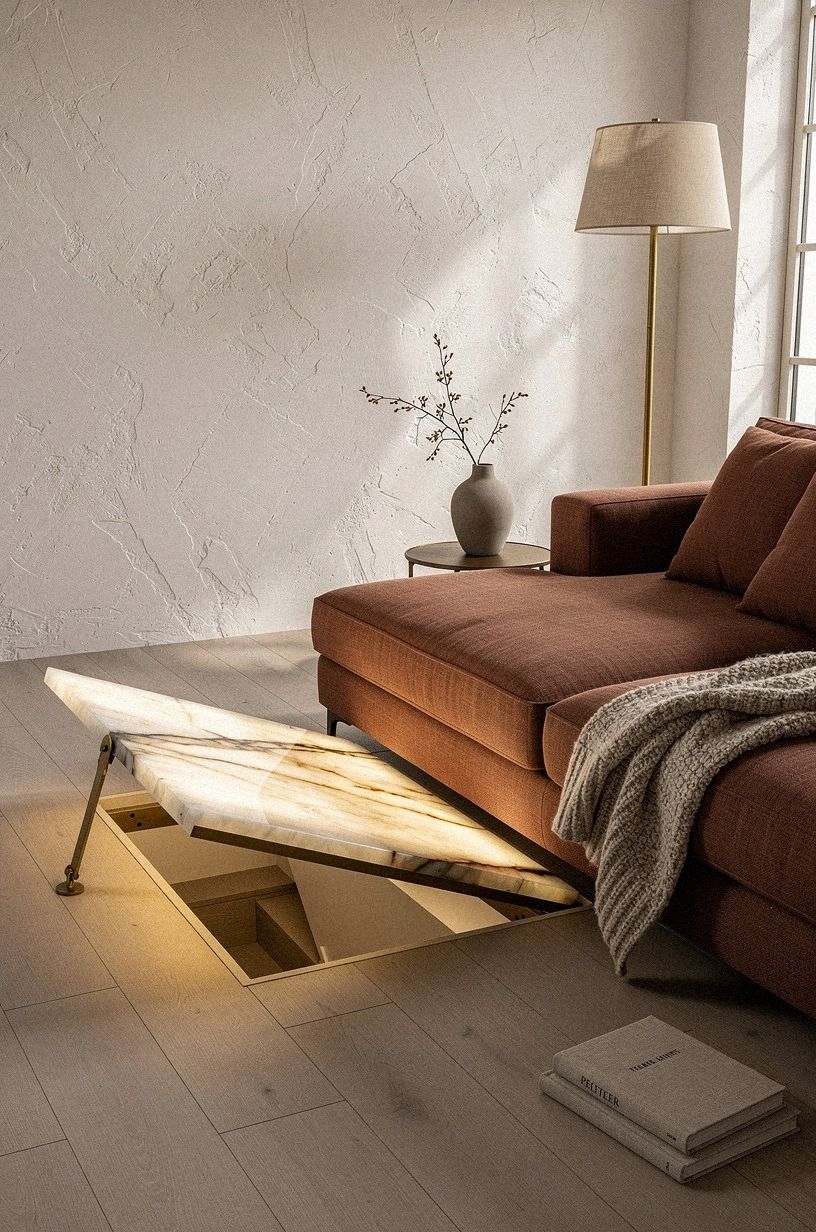
A floor hatch works when you treat it like part of the seating zone, not like a trap.
3Wrap the entrance in stone veneer
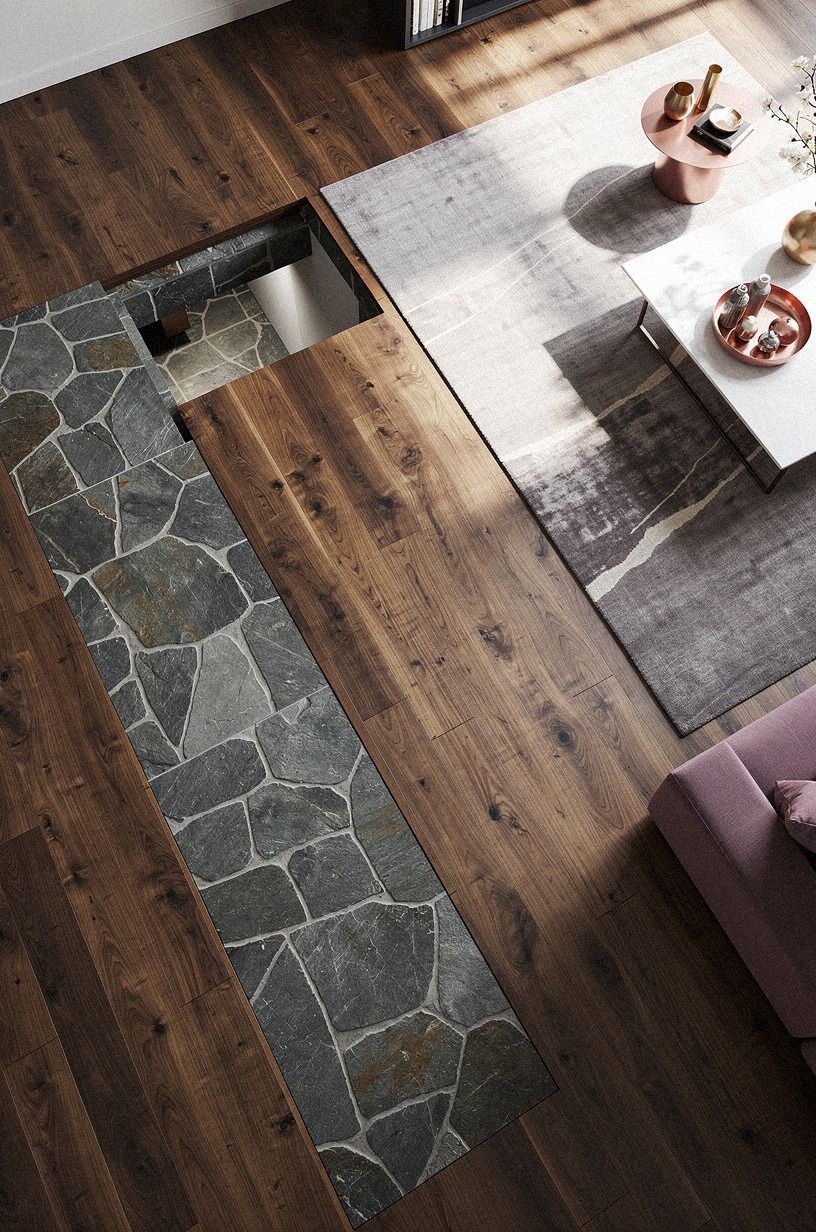
Stone veneer is the move when your basement entry sits in a room that already wants weight. A full-height ledgestone face in honed bluestone with grey-veining frames the door like a small grotto, and the seams hide best when the stone runs uninterrupted across the reveal. Don’t break the courses at the door line.
What makes stone work is restraint around it. A Belgian linen slipper chair in oat, a bouclé pouf in ivory, a thin walnut bench. Anything glossy fights the stone and you’ll feel the tug every time you walk past.
And keep the lighting low and directional. A pair of aged bronze uplights set into the floor trim throws a soft wash up the stone.
For that moody, hushed quality at full scale, this basement speakeasy guide walks through the same stone-and-shadow moves. Worth a read.
4Sink a speakeasy lounge below the sofa
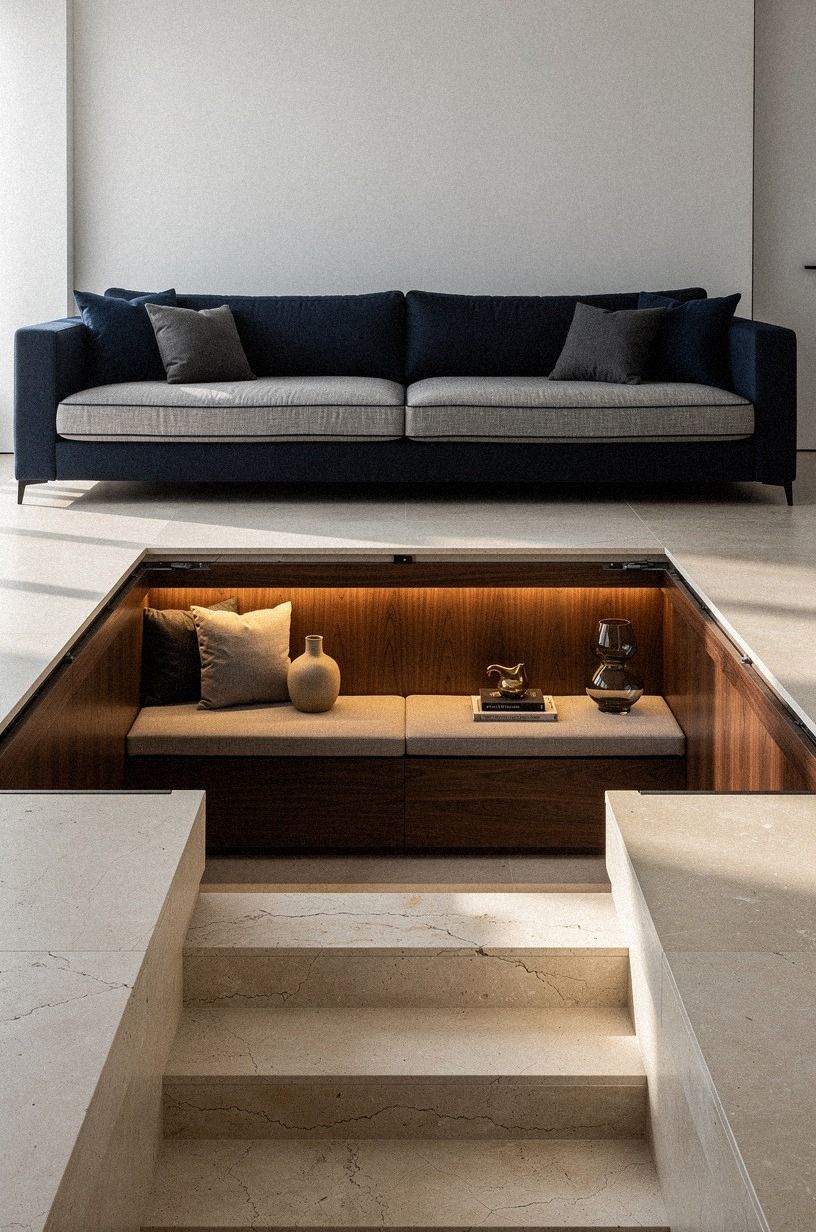
If you’ve got the ceiling height, a step-down lounge below the main sofa line can make an underground hidden room feel richer than another plain media nook. Seven feet is the minimum finished ceiling I can live with downstairs, and more matters here because the whole point is that you feel tucked in, not compressed. Navy upholstery, white walls, walnut millwork, and a raw linen weave on the cushions give you that low-lit, sultry, old-money hush without making the room dark.
You don’t need many pieces. One built-in bench.
One deep table. A pair of low lamps that throw amber instead of white.
I’d rather see a compact Article Sven-style seat in tobacco leather than a giant sectional jammed into the pit, because oversized furniture kills the reveal.
What makes this one work is restraint. The travertine steps should feel solid underfoot, the wood tone above and below should match, and your upper living room should still read as the star from across the room.
If you’re balancing another hideaway nearby, these under-bed hideout ideas are a good reminder that small concealed spaces work hardest when circulation stays easy. For the full atmospheric playbook, this 1920s speakeasy decor guide is where I send most people before they pick a single finish.
5Camouflage the door with fluted wood slats
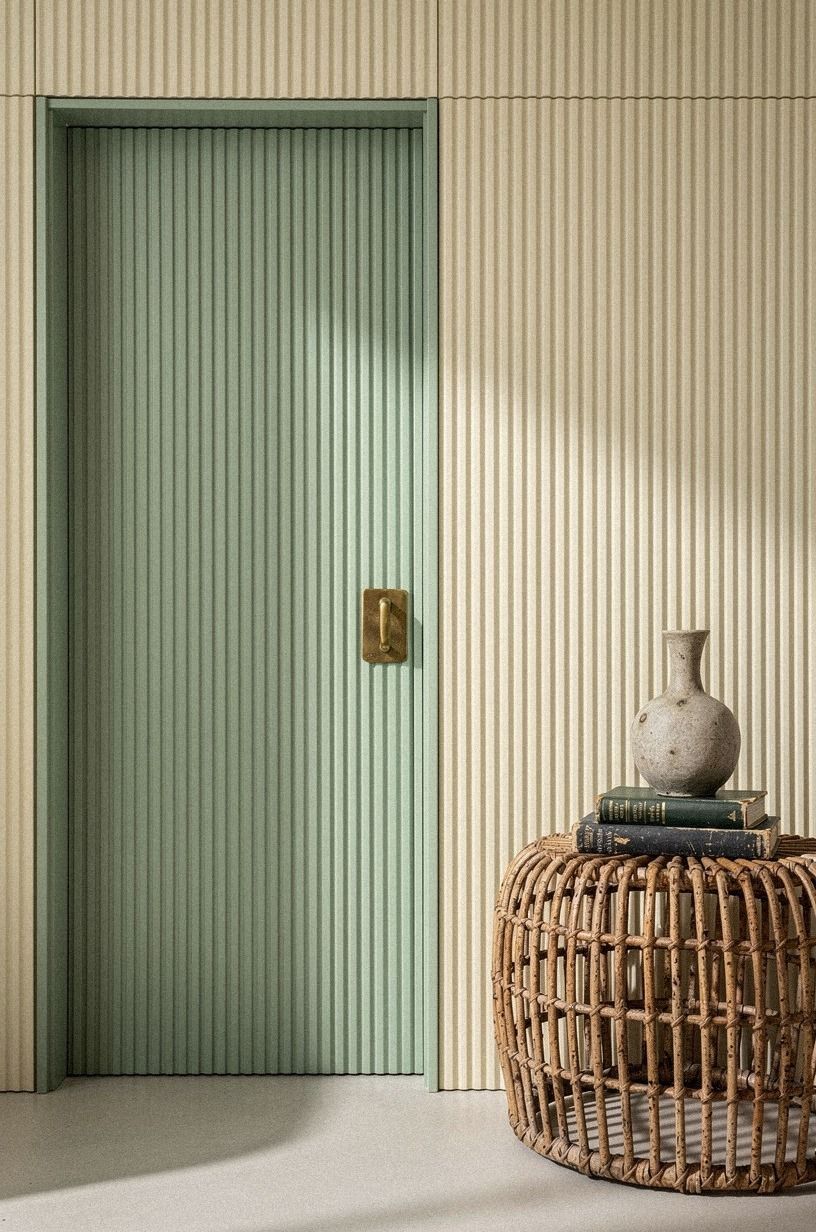
Fluted slats are one of the easiest ways to hide a door seam in plain sight, especially if your living room already wants vertical rhythm. I like solid white oak fluting at 1/2-inch ribs over a continuous substrate, because anything thinner reads as wallpaper and your eye catches it instantly.
What separates a clean install from a busy one is the spacing. I’d keep ribs at 1.5 to 2 inches on center, then stop the slats a half inch short of the door line so the seam disappears into the reveal.
One unlacquered brass edge pull in the same warm tone as your floor feels considered. Bright chrome pulls kill the effect every time.
And don’t over-color the slats. A wash of Farrow & Ball Drop Cloth or a soft putty neutral lets the wood grain breathe.
For more fluted-slat inspiration that doesn’t lean dark, this art deco speakeasy piece treats fluting as architecture. Steal the proportions.
6Build a trapdoor coffee table landing
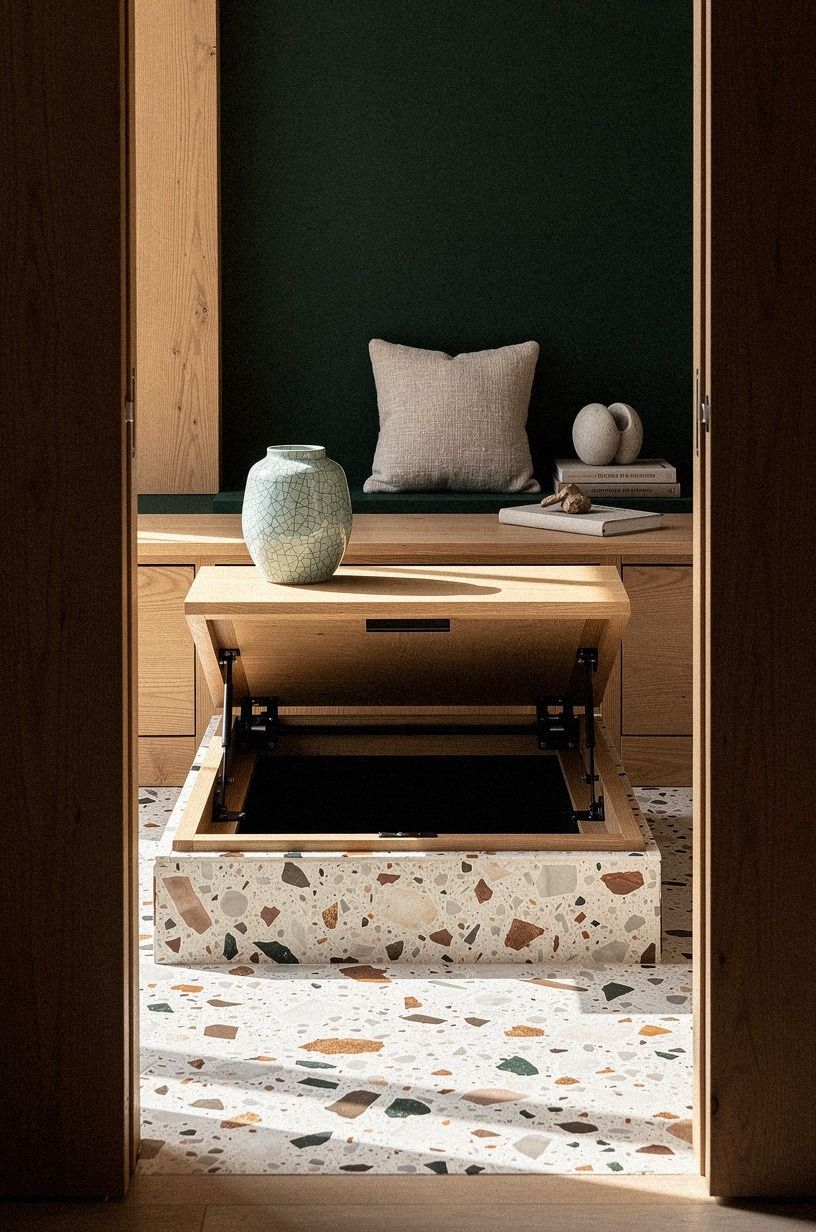
This is the one most people overcomplicate. A trapdoor coffee table landing only works if the table feels planted even when the panel opens, which means you design the stair landing first. I love oversized-chip terrazzo for that lower landing because it can handle visual attention, and forest green plus rust above it gives the opening some heat.
Set the table on a hinged platform that clears the stair by a few inches and opens toward the longest sightline in the room. That way, when you pull it up, you reveal the landing cleanly instead of fighting the sofa edge.
You also want enough zone around it. I wouldn’t squeeze this into less than 100 square feet of seating area.
And use furniture with real heft. A skinny table on a lifting panel looks like stagecraft. A chunky top in solid walnut or even a softened concrete finish looks intentional.
If you’re gathering references for a living room that hides more than it shows, I still come back to these movie-like hidden-room layouts for proportion cues. The opening should feel inevitable once you see it.
7Hide storage behind a fireplace surround
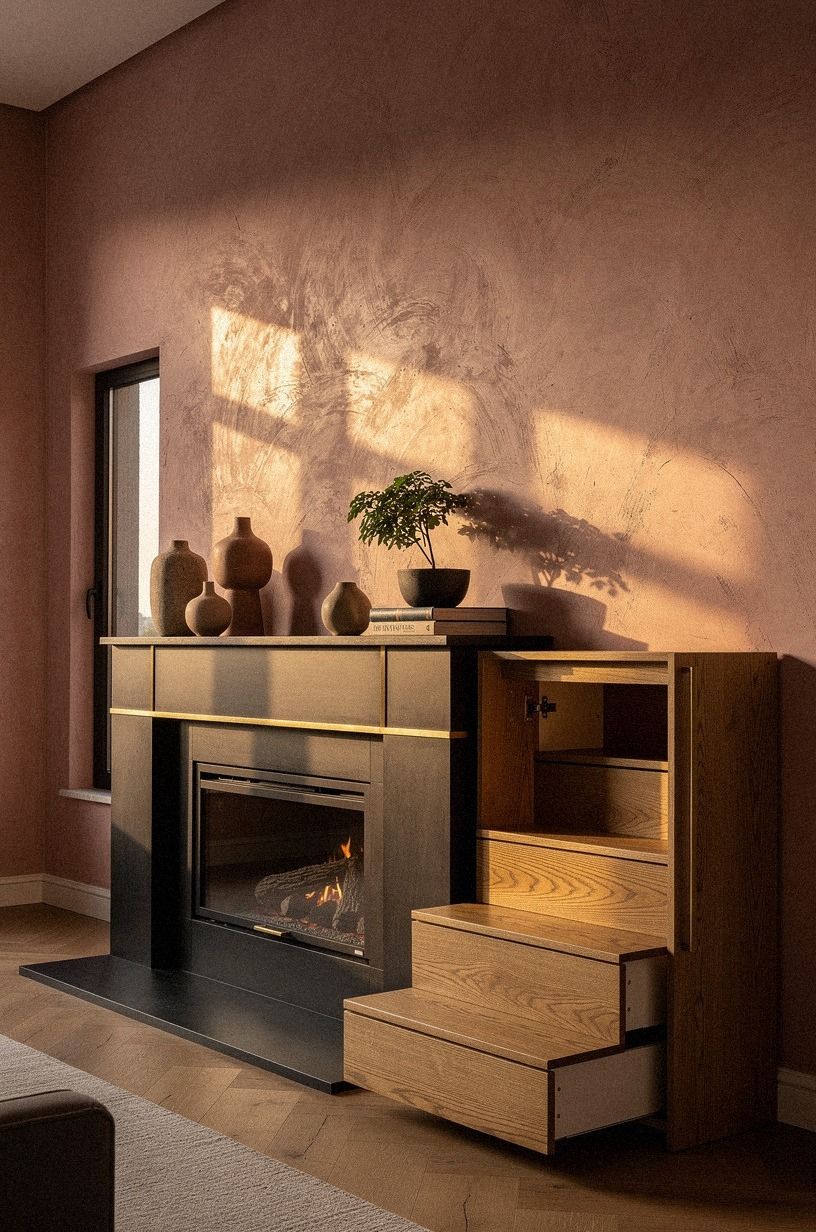
A fireplace wall is a strong place to hide basement storage because people already expect layers there.
8Panel the basement wall in dark walnut
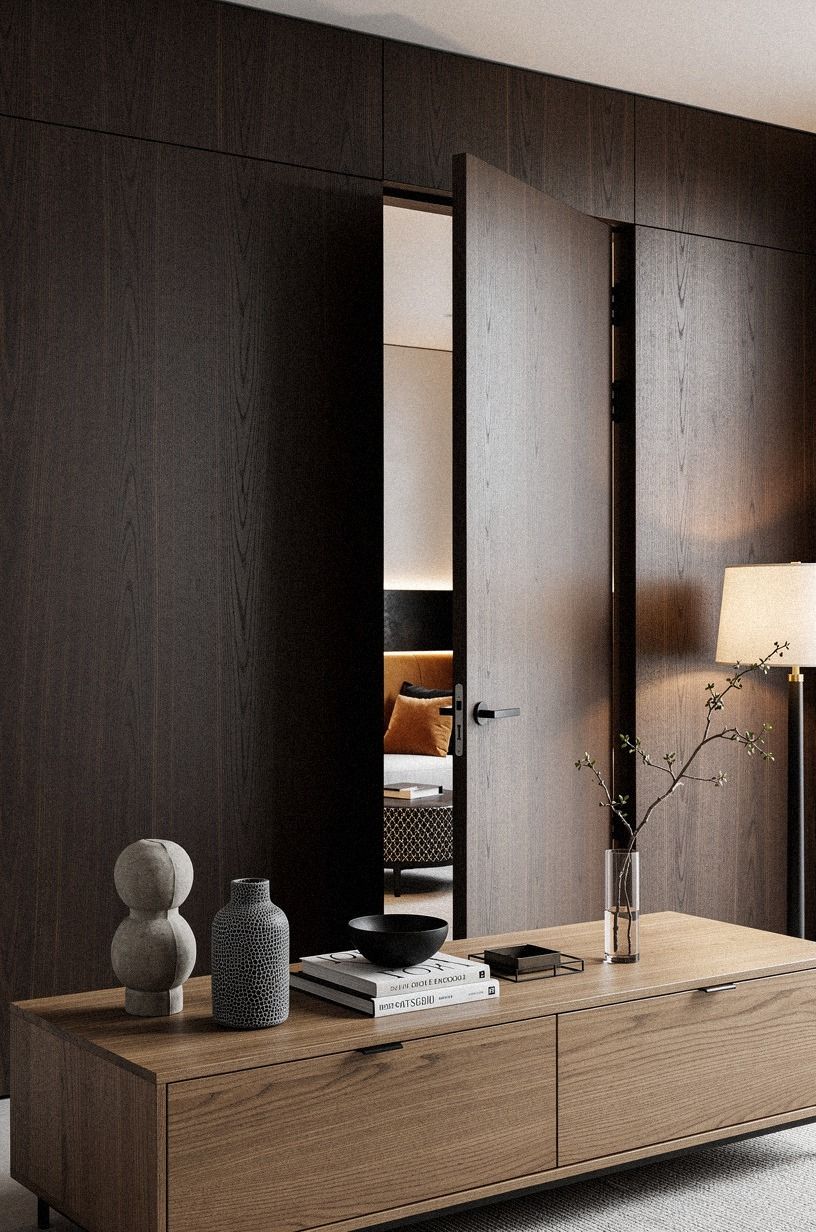
Dark walnut paneling can make a lower-level entry feel finished before you add much else. I like it best in a relaxed three-quarter view room where the concealed door swings just slightly open, enough to show that the underground room beyond isn’t a utility cave but part of the house. Dark walnut veneer panels with vertical grain, paired with a pale rug and white walls upstairs, land better than all-over dark paint.
What you spend downstairs depends on whether you’re styling or fully finishing. This is where the numbers help:
If your slab is cold, LVP flooring over slab with underlayment is still the easiest win for comfort and cost control. And if you want a deeper, inkier wall inside the concealed room, Farrow & Ball Railings No.31 gives you that soft near-black without going flat. For more hidden entry inspiration that still feels domestic, this closet conversion guide is worth a look.
9Create a sunken reading pit downstairs
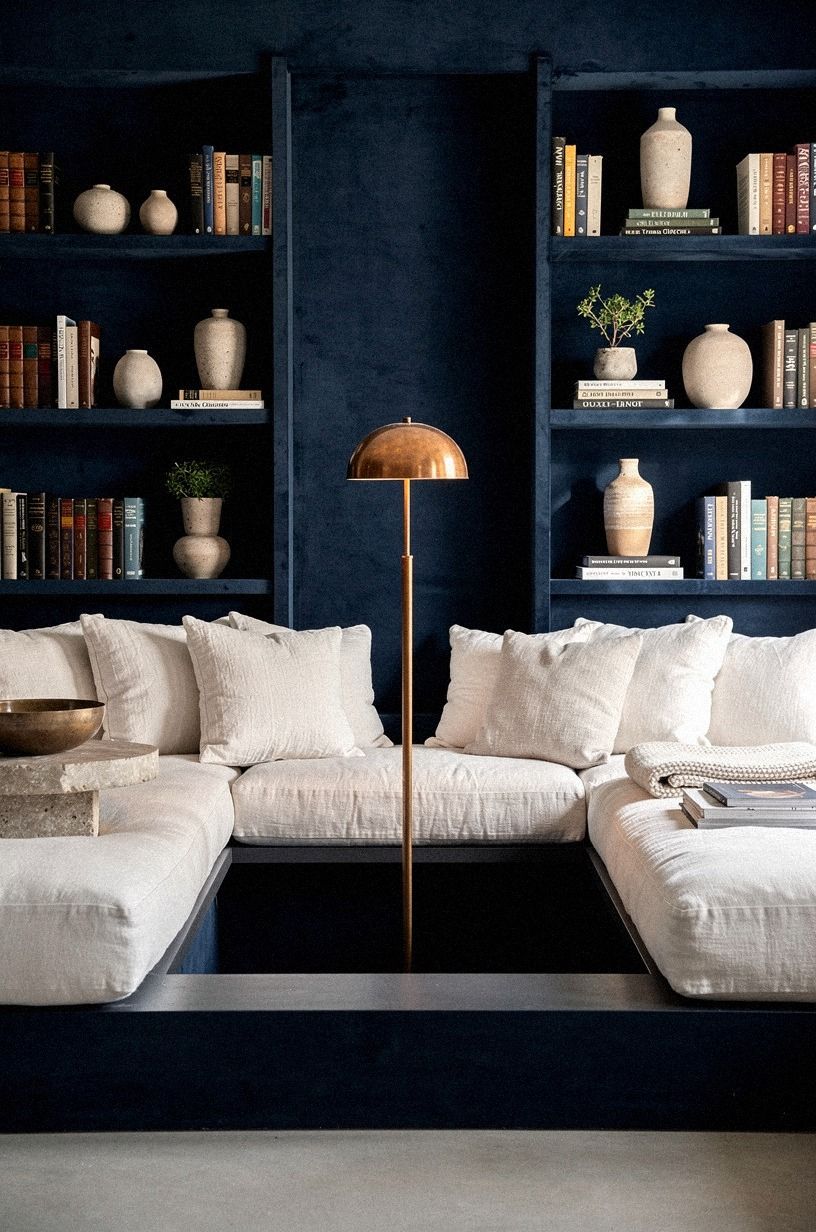
A reading pit is worth it when you want the basement to feel like destination space, not overflow. The best ones aren’t crowded.
They give you one good ledge for books, one low table for tea, and enough cushion depth that you don’t shift every three minutes. Ivory cushions in washed Belgian linen and midnight-painted ledges make the room feel hushed right away.
You also want your lighting low and layered. One recessed light overhead won’t cut it. I’d rather see two wall lights and one table lamp near the ledge, because that spreads the glow where your body sits.
Why build a reading pit if the light still feels like a laundry room?
But keep the colors grounded. CB2 Primitivo bouclé energy is a good reference for texture, yet I’d skip bright white performance fabric down here because it reads harsh once the sun disappears. If you’re planning other tucked-away zones for sleep or retreat, these bedroom hideaway ideas show how much softer a concealed room feels when the textiles carry the mood.
10Frame a concealed bar with arched millwork
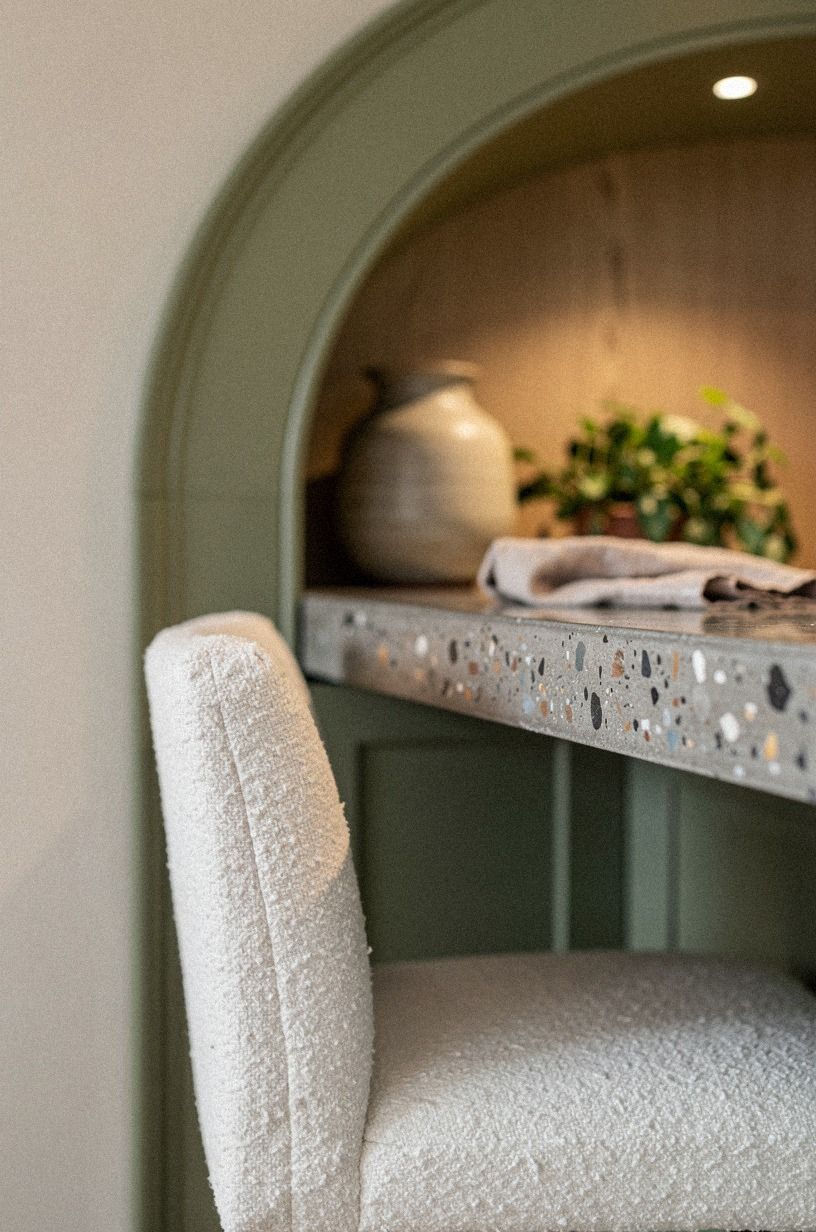
An arched opening gives a hidden basement ideas scheme some ceremony, and that’s exactly why I like it around a bar. When the trim is painted sage and the curve sits over a poured concrete counter with visible aggregate, the concealed entry feels architectural instead of cute. Add the edge of one bouclé counter stool, maybe from West Elm, and the room starts to feel designed from the floor up.
The move is scale. Keep the arch broad, not skinny, and let the lower storage disappear into flat-front cabinetry. If you can, repeat the arch once elsewhere in the room, maybe in a mirror or niche, so the shape doesn’t scream for attention.
And don’t polish everything. A concrete top, warm sage trim, one aged brass tap, and a little shadow do more for you than glossy bar hardware ever will.
For mood cues, I like this movie-inspired hidden-room article because it understands that drama comes from framing, not clutter. Less stuff.
Better line. So much better!
If you’re pairing the bar with the rest of the basement scheme, this speakeasy home bar design guide goes deeper into the millwork math.
11Blend a vault door into gallery walls
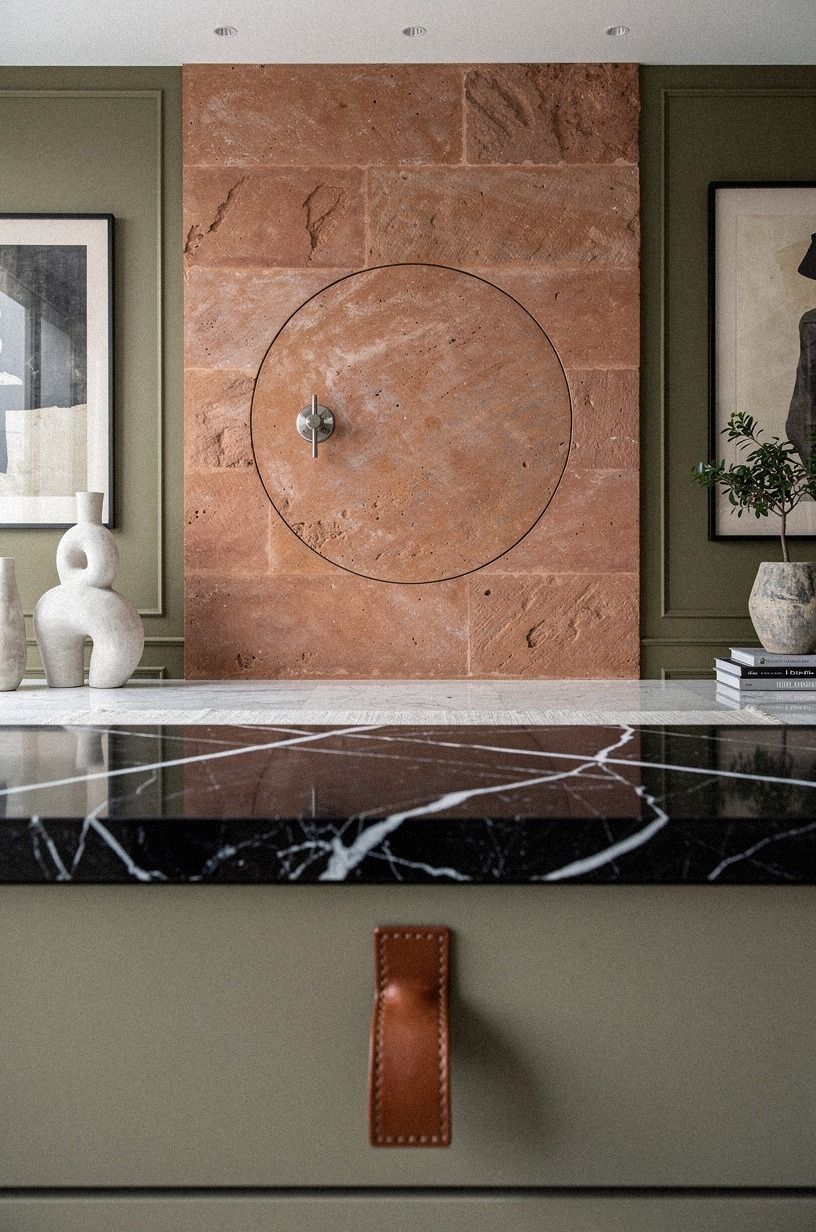
A vault-style door can go wrong fast if you treat it like a movie prop.
12Light the stairwell with bunker-style sconces
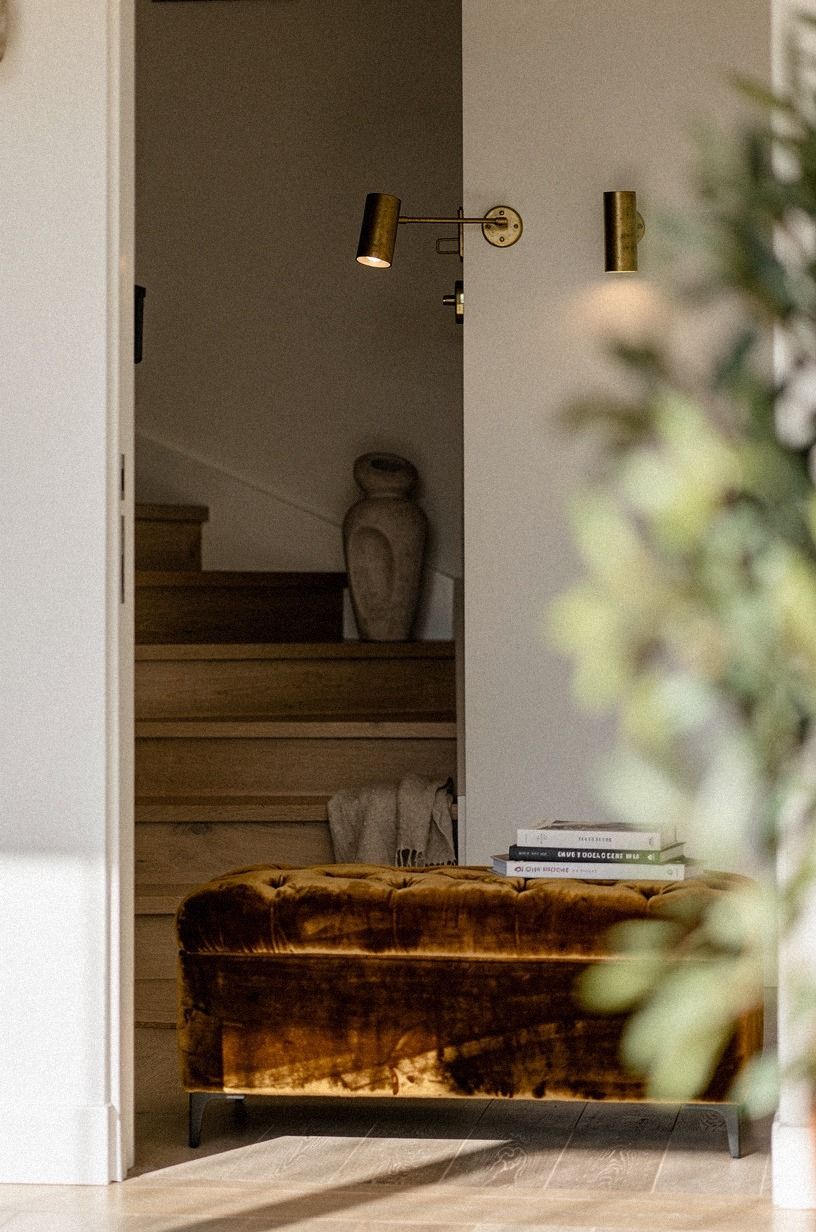
Good stairwell lighting is what makes an underground room feel intentional the second you head down. Unlacquered brass bunker sconces with perforated shades throw a tight pool of warm light at each tread, and they age beautifully in a basement where humidity usually roughs up cheaper finishes inside a year.
Spacing matters more than fixture count. I’d mount every third tread, not every tread, because the rhythm should feel like punctuation, not runway lights. Wire them to a dimmer on a separate circuit from the overhead, so the stairwell can run on its own quiet glow when nobody’s going down.
And keep the switch in the right place. Right inside the basement door, plus a three-way at the top of the stairs.
That tiny detail is what separates a basement you use from one you avoid. For the trim and color choices that pull this whole stairwell together, this speakeasy lighting playbook is the reference I keep open.
13Why does a basement entrance need its own color story?
Because the eye reads the upper floor and the stair as one continuous move, and a flat off-white transition makes the lower level feel like a basement, not a room.
14Should you build the hidden panel before or after the basement is finished?
After. Always after.
I made the mistake once of building the door panel first because the reveal was so fun, then finishing the basement last, and the panel warped within a season. Basements breathe differently than upstairs rooms.
What I’d do instead is finish the basement first, run the dehumidifier for two weeks, then measure and build the panel to the room as it actually lives. The cost difference is zero, and you save yourself the heartbreak of a swollen seam.
Same logic applies to the trim. A solid poplar reveal in a basement wants acclimation.
If you’re piecing the plan together across multiple rooms, this how-to build a secret room step-by-step guide keeps you from ordering the wrong hinges in the wrong order.
15Is the Benjamin Moore White Dove basement wall worth the upgrade?
Honestly, no, not on the downstairs wall itself.
16Build a slim wine cellar behind a false closet door
A wine cellar only feels right in a basement, and a false closet door is the gentlest way to introduce one. I’d build a climate-controlled nook behind a stock closet door, with redwood wine racking on the back wall and a Vintage Vault cooling unit set to 55°F. The door reads as closet.
The room inside reads as a serious adult choice.
What keeps this from feeling gimmicky is the lighting and the door hardware. A single picture light over the racking throws a quiet wash, and one brass kick plate at the threshold signals “I’m not a closet.” The upstairs door is a flat slab in Benjamin Moore Pale Oak OC-20 so it disappears into the wall.
If you’re not ready for the cooling unit, a simpler version with passive ventilation gets you 80% of the way for a fraction. For the spec math, this hidden wet bar guide covers the same cooling-and-finish choices.
17Hide the laundry behind a rolling barn-style panel
If your basement doubles as laundry and hangout space, the loudest visual break is the washing machine.
18Tuck a podcast booth into the smallest dead corner
Every basement has a corner that ended up being where the exercise bike used to live. That’s the spot for a sound-treated podcast booth, and it’ll do more for your lower level than any other single upgrade. I’d frame a 5×7 nook with mineral wool insulation in the walls, hang a solid core door with a perimeter seal, and finish the interior in walnut slats over acoustic felt.
What changes the room is the door. When you close it, the rest of the basement gets dramatically quieter.
You didn’t add a partition, you didn’t move a wall, and your partner can watch a movie upstairs while you record. The unlacquered brass door pull is the same line as the rest of the basement, so the door disappears when you’re not using it.
Budget-wise, you’re looking at roughly $1,800 to $4,000 depending on the door and the felt, which is cheaper than most basement renovations and adds daily use. Worth every dollar! If you’re pairing the booth with a recording-grade setup, this speakeasy home office guide handles the dark-academia side of the same mood.
Same walnut, same brass, same hush.
What I Learned After Trying to Make Hidden Rooms Too Clever
The best underground room projects aren’t really about hiding. They’re about making the lower level feel worth entering.
That’s the mistake I made early on. I kept chasing the reveal: the panel that vanished, the door nobody could spot.
For about five minutes, that approach is fun. Then you live with it, and you realize you built suspense where you should’ve built ease.
What works better is a decision frame. First, make the access point useful even when it’s closed.
A bookcase should hold books. A fireplace wall should still anchor the room.
A coffee table landing should still support a tray. If the concealed piece only exists to surprise people, you’ll resent it the first time you have groceries in one hand and need to get downstairs with the other.
Second, spend money where your body notices it. Better tread lighting.
Better underlayment under LVP flooring. A real hand feel on solid white oak instead of flimsy trim wrap.
That’s where the room starts feeling expensive. Not the gimmick.
Nobody tells you this, but your feet make the decision before your eyes do.
And third, let the downstairs room have its own atmosphere. A reading pit should feel quieter than the living room above.
A bar should feel denser. A lounge should feel lower and warmer.
That’s why I keep coming back to grounded materials like walnut, linen, Venetian plaster, and dark paint with a little softness in it. They don’t beg for attention, but they hold it. If I have to choose between a more invisible panel and a more convincing room on the other side, I’m choosing the room every time.
You will too once you’ve lived with both.
The Questions Worth Answering First
What is the best underground & basement secret room idea for a small living room?
Yes, the best pick for a small living room is usually the bookcase wall or the fluted-slat panel because both keep your floor open. More storage with less visual clutter is the win. An IKEA KALLAX-style insert or slim built-in shelves help you hide access without choking circulation.
Where can I buy underground & basement secret room pieces on a budget?
Start with IKEA, Target Threshold, and Wayfair for baskets, sconces, stools, and storage pieces that can fake a custom look. Lower spend, better layering is the goal. Facebook Marketplace is still where I’d hunt for solid wood side tables and older brass lights.
For deeper sourcing on the bar side, this hidden mini bar guide breaks down where the real spend goes.
How much does an underground & basement secret room makeover cost?
A cosmetic update usually lands around $500 to $2,500, while a more serious basement finish can move into $8,000 to $25,000 fast. Paint and lighting give the biggest visual return. Flooring, built-ins, and wet-bar plumbing are what push the budget hardest.
For a deeper cost walk-through, this how-to build a secret room guide breaks down the line items honestly.
Can I build an underground & basement secret room on a budget?
Yes, and I’d start with the cheap moves first. Paint, lighting, and layout do a lot. Removable sconces.
A heavier rug upstairs. A secondhand bookcase wall look built from stock units.
Bunker-style sconces from a salvage yard run $40 each and look like they cost ten times that.
Is an underground & basement secret room worth it in a small space?
Yes, especially in a small space, because hidden access lets one room do two jobs without looking overfilled. You keep the square footage working harder.
I just wouldn’t center the entry in the main walking path. Tuck it beside seating or into millwork and it feels calmer.
Is an underground & basement secret room a good idea for a rental?
Yes, if you stay reversible. No-damage upgrades can still shift the mood.
Peel-and-stick sconces, tension-mounted drapery, removable slat panels, and freestanding storage all help. For another low-commitment hideaway angle, this closet hideout article shows how much you can do without tearing walls apart.
What’s the easiest underground & basement secret room idea to DIY?
A sliding barn-style panel over the laundry. Solid wood panel, flat black track, a Saturday afternoon.
Around $200 in materials and you get a daily-use upgrade that holds for years. The first time you close it during a dinner party, you’ll wonder why you didn’t do it sooner.
Where I’d Start First
If I had to pick one, I’d start with the bookcase stair wall. It hides access and adds storage, so you get two fixes from one build, and the rest of the basement plans fall into place once that wall reads as furniture instead of a door. Pin it for the weekend.