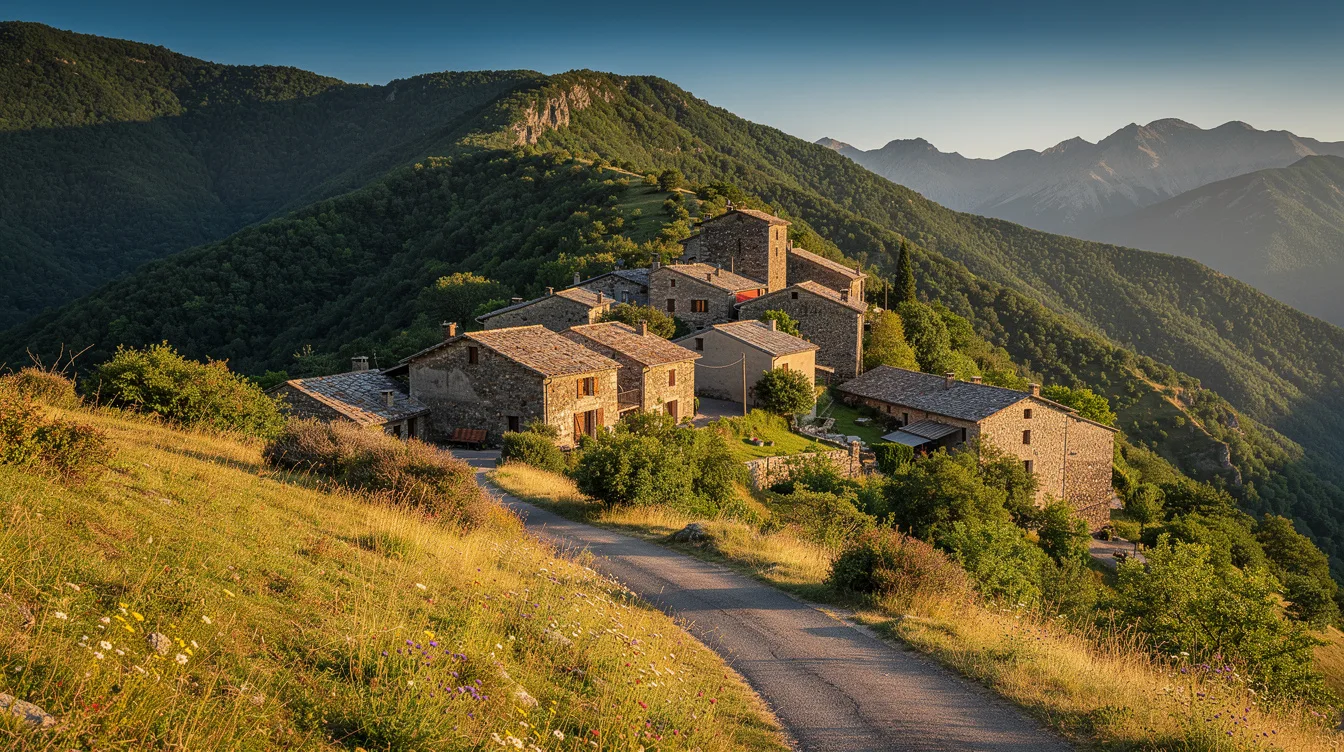
Évol is a French mountain village with a distinction that took centuries to assemble. Its Romanesque church dates to the 11th century, the ruins above it to the 13th century, and its place among Les Plus Beaux Villages de France began in 2003.
That mix is the point. You don’t come for a packed itinerary. You come because stone houses, slate roofs, and an old bell tower still make a small village feel like a destination.
The 11th-century church still sets the pace
In the Haut-Conflent, Évol sits above Olette in the Pyrénées-Orientales. Spring, summer, and fall are the sensible seasons for a slow walk through its narrow lanes.
And the first landmark to find is the Romanesque Church of Saint-André. Its bell tower was built in the 11th century and has been a historic monument since 1943, which gives the village a welcome seriousness beneath all that mountain charm.
You’ll notice the materials before anything else. Schist walls feel dark and cool in the shade, while lauze roofs catch the hard southern light. It’s compact, but never staged.
Is Évol worth visiting for the church alone?
Yes, if you like places where the architecture explains the setting. Saint-André is not a grand urban church. But its age and position make it feel inseparable from Évol, as though the village grew outward from the bell tower.
That said, don’t expect a day of major monuments. The reward is quieter: the sound of your steps on stone, the clean mountain air, and a church that has outlasted almost every change around it.
A 13th-century fortress watches from above
The remains of the medieval fortress of the viscounts of So dominate Évol from above. They date to the 13th century, and that high vantage makes the village’s setting immediately clear: this was mountain country built for position as much as comfort.
But the ruins are only remnants, not a polished castle visit. That restraint helps. You can look up from the lanes and understand the old hierarchy of the place without being handed an entertainment version of it.
Because Évol is small, the fortress never feels separate from village life. The old defenses, the church, and the slate-roofed homes all sit within the same view. It’s historic, but not museum-still.
The village also has a small Museum of Popular Arts and Traditions in the former town hall and school. It traces rural life here, which is useful context after you’ve spent time looking at buildings that can otherwise seem too quiet to read.
Why 2003 matters more than a tourism label
Évol joined Les Plus Beaux Villages de France in 2003. It is one of four villages in the Pyrénées-Orientales with that designation, and the label recognizes the preservation of a place that once faced a much thinner future.
The population fell from 420 residents in 1851 to about 20 today. That’s the part visitors should hold in mind: the village’s calm is real, but it comes from demographic loss as well as mountain serenity.
And restoration has kept the historic fabric intact. You see it in the preserved homes and the continuity of the lanes, not in flashy additions. The place feels cared for, though it doesn’t pretend to be a living city.
If you’re drawn to French villages with more foot traffic and more shops, Évol may feel too spare. If you prefer a place where the past remains visible because little has replaced it, you’ll likely linger longer than planned.
Getting there takes intention
Évol is part of the commune of Olette, about 2 miles northwest of it, within the Regional Natural Park of the Catalan Pyrenees. It’s roughly an hour from Perpignan by car via Prades and Olette, so a vehicle is the practical choice.
There is no train station in Évol. Stations on the Yellow Train line are farther along the valley, which makes rail a possibility for the wider area but not a direct arrival plan.
When should you visit Évol?
Spring brings flowers and milder temperatures, though mountain weather can shift quickly. Summer has long days and pleasant conditions, but it also draws the most visitors.
Fall is the better bet if you want quieter lanes and changing color in the surrounding hills. Winter can be atmospheric under snow, but access may be difficult and some businesses may be closed.
By late afternoon, the stone walls hold their shadows, the church tower cuts cleanly against the ridge, and Évol returns to the measured silence that earned its lasting distinction.