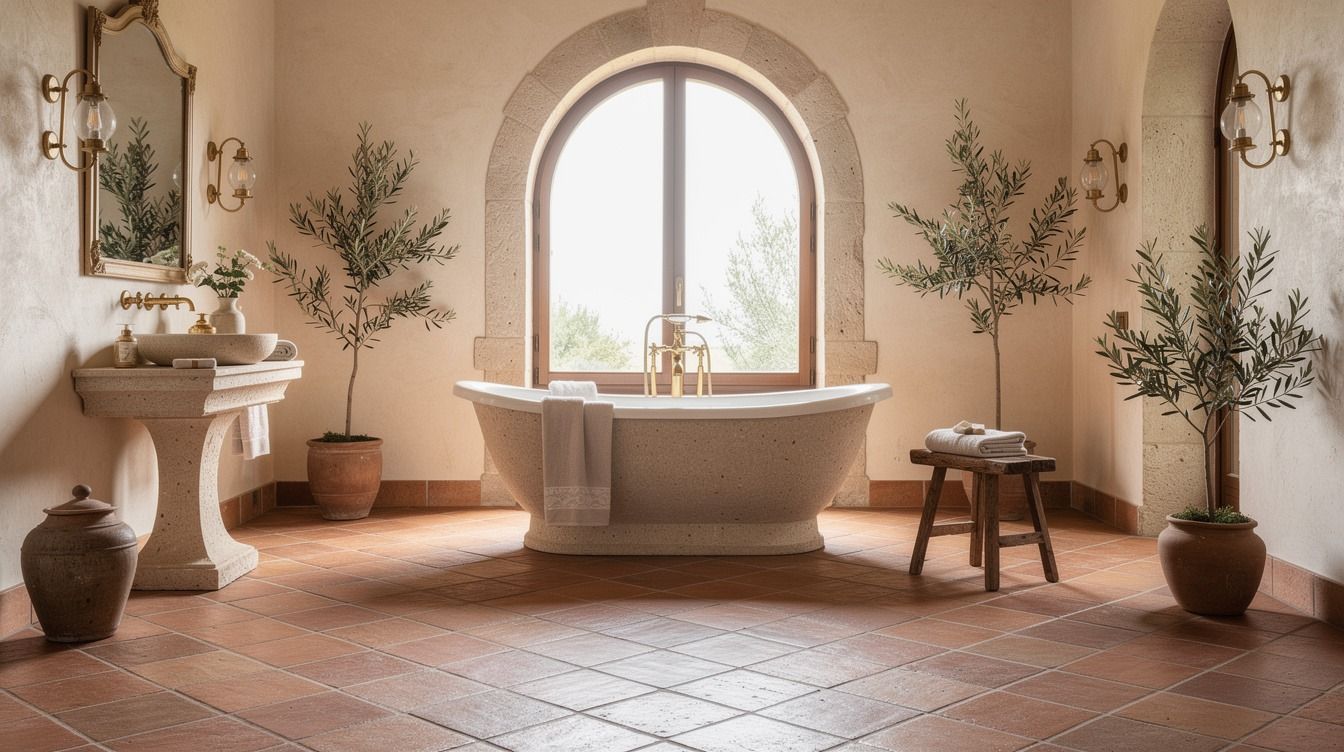
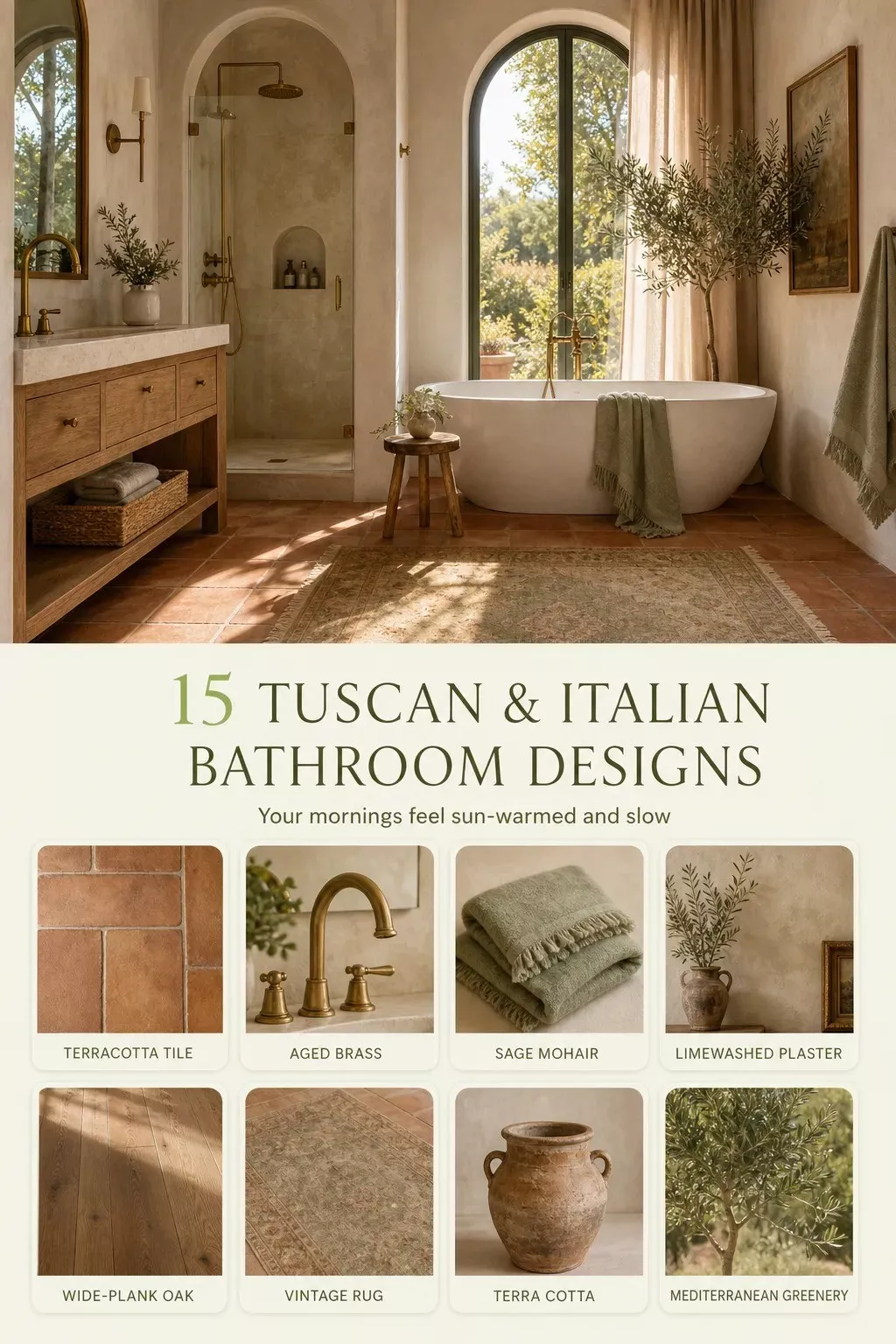
A warm Tuscan bathroom typically runs $400 to $1,200 in swaps, no renovation needed. I’ve styled a lot of them over the years, and the ones that actually feel Italian almost never started with a contractor. They started with paint, brass, linen, and one good arched mirror. Here’s the full formula, less than dinner out for most of the moves.
- Anchor the room with terracotta floor tile, the Terracotta Anchor
- Skip the all-white and paint the ceiling a soft putty
- Float an arched mirror to fake the villa window, the Arched Mirror Move
- Layer book-matched walnut where you’d usually go chrome
- Build the vanity out of a chunky reclaimed-wood console, the Reclaimed Console Move
- Frame the shower in unlacquered brass instead of chrome
- Why do most bathroom lights make the room feel clinical?
- Swap the standard shower curtain for a linen panel on a tension rod
- Why does a towel basket beat a closet every single time?
- Light the room from three sources at three heights, the Three-Height Light Stack
- Why does every warm bathroom have a plant in the corner?
- Why does every Italian villa bathroom feel warm even when nothing matches?
- Lean a vintage olive oil tin as a counter vase
- Display the soap in a hand-thrown stoneware dish
- End the room with one piece of original art, not a print
1Anchor the room with terracotta floor tile, the Terracotta Anchor
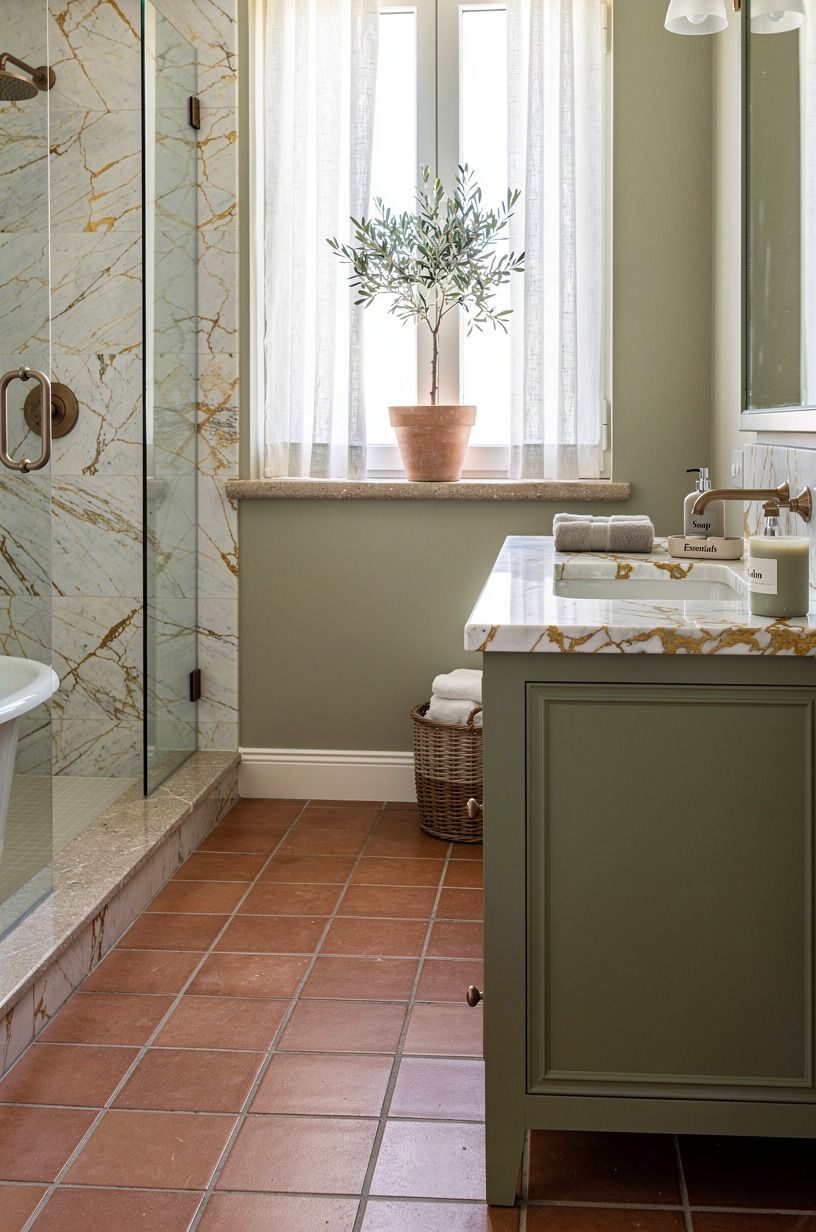
Unfired terracotta floor tile is what tells your feet they’re in Italy before anything else does. The patina builds over years, and the warm clay color makes every white towel look expensive.
Skip the porcelain wood-look tile entirely, even the good ones, because nothing fakes terracotta. Six square feet of real terracotta runs about $15 to $35 per square foot installed, and you can lay it as a rug-zone in front of the vanity if a full floor isn’t in the budget.
The texture catches the light differently at every hour, which is the whole point of an old-world floor. Pull the warm clay tones up the wall as well, even just on the back of the niche shelf, so your eye reads one continuous earth tone instead of three competing surfaces. If you’re leaning Mediterranean, our 15 Mediterranean bathroom ideas straight from Italian villas covers the floor and wall pairings that hold up.
If you love the warm-clay palette, our 11 sun-soaked spaces where terracotta tiles meet honey-toned wood shows you what the floor looks like when the rest of the room cooperates, and our 23 terracotta sofas and sun-soaked corners carry the same terracotta family into the living room.
2Skip the all-white and paint the ceiling a soft putty
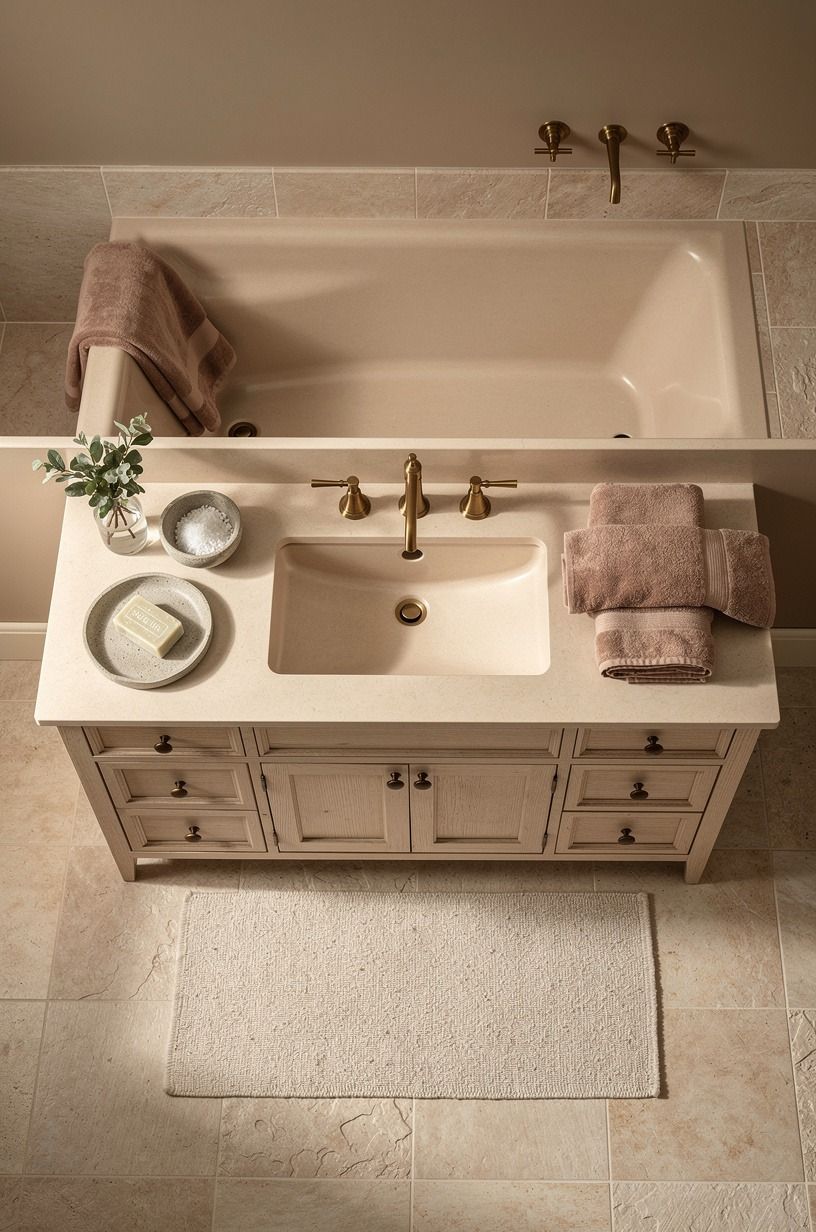
Everyone paints the bathroom ceiling the same flat white, and that’s exactly why the room feels like a clinic.
3Float an arched mirror to fake the villa window, the Arched Mirror Move
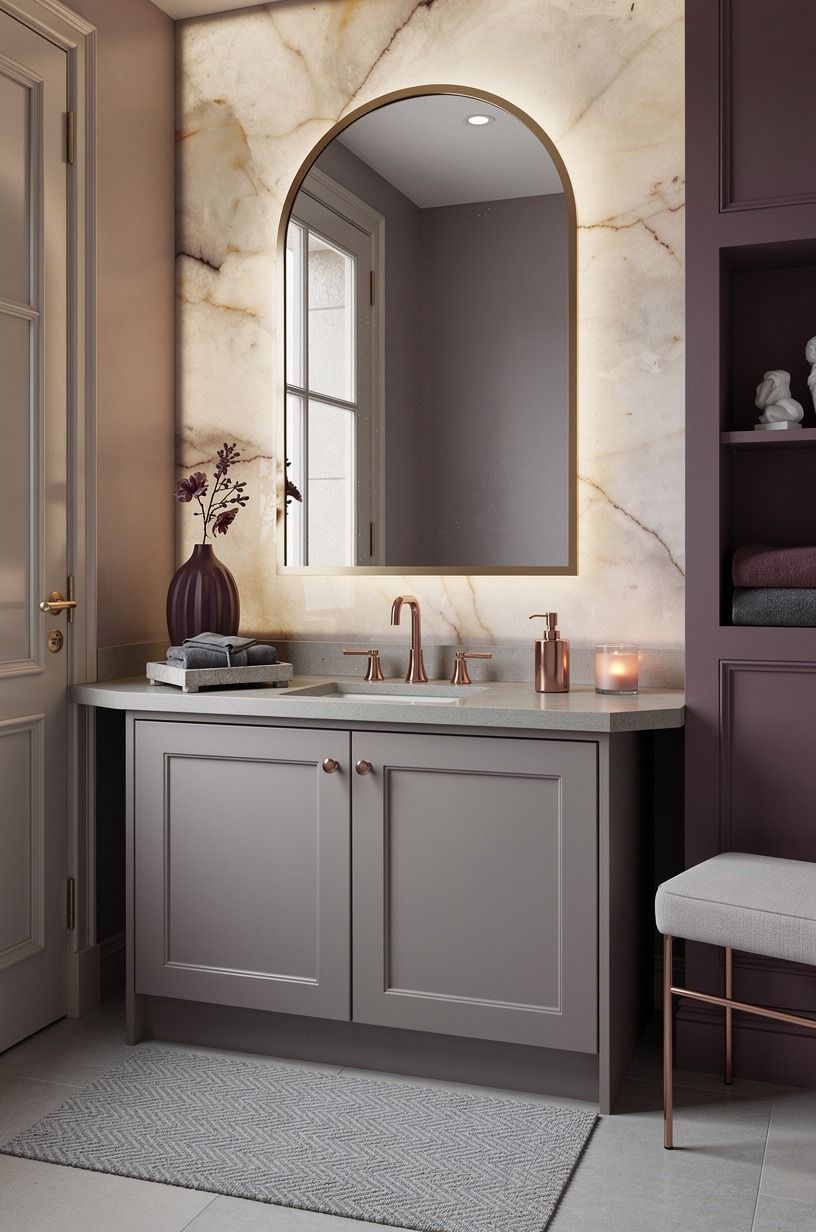
Most villa bathrooms have at least one arched window, and you can borrow the shape of one for about $150 with an arched mirror hung over the vanity. The arch softens every hard rectangle in the room, and it’ll bounce whatever natural light you’ve got across the tile instead of swallowing it.
Go for an arched top in brushed rose gold or a thin black metal frame, never a plastic one, because the frame is the part the eye reads first. Hang it about five inches above the backsplash so you get full reflection of the faucet and the sconces, not your own chin.
The mirror is essentially a window that always works, even in a windowless powder room, and that’s why it does the heavy lifting. If you want to push the warm-metal look further, our cozy bathroom lighting guide breaks down which metals age the prettiest next to brass.
4Layer book-matched walnut where you’d usually go chrome
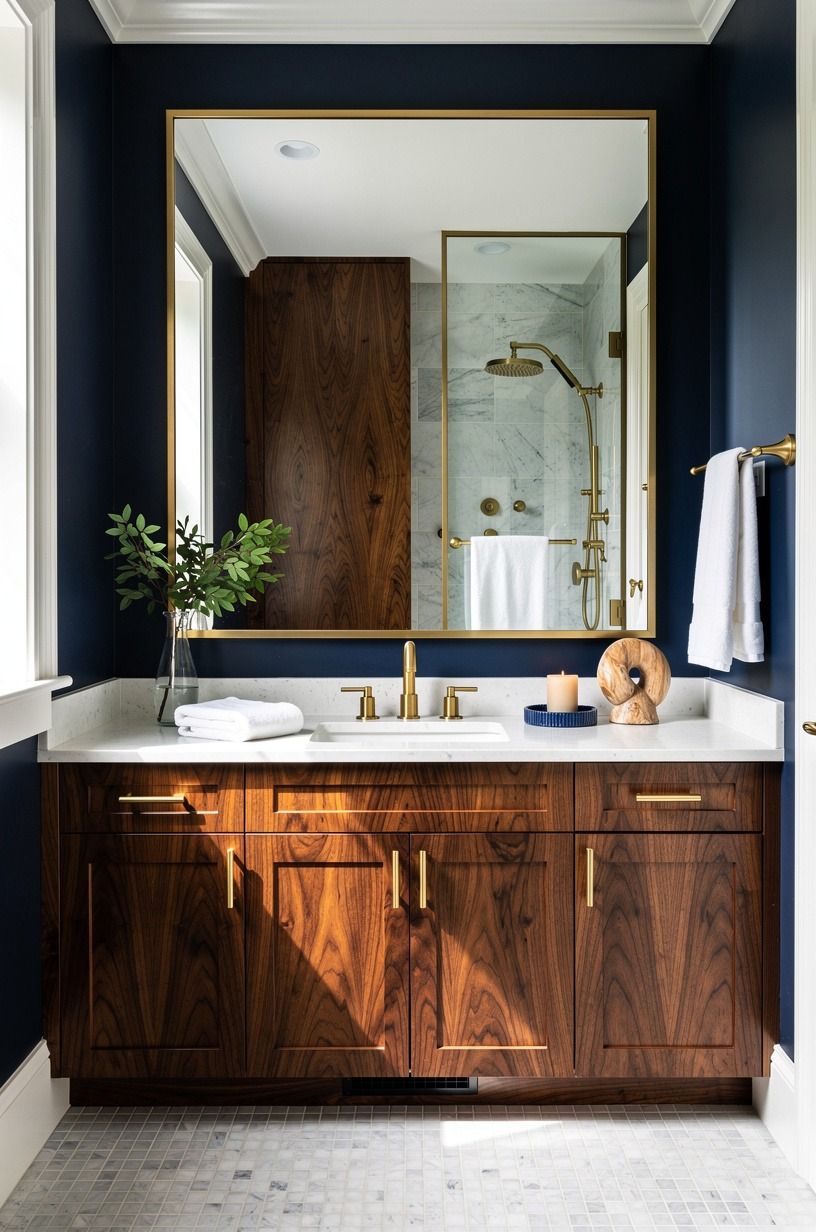
Book-matched walnut is the wood that anchors cool palettes, and that’s the entire pitch.
5Build the vanity out of a chunky reclaimed-wood console, the Reclaimed Console Move
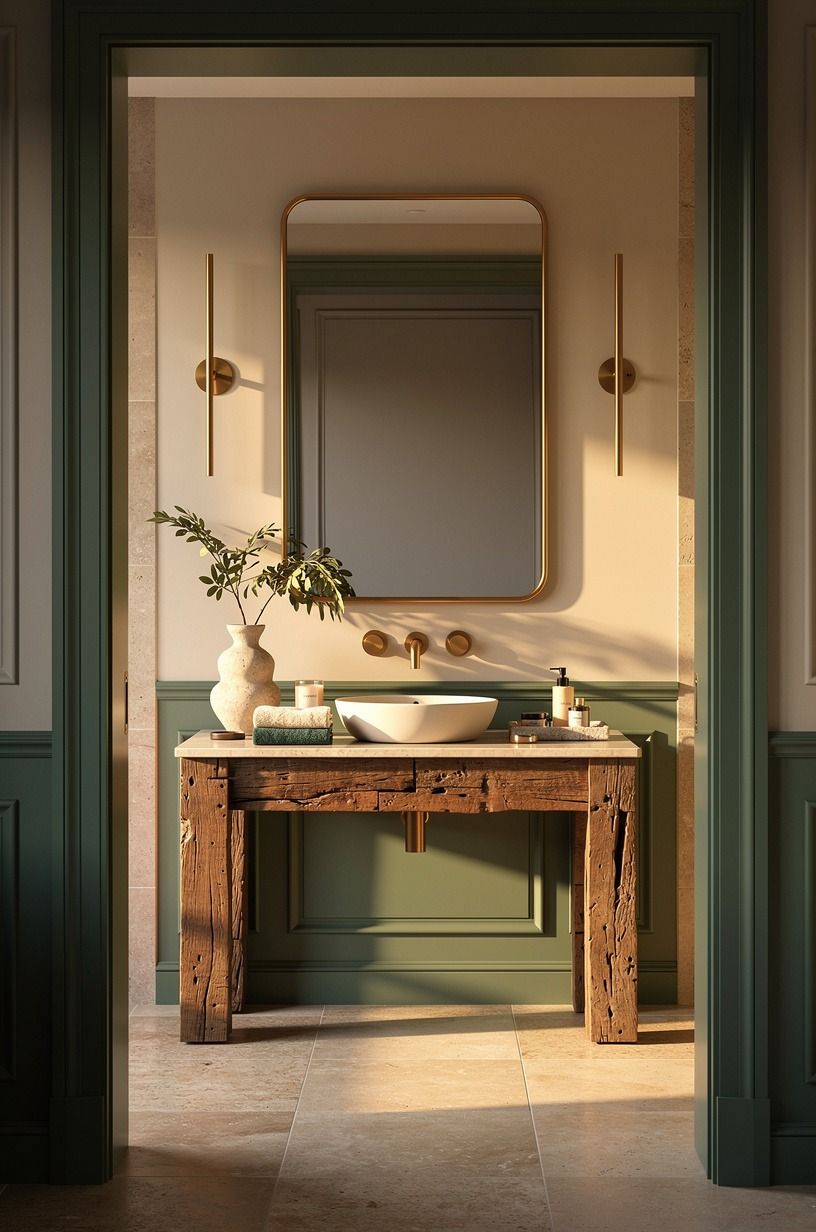
New vanities look like new vanities, no matter the price. A reclaimed wood console with a stone top reads like something a Tuscan farmhouse has had for ninety years, and you can build one for $400 to $900. Hunt Facebook Marketplace and local architectural salvage for a 30 to 36-inch console with simple lines, then drop a honed travertine or Carrara marble top on it.
For context, here’s roughly where a full Tuscan bathroom refresh lands in the US today:
The 32 to 36-inch console height is the standard for comfortable daily use, and the open shelf below gives you a place to stack rolled towels in a basket. A vessel sink on top keeps the wall-mounted plumbing look without custom cabinetry.
The patina of the old wood does the styling for you, and you’ll save about 60% over a comparable prebuilt vanity. Add an unlacquered brass mirror above it and you’ve got the entire farmhouse villa formula.
For a deeper dive into the warm-wood zone, our oak kitchen cabinet ideas for a warm modern look translates the same logic to the kitchen if you want consistency between rooms.
6Frame the shower in unlacquered brass instead of chrome
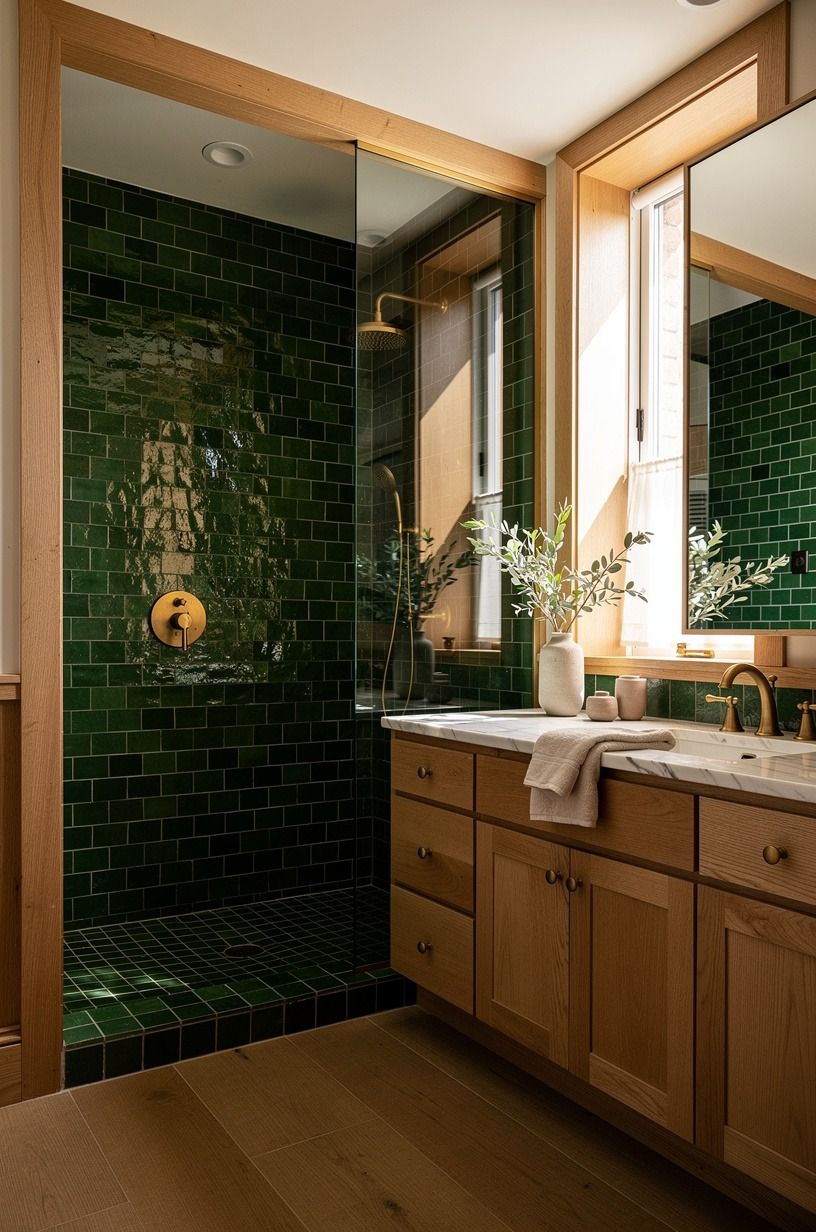
Chrome fixtures are fine, but they’re also the finish of every basic bathroom since 1998.
7Why do most bathroom lights make the room feel clinical?
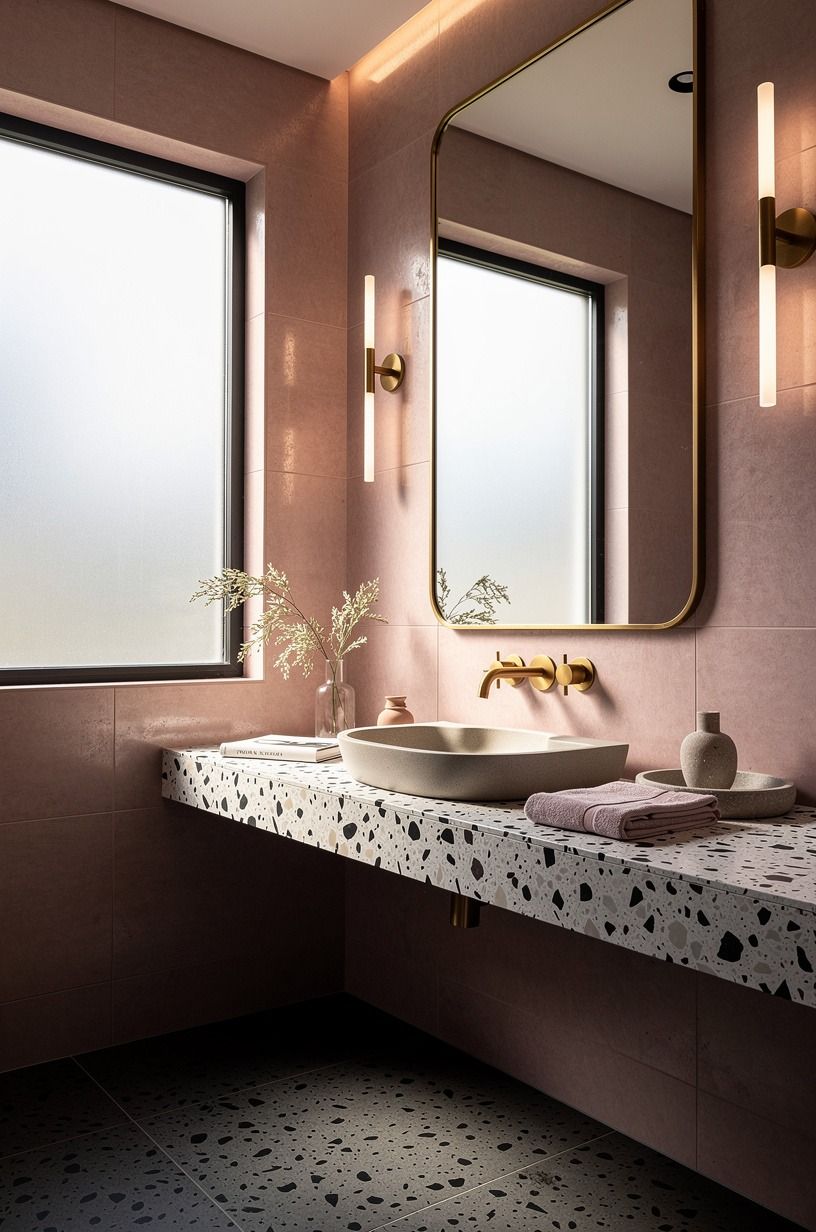
Overhead light alone is the single fastest way to make a bathroom feel like a gas station. Two sconces flanking the mirror at eye level fix it, and oil-rubbed bronze is the warm Italian choice that ages like a leather chair.
Hardwire them if you can, but the battery-operated stick-on sconces from Amazon and IKEA have gotten genuinely good (about $40 a pair, three hours of installation, zero electrician). Aim for 2700K warm bulbs, never 4000K daylight, because cool light flattens terracotta and brass. The eye needs the sconces to land on the face at an angle, which is why flanking beats overhead every single time.
And if you can’t do two, one offset sconce at jaw height beats the ceiling fixture by a mile. You’ll see the difference in every mirror selfie!
If you’re lighting more than just the vanity, our breakfast nook lighting ideas covers the same sconce-vs-pendant logic in another room.
8Swap the standard shower curtain for a linen panel on a tension rod
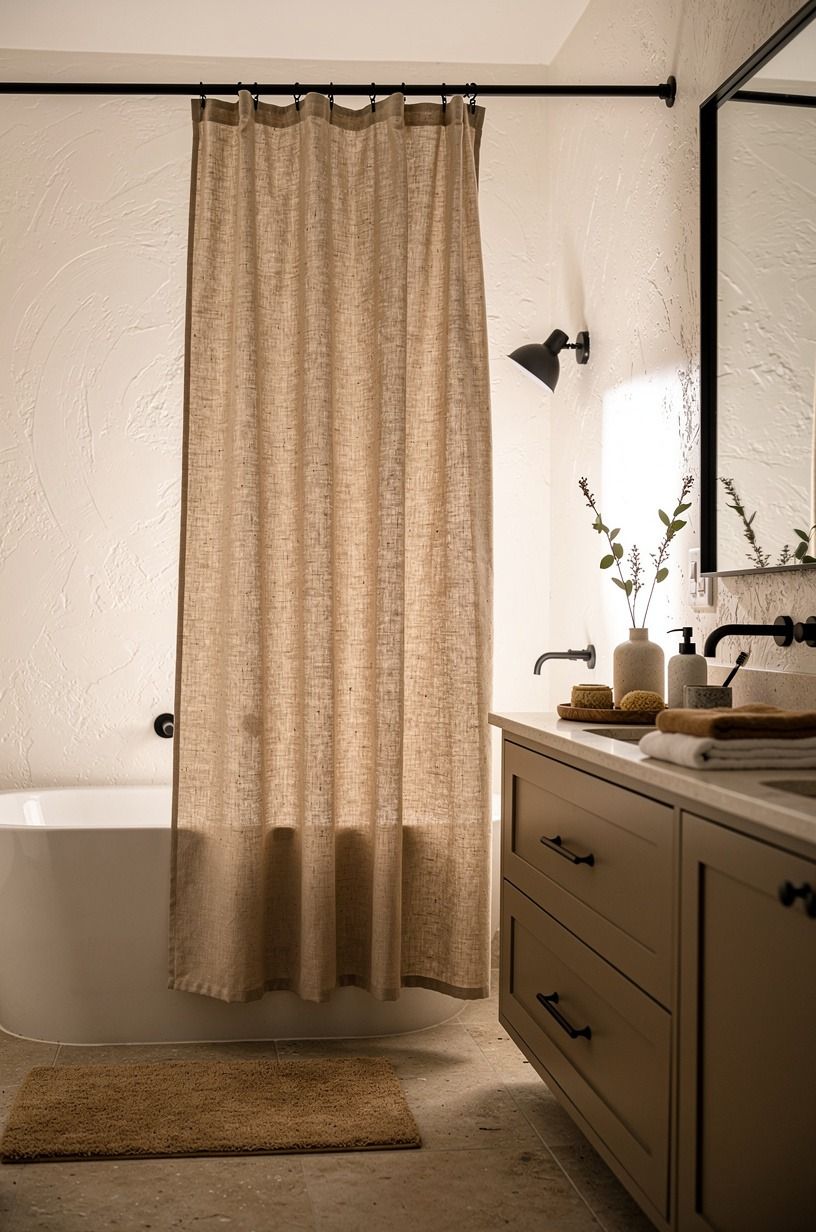
Polyester shower curtains are plastic with a marketing team.
9Why does a towel basket beat a closet every single time?
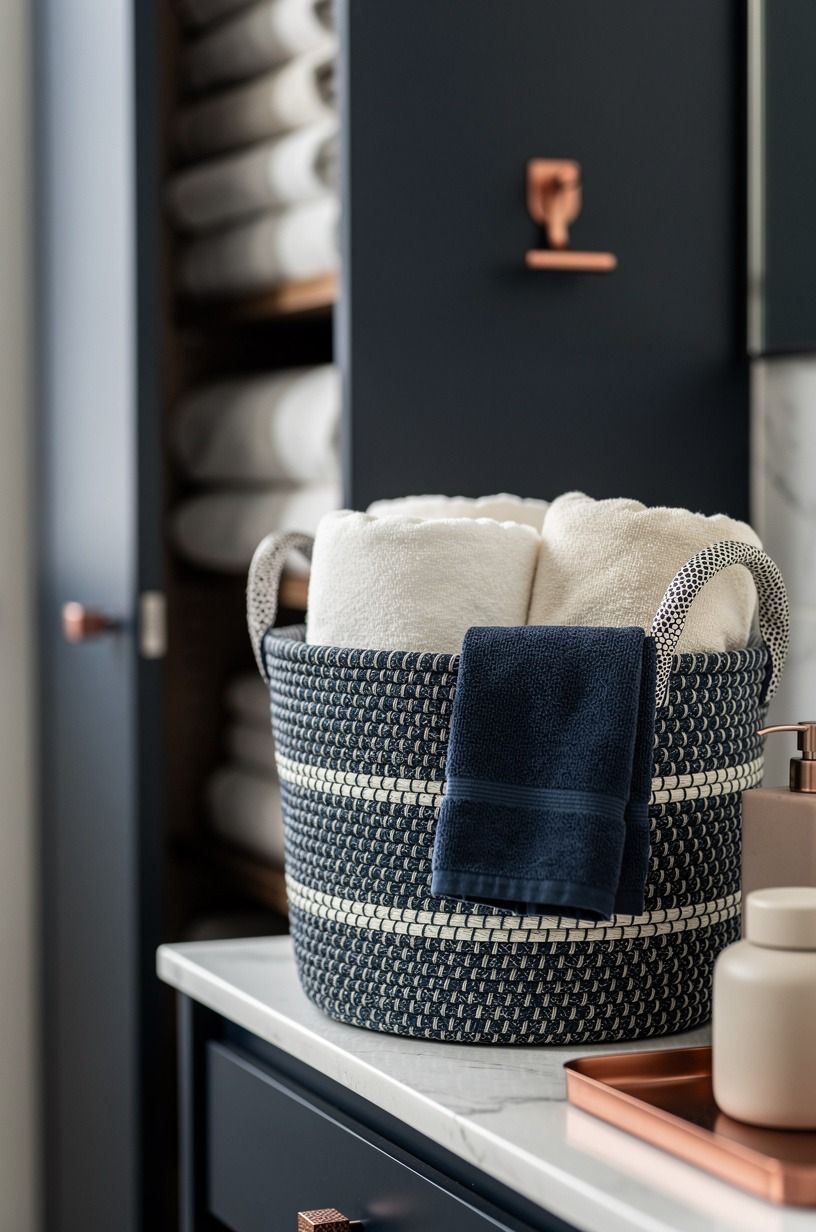
But hiding all your towels behind a door is a missed opportunity. A wide dark walnut or rattan basket on the floor next to the tub, piled with cream and oat-colored towels, does more styling per dollar than almost any other move.
Roll them, don’t fold, because rolled reads hotel and folded reads dorm. You’ll want about six to eight bath towels and a stack of washcloths visible at all times, and the basket itself becomes the third texture after the linen and the wood.
A 20-inch wide basket runs $40 to $120 depending on the material, and you can almost always find a good one at HomeGoods, Target, or any home store in late summer. If the towel colors vary, hold them to one warm family, never crisp white, because stark white breaks the midnight blue warmth.
The pile itself is the styling! For the linen stack that goes in the basket, our best linen duvet covers rounds up the same warm-fabric family at a higher thread count, and Coyuchi’s Mediterranean linen towel is the closest match to what you’ll find in old Italian homes.
10Light the room from three sources at three heights, the Three-Height Light Stack
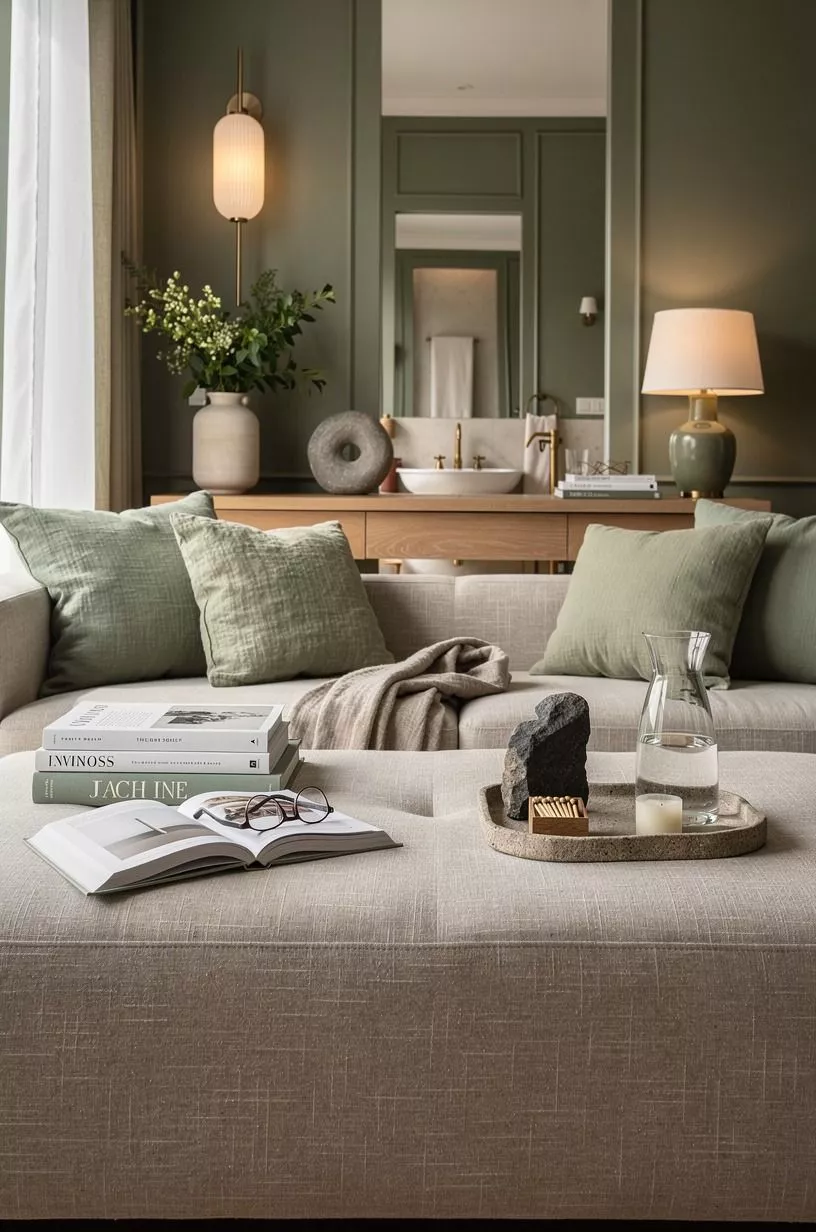
One ceiling fixture at 8 feet and nothing else is the cheapest-looking lighting plan you can buy. Three sources at three different heights fix it, and that’s the entire stack: sconce at 60 inches, table lamp on the vanity at 30 inches, candle on the tub at zero.
The lamp sounds strange in a bathroom until you try it, and then you’ll never go back, because the warm pool of light at counter height is what makes the room feel like a hotel suite. A small ceramic lamp with a linen shade, cord tucked behind the vanity, runs $40 to $80.
Add a tea light or a battery-operated pillar on the tub edge, and you’ve turned bath time into something the whole room wants to be part of. It’s the smallest investment that gives the biggest mood!
If you want to take the layered-light formula past the bathroom, our cozy backyard lighting ideas carry the same three-height logic outdoors, and our breakfast nook lighting ideas show how the same sconce-and-pendant pair works in a kitchen.
11Why does every warm bathroom have a plant in the corner?
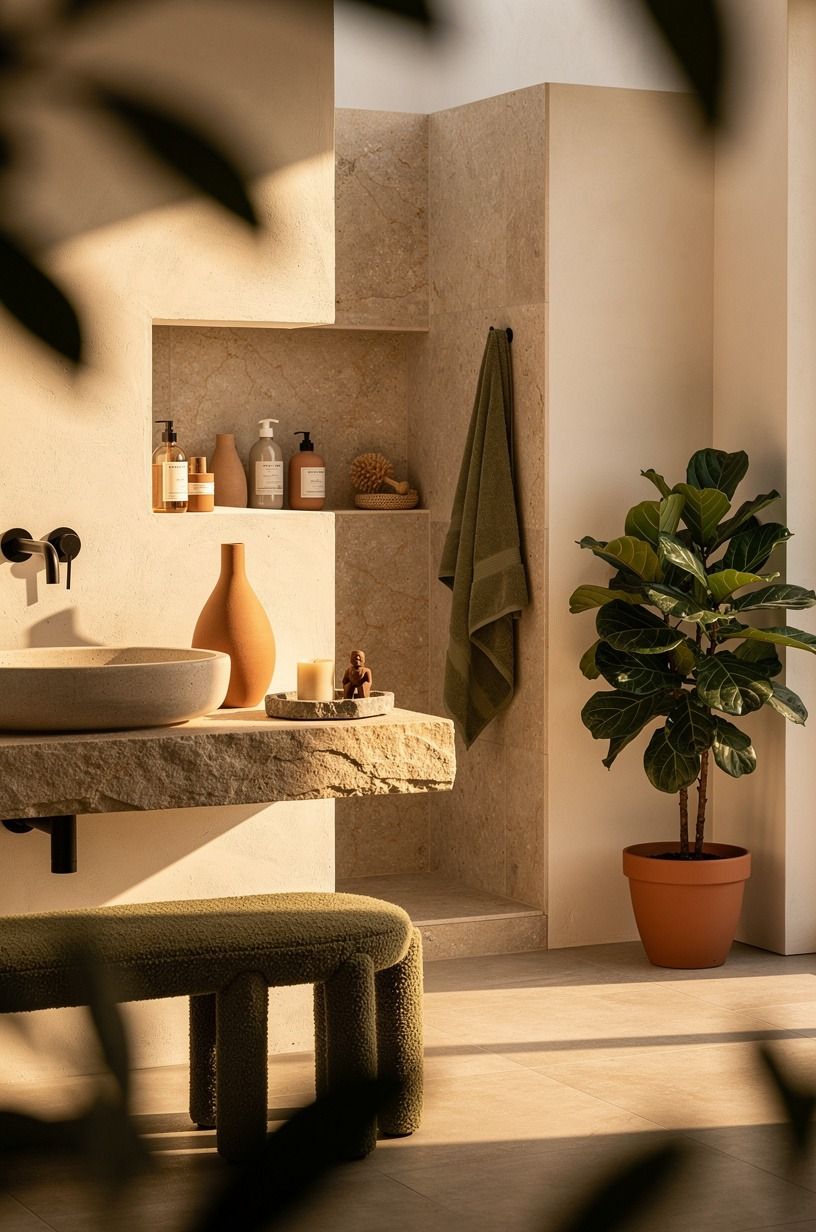
A live plant in the bathroom is one of those things you don’t think to do until you’ve seen it in someone else’s house, and then you can’t unsee it. A small potted olive tree on a stand in the corner, or a rosemary plant on the windowsill, brings in the silver-green that Tuscan farmhouse gardens lean on hard.
Both thrive in humidity, which is what the bathroom already provides. The pot matters as much as the plant, so go terracotta or aged stone, never plastic. A 2 to 3-foot olive runs $35 to $80 at a local nursery, smaller rosemary about $8.
The plant will outlast every trend piece in the room and look more Tuscan every year. If your bathroom has zero natural light, our best plants for a windowless bathroom lists the four that don’t care.
12Why does every Italian villa bathroom feel warm even when nothing matches?
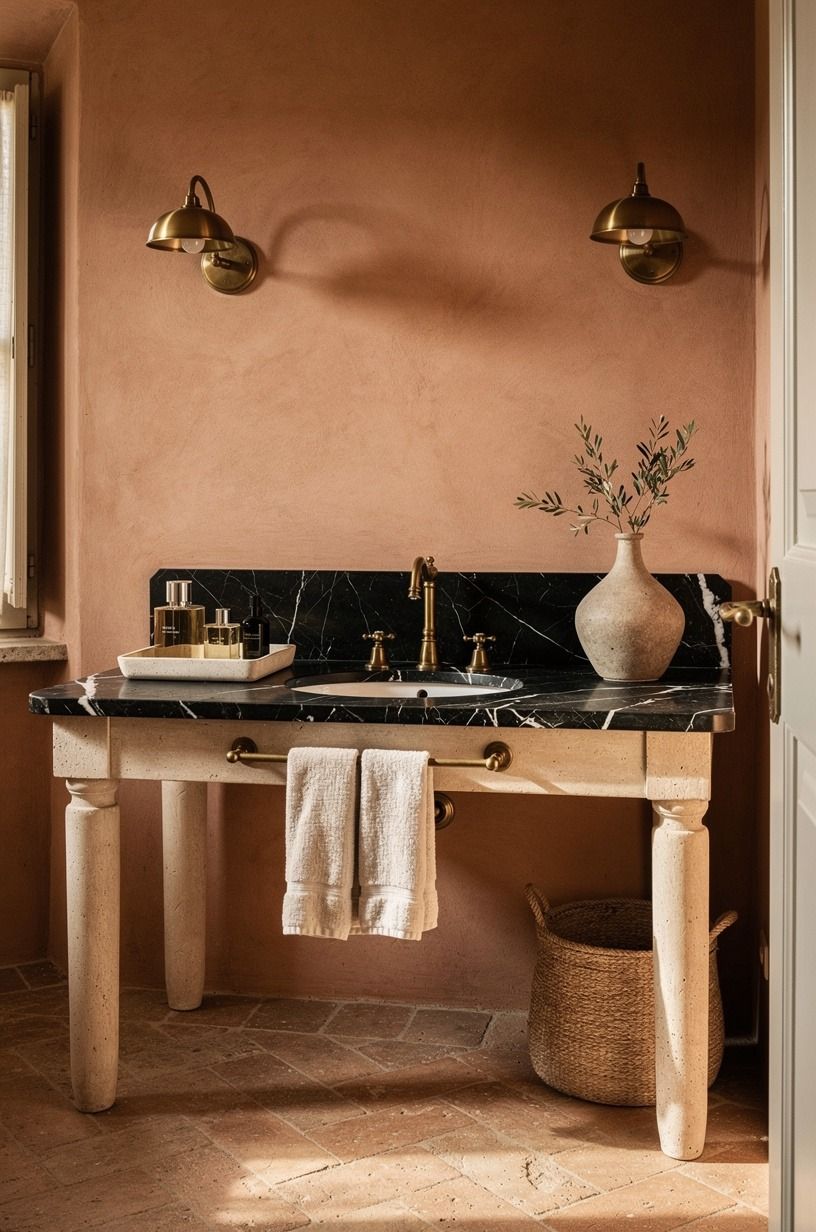
Pairing black marble with warm brass sounds like a clash, but the shared undertone is what holds the room together.
13Lean a vintage olive oil tin as a counter vase
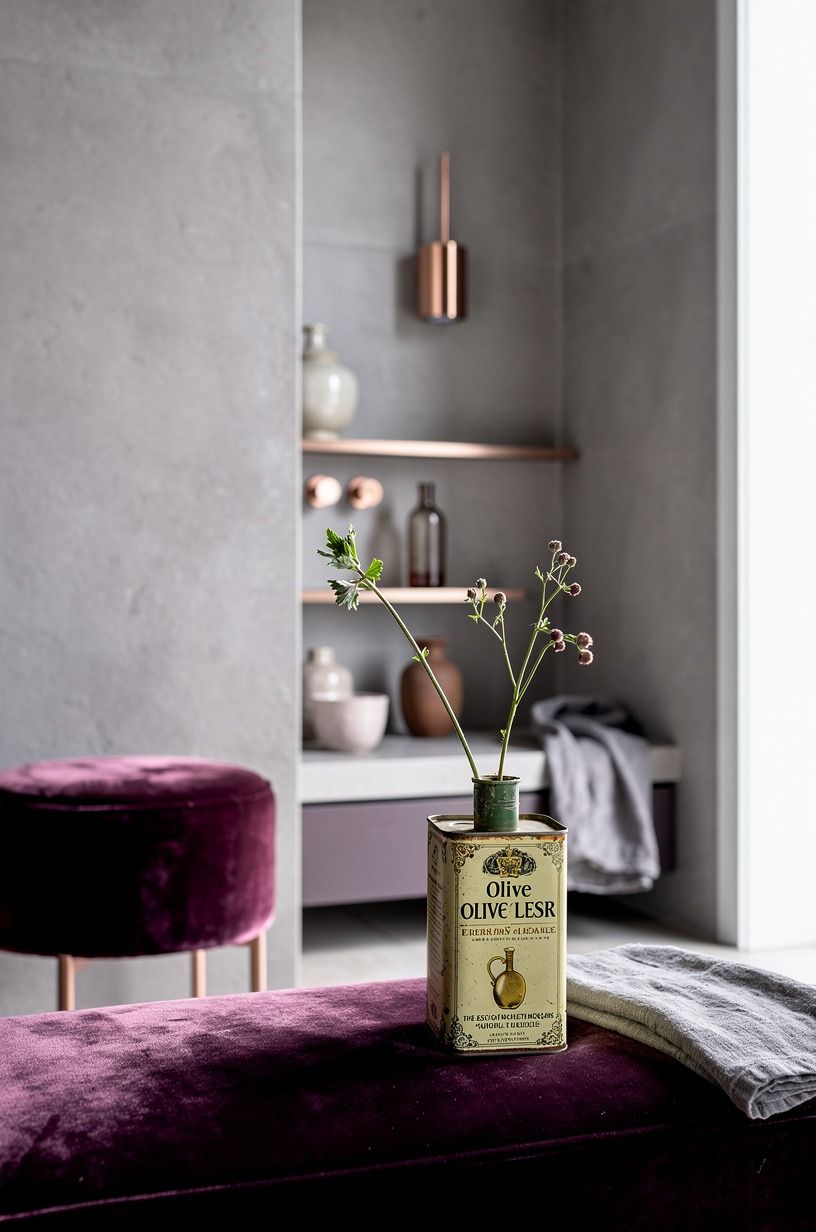
Lean a vintage Italian olive oil tin, the kind with the slightly faded typography, against the wall beside the faucet, and you’ve got a free styling moment. Etsy and flea markets are full of these for $10 to $30 each, and they hold a sprig of eucalyptus, a single stem of dried lavender, or nothing at all.
The tin is doing the work, not what’s inside it. Skip fresh flowers that need water and a vase, because this is about texture and patina, not bloom.
The tin reads lived-in, collected, and a little accidental, which is exactly the villa formula. Pair it with a hand-thrown stoneware soap dish and a small amber glass bottle of olive oil hand soap, and you’ve got the whole counter styled in about 90 seconds.
And you don’t need to commit, swap the tin seasonally. For more of the collected-not-decorated logic, our Mediterranean bedroom ideas carry the same tins-and-aged-brass palette in the bedroom.
14Display the soap in a hand-thrown stoneware dish
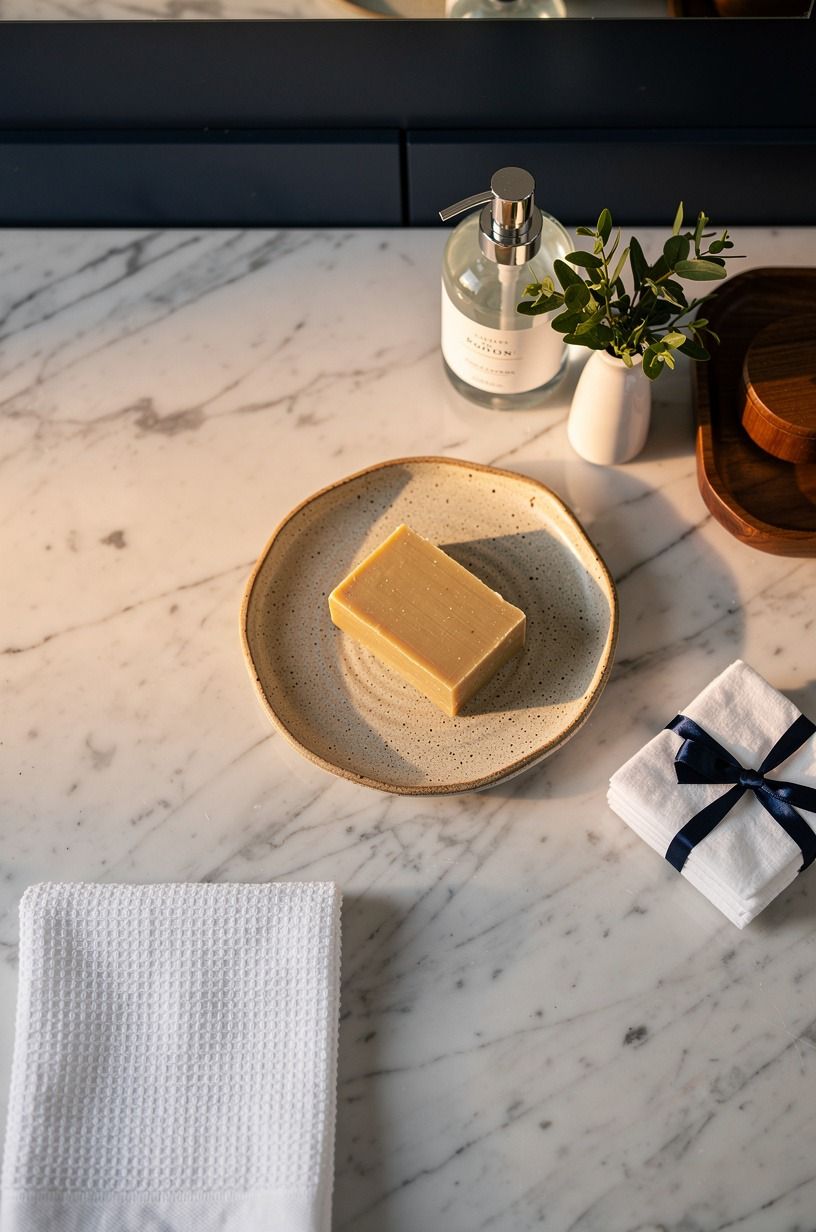
Liquid soap in a plastic pump is fine, but it reads dorm. Pour a hand soap into a hand-thrown stoneware dish with a small wooden or brass scoop, and the whole counter feels considered.
Etsy has small stoneware dishes for $12 to $35, and a good olive oil soap from a local maker is about the same. The dish catches the small water spots, the soap dries between uses, and the whole thing reads like a small still life.
Pair the soap dish with a tray, the same width as the vanity, in warm wood or aged brass, and you’ve grouped everything visually so the eye reads one styled moment instead of three random objects. The tray is the cheap move that makes any counter look intentional.
And the dish itself, when it’s empty for guests, looks better than it does full. If you’re matching the dish to the rest of the warm palette, our terracotta sofa and sun-soaked corner guide shows how the same clay-tone pottery lands in a living room.
15End the room with one piece of original art, not a print
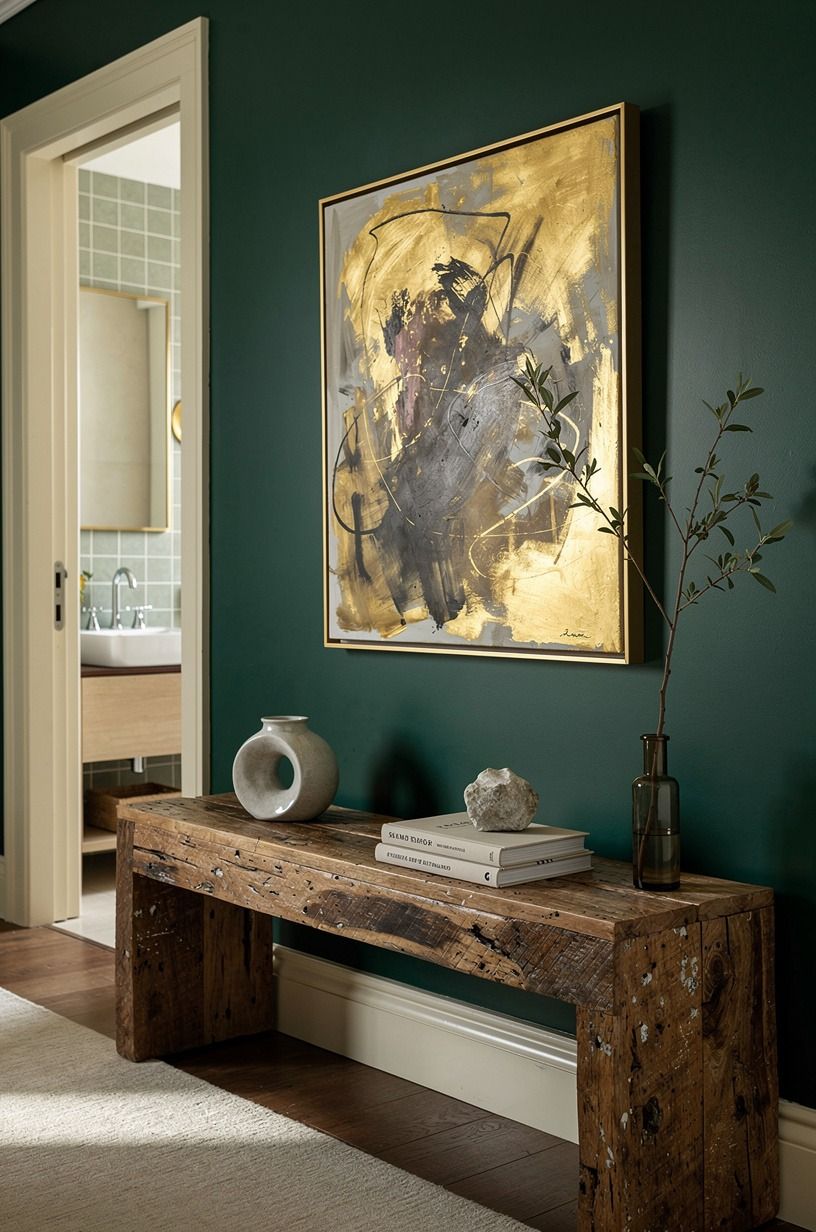
Art in the bathroom doesn’t have to be permanent. Lean one piece of original art (a small oil, a vintage landscape print, or even a thrift-store oil sketch) against the wall on a slim shelf above the toilet, and you’ve got the European villa finishing touch. The piece does more work than you think, because it’s the only object in the room that has no utility.
And a room that includes something purely decorative reads intentional. Skip the framed poster, the typography word art, and the generic line drawing.
A small 8×10 original runs $20 to $80 at a local gallery or art fair, and the frame can be a simple thin teak. The shelf itself, in warm wood or stone, is about $25 to $50.
Rotate the piece seasonally if you get bored. The room will feel finished. If you want the whole villa vibe beyond the bathroom, our French farmhouse rooms carry the same single-piece-of-art discipline across an entire home.
What every Italian villa bathroom has in common
I’ve spent enough time in old Italian homes to know the answer isn’t the budget, it’s the rule they all share, and it’s not what you’d expect. None of these villas were “designed” in the modern sense. They were built a piece at a time, with the same warm family of materials, and added to over decades.
Terracotta, brass, linen, wood, stone, plaster. That’s the whole palette, repeated.
Modern bathrooms fail because they try to be too many things at once, and the eye reads busy instead of warm.
Here’s the part I keep coming back to. When you walk into a room that feels instantly calm, the materials all share a temperature, not a color. The wood is warm.
The metal is warm. The paint has yellow or red in it, even when it’s a soft gray. Cool-toned rooms feel like offices, no matter how nice the tile is.
And warm-toned rooms feel like homes, even when the tile is cracked.
The Tuscan formula isn’t about money. It’s about choosing from one shelf at the store and ignoring every other shelf.
Three warm woods, one warm metal, one warm paint, linen instead of cotton, terracotta instead of porcelain. The room looks collected because every choice points the same direction, and the eye stops scanning.
I made the mistake once of buying the perfect aged brass faucet and pairing it with a cool gray vanity because the showroom did it. It looked fine in the store and it looked like a hotel bathroom in my house, in a bad way. The temperature mismatch is the thing your eye can’t quite name but feels.
So if you’re starting from scratch, pick your temperature first. Then your materials. Then your styling.
And don’t apologize for the warm. The cool crowd will come back around in a few years, and you’ll still have a bathroom that feels like a villa in October.
If you want the full villa formula beyond the bathroom, our cozy bathrooms that feel like a spa retreat shows how the same temperature rule plays out in modern remodels, and our French farmhouse rooms carry the rule across an entire home.
What People Always Want to Know
What is the best Tuscan bathroom idea for a small bathroom?
Terracotta-toned paint and a single arched mirror do more for a tiny bathroom than any renovation will. For small powder rooms, Farrow & Ball Drop Cloth on the walls plus a slim unlacquered brass sconce reads warm from any angle. If you want a single pick, go with the wall color first.
The mirror is doing the styling, the tile is doing the texture, but the wall color sets the temperature.
Where can I buy Tuscan and Italian bathroom pieces on a budget?
Facebook Marketplace and local architectural salvage are your best friend for the reclaimed-wood console and the vintage olive oil tins. For new pieces, IKEA has surprisingly clean terracotta planters, and Target’s Threshold line does olive-wood baskets under $60.
World Market and HomeGoods carry hand-thrown stoneware in the $15 to $30 range, and Wayfair’s solid brass faucets start around $120. None of these are affiliate links, by the way, we don’t do that here. Just the stores we actually shop.
How much does a Tuscan Italian bathroom makeover cost?
Honestly, a lot less than you’d think. A pure refresh (paint, mirror, faucet, textiles) typically runs $200 to $1,200.
A mid-range redo with a new vanity and partial tile work lands around $3,000 to $9,000. A full re-tiled shower and floor with plumbing moves starts at $12,000 and climbs fast.
Most of what I’ve listed here costs under $400 total, because the formula is built on swaps, not construction. You don’t need the renovation to get the look!
For the full remodel math, our master bathroom remodel before and afters breaks down where the real money goes.
Can I create a Tuscan bathroom on a budget?
Yes, and the budget version is honestly the better version. Three free moves first: paint the ceiling a soft putty, swap your chrome hardware for brass, and stack rolled cream towels in an open basket.
Each one is under $50 if you buy nothing. The next tier, around $150 to $300, gets you the arched mirror and the linen shower panel.
After that, save for the reclaimed-wood console and the unlacquered brass faucet, because those two pieces do the heaviest styling. You don’t need to do it all at once.
Is a Tuscan bathroom worth it in a small space?
Worth it, and small spaces are the easier win. A powder room or a compact full bath only needs three or four moves to feel transformed, because every surface is visible at once.
The arched mirror, the warm wall color, the brass faucet, and the linen shower panel. That’s it.
The room reads villa the moment you walk in. Don’t try to crowd more in.
Restraint is the entire Italian move.
Is a Tuscan bathroom a good idea for a rental?
Yes, because the entire formula is renter-friendly. Peel-and-stick zellige-look tile for the shower wall, a tension-rod linen panel instead of a mounted curtain, battery-operated brass sconces with adhesive mounts, and a console vanity that doesn’t require plumbing changes.
Every piece comes out cleanly when you leave. The landlord will probably thank you, because you’ll leave the bathroom better than you found it.
Where I’d Start First
If I had to pick one, I’d start with the wall color. You can’t layer warm on top of a cold room.
The brass will fight the tile, the linen will feel theatrical, and the terracotta will look like a mistake. Get the temperature right first.
See our cozy bathroom spa retreat guide for the color pairings.