Brown and noce travertine bathroom ideas work best when the stone gets one crisp counterpoint, such as warm white, aged brass, or soft blue. I learned that after pairing brown tile with too much beige and watching the room turn flat. Your bathroom needs contrast, texture, and a little shadow. Start there!
- Layer light walnut beside warm travertine
- Let Benjamin Moore Chestertown Buff warm the ceiling
- IKEA TONSTAD makes the Two-Wood Rule easy
- Swap chrome for unlacquered brass
- Build The Three-Height Light Stack
- Why does a small bathroom need a pale counter?
- Frame the mirror with a Noce Shadow Line
- Belgian flax linen at the window
- Choose hand-glazed tile for the shower niche
- Brown travertine meets Farrow & Ball Hague Blue
- Anchor the floor with a soft geometric mat
- Mix materials with The Three-Source Rule
- Noce underfoot, pale walls above
- Finish the walls with Sherwin-Williams Sea Salt
1Layer light walnut beside warm travertine
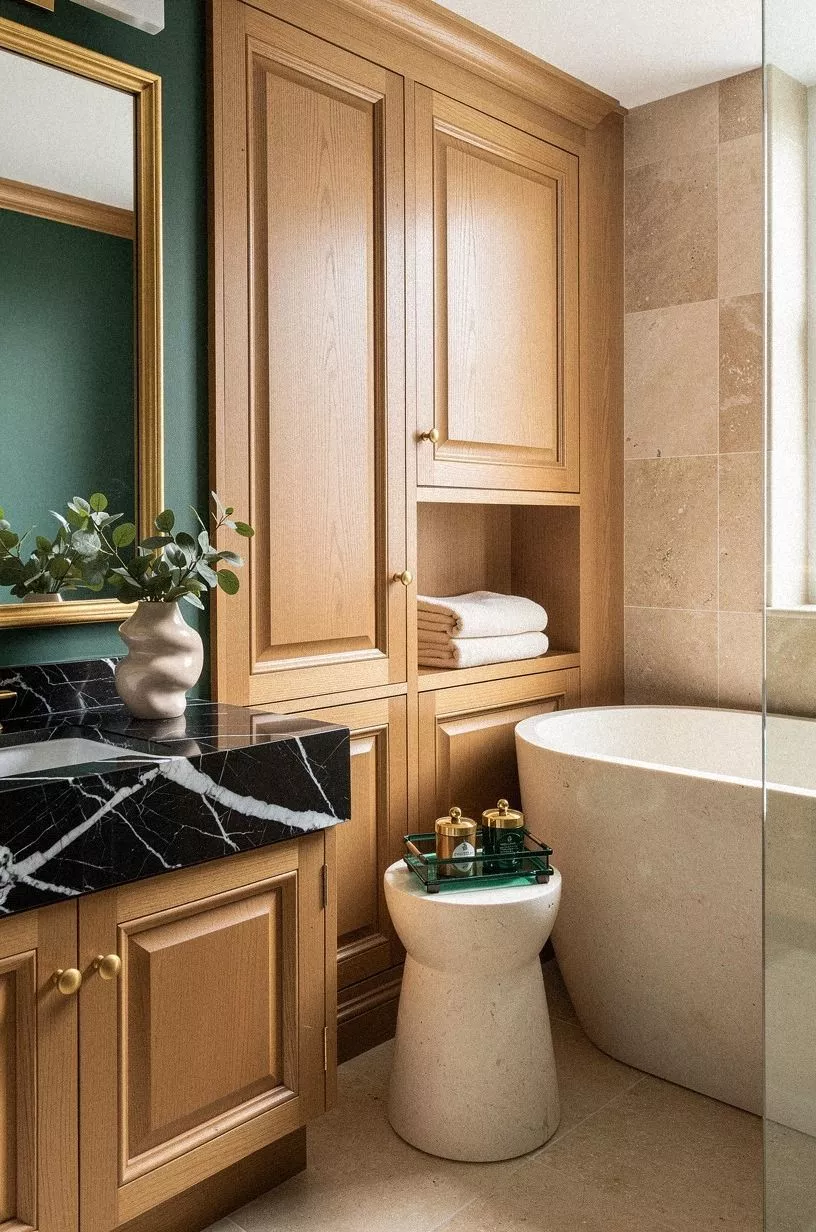
Light walnut keeps Nero Marquina black marble from becoming visually heavy. Choose a vanity in a pale, lightly grained finish, then let the marble carry its crisp white veining. Light walnut veneer looks especially inviting beside black marble when emerald, gold, and cream accents soften the contrast.
You’ll want the vanity to sit between 32 and 36 inches high, which keeps the proportions comfortable without swallowing the wall. If you’re working with a narrow room, a floating cabinet gives your floor more visible space.
I’d skip a chunky dark vanity here. It’ll make the stone look denser.
For the counter, honed Nero Marquina marble with white veins feels calmer than a glossy slab. Your eye can move across the surface without catching a hard reflection from every light. Keep the hardware simple, perhaps one slim pull per drawer.
A small framed print, a folded Turkish cotton towel, and one amber glass vessel are enough. You don’t need more decoration. For another warm stone direction, compare this approach with these dark green wood bathroom ideas and these small warm bathroom ideas.
2Let Benjamin Moore Chestertown Buff warm the ceiling
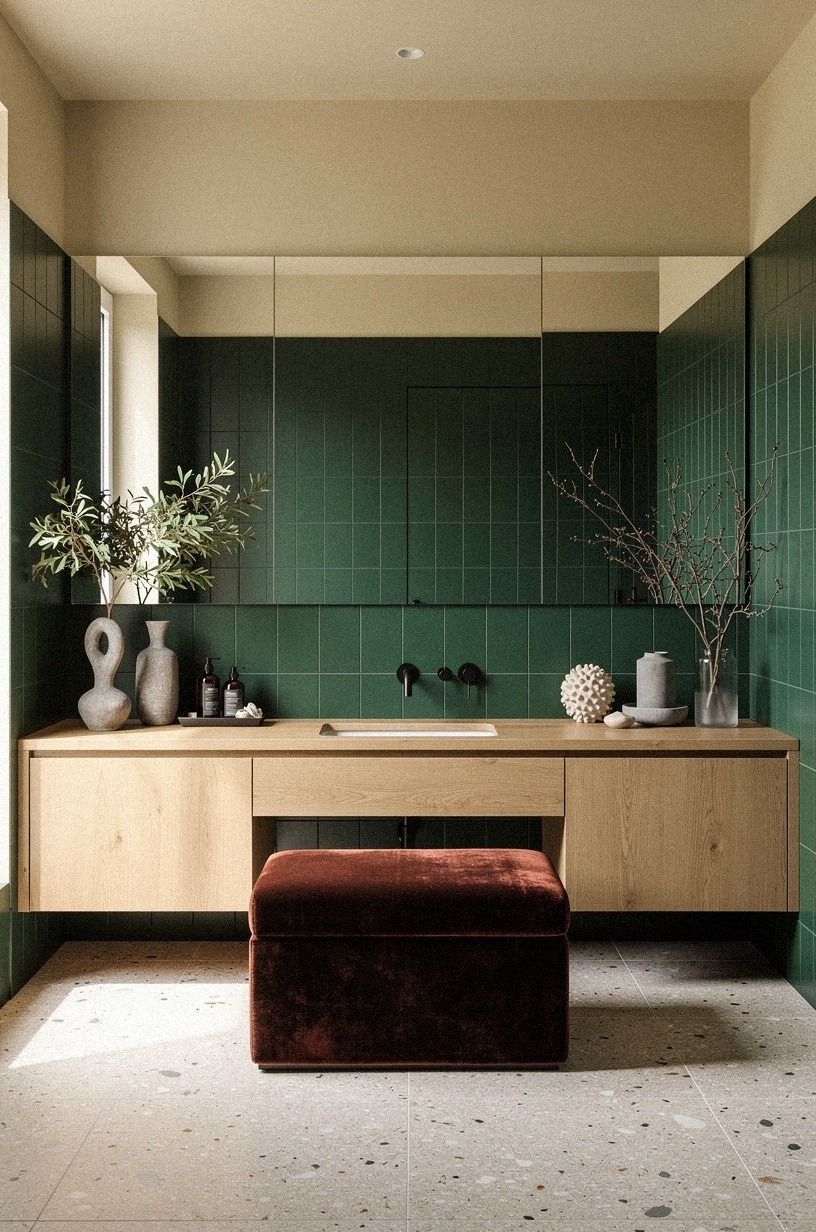
A forest green ceiling can make brown travertine feel intentional instead of dated. Connect it to rust and natural oak elsewhere in the room so the palette feels layered rather than heavy. The deep green gives the stone a richer backdrop without competing with its variation.
You’ll see the strongest result when your trim is softer than bright white. A warm ivory trim lets the bathroom feel earthy and peaceful, while stark white can make the travertine look orange. I tried a cool white once, and it made every brown tile look louder than it was.
Keep the lower half restrained. A small deep-pile mohair velvet stool adds softness beside the vanity, while a pale ceramic sink gives your eye a clean resting point. If your bathroom has limited daylight, use a satin finish on the walls and a flat finish overhead.
That small shift matters!
And don’t forget the door. Your door color is part of the palette, especially in a small room.
A painted wood door in the same forest green family will make the space feel more connected without adding another material. For related color pairings, browse these warm white bathroom ideas.
3IKEA TONSTAD makes the Two-Wood Rule easy
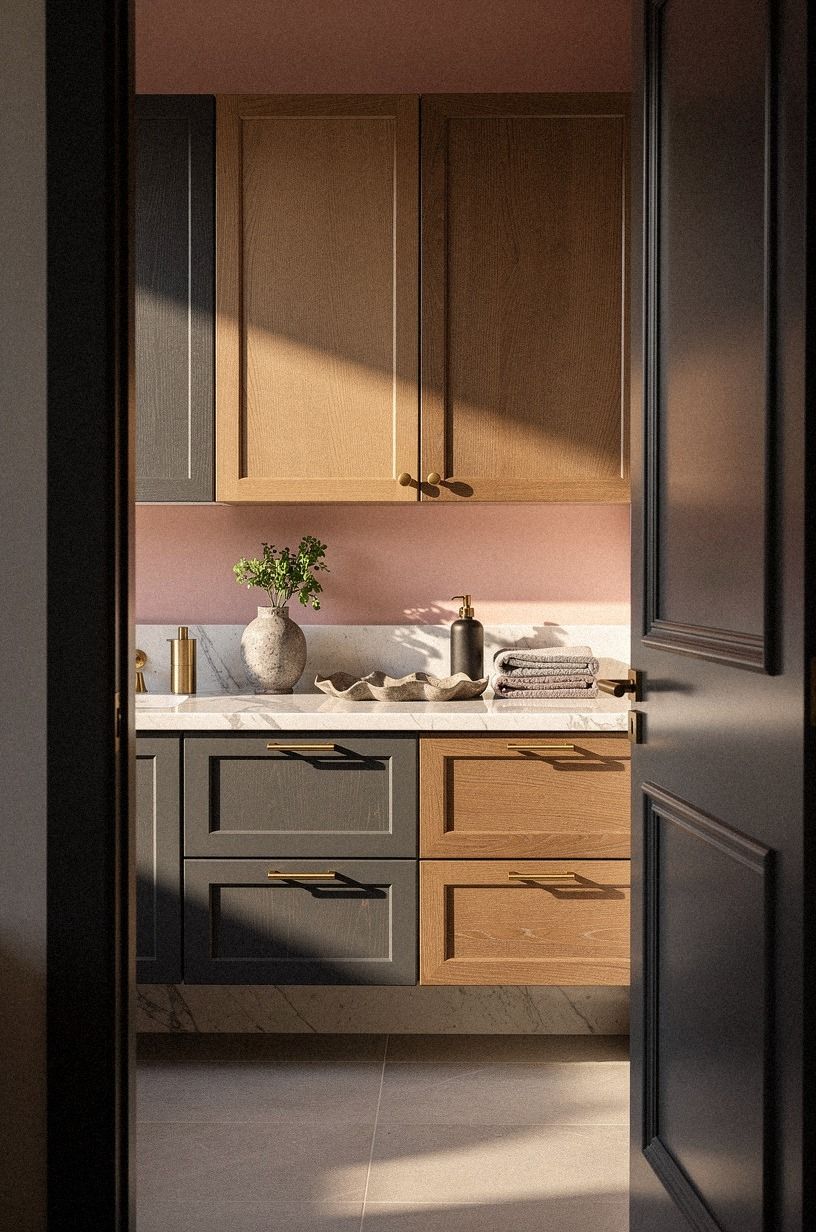
The Two-Wood Rule is simple: use one wood for the vanity and one smaller wood note for styling. Your main vanity might be IKEA TONSTAD oak effect, while a Carrara marble tray or shelf adds a pale second texture. More than that, and the room starts to look like a showroom sample board.
A floating vanity creates a useful strip of shadow below the cabinet. That dark line makes the room feel grounded, yet the exposed floor keeps it airy. You’ll want enough clearance to clean comfortably, especially if your stone has a textured finish that catches dust.
For the second material, choose something with a different scale rather than a louder color. Carrara marble with subtle gray veining brings a quiet contrast to dusty rose, charcoal, and brass. I’d choose that restrained veining over another dark wood.
Your basin should stay visually light. White fireclay undermount sink shapes work well with the warmer stone because they give the eye a bright pause.
If you’re saving elsewhere, spend on the vanity proportions and use basic drawer pulls. These walnut vanity bathroom ideas show the same principle in lighter palettes.
4Swap chrome for unlacquered brass
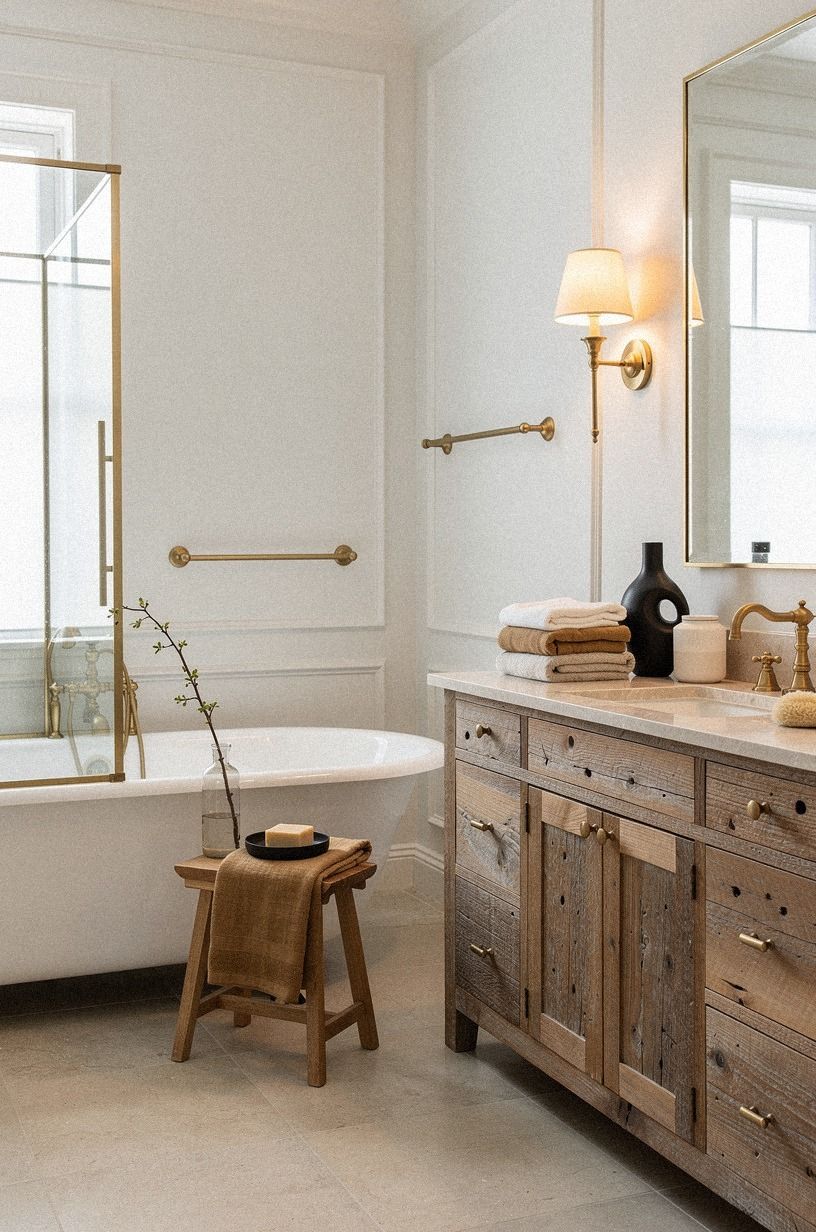
Brown travertine and chrome can feel disconnected. The stone is soft, irregular, and earthy, while polished chrome reads cool and sharp. Reclaimed weathered teak bridges those two worlds with a worn texture that works beautifully alongside warm white, camel, and black accents.
You don’t need teak everywhere. Use it at the stool, shelf, or vanity detail, then stop. If you’re repeating every material, the finish can start to look staged.
Your bathroom should feel collected, not color-coded.
A brushed finish is easier to live with than mirror-polished surfaces. It won’t show every water mark, and the weathered wood will keep the room tactile beside the stone. I’d skip black hardware unless your room already has a strong black detail, such as a window frame.
For a renter-friendly version, choose removable brass-look hooks and a freestanding reclaimed teak stool. You’ll get the warmth without drilling into tile. The change is small, but your eye will notice it the second you walk in!
These unlacquered brass bathroom ideas offer more ways to soften a stone-heavy room.
5Build The Three-Height Light Stack
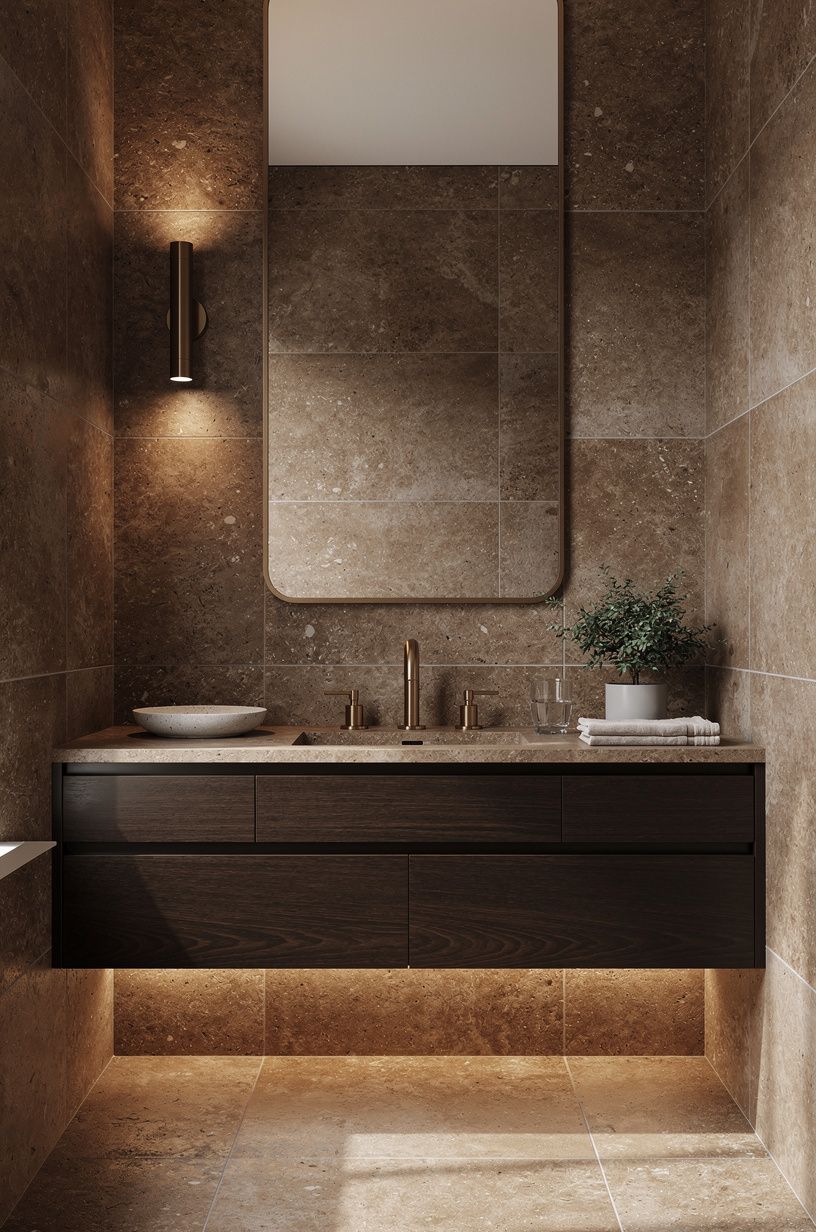
The Three-Height Light Stack uses a ceiling fixture, mirror lighting, and one low glow near the floor. Your bathroom won’t feel warm from a single overhead bulb, no matter how lovely the tile is. Light needs layers, just like the stone needs tonal variation.
Start with a soft ceiling fixture, then add Calacatta marble with gold veining at the vanity or shelf. A low plug-in night-light or tiny lamp on a safe vanity shelf gives your room a gentle evening glow. Copper details and ivory surfaces will keep the midnight blue palette from feeling too dark.
If you’re wiring from scratch, plan the mirror light before the tile layout. A centered fixture looks considered, while a last-minute light squeezed beside the cabinet can make the whole wall feel awkward. I made that mistake in a guest bath, and the electrician’s workaround still annoys me.
Your bulbs should feel warm without turning the stone orange. Choose the softest practical temperature available for your fixture, and test one bulb before buying a full set. For more ideas, see these layered bathroom lighting ideas and this moody deep green bathroom makeover.
6Why does a small bathroom need a pale counter?
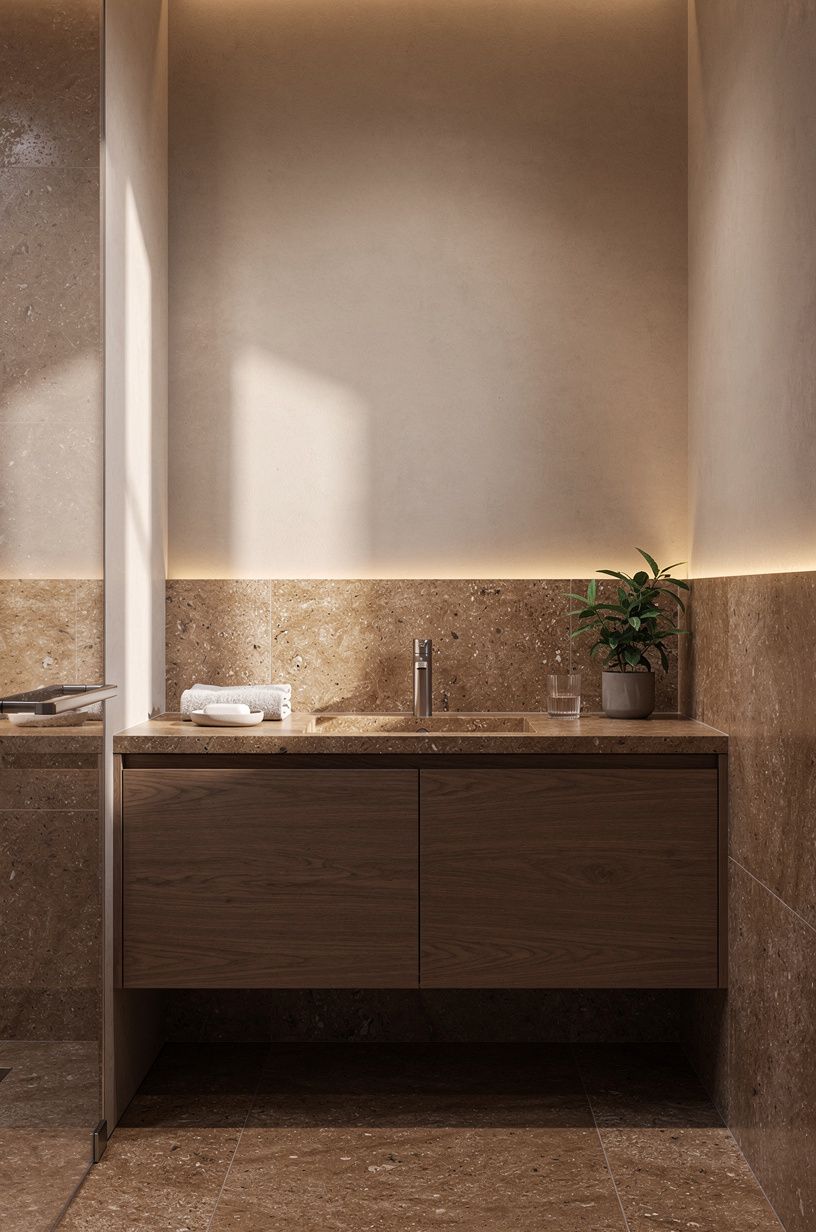
A small bathroom benefits from one pale horizontal surface because it breaks up the brown mass. Cerused white oak gives you that lift while still relating to the warm stone. You’ll keep the room earthy, but your eye won’t read the vanity wall as one solid block.
The counter should be quiet if your travertine has strong movement. Choose a surface with restrained grain rather than another dramatic pattern. I’d avoid a busy marble print here.
It can make your mirror, faucet, and tile all compete for the same small patch of attention.
Your backsplash can stop at the mirror if the wall is painted in Farrow & Ball Joa’s White. That approach saves material and makes the room feel taller. If you’re tiling the full wall, use a narrow format with visible grout so the surface doesn’t become one dark field.
A small room still needs breathing space. Keep your counter items to a soap bottle, a folded hand towel, and one shallow dish.
Three things. No pile of backups. These small bathroom design ideas use the same restraint.
7Frame the mirror with a Noce Shadow Line
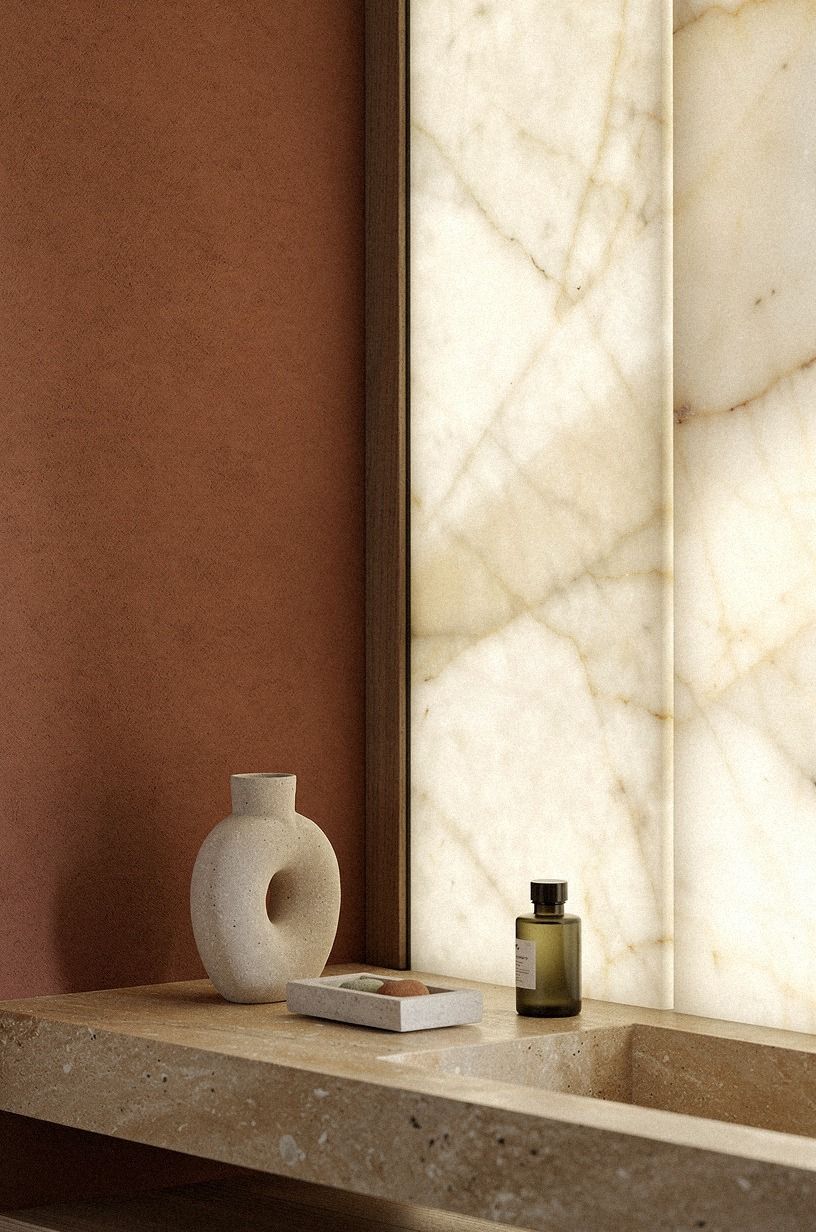
A Noce Shadow Line is the narrow dark border between a framed mirror and the wall behind it. You can create it with backlit translucent onyx, a dark grout edge, or a small reveal around a recessed cabinet. The point is to give the mirror enough weight beside the stone.
The onyx brings a soft glow to a palette of terracotta, stone, and olive. You’ll want the material to stay slimmer than the vanity top, especially if your mirror is wide.
Your mirror should be large enough to serve the room, not merely decorate it. A broad rectangle makes a compact bathroom feel more generous, while an oversized round mirror can soften a boxy layout. I’d skip a tiny arched mirror if you need practical daily light.
Add one small sconce on each side when the wall allows it. If your room is tight, a slim vertical light above the frame can still work. The mirror needs a little darkness around it, or it’ll disappear against pale paint.
These warm wood bathroom mirror ideas are useful if your frame feels too stark.
8Belgian flax linen at the window
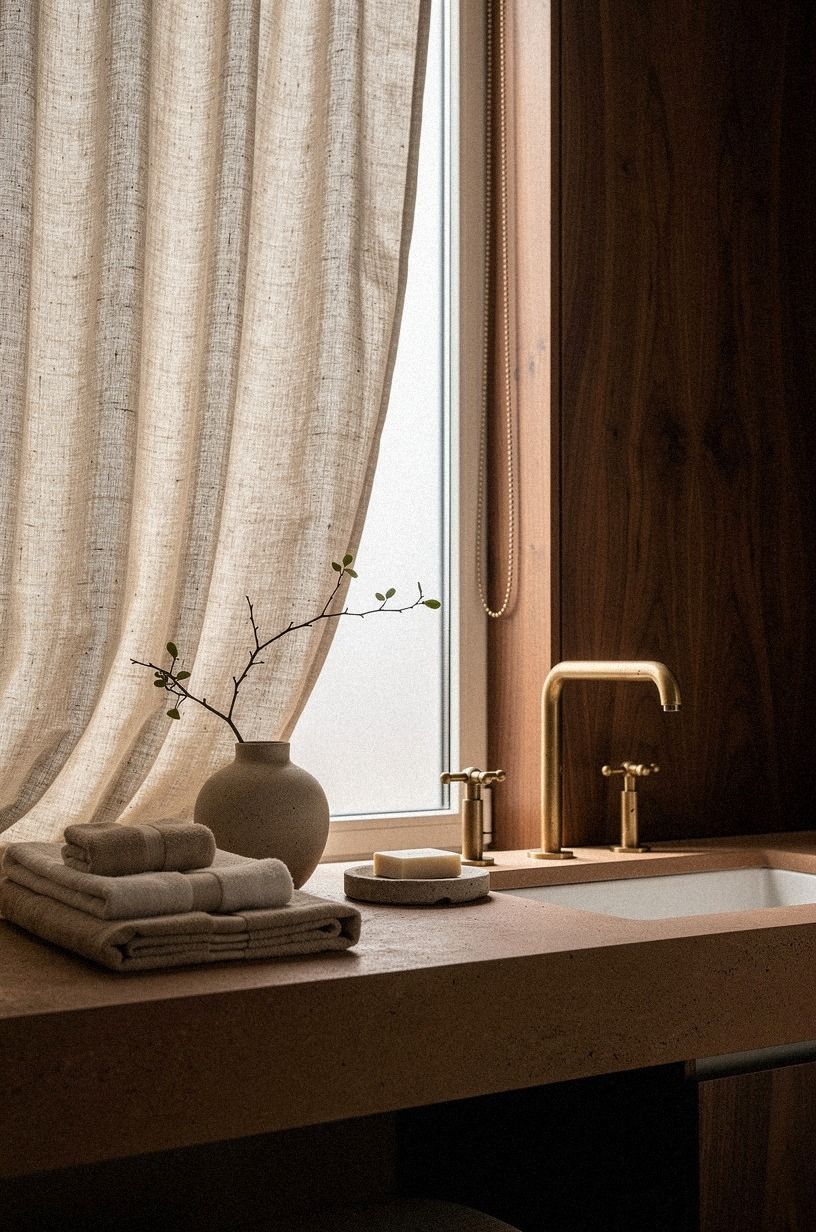
Window fabric can make a warm stone bathroom feel lived-in instead of newly installed. Pair Belgian flax linen with book-matched walnut, aged brass, and clay-toned accessories for a softer, more collected finish.
9Choose hand-glazed tile for the shower niche
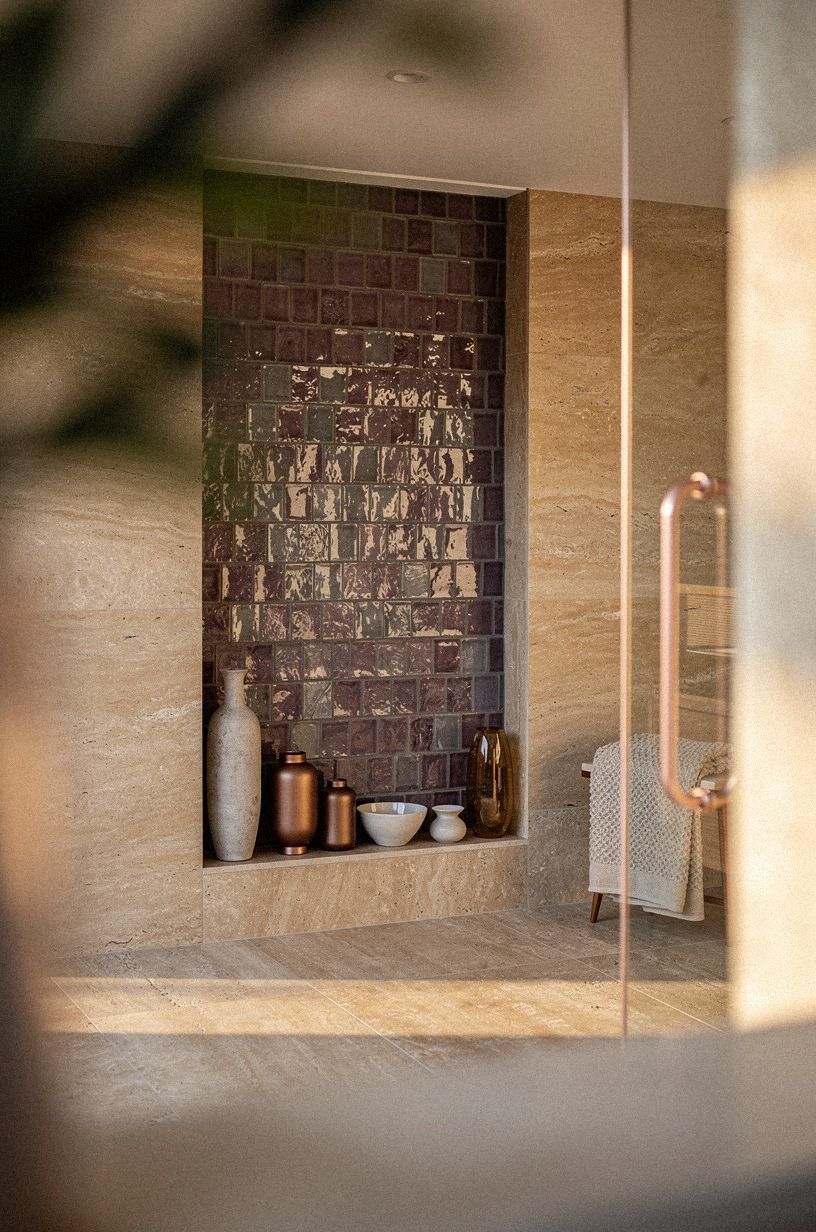
A shower niche is a useful place to introduce variation without covering every wall. Warm travertine gives your noce travertine bathroom a soft, uneven surface that catches water and light. You’ll get depth without needing another bold pattern across the entire shower.
Keep the niche backing darker than the main wall if you want bottles to disappear visually. A light cream backing creates more contrast and helps small objects stay visible. Your choice depends on whether you want the niche to read as a feature or a quiet recess.
The comfortable shower minimum in the brief is 36 by 36 inches. If you’re planning a new layout, protect that footprint before choosing decorative details. I’d never sacrifice usable elbow room for one more strip of tile.
Use matte black bottle vessels only if black appears elsewhere in your room. Otherwise, rose gold hardware and amber glass will keep the shower gentler against plum and gray tones. For a brighter stone palette, look at these white and cream travertine bathroom ideas and these hand-glazed shower tile ideas.
10Brown travertine meets Farrow & Ball Hague Blue
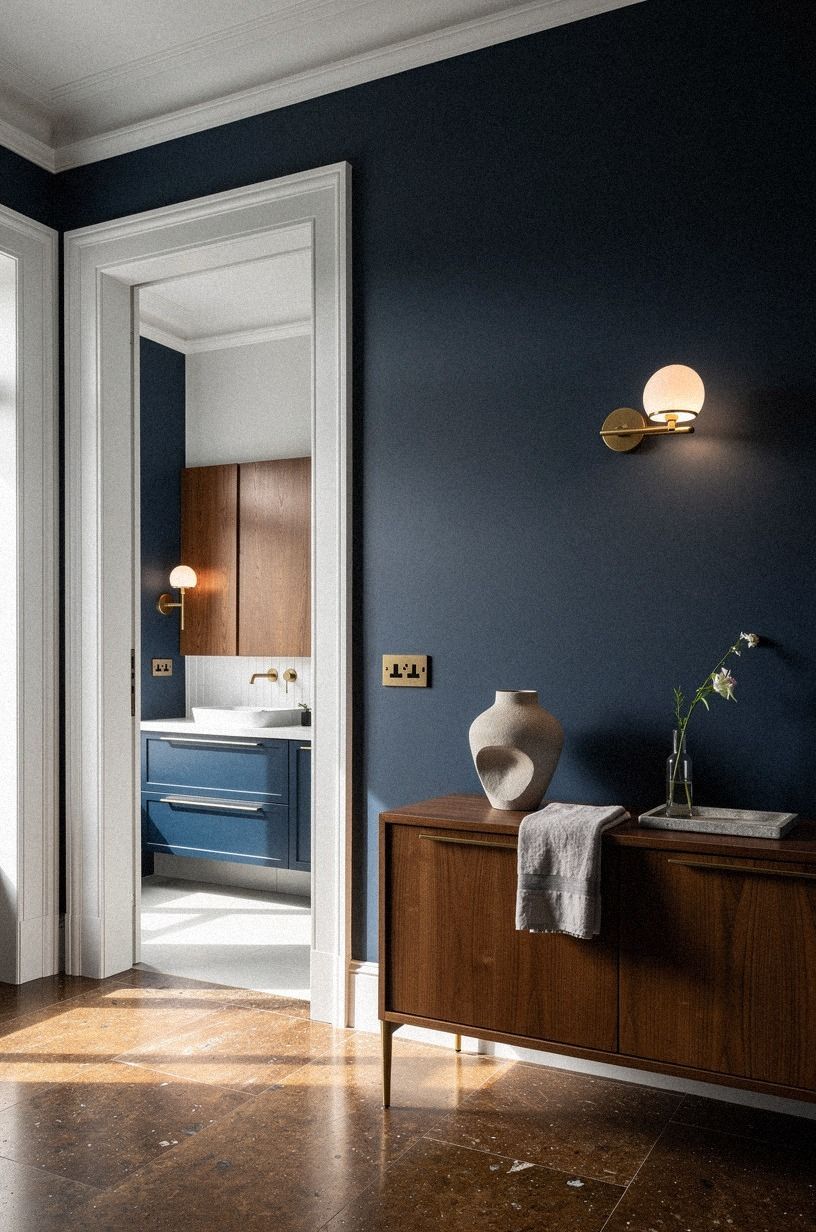
Use it on the vanity wall, the lower half of the room, or the wall behind a freestanding tub. Pair the navy with white, walnut, and unlacquered brass developing a soft patina so the contrast feels warm rather than stark.
11Anchor the floor with a soft geometric mat
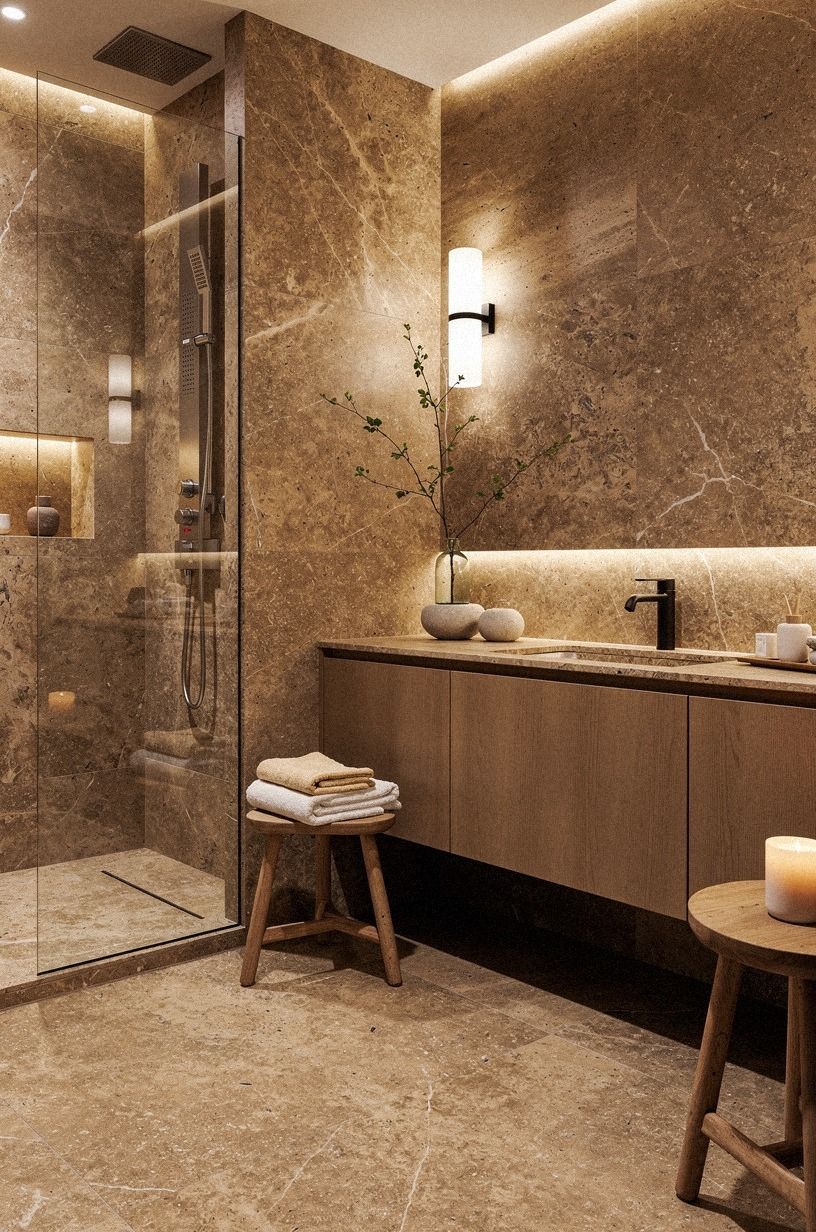
A bath mat can connect the vanity, stone, and painted wall without introducing another hard finish. Wool and cotton flatweave mat styles work best because they add touchable softness while keeping the floor visible around the edges. You’ll want the mat to sit flat, especially near a swinging door.
Choose a pattern with cream and emerald rather than a high-contrast black-and-white design. Your stone already has movement, so the mat should support it quietly.
I’d skip a shaggy pile. It holds moisture and looks awkward beside clean-lined plumbing.
Measure the clearance around your toilet before buying. The brief gives 21 inches in front as the minimum toilet clearance, and your mat shouldn’t reduce that usable space. A narrow runner can work better than a wide rectangle.
For a smaller room, one mat is enough. Add unlacquered brass developing a soft patina through a hook or towel bar, then leave the rest of the floor open.
The effect feels warm, intimate, and easy to maintain. These earthy bathroom ideas show how textiles can carry the warmth.
12Mix materials with The Three-Source Rule
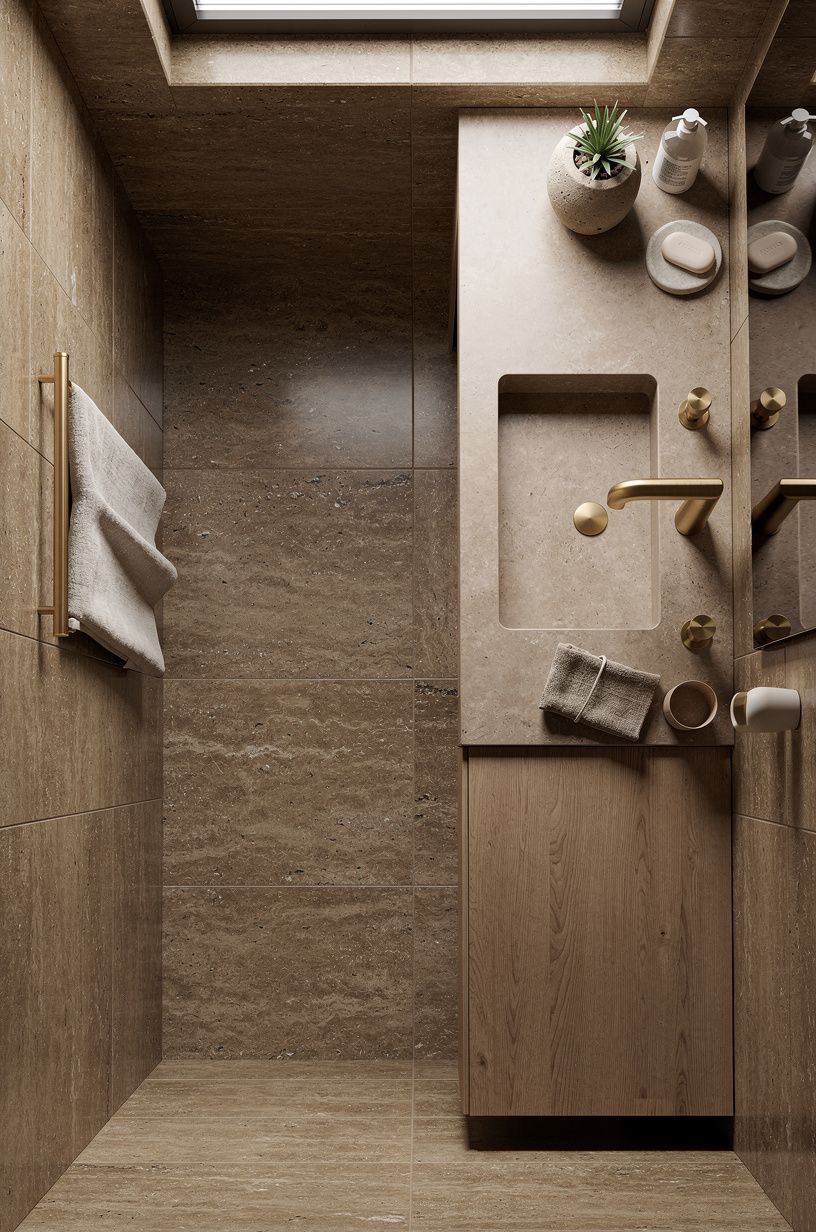
The Three-Source Rule keeps your warm stone bathroom from becoming visually repetitive. Use one stone, one wood, and one metal as the main material sources. Your paint and textiles can soften the mix, but they shouldn’t introduce five more competing finishes.
For example, choose an oversized-chip terrazzo tray as a small textural accent, natural oak for the cabinet, and aged brass for the plumbing. You’ll get contrast without losing the earthy direction. I’d skip adding concrete, black marble, and glossy tile on top of that combination.
Your materials should also feel different under your hand. A honed counter, smooth ceramic basin, and nubby linen towel create more interest than three shiny surfaces. If you’re standing at the vanity every day, texture matters as much as color.
Try the sample pieces together before ordering. You’ll notice quickly if one material feels too orange, too gray, or too polished.
A small sample board can save you from an expensive wall of tile that doesn’t settle with your lighting. These black and brown bathroom ideas take a similar approach.
13Noce underfoot, pale walls above
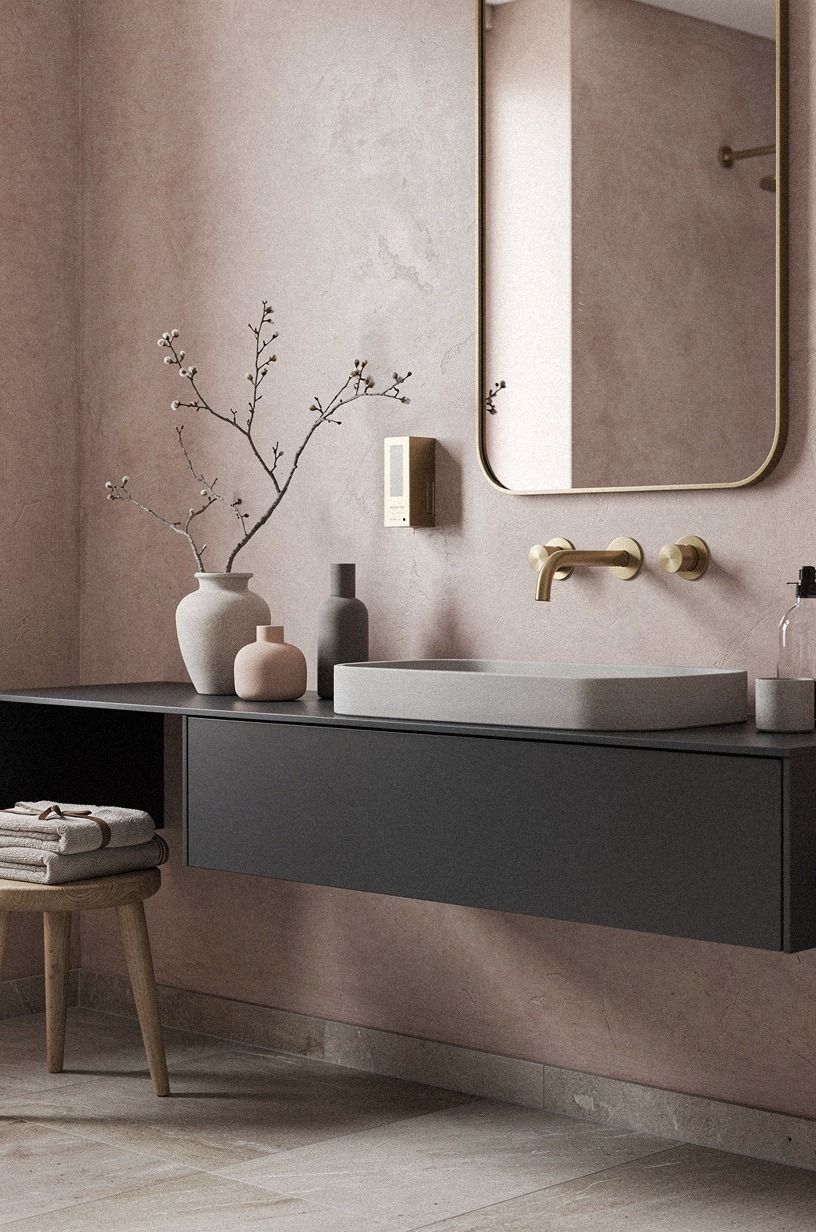
The shower floor is where hand-applied Venetian plaster can feel most convincing because its subtle variation adds a grounded, spa-like quality. Pair it with dusty rose, charcoal, and brass for a warmer contrast.
14Finish the walls with Sherwin-Williams Sea Salt
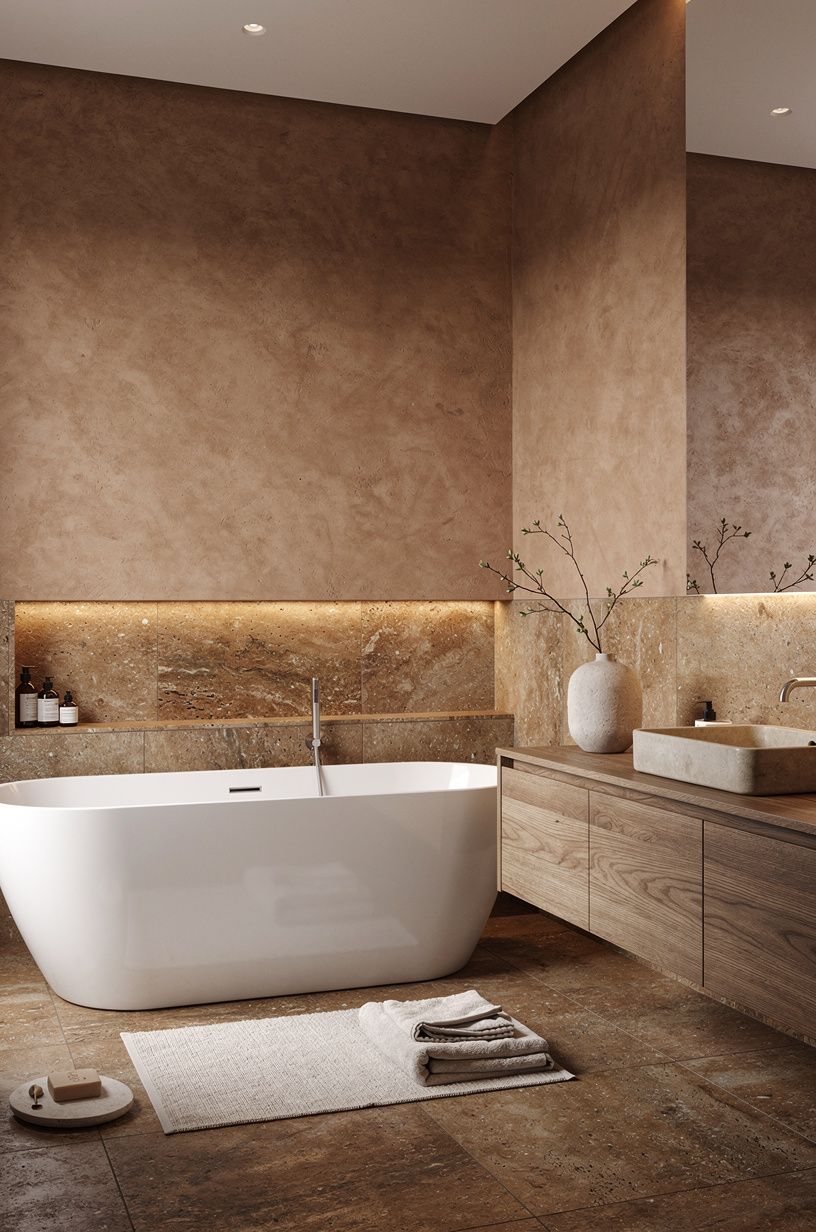
A warm white wall can soften a brown and noce palette when you want an airy edge. Shagreen accents add tactile interest beside camel upholstery and black details without introducing another busy pattern.
Use warm white on the walls above a tiled wainscot or on the vanity wall with soft trim. You’ll get a gentle contrast against the stone, and your brass fixtures will look less yellow.
I’d skip a cool blue-green if your travertine is strongly orange. A warmer neutral may sit more comfortably beside that tone.
Your styling should stay edited. One camel leather stool, a folded cream towel, and a small ceramic cup give the room enough life. You don’t need a shelf crowded with jars and plants.
And if your bathroom gets very little daylight, test the wall color at night as well. Paint changes after sunset.
A sample that looks peaceful in the morning can become gray by evening, so your decision should work for both. These soft green bathroom paint ideas can help you compare nearby tones.
My honest rule for brown travertine
I used to think a warm stone bathroom needed more warmth everywhere. More tan paint, more wood, more brass, more woven baskets. The result was pleasant in theory and flat in person.
The room had no place for your eye to rest because every surface was speaking at the same volume.
What changed my approach was choosing one deliberate counterpoint. Farrow & Ball Hague Blue gave a brown stone wall depth.
Pale linen made the room breathe. A cool cream basin kept the vanity from becoming a block of beige.
You don’t need to cool the whole bathroom down. You need one note that refuses to blend in.
I also learned to respect the stone’s surface. Polished travertine can look slick beside soft textiles, while honed or tumbled finishes carry a quieter, more tactile mood. Your hand notices that difference before your brain names it.
That’s why a pitted slab often feels more expensive than a flawless, shiny one.
The money matters, too. If you’re working with a limited budget, spend first on the surface you’ll touch and see every day, then improve the light. Paint can wait if the room is dim and the faucet feels flimsy.
A warm bathroom doesn’t need a full renovation to feel considered. It needs a point of view, a little restraint, and materials that don’t fight each other.
The Questions I Get Asked Most
What is the best Brown & Noce Travertine Bathroom Ideas for Deep, Earthy Warmth for a small bathroom?
A floating light walnut vanity and pale cream counter are the strongest choices for a small room because they preserve visible floor area. Add IKEA KALLAX birch-effect storage sparingly, then borrow layout ideas from these black and brown bathroom ideas.
Where can I buy Brown & Noce Travertine Bathroom Ideas for Deep, Earthy Warmth pieces on a budget?
Look at IKEA, Wayfair, and Target for vanities, mirrors, towels, and hardware. You can also check Facebook Marketplace or a local thrift store for wood stools and framed mirrors.
Your best savings usually come from buying one strong vintage piece, not many small accessories. These budget bathroom makeover ideas can help prioritize the changes.
How much does a Brown & Noce Travertine Bathroom Ideas for Deep, Earthy Warmth makeover cost?
A light refresh can cost about $100 to $300 if you keep the vanity and tile. Paint, rearranged styling, and cleaning the stone can be free or inexpensive. A full bathroom renovation costs much more, depending on plumbing, tile, and labor.
Can I create a Brown & Noce Travertine Bathroom Ideas for Deep, Earthy Warmth on a budget?
Yes, and you can start without replacing the stone. Paint the walls, change the mirror, and swap the faucet or textiles first. Benjamin Moore White Dove OC-17 on trim can brighten the room for less than a tile replacement.
Is a Brown & Noce Travertine Bathroom Ideas for Deep, Earthy Warmth worth it in a small space?
Yes. A small bathroom helps the palette because fewer materials are competing for attention.
Keep the vanity floating, protect at least 21 inches of toilet clearance, and use one pale surface so your room doesn’t feel visually compressed. These small bathroom storage ideas can preserve that openness.
Is a Brown & Noce Travertine Bathroom Ideas for Deep, Earthy Warmth a good idea for a rental?
Yes, if you focus on removable changes. Try peel-and-stick wall color, a tension curtain rod, removable hooks, and a freestanding stool. You can also replace cabinet pulls and store the original hardware safely, so your landlord won’t inherit a surprise!
Which paint color works best with noce travertine?
Benjamin Moore Chestertown Buff warms the stone, while Farrow & Ball Hague Blue adds dramatic contrast. Sherwin-Williams Sea Salt is the gentler choice if you want an airy, peaceful room. Test each sample beside your actual tile before choosing.
What should I avoid with brown travertine?
Avoid matching every surface to the same beige family. Your bathroom will need one cooler or lighter note, such as pale cream, muted blue-green, or soft ivory. I’d also avoid excessive glossy finishes because they can make irregular stone look less natural.
Where I’d Start First
If I had to pick one, I’d start with the floating light walnut vanity. It gives your stone a clean horizontal break, keeps the floor visible, and prevents the room from becoming a brown box. Pin this idea for later, then test your paint beside the tile before buying anything.