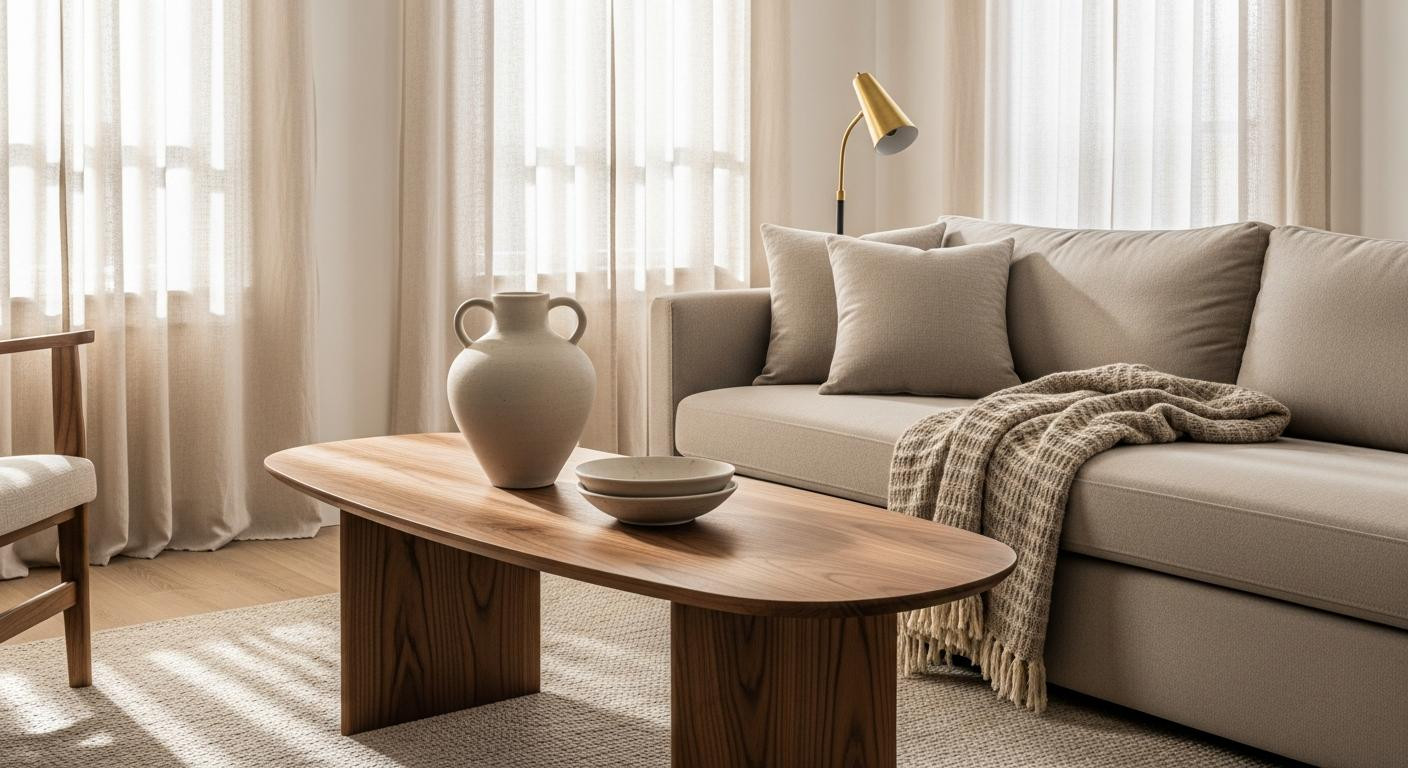
Your living room in May 2026 when the black barn door hardware catches afternoon light and suddenly looks like a 2019 time capsule. The shiplap cost $840 to install in 2022. The distressed wood coffee table ran another $380. But the room feels themed now, like a staged property where nothing relaxes. Your neighbor’s space photographs like a boutique hotel: curved walnut table, oatmeal linen sofa, handmade ceramic lamp. Same square footage, opposite feeling. Farmhouse promised cozy. Japandi delivers calm.
The difference sits in texture, curve, and the 14 material choices that separate a room that soothes from one that performs.
What farmhouse does that makes rooms feel staged instead of lived-in
Farmhouse decor reads as theme because it relies on visual cues that announce “this is farmhouse”: black accents, distressed finishes, rustic wood, galvanized metal, shiplap walls. Those elements work beautifully when combined with restraint, but most farmhouse rooms layer too many signals. The result feels decorated, not designed.
Black hardware on every surface, distressed wood on every table, white shiplap on three walls. Japandi solves this by removing the performance. Walnut wood stays smooth, not distressed. Ceramic stays unglazed, not glossy.
The palette pulls from sand, stone, and warm oak instead of stark white and matte black. A farmhouse room tells you it’s farmhouse. A Japandi room just feels right without announcing why.
The 5 material swaps that make the difference
Warm white walls replace bright white shiplap
Benjamin Moore Swiss Coffee (OC-45) at $94 per gallon creates depth instead of clinical brightness. Farmhouse’s Pure White (SW 7005) reflects light like a hospital corridor. Warm white absorbs and diffuses, making 186-square-foot living rooms feel 20 square feet larger because the walls recede instead of bounce.
Design experts featured in Architectural Digest recommend warm whites with LRV values between 83 and 87 for warm minimalism that doesn’t read cold. And the texture matters too: skip glossy finishes entirely. Matte or eggshell absorbs light without bouncing it back into your eyes.
Curved walnut coffee tables replace distressed wood trunks
Article’s Bios Coffee Table ($549, 42 inches round, walnut veneer) softens circulation paths. Farmhouse’s rectangular distressed wood trunk ($380, sharp corners, black hardware) blocks movement and creates visual stops. Curves keep the eye moving, which makes rooms feel open even when furniture footprints stay identical.
Interior designers with ASID certification note that curved furniture reduces visual clutter by 30% compared to boxy silhouettes. The walnut grain adds warmth without the distressed finish that telegraphs “farmhouse.” But this only works if your coffee table sits at least 18 inches from the sofa edge.
Unglazed ceramic vases replace galvanized metal accents
West Elm’s Pure Ceramic Vase ($34, matte white, 8 inches) absorbs light and sits still. Farmhouse’s galvanized metal pitcher ($28, reflective finish) catches glare and creates visual noise. Matte surfaces make small spaces feel larger because they don’t compete for attention.
Professional organizers with certification confirm that reducing reflective surfaces in a room cuts visual stimulation by nearly half. That’s the nervous-system regulation the LA Times references when they call Japandi “simplicity with soul.”
Linen curtains in oatmeal replace white cotton panels
IKEA’s Aina Linen Curtains ($87 for two 96-inch panels, natural) scatter light instead of blocking it. Farmhouse’s bright white cotton panels ($54, polyester blend) reflect too much brightness back into the room. Linen curtains diffuse afternoon sun into a soft glow that makes the room feel six degrees calmer without changing the thermostat.
The texture adds visual interest at eye level, which farmhouse rooms often lack. One design voice quoted by Country & Town House calls this “purposeful simplicity.” The linen wrinkles slightly, and that imperfection is the point.
Low walnut bed frames replace tall distressed wood frames
Thuma’s Classic Bed Frame (queen, $1,095, walnut, 10 inches off the floor) grounds the bedroom visually. Farmhouse’s tall distressed frames (24 inches high, chunky posts, black hardware) dominate small bedrooms and make 8-foot ceilings feel lower. Low frames create negative space above the mattress, which makes the room feel taller and more open.
Lighting designers with residential portfolios note that lower furniture allows wall sconces and pendant lights to work at proper heights. The walnut finish pairs with brass hardware better than distressed gray-brown wood ever could.
Why Japandi works in apartments where farmhouse fails
Farmhouse needs architectural support Japandi doesn’t
Shiplap walls cost $6 to $8 per square foot installed. Exposed beams require 9-foot ceilings. Barn doors need 8 feet of wall clearance. Most rentals and newer builds lack these bones, so farmhouse elements look applied instead of integrated.
Japandi works in a 340-square-foot studio or a 2,400-square-foot house because it relies on furniture and textiles, not architecture. A walnut coffee table, linen curtains, and three handmade ceramic pieces transform any space without asking permission or requiring installation. That’s where curved furniture becomes critical: it adapts to any floor plan.
Japandi scales to any room size
Farmhouse feels cluttered below 250 square feet because its layered aesthetic (wood signs, metal accents, baskets, distressed finishes) needs space to breathe. Japandi’s “less, but better” philosophy works in 180-square-foot bedrooms because six perfect objects create more visual impact than fourteen farmhouse cues fighting for attention.
And it photographs better. The Oblist describes 2026 Japandi as spaces that “restore rather than stimulate.” That calm translates to resale appeal and rental listings that look professionally staged without the $800 staging fee.
Your questions about the Japandi trend replacing farmhouse answered
Can I mix Japandi pieces into my existing farmhouse room?
Yes, but start by removing 30% of farmhouse’s visual signals. Swap black hardware for brass or walnut. Replace distressed wood with smooth oak. Keep the neutral palette but drop the themed accents: metal signs, galvanized decor, script-font wall art.
Add one curved piece and three unglazed ceramic objects. The room will transition from “obviously farmhouse” to “quietly intentional” without requiring a full reset. Target’s Studio McGee line offers Japandi-adjacent ceramics starting at $18.
Does Japandi work in traditional homes with dark wood trim?
Japandi’s warm oak and walnut tones complement traditional wood finishes better than farmhouse’s distressed gray-brown wood. The key sits in matching wood undertones: if your trim reads orange-toned, choose walnut furniture; if it reads cool, choose white oak. Both sit at 1,360 Janka hardness, so durability stays consistent.
What’s the minimum budget for a Japandi living room refresh?
$340 gets you a walnut-toned coffee table ($180 from Article’s sale section), two linen curtain panels ($87 from IKEA), and three ceramic pieces ($73 total from West Elm or Target). That’s enough to shift the visual language from farmhouse to Japandi without touching the walls or replacing the sofa.
The emotional difference between farmhouse cozy and Japandi calm
Farmhouse promised cozy, but cozy often means busy. Textured throws, patterned pillows, wood signs with script fonts, baskets holding more baskets. The eye moves constantly, which feels warm during a 30-minute visit but exhausting after eight hours.
Japandi calm comes from visual rest: smooth walnut, unglazed ceramic, soft linen, negative space. Design experts with certification describe it as “warm minimalism,” which means enough texture to feel human but enough restraint to feel adult. The room holds six objects instead of fourteen. Your sister asks if you hired a designer.
May afternoon light through linen curtains in oatmeal, diffused and soft across a curved walnut table holding one handmade ceramic vase. The room holds six objects instead of fourteen. You didn’t hire anyone. You just stopped performing farmhouse and started living in calm.