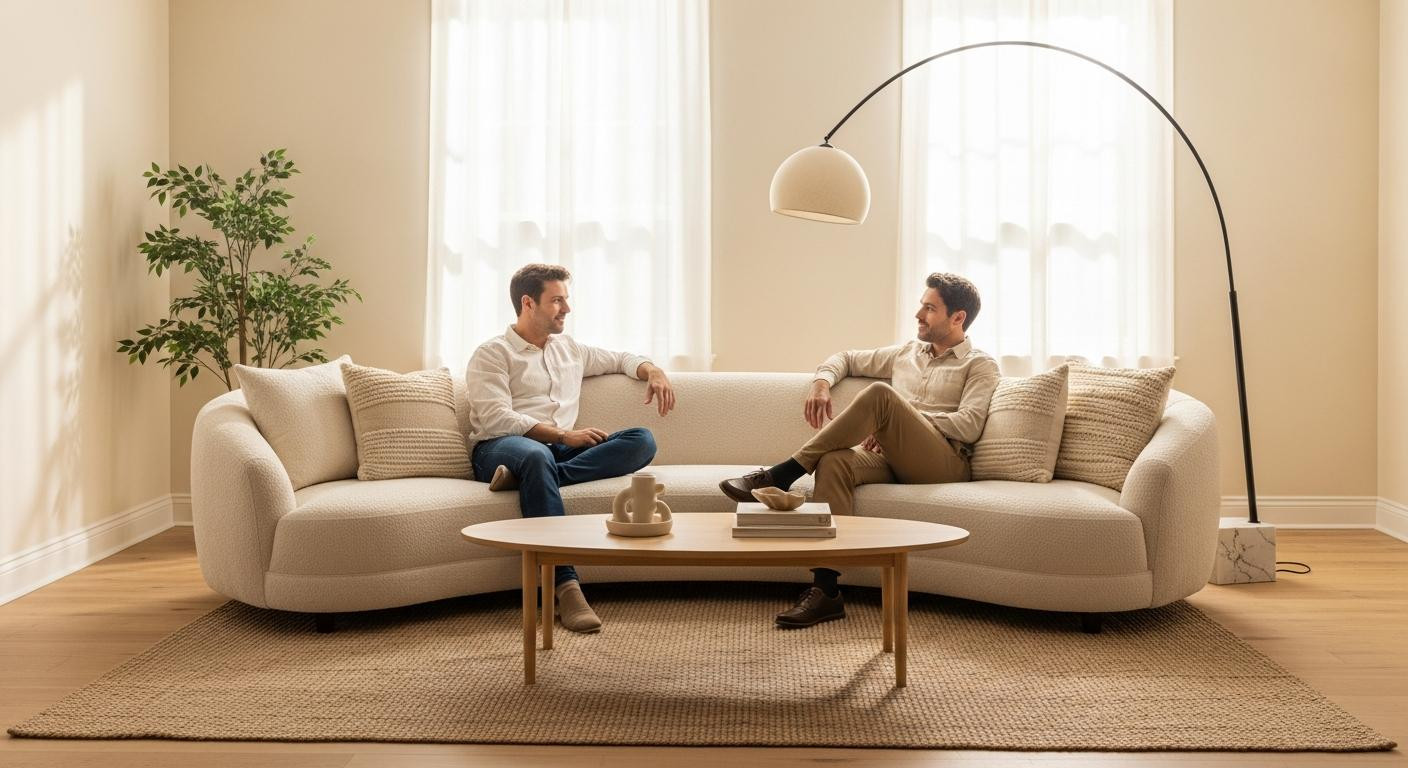
Your living room holds a straight sectional pushed against the wall, and every May dinner party ends with guests perched in a line facing the TV instead of each other. The sofa cost $1,299 in 2023. It seats five. But the room feels like a dentist’s waiting area because 92 inches of rigid upholstery creates a barrier instead of a conversation zone. Three blocks over, your neighbor’s apartment has the same square footage but photographs like a boutique hotel because her curved sofa floats in the center, defining the seating area without blocking sightlines. The difference isn’t budget. It’s geometry.
Curves replaced straight lines because rooms got tired of feeling institutional
The shift happened between 2024 and 2026 when design coverage stopped celebrating stark minimalism and started using phrases like soft modern and warm minimal. POVISON’s 2026 trend guide shows curved sofas as the headline seating trend. Homes & Gardens calls them essential for rooms moving away from sharp angles.
The market broadened. Curved silhouettes now appear at IKEA, Target, and Wayfair, not just Restoration Hardware showrooms. According to home interiors experts featured in Homes & Gardens, rounded furnishings help interiors feel calmer and more inviting.
The complaint wasn’t that straight sofas were ugly. It’s that they made rooms that feel too hard, too angular, too cold. The bouclé texture scatters afternoon light instead of reflecting it, which keeps the space from feeling sterile.
A curved sofa changes three specific things about how a room works
It softens visual weight without adding fabric or color
A 90-inch sectional creates a horizontal line that cuts the room in half. A 90-inch curved sofa creates an arc that guides the eye around the space instead of stopping it. New York designers quoted by Veranda confirm that curved silhouettes soften a floor plan and support fluid circulation.
The shape keeps the room from feeling divided into sofa side and everything else. And that matters more in open-plan spaces where straight sofas make conversation feel stiff.
It turns a seating area into a conversation zone
Straight sofas make people sit in rows. Curved sofas angle bodies toward each other. Los Angeles designers interviewed by the LA Times in June 2025 noted that curves add a more relaxed feel and help soften angular spaces.
The effect is social. The room stops feeling like a waiting area and starts feeling like a place where people actually talk. But only if you have at least 30 inches of walkway clearance around the piece.
The trade-offs designers don’t mention in the magazine spreads
Curved sofas fail against flat walls
Interior designers warn that curved pieces can look awkward when pushed against a wall and may visually eat up more space than straight sofas in smaller rooms. The advice from design professionals: if your room is under 180 square feet, a curve works only if you can float it at least 18 inches from the wall.
Otherwise, the shape reads as bulky rather than elegant. In rooms under 10 feet wide, stick to a shallow arc or skip the curve entirely.
They sacrifice seating capacity for style
Design experts note that curved sofas underperform on function, failing core needs like seating capacity, lounging, and flexibility. A 92-inch straight sectional seats five adults comfortably. A 92-inch curved sofa seats four, and only two can fully recline.
If you host weekly game nights, the trade-off matters. The linen feels inviting under your palm, but there’s nowhere for the fifth person to sit.
What actually makes one curve look expensive and another look like a hotel lobby
The difference sits in arm height and cushion depth. Restoration Hardware’s curves work because the seat depth hits 42 inches and the arms stay low enough to preserve sightlines. Budget versions from Wayfair often fail because 34-inch seat depth feels perched, and high rolled arms block the sculptural silhouette that makes curves photograph well.
Article and West Elm hit the middle: 38-inch depth, mid-height arms, textured neutrals like bouclé or linen that scatter light instead of reflecting it. The shape gets you halfway to expensive. The proportions finish the job.
And that’s the detail most people miss when they wonder why their $640 curved loveseat doesn’t feel like the $3,200 version in the magazine. It’s not the fabric. It’s the math.
Your questions about rounded sofas answered
Do curved sofas work in small apartments?
Only if the room is large enough to float the piece. Designers recommend at least 186 square feet with 18 inches of clearance behind the sofa. Smaller spaces should use a curved accent chair or rounded ottoman instead of committing the full layout to an arc.
From there, you can add a kidney-shaped coffee table or arched floor lamp. The effect still softens the room without floating curved sofa defining a zone that blocks traffic flow.
What rug shape works under a curved sofa?
Round rugs amplify the curve and can make the room feel too themed. Rectangular rugs in 8×10 or 9×12 create contrast that grounds the piece. The rug should extend 12 inches beyond the sofa’s footprint on all sides.
Natural jute or low-pile wool in warm beige keeps the space from feeling too soft. The texture under bare feet adds warmth without competing with the bouclé.
How much does a decent curved sofa cost in 2026?
Budget options at IKEA and Target start at $640. Midrange pieces from Article and West Elm run $980 to $1,400. High-end custom and Restoration Hardware versions reach $3,200 to $5,800.
The price jump from $980 to $3,200 mostly buys frame quality, seat depth, and upholstery durability. But the visual difference on Instagram is smaller than you’d think. Soft modern apartment living room with sculptural furniture looks editorial regardless of price if the proportions are right.
The curved bouclé sofa floats 22 inches from the wall in afternoon light, casting a soft shadow that moves across the jute rug as the sun shifts. Three people sit angled toward each other without adjusting their bodies. The room doesn’t feel decorated. It feels designed for actual conversation.