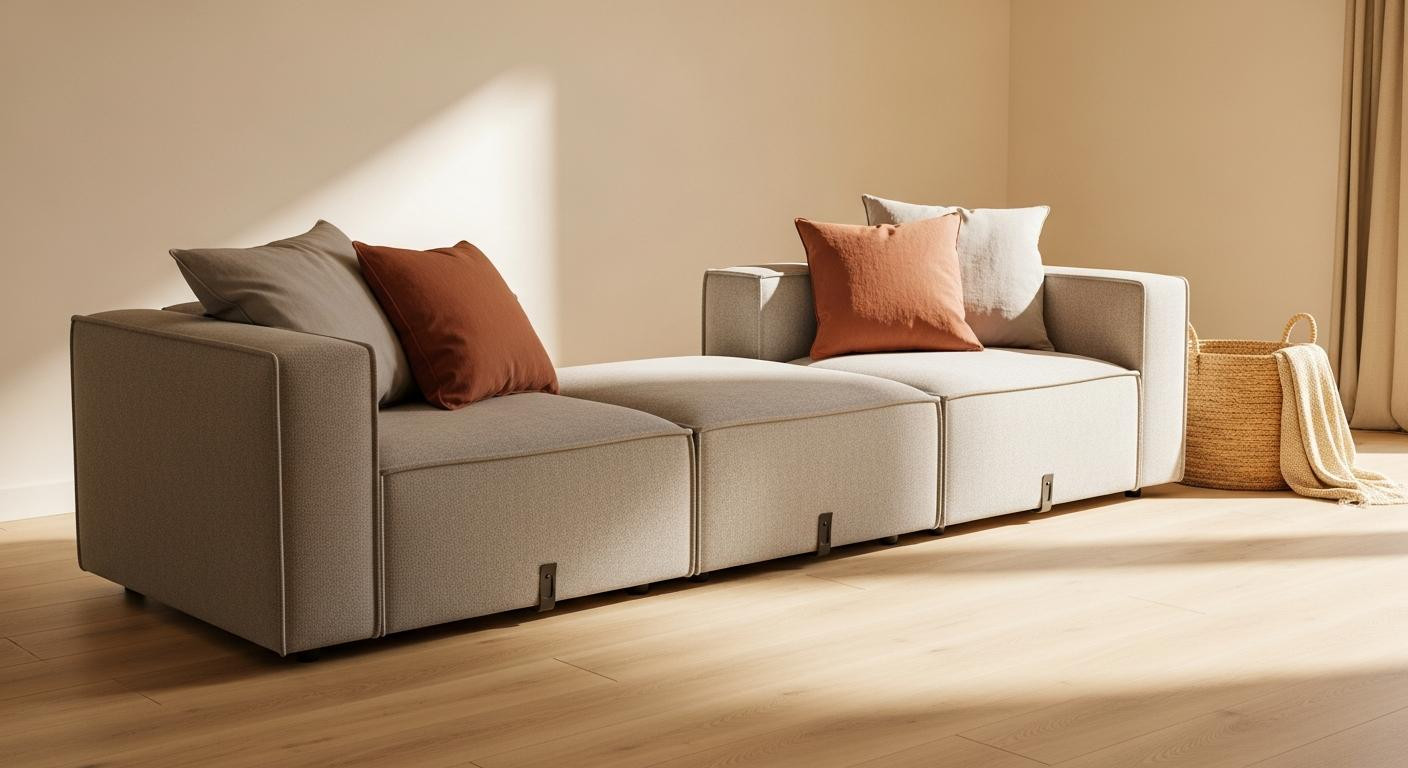
Your lease ends in November and you’ve already lost three pieces of furniture to narrow stairwells. The sectional that looked perfect in the showroom won’t fit through a 32-inch doorway. Your neighbor’s living room photographs like a designer showroom, but everything she owns breaks down into pieces light enough to carry alone. The difference isn’t budget. It’s whether your furniture was built to stay or designed to follow you across five apartments without losing its shape, its style, or your deposit.
The 28-pound modular sofa section that survives four moves without looking temporary
Modular sofas cost more upfront because they’re engineered to disassemble without damage. The Burrow Nomad breaks into three sections at 28 pounds each, which means one person can carry each piece up three flights of stairs. But assembled, it reads as substantial. The frame sits at 17 inches seat height with 25-inch arms, the same proportions as fixed sectionals that weigh 180 pounds and require four people to move.
And that weight difference matters when you’re packing a 10-foot truck instead of hiring movers. According to furniture designers who specialize in small-space solutions, modular construction adds $400 to $680 to the cost of a three-seat sofa compared to non-modular equivalents. But it eliminates the $800 to $1,200 you’d spend replacing a fixed sectional damaged during transport or one that simply won’t fit through your next apartment’s entrance.
The connection hardware makes the difference between furniture that shifts during sitting and pieces that stay locked. Burrow uses metal clips that snap sections together in 8 to 12 minutes without tools. Floyd uses bolt-through brackets that require a hex key but create a tighter join. Both systems keep armrests from drifting when you lean into them, which is the failure point of friction-based Budget modulars that separate every time you sit down.
Standard doorways reject 86-inch sectionals but accept 34-inch modular pieces
US apartment doorways measure 30 to 36 inches in width, but the effective clearance is usually 28 to 34 inches once you account for door frames and hinges. A standard three-seat sectional spans 86 to 96 inches when assembled, which means it only fits through a doorway if it’s built to come apart. And most aren’t.
That’s why professional organizers with residential moving experience recommend measuring individual sections, not total furniture dimensions. A Burrow section measures 34 inches wide, a Floyd section 32 inches, and an Article Timber section 30 inches. All three clear standard doorways with room to angle through. A West Elm non-modular sofa at 88 inches requires removal of the door frame or a ground-floor apartment.
But modularity isn’t just about doorways. It’s about staircases, elevators, and the reality that you’ll move an average of 11 times in your lifetime if you’re renting in a major US city. Each move where your furniture fits easily saves $200 to $400 in professional mover fees for difficult access or damage repair.
Storage furniture that holds 40 pounds but weighs 22 makes packing faster than closets
Rattan storage benches weigh 22 pounds empty and hold 40 pounds of linens, which gives them a better weight-to-capacity ratio than wood credenzas at 65 pounds that hold 80 pounds. And they double as seating, which means they earn their floor space in small apartments. West Elm’s rattan bench costs $279, Target’s version costs $89, and both pack flat when you wrap the frame in moving blankets.
Seagrass baskets stack inside each other during moves. A set of three weighs 9 pounds total and holds 24 pounds of books, throws, or kitchen items when separated. That’s the kind of dual-purpose storage that design experts featured in home organization coverage recommend for renters, because visible storage becomes decor instead of hiding in closets you’ll empty in six months.
Nesting tables compress for transport in ways fixed coffee tables don’t. A set of three weighs 12 to 15 pounds combined and fits in a Honda Accord trunk at 16.7 cubic feet capacity. Add four seagrass baskets and two flat-pack benches, and you’ve loaded functional furniture that would require a pickup truck if it were solid wood construction.
Leaning mirrors weigh 14 pounds and skip the wall anchors that cost you your deposit
Floor mirrors lean at an 82-degree angle against the wall and create vertical lift without drilling. West Elm’s Colby mirror stands 68 inches tall, weighs 14 pounds, and costs $279. It reflects ceiling height and makes small rooms feel architectural. But unlike hung mirrors that require wall anchors and leave holes, it sits on the floor and moves to your next apartment in November without a repair bill.
The packing technique matters more than the mirror weight. Bubble wrap the corners first, add cardboard edge guards to the frame, wrap the whole piece in moving blankets, and position it vertically in the truck. According to Command strips and adhesive hooks guidance for renters, vertical transport distributes stress across the frame instead of concentrating it at a single hanging point where mirrors crack during moves.
Modular furniture costs 22% more now but outlasts fixed pieces by 4 years across multiple apartments
The Burrow Nomad modular sofa costs $1,895 for three seats. A West Elm non-modular equivalent costs $1,548. That’s a $347 premium, or 22% more. But modular sofas last 10 to 12 years across multiple moves because their frames don’t stress during disassembly. Fixed sectionals last 7 to 8 years in one location, but rarely survive three moves without frame damage or upholstery tears that cost $400 to $800 to repair.
Storage benches made from woven materials age visibly better than upholstered furniture because rattan and seagrass develop patina instead of stains. A $279 rattan bench used across four apartments and six years costs $46 per year. A $180 upholstered ottoman that needs replacing after two moves costs $90 per year. The higher upfront cost delivers lower annual cost if you’re planning to move more than once.
And that’s the investment calculus renters miss when they buy cheap fixed furniture. Paying $347 to $680 more for modular pieces now avoids $1,200 to $2,400 in replacement costs across the next decade. Especially when paired with storage furniture that travels and maintains its structure through repeated packing.
Your questions about portable decor that moves with renters answered
Does modular furniture feel less stable than regular sofas when you sit on it?
Properly connected modular pieces don’t shift during normal use. Push the armrest laterally with your full weight. Quality modulars resist movement because metal clips or bolt-through brackets lock sections together. Budget friction-based versions slide apart, which you’ll notice within the first week. Check the connection type before you buy, not after delivery.
What’s the actual weight limit for furniture you can move alone up stairs?
Under 35 pounds per piece for solo carrying up one flight without rest stops. Most modular sofa sections land at 25 to 32 pounds. Storage ottomans sit at 18 to 24 pounds. Nesting table sets weigh 8 to 15 pounds total. Above 40 pounds requires two people or a furniture dolly, which adds complexity to DIY moves and increases damage risk on tight staircases.
How much does choosing portable decor actually add to your total furniture cost?
Modular sofas cost 18% to 35% more than fixed equivalents, which translates to a $347 to $680 premium on a three-seat sofa. But they eliminate $400 to $800 per move in damage replacement costs and fit through doorways that reject 86-inch sectionals. The break-even point hits after two moves, which most renters in urban markets reach within 4 to 6 years. Beyond that, you’re saving money every time you pack the truck.
The modular sofa sections stack in your garage on move-out morning, each piece 28 pounds and small enough to carry alone down three flights of stairs. They’ll fit through your next apartment’s 32-inch doorway, the one after that, and eventually the house you buy in five years when you’re ready to stop moving. The rattan bench holds the same throw blankets it held three apartments ago, its frame unmarked by the moves. That’s permanence built from pieces designed to leave. And when you unpack in November, the room feels exactly like the one you’re leaving now, only the walls and the light are different.