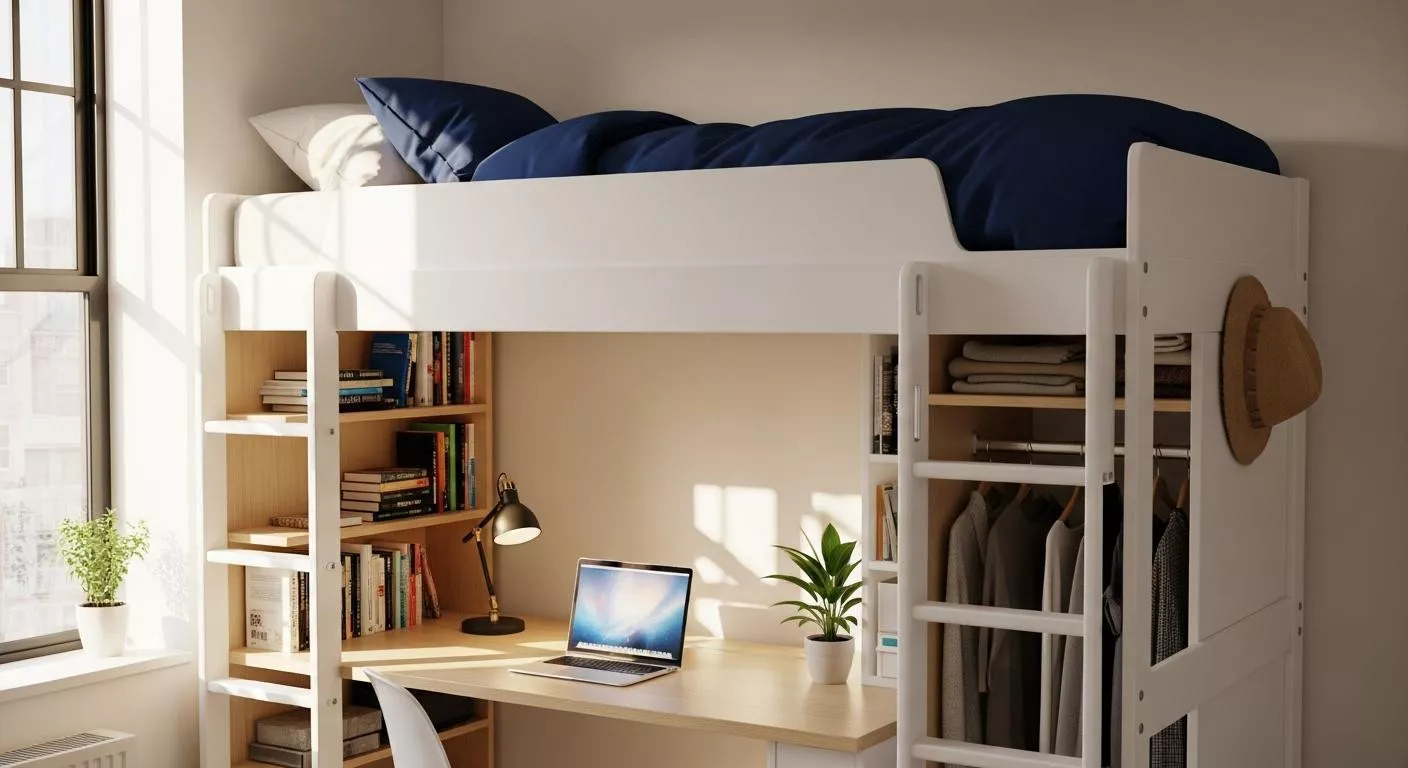
Your studio apartment measures 290 square feet on a Tuesday afternoon in May when you realize a queen bed takes 33 square feet, your desk needs another 10, and the wardrobe you’ve been pricing at West Elm requires 6 more. That’s 49 square feet of furniture before you add a place to eat or room to walk. Elizabeth Faulkner solved this in her Hell’s Kitchen studio with $473 worth of IKEA furniture that stacks sleep, work, and storage into 24 square feet of floor space. The room holds a bedroom, an office, and a closet without a single wall or curtain divider.
The difference isn’t magic. It’s vertical architecture in a building where you can’t knock down walls.
A loft bed reclaims 42 cubic feet your apartment didn’t know it had
The IKEA SMÅSTAD loft bed costs $473 and measures 3 feet 9 inches deep, 6 feet 5 inches wide, and 5 feet 11 inches tall. That vertical dimension matters because most NYC studios waste the space between 40 inches (where a dresser stops) and 96 inches (where the ceiling starts). Faulkner’s unit stacks a twin mattress on top, a desk surface at 29 inches, a wardrobe with hanging rod below, and a bookcase with five shelves along the side.
The entire system occupies 24 square feet of floor area but provides storage and work surface equivalent to 49 square feet of separate furniture. The catch: assembly takes six hours with two people and requires drilling into the frame for stability. The desk surface measures 54 inches wide, tight for dual monitors but workable for a laptop and notebook.
If your ceiling height falls below 96 inches, measure twice because you need 35 inches of clearance above the mattress to sit upright. The bed frame holds 220 pounds on the sleeping platform. The desk holds 50 pounds before slight flexing starts.
What it replaces in spatial math
A West Elm mid-century bed frame (33 sq ft) plus a CB2 desk (10 sq ft) plus a freestanding IKEA PAX wardrobe (6 sq ft) totals 49 square feet of blocked floor space and costs $1,680 combined. The SMÅSTAD delivers the same function in half the footprint at 28 percent of the cost. That’s the difference between a studio that feels like a bedroom with furniture shoved against walls and one that has room to breathe.
Interior designers with residential portfolios note that loft beds make sense when every square foot costs $58 per month in rent. In larger apartments, separate furniture reads more adult. But in studios where a bed eliminates your living room, vertical stacking becomes spatial strategy, not dormroom nostalgia.
The $100 bench that holds 14 cubic feet and seats two
IKEA’s SMÅSTAD bench costs around $100 and measures 35 inches wide, 20 inches deep, and 19 inches tall. The lid lifts to reveal storage for winter coats, extra bedding, or the vacuum you’re not supposed to keep visible in a studio. Katy Ma bought one for her 400-square-foot apartment because she needed seating that didn’t block the window and storage that didn’t require closet space she didn’t have.
The cushion compresses after eight months of daily use, but the storage holds 14 cubic feet. That’s roughly equivalent to two large suitcases stacked in a closet you’d need to build. Place it under a window to create a reading nook, or use it as a room divider between sleeping and living zones without blocking natural light.
Fold-down tables give you a dining room for 6 inches of wall space
The IKEA Burista wall-mounted drop-leaf table costs $59.99 and folds flat to 6 inches when closed, opening to 31 inches when you need to eat. Faulkner mounted one in her Hell’s Kitchen studio across from the kitchen alcove. Four people can sit comfortably when the leaf extends. When dinner ends, the table disappears against the wall and the room becomes a living area again.
Installation requires finding studs in plaster walls, which older NYC buildings make complicated. The table holds 30 pounds safely, enough for plates and serving dishes but not enough to sit on. The alternative: a traditional dining table occupies 15 square feet permanently, even when you’re eating takeout on the couch five nights a week.
Why this only works if you don’t meal prep
If you cook batch meals on Sundays, you need a table that stays open. But for weeknight dinners and weekend hosting, a fold-down surface gives you function without spatial commitment. The NORDEN table alternative for slightly larger spaces seats two to four and includes six built-in drawers, but it requires 10 square feet even when compact.
And that’s the calculation renters make constantly. Does the furniture earn its footprint?
Vertical storage doesn’t make rooms feel smaller when the furniture is open-sided
Designer Marnie Salmon chose IKEA’s ENHET shelving for Lakesha Charles’s kitchen because the open-sided design keeps the room from feeling walled-in. Solid cabinets create visual barriers. Open shelves let light pass through, making 98 square feet feel more like 110. The system costs less than custom cabinetry and mounts without permanent wall damage, critical for renters who’ll move in 18 months.
The trade-off: everything stored on open shelves needs to look intentional, which means matching containers and regular decluttering. Professional organizers with certification confirm that vertical storage reclaims up to 25 percent of closet space when deployed strategically, but only if you maintain visual discipline.
Your questions about IKEA small space solutions that NYC apartments swear by answered
Do IKEA small-space products actually last in NYC apartments?
Faulkner’s SMÅSTAD loft bed has held up for nine months with daily use. The particleboard construction shows minor edge wear where the desk surface meets the wardrobe frame, but the structure remains stable. Budget for replacement in five years rather than 15, but at $473 versus $1,680 for separate pieces, the math still favors modular. IKEA rates the bed for 220 pounds on the sleeping platform.
Can you make IKEA furniture look less like a college dorm?
Swap hardware for brass or matte black pulls from Anthropologie at $4 to $8 each. Add wood stain to visible pine legs. Use linen storage boxes instead of plastic bins on open shelves. The furniture stays functional, but small upgrades shift the visual read from dormroom to intentional minimal. And that’s the difference between furniture that solves a problem and furniture that looks like it solved a problem.
What’s the biggest mistake people make buying IKEA for small spaces?
Buying furniture that looks small in the showroom but blocks circulation paths in a 290-square-foot room. Measure your actual floor space and walking routes before ordering. A 72-inch sofa might fit against the wall but eliminate the path to the bathroom. Lighting designers with residential portfolios recommend maintaining at least 30 inches between furniture pieces for comfortable movement, which means your sofa might be too big even if the dimensions technically fit.
Faulkner’s studio at 7pm on a Thursday when she pulls the NORDEN table away from the wall for dinner. The space holds four chairs, a bed, a desk, a wardrobe, and room to walk without turning sideways. The rent costs $2,400 monthly. The furniture cost $800 total.