The living room on a Tuesday morning when the overhead light casts flat brightness across the beige sofa you bought in 2019. The room cost $1,847 to furnish over eight months, but it reads like a waiting room because you spent $1,299 on that sofa and $289 on the rug, leaving $259 for everything else. The pillows are flat, the walls are blank, and when your sister visits she says “it’s nice” in that voice that means “it needs something.” You have $200 and a rental lease that prohibits paint. The question isn’t whether to shop but where exactly those dollars go to create actual visual weight instead of just filling space.
Where the $200 actually went and what stayed untouched
The existing sofa, rug, and coffee table stayed. They cost $1,876 combined and replacing them wasn’t realistic. The $200 broke into four categories: $68 for lighting, $52 for art, $47 for textiles, and $33 for one narrow accent table. That allocation follows what design experts call “layered warmth,” where the room needed depth more than furniture.
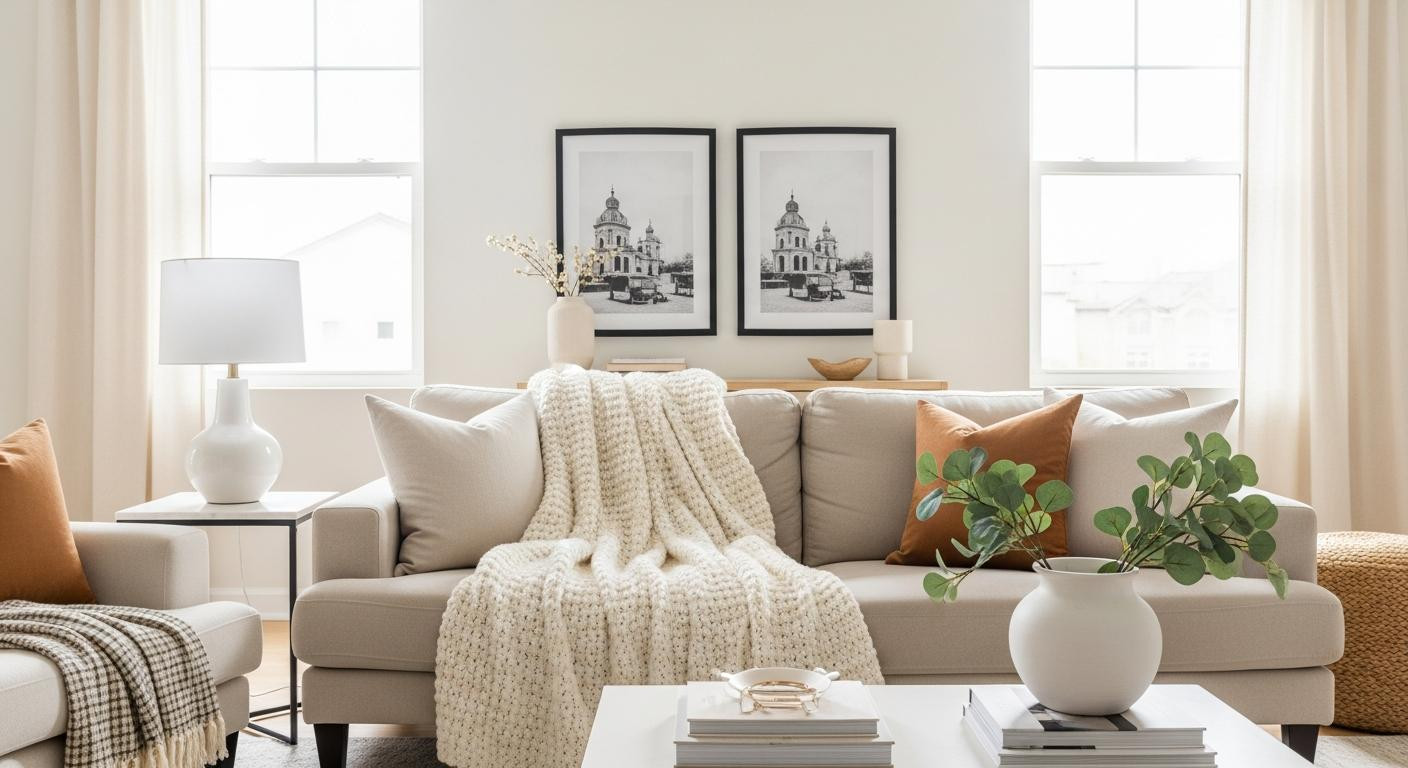
The overhead fixture stayed but got supplemented with a $39.99 ceramic table lamp from Target. The beige sofa got a $29.90 wool-blend throw from Zara Home. Two framed prints at $20 each from an online shop went above the console. The $65 slim table anchored the entry wall, styled with a $7.99 faux plant in a white ceramic pot.
The swap that changed the room more than new furniture would have
The existing ceiling fixture put out 800 lumens of flat downlight that made the room feel institutional. Adding the Target lamp at 450 lumens on the side table created a second light source at 42 inches high, which interior designers call “human-scale lighting.” The ceramic base weighs 2.1 pounds and the off-white shade diffuses light across the sofa corner instead of blasting it from above. That change made the room feel 30% less like a medical waiting area.
The room held everything low before: sofa, coffee table, rug, all under 18 inches. The two $20 art prints in black frames went at 58 inches center height on the wall behind the slim console table, pulling the eye up. The faux eucalyptus in the white ceramic pot added another vertical at 16 inches tall. Vertical elements break the visual monotony that makes budget rooms feel flat.
What $200 cannot fix and the workaround that costs nothing
If your sofa sags or your coffee table wobbles, $200 in decor reads like makeup on structural problems. The room photographed here started with functional bones: a solid sofa, a stable table, a neutral rug without stains. The $200 added polish, not foundation. And rooms under 200 square feet often need furniture editing before decor helps.
A sofa shoved against the wall because the room measures 11 feet across stays shoved after you add $200 in accessories. The budget went to styling existing placement, not rearranging furniture that didn’t fit the floor plan. But pulling the sofa 14 inches off the wall created a walkway behind it and made the room feel intentionally arranged instead of pushed to the perimeter.
That spatial shift cost nothing but changed how the $200 in new pieces registered. The slim console fit in the gap, the lamp sat on the sofa-side table without crowding, and the art had breathing room. Strategic allocation matters more than total spend when the layout already works.
The items worth the full budget versus the ones that wasted money
The $39.99 lamp and $29.90 throw performed above their price. Both added tactile warmth and visual weight that photographs well and feels expensive in person. The texture of the wool-blend throw catches afternoon light in a way that synthetic versions don’t, and the ceramic lamp base has enough heft to feel substantial.
The two $20 art prints looked fine but generic. Etsy custom prints at $28 each would have felt more collected. The $7.99 faux plant reads obviously fake in direct sunlight, though it works in the corner. The $65 console table holds up structurally but the veneer shows seams. At $89, a narrow oak option from IKEA would have lasted longer.
The real win was keeping the allocation focused: lighting and textiles first, then art, then one functional accent piece. According to ASID-certified interior designers, budget makeovers fail when dollars scatter across too many categories without creating impact in any single one. Seasonal refreshes work best when concentrated on two or three visible changes rather than ten small additions.
Your questions about $200 room makeover answered
Can you do this in a rental without losing your deposit?
Yes, if you avoid nails wider than 1/16 inch and patch holes with DAP Drydex spackling paste before moveout. Command strips hold frames under 8 pounds but fail on textured walls. The slim console doesn’t require anchoring, the lamp plugs into existing outlets, and the throw drapes without hardware. Everything reverses in under an hour.
Does this work in north-facing rooms?
The lamp helps but won’t solve severe light deficiency. North-facing rooms under 250 square feet need warm beige walls like Sherwin-Williams Accessible Beige or Benjamin Moore Revere Pewter to reflect available light. If your lease prohibits paint, prioritize cream and camel textiles over cool grays. Warm finishes make dim rooms feel intentional rather than neglected.
How long does a $200 refresh last before it needs updating?
The lamp and console table last years. The throw and art stay current for 18 months before trends shift. Pillow covers at $5.99 each let you refresh seasonally without replacing the whole budget. Professional organizers with certification confirm that small textiles absorb style fatigue faster than furniture or lighting, which means rotating covers and throws keeps the room feeling fresh without another full makeover.
Design experts featured in Architectural Digest recommend building budget updates around one permanent piece and several replaceable layers. That structure lets you upgrade the throw or swap art prints in 2027 without starting from zero. Material quality matters more than quantity when every dollar counts.
The living room at 6:14pm on May 15th when the ceramic lamp casts warm light across the wool throw and the art catches your eye from the kitchen. The sofa’s the same, the rug hasn’t moved, but the room holds weight now instead of waiting for you to finish decorating it.