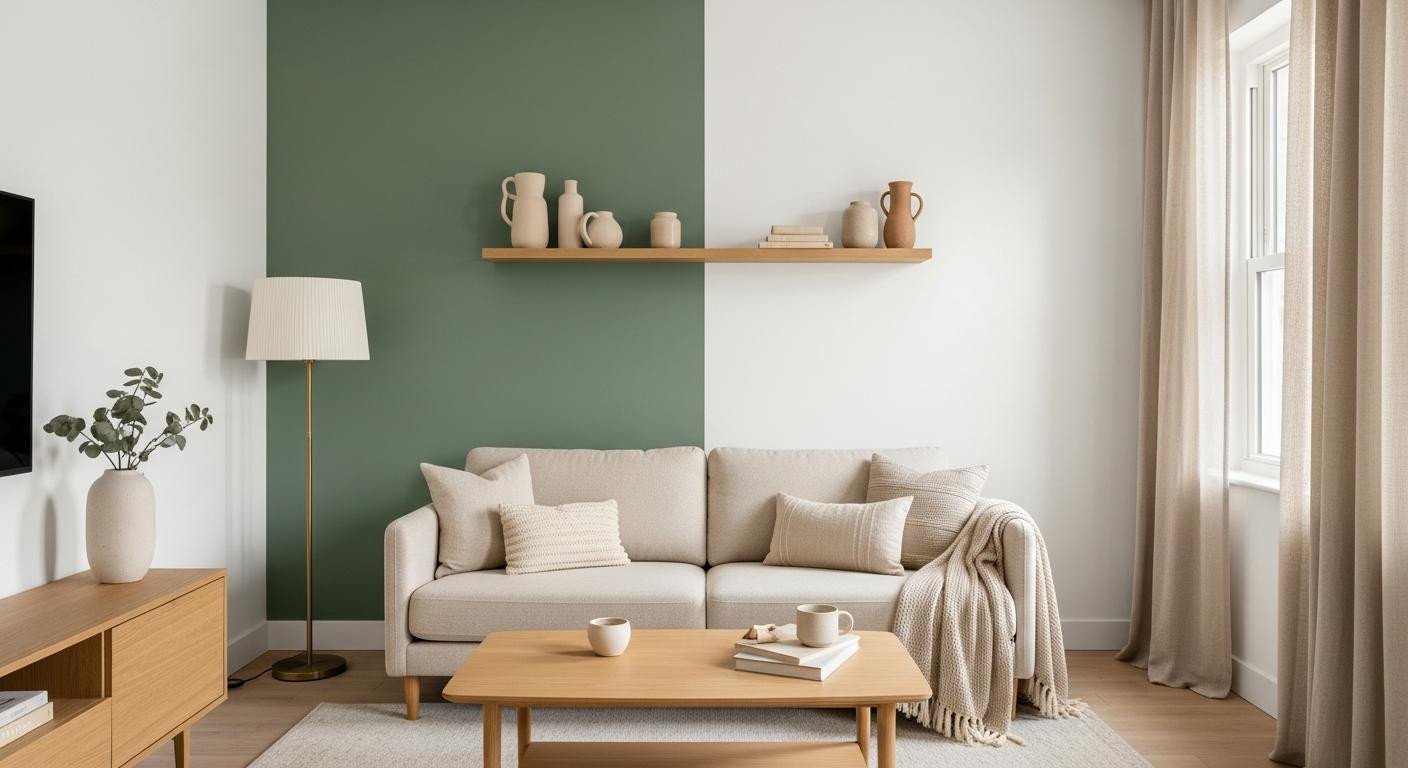
Your 340-square-foot studio at 2pm on a Tuesday in May when afternoon light hits the glossy white subway tile backsplash and bounces straight back at your eyes. The reflection creates visual noise that makes the room feel 18 inches smaller than its actual footprint. Your neighbor’s identical unit uses matte plaster and unglazed ceramic, and her space reads 40% more open despite holding the same furniture. The difference sits in surface finish, not square footage.
Matte materials scatter light across walls instead of reflecting it back, which keeps your peripheral vision from registering spatial boundaries as hard stops. And that’s the kind of detail that quietly elevates the whole space.
Your glossy surfaces are creating false walls your brain reads as boundaries
When light hits a glossy surface at 3pm, it reflects at an equal angle, creating a bright spot your eye registers as a visual obstacle. Matte surfaces diffuse that same light across 180 degrees, softening spatial edges. In a 12×14-foot room, this difference affects approximately 168 square feet of wall surface.
Consider glossy white kitchen cabinets versus matte sage paint. The cabinets bounce light in discrete spots that your peripheral vision interprets as spatial interruptions. Ceramic glossy vases create the same effect on shelves, while unglazed stoneware absorbs light and disappears into the background.
Interior designers with ASID certification consistently use matte finishes to soften visual boundaries in compact spaces. A lacquered coffee table reflects overhead lighting in a way that cuts the room in half visually, while raw wood lets your eyes travel across the surface without interruption.
Sheer curtains scatter daylight instead of blocking it, which adds perceived depth
Linen’s irregular weave breaks up light rays, distributing brightness across the room rather than creating a single bright window source. Polyester’s tight, smooth weave reflects light more uniformly, creating a defined bright zone that your brain reads as a boundary. In a north-facing room with one 36×60-inch window, this affects how light travels across approximately 10 feet of floor space.
West Elm’s Belgian Flax linen curtains run $89 to $149 depending on length, while Target’s polyester sheers cost $24. But linen works best in rooms with strong direct light. Spaces with limited natural light need sheer polyester to maximize brightness even if it creates harder edges.
Floor-length curtains that puddle 1 to 2 inches create continuous vertical lines that make 8-foot ceilings read taller. Curtains that end at the sill create a horizontal break that cuts the wall in half visually. Measure from your rod to the floor, add 2 inches, and that’s your ideal panel length. This only works if your rod sits 3 to 6 inches above the window frame.
The texture of linen curtains that scatter rather than reflect afternoon light makes morning sun feel softer against bare feet on hardwood.
Pale neutrals work differently depending on your wall texture and light direction
Flat paint on smooth drywall in northern light can read cold and institutional, making a small room feel like a waiting area. Warm beige adds yellow undertones that compensate for the blue-gray cast of indirect light. Design experts featured in Architectural Digest recommend testing paint in 2×2-foot swatches for 48 hours to see how it shifts from morning to evening.
This matters more in rooms under 250 square feet where every wall is visible simultaneously. Benjamin Moore Grant Beige and Sherwin-Williams Accessible Beige both work in north-facing spaces under 300 square feet.
Slightly textured walls diffuse light even when painted cool gray or pale blue. The texture breaks up reflection the same way linen fabric does. Farrow & Ball’s Modern Emulsion finish has a 7% sheen, true matte, compared to Benjamin Moore’s Regal Select Matte at 10 to 15% sheen. That 3 to 8% difference affects how much light bounces versus absorbs.
In rooms with strong southern or western light, cool grays with texture prevent glare while maintaining an airy feeling. And the result is a space that feels intentional without announcing itself.
Mirrors triple spatial perception only when positioned to reflect depth, not clutter
A 40-inch mirror placed directly across from a window reflects that window back at you, confirming the room’s actual dimensions. The same mirror angled 30 to 45 degrees reflects the longest sightline in the room, usually the diagonal, which shows your brain a vista it can’t see with direct vision.
This creates perceived depth because your peripheral vision registers space beyond your normal sightline. Professional organizers with certification confirm that moving your mirror to catch oblique angles instead of direct reflection makes cramped bedrooms read significantly larger.
Avoid mirroring cluttered surfaces. A mirror reflecting a crowded bookshelf doubles visual density instead of expanding space. And that’s the balance that makes this setup work.
Vertical storage keeps floor space clear while adding functional breathing room
Furniture on the floor creates visual interruptions every 24 to 36 inches, chopping your sightline into segments. Vertical storage that keeps floor space clear lets your eyes travel the full width of the room without stopping.
Floating shelves at 60 inches high hold the same books as a floor bookcase but leave 15 square feet of visual floor space open. That’s the difference between a room that feels navigable and one that feels stuffed.
Wall-mounted cabinets in small kitchens create 8 to 12 inches of counter depth that makes the space feel functional instead of cramped. The cabinets hover, and the floor breathes underneath.
Your questions about opening up a cramped apartment answered
Does this work in rentals where I can’t change paint or lighting
Yes. Matte-finish textiles like linen curtains, cotton rugs, and unglazed ceramic that absorbs rather than bounces light don’t require permanent changes. Replace glossy acrylic frames with natural wood, swap polyester throw pillows for linen or cotton, choose matte ceramic lamps instead of glossy metal. Renters get 70% of the spatial benefit from surface finish changes alone.
What if my apartment has no natural light
Matte surfaces become even more critical in artificially lit spaces. Glossy finishes under LED or fluorescent light create harsh reflections that emphasize spatial limits. Use warm-toned matte paint if allowed, or large matte fabric panels like tapestries or quilts to absorb artificial light. Add 3 to 4 light sources at different heights instead of one overhead fixture to distribute brightness without glare.
How much does this actually cost for a one-bedroom
For a 600-square-foot one-bedroom: two pairs of linen curtains at $180 to $300, matte paint for one accent wall if allowed at $60, three unglazed ceramic pieces at $75 to $120, one large mirror at $80 to $180, swapping glossy frames for wood at $40. Total: $435 to $740. The spatial perception shift happens immediately when you change surface finish, not gradually like furniture upgrades.
Your living room at 4pm when light scatters across raw plaster instead of bouncing off glossy white, and the wall stops announcing itself as a barrier.