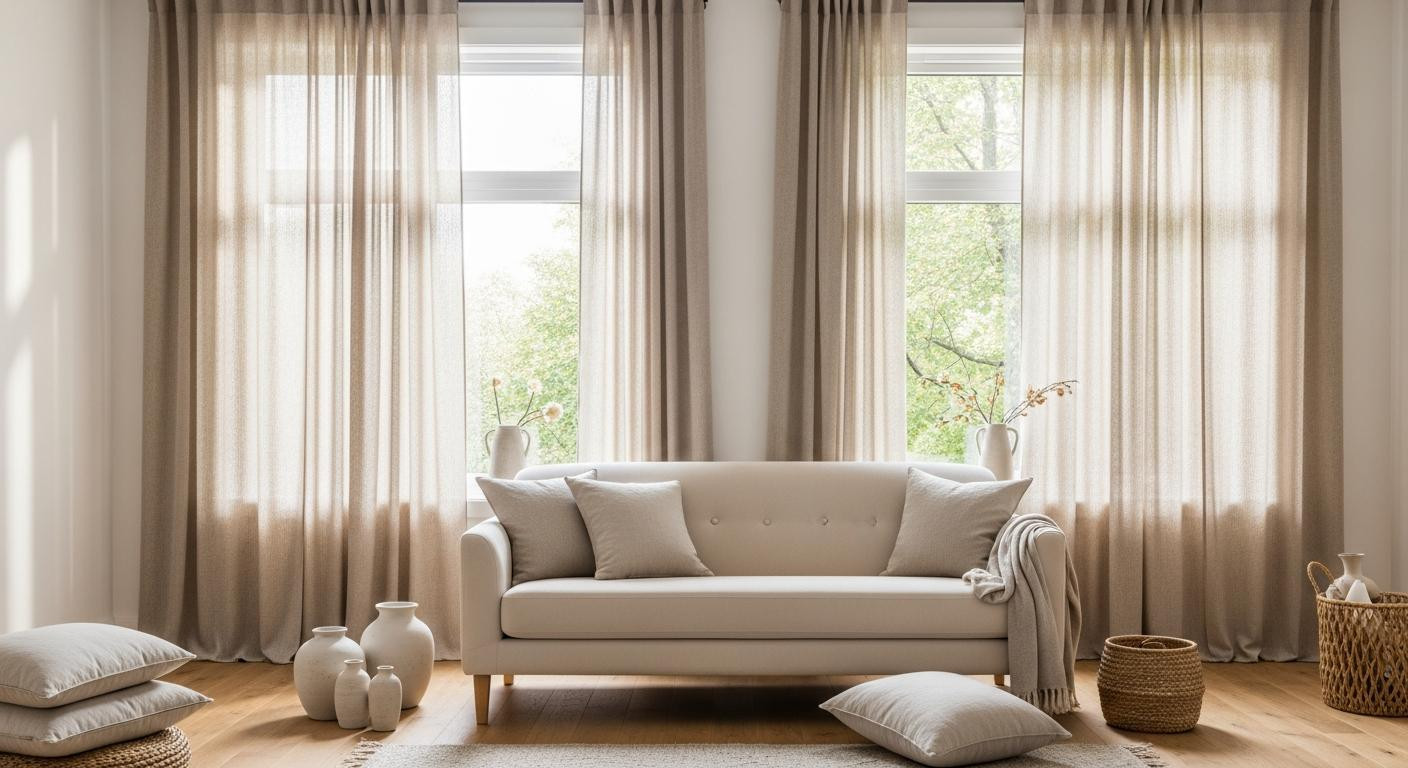
Your living room holds $2,100 worth of furniture but still feels like a waiting room at 3pm on a Wednesday. The sofa cost $1,299. The rug ran $380. But when afternoon light hits the polyester curtains from Target, the room reflects glare like a dental office. Your neighbor’s space costs less but photographs like Domino because she hung $180 worth of linen at the windows. The fabric doesn’t just look different. Linen’s loose weave scatters light instead of bouncing it back, dropping visual harshness by what feels like six degrees even when the thermostat stays constant.
That shift happens because of fiber structure, not color choice. And it’s why linen is showing up in every room right now, from curtains to bedding to slipcovers.
Linen’s fiber structure changes how light behaves in a room
Cotton weaves tight. Polyester reflects. Linen’s flax fibers create irregular gaps at the microscopic level that diffuse rather than block incoming light.
Typical home decor linen runs 12 to 16 threads per inch, compared to 200-plus in cotton sateen. Those gaps let light pass through while breaking up harsh beams into softer scatter. According to textile-focused interior designers, this creates a visually calmer space because your eyes aren’t compensating for glare points on walls and floors.
The effect works independent of color. Oat linen and charcoal linen both soften light the same way, which is why the fabric shows up across neutral and saturated palettes. But the real payoff happens in south-facing rooms, where direct sun can make synthetic curtains feel like stage lighting. Linen takes that same afternoon beam and turns it into something closer to golden hour at 2pm.
The wrinkle everyone fears is actually doing spatial work
Natural creasing adds depth without pattern
Linen’s tendency to wrinkle creates micro-shadows that add visual texture to flat surfaces. It’s similar to texture over color as the defining 2026 shift, where surface dimension matters more than hue. This works particularly well in minimal spaces where pattern would create noise.
Design experts featured in Architectural Digest note that this “lived-in luxury” aesthetic improves over time as the fabric relaxes. The effect increases with each wash, making linen one of few materials that gets better with age rather than degrading into something you need to replace.
Stiff linen reads cheap, relaxed linen reads expensive
There’s a tactile and visual difference between heavily starched linen, which fights its nature, and softly laundered linen that’s been washed four to six times. Restoration Hardware and Belgian linen brands pre-wash their textiles for exactly this reason. A $340 duvet cover from RH arrives already soft, while a $89 set from Target needs half a dozen cycles to hit the same hand feel.
That aging process frustrates people expecting crisp permanence. But it satisfies those chasing the quiet luxury look that’s replacing cold, glossy decor, where imperfection signals authenticity instead of carelessness.
Linen cools rooms psychologically even when temperature stays constant
Matte texture absorbs visual heat
Shiny surfaces like velvet, satin, and lacquered wood create hot spots that make rooms feel warmer regardless of actual temperature. Linen’s matte finish absorbs light instead of reflecting it. Compare the visual temperature of a linen sofa versus a leather sofa in the same afternoon sun. One feels breathable at 72 degrees, the other feels sticky.
Your forearm on linen upholstery at room temperature feels cooler than on synthetic microfiber because the weave allows air circulation at the skin level. That’s a physical effect, but the visual cue reinforces it. When a fabric looks matte and textured, your brain registers it as cooler even before you sit down.
Breathable weave suggests airflow
When you can see individual threads in a weave, your brain registers permeability even on a wall hanging that doesn’t actually move air. This makes linen particularly effective in small spaces or rooms with limited ventilation, where visual heaviness compounds physical stuffiness. It’s similar to the way linen curtains filter afternoon light without blocking it completely.
And this works year-round, unlike seasonal fabrics that carry winter or summer associations. Linen doesn’t signal cold-weather coziness or warm-weather airiness. It just reads as neutral and breathable in January and July.
The linen that works isn’t always the linen that’s trending
Pinterest linen is always white, always European, always pooling on the floor in perfect rumples. Real-home linen involves compromises. 150gsm weight works for curtains that need to drape, but upholstery needs 280gsm for structure. Linen-blend options at 35% linen and 65% cotton reduce wrinkling for households that can’t embrace full rumple.
Price reality matters too. Belgian flax runs $89 per yard at specialty retailers. Linen-look blend from Fabric Wholesale Direct costs $24 per yard. Only tight-weave 100% linen delivers the full light-scattering effect, but blends still outperform synthetics in terms of visual softness and tactile appeal.
Linen isn’t suitable for homes with messy eaters or high-soil situations. Oat and white linen show every coffee drip. Performance fabrics outperform linen for stain resistance by a wide margin. But if your priority is spaces that feel finished even with minimal furniture, linen does spatial work that treated polyester simply can’t.
Your questions about linen in 2026 answered
Does linen actually last longer than cotton, or is that marketing?
100% linen strengthens with washing up to about 20 cycles, then plateaus. Cotton weakens after 15 to 20 washes as fibers break down. Quality linen curtains last 8 to 12 years with annual washing. Cotton equivalents last five to seven years. That only applies to tight-weave linen above 200gsm. Lightweight linen-look fabrics don’t demonstrate the same durability.
South-facing linen curtains fade faster than any longevity advantage they hold. UV exposure is linen’s biggest weakness, outpacing wear from washing or daily use.
Why does linen bedding cost $340 when cotton is $89?
Flax cultivation requires cool, damp climates, manual harvesting in many regions, and a 100-day growing cycle versus cotton’s 150 to 180 days across wider geography. Processing flax into linen thread takes longer than cotton ginning. European linen from Belgium, France, and Lithuania commands a premium because of established infrastructure and quality control. Chinese linen runs cheaper but with less consistency.
The $89 linen sets are usually linen-cotton blends or lighter weight at 120 to 150gsm that won’t hold up as long. A $340 Belgian linen duvet set arrives pre-washed and sits at 220 to 280gsm.
Can renters use linen curtains without custom rods?
Yes, if ceiling height allows standard 84-inch or 96-inch panels. Linen’s weight sits heavier than polyester but lighter than velvet, which works on basic tension rods up to 48 inches wide or standard brackets. Linen’s drape improves with length, so puddling with an extra two to four inches on the floor enhances the effect but isn’t required.
Very lightweight linen under 150gsm may billow too much on tension rods in drafty apartments. Look for mid-weight panels at 180 to 220gsm for stability.
Your bedroom at 7:18am when May sunlight filters through oat linen curtains and hits the wall in soft parallelograms instead of harsh rectangles. The fabric moves slightly in cross-breeze from the window you cracked last night. The room holds the same furniture it did in March, but your shoulders drop two inches lower when you walk in.