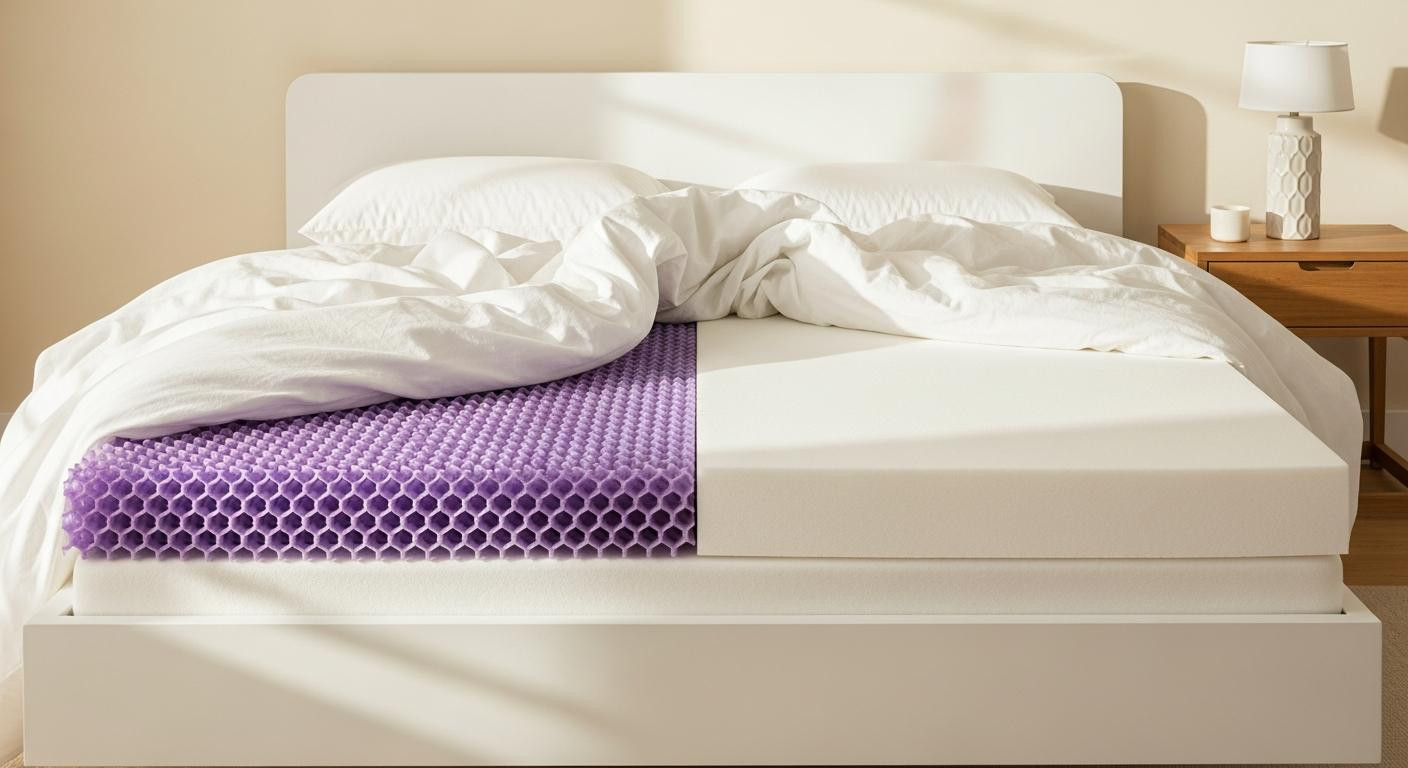
The Purple mattress topper feels like pressing your palm into a grid of tiny trampolines. Each 1.4-inch hyperelastic polymer column collapses under your hand, then springs back the second you lift it. Six inches away, the Casper topper’s 2-inch memory foam layer absorbs your touch and releases slowly, like dough rising in reverse. That’s the mechanical difference between gel that bounces and foam that cushions. When your bedroom hits 72 degrees in late April and your shoulder’s been digging into the same spot for six hours, one material keeps air moving while the other wraps around pressure points. Your sleep position and your thermostat will tell you which one you need.
How gel grids and memory foam respond to 150 pounds of shoulder pressure
Purple’s gel grid has 1,800 open columns per square foot. When you lie on your side, your shoulder and hip concentrate 90 to 110 pounds of weight onto 8 to 12 square inches of surface. The columns under those points collapse vertically while the surrounding grid stays elevated. It’s not uniform compression. It’s targeted collapse that keeps your spine aligned without letting your whole body sink in.
Casper’s viscoelastic foam spreads that same 90 pounds across 40 to 50 square inches. The foam compresses uniformly in all directions, which eliminates the distinct pressure points you’d feel on Purple’s grid. But it also means less airflow and slower response time when you shift positions at 3am. According to ASID-certified interior designers who assess bedroom comfort, the difference isn’t just feel. It’s how your body’s weight gets distributed across the sleep surface, which changes whether you wake up with numb fingers or a stiff lower back.
And the sensory contrast is immediate. Purple feels like a firm sponge with pockets. Casper feels like slow-motion quicksand that eventually firms up beneath you.
Why Purple sleeps cooler but Casper relieves more shoulder pain
Purple’s open grid lets air move but creates pressure on soft tissue
Those 1,800 columns leave gaps for air to move through. NapLab gives Purple a 10 out of 10 cooling score because the surface stays 3 to 4 degrees cooler than closed-cell foam. When your bedroom temperature sits at 74 degrees in May, that difference keeps you from waking up with a damp pillowcase. But each column under your shoulder blade creates a distinct point of contact. If you’re a 140-pound side sleeper, that’s 8 to 9 pounds concentrated on each grid point under your shoulder.
You won’t overheat. But you might wake up with that specific tenderness that comes from sleeping on something too firm in small spots. The grid works exceptionally well for back sleepers who distribute weight more evenly across the surface.
Casper’s foam absorbs pressure completely but traps body heat
Casper’s 2-inch memory foam layer spreads your shoulder’s weight across a much larger area. Your shoulder sinks in uniformly, which eliminates pressure points entirely. But closed-cell foam traps the heat your body generates overnight. In May, when ambient bedroom temperature hovers around 72 to 74 degrees, Casper’s surface can feel 5 to 6 degrees warmer than Purple’s open grid.
Design experts featured in Architectural Digest confirm that material choice affects not just comfort but perceived bedroom temperature. You’ll wake up with comfortable shoulders and a sweaty back. That’s the trade-off Casper makes for superior pressure relief.
What 6 out of 10 firmness means when one material bounces and the other sinks
Purple’s 6.5 firmness feels firmer because it pushes back instantly
Both mattresses rate around 6 to 6.5 on the firmness scale, but Purple’s gel responds in milliseconds. When you shift positions, the grid pushes back against your movement like a trampoline. This responsive feel reads as firmer to most sleepers even though compression depth is similar to Casper. If you weigh under 130 pounds, you might not sink deep enough into the grid to feel the cushioning effect.
The surface stays supportive but can feel too resistant for lightweight side sleepers. And that’s not a defect. It’s how hyperelastic polymer behaves under insufficient load.
Casper’s 6 firmness feels softer because foam delays its pushback
Casper’s foam takes 1 to 2 seconds to fully respond to movement. You sink in, the foam compresses, then slowly firms up underneath you. This delayed response feels softer and more enveloping. Heavier sleepers over 200 pounds appreciate this because they sink past the initial softness into the firmer support layers below.
Lighter sleepers sometimes feel like they’re sleeping on the mattress rather than in it. The 11-inch Casper versus 9.25-inch Purple also changes how high the sleep surface sits, which matters if you’re pairing the mattress with breathable sheets that stay put during night sweats.
The $200 price gap buys different solutions to the same spring problem
Purple queen costs $1,499. Casper queen costs $1,295. That $204 difference buys either advanced cooling or superior pressure relief, not both. If you wake up sweating through April and May, Purple’s airflow justifies the premium. If you wake up with shoulder or hip pain, Casper’s conforming foam is worth choosing even if you run warmer at night.
Neither mattress solves both problems perfectly. The decision isn’t about better or worse. It’s about which physical discomfort you’re trying to eliminate first. Both come with 100-night trials and 10-year warranties, so the financial risk is time, not money. Professional organizers with certification note that upgrading sleep surfaces often triggers a full bedroom refresh that makes small rooms feel bigger when paired with decluttering and better lighting.
Your questions about Purple vs Casper for spring sleeping answered
Can I use cooling sheets to fix Casper’s heat retention?
Partially. Breathable percale or linen sheets can reduce Casper’s warmth by 2 to 3 degrees, but closed-cell foam inherently traps more heat than open-grid construction. If you’re already a hot sleeper, sheets won’t fully compensate for material differences. Combine Casper with a breathable mattress protector under $100 and moisture-wicking sheets for better results. Lighting designers with residential portfolios also recommend pairing temperature management with linen curtains that scatter light and reduce perceived heat during afternoon naps.
Will Purple’s grid feel too firm if I’m a side sleeper under 140 pounds?
Possibly. Lighter side sleepers often don’t sink deep enough into the grid to reach the cushioning zone. You’ll feel more pressure points under shoulders and hips. If you weigh under 140 pounds and sleep on your side, test Purple in-store first or plan to use the 100-night trial seriously. Sleep product testers from Mattress Clarity confirm that body weight thresholds change how gel grids perform, especially for women under 5 foot 4.
Which one works better with an adjustable base?
Purple. The gel grid flexes without compressing permanently, which works well with adjustable bases that change angles frequently. Casper’s memory foam can develop permanent impressions at hinge points if you keep the base in the same position for months. Purple’s construction rebounds fully regardless of how often you adjust positioning. And that resilience matters if you’re also testing fabric textures before buying bedroom upgrades you can’t return.
Your bedroom at 11pm on a Tuesday in late May when you press your hand into the mattress surface one more time before turning off the light. The grid buckles and springs back. The foam compresses and slowly rises. Your shoulder knows which one it prefers.