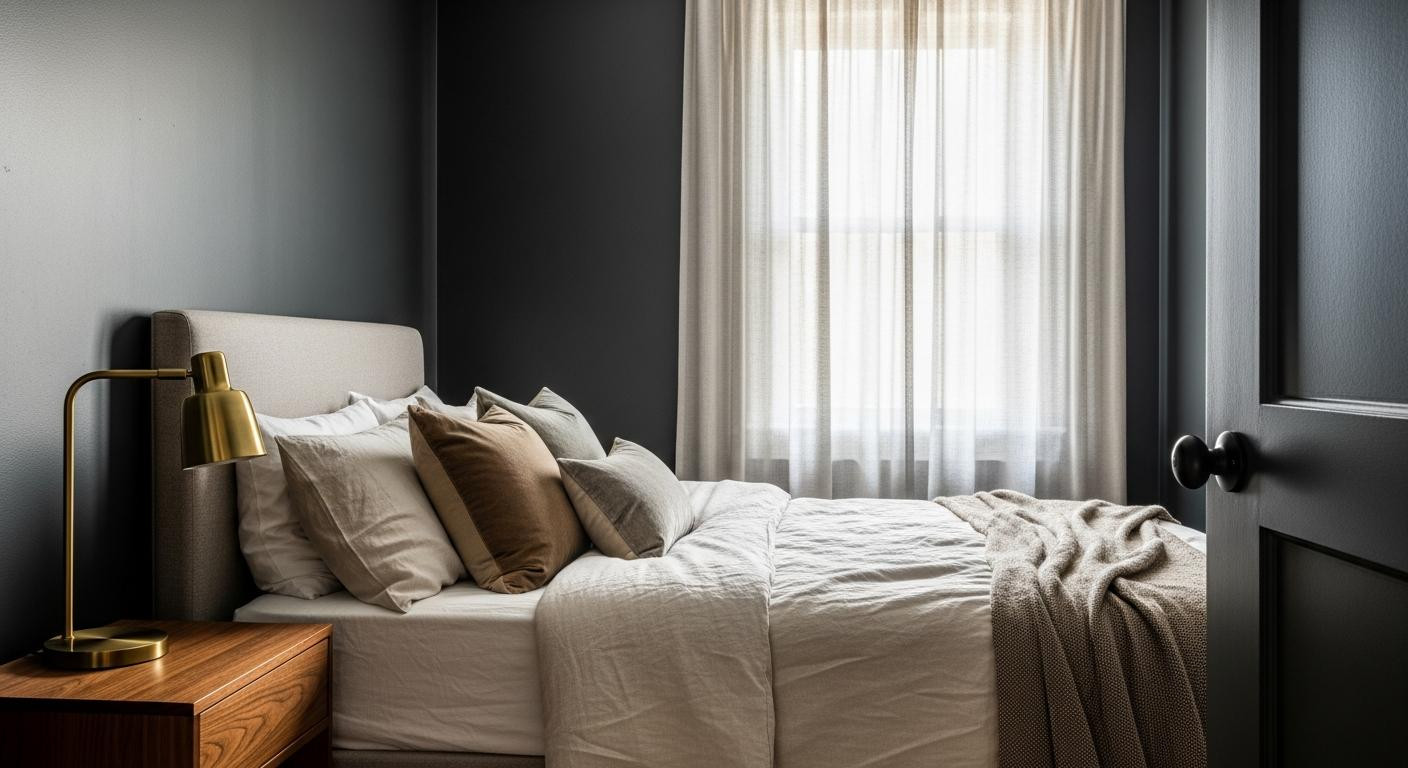
Your bedroom at 11:06pm on a Tuesday in May when you finally turn off the overhead light and the beige walls glow with that familiar rental-white flatness. The room cost $840 to furnish over six months, but it still feels like a hotel corridor because safe paint keeps it from feeling like yours. Dark bedrooms are taking over Pinterest and TikTok, but the ones that work don’t just go dark—they go warm, textured, and intentional.
Aubergine, forest green, and soft charcoal are replacing cold gray because they make bedrooms feel like sanctuaries instead of caves. The difference sits in three specific moves that keep dark from feeling depressing.
Dark paint makes small bedrooms feel intentional, not smaller
The biggest fear around dark bedrooms is that they’ll shrink the space. But designers featured in Architectural Digest confirm the opposite happens in rooms under 120 square feet. Dark walls blur boundaries instead of highlighting them, which makes a 10×11 bedroom feel enveloping rather than cramped.
A white box has harsh corners that bounce light and emphasize every limitation. The same room painted in Benjamin Moore Kendall Charcoal lets edges recede into shadow, creating depth through tone instead of square footage. And aubergine acts almost like a moody neutral, adding richness without reading Gothic or heavy.
What makes this work is matte paint. Flat finishes absorb light instead of reflecting it, which reduces visual noise and makes small rooms feel calm. That’s the setup that turns a cramped bedroom into a cocooning retreat.
The cocooning effect only works if your lighting is warm, not overhead
A single ceiling fixture throws flat light that creates harsh contrast against dark walls. The room feels like a theater set, not a place you want to sleep. Designers with residential portfolios recommend three light sources at different heights to create layers instead of glare.
The three-lamp rule for moody bedrooms
One bedside lamp at 24 inches above the mattress. One floor lamp in a corner at 58 to 62 inches. One accent light, either a wall sconce or picture light, at 48 inches from the floor. Use warm LED bulbs at 2700K, not daylight 5000K, which reads cold and clinical in dark spaces.
The layering makes dark walls feel intentional, like a boutique hotel, because light settles into the space instead of bouncing off it. Swapping rental fixtures and storing the originals lets you upgrade without losing your deposit.
Warm textiles keep dark walls from feeling cold
Dark rooms without texture read sterile, no matter how good the paint color is. Velvet headboards and throws absorb light, creating softness. Linen curtains scatter light instead of reflecting it, which prevents glare without blocking warmth.
HomeGoods-certified style experts recommend faux fur, layered throws, and tone-on-tone accents to balance dark walls. A forest green bedroom with chrome fixtures reads medical. The same room with unlacquered brass reads editorial.
Brass and walnut add warmth without color
Metal and wood tones matter more in dark rooms than in light ones. Target brass lamps start at $65, and walnut nightstands from IKEA run around $89. Both introduce warm undertones that prevent the space from feeling too cool or sterile.
But the finish on those metals changes the mood. Polished brass feels formal. Unlacquered or antique brass feels relaxed, which is what you want in a bedroom.
The paint sheen that makes or breaks dark bedrooms
Matte and eggshell finishes absorb light, making dark colors feel velvety and rich. Satin or semi-gloss finishes reflect light, creating hot spots that make the room feel uneven and cheaper. Matte surfaces make small spaces feel bigger because they diffuse light instead of bouncing it.
Benjamin Moore matte finish in Kendall Charcoal costs around $70 per gallon and covers 350 to 400 square feet. Farrow & Ball estate emulsion in Railings runs $89 per gallon but photographs like $200 designer paint because the finish is that good.
And if you’re scared to commit fully, warm neutrals like aubergine or soft plum give you depth without the drama of full black.
Your questions about moody bedrooms answered
Will dark paint make my bedroom feel smaller if it’s only 95 square feet?
No. Dark walls blur boundaries, which makes small rooms feel enveloping rather than cramped. The key is using matte finish and warm lighting at multiple heights. Avoid overhead fixtures that create harsh contrast.
What’s the easiest dark color for someone scared to commit?
Start with dark aubergine or soft charcoal on one accent wall behind the bed. Both read as moody neutrals that add depth without feeling Gothic. If it works, drench the full room in the same color, including trim and ceiling, for a cohesive look.
How much does a moody bedroom makeover cost?
A weekend DIY version runs $180 to $340. One gallon of premium matte paint costs $70 to $89. Two warm LED bulbs at 2700K run $18. One brass lamp from Target costs $65. One velvet throw from HomeGoods runs $32 to $47. Professional painting adds $200 to $400 depending on room size.
The bedroom at 10:34pm when you turn off the last lamp and the aubergine walls hold just enough shadow to make the space feel like it’s hugging you into sleep. Not a cave. Not cold. Just intentional, warm, and finally yours.