
Yes, your living room can hold every toy your kids own and still look like an adult lives here. I know because I did it wrong first. For a year, our play corner was a plastic bin pile in plain sight, and it made the whole room feel like a daycare. Then I stopped adding storage and started hiding it. These are the 11 moves that worked, most of them cheap, none of them permanent.
- Build a Window Bench With a Lift-Up Lid
- The Closed-Door Rule: Cube Storage That Doesn’t Look Like a Classroom
- Pick a Storage Ottoman Over a Toy Box, Every Time
- Tuck the Mess Behind a Skirted Console Table
- Can a Floor-Length Curtain Hide a Whole Play Corner?
- Style Grown-Up Baskets That Swallow Toys Whole
- Turn a Closet Into a Playhouse in the Living Room
- Panel an Accent Wall With Hidden Doors
- The Disappearing Act: Paint Storage the Same Color as the Wall
- Why Not Claim the Dead Zone Behind Your Sofa?
- The Ten-Minute Reset: One Rolling Cart and a Routine
1Build a Window Bench With a Lift-Up Lid
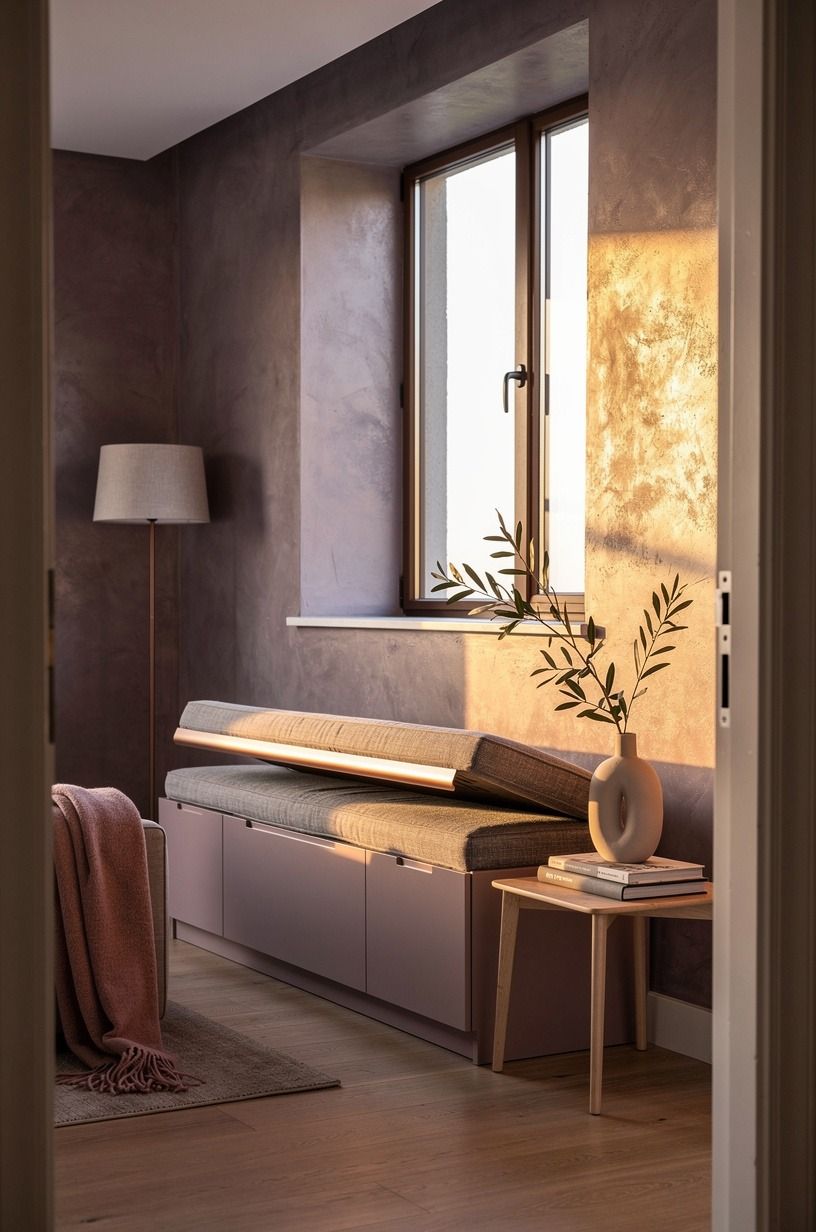
A window bench is the single hardest-working piece you’ll ever add to a living room. The seat gives you reading light and extra perch space for guests.
The box underneath swallows an entire toy category in one drop. I’m talking the whole block collection, gone in three seconds.
Go at least 18 inches deep and 24 inches tall so the lid clears a cushion. Inside, skip dividers. One open cavity fits the awkward stuff, the ride-on car, the play kitchen pots, the giant stuffed dog your aunt sent.
A hand-applied Venetian plaster finish in a muted plum reads as furniture, not toy chest, and it only gets better with age.
The mistake I made on round one: a piano hinge that slammed. Spend the extra fifteen dollars on soft-close hinges or a lid support.
Your toddler’s fingers will thank you, and you’ll stop flinching every time cleanup starts. If you’re renting, a freestanding storage bench does the same job with zero screws in the wall.
2The Closed-Door Rule: Cube Storage That Doesn’t Look Like a Classroom
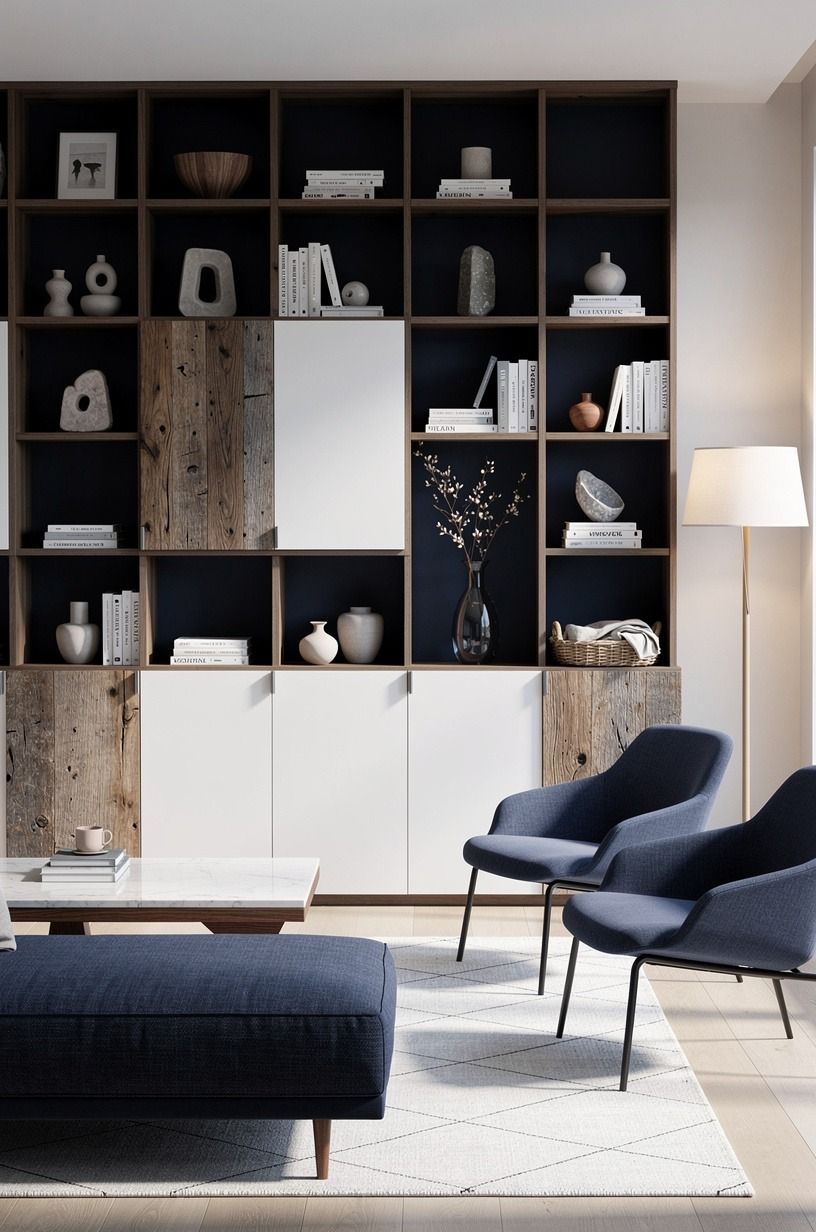
Here’s the rule I wish someone had handed me earlier: if you can see the toys, the storage isn’t finished. Open cube shelves with cute bins look great on day one and like a rummage sale by day four. Doors change everything.
The IKEA KALLAX with door inserts is the default for a reason. Four cubes with doors, four with canvas bins, and you’ve got a wall of storage that reads as a sideboard.
Mount it on legs, add a reclaimed teak top, and nobody guesses what’s inside. It’s the same logic as the hidden bar in the living room move, concealment first, function second.
Keep the bins at kid height, between 36 and 48 inches off the floor, so your kids can put things away themselves. That’s the whole system working. If they can’t reach it, you’ll be the one doing cleanup forever.
And pick bins with handles. Handles mean one-hand grabs, and one-hand grabs mean it happens.
3Pick a Storage Ottoman Over a Toy Box, Every Time
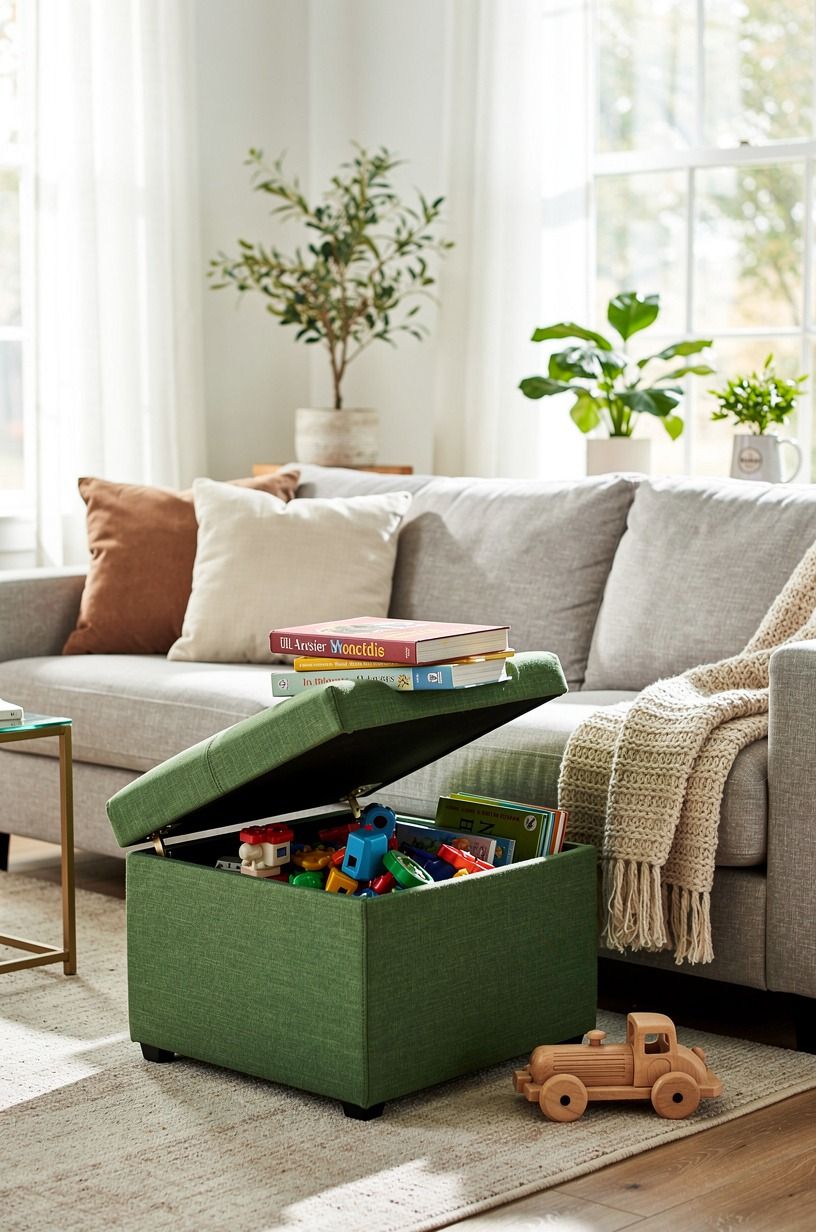
A toy box announces itself. A storage ottoman hides in the open.
I’d take the ottoman every single time, and the reason is simple: it does three jobs. Footrest, extra seat, toy vault.
The toy box does one.
Look for a hinged top, not a lift-off lid, because a loose lid ends up on the floor by Tuesday. Around 30 inches wide holds a surprising amount, puzzles, dress-up clothes, the entire dinosaur population. A washed Belgian linen version in deep emerald costs more than plastic and pays you back every time an adult walks in and doesn’t clock a single toy.
The trap to avoid: buying one too small to matter. A 20-inch ottoman holds a throw blanket and nothing else.
Go bigger than feels right. And put it where the play happens, not across the room.
Storage that requires a commute doesn’t get used. Mine sits in front of the sofa, and the nightly reset takes about ninety seconds.
That’s the whole pitch.
4Tuck the Mess Behind a Skirted Console Table
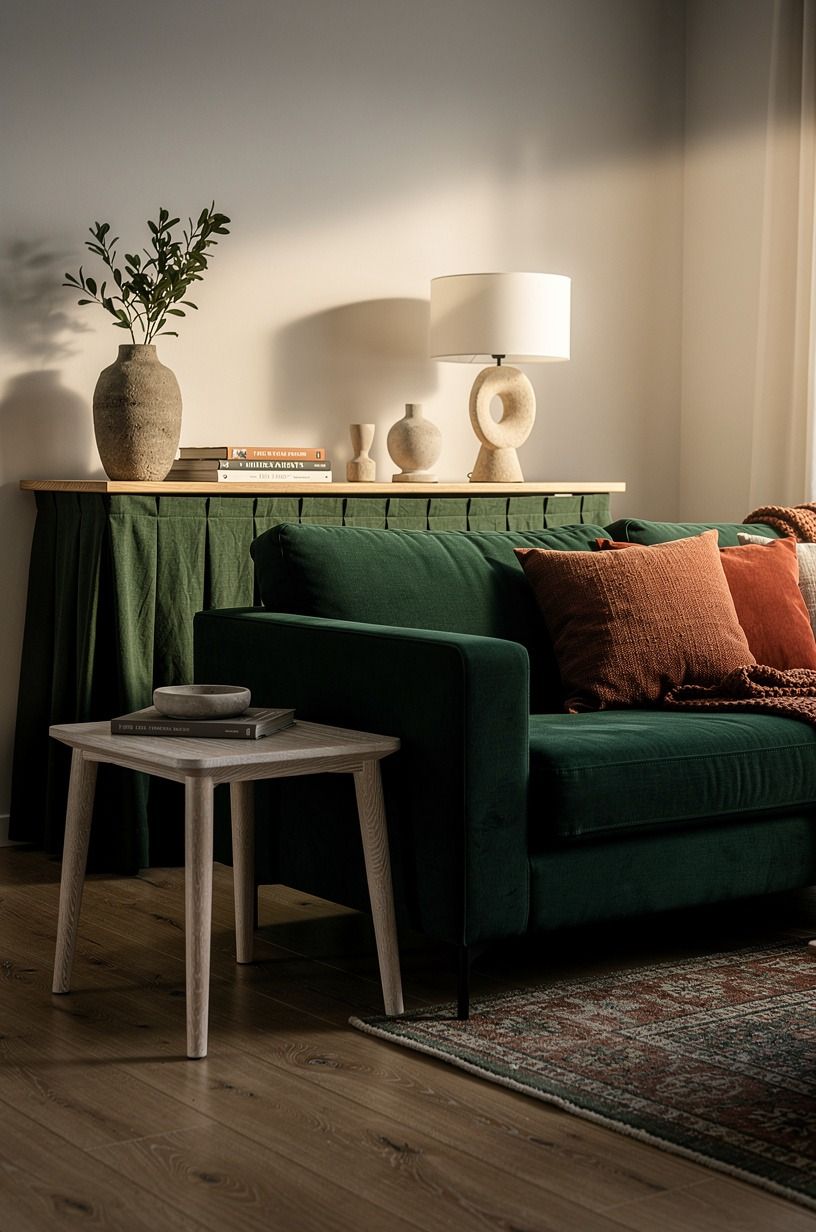
A console table with a floor-length skirt is the oldest hiding spot in decorating, and it’s having a real comeback.
5Can a Floor-Length Curtain Hide a Whole Play Corner?
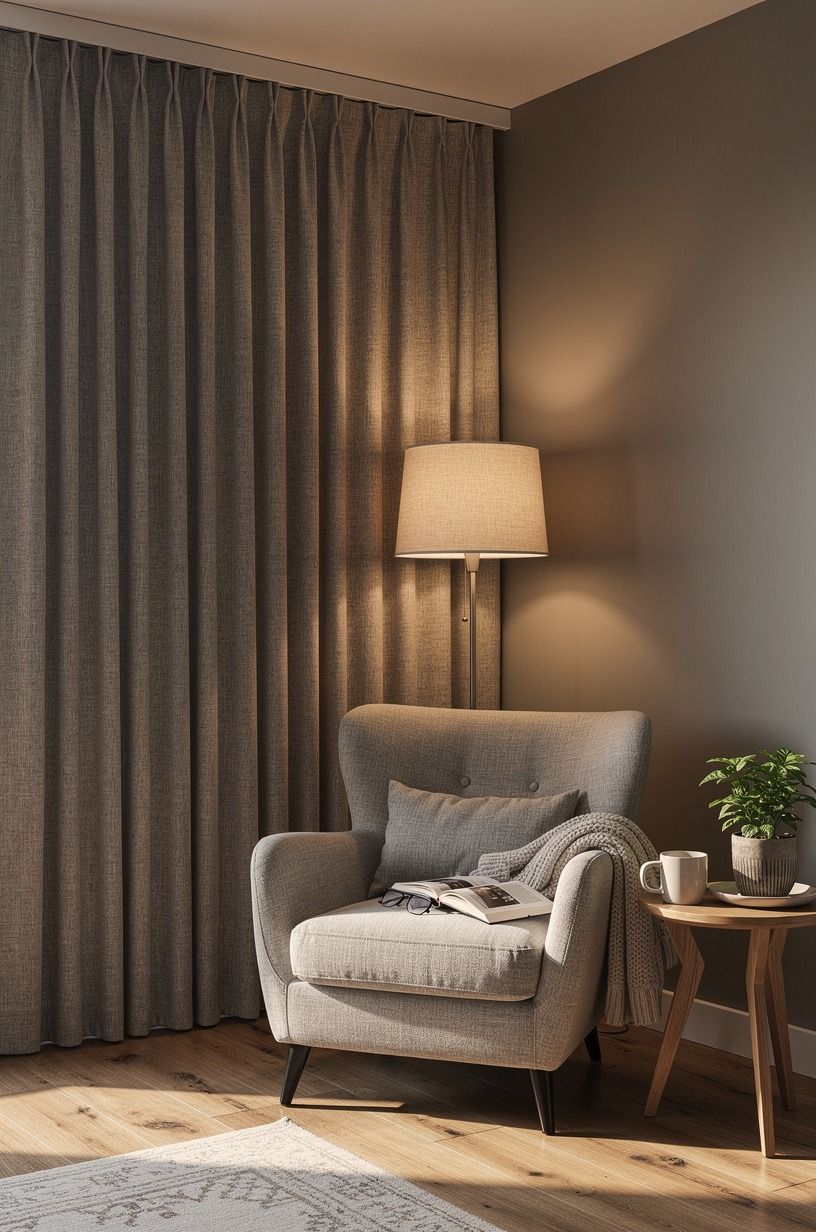
It can, and it might be the cheapest full-room fix on this list. A ceiling-mounted curtain track across one corner turns a toy explosion into a soft wall in about four seconds. Closed, it’s a draped accent.
Open, it’s playtime. Total cost runs about sixty to a hundred dollars depending on the fabric.
The move is height. Mount the track at the ceiling, not the window line, so the curtain reads as architecture.
A heavy velvet panel in dusty rose feels deliberate, almost theatrical, and it absorbs sound too. A brass track overhead keeps the whole thing polished.
Velvet genuinely changes how a room feels, and there’s a reason a velvet throw makes a living room feel 8 degrees warmer than it is.
Renters, this one’s yours. Ceiling tracks mount with a handful of screws, and tension-rod versions need none. One warning: skip the cheap polyester sheers.
They look like a hospital divider. Spend on the fabric, save on the hardware.
That’s the right order, and reversing it is the mistake I see most.
6Style Grown-Up Baskets That Swallow Toys Whole
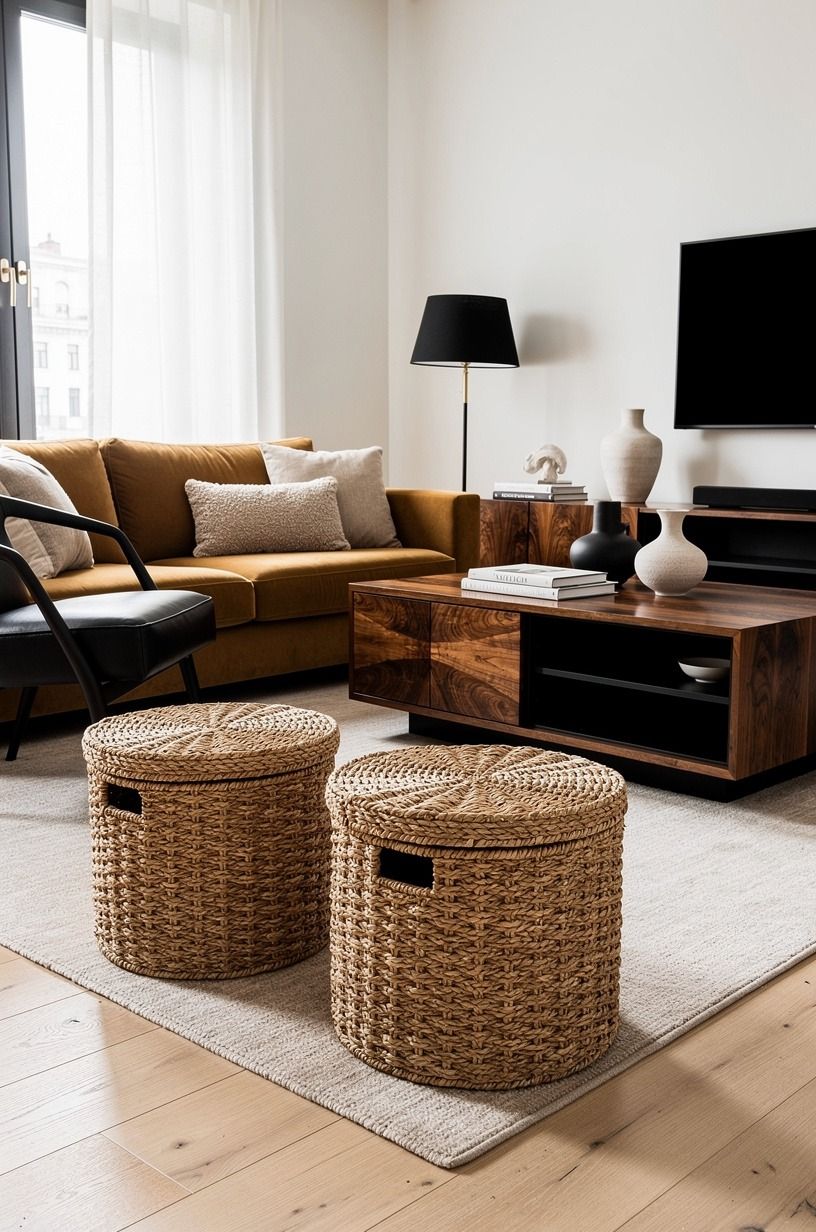
Baskets are the gateway move, and they’re the one I’d hand to anyone starting tonight. Not toy baskets.
Real ones, big enough to hold a throw and handsome enough to sit next to the sofa. Three of them will absorb an entire play zone.
The formula that works in my house: one by the sofa for current favorites, one by the fireplace for books, one near the window for the rotating weird stuff. Chunky camel-toned baskets with lids hide the most, since a lid means the mess isn’t even visible from above. Without lids, keep them under a console or beside a chair so the sightline stays clean.
Here’s a nominal-style shopping list that’s served me well: one lidded hamper, book-matched walnut. Two belly baskets, warm natural weave.
One wire basket for library books. Nothing matching on purpose.
And a word of caution from experience. Baskets under 14 inches wide are decorative, not functional.
They hold one puzzle and a dream. Size up, and place them where the toys already land.
You’ll never train the toys to cross the room. I’ve tried.
7Turn a Closet Into a Playhouse in the Living Room
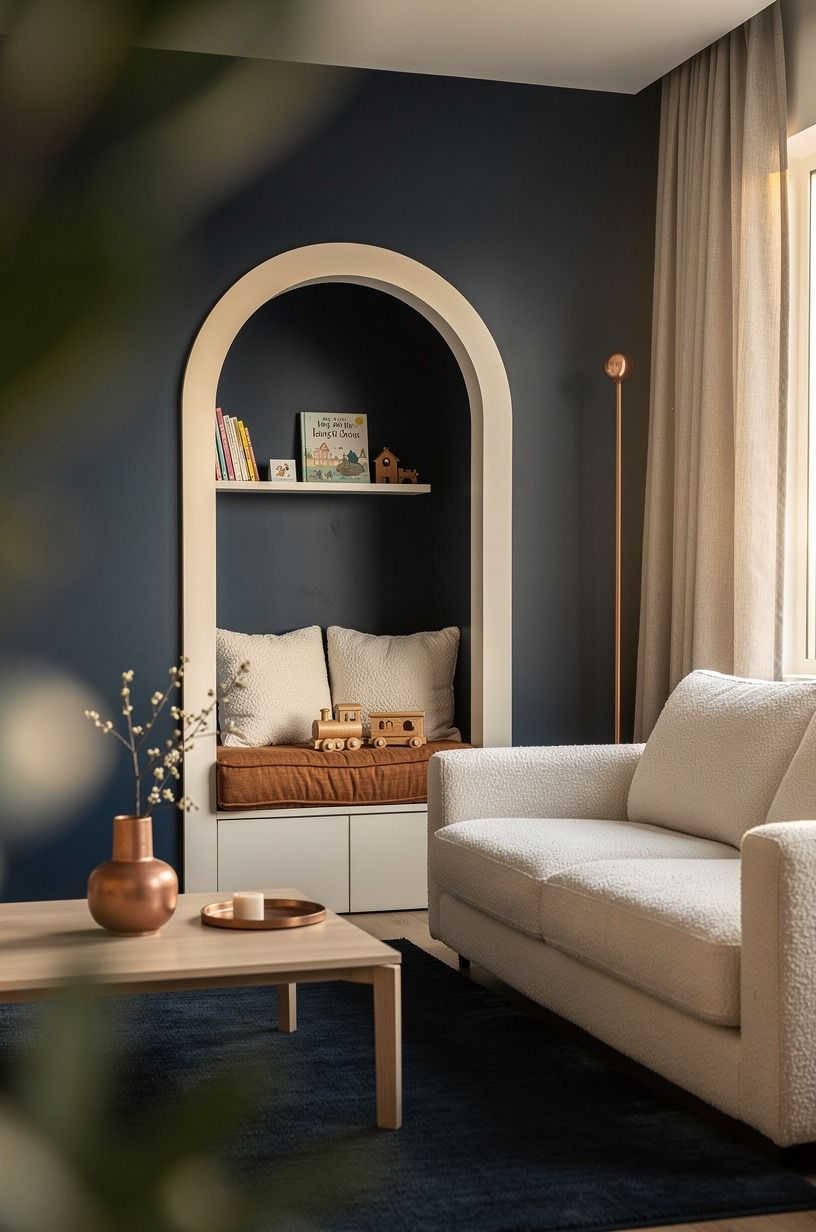
If your living room has an underused closet, you’ve got a hidden room sitting there waiting. Take the doors off, and that dark box becomes a playhouse in the living room that kids lose their minds over.
Mine did. It’s a room inside a room, and kids are wired to love exactly that.
Paint the inside a color that feels like a world. Farrow & Ball Hague Blue (No.30) reads midnight and storybook without going nursery. Add an organic bouclé cushion on the floor, a copper battery sconce on the wall, a low shelf at 36 inches for the good stuff.
Curtains on a tension rod replace the doors, so the whole thing vanishes at night.
The real win is containment. Toys live in the playhouse because the playhouse is the fun place, and the rest of your room stays yours. It’s the same principle behind hidden doors in the living room, the magic is in the reveal.
Budget sits around a hundred to two hundred dollars, mostly paint and the cushion. One caveat: anchor any shelving to studs.
Kids climb. Every parent learns this once.
8Panel an Accent Wall With Hidden Doors
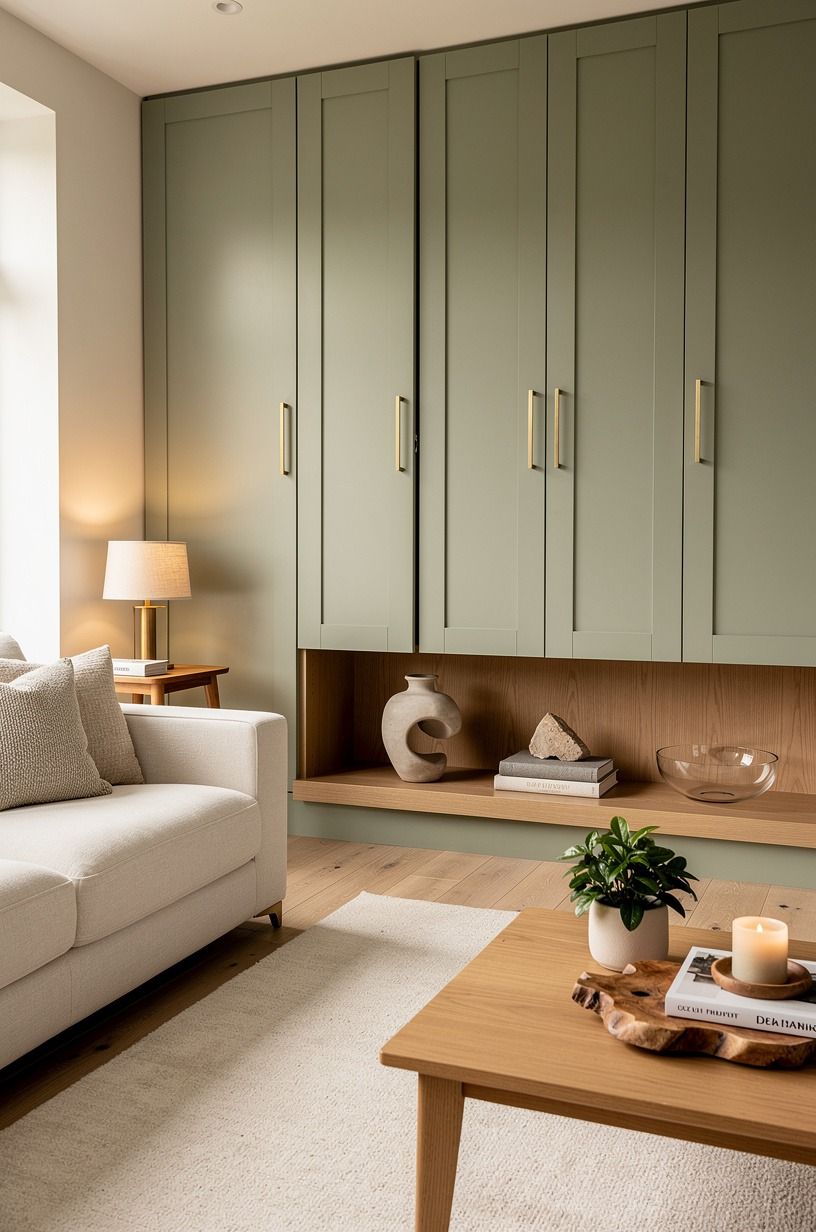
This is the move that makes people gasp, and it’s more doable than it looks. An accent wall with hidden doors means floor-to-ceiling paneling where two or three sections are actually cabinets.
Push to open, and the toy storage appears. Closed, it’s a wall.
The approachable version: vertical slat paneling over basic IKEA cabinets, with unlacquered brass touch-latches that develop a patina as little hands work them. The slats hide the seams, which is the whole game. A coat of Benjamin Moore Soft Fern (2144-40) on everything, cabinets and slats alike, makes it read as one architectural piece.
It’s a sage green that plays warm in lamplight and cool at noon, and it flatters almost any sofa fabric.
I’ve written about hidden door ideas for the living room before, and the panel route beats a single disguised door for families because you get volume, not a novelty. Cost lands in the mid range, roughly $1,000 to $3,500 with a carpenter, less if you DIY the slats. Honestly?
Worth every dollar if this is your forever home. If it’s not, the curtain from section five gets you eighty percent of the effect.
9The Disappearing Act: Paint Storage the Same Color as the Wall
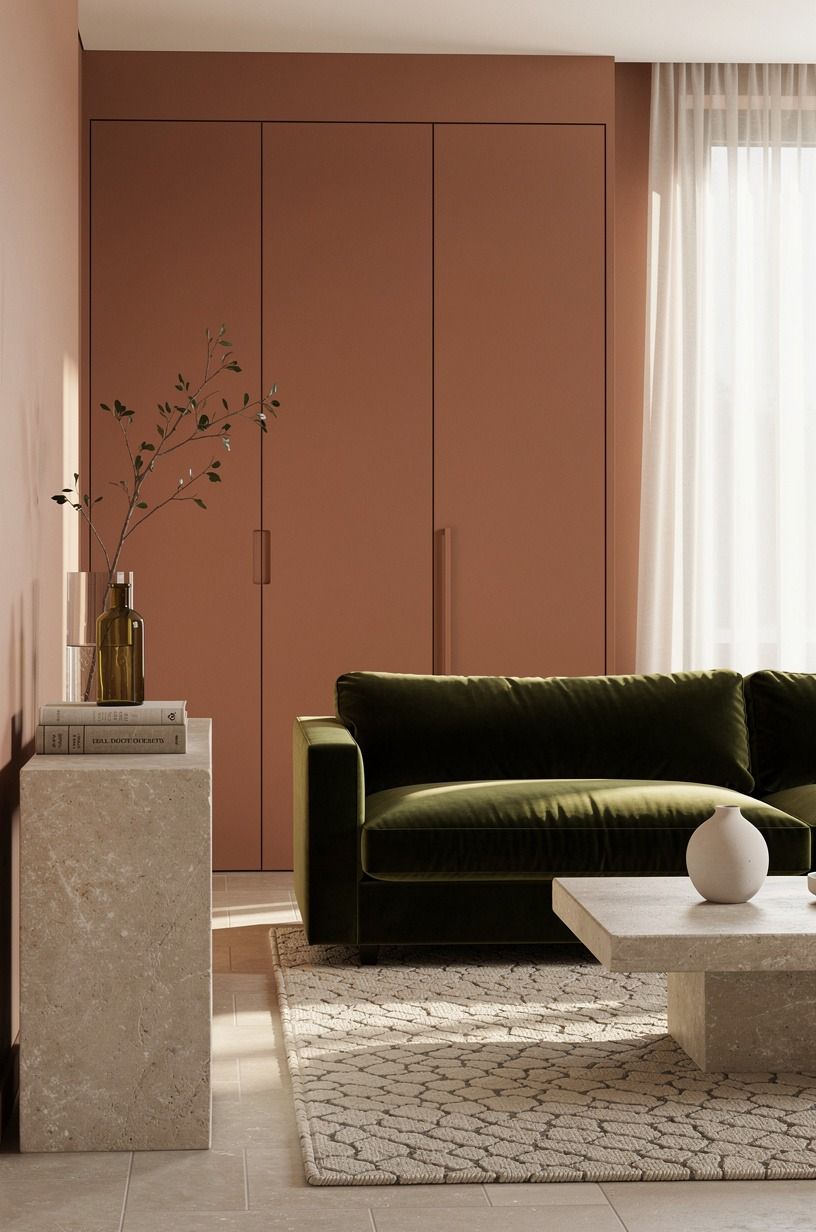
Here’s a principle designers use constantly and homeowners rarely do: whatever matches the wall stops existing visually. A bookcase painted the wall color doesn’t read as furniture. It reads as depth.
Your storage load doubles and the room still feels empty in the best way.
This works with the cheapest bones. A basic IKEA HEMNES bookcase, two coats of your wall color, and suddenly it looks built in. Sherwin-Williams Evergreen Fog (SW 9130) is a muted olive-green that hides scuffs better than white, and scuffs are guaranteed in a house with kids.
Satin finish, always. Flat paint on furniture shows every handprint by Friday.
The opinion I’ll stand on: skip the white storage wall. White looks crisp on Pinterest and exhausted in real life, and every fingerprint tells on you.
A mid-tone hides the evidence. Pair the painted pieces with one contrast, maybe a deep-pile mohair velvet chair in a stone tone, and the whole wall looks intentional.
It reminds me of the move where terracotta fixes a cold gray living room in three pieces, color does the work so the square footage doesn’t have to.
10Why Not Claim the Dead Zone Behind Your Sofa?
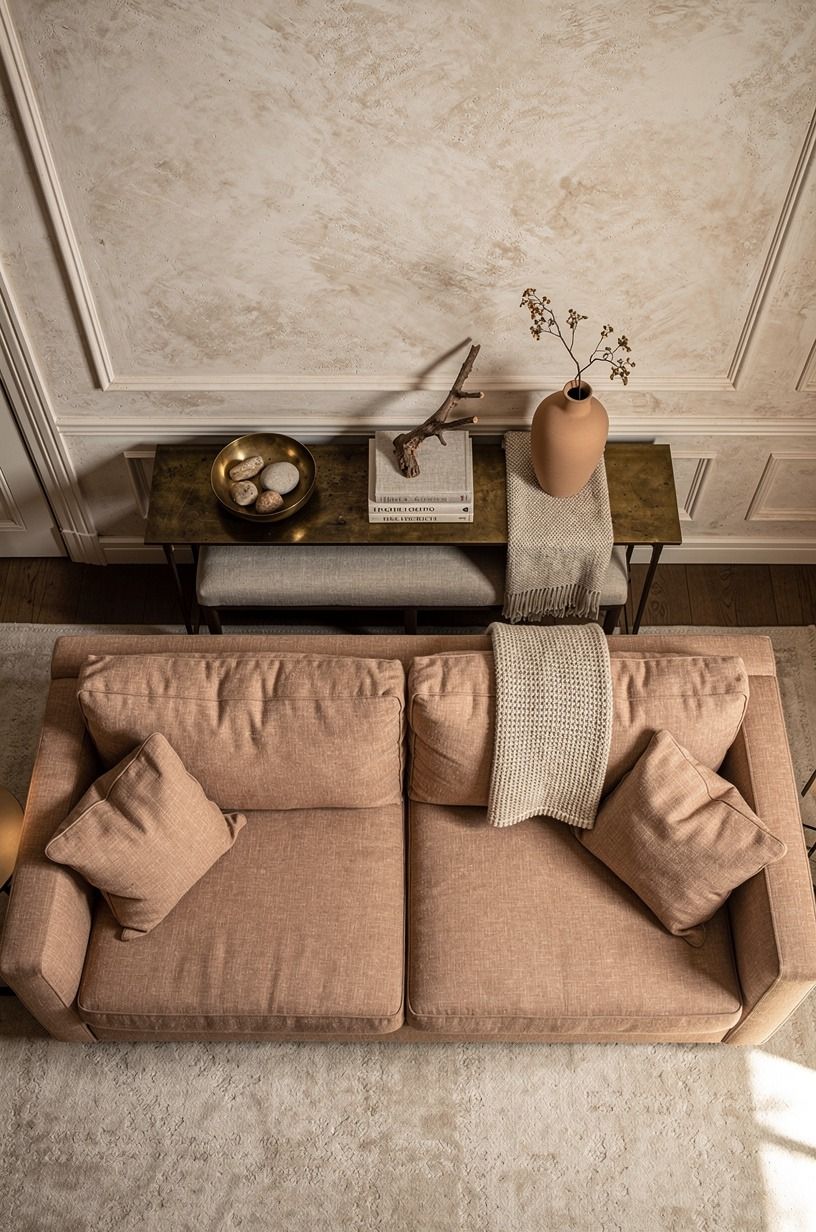
There’s usually eight to twelve inches of wasted space behind a sofa, and it’s the sneakiest storage in the room. Pull the sofa forward, drop a narrow console behind it, and line the gap with low bins. The toys vanish behind the one piece of furniture nobody moves.
A console about 10 inches deep is plenty. Target Threshold makes affordable narrow ones, or a simple board on brackets does it for forty dollars.
Slide in canvas bins in clay and linen tones that sit quiet against the sofa, and the whole setup disappears from every angle that matters. Guests sitting down see a styled ledge with an aged brass lamp and a plant.
Fair warning, and I say this with love: if your sofa is already too big for the room, this move makes the hallway feeling worse. Fix the scale first.
But in a right-sized room, this gap is free square footage you’ve been ignoring. The bins also work as a boundary.
Toys live behind the sofa, adults live in front of it. Nobody negotiated that line.
It just happened, and it holds every single day.
11The Ten-Minute Reset: One Rolling Cart and a Routine
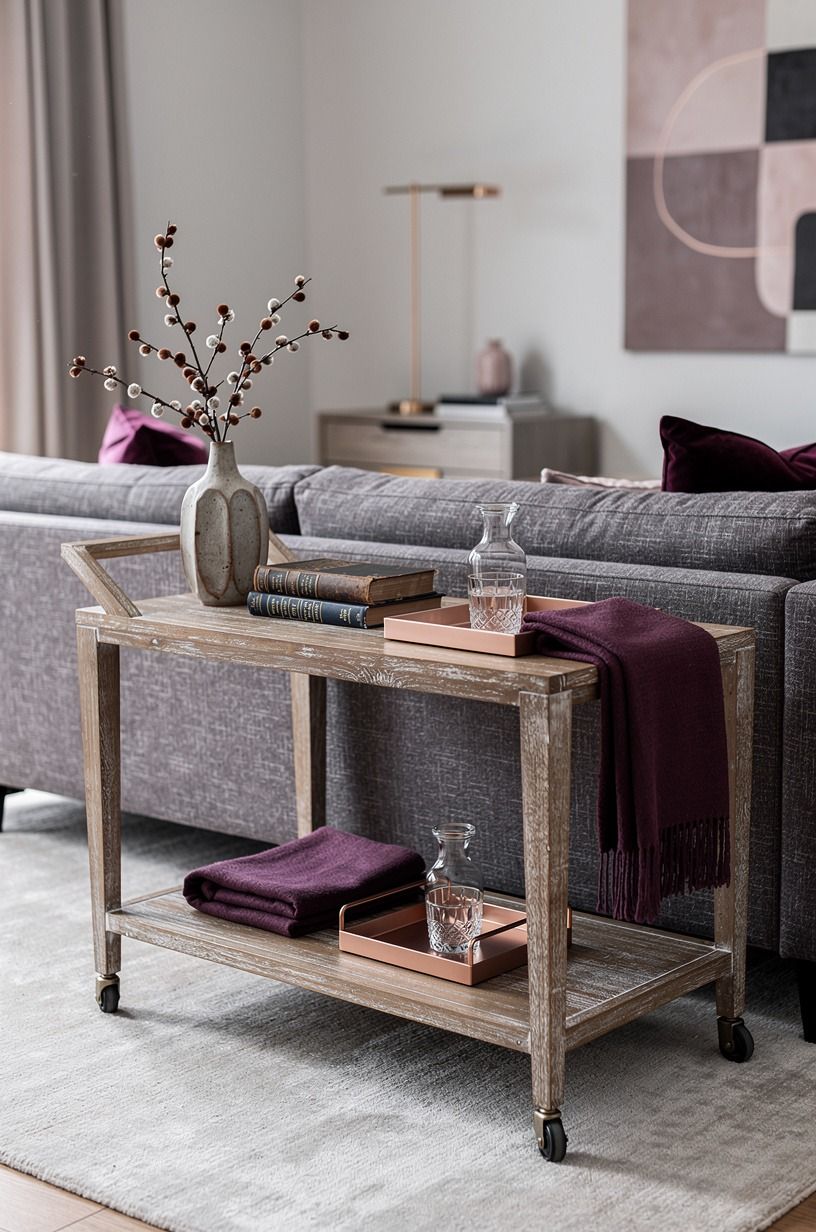
All the hidden storage in the world fails without a way to get toys into it. So here’s the system that saved my evenings: a rolling cart that parks in a closet, plus ten minutes before bed. The cart does the sweeping.
The cabinets do the hiding. You do almost nothing.
A three-tier cart, the IKEA RASKOG is the classic, rolls around the room while everyone drops toys in by zone. Top tier, small stuff.
Middle, books. Bottom, the big weird pieces. Then the cart docks at the cabinets and everything transfers in about two minutes.
Total reset, start to finish, under ten minutes. Every single evening!
The counterintuitive part: the routine matters more than the furniture. A $600 cabinet with no habit becomes a junk drawer with doors.
A $35 cart with a habit keeps your whole room adult-shaped. Start the reset right after dinner, before anyone’s tired, and let the kids toss instead of sort.
Tossing is fun. Sorting is a negotiation.
You’re not running a museum, you’re running a closing shift, and closing shifts are about speed.
What Hidden Toy Storage Costs
The short answer: a lot less than a playroom addition. A cosmetic, hide-it-all refresh typically runs $150 to $600. Here’s how the tiers break down across US averages:
Most families land in the budget tier and stay there happily. A 5×7 play rug, three big baskets, and one KALLAX wall with doors covers ninety percent of the problem. Save the high tier for built-ins you’ll keep for a decade.
What I Got Wrong the First Time (So You Don’t Have To)
I want to be honest about my failures here, because I made almost all of them. My first attempt at hiding toys was a beautiful disaster: open shelving, fifteen matching white bins, everything labeled with a label maker I was unreasonably proud of.
It lasted eleven days. The labels didn’t matter because my kids couldn’t read, the bins were too small, and the whole wall was visible from the sofa, so the mess was always on display.
I had built a museum exhibit of clutter.
The second mistake was buying storage for the room I wished I had instead of the room I actually had. I ordered a gorgeous oak toy cabinet that was four inches too deep for the only wall it could live on. It stuck out past the doorway, the door clipped it every time, and I kept it for a year out of spite before selling it at a loss.
Measure first. Then measure again.
Then write the number down somewhere you’ll find it.
But the biggest error was philosophical. I thought the goal was hiding toys from guests.
It’s not. The goal is a room that can flip between kid mode and adult mode in minutes, because you’re the one living in it every day.
Once I understood that, every decision got easier. Storage went where the play already happened.
Lids and doors replaced open bins. The reset became a routine instead of a Saturday project.
What I’d tell anyone starting out: buy less storage than you think you need, make it disappear, and put it where the toys land. That’s it.
The families who succeed at this aren’t the ones with the most cabinets. They’re the ones whose cleanup takes less time than making tea.
Build for that, and the room takes care of itself.
The Questions Worth Answering First
What is the best hidden playroom setup for a small living room?
A closed-door cube wall plus one big storage ottoman. The IKEA KALLAX with doors handles volume, the ottoman handles the daily churn, and both read as real furniture. Small rooms reward closed storage over bins, since you can’t hide clutter with distance.
Where can I buy hidden toy storage pieces on a budget?
IKEA for cube systems and carts, Target’s Threshold line for narrow consoles, Wayfair for storage benches. For baskets, check Facebook Marketplace and thrift stores first. Real rattan shows up constantly for a few dollars, and it looks better aged.
How much does a hidden playroom living room makeover cost?
Most families spend about 150 to 600 dollars for the full budget version: paint, bins, baskets, one storage piece. The curtain divider move costs under a hundred. Paint and rearranging what you own costs nothing at all.
Can I create a hidden playroom on a tight budget?
Yes, and start free. Pull the sofa forward for the dead zone, move toys out of sight lines, repaint one shelf the wall color. Then add one lidded basket and a tension-rod curtain.
You’ll cover most of the problem for under eighty dollars.
Is a hidden playroom worth it in a small space?
Worth it, and small spaces make it easier. There’s less room for toys to spread, so containment works faster.
Keep storage under 48 inches tall so sightlines stay open. And if your small living room feels cold, warm closed storage actually helps the cozy factor too.
Is a hidden playroom a good idea for a rental?
Yes, since most of these moves are no-damage. Tension rods, freestanding benches, rolling carts, removable wallpaper inside a closet playhouse.
Skip the panel wall and lean on curtains and consoles instead. Your deposit survives, and so does the playroom.
Where I’d Start Tonight
If I had to pick one, I’d start with the closed-door cube wall. Open bins show the mess even when they’re full, and doors end that in one afternoon. Pin this for later and start measuring your wall tonight.