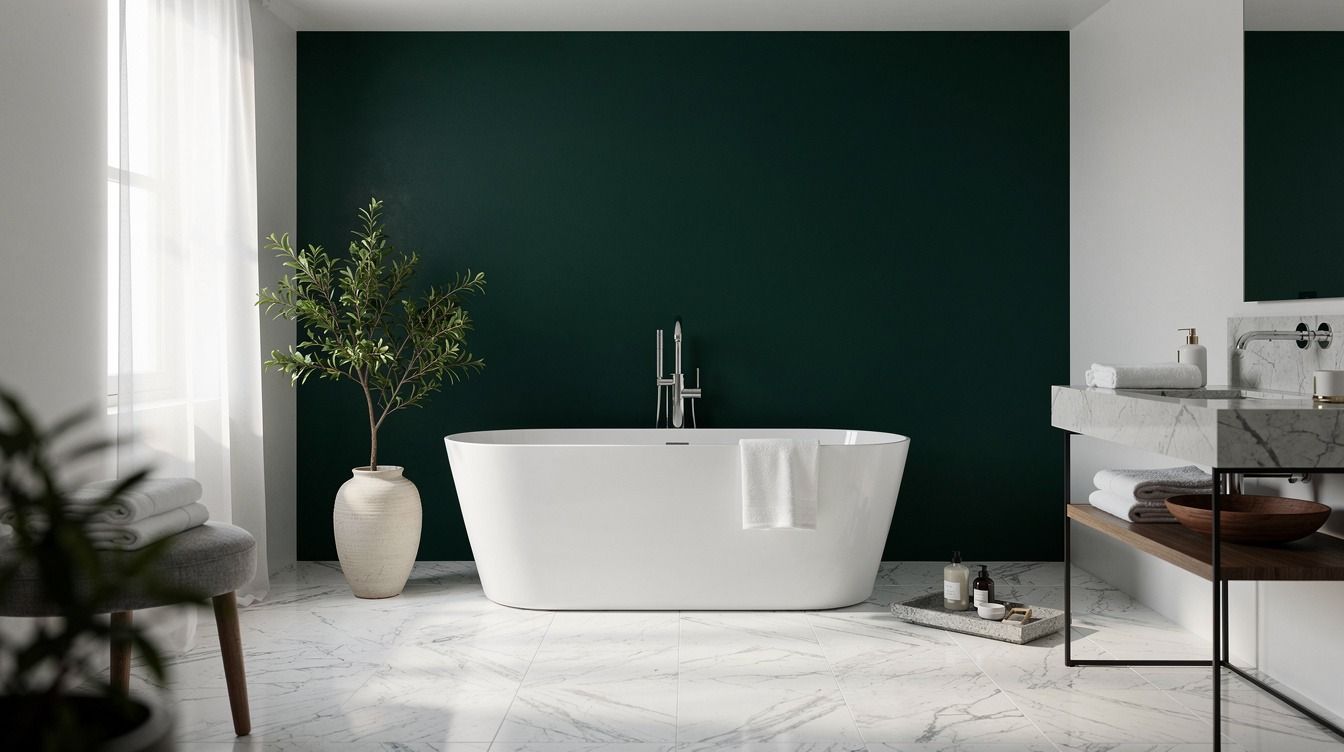
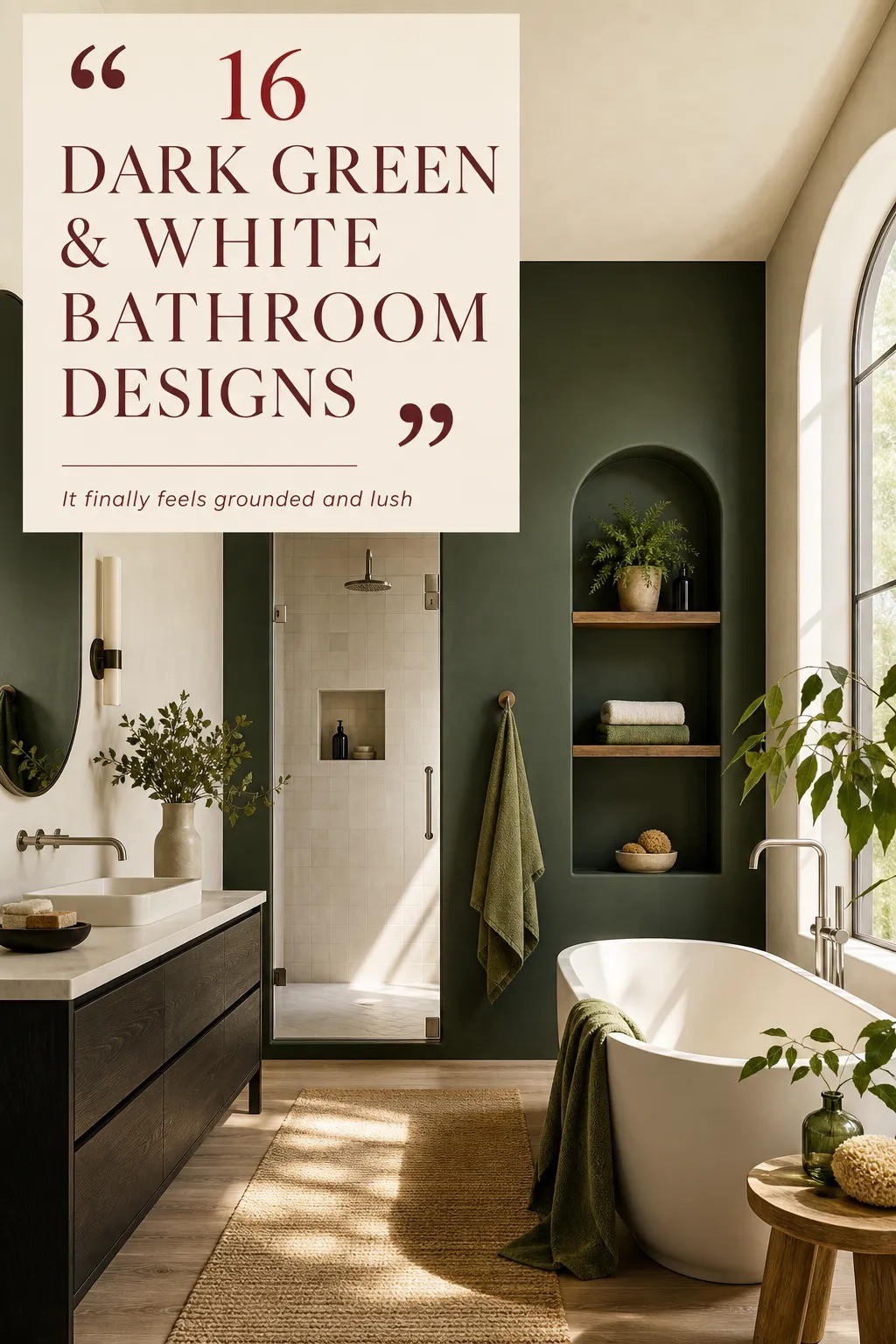
I’ve painted more bathrooms than I want to admit, and for years I defaulted to all-white because I was scared of anything else. Dark green scared me most. I thought it would shrink the room, fight the light, and date the whole space in two seasons. Then I tried it on a single wall behind a client’s vanity, in Farrow & Ball Studio Green, and the white stopped looking sterile the second the second coat dried. That’s the move!
Here’s the thing: dark green doesn’t fight white. It makes white look intentional. The crisp contrast reads as designed instead of default, and you don’t need a full renovation to get it.
A $40 tin of paint, a roll of zellige tile on one wall, a brass mirror, and you’ve moved the whole room from “starter bathroom” to “I thought about this.” Most of these swaps run between $40 and $400, and I’ve included the exact ranges below so you can plan the spend.
These 16 dark green and white bathroom ideas are the moves I keep coming back to, with the ones I’d skip flagged up front. Save the budget table, pin your favorite, and let’s make this room feel like something worth walking into!
- commit to one wall in deep forest green
- anchor the vanity with brass and warm travertine
- layer the Three-Height Light Stack
- swap subway tile for oversized-chip terrazzo on the wet wall
- build the Two-Wood Rule for warmth
- float a chunky wood shelf over the toilet
- frame the mirror instead of buying a builder-grade one
- What plant earns the corner?
- use Nero Marquina marble with white veins on the countertop
- hang a pair of sculptural sconces
- Does a vintage runner earn the bathroom floor?
- try peel-and-stick wallpaper for renters
- Why does the 60/40 paint split beat a full green wall?
- style the vanity tray like a small still life
- swap the shower curtain for sage linen
- Does one real art piece really change the room?
1commit to one wall in deep forest green
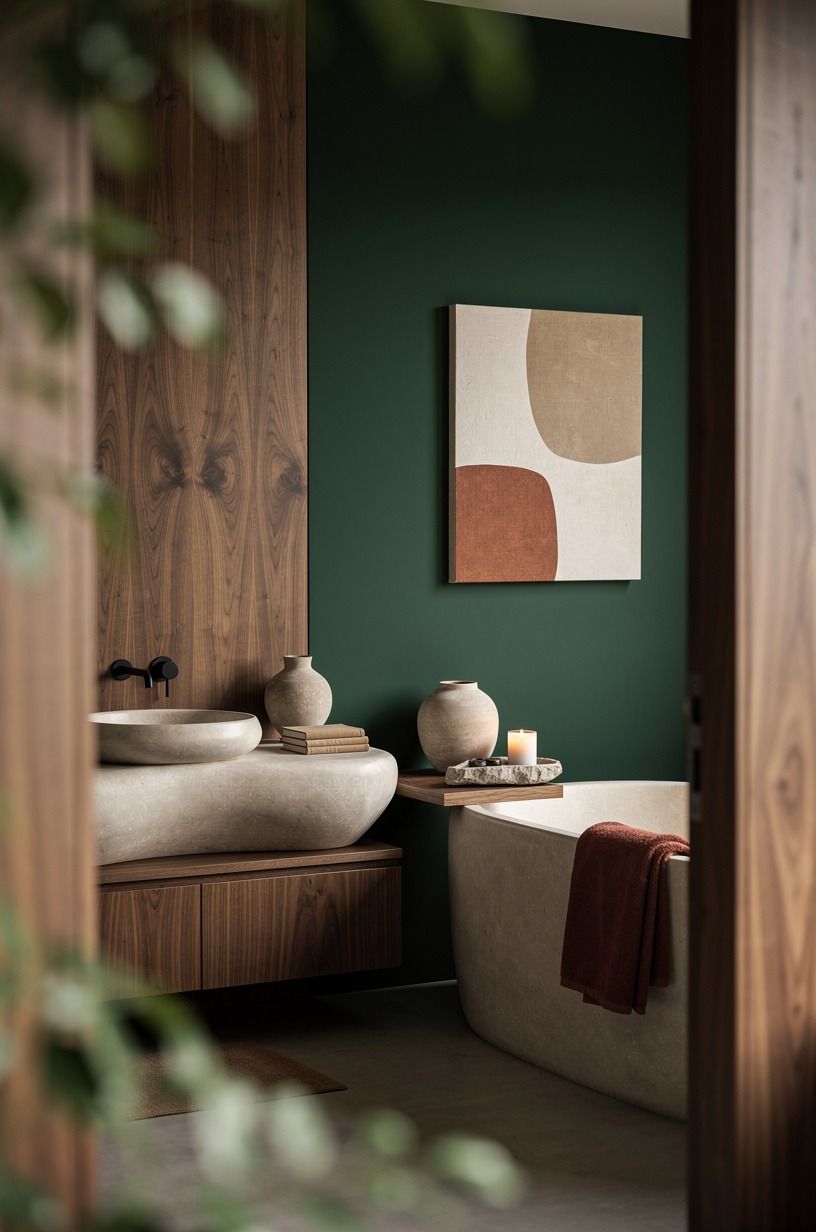
Single-wall commitment is the move if you’re nervous. Paint the wall behind the vanity in Farrow & Ball Studio Green (or Benjamin Moore Essex Green HC-188 for a touch warmer) and leave the other three walls in your existing white. Pair the wall with a book-matched walnut vanity or floating shelf so the warmth comes through the wood grain instead of another layer of paint, and add a rust linen hand towel or stool so the warm tones in the cabinetry find an echo.
The green reads as a backdrop instead of a box, and the room stays bright because light still bounces off three clean walls. A gallon of quality paint runs about $45 to $70, and a weekend is all it takes.
Don’t tape the ceiling if you’re a steady roller, the green line looks better slightly imperfect than razor-sharp. I’ve done this twice now and both clients kept it for years. If you’re planning a bigger refresh, our moody dark green bathroom ideas guide covers the full-room commitment version, and the moody deep green before-and-after shows the exact transformation I’m talking about.
2anchor the vanity with brass and warm travertine
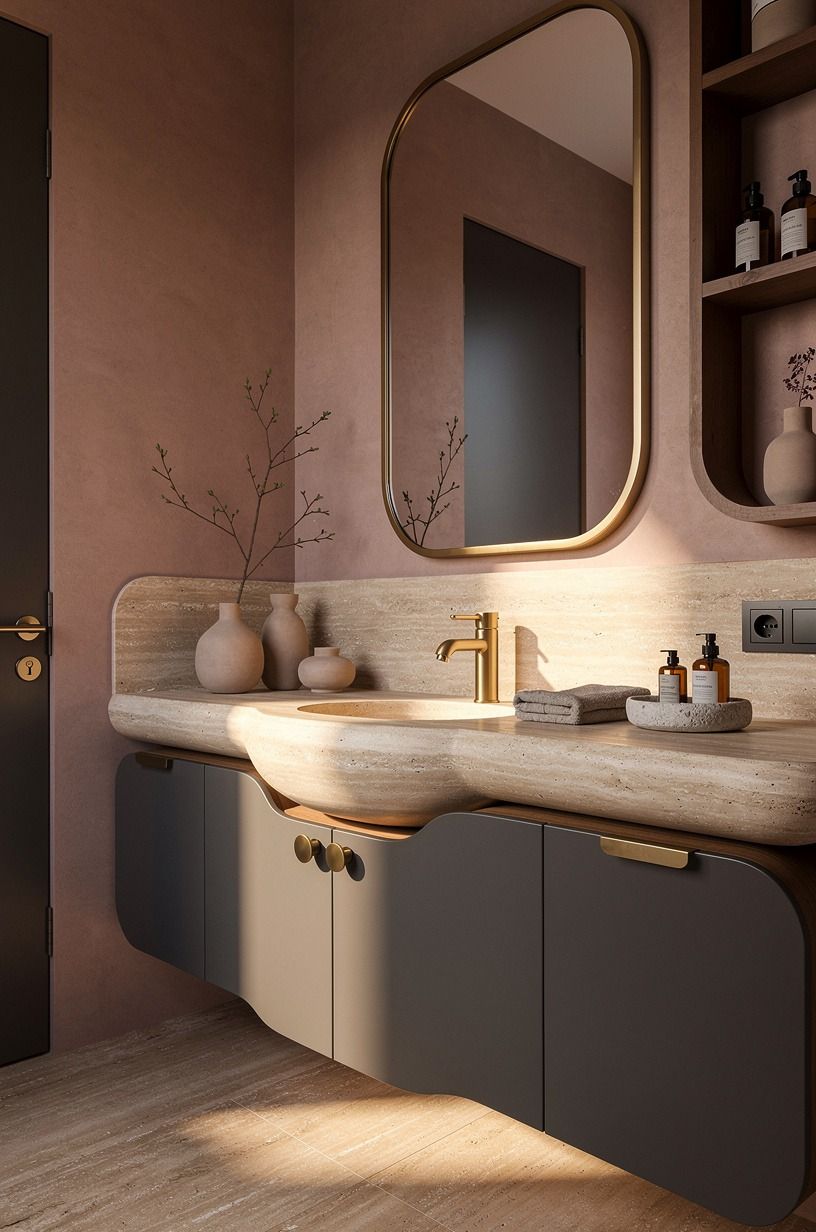
Warm metals against a moody palette is the combination that makes the whole composition feel grown up. A brushed brass faucet, an unlacquered brass mirror frame, warm travertine for the vanity top or a stone soap tray, and matching cabinet pulls will pull every accent into the same warm family. A dusty rose candle vessel and a charcoal accessory box cool the palette down just enough so the brass doesn’t go yellow.
For a vanity update, expect $120 to $450 for a quality brass faucet, $80 to $200 for a framed mirror, and another $200 to $600 for a travertine top or accent shelf. Brass develops a soft patina over time, and that’s what makes the room look richer.
Total vanity-area refresh usually lands around $400 to $1,200 for the brass-plus-stone swap alone. You’ll see the difference the moment the contractor walks out. If you’re going the glam direction with brass-heavy everything, our dark green and gold bathroom ideas takes it further with veined marble and antique mirror.
3layer the Three-Height Light Stack
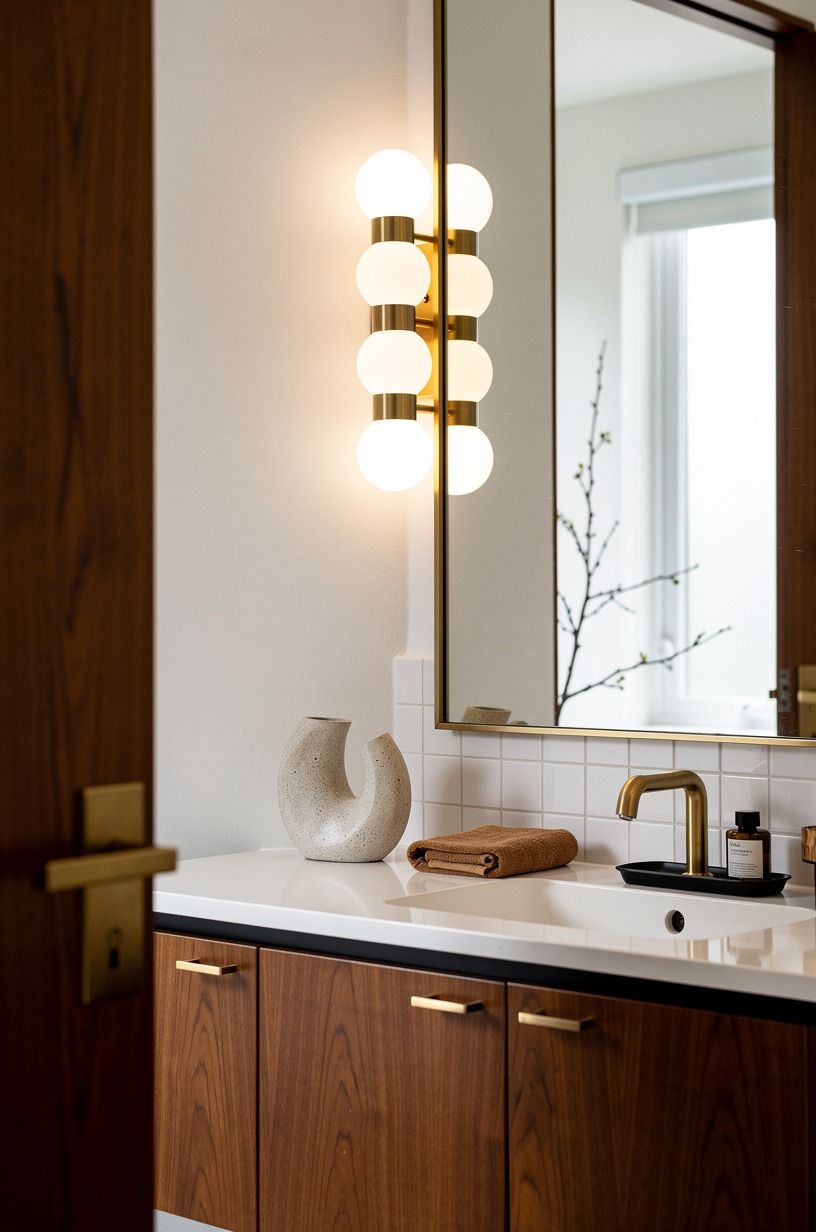
Lighting is where most dark green bathrooms lose it. One overhead fixture throws shadow down on your face and turns everything into mud. The fix is what I call the Three-Height Light Stack: a ceiling mount in warm white for general light, sconces at eye level in camel ceramic or black metal flanking the mirror, and a low accent light (a small LED strip under the vanity, or a warm table lamp on a shelf) for evening glow.
The unlacquered brass on the sconce hardware develops a patina that picks up the warm tones in the room. Mixing the three heights stops the cave effect.
The eye-level sconces are doing the most work, they’re what makes your skin look like skin instead of a passport office line. Aim for warm bulbs (2700K), and dim everything if you can.
If you’re wiring more than one switch, our warm lighting guide has the bulb temps and wattage breakdowns.
4swap subway tile for oversized-chip terrazzo on the wet wall
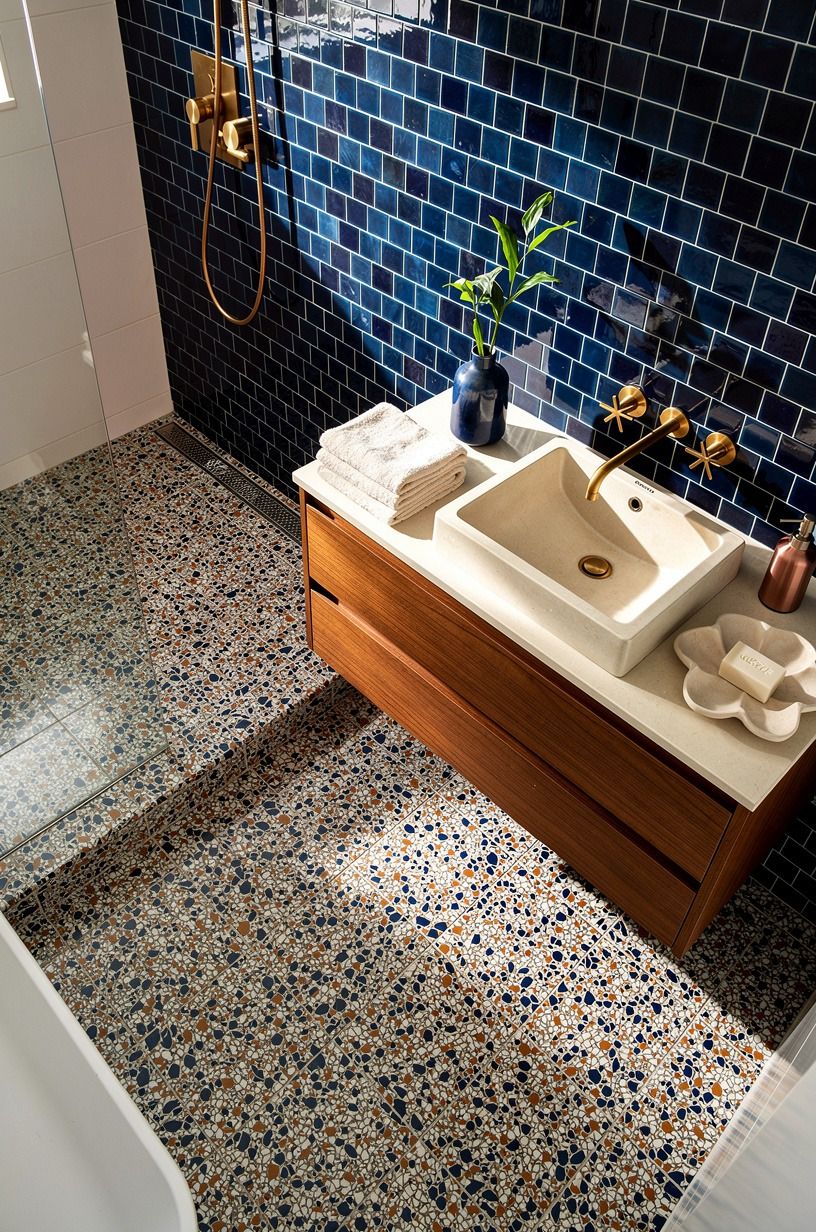
Subway tile is the safe choice and it works, but it’s also the choice everyone defaults to. Oversized-chip terrazzo in midnight blue with copper flecks and ivory chips on the shower wall reads as a step up the second the light hits the surface. The chips catch light at different angles, and that’s the whole point.
No two slabs are the same. Expect $25 to $50 per square foot installed, so a single wet wall lands around $600 to $1,800.
Worth every penny if the shower is the focal point of the room, and skippable if the shower is tucked behind a door you’ll never see.
5build the Two-Wood Rule for warmth
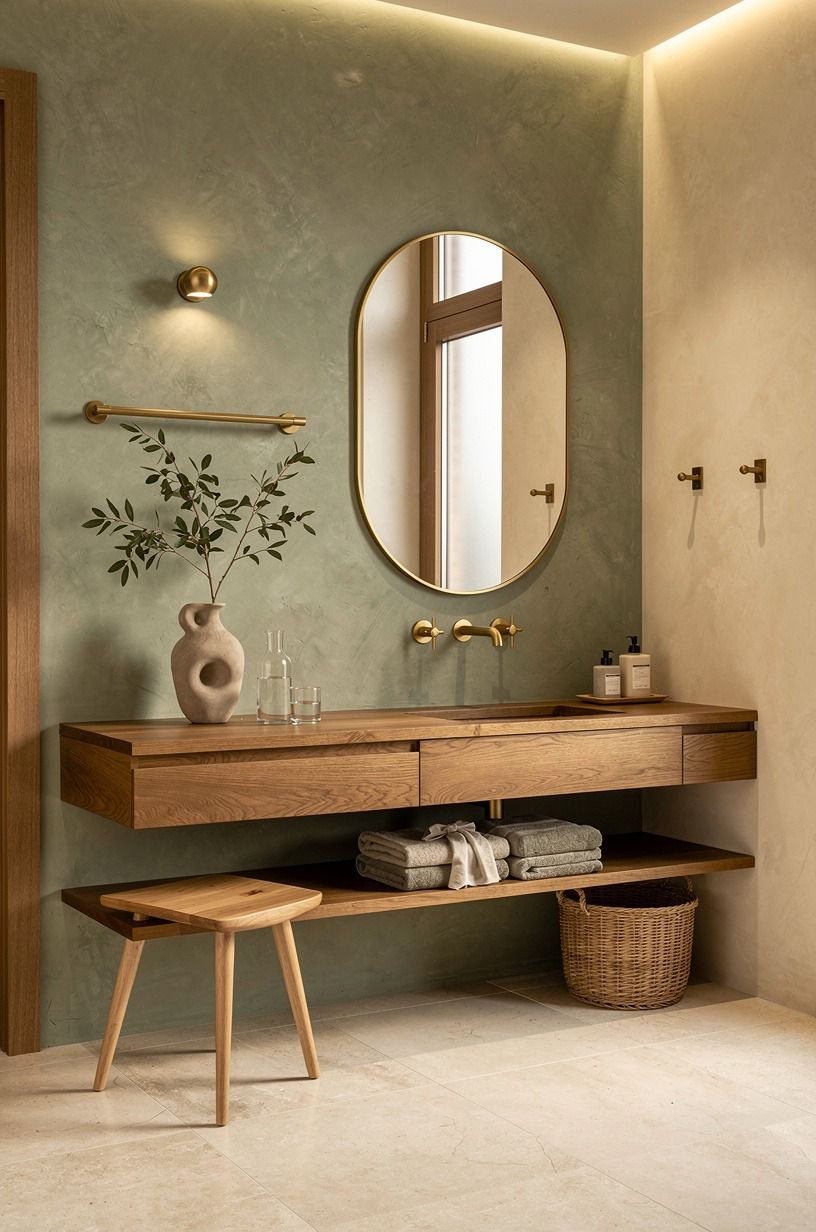
Cold finishes look bad against any colored wall. Warm finishes look rich. The difference is the wood and plaster you put next to it.
My Two-Wood Rule: pick a soft base (warm cream Venetian plaster on the wall) plus two warm wood tones (a base oak or teak vanity, plus one accent in walnut or mahogany), and keep metal finishes warm brass or aged bronze. No cool ash, no gray-washed anything.
Sage green walls against cream plaster and natural wood is the move I keep recommending. The plaster softens the green so it reads as a quiet envelope instead of a flat color wall, and the wood grain breaks up the planes.
White oak and dark green together still works. Vanity bases run $400 to $2,500 depending on whether you go IKEA solid wood or a custom build.
Save the cool gray tones for the laundry room. If you’re picking woods across the whole house, the dark table linens warm-wood pairing guide shows how warm woods shift a whole room’s temperature.
6float a chunky wood shelf over the toilet
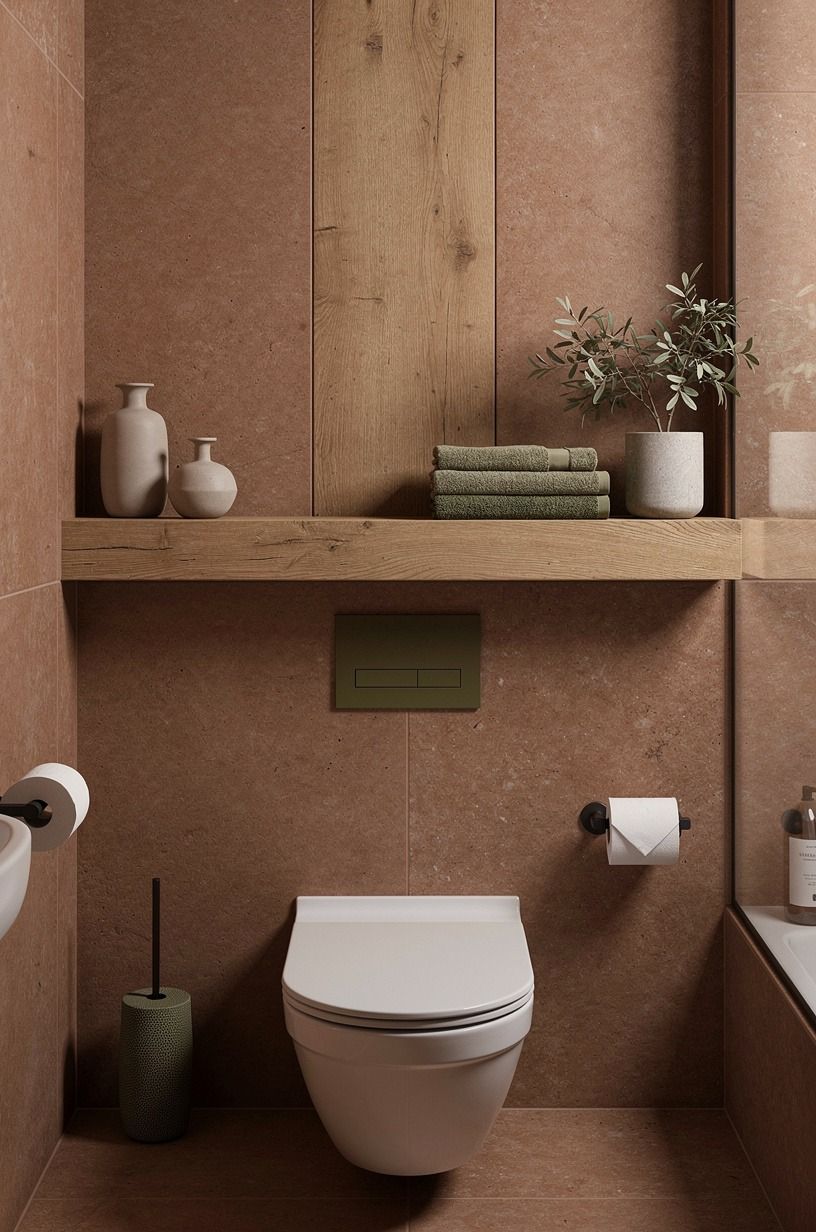
The space above the toilet is wasted square footage. A chunky white oak floating shelf, 8 to 12 inches deep, holds rolled towels in a terracotta basket, a small olive plant in a clay pot, and one piece of stone-framed art without crowding. A small shagreen-wrapped vessel or tray on the shelf gives the surface a third material the eye can rest on.
You can mount one in about an hour with a drill, a level, and two brackets rated for the load. $40 to $120 depending on the wood and bracket style. Keep styling tight: three rolled cotton towels, one plant, one object.
I’ve seen clients turn this into a graveyard of stuff, and the wall looks worse for it. Less is more here, always.
7frame the mirror instead of buying a builder-grade one
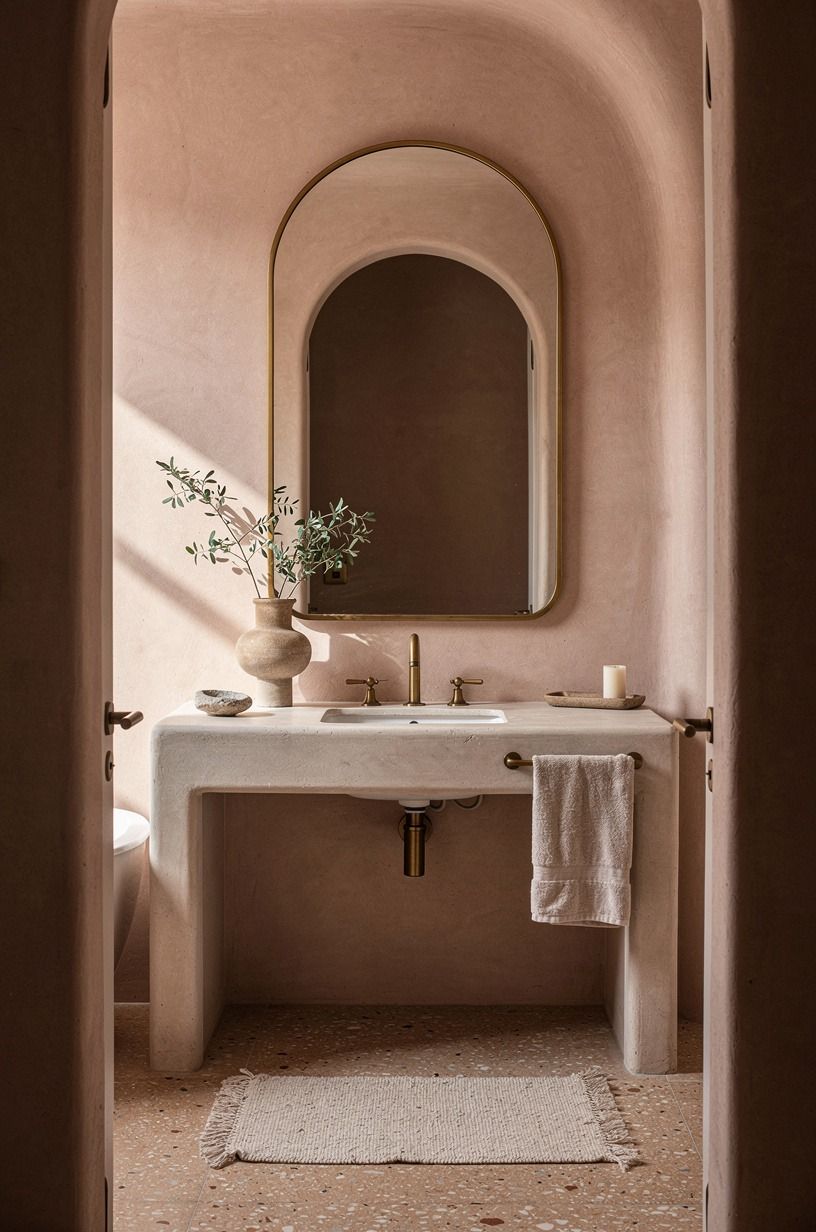
The builder mirror that came with the bathroom is doing nothing for you. Frame it.
A simple aged brass or weathered wood frame around the existing mirror costs $80 to $250 and changes the entire vanity wall. Hang a washed Belgian linen panel nearby for softness, and let the clay-toned wall behind it warm up the whole corner.
It’s a 20-minute job for a carpenter if you’re not DIY-inclined.
A framed mirror also reads better in listing photos than the wall-attached slab, which matters if you’re selling the home. Go at least 1 inch thick on the frame profile, anything thinner reads as a strip of tape.
And skip the frameless “modern” trend here, your warm-tone wall needs the visual weight of a real edge. For another angle on framing as a high-impact swap, our black-and-white bathroom contrast guide covers the same contrast logic.
8What plant earns the corner?
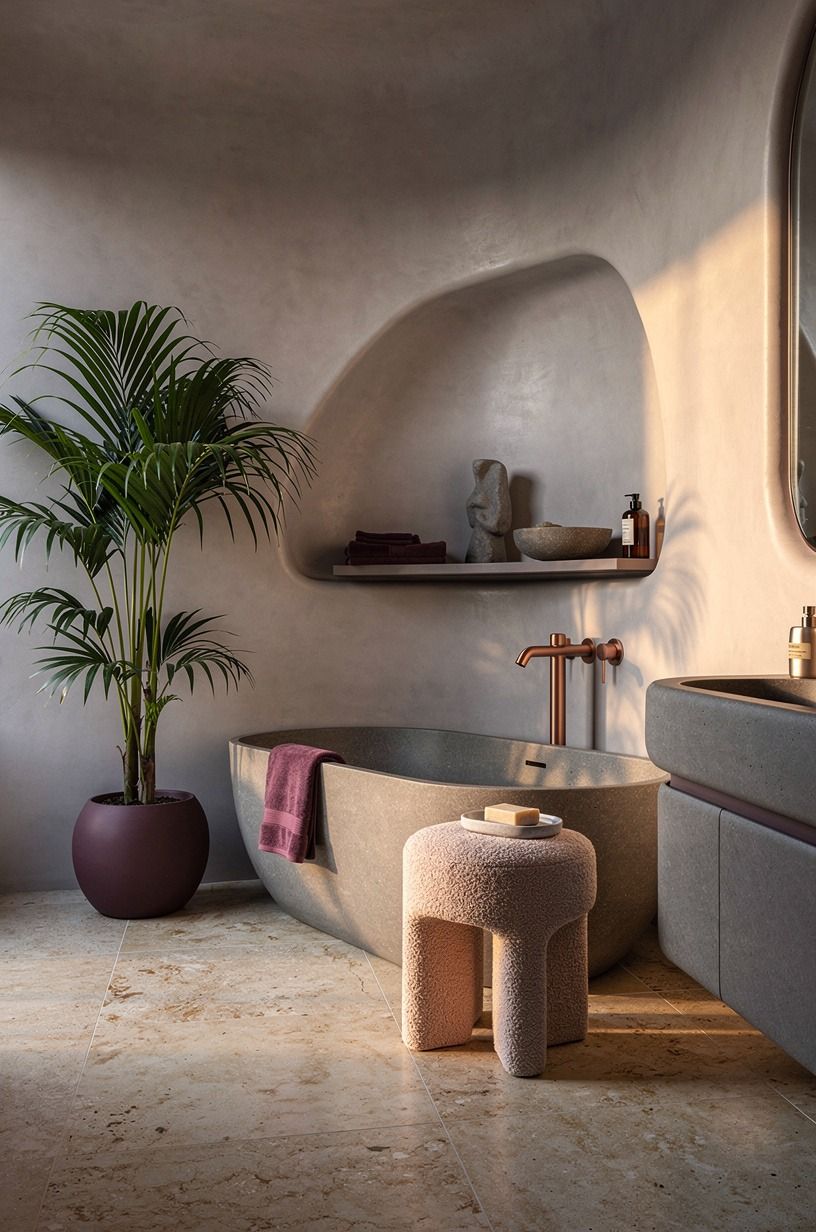
One oversized plant, not three small ones. That’s the rule.
A fiddle leaf fig or a tall snake plant in a rose gold-banded ceramic planter set on an organic bouclé stool in plum turns a sterile bathroom into something with breath. A soft gray linen behind it and you’ve got a corner that looks intentional instead of stuck in.
Plants cost $25 to $80 for a starter size, and you’ll need a saucer you don’t mind looking at. The fiddle leaf will need bright indirect light, so if your bathroom is windowless, swap to a pothos or ZZ plant and stop fighting it.
Real plants are the cheapest way to make any bathroom feel intentional instead of decorated. If you love the deeper-tone water-meets-stone look, our turquoise cove between cliffs and pines piece captures the same color story from nature.
9use Nero Marquina marble with white veins on the countertop
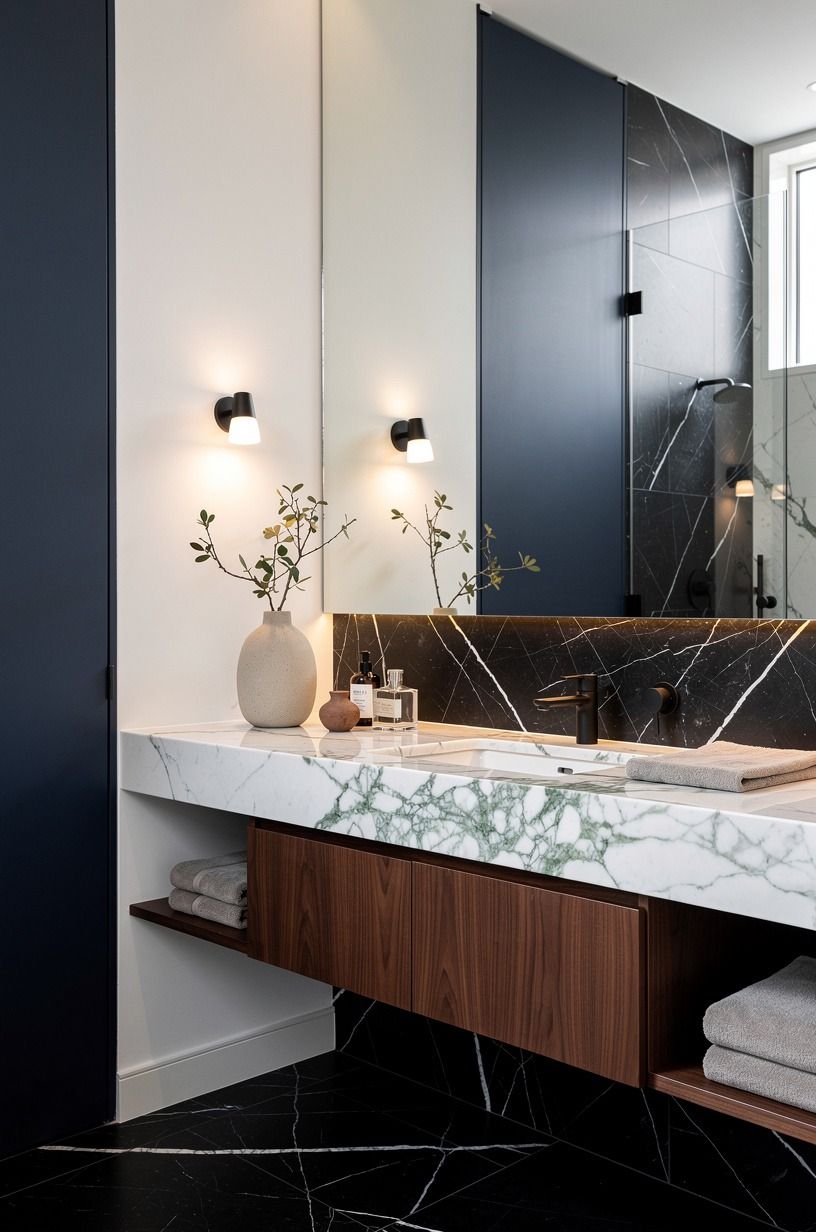
The countertop is the second-most visible surface after the wall. Nero Marquina, a deep black marble shot through with bright white veins, reads cinematic against navy walls and warm walnut cabinetry. It feels like a boutique hotel suite instead of a starter bath.
A marble slab runs $50 to $100 per square foot installed, so budget $800 to $2,500 for a vanity top. If marble isn’t in the budget, a quartz countertop with a black-and-white veining pattern mimics the look for $40 to $70 per square foot.
Either way, avoid speckled granite, it fights the dark palette and dates the room instantly. I’ve pulled more orange-speckled granite tops than I can count.
10hang a pair of sculptural sconces
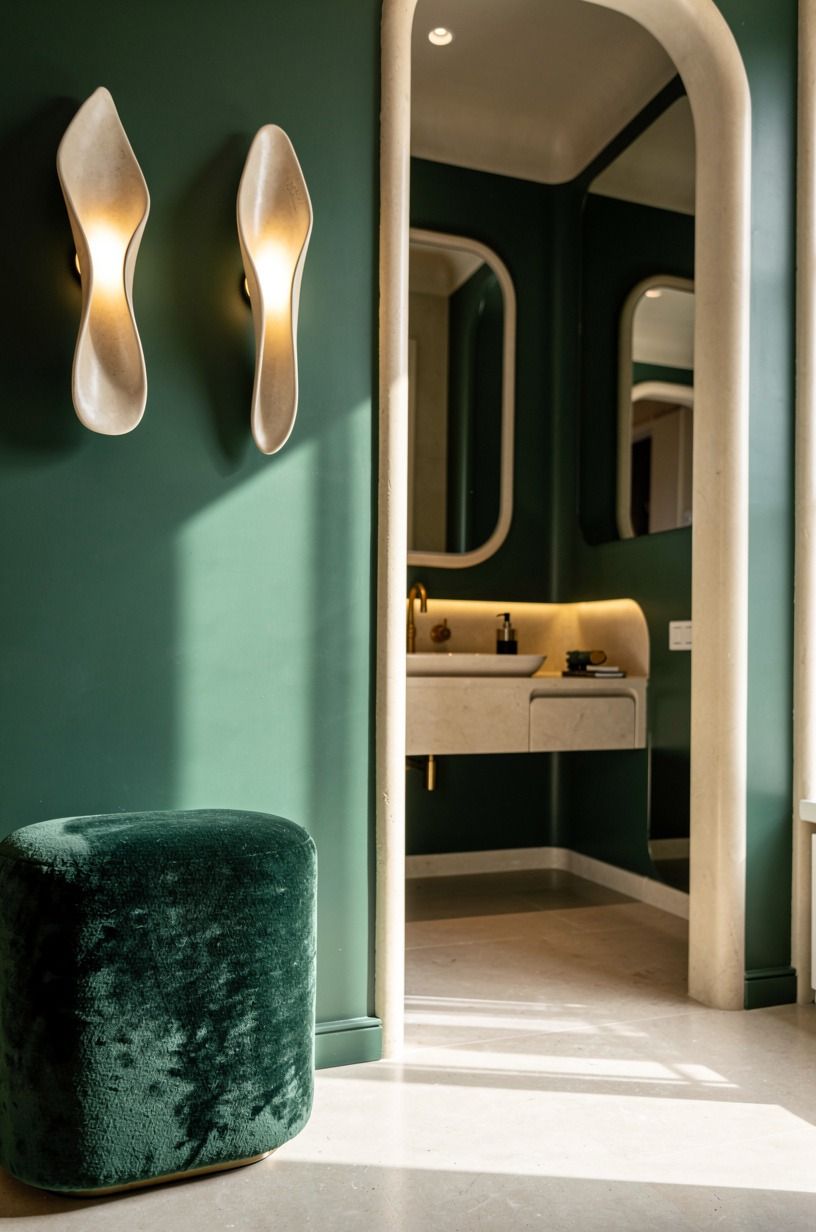
Flanking the mirror with wall sconces doubles the cozy at night and frames the focal point. A small bench or stool in emerald mohair velvet nearby pulls the green family into the floor zone, and a cream ceramic catch-all on the vanity keeps the palette honest. Warm, dimmable bulbs only, nothing blue.
The battery-operated versions mean you don’t need an electrician, and if you’re wiring the whole room our warm lighting guide covers the bulb temps.
The soft side-glow is what makes a room feel like an evening, not an office. Go for $80 to $250 per sconce and pair them at eye level on either side of the mirror.
If you can only afford one swap, do this. It’s the single change with the biggest payoff per dollar, and you’ll feel it every morning.
11Does a vintage runner earn the bathroom floor?
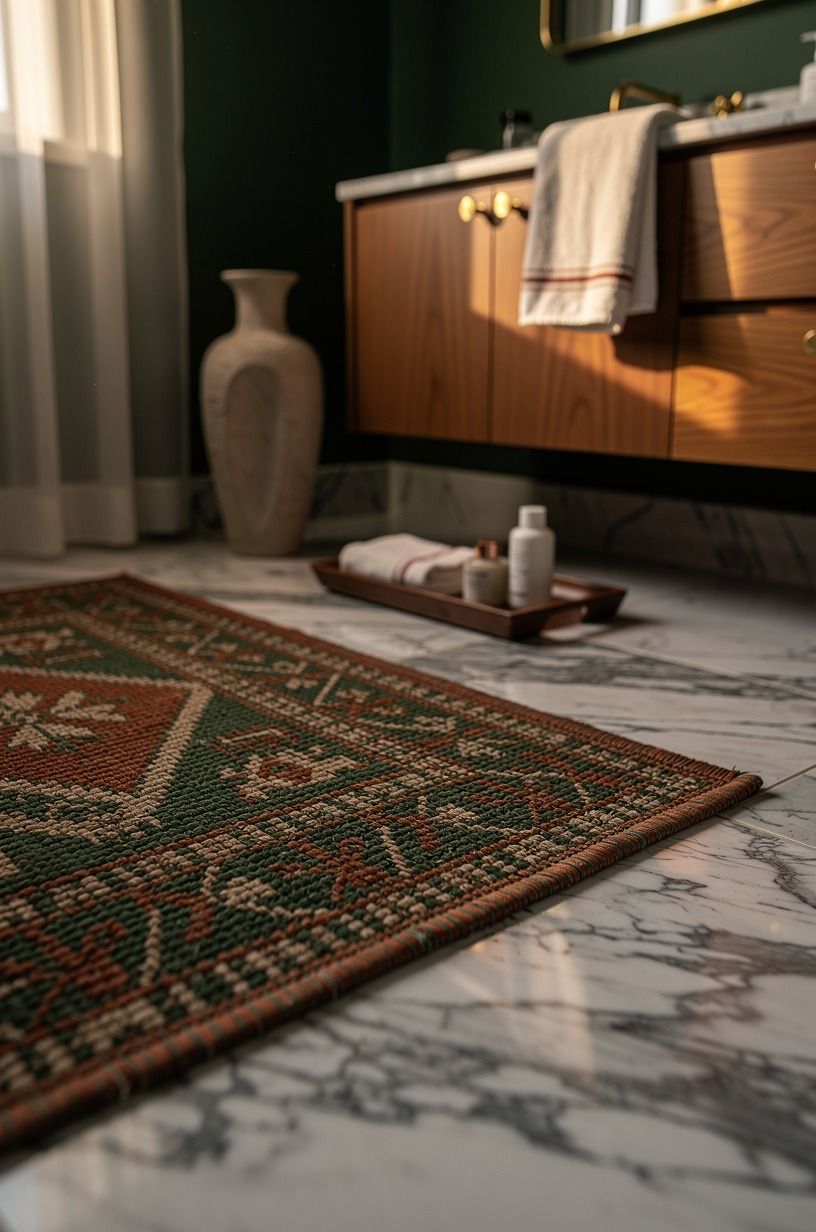
A patterned runner in forest green and rust down a long bathroom floor makes the room feel like a hallway in a good way. Choose one that nods to Carrara tones in the pattern so it sits calmly against marble or stone-look tile, the kind with a runner you’d see at a quiet Mediterranean villa.
Expect $80 to $300 for a quality vintage or vintage-look runner, and add a rubber liner underneath to keep it from slipping on tile. Skip anything bleach-prone, a bathroom runner gets wet whether you plan for it or not. If your bathroom is small and a long runner would crowd the space, lay a flat woven mat under the vanity and call it done.
The runner is a story only if the room has a runway for it.
12try peel-and-stick wallpaper for renters
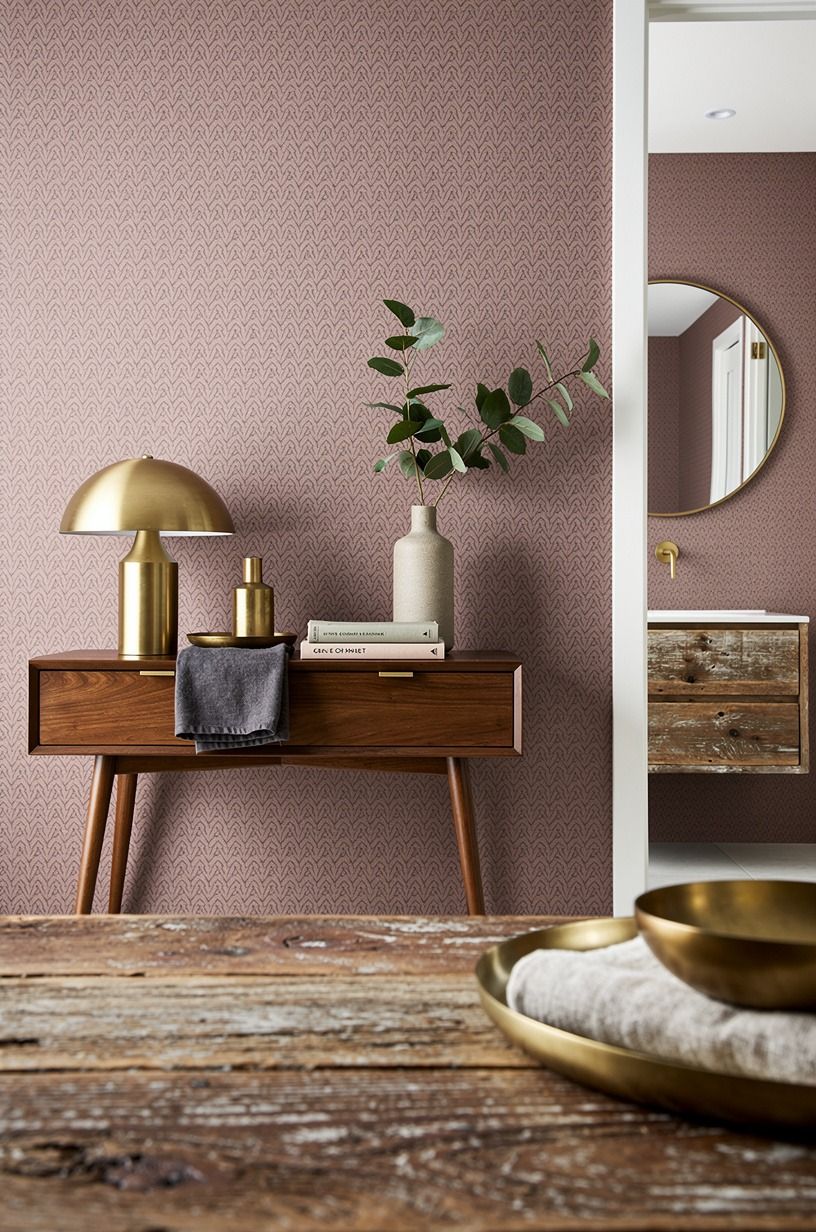
If you can’t paint, peel-and-stick wallpaper in a dusty rose botanical or palm pattern gives you the same color commitment without the security deposit hit. A floating shelf in reclaimed weathered teak ties the warm accent to a wood detail you can take with you when you move. Modern versions look good now, not like the 2010 contact paper everyone remembers.
Budget $80 to $250 for a single accent wall, and the install takes an afternoon. Use a smoothing tool and a sharp blade for the corners. When you move out, the paper peels off with a hairdryer and a little patience.
I’ve helped three renters do this in the past year, and all three got their deposits back. If you want the same vibe without commitment, this is the move.
13Why does the 60/40 paint split beat a full green wall?
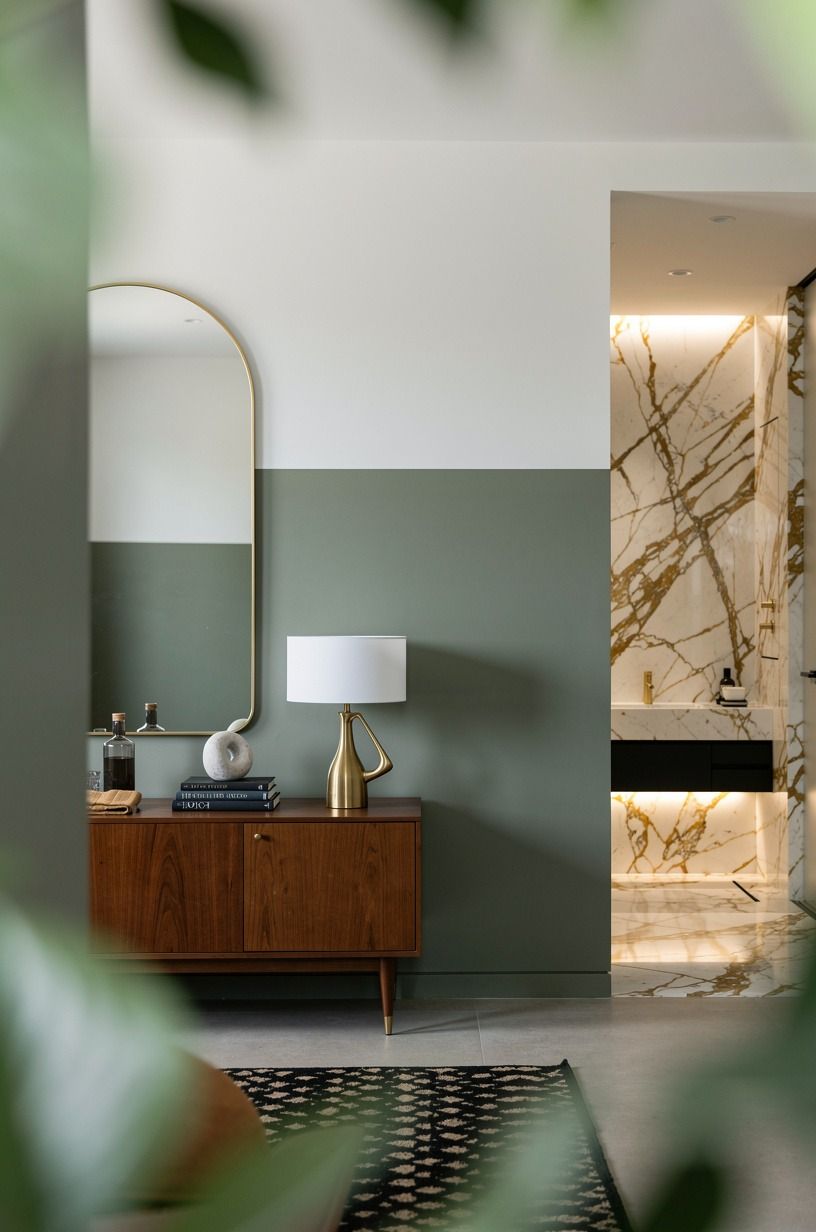
If a full green wall feels too much, do a 60/40 split: 60% warm white on the bottom half of the wall, 40% green on top, divided by a thin unlacquered brass or black picture rail. A Calacatta-look marble counter or shelf nearby picks up the gold veining so the whole room reads as one palette instead of two paint cans.
The 60/40 ratio is what designers reach for because the human eye reads the lower band as the “ground” of the room and the upper band as the “sky.” Both bands feel contained, neither feels like a ceiling dropping or a floor rising. The rail is the move that ties them together. $30 to $80 for paint and rail, a weekend of work, and you’ve got the boutique-hotel effect without a contractor.
14style the vanity tray like a small still life
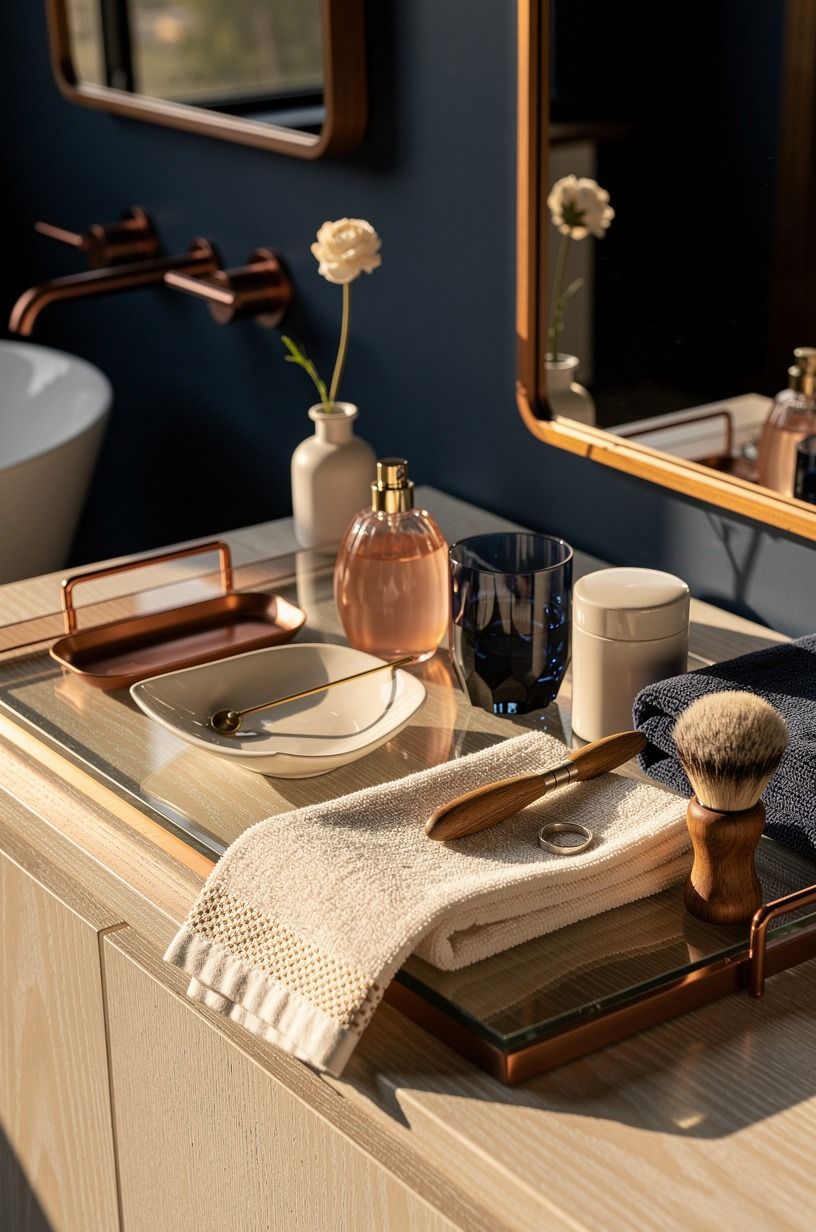
A small tray on the vanity counter, three objects only: a cerused white oak tray, a midnight blue ceramic soap pump, a glass jar with cotton rounds, and a single candle in a copper vessel. That’s the whole arrangement. The tray creates order, the objects create warmth.
The tray itself runs $30 to $90 for cerused white oak (try Etsy, or a vintage brass one on Facebook Marketplace for under $30 and swap the metal story). Skip the matching bathroom set from Target, it reads as “starter bathroom” every time and the deeper palette will fight it.
Less stuff, more intention. Trust the tray, every single time!
This is the rule I keep coming back to in every room, and the bathroom is no different.
15swap the shower curtain for sage linen
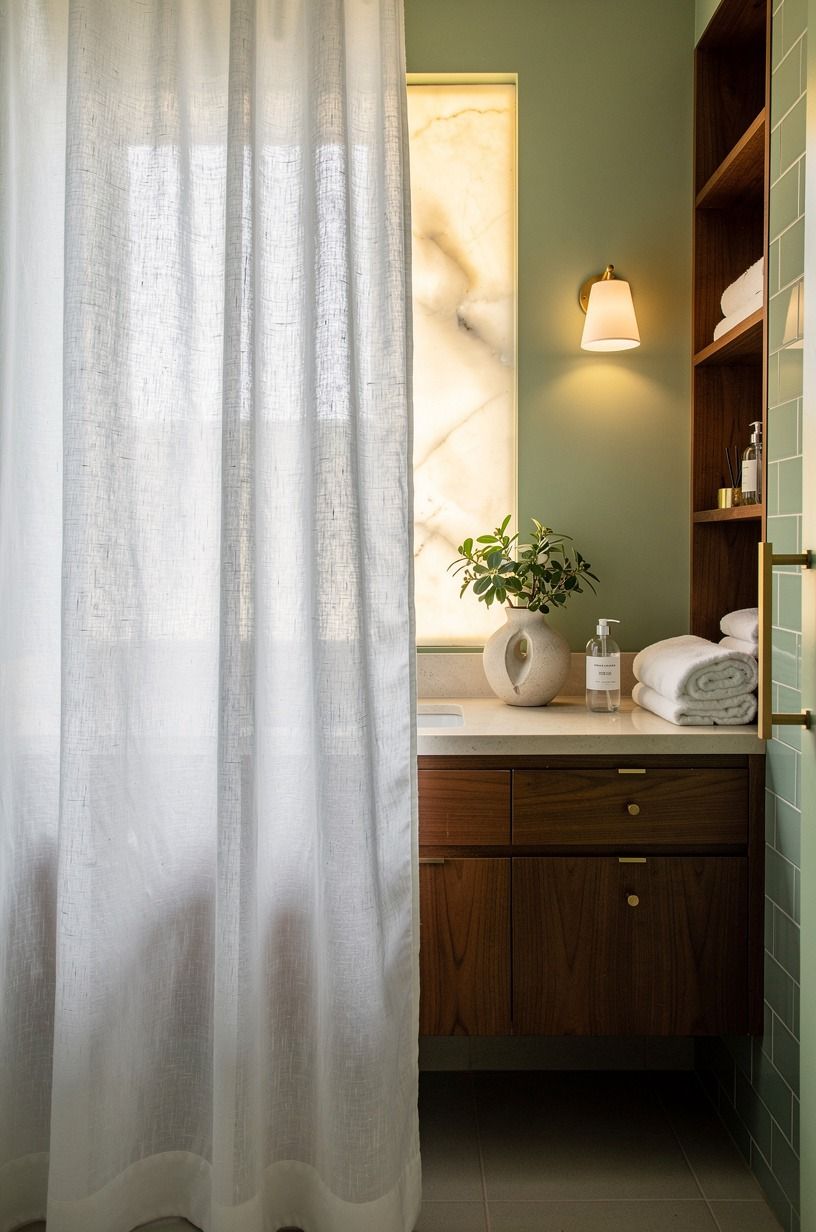
A linen shower curtain in sage green, warm cream, or natural moves the eye up and makes the room feel cleaner than a busy patterned one. The texture catches light without shouting. A backlit translucent onyx alcove or shelf beside the tub turns the corner of the curtain into a soft glow as the light bleeds through the stone. $80 to $200 for a quality linen curtain, and it lasts years.
Hang it high (within 6 inches of the ceiling) and wide (extending past the rod’s returns) so the curtain frames the tub instead of bunching in the middle. The visual upgrade is twice what you’d expect.
Pair with a simple brass or black rod, and you’ve got a shower zone that looks like it costs four times what it does. For more white-pairs-with-green context, our black-and-white bathroom combo guide shows why crisp contrast always wins, and the dramatic dark green and black piece takes the contrast deeper.
16Does one real art piece really change the room?
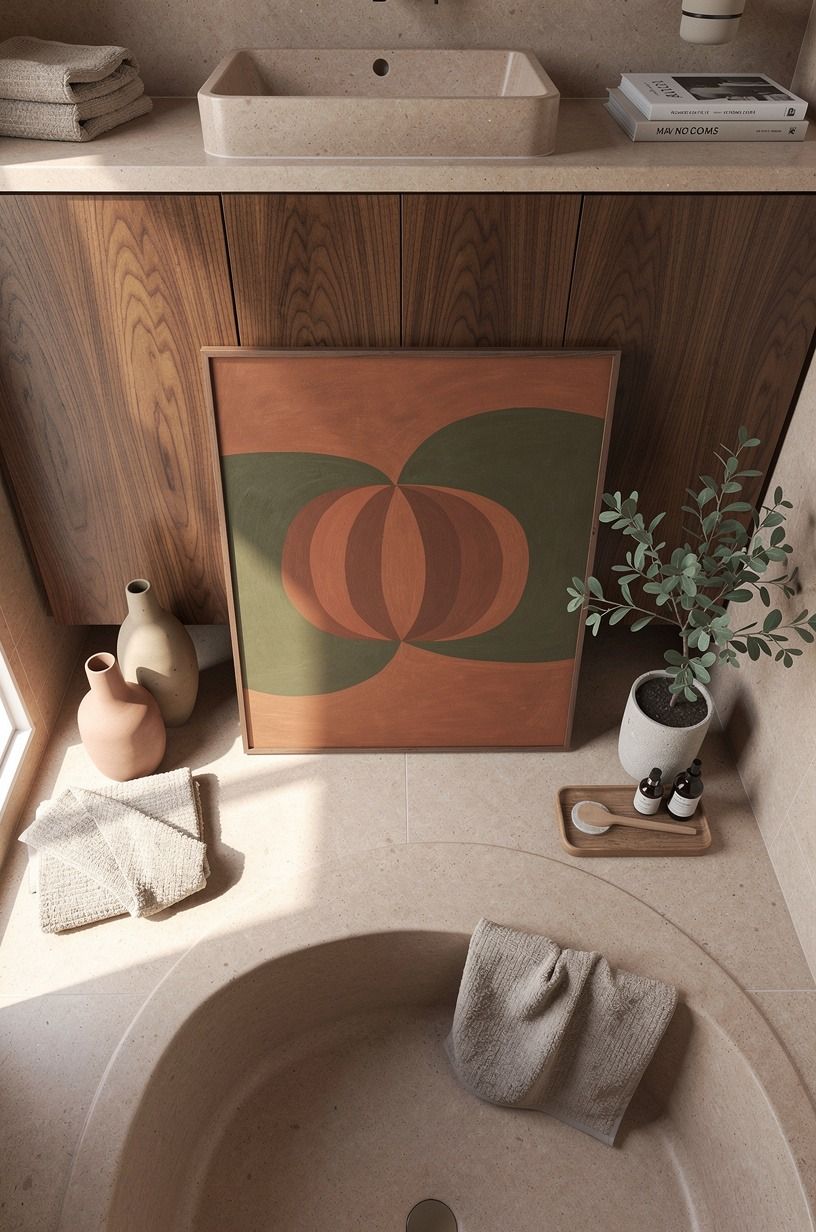
One piece of real art, framed in book-matched walnut and properly hung at eye level against a terracotta wall with a stone ledge below, is the difference between a styled bathroom and a furnished one. A small olive branch in a clay vase keeps the palette honest.
If you’re picking art for a bathroom specifically, choose a print or original with a moisture-resistant frame backing, and rotate the piece seasonally so the room doesn’t go stale. A single 11-by-14 piece hung at eye level reads as a deliberate composition; three small frames turn into a dorm wall.
One piece, one frame, one wall. That’s the brief.
What things cost, in real numbers
Before you start opening tabs, here’s the honest price breakdown I’ve seen across a dozen bathroom refreshes:
A few specific line items to plan around:
You don’t have to do everything at once. Most of my clients start at the Budget tier and add one Mid-tier upgrade per year until the room feels done. The vanity height you want to hit is 32 to 36 inches (81 to 91 cm) for comfort, with at least 21 inches (53 cm) of clearance in front of the toilet.
Standard tubs run 60 by 30 inches, and a comfortable shower is at least 36 by 36 inches. These dimensions are where the room works day to day.
Why dark green and white is having a moment
Two trends are converging. First, the all-white “spa” bathroom started reading as cold and corporate after a decade of dominance, and designers reached for color.
Dark green was the obvious warm-but-grown-up choice. Second, the broader return to warm woods and unlacquered brass makes green look intentional instead of decorative. The look photographs well, holds up against the white-trim trend cycle, and works in rentals if you pick no-damage moves.
That’s why it’s stuck around longer than the sage-green-everything wave of 2022.
If you only do one thing, start here
If I had to pick one move, I’d start with the green wall. Everything else you do after will lean into it, and you’ll waste less money guessing.
Farrow & Ball Studio Green is the safe bet, but Benjamin Moore Essex Green HC-188 reads warmer if your bathroom gets cool afternoon light. A gallon and a Sunday is the whole commitment, and you’ll know within an hour if it’s the direction.
The Questions I Get Asked Most
What is the best dark green and white bathroom combo for a small bathroom?
For a small bath, go with one green accent wall and skip the all-green treatment. Farrow & Ball Studio Green on the wall behind the vanity, paired with white oak shelving and brushed brass hardware, reads bigger than an all-white version because the contrast gives the eye a place to land.
Keep the ceiling and trim bright white, and stay away from dark grout lines. Small rooms need every photon of bounce light they can get, and dark grout eats it.
Where can I buy dark green and white bathroom pieces on a budget?
IKEA for the vanity base and mirrors (look at the HEMNES and TONSTAD lines), Target Threshold for hardware and textiles, and Wayfair for the brass faucets if you can wait for a sale. For vintage brass frames and trays, Facebook Marketplace and thrift stores are where I’ve found the best unlacquered pieces for under $30. Skip Amazon for bathroom hardware if you can, the quality variance is real and you’ll be replacing it in two years.
How much does a dark green and white bathroom makeover cost?
Honestly, anywhere from $200 to $30,000 depending on how far you go. A cosmetic refresh (paint, mirror, faucet, textiles) runs about $200 to $1,200. A mid-range redo with a new vanity, partial wall tile, and lighting lands around $3,000 to $9,000.
A full re-tile and plumbing job starts near $12,000 and climbs. Most of my clients land in the budget-to-mid tier and get 80% of the look.
Can I create a dark green and white bathroom on a budget?
Yes, and you can do most of it for the cost of a dinner out. Free: reorganize what you already own and remove everything that doesn’t earn its place.
Cheap ($40 to $80): one tin of dark green paint and a weekend. Cheaper still ($20 to $40): swap cabinet pulls for brushed brass versions, and rehang your mirror with a thrifted frame.
None of these moves require a contractor. If you want a deeper dive on no-renovation refreshes, our hidden storage in small spaces guide walks through the same budget playbook.
Is dark green and white bathroom worth it in a small space?
Worth it, yes, especially in a small space. The contrast makes a tight room feel designed instead of cramped.
The move is keeping the green on one wall only (a feature wall behind the vanity or the shower) and keeping every other surface light. A small bathroom with Farrow & Ball Studio Green on one wall and white everywhere else photographs bigger than an all-white version.
Trust the contrast, it’s doing the work for you.
Is dark green and white bathroom a good idea for a rental?
Yes, with a few no-damage swaps. Peel-and-stick wallpaper in dark green botanical or palm patterns gives you the green without the security deposit hit.
A tension rod for the shower curtain leaves no holes. Removable hooks for towels and robes instead of drilled hardware.
And a large framed mirror leaned against the wall instead of mounted. I’ve helped three renters pull off the look in the past year, and all three got their deposits back.
For a deeper look at rental-friendly bathroom moves, our rental bathroom refresh guide covers the same principles.
Where I’d Start First
If I had to pick one, I’d start with the green wall. You can’t layer warmth on top of a cold room, the brass, the wood, the art will all fight it instead of building on it. Get the green right first.
Everything else lands.
The One I’d Do Tonight
Paint the wall behind your vanity. One tin of Farrow & Ball Studio Green, a roller, a Sunday afternoon, and you’ve moved the whole room from “starter bathroom” to “I thought about this.” It’s the cheapest move with the biggest payoff, and you can roll it back to white in a weekend if you change your mind. Start there, then layer the rest.