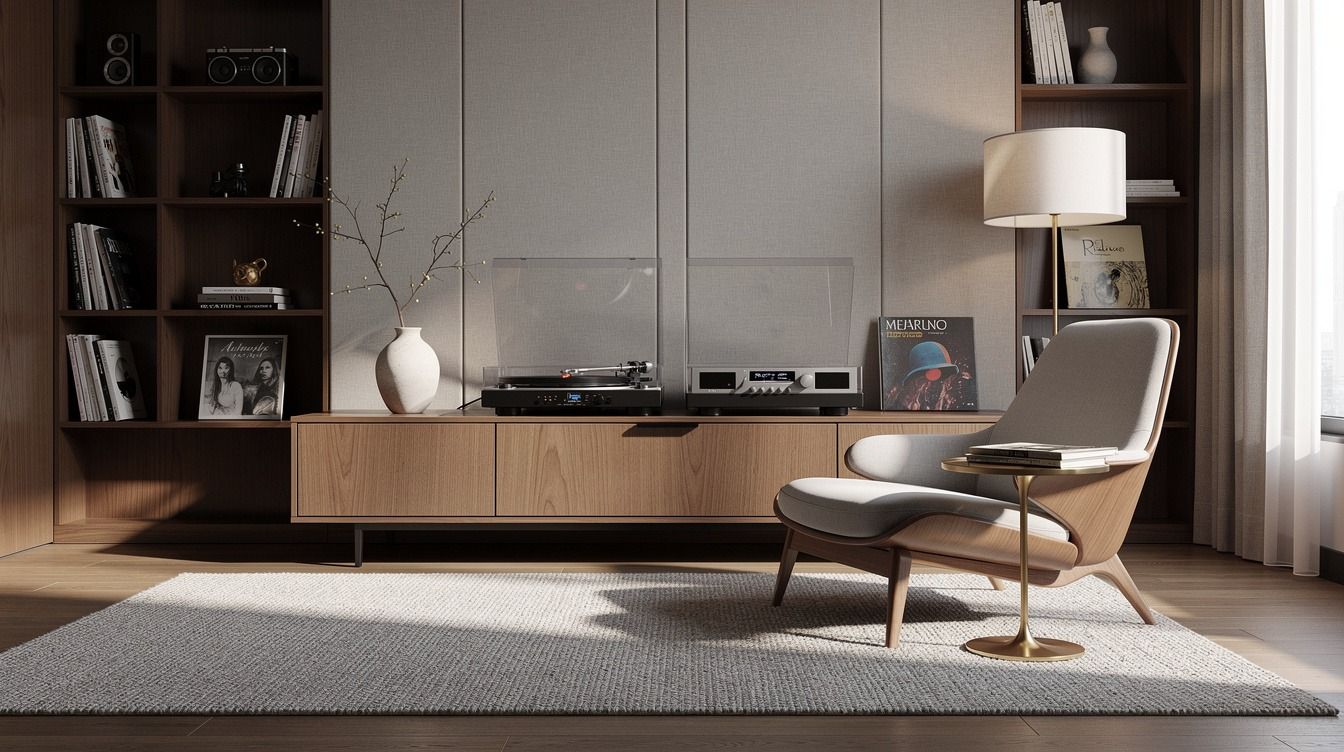
Vinyl listening room ideas for audiophiles work best when your room supports the ritual, not just the gear. I once packed my turntable against a bare wall and blamed the speakers for every sharp cymbal. Wrong culprit. Your records need softness, clear sightlines, and a seat you’ll stay in long after side A ends.
Don’t overthink: Build the Three-Source Rule for a Hi Fi Room.
- Float the Turntable Zone (The Quiet-Edge Method)
- Build the Three-Source Rule for a Hi Fi Room
- Layer a Wool Rug Beneath the Listening Chair
- Paint the Back Wall in Farrow & Ball Pigeon
- Let Record Sleeves Become the Rotating Gallery
- Choose a Low Seat That Keeps You Listening
- Use Curtains to Soften the Glass Without Hiding It
- Skip Matching Speakers for a More Lived-In Look
- Create a Record Flip Station Beside Your Chair
- Hang a Textile Behind the Speakers Instead of More Art
- Make Benjamin Moore White Dove Work Harder
- Anchor the Room With One Honest Storage Wall
- Budget the Listening Room Before You Chase Equipment
- Frame the Hi Fi Vintage Corner With a Bar Cart
- Turn the Last Wall Into a No-Screen Listening Nook
1Float the Turntable Zone (The Quiet-Edge Method)
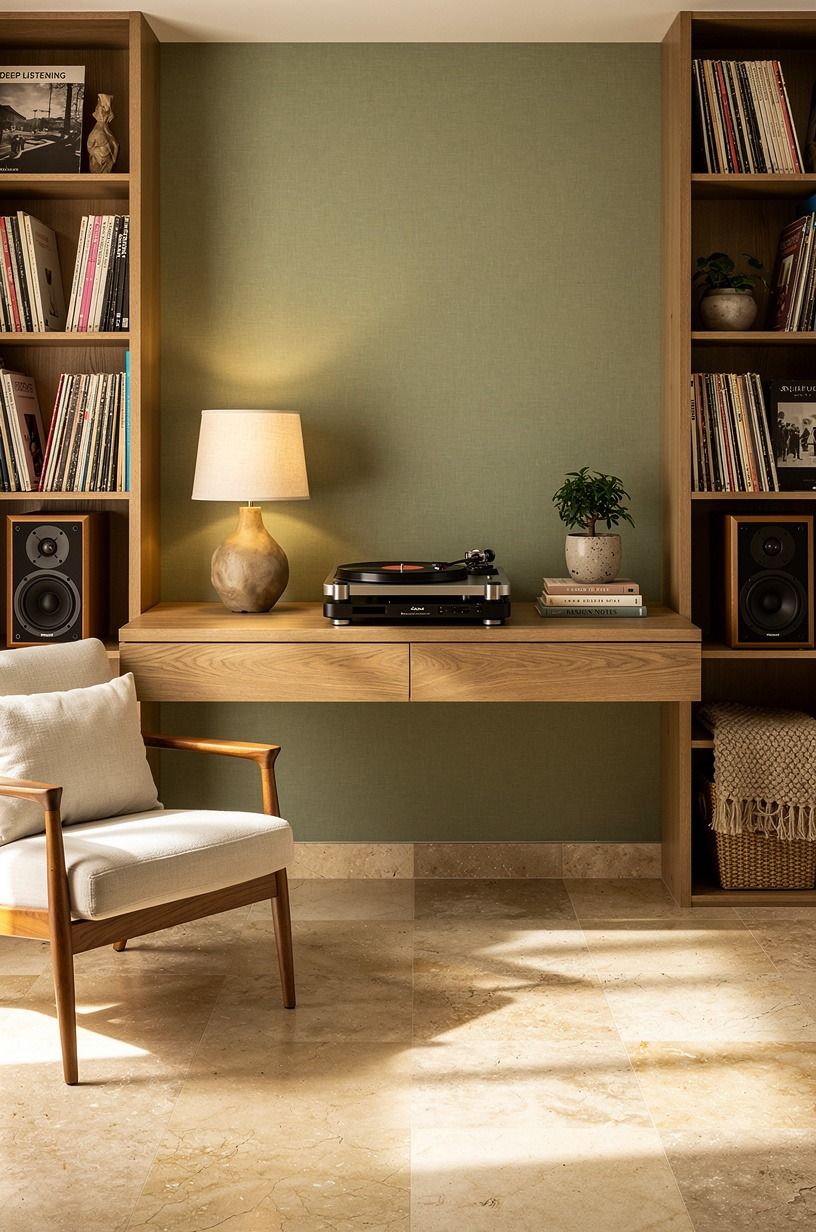
Pull your turntable console away from the busiest path so you aren’t brushing past the needle every time you cross the room. You’ll hear less accidental vibration, and your setup will feel intentional instead of parked.
Choose a warm travertine console with closed storage below and breathing room around the amplifier. I’d skip a flimsy open cube here. It looks airy, sure, but your records collect dust and the cables become the whole visual story.
A small lamp beside the records, one framed sleeve, one ceramic dish for the brush. Sage green, warm cream, and natural wood keep the vinyl listening room aesthetic from feeling too precious.
Typical cost by tier (US averages):
2Build the Three-Source Rule for a Hi Fi Room
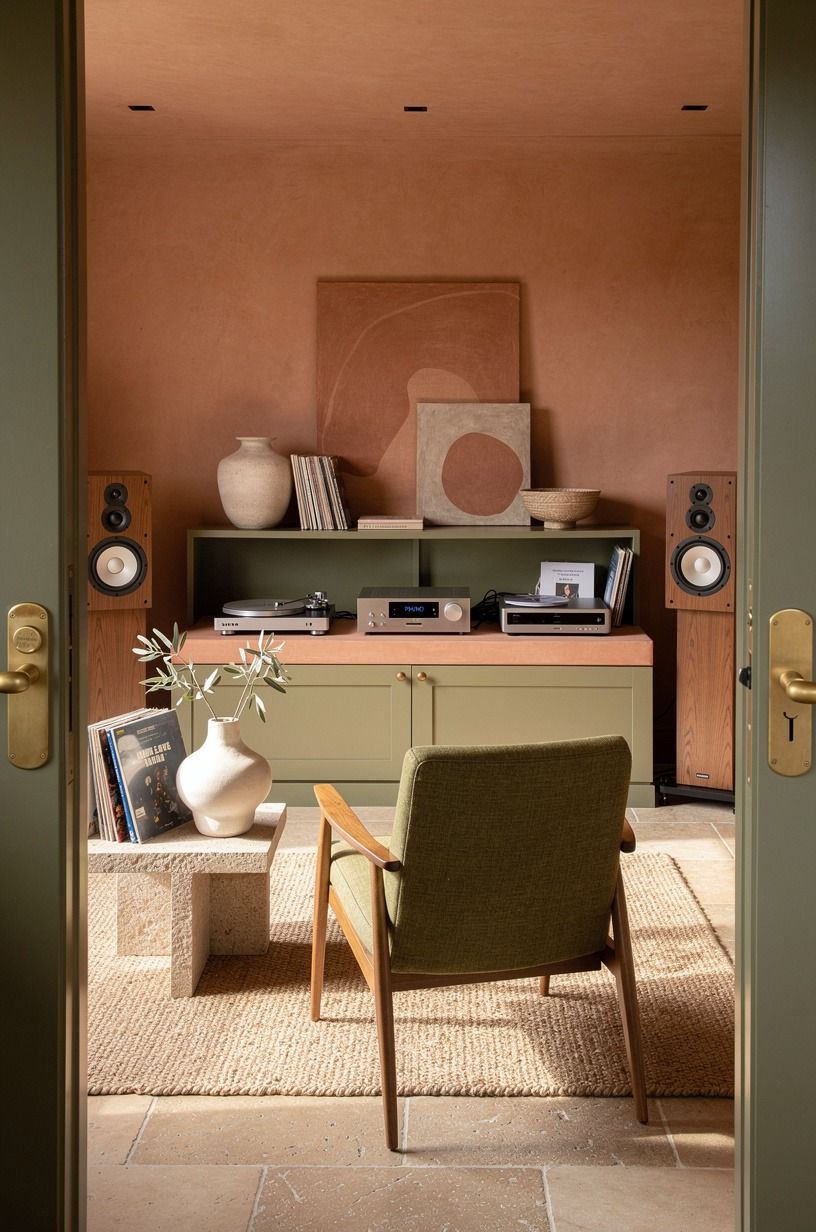
Use three sources of light: overhead, task, and ambient. A terracotta, stone, and olive scheme gets much richer when an unlacquered brass lamp is allowed to develop its own patina instead of looking newly unboxed.
3Layer a Wool Rug Beneath the Listening Chair
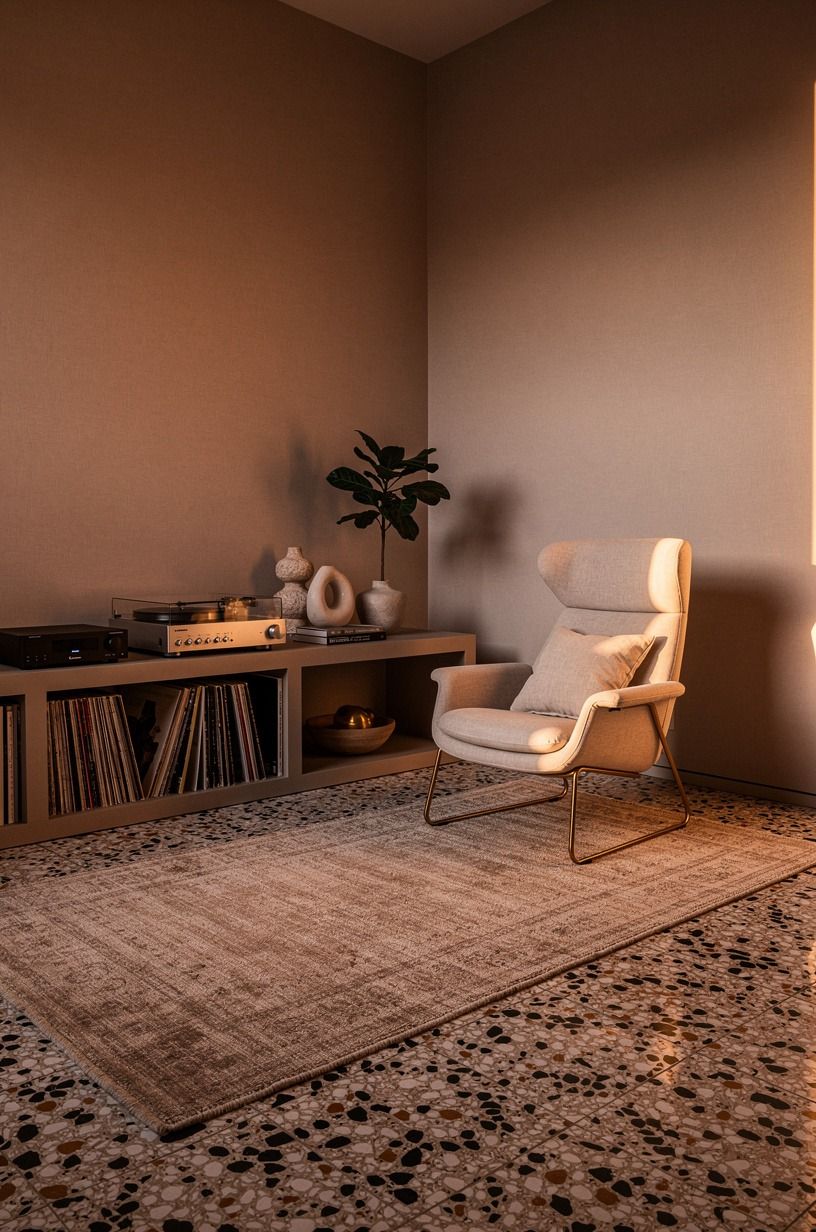
A wool rug gives your listening corner a softer, more grounded landing spot. Make it large enough that the furniture overlaps it, because a postage-stamp rug under only the chair makes your room feel chopped into little islands.
Try hand-knotted wool with a quiet pattern, not a loud geometric that competes with album art. Pair it with an oversized-chip terrazzo table or plinth so the clay, linen, and aged-brass tones still have something crisp to push against.
I’ve tried thin flatweaves under a serious setup. They’re practical, but they don’t hold the room together the same way.
– Faded rust and oat tones – A thick felt rug pad – One Article Sven tan leather chair at the edge
4Paint the Back Wall in Farrow & Ball Pigeon
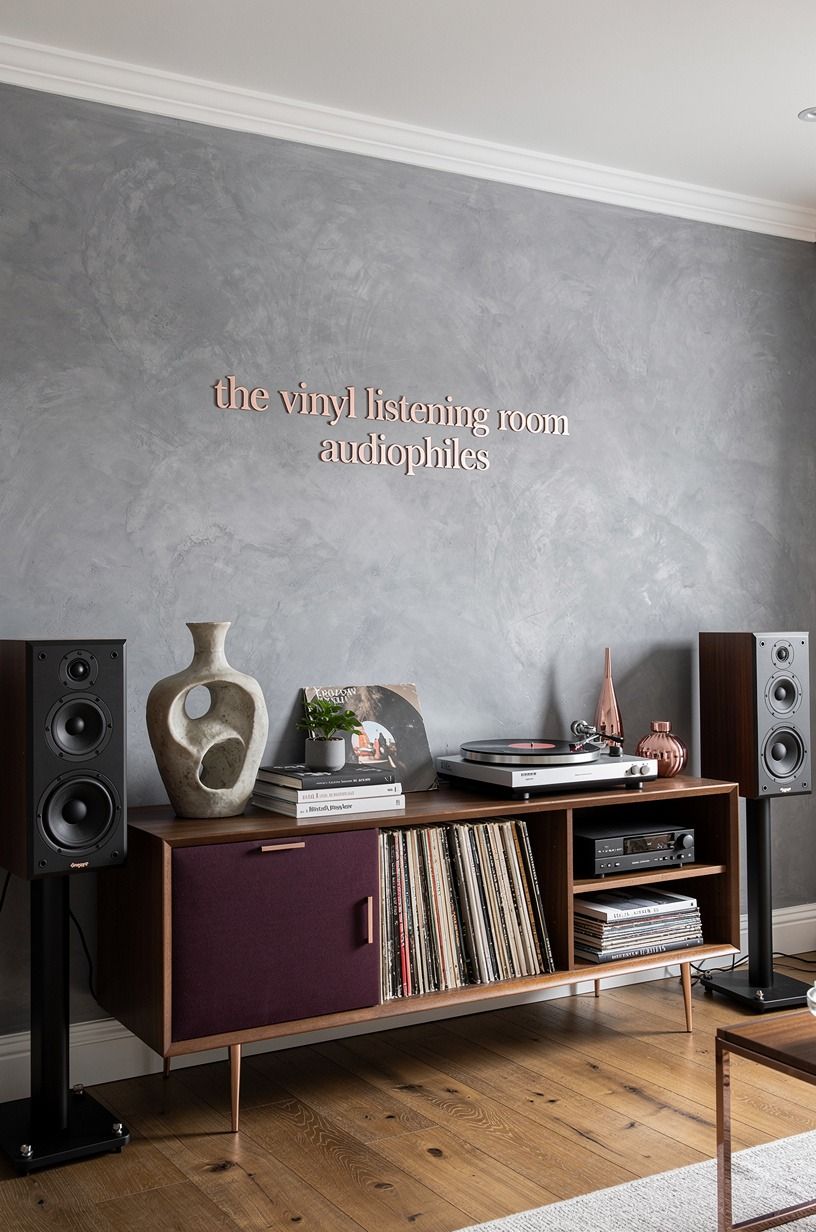
Give the wall behind your records some weight with Farrow & Ball Pigeon No. 25. If the room already leans plum and grey, a hand-applied Venetian plaster finish in a muted rose tone can bring softness without turning the wall into a flat block of color.
5Let Record Sleeves Become the Rotating Gallery
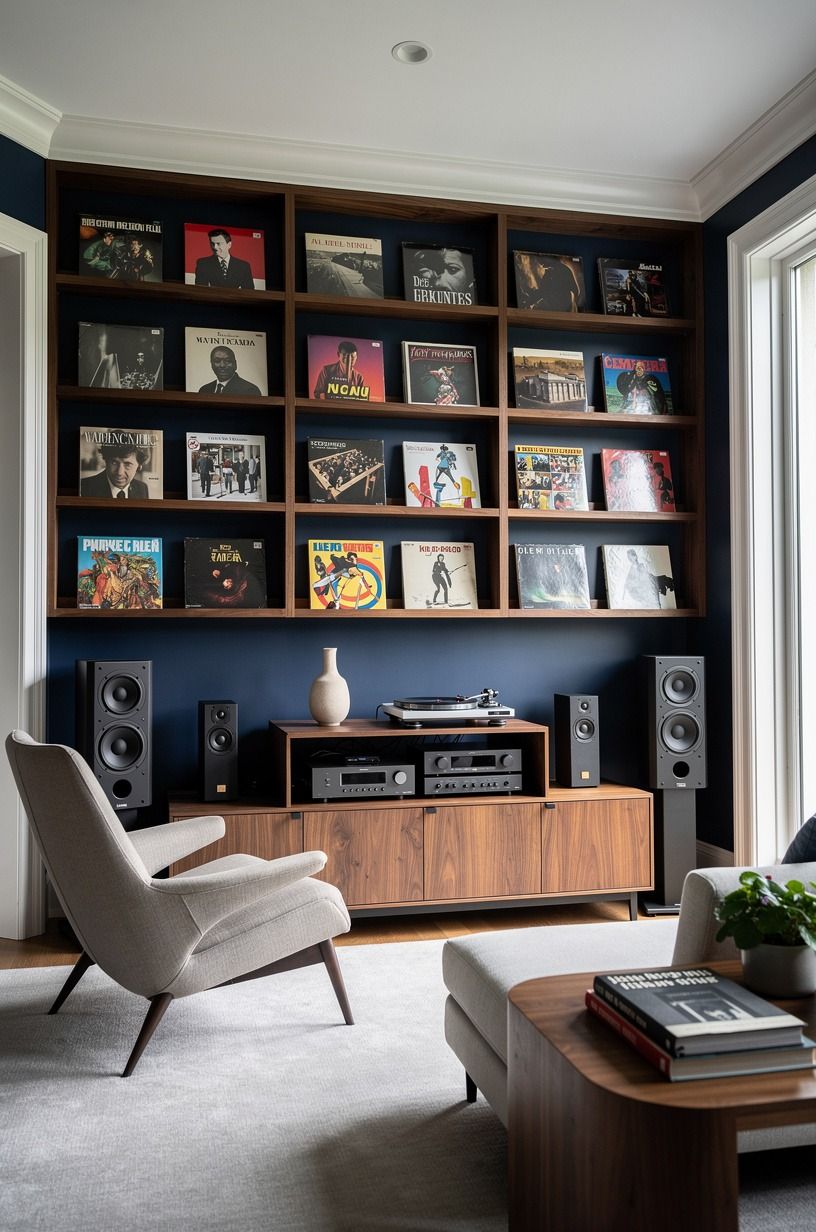
Hang the records you’re playing most often rather than hiding every sleeve in a cabinet. Your favorite covers can carry color through the room, and you’ll reach for music more when it’s visible.
Keep the art center about 57 to 60 inches from the floor. Use natural oak picture ledges instead of adhesive sleeves that curl at the corners, especially if you’re renting.
One sleeve. Then another. Leave some wall blank.
You don’t need to frame every album you own, and I’d avoid matching black frames. They make a living collection look like office signage.
Navy, white, walnut, and small shagreen accents give the display a more collected finish. These texture layers for a tiny room will help you add depth without crowding your walls.
6Choose a Low Seat That Keeps You Listening
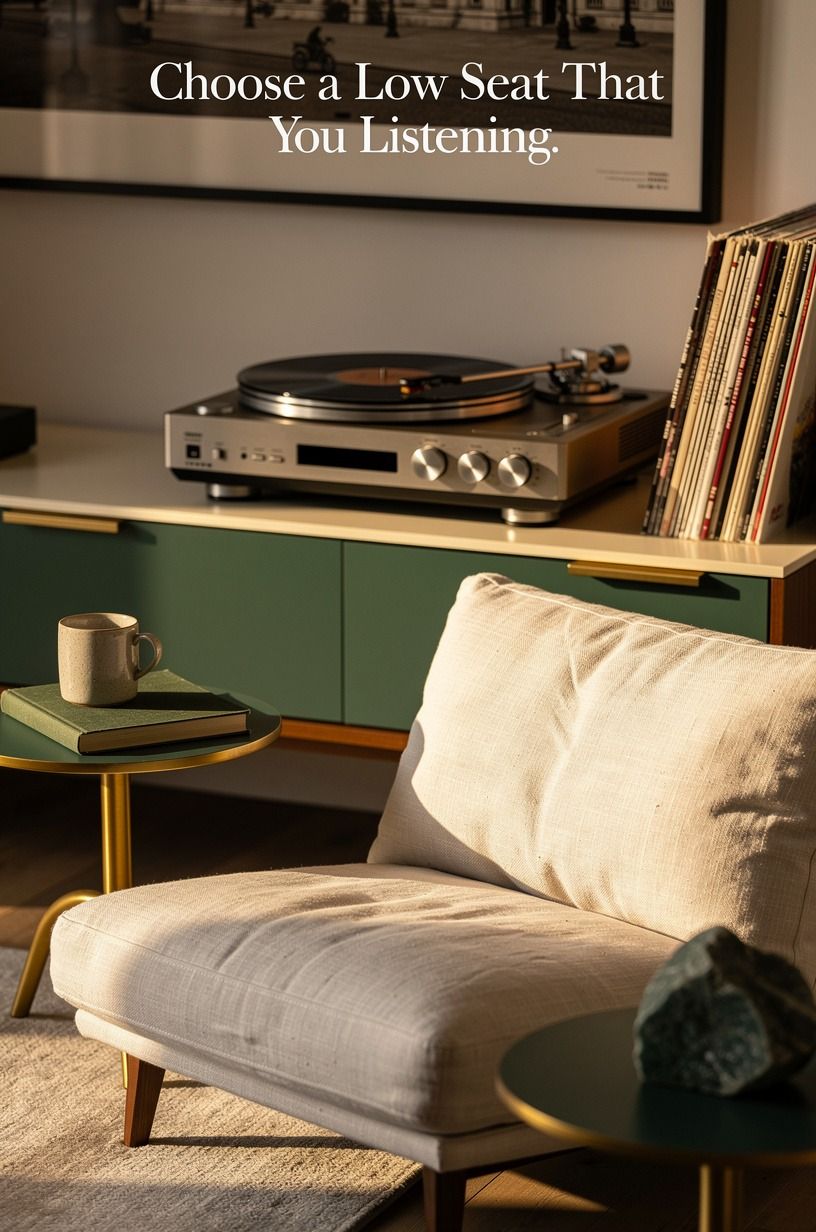
Your listening chair should invite stillness, not a nap you regret at midnight. A low, deep seat helps you settle into the music, but you’ll want an arm height that still makes flipping a record easy.
The CB2 Primitivo bouclé chair is a better visual fit than a giant recliner in most rooms. I’d skip the oversized recliner unless you’ve got a separate media room. Its bulk interrupts the speaker sightline, and suddenly your hi fi room feels like a den from another decade.
Put a washed Belgian linen lumbar pillow there instead. Emerald, gold, and cream keep the chair refined rather than puffy.

7Use Curtains to Soften the Glass Without Hiding It
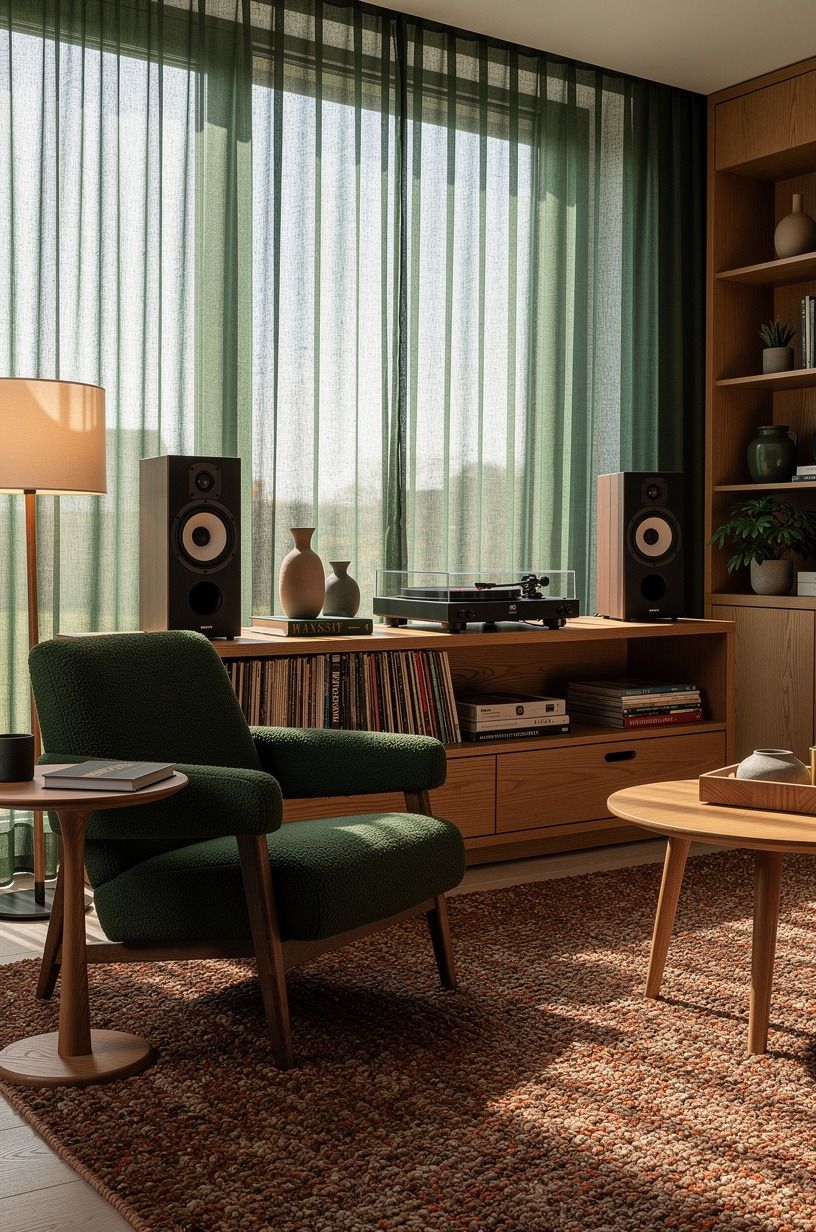
Mount the curtain rod 4 to 6 inches above the window frame and take the panels all the way to the floor. Forest green, rust, natural oak, and an organic bouclé panel add softness while letting the room keep its daylight.
8Skip Matching Speakers for a More Lived-In Look
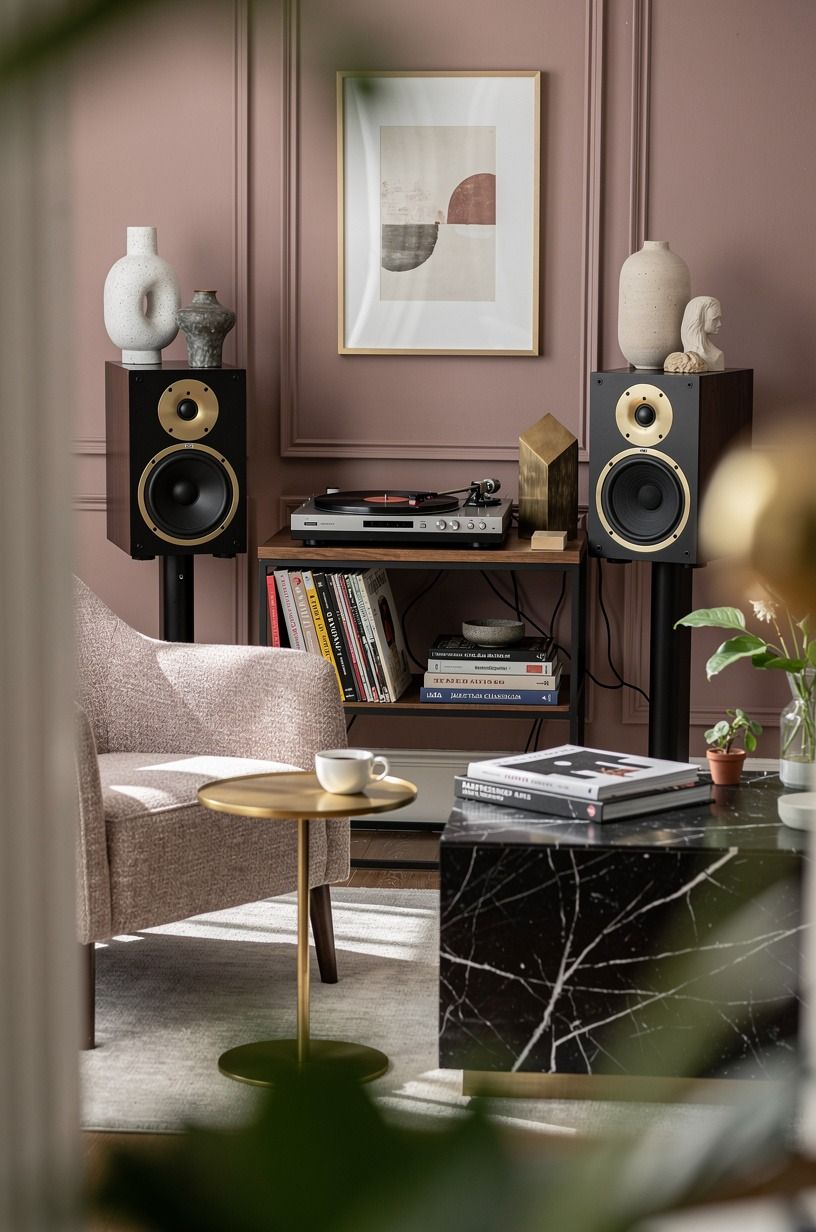
Matching every surface to your speakers is the fastest route to a showroom mood. Let the speaker cabinets stand apart from an oak console, then connect them through one smaller repeated note, like a Nero Marquina marble lamp base with its fine white veining.
That’s the Two-Wood Rule: two related wood tones, never five competing ones. Your eye gets variation without visual static.
I went back and forth on this in my own room because matching seemed safer. It wasn’t. Dusty rose, charcoal, and brass felt more collected, more personal, and a little less like I’d bought a package deal.
Your sofa may be making the room feel like a blocked hallway if it’s swallowing that contrast.
9Create a Record Flip Station Beside Your Chair
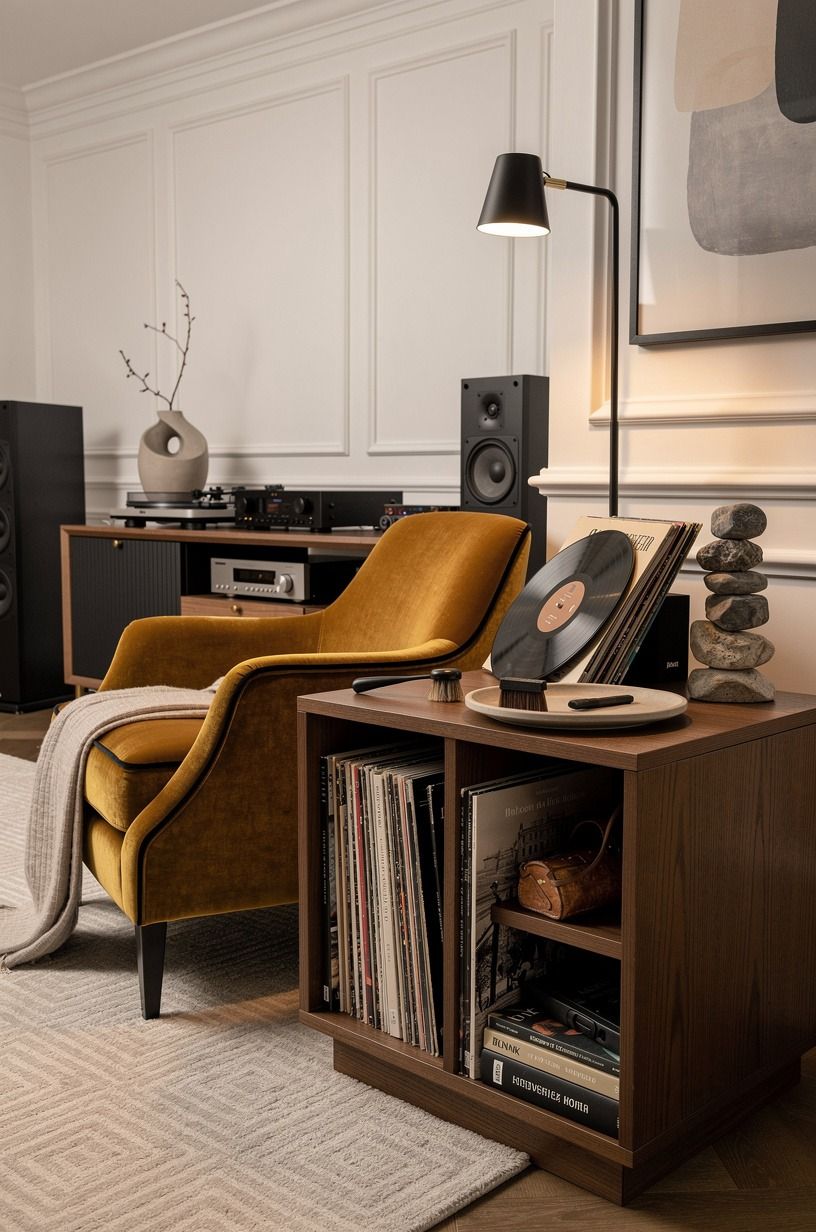
Put the records you’re playing this week within arm’s reach. You’ll keep the listening session moving, and you won’t stand up with the fragile sleeve balanced under your elbow.
A narrow IKEA KALLAX birch-effect unit works if you style the top with restraint. One small lamp. A deep-pile mohair velvet tray liner.
Your cleaning brush and a folded cloth. That’s enough.
Don’t stack records horizontally in a teetering pile. It looks casually cool for about ten minutes, then you’re fishing for a sleeve while the next track begins.
This is a small ritual, but it changes the room. Your music becomes easier to choose, which means you’ll use the setup more.
10Hang a Textile Behind the Speakers Instead of More Art
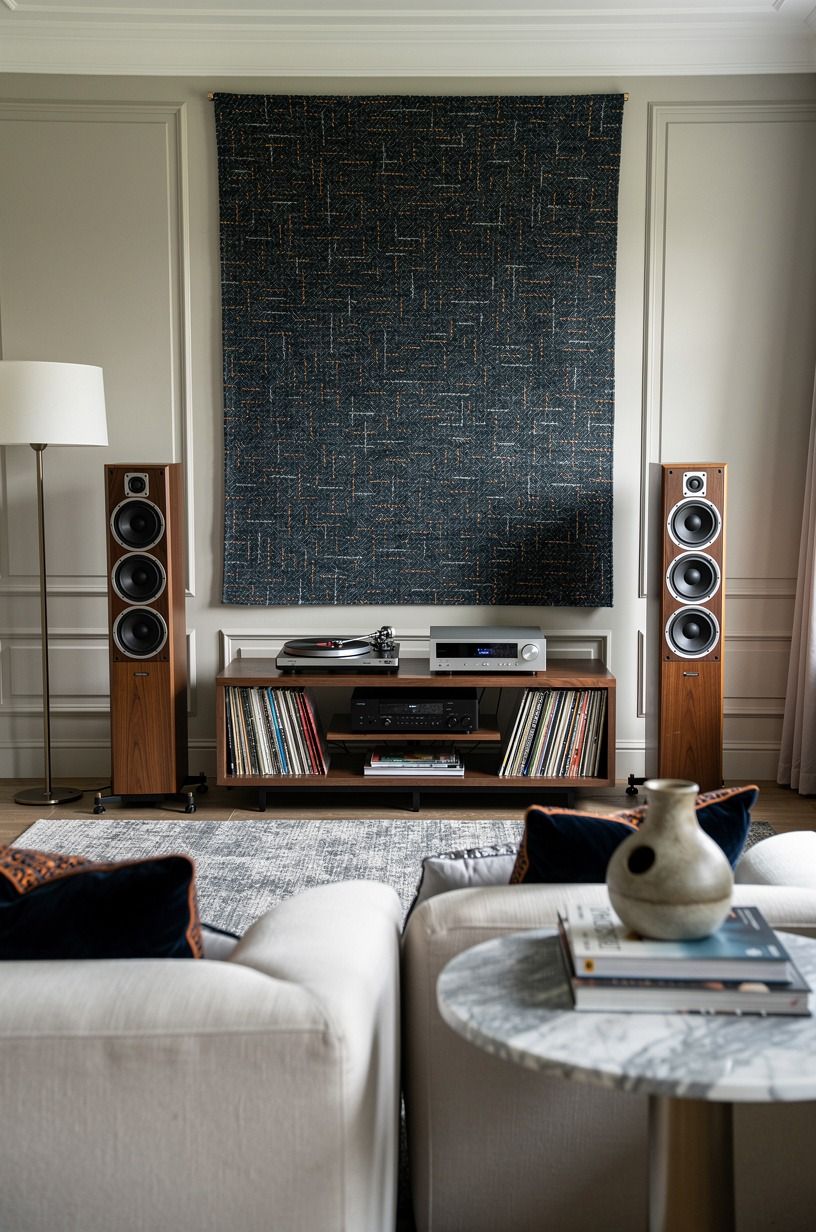
A textile behind the speakers can calm a blank wall without adding another hard, reflective framed surface. Your room gets warmth, and the speaker wall feels more intimate after dark.
Try a vintage Turkish kilim in midnight blue, copper, and ivory. I’d choose that over a huge abstract canvas for this exact spot. A small Carrara marble table nearby adds a pale counterpoint without making the listening wall into a visual argument.
Hang it with its center near the standard 57 to 60 inch range, then let the speaker cabinets sit slightly in front. Your setup will look layered, not pinned flat.
And if it feels a little odd at first, give it a week. Rooms need time to settle.
11Make Benjamin Moore White Dove Work Harder
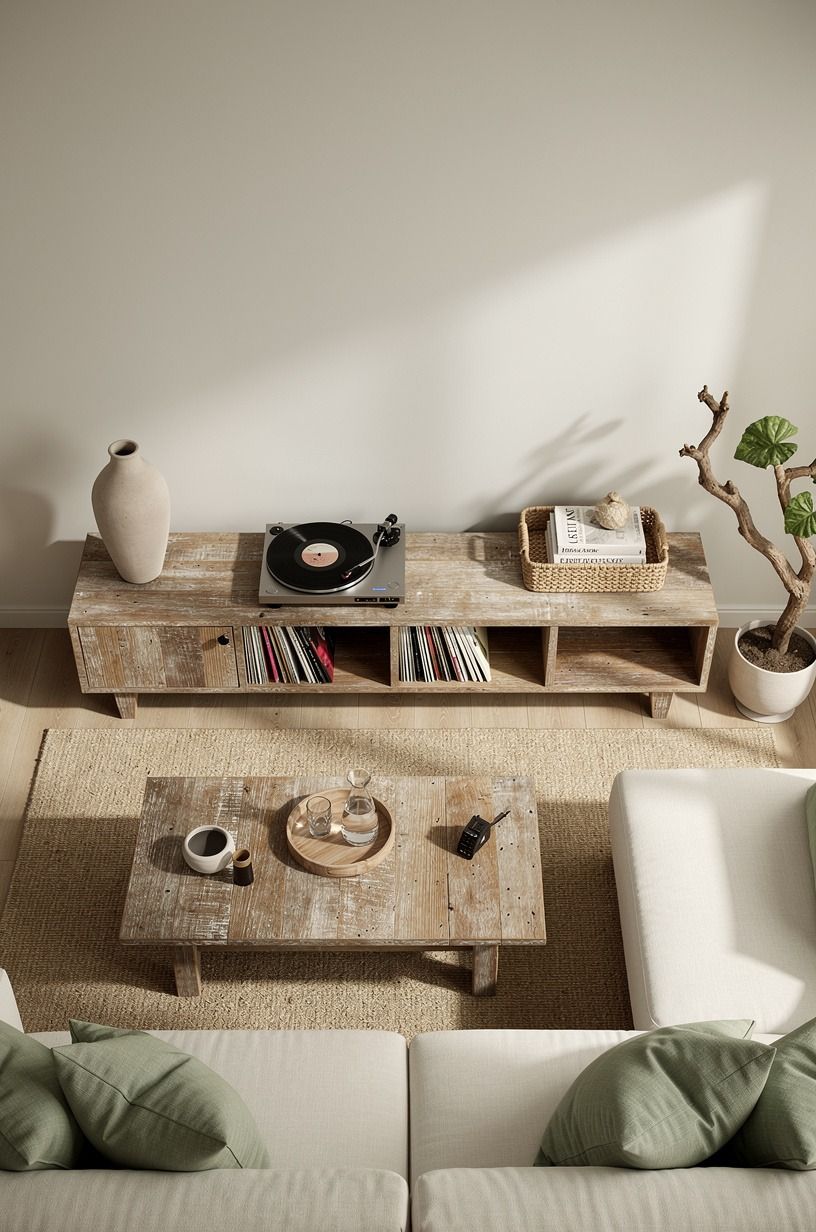
Use Benjamin Moore White Dove OC-17 on surrounding walls when your record area needs brightness but plain white feels too stark. You’ll get a warmer backdrop that lets black components recede instead of shouting at you.
Pair it with reclaimed, weathered teak shelving and a tobacco leather chair. Sage green, warm cream, and natural wood keep the contrast subtle, which is exactly why it works in an audiophile space where equipment already brings plenty of dark geometry.
I wouldn’t choose cool gray here. Sherwin-Williams Agreeable Gray SW 7029 can work in a sunny room, but it goes flat beside walnut and charcoal speaker cloth.
Warm walls. Dark music. No glare!
This tiny-room layout story is useful if your listening space shares a room with everything else.
12Anchor the Room With One Honest Storage Wall
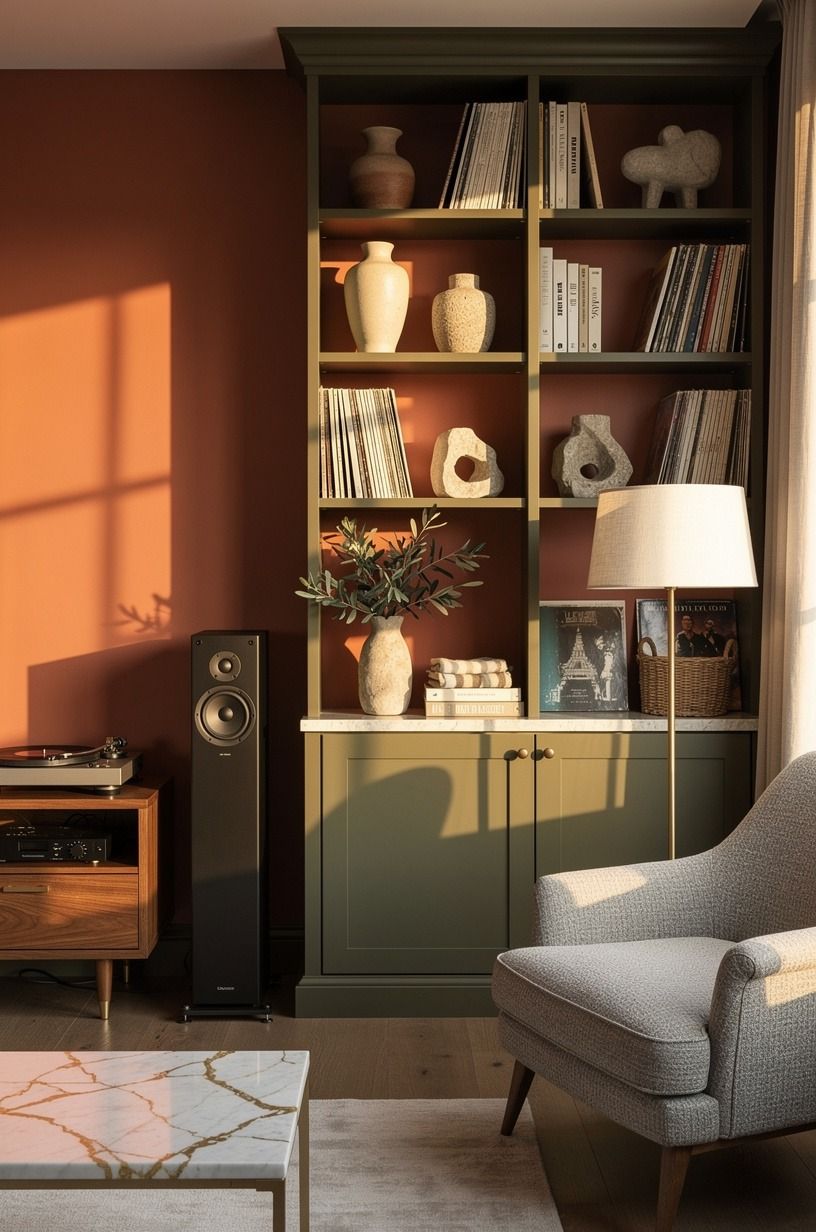
A full storage wall is worth doing when records, books, and components need a home. Your collection stays accessible, and you stop treating every open surface as overflow storage.
Use IKEA TONSTAD oak veneer units along the lower wall, then leave the upper half less crowded. A small piece of Calacatta marble with gold veining can lift the terracotta, stone, and olive palette without making the room feel overdone.
The best vinyl listening room ideas don’t hide personality. A few records facing outward, a stack of music books, an old concert ticket in a brushed brass frame. Enough story, not clutter.
What’s the point of a collection if your room makes it feel like paperwork?
13Budget the Listening Room Before You Chase Equipment
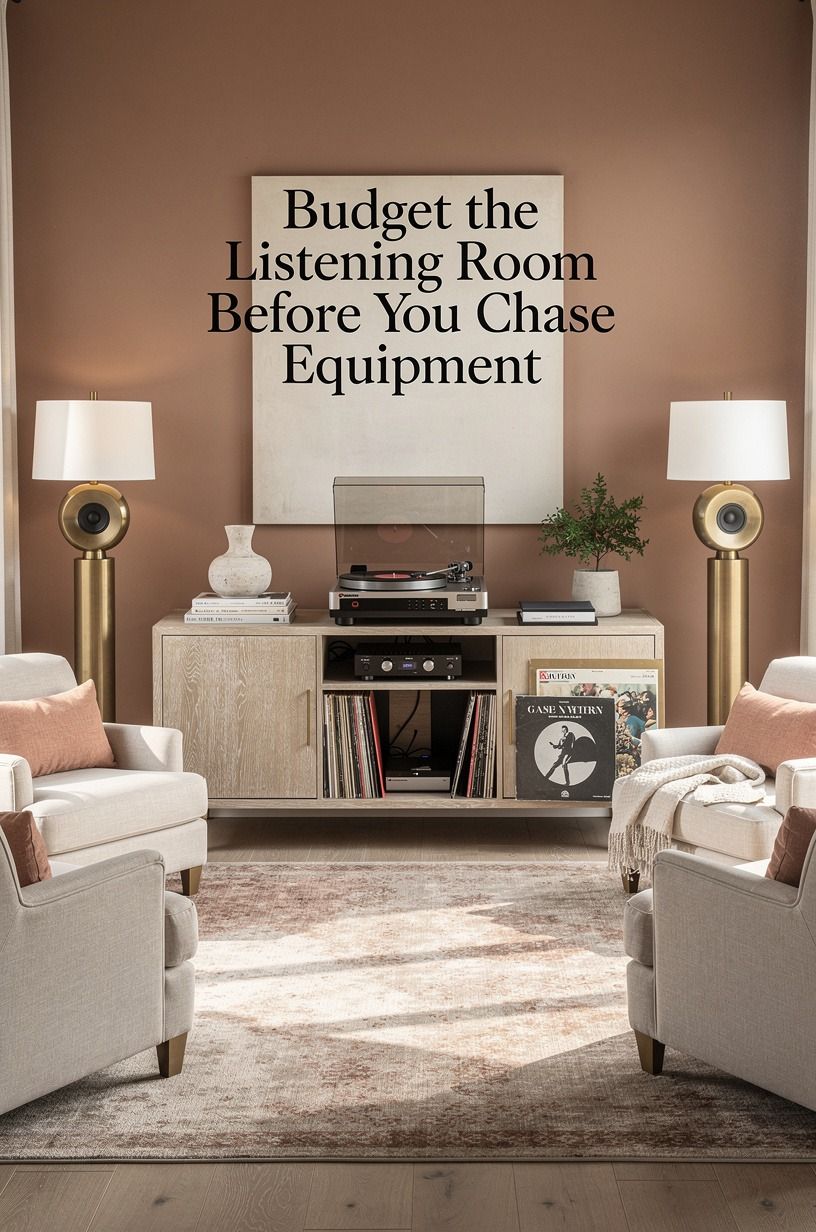
Start with the room’s practical comfort before you buy another object. Clay, linen, aged brass, and cerused white oak are the kinds of finishes that make a modest budget feel deliberate.
14Frame the Hi Fi Vintage Corner With a Bar Cart
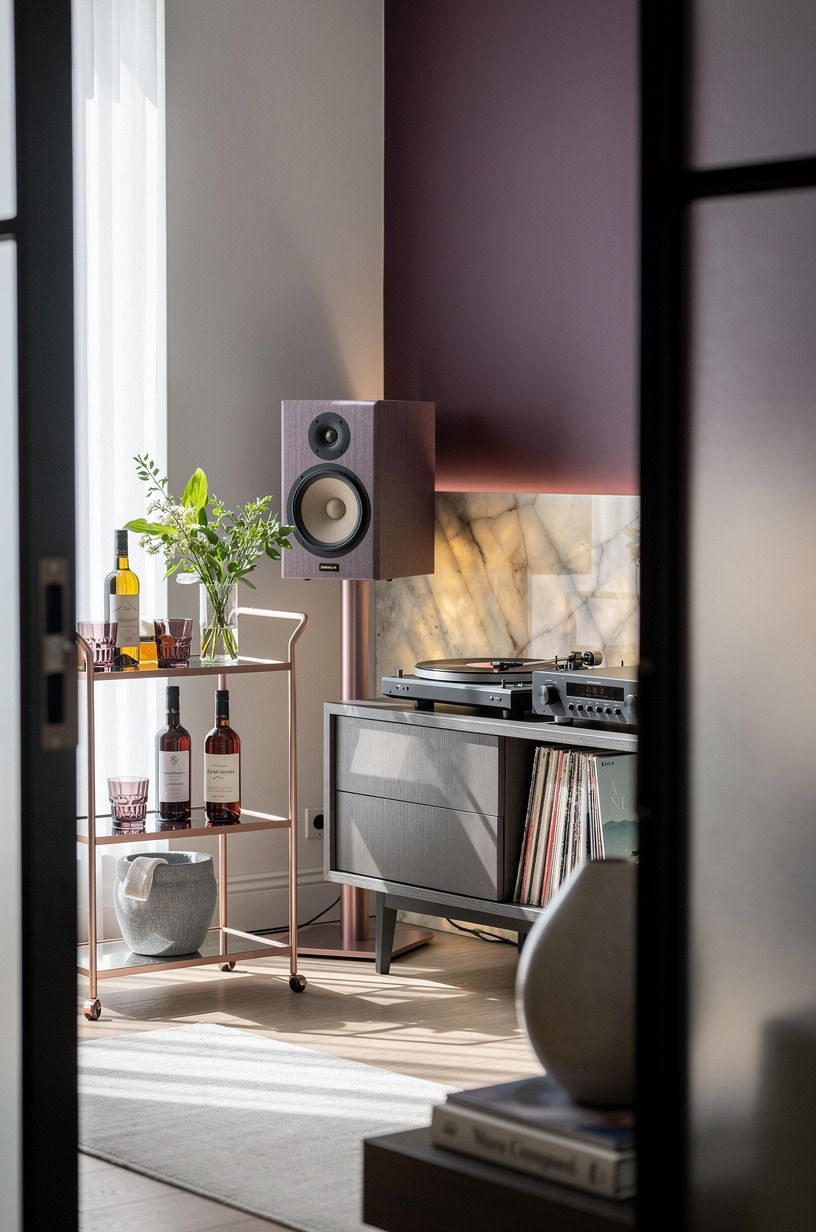
A bar cart beside a listening zone works because it gives your evening objects a place to land. Your drink, record brush, notebook, and lamp don’t migrate across the console where they can crowd the components.
Use a Target Threshold brass-and-glass cart beside a softly glowing translucent onyx lamp. Plum, grey, and rose-gold notes keep the corner moody without making it heavy.
I’d keep the lower shelf mostly empty. Bottles, cords, and miscellaneous tools packed together can make the whole corner feel fussy.
One carafe. Two glasses. A low ceramic bowl for sleeves.
This is where a room gets charming without trying too hard. And it’s renter-friendly, which matters if you can’t build in anything permanent.
15Turn the Last Wall Into a No-Screen Listening Nook
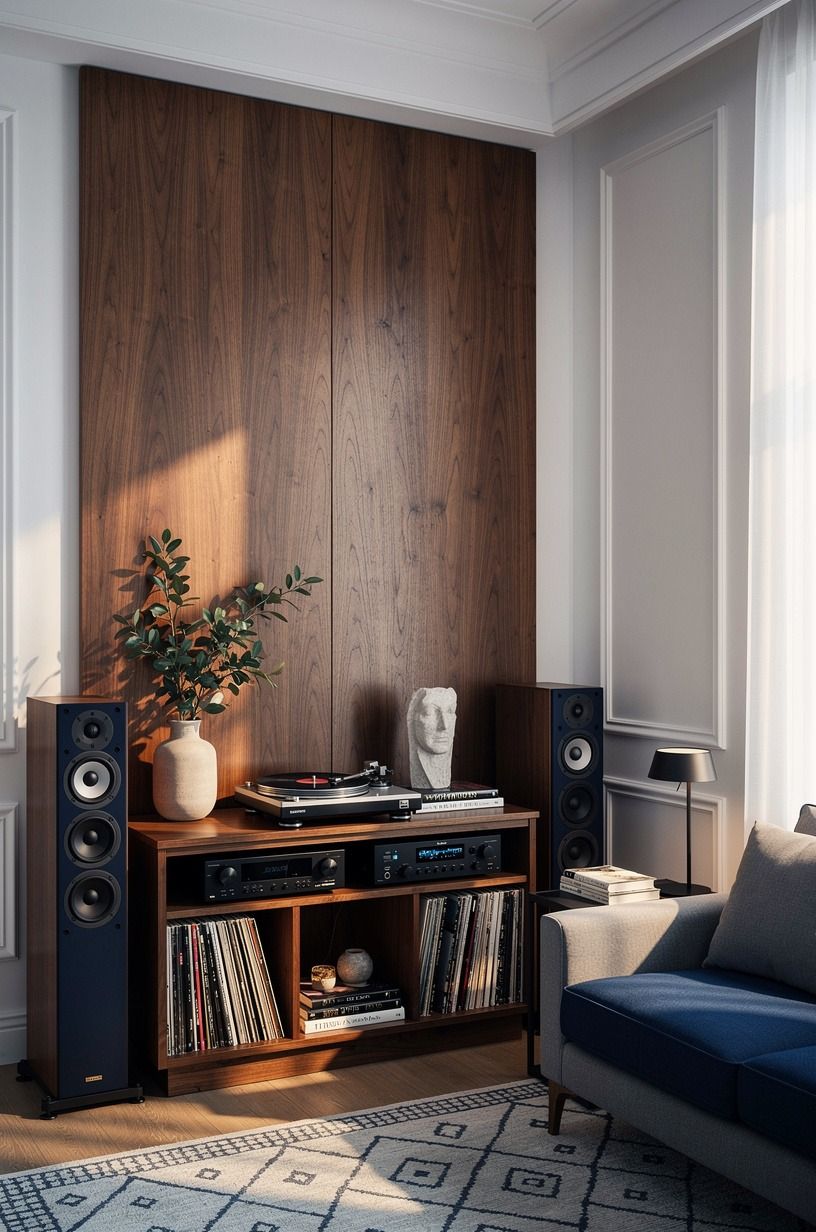
Give one wall a job that isn’t television. Your room will feel more peaceful when the turntable gets its own focus, and you may be surprised how often you choose records over background streaming.
Place your chair toward the speakers, with the side table close enough for a drink but not blocking your path. A book-matched walnut side table and navy-and-white layers add softness without demanding attention.
I’d choose a modest chair and a proper side table over a second sofa. More seating sounds generous, but it often makes a small vinyl room feel crowded and pushes everyone too far from the music.
A little restraint pays off. Big time!
If your Pinterest Nordic room feels cold because furniture is too big, this is the same lesson in another outfit.
Why a Listening Room Feels Different Once You Use It
I think the appeal of a dedicated listening room has less to do with nostalgia than people admit. We’re surrounded by sound that asks nothing of us: autoplay, clips, notifications, a television murmuring from another room.
Vinyl asks you to make a choice. You pick an album, take it from the sleeve, lower the needle, and accept that you can’t skip every quiet passage just because your attention twitched.
That’s why I don’t love the ultra-minimal version of this room. A spotless console and one designer chair can photograph well, but it doesn’t always invite a real Tuesday night.
Your listening room should show evidence that you use it. A record leaning by the chair. A worn spot on the rug.
A lamp that throws amber light only to the rug’s edge. Those details aren’t messy failures.
They’re proof.
I’ve also learned that expensive gear can’t rescue a room you don’t want to inhabit. I once focused on cables and components while sitting under one harsh overhead fixture on a stiff chair. The sound may have been accurate; the experience was miserable.
So I changed the lamp, added a rug, moved the chair, and kept the technical pieces where they belonged. The room finally asked me to stay.
Your goal isn’t perfection. It’s a room that makes playing one more side feel reasonable, even when you should probably be asleep.
The Questions Worth Answering First
What is the best vinyl listening room idea for a small vinyl listening room?
A compact console and one dedicated chair are the best start for a small room. IKEA KALLAX storage keeps records upright while a slim chair preserves your walking path. Keep your speakers visually clear, then borrow these small-room texture layers instead of adding bulk.
Where can I buy vinyl listening room pieces on a budget?
Look at IKEA, Target, and Wayfair for storage, lamps, and curtains. Facebook Marketplace and thrift stores are better for wood tables with real character. Your best buy is usually a sturdy used console, not a new decorative shelf that can’t carry records.
How much does a vinyl listening room makeover cost?
A basic refresh typically costs about $200 to $800. Paint, textiles, art, and organization make up that lower range, while a rug, chair, and lighting can push your plan into the $1,500 to $5,000 range.
Can I create a vinyl listening room on a budget?
Yes, and you don’t need a renovation. Better placement is free: move the chair, pull the console from traffic, and edit your shelves. Add thrifted curtains, a used lamp, and one soft textile before buying more furniture.
Is a vinyl listening room worth it in a small space?
Yes, a small room can make the ritual feel more intimate. A defined listening corner stops your setup from becoming clutter, especially if your chair faces the speakers and the storage stays on one wall. This studio layout guide can help you protect that path.
Is a vinyl listening room a good idea for a rental?
Yes, if you use reversible layers. Removable warmth comes from tension-rod curtains, peel-and-stick wall art, and freestanding storage. Skip permanent shelves, then let rugs and lamps do the visual heavy lifting.
Where I’d Start First
If I had to pick one, I’d start with the listening chair. Your body decides whether you’ll play another record, and a stiff seat makes even good sound feel like homework. Pin the chair idea for later and keep your room from feeling blocked.