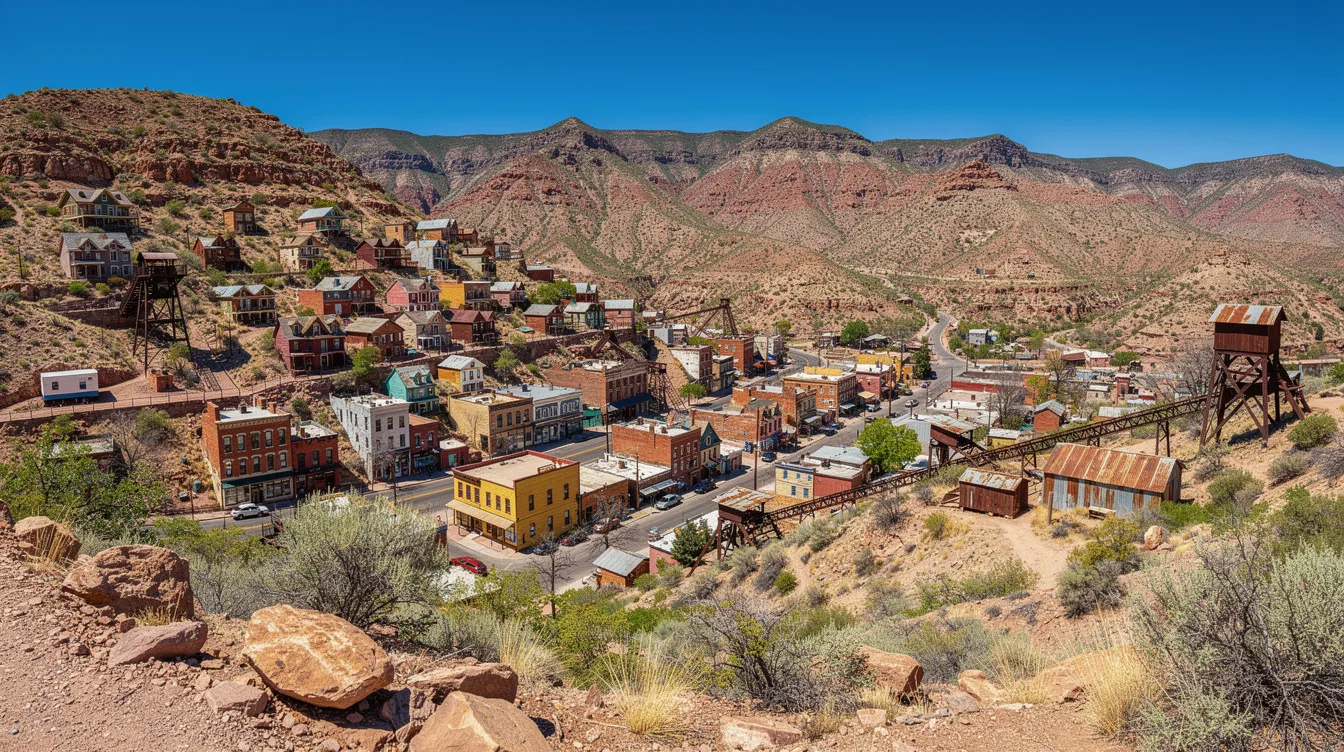
Bisbee began in 1880, after major copper, gold, and silver deposits were found in southeastern Arizona. That origin still shapes the town. Its old streets climb and turn through buildings that were built when mining set the pace.
You come here for a former mining city, but you stay because it refuses to feel like a museum set. The town is historic and a little odd, with galleries and cafés where industrial history still hangs in the air.
Bisbee sits in Cochise County, near the Mexican border and in the Mule Mountains. The setting matters because elevation gives it a milder climate than Arizona’s hotter desert cities, so it works as a year-round stop.
And this is a place with limits worth knowing. The streets are narrow and steep, which makes wandering rewarding but less simple if you want everything close and level.
1880 changed this corner of Arizona
The discoveries of copper, gold, and silver turned a mountain settlement into a major American copper center. For decades, Bisbee was one of the country’s important mining towns, and it was once the largest city between Houston and Los Angeles.
But the large-scale mining era ended when the Lavender Pit closed in the 1970s. That shift could have emptied the town. Instead, older buildings remained, and Bisbee became an artist community with a distinctly lived-in past.
Copper, gold, and silver are more than a story on a plaque here. They explain why the town’s commercial streets feel compressed into the hills, and why old construction gives every turn a sense of weight.
You don’t need to know mining history before arriving. Still, understanding that 1880 beginning makes the town’s present-day galleries and quirky shops feel less random, and more like a practical second act.
The old town is steep, close, and worth the climb
Bisbee’s old town has narrow streets, Victorian buildings, and early 20th-century storefronts. Cafés sit alongside art galleries and vintage shops, so an ordinary walk can become an afternoon of browsing.
And the uphill routes are part of the point. You’ll notice doors, stairways, and weathered façades at a slower pace because the grade asks you to stop now and then.
Old town feels lively, but never like a large Arizona city. The trade-off is clear: its close quarters create character, though travelers who dislike steep walking may want to keep plans flexible.
The preserved architecture gives Bisbee its strongest visual pull. Stone, brick, and old storefront details catch the changing light, while the streets keep revealing another small shop just around a bend.
Go underground to understand the town
Can you visit the mining past directly?
Yes. The Copper Queen Mine tour takes visitors underground with guides, offering a direct look at the industrial work that once defined Bisbee. It’s the clearest way to connect the town’s compact streets to the deposits below them.
But don’t treat the tour as the whole story. Above ground, the Bisbee Mining & Historical Museum covers local mining and frontier history, which gives the old buildings more context than a quick photo stop can.
You can make both stops part of the same day, then return to the streets with sharper eyes. The museum explains the history, while the mine tour puts you closer to its physical scale.
There’s a useful contrast in that pairing. One experience looks backward through objects and history, while the other brings you into the working world that shaped the town’s fortunes.
It’s close to Tucson, but it feels far from it
Bisbee is about 90.1 miles southeast of Tucson. It is also roughly 8 miles north of the Mexico border, which gives this corner of Arizona a different geographic feel from the state’s better-known desert cities.
And you don’t need a complicated reason to stop. Its mountain setting, preserved old town, and former-mining identity make it a solid destination when you want Arizona with more texture than a highway exit.
4,923 residents lived here at the 2020 census. That small scale keeps the town intimate, but it also means the pleasure lies in lingering rather than racing through a long checklist.
The climate is described as milder than desert cities because of the elevation. You’ll still want to plan around your own comfort, yet Bisbee is a sensible year-round choice when lower Arizona feels too hot.
Beyond Bisbee, the southeast opens up
Bisbee can anchor a wider southeastern Arizona trip. Tombstone, Coronado National Memorial, the Chiricahua Mountains, and Coronado National Forest are all nearby attractions named in local travel information.
But Bisbee has its own rhythm. You should give it time before moving on, because its appeal comes less from one grand sight and more from following streets that keep folding into the mountains.
The town’s mining years are over, and that absence is part of the atmosphere. What remains is architecture, art, and a small community that found another use for a hard-built place.
By late afternoon, the steep streets quiet down, and old façades hold the last dry light against the hills.