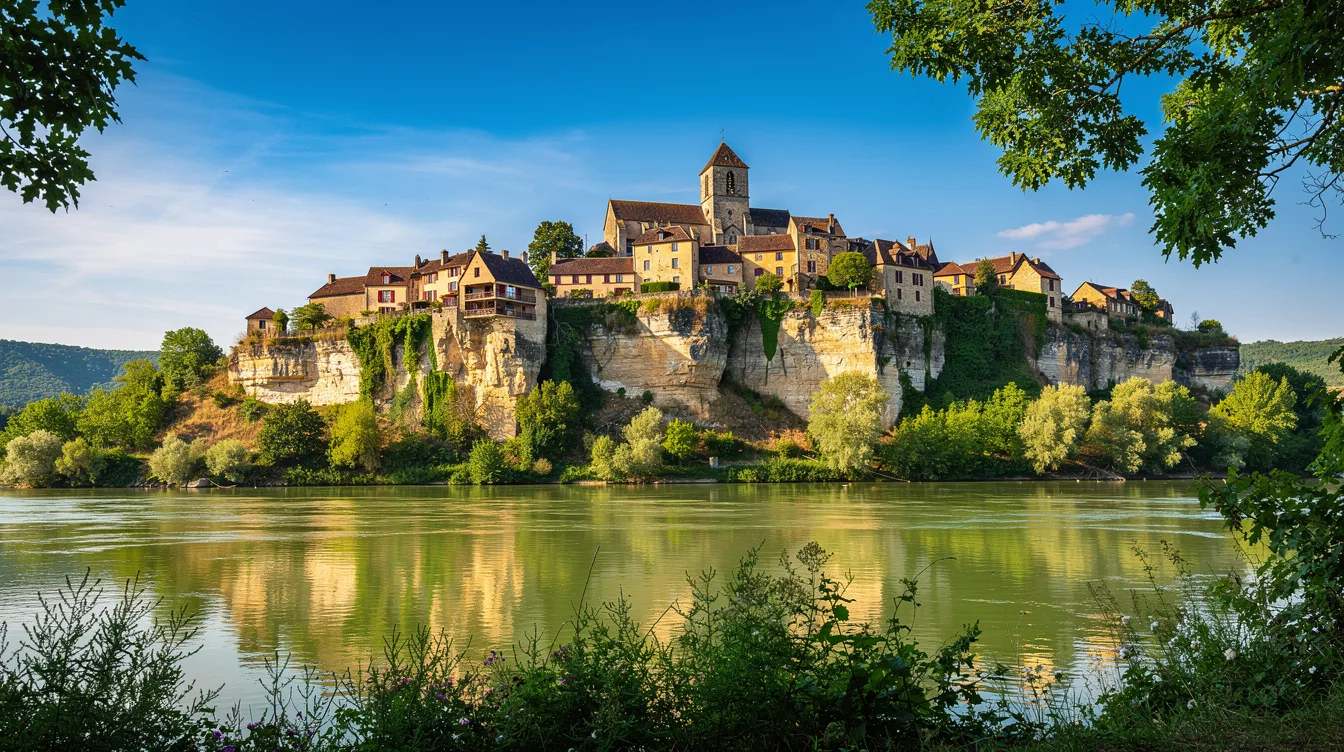
Saint-Cirq-Lapopie rises 328 feet above the Lot River, and that height explains its pull. The village sits on a steep cliff in southwestern France, **18.6 miles** east of Cahors, where medieval streets make the river valley feel far below.
It was chosen for defense long ago. Now the same position makes you stop walking, lean toward the stone edge, and watch the Lot bend through the valley.
328 feet above the Lot, with nowhere to rush
The title’s promise is real: this is a medieval village built 328 feet above the Lot. You come for the cliff-top setting, but the tighter reward is how the streets compress your pace, with old walls and corners that don’t invite hurried sightseeing.
And Saint-Cirq-Lapopie is only about 18.6 miles from Cahors, so it works as a day trip. But it doesn’t feel like a quick stop once you’re inside the old town, because the climb and the views ask for more time.
The village is in the Lot department of Occitanie and within the Parc naturel régional des Causses du Quercy. That park became a UNESCO Global Geopark in 2017, adding a wider natural setting to a place that can otherwise feel almost museum-like.
A celebrated village, and the crowds that follow
With only 201 residents recorded in 2023, Saint-Cirq-Lapopie has a very small permanent population. Yet it was voted the French people’s favorite village in 2012, a distinction that brought national attention and an annual visitor count reported at 400,000 that same year.
That’s the trade-off. It’s celebrated for good reason, but summer can feel crowded enough to blunt the pleasure of its narrow lanes.
And it belongs to Les Plus Beaux Villages de France, the French association for especially notable small villages. It is also recognized as a Grand Site de Midi-Pyrénées, so the formal labels are plentiful, though the cliff above the water remains the more convincing argument.
The medieval core contains 13 historic monuments, including the Château de Saint-Cirq-Lapopie, La Fourdonne, and the Musée Rignault. You’ll find history everywhere here, but not as a single grand complex with a tidy route.
When should you visit Saint-Cirq-Lapopie?
Spring and fall are the better choices if you want fewer people than summer brings. The sources recommend both seasons, and the village’s stone lanes are easier to enjoy when you can pause without moving with a crowd.
But winter has its own appeal if you accept the limits. It is quieter and more authentic in mood, though some shops close, so don’t arrive expecting every door to be open.
Getting there from Cahors without overcomplicating it
From Cahors, the drive takes about 30 minutes. Several paid parking areas, P1 through P6, sit around the village, and the lower parking lot is recommended in summer, when arriving early or later in the day can make a real difference.
And you don’t have to drive. LiO bus line 889 connects Cahors and Saint-Cirq-Lapopie, while a boat option runs from Bouziès. The boat is the more atmospheric choice if your schedule allows it, because arriving by river makes the cliff placement immediately clear.
The village also lies on the French Way of St. James. Pilgrims arriving from Cabrerets pass through before continuing toward Cahors and St Stephen’s cathedral, which gives these lanes a purpose beyond tourism.
The real reason to stay until later
Saint-Cirq-Lapopie became popular with artists, and later drew the writer André Breton. You don’t need that backstory to appreciate the place, but it helps explain why its stone facades and river overlook have held attention for so long.
But don’t treat it as a checklist of monuments. Walk slowly, accept the steep setting, and let the village be a little inconvenient. By evening, when the summer day-trippers thin out, the Lot below catches the remaining light and the cliff feels less like a viewpoint than a perch.