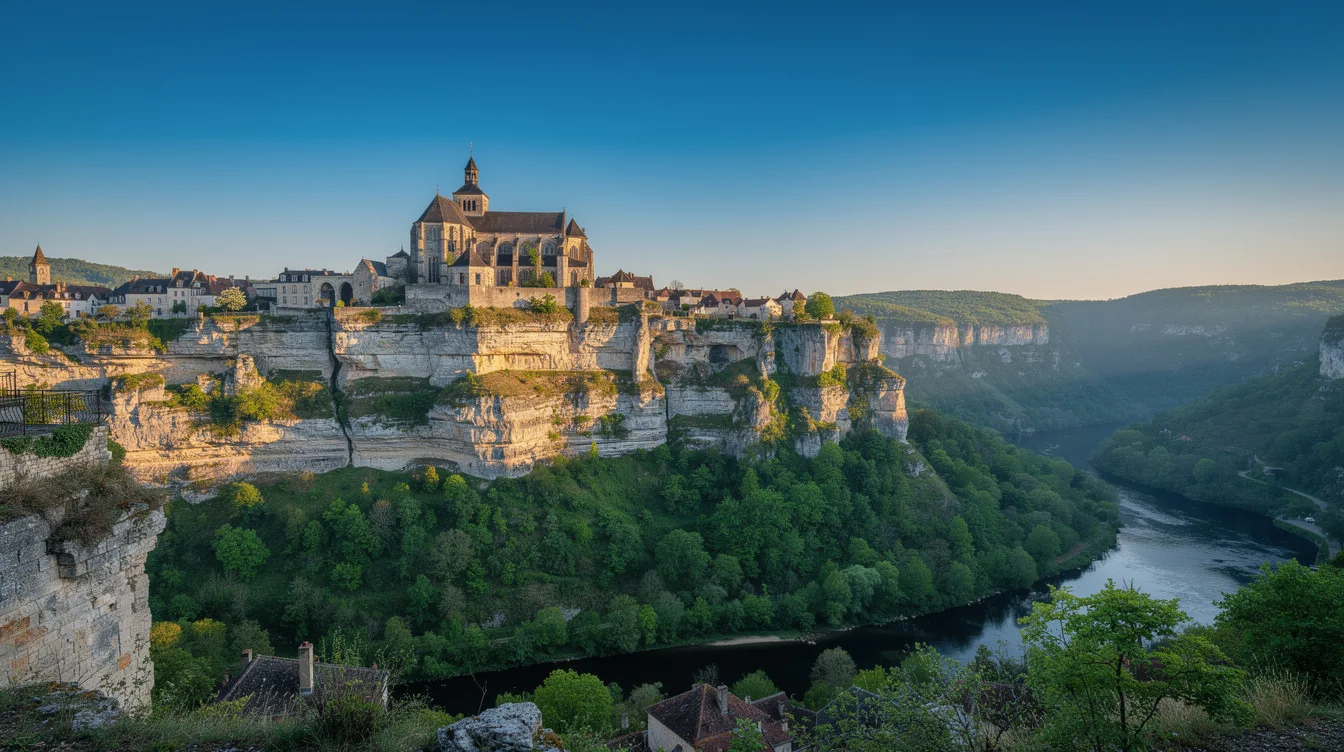
Rocamadour clings to a cliff above the Alzou River in southwest France, and its sanctuary has drawn pilgrims since the 12th century. The pull is physical as much as spiritual: 216 steps rise toward a Black Madonna, with stone walls pressing close.
You arrive in the Lot department expecting a village. Instead, you get a vertical argument between rock, river, and human persistence. The cliff rises 394 feet above the gorge, so nearly every upward glance feels theatrical.
216 steps make the sanctuary feel earned
The climb begins from the lower town, where the buildings gather near the river before the village turns sharply upward. And the steps change the pace immediately, replacing casual sightseeing with a steady, deliberate ascent.
Tradition holds that pilgrims climbed these 216 steps on their knees. You don’t need to copy them, thankfully, but walking them slowly explains why Rocamadour never feels like a monument you simply tick off.
There is a lift if the staircase isn’t right for you. That’s a practical mercy, especially because the appeal here lies above, in the religious quarter halfway up the cliff.
The sanctuary contains the wooden Black Madonna, a 12th-century image kept in a Gothic niche. It is small in scale compared with the rock around it, which makes the encounter feel quieter than the approach suggests.
The 12th-century draw still holds
Rocamadour became a major Christian pilgrimage destination in the Middle Ages, linked to the legend of Saint Amadour. But the place doesn’t require belief to make an impression, because the route itself tells the story in stone.
The Romanesque basilica of Saint-Sauveur and the 12th-century crypt of Saint-Amadour sit within the sanctuary complex. Dark interiors, worn surfaces, and the sudden coolness after the steps give the religious quarter real weight.
Since the 12th century, anonymous pilgrims and famous visitors have come here. The site was also an important stop on the Way of St. James, which helps explain why this improbable cliff settlement became so influential.
You can feel the tension between devotion and tourism. It is busy, certainly, yet the old route still asks you to look up, slow down, and accept that the climb sets the terms.
Three levels, one cliff, no easy shortcut
The village rises in stages: a lower town, a middle religious quarter, and a medieval château at the summit. This arrangement came from the Middle Ages, but it still gives a visit a satisfying sense of progression.
The lower town has the Porte Basse and a restored 15th-century hall. From there, the sanctuary becomes the obvious destination, while the château keeps watch from above with the confidence of a place that has seen crowds before.
And the setting is the real reason to linger. Rocamadour stands at roughly 915 feet in elevation, overlooking the Alzou gorge, where rocky walls tighten the view and make the village seem even more suspended.
The château crowns the cliff, while the churches hold the middle ground. It is dramatic, but not effortless: stairs are part of the experience, and anyone seeking level walks should plan around that fact.
Small commune, enormous visitor pull
Only about 597 residents live in Rocamadour, yet the commune receives roughly 1.5 million visitors each year. That mismatch is startling, and it explains why the site can feel intimate in one corner and crowded in the next.
The village lies in the Causses du Quercy Regional Nature Park, 22.4 miles north-northeast of Cahors by road. You can arrive by car from the A20, or use the Rocamadour-Padirac rail station on the Brive-la-Gaillarde to Toulouse line.
There are nearby distractions, including the Chapelle de l’Hospitalet and La Forêt des Singes. But I’d resist rushing away too quickly, because Rocamadour works best when you give the sanctuary and its approach unhurried attention.
Food offers a welcome change of register after all that stone. Rocamadour goat cheese is the local name to know, alongside regional walnuts, truffles, and lavender, though the village’s vertical drama remains the lasting flavor.
Stay until the cliff changes tone
Rocamadour has UNESCO World Heritage status through the Camino de Santiago route. That designation matters, but the more immediate fact is simple: this is a place built around arrival, ascent, and the pause that follows.
Take the lift if you need it. Take the steps if you can. By the time you face the Black Madonna, the sound of the lower town has faded, and the pale cliff seems to hold the whole village in place.