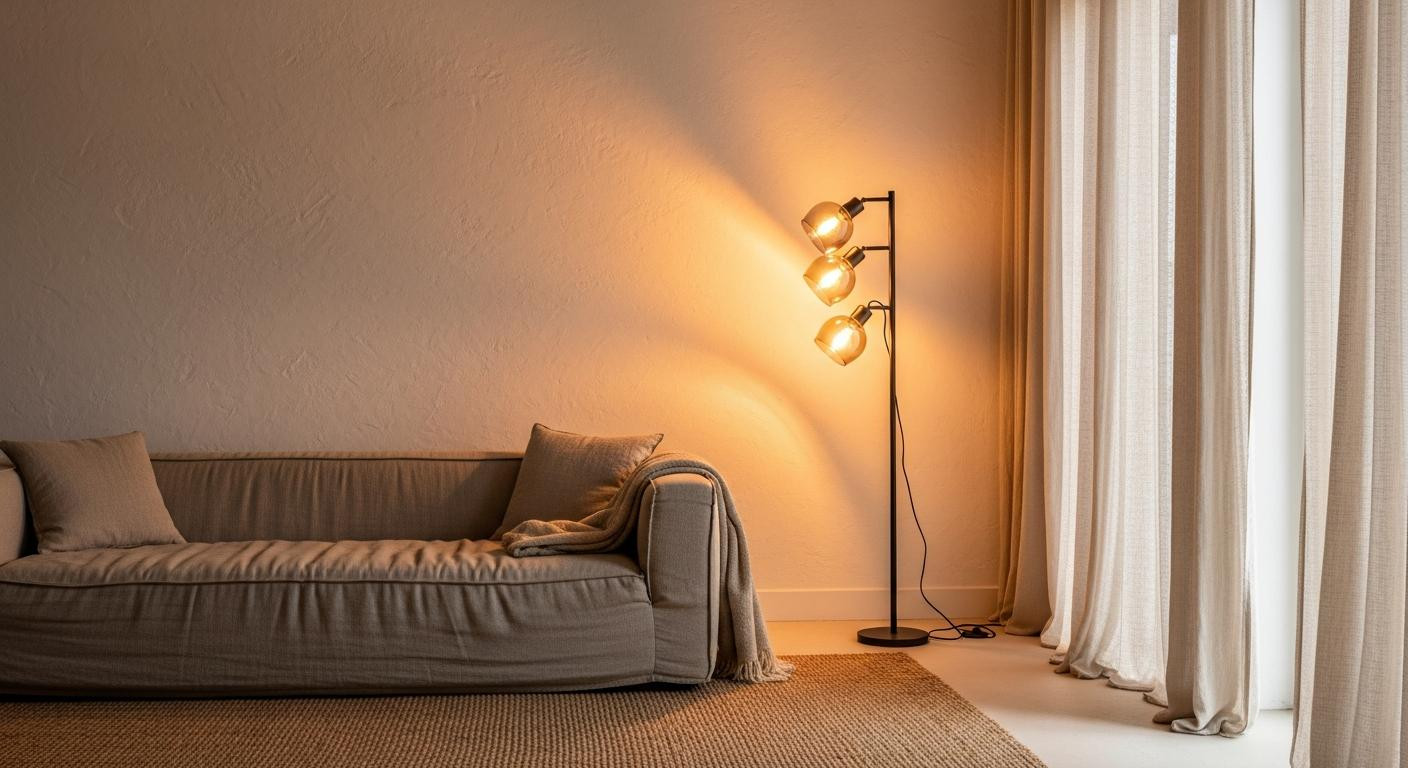
Your living room has a white sofa, a glass coffee table, and nothing on the walls. It cost $2,400 to furnish, and it looks exactly like minimalism is supposed to look. But when you walk in at 3pm on a Tuesday, the space feels like a dentist’s office. The light bounces off every surface. Your eye slides across the room in one uninterrupted sweep. That’s the problem: cold minimalism uses reflective surfaces and cool light that create visual noise without emotional warmth. Warm minimalism fixes this by changing how light behaves, not by adding more furniture.
Your room feels empty because light bounces instead of settling
Cold minimalism uses glossy subway tile, polished wood floors, and glass tables that reflect light like a gym. Every surface sends light careening around the room, and your brain registers that as visual clutter. Warm minimalism uses matte plaster, unglazed ceramic, flat-finish paint, and linen that scatter light instead of reflecting it. When light diffuses, your eye relaxes.
A matte wall absorbs 40 to 60 percent of incident light, creating soft gradients instead of sharp highlights. That gradient is what your brain interprets as warmth. The light stops moving and starts living in the room. Matte surfaces make small apartments feel 40% bigger than glossy ones because they eliminate the visual competition reflective finishes create.
Texture creates visual friction that reads as fullness
Your brain perceives empty space by how easily the eye moves across surfaces. A smooth white room lets your gaze slide from wall to floor in one uninterrupted sweep, and that’s why it feels vacant. Texture interrupts that slide. A chunky wool throw, a jute rug, a linen sofa with visible weave—each adds visual friction. Your eye stops, registers detail, moves on.
That stopping is what makes a room feel inhabited. Design experts featured in Architectural Digest recommend layering boucle with rattan, velvet with marble, linen with wood specifically to create those micro-interruptions. You’re not adding clutter; you’re adding visual rest stops. And the result is a space that feels full without a single extra object on the shelf.
Monochromatic warmth uses color depth, not color variety
Cold minimalism often uses white plus one accent color. Warm minimalism uses five shades of the same warm neutral—cream, oat, sand, tan, mocha—to create depth without contrast. That tonal layering makes the eye work to distinguish surfaces, which tricks the brain into reading complexity where there’s actually simplicity.
A monochromatic beige room with five tonal shifts feels richer than a white room with navy pillows because tonal variation creates subtle visual hierarchy. The warm neutral rule that makes 180 sq ft feel like 240 works because the space has dimension without objects competing for attention. The palette does the work furniture used to do.
2700K bulbs make beige read as caramel instead of builder-grade
Your minimalist furniture looks cheap under 5000K daylight bulbs because that blue-spectrum light reveals every flat surface and mass-market finish. Swap to 2700 to 3000K warm bulbs and the same beige sofa suddenly looks like aged linen. Warm light adds amber undertones that soften hard edges and deepen neutral colors.
This isn’t placebo—it’s physics. Lower Kelvin temperatures emphasize red and yellow wavelengths, which our eyes associate with firelight, sunset, and safety. A $38 floor lamp with a 2700K bulb transforms a room faster than a $1,200 furniture swap because it changes how every surface in the space reflects color back to you. Lighting designers with residential portfolios note that warm light can shift perceived room temperature by several degrees without touching the thermostat.
Layered lighting creates shadow, and shadow creates shape
Overhead lighting flattens rooms by eliminating shadows—that’s the waiting room effect. Warm minimalism uses three light sources at different heights: a floor lamp in one corner, a table lamp on the sideboard, a pendant over the dining table. Those layered sources create overlapping pools of light with soft shadows between them.
Shadows give objects definition. A sofa without shadow looks two-dimensional. A sofa with shadow looks sculptural. You’re not adding furniture; you’re adding dimension to the furniture you already own. Linen curtains scatter light instead of reflecting it, which helps those layered sources blend instead of competing. The space feels cohesive because the light quality is consistent across every corner.
Empty space is the design if it’s warm empty, not cold empty
The difference between sparse and serene sits in what the empty space feels like. Cold empty is a white wall with nothing on it. Warm empty is a cream wall with a 2700K sconce casting amber light across textured plaster. The wall is still empty—no art, no shelves—but the light and surface quality make the emptiness feel intentional instead of unfinished.
Warm minimalism doesn’t fear negative space. It warms the negative space so your eye reads it as restful, not neglected. Curved sofas are taking over because straight sectionals made rooms feel like waiting areas, and the same principle applies to walls and floors. Softening the hard edges—through light, through texture, through rounded forms—makes the blank space feel like breathing room instead of emptiness.
Your questions about warm minimalism answered
Can I do warm minimalism in a rental without painting?
Yes—focus on lighting and textiles. Swap bulbs to 2700K, add linen curtains that scatter light, layer a jute rug over builder-grade carpet. Renters have more control over light temperature and fabric texture than they think. A $60 floor lamp with a warm bulb changes a room faster than paint.
Does warm minimalism work in small spaces?
Better than cold minimalism. Warm tones and matte surfaces make small rooms feel cozy instead of cramped. A 180-square-foot studio in beige with layered lighting reads as intimate. The same studio in white with overhead lighting reads as a cell. The warmth adds emotional dimension that square footage can’t.
How much does it cost to warm up a cold minimalist room?
Budget: $94. Swap bulbs for $18, add one textured throw for $38, one jute rug for $38. Mid-range: add a boucle pillow for $68, linen curtains for $94, ceramic lamp for $87. The cost sits in textiles and lighting, not furniture replacement. You’re changing how the room feels, not what’s in it.
Your living room at 7:18pm when you turn on the new floor lamp and the oat-colored walls go amber. The furniture hasn’t changed. The room just stopped bouncing light and started holding it.