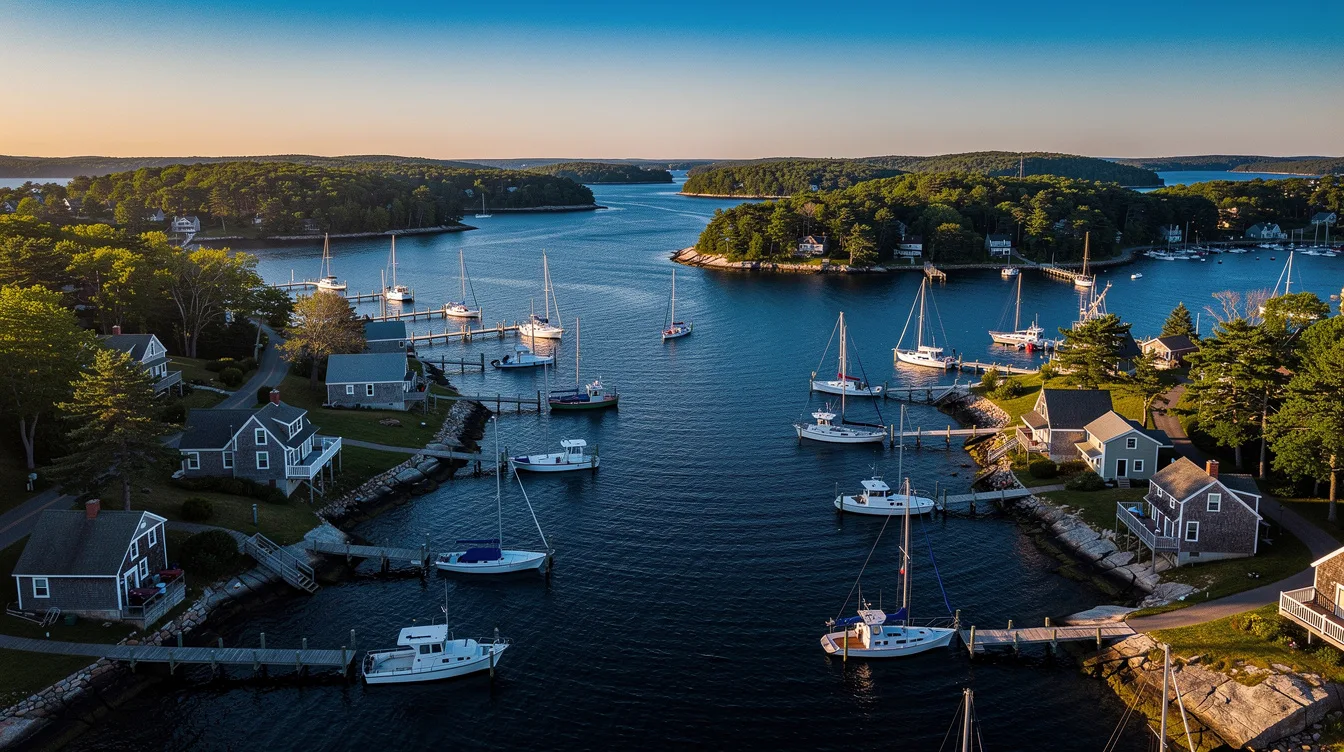
Boothbay Harbor was built for the moment bad weather turns a working coast uneasy. Its large, deep, protected harbor could once take in 400 to 500 vessels at a time, including Friendship Sloops looking for shelter.
That scale changes how you see the town. This isn’t a harbor made for a quick photo and a lobster roll, though you can certainly find both. It’s a harbor whose shape gave sailors a reason to wait out the weather instead of fighting it.
A harbor that made room when weather closed in
The answer to the title sits right on the water: protection and depth mattered more than spectacle. When conditions worsened, boats could crowd into Boothbay Harbor, so the harbor became a practical refuge on the Gulf of Maine.
And that old purpose still gives the waterfront its pull. Fishing boats, sailboats, and excursion vessels share the view, while the docks keep the town facing the water rather than turning its back on it.
But don’t expect wilderness silence in high season. Restaurants, galleries, small shops, and independent hotels cluster near the docks, which makes the harbor lively without making it feel like a city waterfront.
You can feel the working logic in the tight relationship between boats and shore. The smell of seafood may drift past storefronts, and masts cut across the sky, but the place’s best story is still shelter.
From a fishing outpost to its own town in 1889
Documented European presence here reaches back to 1623, when an English fishing outpost called Cape Newagen appeared in the region. The settlement history was far from smooth, and conflict drove colonists away more than once.
By the time Boothbay Harbor became a separate town on February 16, 1889, the harbor had long helped support fishing and marine work. That history explains why the waterfront feels functional even when visitors fill the sidewalks.
And the town’s past doesn’t need a museum-style voice-over to register. Look across the harbor, then remember that vessels once arrived here because the weather left them few better options.
But history isn’t the only reason to go. Boat tours, whale watching, coastal islands, and lobster restaurants give you plenty to do, even if the strongest experience is simply slowing down beside the slips.
The peninsula gives you water on both sides
Lincoln County places Boothbay Harbor at the southern end of a peninsula in the Gulf of Maine. The tidal Sheepscot River lies west, Linekin Bay lies east, and the harbor opens south toward the bay.
That geography makes the town feel contained rather than isolated. You’re never far from a dock, an inlet, or the next turn toward the coast, so even an unhurried afternoon has a sense of motion.
And there’s more beyond the central harbor. West Boothbay Harbor, Bayville, Sprucewold, and Isle of Springs are part of the town, while Southport Island sits across Townsend Gut.
If you want a break from the waterfront, the nearby Coastal Maine Botanical Gardens is known for its large troll sculptures. It’s a useful change of pace, though the coast remains the reason most people come.
Do you need a car?
A car is very useful, and may feel indispensable if you want to explore the peninsula. Route 27 runs north to Wiscasset, while Route 96 heads toward East Boothbay and Ocean Point.
Boothbay Harbor is about 59 miles from Portland, and the drive commonly takes around 1 hour 20 minutes via US-1 and Route 27. That distance makes it a realistic coastal add-on, but not a place to treat as a walkable extension of Portland.
September and October are the smart compromise
June through October is the main visiting window. Summer brings the fullest run of restaurants and excursions, but it also brings larger crowds and higher prices, which can drain some calm from a small harbor town.
But September and October are the better bet if you value room to breathe. Sources point to quieter streets, cooler temperatures, and fall color, while the coast still gives you the reason you came.
You should know the off-season trade-off. April and May can mean fewer people but seasonal closures, while November through March is cold and sometimes snowy, better for a quiet retreat than a first visit.
By late afternoon, the boats settle into the harbor and the dockside noise thins. That protected water is still doing what made this town matter in the first place.