King Henry I of England died at Lyons-la-Forêt on December 1, 1135, reportedly after eating too many lampreys. The story is grisly, but it gives this quiet Norman village a strange hold on history: an English king died here, far from England, in a castle he had built.
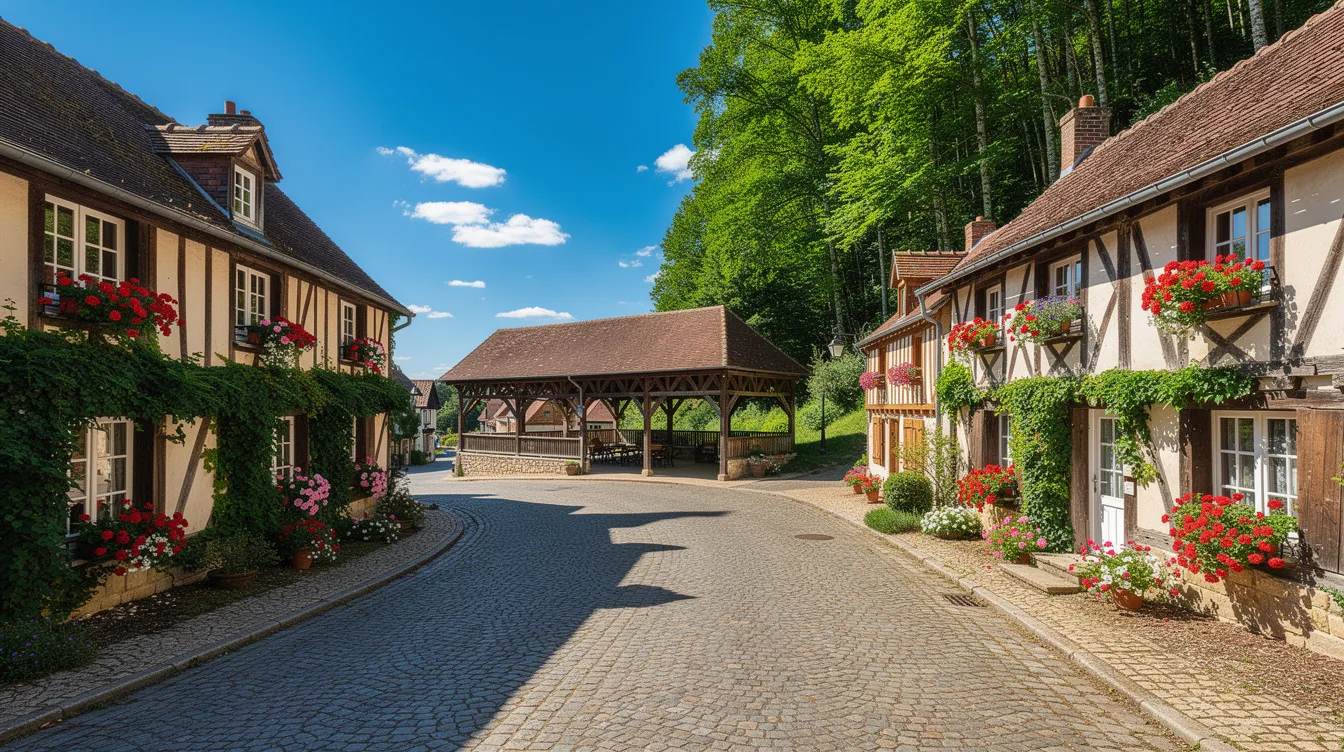
Today, Lyons-la-Forêt feels far less dramatic. Timbered facades and pink brick frame the central square, while the forest presses close beyond the roofs. You come for a day from Rouen, then find the village makes a convincing case for lingering.
A royal death behind the village calm
The king’s death is the reason many visitors know the place. Henry I built the castle here at the start of the 12th century, when Lyons was still called Saint-Denis-en-Lyons. The castle is private property now, so don’t expect a grand royal tour.
But the historical point lands precisely because the setting is so modest. A place tied to medieval power is now a commune of 742 residents, with a covered market square and narrow streets that reward a slow walk rather than a checklist.
The lamprey account comes with a useful caution. The source calls it food poisoning after a “surfeit” of lampreys, fish Henry was said to love excessively. You can enjoy the tale without treating every medieval detail as certain, since the account itself uses that qualification.
And the death happened on December 1, 1135, not in some distant English court. That fact changes the scale of a visit. You’re standing in a French village where the Anglo-Norman world became suddenly, inconveniently real.
Why the forest still sets the mood
The Forest of Lyons surrounds the village and explains its particular atmosphere. It is Normandy’s largest state forest, covering 10,700 hectares, and it is among Europe’s largest beech forests. The straight trunks have often been compared to a cathedral.
That scale makes Lyons-la-Forêt feel remote, but it isn’t hard to reach. Rouen is 21.1 miles away, so you can leave the city behind without committing to a complicated overnight route. The forest also gives walkers, cyclists, and riders room to spread out.
But don’t come expecting a theme-park version of medieval France. The reward is quieter: open clearings, small hamlets, and tall beech trunks rising in pale vertical lines. If you like destinations that ask you to slow down, this is the better argument.
The Lieure runs through the commune before joining the Andelle. You may notice water near the village, but the trees are the larger presence. They soften the edges of the streets and make even the central square feel connected to the woods.
The square is where a short visit becomes a full afternoon
The covered market place dates to the 18th century, while the Church of Saint-Denis combines 12th- and 18th-century fabric. The town hall dates from the 17th century. That mix keeps the village from feeling frozen in one era.
And the central square is the place to begin. Look up at the timber framing, then notice the pink brick between it. The buildings have the slightly uneven texture that photographs flatten, so give yourself time to walk around rather than stopping at one corner.
The market is traditionally held Thursday, Saturday, and Sunday mornings under the hall. That timing matters if you want the square with some local movement. On another day, it may feel almost too quiet, which is either the limitation or the appeal.
You can also seek out the old houses on rue du Bout-de-Bas, the former Cordeliers convent, and the former bailliage that became town hall. Two film versions of Madame Bovary were made here, in 1933 and 1991, though the village doesn’t need cinema history to hold your attention.
Make Lyons-la-Forêt a forest day, not a rushed stop
If you have more time, nearby options include Notre-Dame de Fontaine-Guérard Abbey, Mortemer Abbey, Vascoeuil Castle, and Martainville Castle. But there’s a trade-off: adding every nearby sight can turn a village visit into a drive-by.
My advice is to choose one extra stop, then return to Lyons-la-Forêt for the late afternoon. You’ll understand the place better on foot, when the market hall is quieter and the forest edge seems closer than it did on arrival.
Can you visit without an elaborate plan?
Yes. The village works for a calm day trip because Rouen is only 21.1 miles away and the center concentrates its main sights. But plan around the market if that matters to you, and accept that the castle connected to Henry I is private.
By the time the square empties, timber and pink brick hold the remaining light, and the beech forest waits just beyond the last houses.