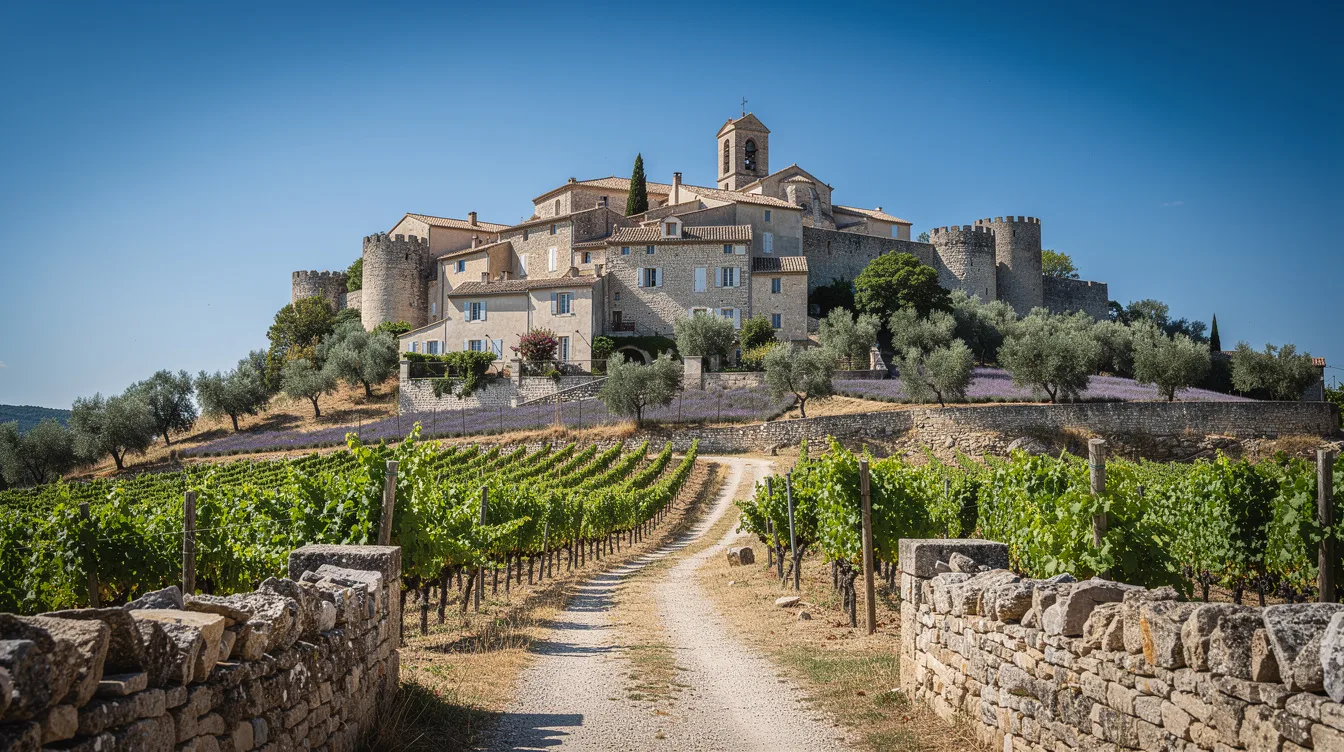
Ménerbes held out for five years, two months, and eight days. From 1573 to 1578, this walled village in France’s Vaucluse department absorbed more than 900 cannon shots during a siege that tore through its towers.
That’s a much sharper reason to visit than another pretty-stone-village promise. You come to Ménerbes in the Luberon for the weight of that resistance, then find a place where the old walls still make the village feel compact and watchful.
A five-year siege still shapes the village
The siege of Ménerbes pitted Protestants against Catholics during the French Wars of Religion. The citadel began as a Protestant stronghold, and Catholic forces surrounded it with trenches, so the conflict kept tightening around a very small settlement.
And the numbers are startling. The defenders faced 14 tons of lead bullets, incendiary barrages, and cannon fire that destroyed the citadel’s towers. You won’t find a battlefield recreated for visitors, which makes the surviving village feel more human and less theatrical.
But Ménerbes did not fall quickly. Negotiations ended the siege on December 9, 1578, after an episode that drained the finances of towns in the Comtat Venaissin and weighed heavily on papal accounts.
The Luberon setting is part of the story
The Luberon mountains frame Ménerbes, whose main settlement sits on a hilltop in the foothills of the French Alps. The defensive logic is easy to understand from that position: a village on higher ground could see trouble coming, even if it could not always stop it.
And you should give yourself permission to move slowly here. The appeal is in the compressed scale, the pale stone, and the sense that the village’s edges were drawn for protection long before they were photographed.
Beyond the village, the Calavon River forms part of the commune’s northern border. The farms around Ménerbes grow lavender, mushrooms, truffles, and grapes for red wine, so the setting is rural, but it has never been empty.
Is Ménerbes only for history lovers?
No. History gives the place its bite, but Ménerbes also belongs to Les Plus Beaux Villages de France, an association for France’s most beautiful villages. That designation draws visitors, so expect company rather than solitude.
But it is not a museum piece. The commune had 962 residents in 2023, which means there’s still a lived-in scale beneath the reputation. You’re walking through a home town, not an outdoor set.
Corkscrews and artists add a stranger second act
If cannonballs aren’t your preferred travel subject, Ménerbes has a quirkier stop: the Musée du Tire-Bouchon, a museum devoted to corkscrews. It’s a pleasingly specific detour in a region tied to wine, and it keeps the visit from becoming all stone and siege dates.
And the village later became associated with artists and writers. The former home of Dora Maar now hosts the Brown Foundation Fellows Program, with residencies for mid-career professionals in the arts and humanities lasting one to three months.
English-speaking travelers may know Ménerbes through a British writer’s books about life in Provence. That literary fame brought attention to the Luberon, but the village’s older story remains the more compelling one.
Come for the walls, stay for the quiet after them
Ménerbes is in Provence-Alpes-Côte d’Azur, in southeastern France, within the Vaucluse department. It is also part of the Luberon, so it fits naturally into a wider exploration of the region without needing a grand itinerary of its own.
But don’t rush it as a quick photo stop. The village rewards looking for the stubborn details: walls that survived, towers that did not, and streets that still carry the logic of a place built to endure.
By the time you leave the hilltop, the siege’s numbers linger longer than the souvenirs: five years, two months, eight days, and more than 900 cannon shots against a village that refused to give in.