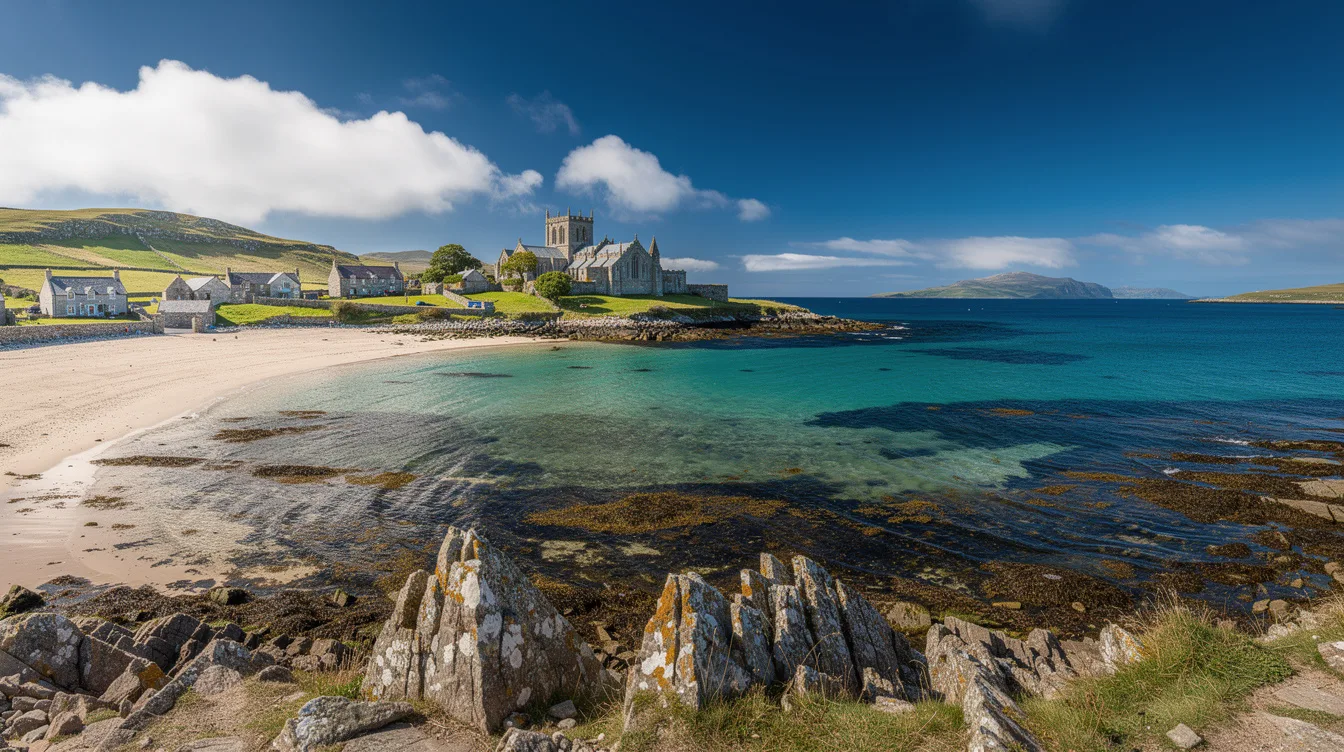
Iona is only a 10-minute ferry ride from Fionnphort on Mull, yet the crossing changes the pace completely. The island sits in the Inner Hebrides off Scotland’s west coast, and its small scale makes you slow down almost immediately.
But the real reason to come is older than the ferry timetable. In 563, an Irish monk founded the monastery that made Iona one of the major centers of Gaelic monasticism in Britain and Ireland.
A short crossing leads to a long history
The passenger ferry leaves Fionnphort and crosses the Sound of Iona in about 10 minutes. You can see Mull behind you as the boat approaches, which makes the island feel remote without making it difficult to reach.
And cars are generally not allowed for visitors, so you arrive on foot. That restriction is practical rather than precious. It keeps the lanes quieter, and it means your first view of Iona is likely to be the harbor, the water, and people walking with bags.
The island is roughly 3 miles long and narrow enough that the sea never feels far away. You can cover a great deal without a vehicle, but the open ground leaves little room to hurry unnoticed.
There are fewer than 200 permanent residents. Visitors still come in large numbers for retreats, history, and the shore, so this is not an empty island. But it has a lived-in rhythm that asks you to pay attention.
The monastery is the point, not a backdrop
The abbey complex stands on or near the site of the original monastery. Its importance comes from what began here: Iona became a leading center of Gaelic monastic life for centuries, with influence reaching across Britain and Ireland.
And that history gives the visit its weight. You do not need to arrive as a pilgrim to feel it. The stone buildings and church sites make a clear argument for lingering, especially after the ferry’s quick, practical crossing.
Iona Abbey is also associated with an active ecumenical community and retreat programs. That makes the island more than a historical stop. You may encounter visitors who came for quiet reflection, not simply a photograph.
But don’t expect a museum experience sealed behind glass. The religious heritage is still part of the island’s present identity, and that can feel more intimate than a conventional landmark visit.
Is Iona only for religious travelers?
No. You can come for the abbey without sharing its religious purpose, because the island’s story is also about place, travel, and the persistence of a small community. Still, the monastery is central.
Treating it as scenery misses what makes Iona distinct.
Dùn Ì gives the island its wide view
If you want the island’s broadest perspective, walk up Dùn Ì, Iona’s highest point. At 331 feet, it is not a mountain by Scottish standards, but the exposed rise gives you a fuller sense of the sea and the low ground below.
And the climb has an honest trade-off. The elevation is modest, yet the island’s open, largely treeless setting can make the route feel more exposed than you expect. Bring a layer and let the weather set the pace.
The coast combines white-sand bays with rocky knolls of ancient Lewisian gneiss. Light shifts quickly across the pale shore and darker rock, so a walk here rewards looking up as often as looking down.
But Iona is not all sweeping views. Its appeal is often quieter: the sound of feet on a lane, a low ferry engine across the water, and the feeling that there is nowhere useful to rush.
Plan around Mull, then leave the car behind
Most visitors reach Mull by ferry from Oban to Craignure, then continue across the island to Fionnphort. From there, the passenger ferry handles the final crossing to Iona. The route takes commitment, which is part of why the arrival feels earned.
And you should plan the island as a walking destination from the start. Pack what you need before boarding at Fionnphort, because the ferry is a threshold. Once you step off, the practical mainland mindset feels out of place.
Tourism and small-scale farming support the modern island, while much of the land belongs to the National Trust for Scotland. That mix explains the atmosphere: cared for, visited, and still shaped by people who live there year-round.
The ferry turns back toward Mull, the harbor settles, and Iona becomes quiet enough to hear the water against the shore.