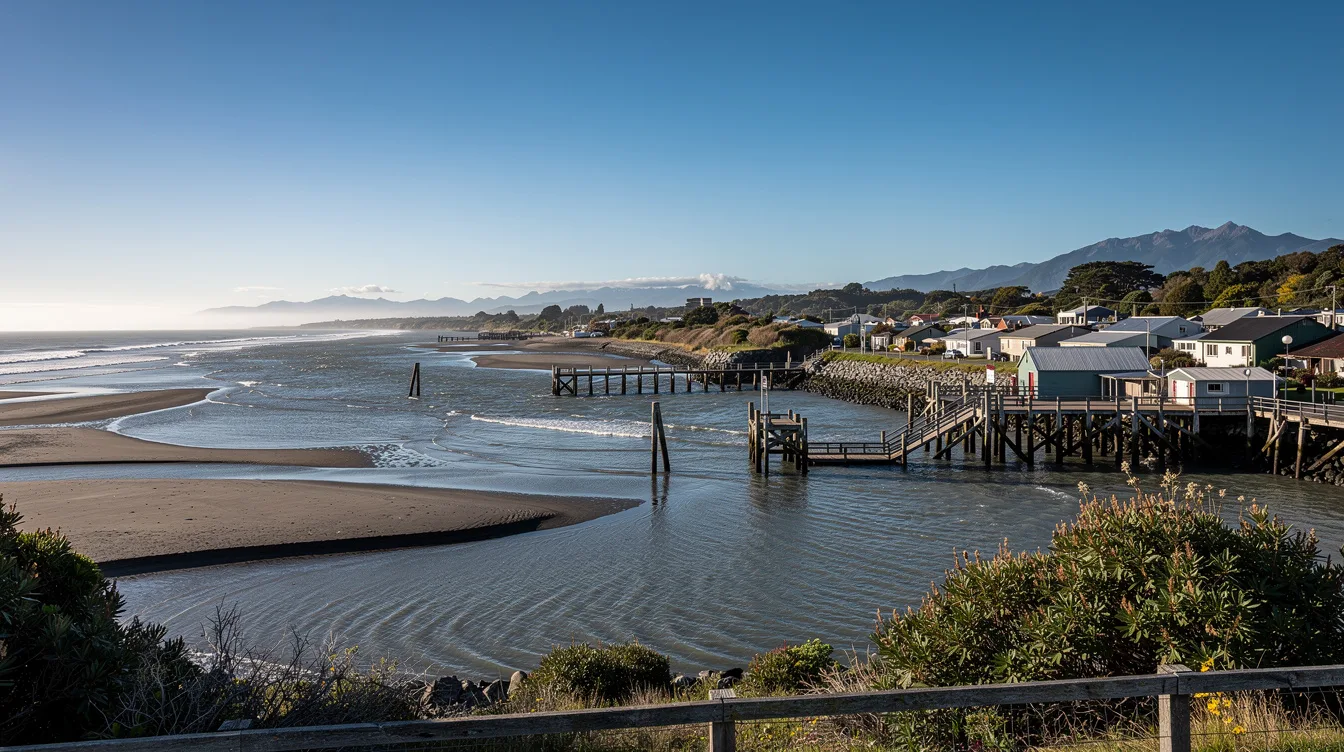
Hokitika did not become important by accident. Founded around gold mining in 1864, this West Coast town became a working gateway almost overnight. In 1867, its port ranked first in New Zealand for incoming vessels and export value, with gold driving both numbers.
And on September 16 that year, 41 vessels lay alongside the wharf, some packed three and four deep. That scale is hard to picture from today’s compact waterfront, which is exactly why Hokitika rewards travelers who slow down long enough to look past the driftwood.
A gold-rush port with a dangerous edge
The harbor made Hokitika rich, but it was never easy. Gold brought ships in, yet the same coast made every arrival a serious undertaking.
But you can still feel the logic of the place near the mouth of the Hokitika River. The Tasman Sea pushes in close, and the town sits where cargo once moved from water to wharf. The 1867 port ranking is the real story here, not a decorative plaque.
You’re visiting a town shaped by a boom that burned fast. Hokitika was among New Zealand’s most populous centers by late 1866, then the gold and port trade declined. Lively in its history, it feels measured now.
Revell Street is where the town feels current
Walk Revell Street before heading to the beach. Hokitika’s center is compact, with historic buildings, galleries, cafes, wood carving, and pounamu jewelry. Pounamu, also called greenstone, remains a defining local craft rather than a souvenir afterthought.
And the town is more art-minded than the busier glacier stops farther south. That’s a useful trade-off if you want an overnight stop with character. If you expect a packed resort strip, you’ll be disappointed, and probably happier elsewhere.
That small scale keeps errands, galleries, and the shore close together, so you can arrive without a tightly scheduled afternoon and still get a sense of place.
The beach earns your sunset plans
Hokitika Beach is free and wild, with surf, driftwood, and the large “HOKITIKA” sign built from beach timber. Go late. The low light over the Tasman Sea is the kind that makes you cancel an indoor plan.
But don’t mistake it for a calm swimming beach. The appeal is the shore itself, the salt air, the scattered wood, and the sound of water rolling in.
After dark, take the short free walk at Glow Worm Dell. The bush changes the mood completely. You leave the open coast behind, and small points of light appear in the darkness.
Hokitika Gorge is worth the drive
The headline-blue water at Hokitika Gorge is roughly a 30-minute drive. The main walk is about 1.5 miles round trip and takes around 90 minutes, with forest, walkways, and a suspension bridge.
And you should go early if weather allows. The gorge’s intense turquoise water is the payoff, while the wet forest makes the approach feel cool and close. It’s popular, but the walk is short enough to fit before a slower afternoon.
Can you keep exploring after the gorge?
Yes. Lake Kaniere and Dorothy Falls make a worthwhile follow-up for quiet water and rain-forest scenery. You can swim if conditions allow, though this coast’s weather changes quickly, so don’t build a day around clear skies.
The West Coast Treetop Walk is another option, with an elevated path through rimu and kahikatea canopy and views toward Lake Mahinapua and the mountains. Or take part of the West Coast Wilderness Trail by bike or e-bike, which crosses forest, glacial rivers, and former gold-mining settlements.
Getting there means accepting the weather
Hokitika is on New Zealand’s South Island West Coast. It works especially well as a one- or two-night stop between Christchurch, Arthur’s Pass, and Franz Josef or Haast.
But pack a waterproof jacket in every season. Rain is spread across the year, and the road through Arthur’s Pass can be winding and difficult in poor conditions. Check road status before you cross the pass or continue toward the glaciers.
Can you fly into Hokitika?
Yes. Hokitika Airport has service from Christchurch and is the only West Coast town with Air New Zealand flights. That makes the town remote in feel, but not necessarily difficult to reach if you don’t want the long drive.
By the time the light fades over the driftwood sign, the old gold port has gone quiet again, with the Tasman surf doing most of the talking.