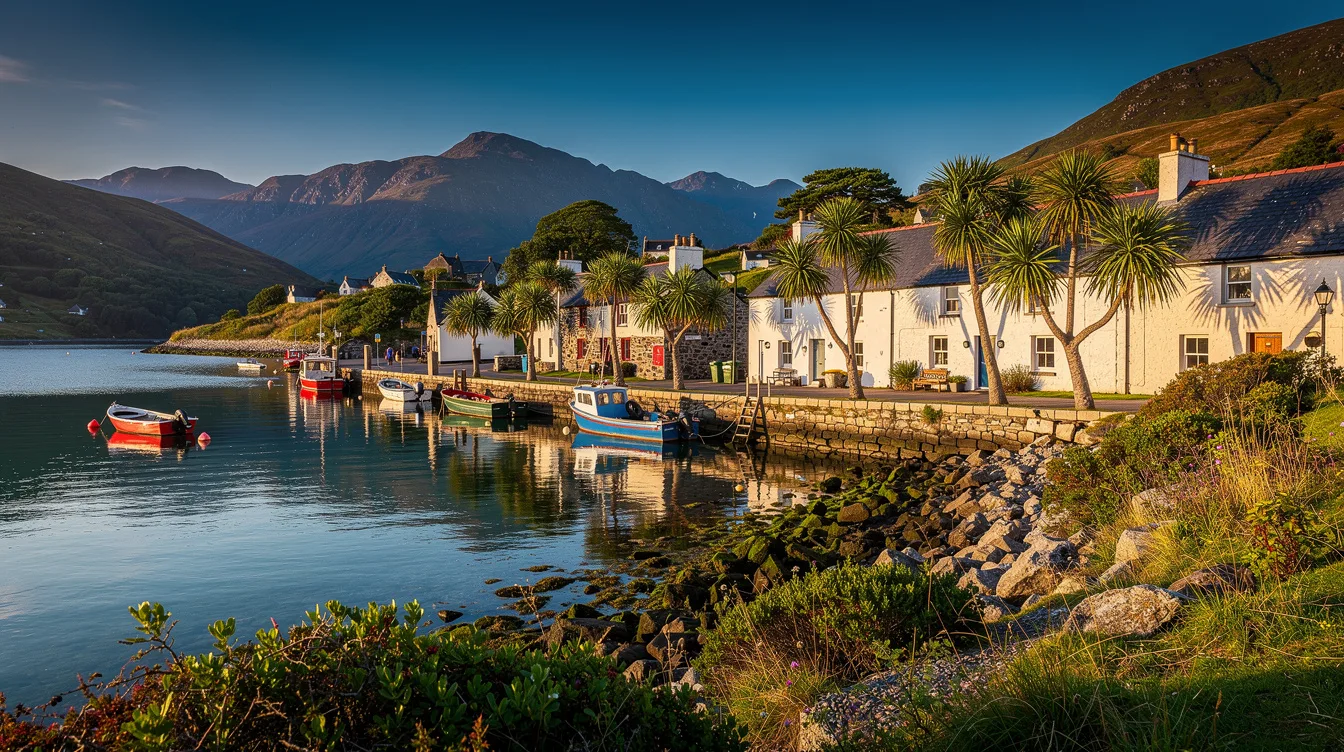
Plockton has just 468 residents, yet its harbor can feel almost subtropical. New Zealand cabbage trees have lined Harbour Street since the 1960s, their spiky crowns rising above whitewashed cottages on Loch Carron.
That contradiction is the reason to come. The village faces away from prevailing winds, and the North Atlantic Drift softens this far-north corner of Scotland enough for Cordyline australis to prosper.
A Highland harbor with an unexpected warm-weather look
Walk toward the water and the effect lands quickly. Palm-like trees frame the harbor, while yachts sit beyond the cottages and the Applecross mountains fill the distance. It’s a strange, pleasing collision of climates.
But Plockton is still firmly Highland. The light can turn cool across Loch Carron, and the village’s compact waterfront means you’ll see its appeal in a short walk rather than through a long itinerary.
The planned settlement took shape around 1800 as a fishing village. Its herring-era purpose has faded, but the sheltered inlet still draws boats, which is why the harbor remains the village’s best place to linger.
Start at Harbour Street, then let the water set the pace
Harbour Street is where the trees make their case. Don’t rush past them for a quick photograph. Follow the waterfront slowly, notice the cottages reflected in the inlet, then look back toward the mountains.
And you don’t need a packed schedule here. Plockton has a general store with a café, a takeaway, a restaurant, a newsagent and craft shop, plus three hotels with pubs. That’s enough for a relaxed stop, though choices are limited compared with Skye.
The village also has a visitor centre that typically operates from Easter to October. Its small scale is part of the point, but high-summer parking can become busy, so arriving early makes the waterfront feel less hurried.
Can you arrive by train?
Yes. Plockton railway station sits on the Kyle of Lochalsh Line, and it’s roughly a 10-minute walk from the village. That makes the train a smart option if you’d rather arrive with the view than spend your time looking for parking.
But the station isn’t the village itself. The pleasure comes after the walk, when the trees and harbor appear and Loch Carron opens beside you.
Only 6.2 miles from Kyle, but a different mood
Plockton lies about 6.2 miles northeast of Kyle of Lochalsh, the mainland gateway to Skye. It’s close enough to add before or after an island trip, yet the sheltered shore gives it a quieter rhythm.
Because it sits on Loch Carron’s eastern shore, Plockton looks toward the water and the Applecross mountains rather than toward Skye’s busier routes. You’ll still encounter day-trippers in peak season, but the village rewards anyone who stays longer than a photo stop.
Beyond the harbor, the wider Lochalsh and Wester Ross coast brings secluded bays, coral beaches, small islands, and chances to spot marine wildlife. Those details belong to the surrounding area, not a promise that every short walk from Plockton delivers them.
A place shaped by fishing, screens, and daily village life
Plockton began as a planned fishing community, and many houses date from the nineteenth and twentieth centuries. The tidy waterfront has also appeared on screen, including as the setting for the fictional village in Hamish Macbeth.
And that recognizability can be useful. If the cottages look familiar, they may be familiar, but the television connection never overwhelms the real draw: a sheltered Highland inlet where cabbage trees belong, somehow, beside the water.
Plockton also has a library, village hall, and local places to eat and sleep. It’s tourist-friendly, but it doesn’t need much staging. The harbor already does the work.
The best reason to stop is the least complicated one
Come for the oddity of a nearly subtropical streetscape in the Highlands. Stay because the trees make more sense once you feel how protected the shore is from the wind.
There are no grand claims required. At the edge of Loch Carron, the cabbage trees rustle above Harbour Street, and the yachts barely disturb the water.