
I used to judge a bedroom chandelier by its sparkle, then noticed how quickly a dramatic fixture can overwhelm a grand bed. For a hotel-style room, I now begin with a chandelier about 70-90 cm wide and let the bed’s proportions set the tone.
The lowest point should land around 2.15-2.30 meters above the floor, but that range only starts the conversation. Ceiling height, walking clearance, and the full hanging assembly decide whether the installation actually works.
The best result feels balanced from the doorway and comfortable from the mattress. A shallow, diffused linen chandelier often gives the room more polish than a taller fixture with too much visual weight.
Start With the Bed’s Visual Weight
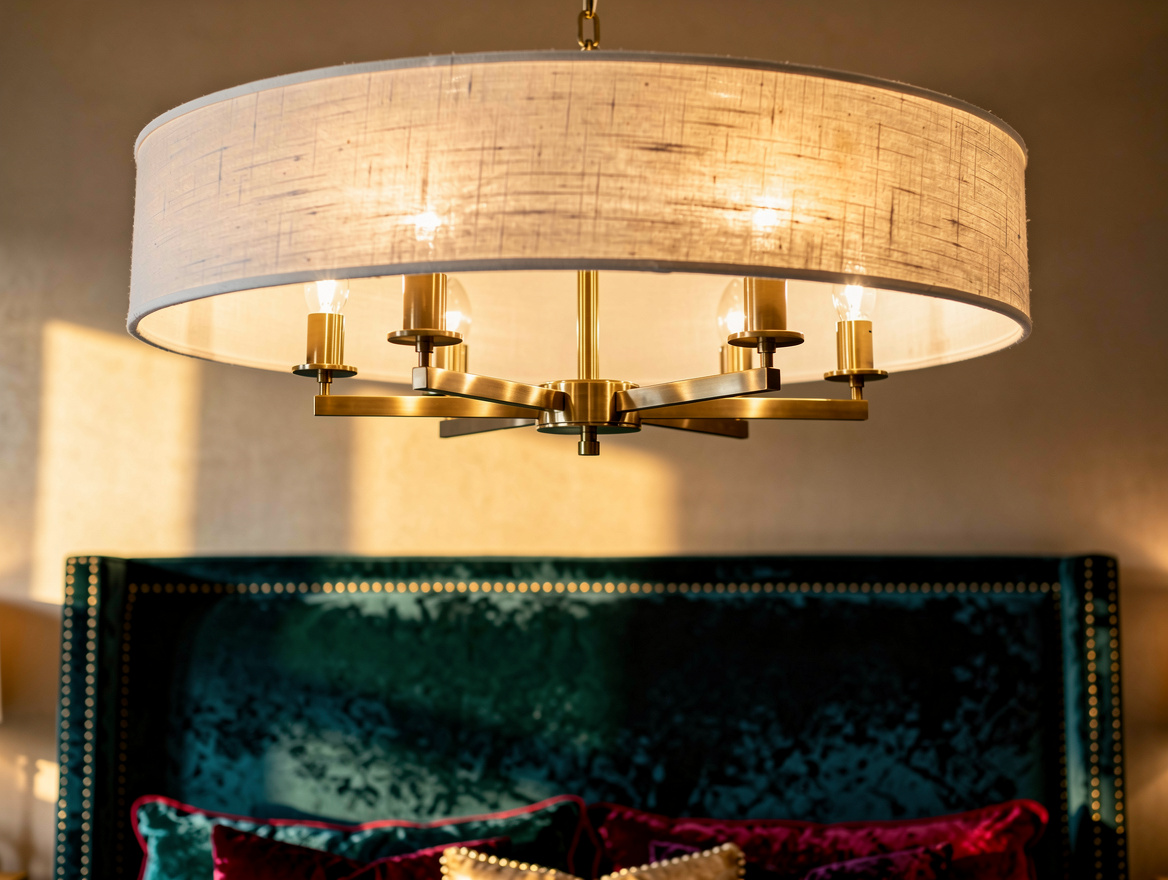
I begin with the bed because the chandelier has to answer its scale. A grand upholstered headboard already brings height, fabric, and visual weight, so a broad, shallow linen-shaded chandelier usually feels more composed than a tall, crowded cluster.
For a hotel-style bedroom, I would start with a fixture about 70-90 cm wide, or roughly 28-36 inches. That range gives a large bed enough presence without allowing the light to compete with the headboard.
My favorite directions are linen shades, milk glass, and softly diffused sculptural forms. A dense crystal design can feel heavy quickly, while an open frame or translucent finish spreads the same width with less visual pressure.
The goal is proportion, not drama for its own sake. When the bed feels generous and the chandelier feels calm, the room starts to resemble a thoughtful hotel suite.
Measure the Entire Hanging Assembly
The measurement that matters runs from the ceiling to the chandelier’s lowest point. I include the canopy, rods, chain, cord, attachment hardware, and every part of the brass mounting assembly, because the listed body height rarely tells the complete story.
With a typical bedroom ceiling, I aim to keep the bottom of the installed light about 2.15-2.30 meters above the floor, or approximately 7 feet 1 inch to 7 feet 7 inches. That is a planning range, not a universal installation rule.
Bedroom guidance commonly uses roughly 7 feet as the minimum clearance in walking areas. I still ask an electrician to confirm the selected fixture’s minimum installed height and mounting requirements before the box is moved.
A chandelier that fits on paper can become too low once the canopy and suspension hardware are added. I draw the full drop on the wall first, then compare it with the bed, the walking path, and the ceiling fan if one is present.
Match the Ceiling to the Fixture Shape
On a 2.40-meter ceiling, about 7 feet 10 inches, I look for a broad flush mount or shallow semi-flush design with a strong horizontal silhouette. A low-profile milk glass fixture can still feel special when its finish echoes the nightstands or cabinet hardware.
At about 2.50 meters, or 8 feet 2 inches, a shallow drum or compact semi-flush chandelier usually gives the bed enough presence. I would avoid a long chain here, since the extra drop can make the ceiling feel lower and the bed feel boxed in.
Around 2.70 meters, or 8 feet 10 inches, the room can handle a wide globe, shaded-arm design, or shallow sculptural fixture. At roughly 3.00 meters, or 9 feet 10 inches, a more substantial suspended chandelier has room to breathe.
Ceilings near 3.30 meters, or about 10 feet 10 inches, can support a longer suspension or layered statement form. These are proposed layout dimensions, not regulatory clearances, so the installer’s product specifications still control.
Set the Width Against the Mattress
I use the mattress width as the first proportion check. For a 160 cm bed, I would test a chandelier about 60-80 cm wide; for a 180-200 cm bed, I would begin around 70-90 cm.
One proportioning approach places the fixture at about half to two-thirds of the mattress width. For a 180 cm bed, that suggests roughly 90-120 cm, though I treat that as an upper-scale visual option rather than an automatic shopping size.
Move toward about 90-110 cm when the bedroom is generous, the headboard is especially wide, or the fixture has an airy silhouette. A compact black metal chandelier can dominate at a smaller diameter, while translucent glass can carry more width without the same bulk.
I would compare a paper circle or taped outline with the bed before ordering. This simple test reveals whether the light balances the mattress or starts to crowd the headboard.

Center the Light Where the Bed Works
Across the room, the chandelier should follow the bed’s centerline. I mark that line from the center of the headboard to the foot of the mattress, then check it from the doorway and from the most common sitting position.
Along the bed’s length, I often prefer the middle-to-foot area over the space directly above the pillows. That placement keeps the fixture connected to the bed while leaving the headboard visually quiet beneath a soft white chandelier.
Directly above the pillows can work in a tall room, but it deserves extra caution. People sit up, stretch, change bedding, and reach across the mattress, so the lowest point must feel comfortable during ordinary use.
When the bed is centered between windows, the light should also respect the window rhythm. A slightly off-center installation can make the entire room feel crooked, even when the chandelier itself is beautiful.
Test the Clearance Before Wiring
Before installation, I make a full-size mock-up from cardboard or painter’s tape. I mark the proposed lowest point, walk around the bed, sit against the headboard, and reach as if I were making the bed beneath the upholstered headboard.
This test catches problems that a floor plan misses, especially in a room with a thick mattress, a tall footboard, or a low ceiling. It also shows whether the light lands in the walking path when the bed is wider than expected.
If I am comparing fixtures from Wayfair, Home Depot, or Lowe’s, I review the complete hanging dimensions rather than filtering by body height alone. I also confirm that the box, bracket, dimmer, and ceiling structure can support the chosen material and weight.
My first move would be simple: tape a 70-90 cm circle over the bed, mark a bottom point about 2.15-2.30 meters above the floor, and live with that outline for a day. The right chandelier should make the grand bed feel settled, with clear movement around it.

Begin with a taped outline, test the width against the mattress, and measure from the ceiling to the fixture’s true lowest point. That order keeps the chandelier elegant, useful, and proportionate to the bed.
Mia Carter writes about small-space living and budget home makeovers. She has restyled three rentals and tests most ideas in her own 45 sqm flat.