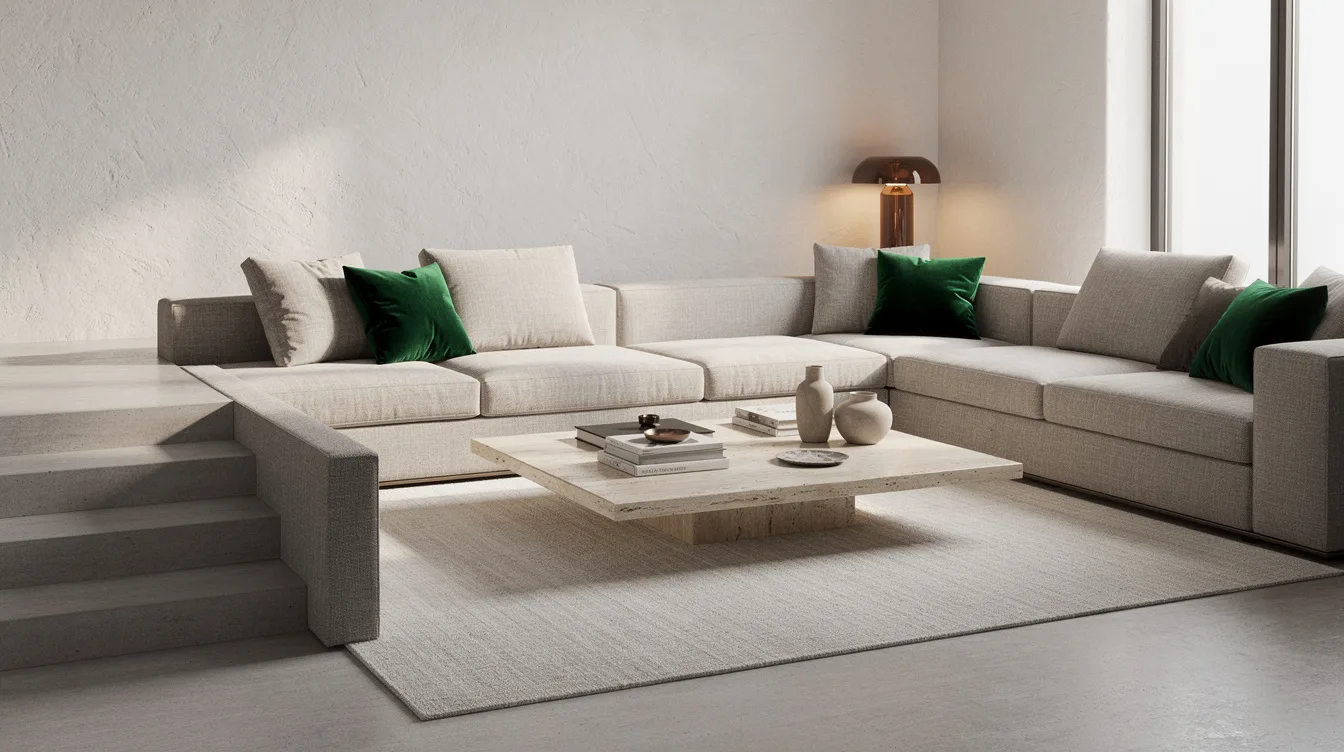
Everyone wants the pit and nobody measures the step. I’ve watched people drop a 45-inch-deep sectional into a lowered room and discover there’s no way to walk past it.
Modular sectionals that suit these layouts typically run around $679 to roughly $3,077, and a custom built-in pit pushes well past that once carpentry enters the picture. The seating is the easy part. The geometry is what makes or breaks it.
Wrap the Bench Around the Full Perimeter
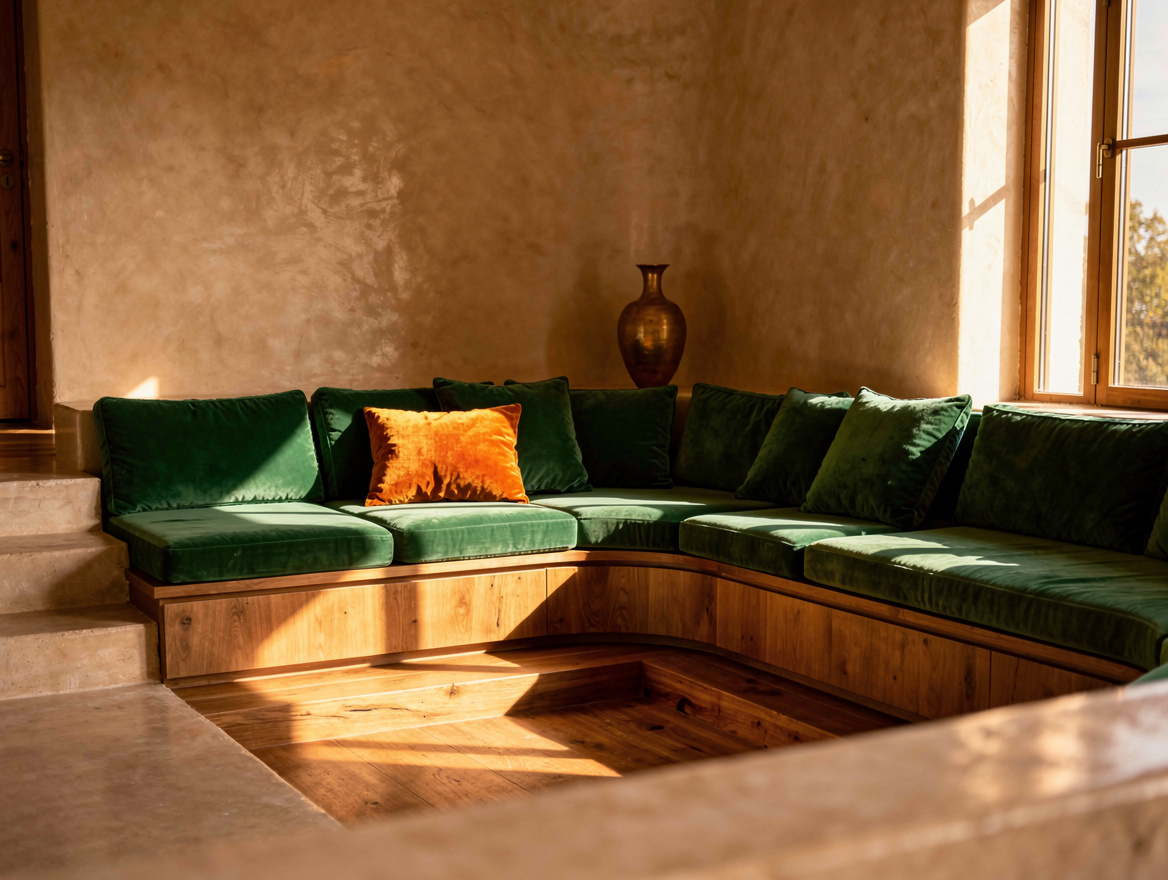
The most architectural move is continuous built-in bench seating that follows the lowered edge of the pit. It reads custom because it is, and it wastes zero inches of floor.
Pair it with loose back cushions in linen and a low table you can reach from any seat. Skip the matching throw-pillow set that comes with nothing.
Expect carpentry plus upholstery to add several thousand dollars over a sofa, since it’s framing, foam, and finish work all at once.
Build a U-Shape and Let the Table Anchor It
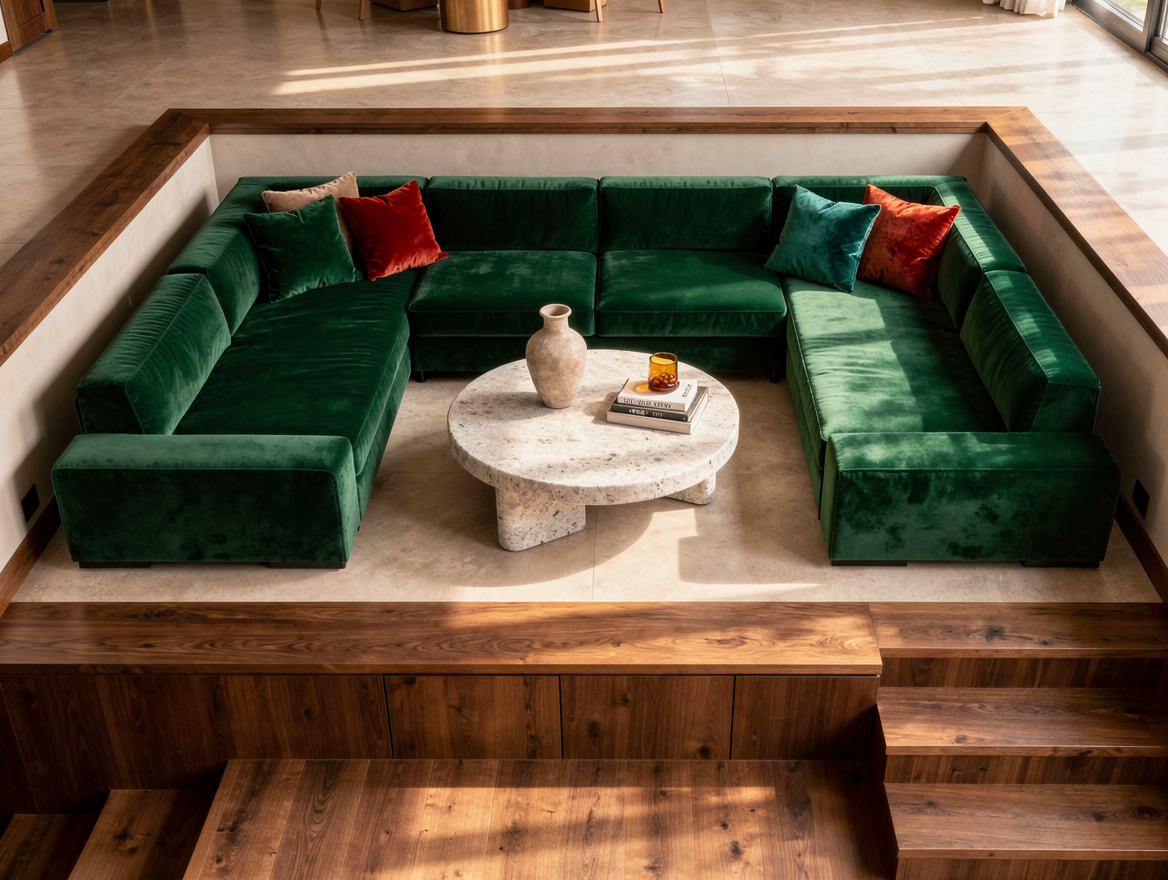
A U around a central coffee table is the layout that suits pit geometry best, and everyone can actually hear each other. Three sides of seating, one open side for entry.
West Elm‘s Harmony modular comes in multiple depths, which matters here: you want the same depth on all three runs or the U looks crooked.
Mid-range modular sectionals typically land somewhere around $1,200 to $3,000, and that’s the tier where the fabric stops feeling thin.
Close a Narrow Pit With an L Plus One Chair
If the room is narrow, a full U will choke it. Run an L along two sides and close the open leg with an ottoman or a single lounge chair.
This is the layout I’d pick in a rental. In my last place, a 3-piece sectional plus one chair covered the same seating count as a 4-piece and left me a real walking path.
Look at the budget end for this: mass-market 2- and 3-piece sectionals typically run about $600 to $1,200, often chaise-based.
Set Your Seat Height at 18 to 20 Inches
Seat height is the number people get wrong, and in a sunken room the mistake compounds because you’re already down a step. Roughly 18 to 20 inches is the comfortable range for sectionals.
Go lower and guests do the slow, undignified climb back up. Go higher and the whole point of a sunken room disappears.
Measure from the finished pit floor, not the upper level. Plaster and thick rugs eat an inch you didn’t budget for.
Choose Depth Before You Choose Fabric
Overall depth on many modular systems runs about 40 to 45 inches, and premium deep-seat versions push toward 50. RH‘s Cloud Modular offers a 40-inch depth and a 45-inch luxe version, which is a genuinely different piece of furniture.
Seat depth with cushions typically sits around 22 to 26 inches. Without back cushions, bench-style systems can read 32 inches and up, which is nap territory.
Here’s my opinion: 45 inches is a commitment, not an upgrade. Tape the footprint on your floor first.
Leave 30 to 36 Inches of Walking Room
A pit with no circulation path is a trap, not a conversation area. Plan for roughly 30 to 36 inches of clear path around the seating edge if people need to move through.
Common 4-piece sectional widths run about 118 to 128 inches, and a 6-piece setup lands near 139 inches. Subtract your clearance before you fall for the bigger one.
If the pit is going in from scratch, draw the steps and the seating platform together. Step width, sofa depth, and table clearance are one calculation.
Pick Performance Fabric Unless You’re Chasing the Look
Textures showing up in these rooms now: bouclé, linen, performance velvet, natural wood, stone, matte finishes. Neutral tones, soft geometry, curved sectionals inside a clean frame.
For a family, performance fabric is the honest default. It survives feet and spills, and nobody has ever regretted it.
For the high-end architectural version, linen or bouclé on a custom bench reads more current. Just know you’re choosing photographs over practicality.
Order of operations, if you’re starting today: confirm the pit’s finished floor height, then set seat height, then pick depth, and only then look at fabric swatches. Reverse that order and you’ll buy a sectional you have to return.
Mia Carter writes about small-space living and budget home makeovers. She has restyled three rentals and tests most ideas in her own 45 sqm flat.