
I’ve walked into a lot of small bedrooms, and the ones that feel generous never got there by accident. They got there because somebody found the floor nobody was using. That’s the whole game. Closet doors, headboard inches, the dead space over the door frame, the strip of wall above the dresser. It’s all storage hiding in plain sight. And once you start seeing it that way, you can’t stop. Here are the eleven moves I keep coming back to, the ones that lift a small room without turning it into a dorm.
And yes, you’ll notice almost none of them involve buying a bigger dresser!
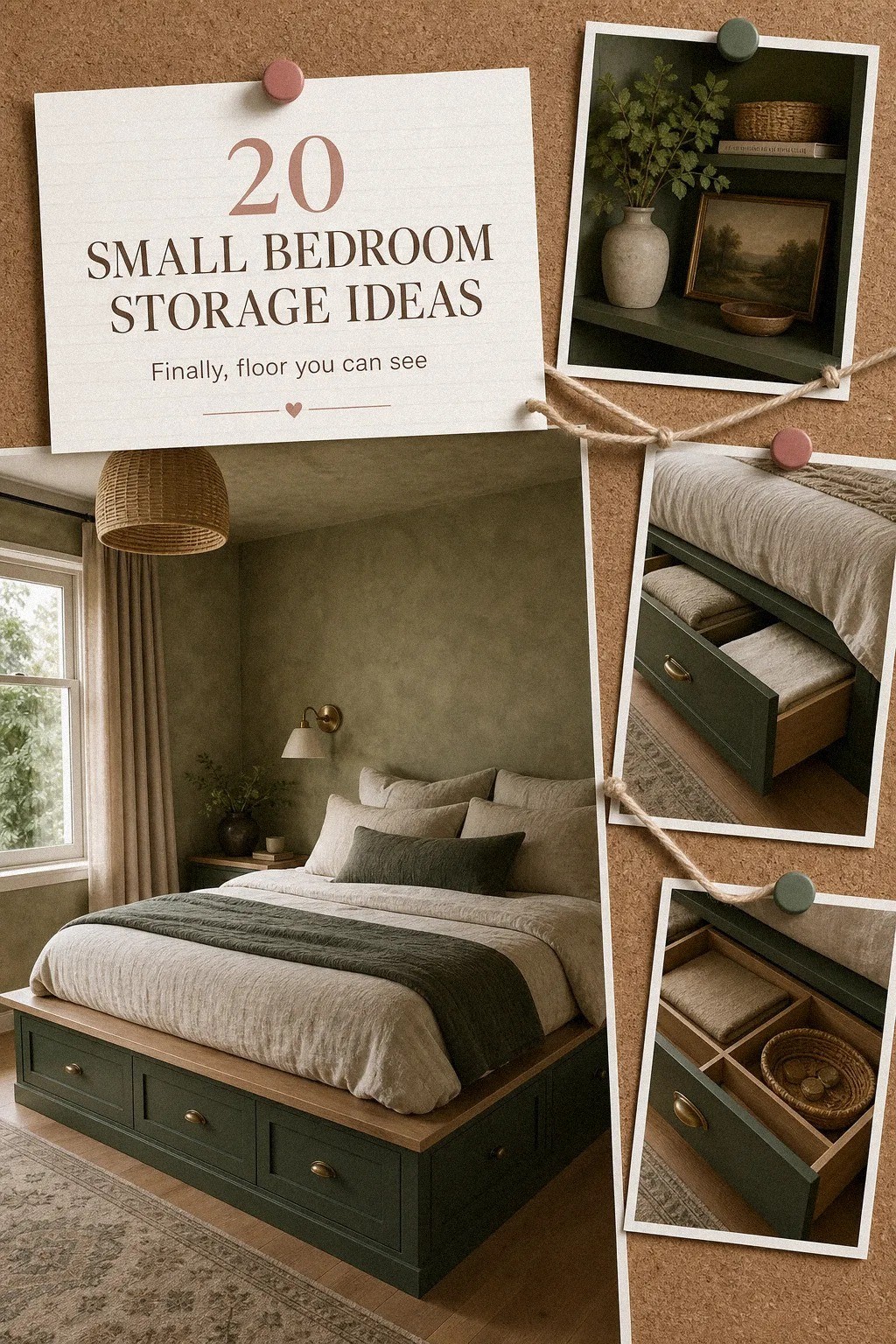
- Raise the bed on a platform with deep drawers tucked underneath
- Slide shallow baskets under the bed, labels facing out
- Float a slim shelf strip just above the headboard
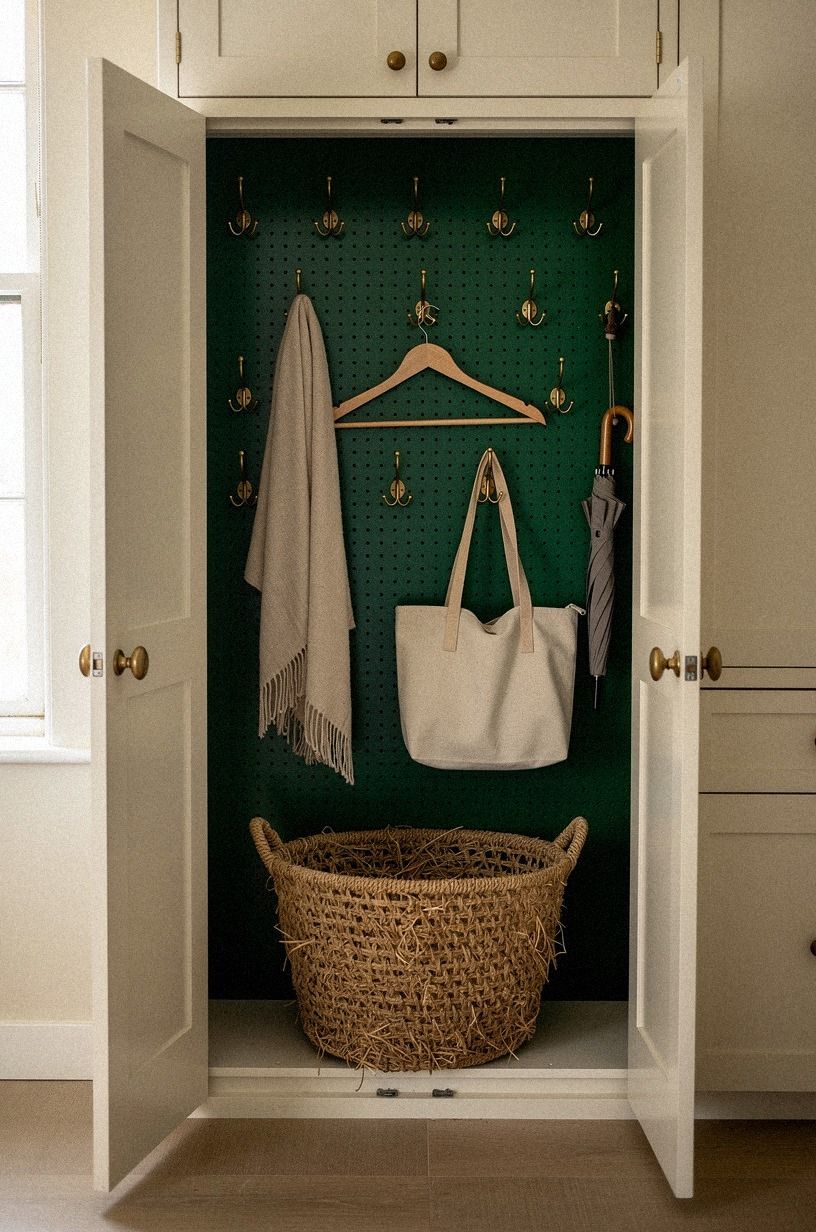
- Mount a pegboard panel on the inside of the closet door
- Stack two slim nightstands at staggered heights
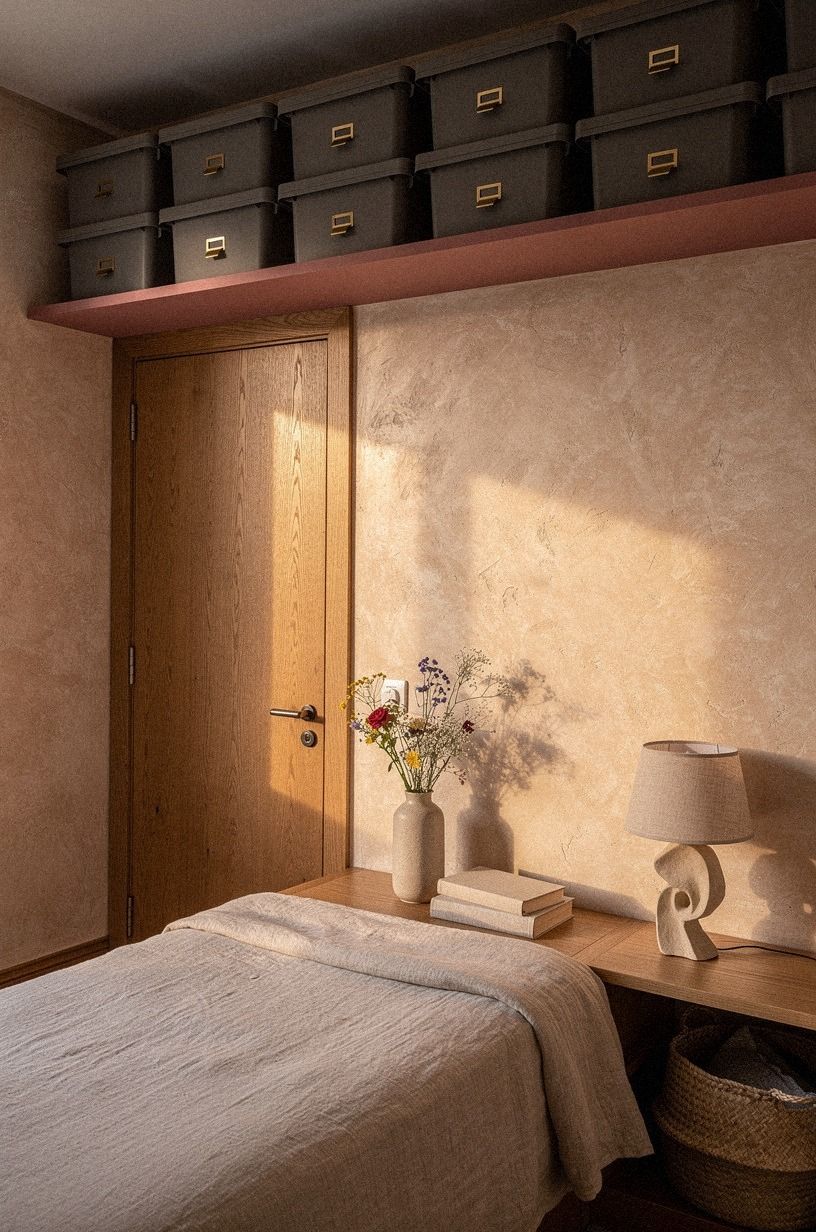
- Run a long shelf above the door frame for off-season bins
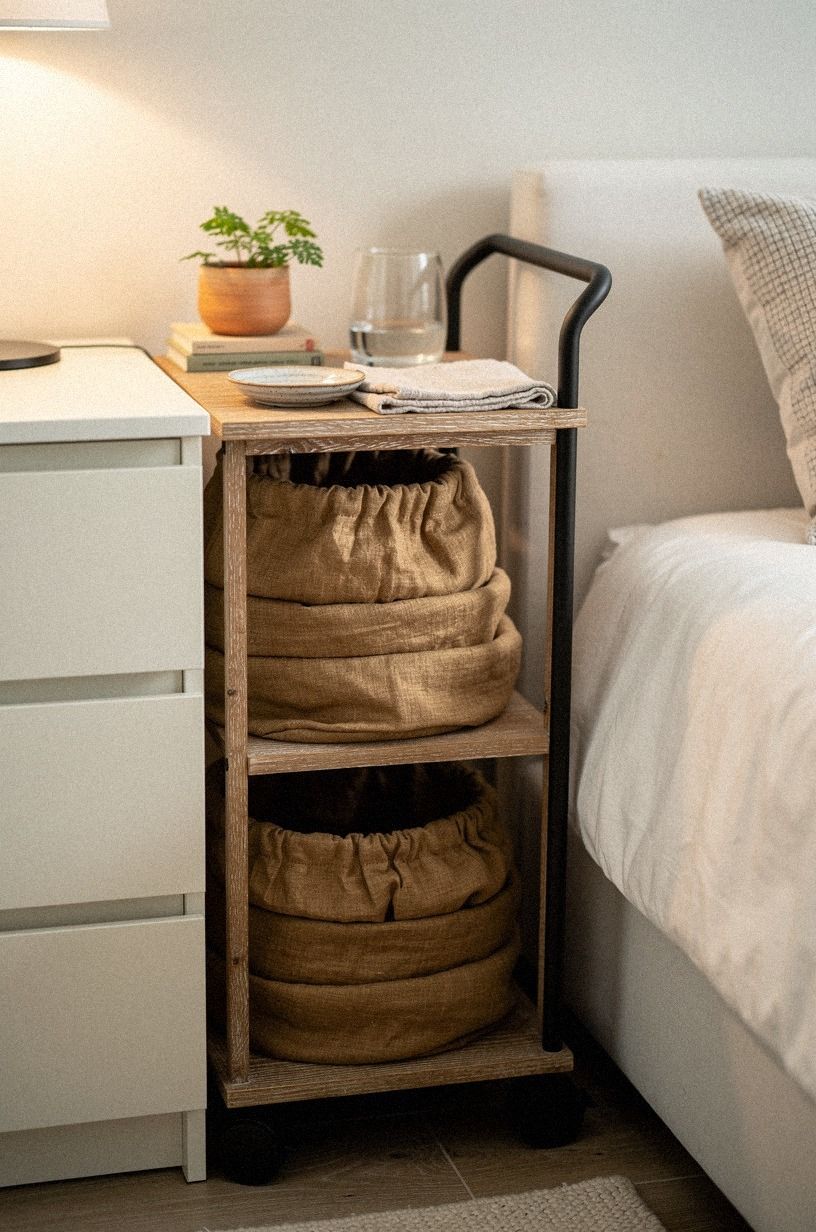
- Tuck a narrow rolling cart into the gap beside the dresser
- Flip all the hangers to face the same direction
- Clip a wire basket onto the bedframe rail
- Stagger floating cubes up the corner, climbing the wall
- Edit what you own before buying another organizer
- What does the back of a door actually do for you?
- Why doesn’t anyone put a shelf above the closet rod?
- IKEA KALLAX, turned sideways, is the cheapest built-in you’ll ever own
- Add a Slim Floating Vanity with Drawers Underneath
- The Two-Minute Rule Beats Every Organizer You’ll Ever Buy
- Squeeze a Storage Bench Under the Window
- Replace Your Dresser Doors with Curtains for Soft Storage
- Hang a Quarter-Round Hook Rail in the Closet’s Dead Corner
- Stack Two Suitcases Under the Bed for Off-Season Storage
1Raise the bed on a platform with deep drawers tucked underneath
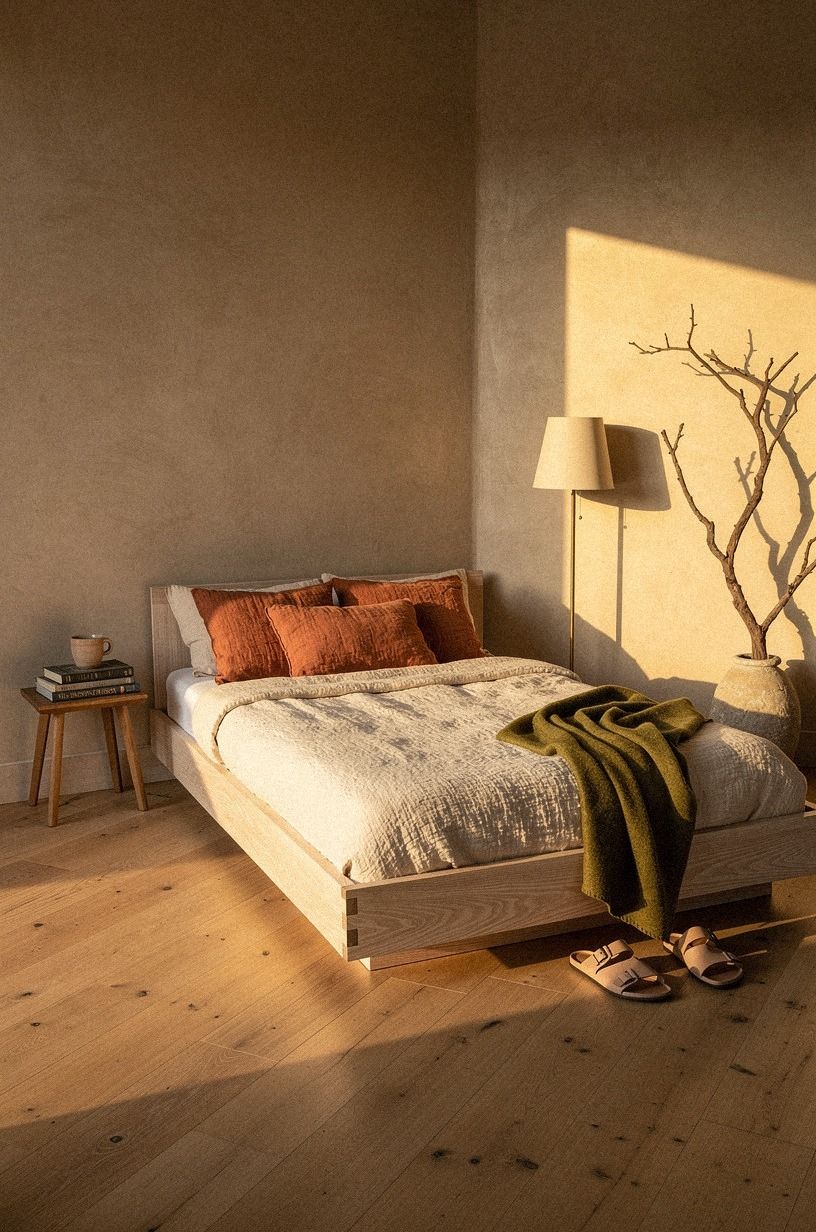
If you only do one thing from this whole list, do this. A platform bed with deep linen-lined drawers underneath eats roughly twelve square feet of clutter you’d otherwise shove into a closet.
I’ve measured it. In a 10×10 bedroom, that drawer volume is the difference between a room that breathes and a room that panics.
The version I’d build (or buy) uses a cerused white oak platform about 14 inches tall, with two deep drawers on the side facing the dresser and exposed dovetail joints at the base for that quiet custom-shop look. Hardware stays small. Try shagreen knobs the size of a quarter, no chunky pulls.
The wood does the talking.
Pair it with bedding in clay-toned linen so the bed reads warm against the oak grain, and don’t skip sealing the inside of the drawers. I learned that one the hard way when a wool sweater picked up raw oak tannins and came out streaked.
Cheap fix, but annoying. If you’re working with a tight budget, the IKEA MALM high bed frame in oak veneer gives you the same drawer volume for around $269.
If you’ve got more to spend, the Article Culla platform bed in solid ash runs closer to $1,299 and will outlast three apartments. The drawer liner matters too: a strip of unbleached cotton inside each drawer keeps small items from sliding when you open and close, and it costs almost nothing at any fabric store.
Skip the hydraulic lift versions. They’re tempting, but the mechanism eats 3 inches of drawer depth and the mattress gets cranky.
Floor-level drawers always win. If you want to layer this with the rest of the room, our small bedroom layout guide is the next read, and if you’re hunting for more floor-friendly storage, our 9 small bedroom storage ideas that don’t eat the floor pulls the bigger picture together.
2Slide shallow baskets under the bed, labels facing out
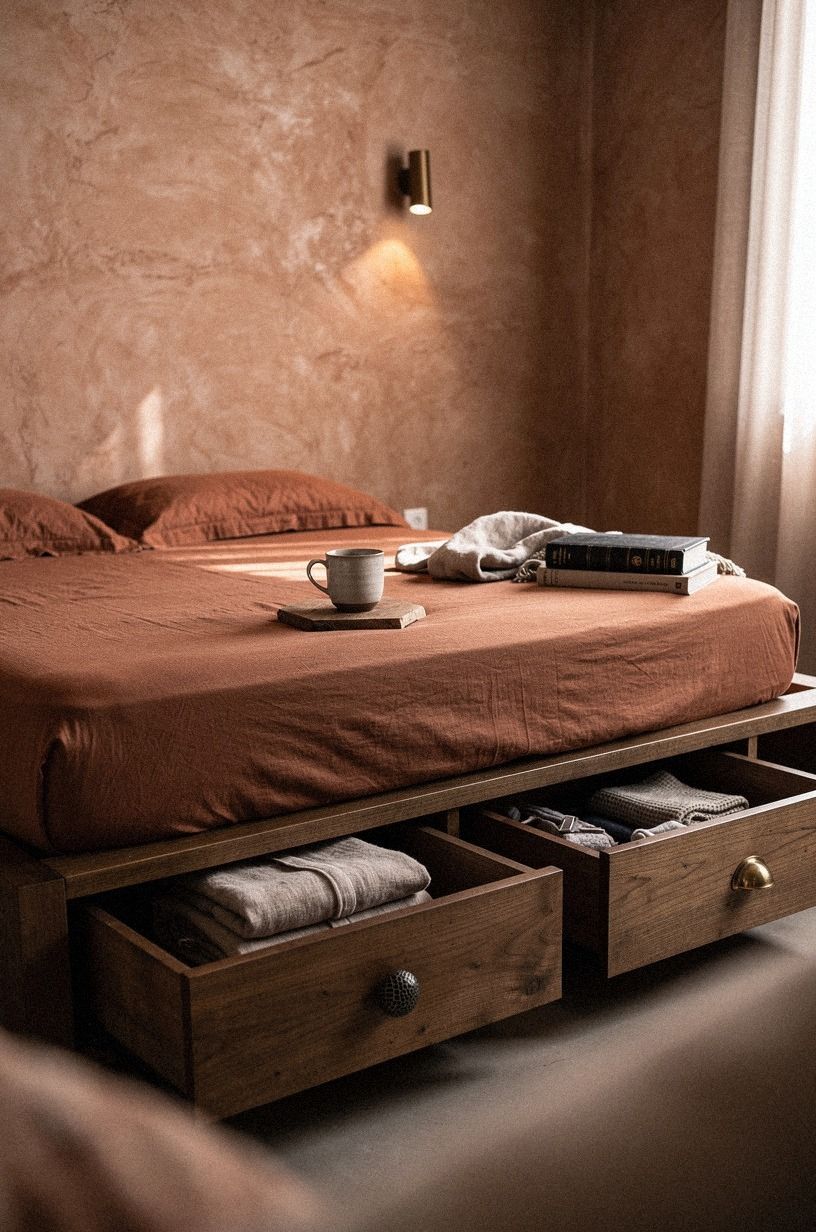
The cheap cousin of the platform, and the move I recommend to every renter who can’t build anything. Shallow woven baskets under 6 inches tall slide under almost any bed on a hard floor. Put the handles facing out, tie a small leather tag on each one, and you’ve just labeled your closet without buying a label maker.
It costs almost nothing and looks like you thought about it for weeks.
What goes in them matters. Off-season shoes.
Sweaters you won’t touch till October. Extra throw blankets.
The bag of receipts you keep meaning to file. Anything flat-ish and infrequently needed. If you can see the label from a crouch, you’ll use them.
If you can’t, you’ll forget they exist and find them during a move three years later, full of mystery.
The baskets themselves run $12 to $30 each at IKEA, Target Threshold, and any decent home store. The IKEA FLÅDIS basket in seagrass is around $15 and slides beautifully.
Skip the fabric bins. They snag on bed skirts and never recover their shape. Hard-sided woven baskets, lined with a strip of muslin so nothing escapes through the weave, are the move.
One small detail: leave the labels facing the doorway, not the wall. You won’t crouch sideways to read them. Trust me on that one.
If your bed sits on slats with no clearance, this one’s a no-go. But if you’ve got 4 inches of air underneath, you’ve got a drawer you haven’t opened yet. For more floor-friendly ideas, check out our 14 small bedroom DIY ideas that work in tight rooms.
3Float a slim shelf strip just above the headboard
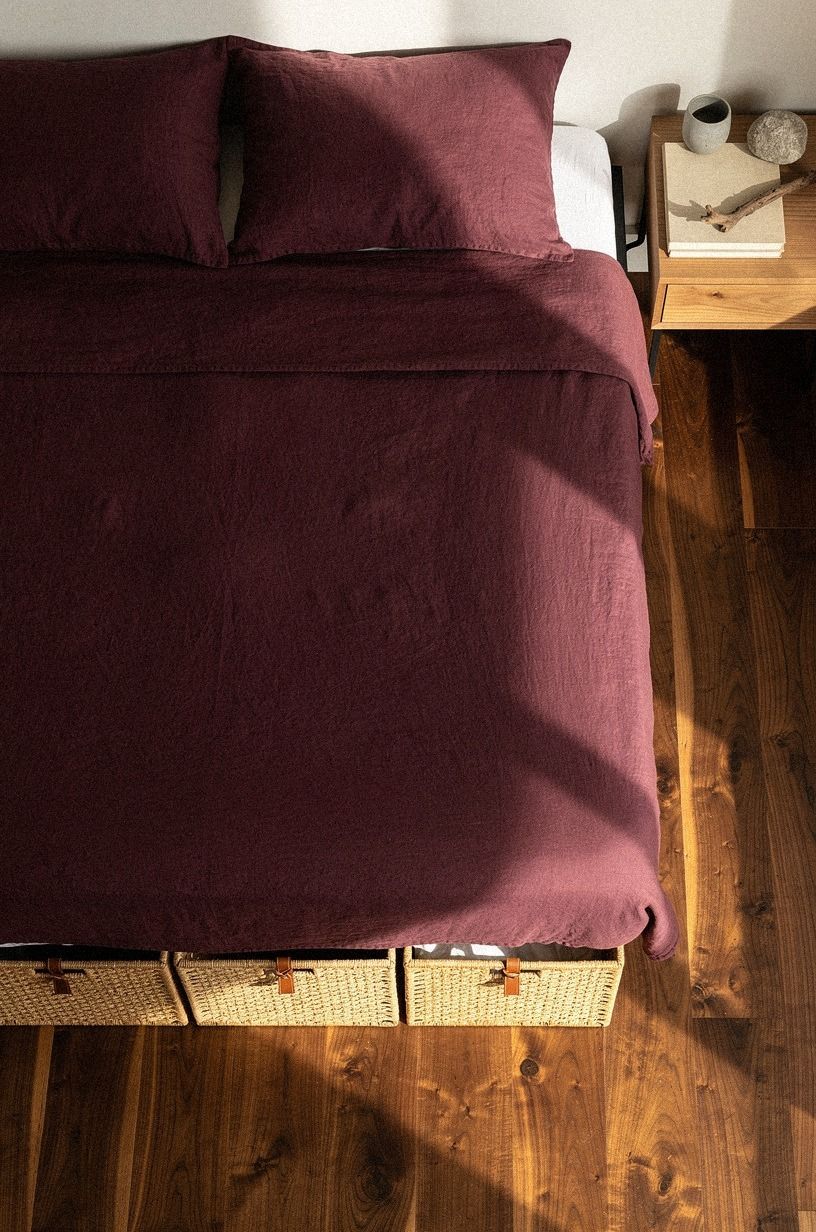
Wall space directly above a headboard is dead space in 90% of small bedrooms. People either ignore it or hang a single piece of art and call it done.
Both are wastes. A slim shelf strip 3 inches deep, as wide as your headboard, gives you a runway for books, a reading lamp, a small framed photo, and a carafe of water without taking up a single square inch of floor.
Your eye reads it as decor, but it functions like a shelf!
Mount it 6 to 10 inches above the headboard top so the books don’t bonk the wall when you flip pages. Use solid white oak if you’ve got the budget (it’ll match the rest of the room), or a slim laminated birch strip from a hardware store if you don’t. The point is keeping the depth shallow.
Go deeper than 4 inches and the whole shelf starts to feel like a second nightstand, which is the opposite of what you want.
Style it like a tiny mantle: two or three books stacked flat, a small framed photo leaning against the wall, one object with a bit of warmth to it. I like a small unlacquered brass bud vase with a single stem of eucalyptus.
The brass catches morning light without screaming for attention. It’s the kind of detail that makes the room feel considered instead of assembled.
And if you’re chasing this kind of layered styling elsewhere in the house, our 15 small bedroom ideas that turn tiny rooms into retreats goes deeper on the layered-object move.
If you’re a renter, use 3M Command Strip shelves rated for the weight. They hold up to 4 pounds cleanly and come off without paint damage.
Don’t try this with a heavy marble bookend. I lost a chunk of drywall that way and the patch job looked worse than the missing shelf.
4Mount a pegboard panel on the inside of the closet door
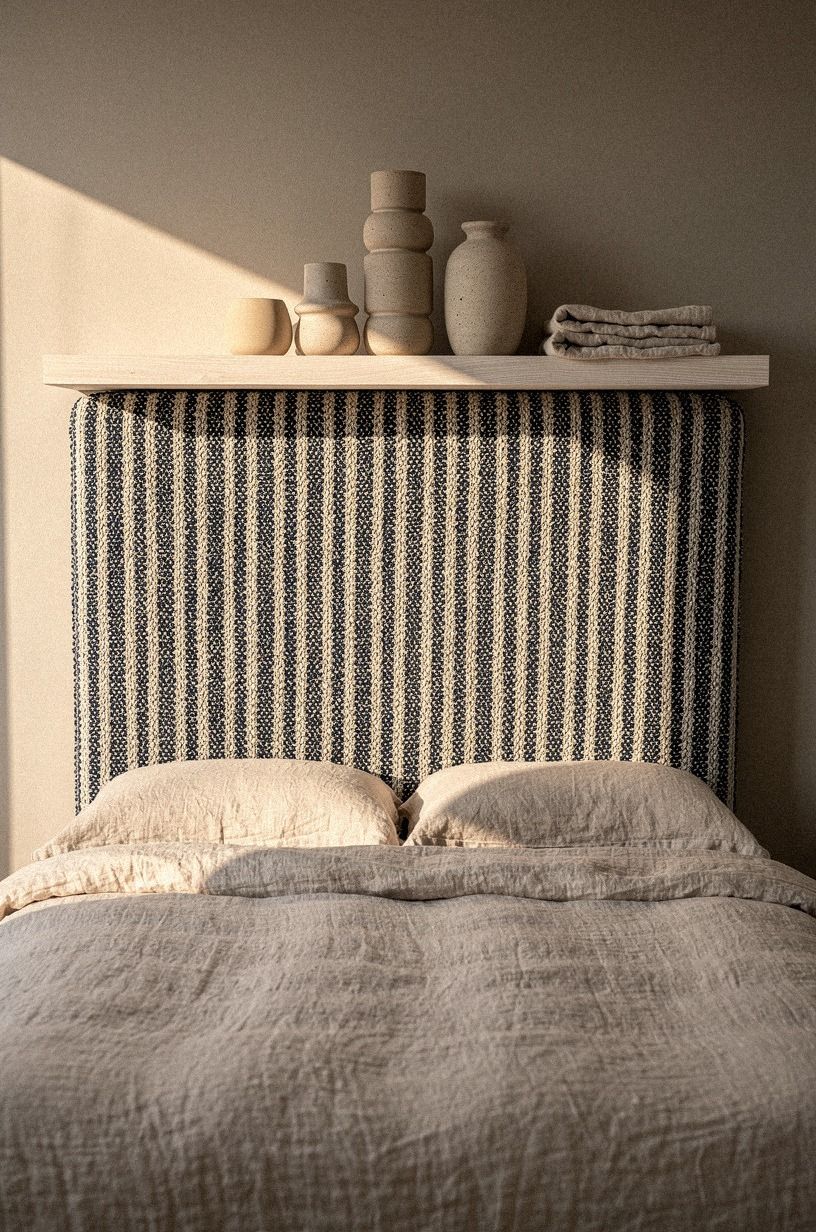
The closet door is the most underused vertical surface in a small bedroom.
5Stack two slim nightstands at staggered heights
Most small bedrooms get one nightstand and call it done. That’s a waste of the corner.
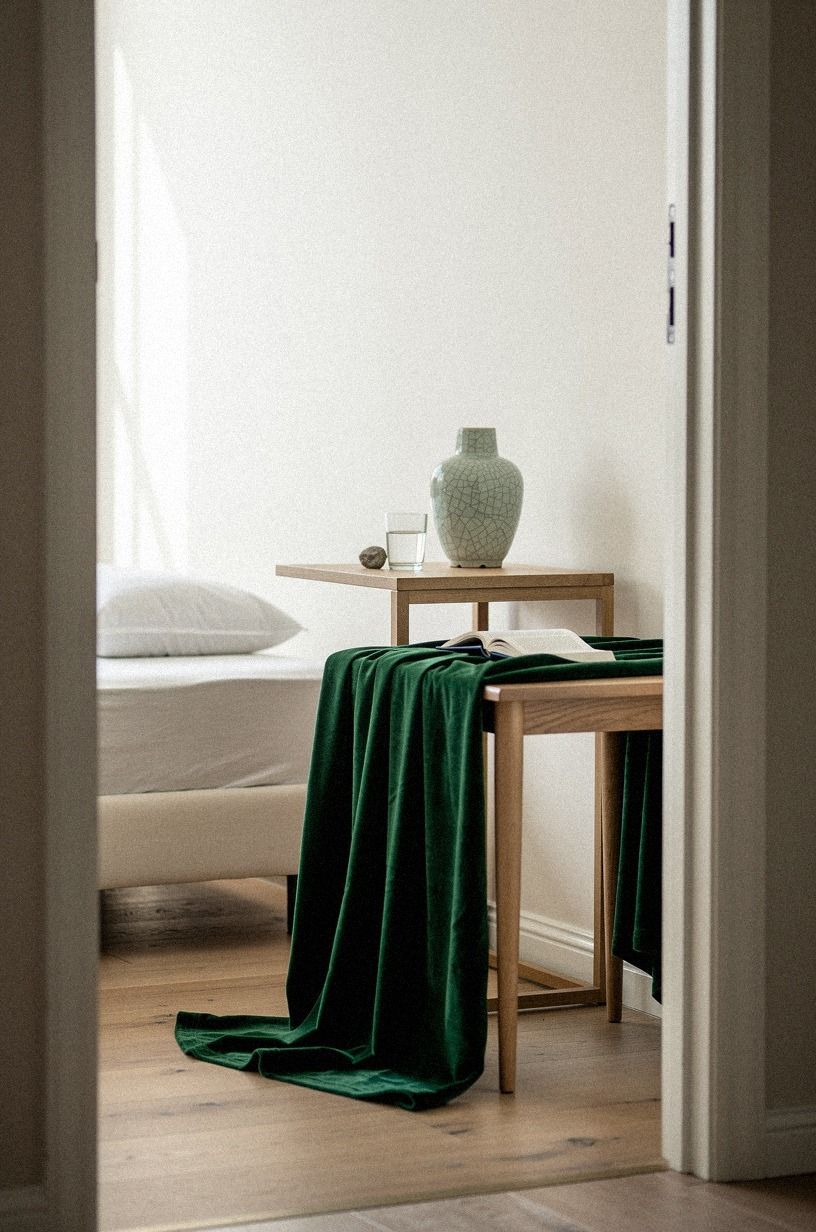
Two slim nightstands, staggered at different heights so the eye reads them as a pair, give you twice the surface and twice the drawer count without doubling the footprint. And the stagger is what makes it look intentional instead of improvised.
The point is the height difference. One at standard 26-inch nightstand height for the lamp and your phone.
The other at 22 inches, slightly lower, holding a stack of books and a carafe. The drop between them is what makes it feel intentional, like a styling decision instead of two mismatched tables. Both in natural oak, both with slim tapered legs, both at 18 inches deep instead of the standard 22, and you’ve just freed up 8 inches of walking room between the bed and the wall.
On top of the lower one, drape a small square of forest-green mohair velvet instead of a runner. Mohair catches light in a way no cotton does, and the green pulls in the shelf color from earlier without being matchy. The runner look is over.
A small draped square reads considered without trying. And if you want a softer drape that doesn’t fight the velvet, a stonewashed linen square in oatmeal tucked under one corner does the layering work without adding visual weight.
If you can’t find two slim oak nightstands at the same place, the IKEA TONSTAD nightstand in oak is 18 inches deep and pairs nicely with the slightly shorter HEMNES version if you sand the legs down an inch. Both under $200 each. And if you’re working through the same furniture logic in a tighter room like the bathroom, our 15 smart small bathroom storage ideas to maximize your space runs the same staggered-height move.
6Run a long shelf above the door frame for off-season bins
The space above a door frame is 12 to 18 inches of vertical room that almost nobody touches.
7Tuck a narrow rolling cart into the gap beside the dresser
The 6-inch gap between your dresser and the wall is not a gap. It’s a closet.
A slim rolling cart 18 inches deep, 12 inches wide, on locking casters slides in and disappears until you need it. That’s where the hair tools live, the small stack of books, the candle collection, the three half-finished tubes of things you do reach for every morning.
You won’t see it 90% of the time, and that’s the point.
The cart itself should be reclaimed teak if you’ve got it, or a slim powder-coated steel version if you don’t. Wood reads warmer; steel reads sharper.
Both work. The point is the casters.
Locking wheels are non-negotiable. You’ll pull it out twice a week, and you do not want it sliding back mid-styling.
Style the top tier with one small object, not a vignette. A camel-linen basket holding your hair ties and clips, or a small ceramic dish for jewelry. The temptation is to treat it like a shelf and pile it up.
Don’t! The rolling cart only stays pretty if the top stays minimal.
Your future self will thank you when you’re not digging through three layers of stuff at 7am.
The IKEA RÅSKOG cart in white is around $50 and works as the cheap version. Skip the black if your room is already dark.
It disappears visually and you’ll lose the cart against the wall for three weeks at a time. White holds its place. If you’re chasing narrow-cart solutions in another room, our 25 kitchen storage ideas that make small spaces look bigger puts the same rolling-cart logic between the fridge and the wall.
8Flip all the hangers to face the same direction
This one costs nothing and changes everything. Walk into your closet, turn every single hanger to face the same way.
Hooks out, shirts facing front, all of them. Suddenly your closet looks twice as full and four times as intentional. It’s the cheapest design move in this whole list, and it photographs like a magazine spread for the price of a Sunday afternoon.
The deeper move: switch to uniform copper-wire hangers. The thin profile means you can fit twice as many pieces on the same rod, and the copper reads warm against midnight-blue linen shirts and ivory knits in a way no plastic hanger ever has. You can find them at any Container Store for about $25 a bundle of 50, or on Amazon for the same.
Don’t mix them with your old plastic ones. The visual noise of mismatched hangers undoes the whole effect.
I’d also flip them seasonally. Heavier pieces (wool coats, lined blazers) facing one way in October, lighter pieces facing the other in April. It’s a small thing, but it makes the closet feel looked-after instead of stuffed, and the eye reads the rhythm.
And here’s the funny part: this is the move that gets the most “where do you store everything?” comments. It’s not really more storage.
It’s just storage that looks like somebody thought about it. Same rod, same clothes, completely different read.
9Clip a wire basket onto the bedframe rail

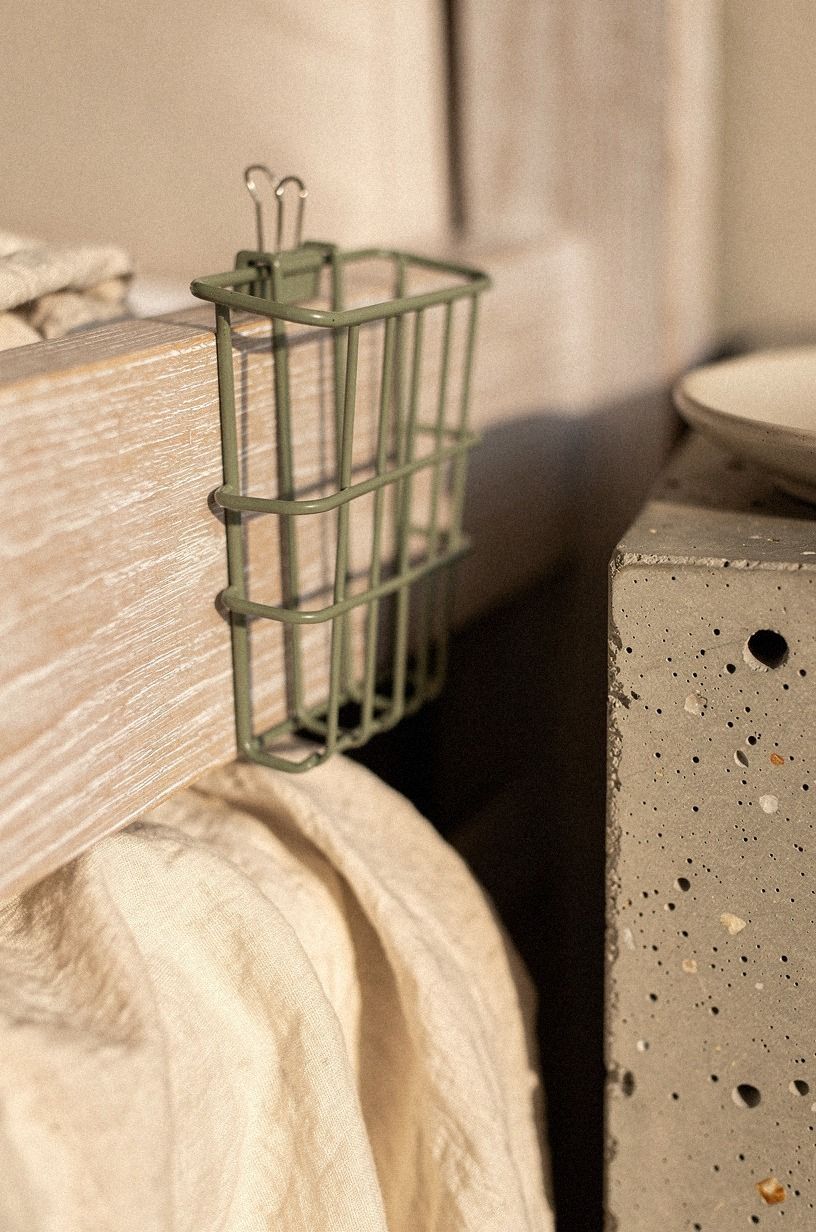
A sage-green wire basket clipped onto the side rail of the bedframe is the single most underrated small-bedroom move I know. It holds whatever you’d otherwise throw on the floor.
The book you’re currently reading, the sleep mask, the lip balm, the phone charger coiled up. It clips on, clips off, moves with the bed if you rearrange.
Total cost under $20, and it does the work of a nightstand without taking the floor space.
The reason it works better than a floor basket: it’s at hand height when you’re sitting on the bed. No crouching, no fishing around. You reach, you grab, you read.
The wire design lets you see what’s inside at a glance, so the basket doesn’t become a junk pile.
Style it with intention. One book, one small object, one soft thing.
Don’t load it up. The basket’s job is to hold your current three items, not your entire bedside drawer.
If you want to hide the contents, use a fabric basket instead, but you’ll lose the clip-on convenience and the quick-glance clarity.
The wire basket clips I’ve had the most luck with are the simple metal carabiner-style clips with a rubberized jaw. They grip a 1 to 2-inch rail without scratching the wood, and they slide off in a second when you want to rearrange. Skip the spring-loaded plastic versions.
They snap within six months and leave a tiny crack in the finish where they were.
Pair it with a poured concrete nightstand on the opposite side if you’ve got the square footage. The concrete reads grounding, the wire reads light, and the bed suddenly has the visual balance of a magazine shoot without costing one. I picked up a 12-inch concrete cube from a local maker for $80 and it’s the only nightstand I’ve never replaced.
If you’re mapping nightstand height to mattress scale, our 14 small bedroom layouts that make the room feel bigger runs the exact dimensions.
10Stagger floating cubes up the corner, climbing the wall
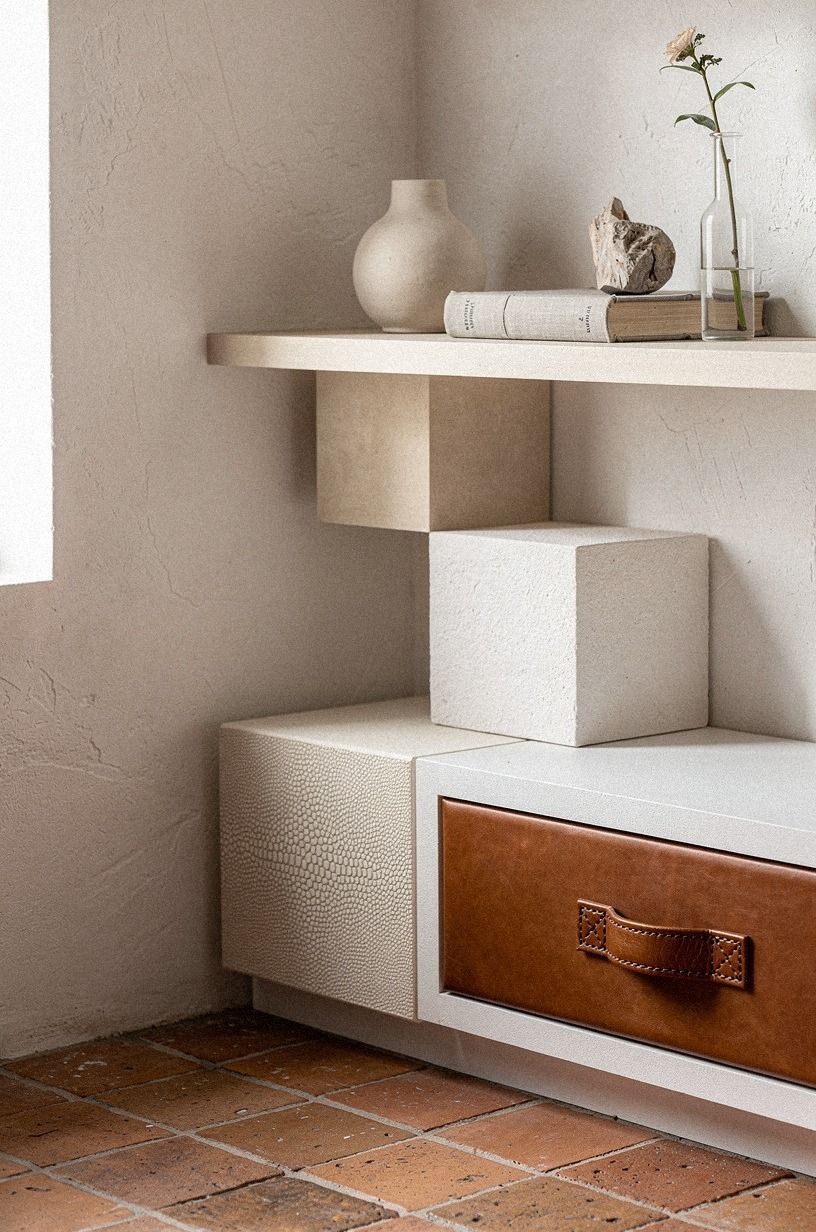
The corner of a small bedroom is vertical real estate begging to be used. Five or six floating cubes, staggered up the wall, climbing toward the ceiling, turn that corner into a small library, a plant shelf, or a display for the objects you really like looking at. And the stagger is what makes it read as a design choice, not just a shelf you stuck on a wall.
The cubes should be solid wood with shagreen-paneled fronts, or simple matte-black powder-coated steel if you want a sharper read. Either works.
The point is the stagger. Not a grid, not a column.
A zigzag climb that draws the eye up and makes the ceiling feel taller than it is. The cubes nearest the floor hold heavier things (books, a small basket of scarves).
The ones at the top hold the lighter objects: a small plant, a framed photo, a single ceramic piece.
Spacing matters more than the cubes themselves. 14 inches between centers reads intentional. 8 inches looks cluttered. 24 inches looks like you gave up halfway. If you don’t trust your eye, lay painter’s tape on the wall in the layout first and live with it for a day. It saves the “I should have moved that one” regret on Saturday.
For the actual cube contents, mix one closed-front cube for the stuff you want hidden (chargers, medicine, the random cables), with two open-front cubes for the objects you want visible. The closed cube keeps the visual clutter down, the open cubes let you style. That’s the 1-2 ratio that makes the whole corner look intentional instead of busy!
The IKEA EKET cube in oak effect is $25 a piece and gives you the modular flexibility. The CB2 Stairway bookshelf runs $499 and handles the stagger for you if you’d rather not build it from scratch.
Either way, the corner goes from dead to done in an afternoon. Worth every dollar.
And if you’re going taller in the room, our 15 small bedroom ideas that turn tiny rooms into retreats does the same vertical-storage move with shelving instead of cubes.
11Edit what you own before buying another organizer
Not a decor move. A real one. Before you buy a single basket, shelf, or cart, edit what you own. Pull everything out of the closet, the drawers, the under-bed bins.
Anything you haven’t worn in a year goes. Anything that doesn’t fit goes. Anything you kept for “someday” and never opened goes.
Donate, consign, gift it, throw it away. Just make it leave.
This is the storage move nobody wants to do because it isn’t shopping. But it’s the one that doubles your usable space overnight, and it’s the only one that doesn’t cost a dollar.
A small bedroom can’t store a large life. The honest math is brutal: if your wardrobe is built for a 200-square-foot closet and your bedroom is 90 square feet, no organizer fixes that. Less stuff fixes it.
That’s the part of home design no catalog will tell you.
I do this every March. Pull everything out, try things on, donate a third.
Every single time I think I’ll miss something. Every single time I don’t. The closet gets breathable, the drawers stop fighting, and the room stops feeling like it’s closing in on me.
That’s worth more than any shelf you’ll ever mount.
If you can, photograph each outfit you wore that week before donating. I keep a small album on my phone called “what I really wore” and it tells me the truth about my closet better than any inventory app.
The photo doesn’t lie. The mirror in the morning does.
For the bigger-picture room strategy beyond storage, our 15 small bedroom ideas that make every inch feel intentional is the right next read.
12What does the back of a door actually do for you?
A door is mostly a flat rectangular surface you’ve been standing in front of twice a day for years without once asking what it’s carrying. In a small room, the back of the entry door is one of the easiest storage wins in the house. No drill, no patching, no stud hunting.
Slim adhesive hooks or an over-the-door rack hold jackets, scarves, hats, robes, the bag you keep meaning to bring to the dry cleaner. Anything that otherwise pools on the chair.
I’d skip the fabric-pocket over-the-door organizers. They look like dorm and the fabric sags in a year. A slim matte black powder-coated steel rack with five hooks runs about $25 and disappears against the door.
Hang the heaviest item on the highest hook so the door doesn’t wobble when you swing it open.
For closets with a regular interior door, this is the same move as section 4. In fact, when I’m working with a renter who needs to keep the deposit clean, I’ll mix the back-of-entry hook rack (for coats) with the closet-door pegboard (for jewelry and accessories).
You split the load by door and you double the available surface. Two doors, two systems, zero holes in the wall. Our tiny bedroom ideas that still feel like a grown-up room covers the renter version in more depth.
13Why doesn’t anyone put a shelf above the closet rod?
Above the closet rod is the attic of your closet. Most people leave it empty because the rod is already there, and the rod feels like enough.
It’s not. That strip of wall above the rod is dead space as wide as your closet and as tall as the shelf you put up.
A single 12-inch-deep shelf across the width gives you roughly 4 cubic feet of storage per running foot for the hat boxes, the seasonal handbags, the out-of-season sweaters you don’t trust to under-bed baskets.
The point is keeping depth shallow. 12 inches lets you see the back of the shelf. 16 inches lets you forget what’s there. I’d cut it to 10 inches if your closet doors are shallow sliders. The shelf itself should be 3/4-inch solid white oak if you’ve got the budget (it’ll hold 40 pounds per linear foot without bowing), or a laminated birch strip if you don’t.
Bracket every 18 inches. Anchored into studs.
Off-season bedding is heavier than it looks, and a sagging closet shelf is the saddest thing in the room. Paint it the same Benjamin Moore White Dove (OC-17) as the ceiling and it disappears entirely, or leave it raw wood for a warmer read.
Your call, both work. If you want the full closet logic in one read, our narrow bedroom layouts that fix the awkward long room maps the rod-to-shelf ratio in real floor plans.
14IKEA KALLAX, turned sideways, is the cheapest built-in you’ll ever own
Lay an IKEA KALLAX unit on its side, push it under the window, drop two long cushions on top, and you’ve just built a daybed with nine deep cubbies of storage behind it. The unit runs about $179 in the birch-effect finish, the cushions another $120, and you’ve freed up the entire bed-pushing-the-dresser-against-the-wall conversation for the rest of the room. In a 10×10 bedroom, a KALLAX daybed buys you a window seat that doubles as a guest bed, a reading nook, and a nine-bin storage wall, all in 79 inches of wall.
Style the open cubbies like the floating cubes in section 10: mix closed-front for the stuff you don’t want visible (chargers, exercise gear, the laptop), open-front for the books and the one plant you keep alive. Add a long lumbar pillow in Belgian flax linen in oatmeal, and you’ve got a guest bed that doesn’t look like a guest bed.
Where it falls down: a single KALLAX is fine for one adult sleeping alone. It’s tight for two adults. I’d skip the daybed move if you regularly share the bed with a partner.
The cushions slide, the depth is shallow, and by 3am someone is on the floor. If you’ve got the square footage for a regular bed plus the daybed, fine.
If you’re counting on it as the only bed, keep section 1 as your primary.
For a deeper read on the KALLAX-as-daybed approach plus a few cousins (the WEST ELM Mid-Century Lounger, the CB2 Stairway daybed), our 15 small bedroom ideas that turn tiny rooms into retreats goes wider on the multi-use-furniture logic.
15Add a Slim Floating Vanity with Drawers Underneath
If you’re currently working with a dresser that doubles as a vanity, you already know the daily chaos: thirty seconds of brush-hunting, three minutes of earring-fishing, and the rest of your morning spent moving the toothbrush out of the way. A wall-mounted floating vanity, even a tiny 24-inch version, pulls the morning zone out of the bedroom zone and gives you back the entire dresser surface for clothes.
The sweet spot is 24 inches wide, 18 inches deep, 30 inches off the floor. Solid white oak if you’ve got the budget, MDF with a Farrow & Ball Borrowed Light paint if you don’t.
Add a single slim drawer for the small stuff (rings, retainers, the spare set of contact lenses) and you’ve won about 12 minutes every morning for the rest of your life. Twelve minutes. That’s the difference between breakfast at home and breakfast in the car.
Pair it with a round brass wall sconce above the mirror and you’ve got a real morning station. The sconce throws light at jaw height, which is what flattering morning light really is.
The overhead ceiling fixture doesn’t. The whole vanity zone should be one Benjamin Moore White Dove (OC-17) wall, painted slightly differently from the rest of the room so your eye reads it as a separate zone without a wall actually dividing it.
For renters, do the same thing with a slim standing vanity table. The IKEA HEMNES vanity in white is about $129 and holds up to daily use. Two drawers instead of one, which means the rings and the brushes and the cords each get a home.
Same idea, no holes.
16The Two-Minute Rule Beats Every Organizer You’ll Ever Buy
Here’s the move nobody wants to hear, and the one that beats every shelf on this list. Two-minute rule: anything that takes less than two minutes to put away gets put away immediately.
The hanger goes back on the rod before you walk out of the bedroom. The coffee cup comes to the kitchen.
The book goes back to the nightstand basket, not the floor next to it. Magazine back to the rack. You get the idea.
The math is the part that surprises people. If every misplaced item costs you 90 seconds of evening cleanup, and you’re dealing with ten items a day, that’s 15 minutes a day, almost two hours a week, almost a full weekend a month. Two minutes upfront, ninety seconds in the evening.
You’re not saving the room. You’re saving the week.
I’m not the rule’s inventor (the productivity world claims a few different originators, none definitively). I’m just the person who tried it for a month and watched the small bedroom stop looking like a small bedroom. Two minutes per item.
Ten items a day. Two hours a week back.
The room gets quieter because there’s nothing in flight.
This pairs best with section 11. Edit first, then enforce the rule. Doing the rule without editing is just reorganizing the same pile.
Together they compound. The room you end up with isn’t a styled room, it’s a settled room, and the difference matters.
Settled rooms don’t photograph as well, but they live a thousand times better. You’ll notice.
17Squeeze a Storage Bench Under the Window
A window seat is wasted square footage in 90% of small bedrooms. People either leave the under-window zone empty (chest of drawers, a small chair that holds one sweater) or they buy a bench that’s pure seating with no storage below. The fix is a storage bench: a hinged-top cushion with a hollow interior, the same depth as your dresser, wide enough to sit two.
The dimensions that hold up: 48 to 60 inches wide, 16 to 18 inches deep, 18 to 20 inches tall. Cushion top in Belgian flax linen in a quiet oat or sage. Hinged top with a slow-close hinge (so it doesn’t slam on small fingers, of which most households have at least one).
Inside is the winter scarf collection, the extra throw blankets, the box of holiday ornaments, the spare set of guest slippers. Whatever doesn’t fit anywhere else but isn’t daily stuff.
Build it yourself for $200 in materials if you’ve got a Saturday, or grab the IKEA NORDLI bench with a custom cushion for closer to $350. Either way, you’ve just turned dead under-window square into roughly 6 cubic feet of storage plus a real seat. Two things from one piece of furniture!
Style the top with one lumbar pillow (not three, one) and one throw. The bench is the spot the room reads as the calm zone, and crowding it with pillows kills the calm.
Felt-tipped furniture pads on the bottom of the bench are non-negotiable if you’ve got hardwood. They cost $4 at any hardware store and they keep the bench from sliding every time you sit down.
Worth every dollar. For the wider room-design logic, our narrow bedroom layouts that fix the awkward long room treats the under-window zone as sacred floor.
18Replace Your Dresser Doors with Curtains for Soft Storage
Most bedroom dressers come with hard doors that swing out and eat 18 to 24 inches of walking room every time you open one. In a small room, that’s the difference between a floor you can vacuum and a floor you can’t reach.
Swap the doors for fabric panels hung from a slim rod, and you’ve freed up that swing zone permanently. The storage inside doesn’t change.
The way you access it does.
The curtains should be a Belgian flax linen in oat or bone, hung from a slim unlacquered brass rod that you mount inside the dresser frame. The linen softens the hard rectangle of the dresser and reads as part of the room, not as a piece of furniture you keep bumping your hip on. Simple slim rings, no fancy hardware, and you’ve got a softer-feeling room without losing a single inch of storage inside the dresser.
Where this falls down: anyone renting who has to put the dresser back to original at move-out. Don’t do this if the dresser came with the apartment.
If it’s your dresser, fine. Otherwise, hold the project until you own the dresser. I learned this when I tried to “refine” an IKEA dresser I didn’t own and got billed $380 for the door replacement at move-out.
The deposit isn’t worth the soft-storage move.
If you want the same soft-storage feeling without the door surgery, drape a single long piece of linen over the front of the dresser and let it hang past the bottom edge by three inches. It’s the budget version and it photographs identically. The eye reads the texture, not the construction.
19Hang a Quarter-Round Hook Rail in the Closet’s Dead Corner
Closet corners collect dust and almost nothing else.
20Stack Two Suitcases Under the Bed for Off-Season Storage
Most people own at least one suitcase they haven’t opened in two years. That’s the storage you didn’t know you had.
A hardshell carry-on and a checked-size roller, stacked flat under the bed, hold roughly 4 cubic feet of out-of-season clothes, spare bedding, the duvet you swap in November, or the box of family photographs you’ve been meaning to scan. Anything you might need once a year but rarely more.
The point is picking suitcases that stack clean. Hardshell polycarbonate roll-aways hold their shape forever and survive the dust under the bed.
Soft-sided duffels compress over a year and start looking like a sad pile by month eight. I’d spend $20 more at the start on the right case and save the headache later.
The Monos Carry-On and the AWAY The Bigger Carry-On both handle under-bed conditions cleanly.
What goes in each matters. The smaller case, top of the stack, is the once-a-year stuff (the winter hat collection, the spare set of sheets for the guest bed).
The larger case, bottom, holds the heavier things (the winter coats in summer, the summer linens in winter). You access the top case maybe four times a year. The bottom case maybe twice.
Everything inside stays wrapped in unbleached muslin so the dust doesn’t drift into the fabric, and the suitcases live on a small wooden tray so they slide out cleanly without dragging on the floor.
This is the move that finally uses the 8 inches of air under the bed that section 2 alone can’t fill. Baskets handle the everyday overflow.
Suitcases handle the seasonal overflow. Together, they turn the bed’s footprint into two storage systems that never get in your way.
Combined total under-bed volume: 8 to 12 cubic feet, all hidden, all accessed twice a year, all free if you’ve already got the luggage.
The cost of all this, in real numbers
Small bedroom storage doesn’t have to be expensive, and the budget table below is what you can realistically expect at each tier. I’ve used US averages across furniture stores, hardware stores, and direct-to-consumer brands. The high end includes things like a custom platform bed and built-in closet work, which most people skip, but it’s there for the reference.
A few material costs to keep in mind if you’re pricing individual pieces:
A queen mattress is 60×80 inches (152×203 cm), so the rug beneath it should extend 18 to 24 inches past the bed on three sides for that “floating” look. A king is 76×80 inches (193×203 cm) and needs a bigger rug or a wider room. Nightstands should sit at mattress height, usually 24 to 28 inches (61 to 71 cm), so your lamp throws light at reading angle instead of from up by your armpit.
The Questions I Get Asked Most
What is the best small bedroom storage for a tight layout?
A platform bed with deep drawers is the single highest-impact move. The IKEA MALM high bed frame in oak veneer gets you roughly 12 cubic feet of drawer space for under $300, and the Article Culla platform bed in solid ash is the upgrade version for closer to $1,300.
The drawers live in the floor nobody’s using, so you don’t lose any wall space or floor space to gain them. That’s the win.
Where can I buy small bedroom storage pieces on a budget?
Three places to start: IKEA for the structural pieces (platform bed, cubes, pegboard), Target Threshold for baskets and soft organizers, and Wayfair for nightstands and shelves you can filter by depth. For second-hand, Facebook Marketplace and OfferUp are gold for solid wood nightstands and dressers.
People move apartments and unload real oak for the price of particle board new. Thrift stores are hit or miss, but the misses cost you twenty minutes.
Worth a Saturday morning. For a tighter read on the budget side, our small bedroom storage ideas that don’t eat the floor pulls the renter moves together in one place.
How much does a small bedroom storage makeover cost?
Honestly, anywhere from about $200 to $5,000 depending on what you’re doing. A renter refresh, with under-bed baskets, pegboard, a rolling cart, two slim nightstands, and a few door hooks, lands around $200 to $800.
A bigger project with a platform bed, new headboard, custom drapes, and a couple of quality light fixtures lands around $1,500 to $5,000. A full custom closet with built-ins starts near $8,000 and climbs from there. You can stop at any tier and the room will still feel intentional.
Free is also a tier if you edit first.
Can I create more storage in a small bedroom on a budget?
Yes, and most of it doesn’t cost anything. Edit what you own first. That’s free and gives back more space than any organizer.
Then flip all your hangers to face one direction (free), add a shelf above the door frame (about $40 in materials), and slide a few woven baskets under the bed (about $15 each). Total spend: under $100. Total space gained: more than you’d think.
That’s the deal. If you want the full playbook, our small bedroom storage ideas that don’t eat the floor walks through the renter moves end to end.
Is small bedroom storage worth it in a small space?
Worth it, more than almost any other bedroom change. Small rooms punish clutter twice as hard as big rooms because every visible object sits in your peripheral vision.
When the storage works, the room gets quieter. When it doesn’t, the room feels like it’s closing in.
Worth every dollar, and worth the weekend it takes to set it up properly. Your nervous system will notice before your eyes do.
For the bigger-picture read on what makes a tiny room feel intentional beyond just storage, our 15 small bedroom ideas that make every inch feel intentional is the right next stop.
Is small bedroom storage a good idea for a rental?
Yes, and most of the moves here are no-damage friendly. Under-bed baskets, rolling carts, and slim nightstands all come out clean.
The pegboard mounts with 3M Command Strips rated for the weight. The over-the-door shelf uses tension rods instead of brackets.
The floating cubes are the only thing that requires a real drill. Skip those if you can’t patch the wall at move-out. Everything else leaves the room the way you found it.
Landlord happy, deposit back, full credit.
How do I add storage to a small bedroom without it looking cluttered?
The pattern is the 1-to-2 ratio: for every closed storage piece (dresser with doors, basket with a lid, suitcase), keep two pieces open (floating shelf, pegboard, open cube). Closed storage hides the visual noise.
Open storage lets the eye read the room as decorative. If you’re 100% closed, the room reads as a closet. 100% open, the room reads as a flea market.
Mix the two at roughly that 1-to-2 ratio and the eye reads it as styled instead of stuffed. Our 15 small bedroom ideas that turn tiny rooms into retreats shows the same closed-to-open ratio across the whole room.
Where I’d Start First
If I had to pick one, I’d start with section 11, the edit. You can’t layer storage on top of a storage problem, and editing what you own is the move that costs nothing and returns more space than any organizer ever will.
Once you’ve cleared the dead weight, sections 1 and 2 (platform bed plus under-bed baskets) lock in the floor storage, and the rest of the list starts compounding. Pin the edit step for later, even if it’s the least glamorous move on the page.