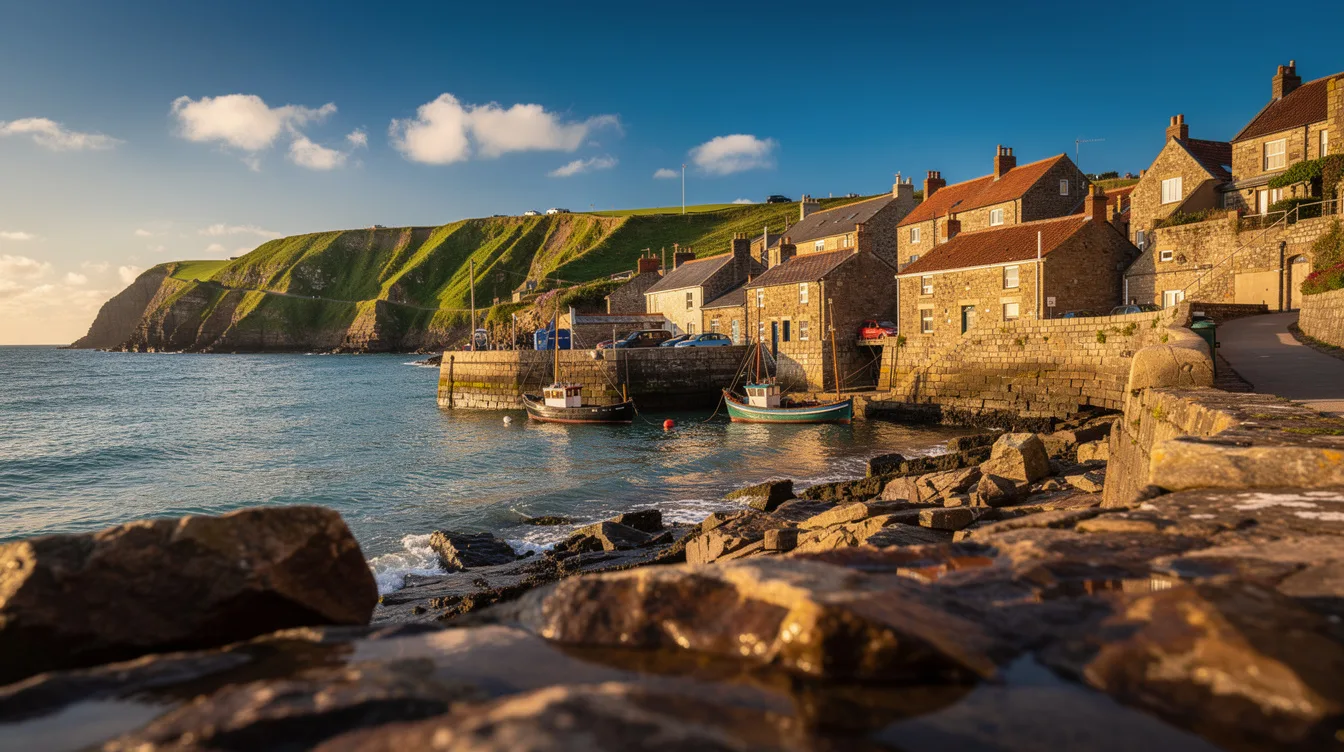
Staithes once sent 80 full-time fishing boats from its harbor at the turn of the 20th century. That number feels startling once you stand in the old village, where cottages press close and the harbor seems made for a much smaller world.
But this North Yorkshire village worked hard. In the 1800s, more than 300 fishermen hauled in the catch from what was then one of northeast England’s largest fishing ports.
A working harbor, then a different kind of crowd
The old center clusters around a sheltered harbor, high cliffs, and two long breakwaters. That shelter mattered to fishing boats, and it still gives the water a contained, quiet look when the coast beyond it feels exposed.
And you can still feel the logic of the place under your shoes. The lanes bend toward the harbor because work once did too, while the upper village sits uphill around High Street and the A174.
Fishing and mining have declined, and tourism now shapes the village. That change brings galleries, shops, seafood restaurants, and holiday cottages, but it also means some older traditions are no longer practiced as widely.
Dog Loup makes the village feel even tighter
The detail worth seeking out is Dog Loup, a passage just 46 cm wide. It is claimed to be the world’s narrowest alley, and the claim lands because the village already feels as if its buildings have leaned together for centuries.
But don’t expect a grand monument. This is a small, almost comic constraint in the middle of real streets, where you notice walls, doorways, and the squeeze of old planning more than any polished visitor display.
You should walk slowly here. The narrow passages are the point, yet they can also make the old village confusing if you arrive expecting broad waterfront promenades and obvious routes.
The A174 keeps Staithes within reach
The A174 runs along the coast between Whitby and Middlesbrough, with Staithes on the route. That direct access makes the village remote in feeling, but not awkward to find.
And the nearby coast gives you options without asking you to abandon the village’s scale. Port Mulgrave is 1.3 miles away, while Runswick Bay is 2.7 miles away.
Staithes is part of the North York Moors National Park, though its strongest impression is maritime. Salt air, rock underfoot, and the hard lines of the breakwaters do more to define a visit than any broad countryside cliché.
There is more here than the old fishing story
The cliffs around the village draw geologists researching Jurassic strata. Port Mulgrave is known as a place to look for ammonite fossils, and visitors spend time opening shaly shoreline rocks in hopes of finding one.
But treat that as a patient shoreline pursuit, not a guaranteed souvenir hunt. The pleasure is in looking closely, with the sea nearby and the village’s tight roofs behind you.
Staithes Museum occupies a disused Primitive Methodist chapel on High Street. Its collection covers village history and the period when a future British naval figure worked here as a teenage shopkeeper’s apprentice in 1745-1746.
August and September bring the village outward
The Staithes and Runswick RNLI Lifeboat Weekend takes place every August. It includes a nightgown parade and supports the local lifeboat station, so the event has a clear connection to the coast rather than a borrowed festival theme.
And the Festival of Arts and Heritage returns each September. Houses and other properties become pop-up galleries, creating a trail through a village whose close-set streets already reward wandering.
You can visit throughout the year, but those annual weekends change the mood. The trade-off is simple: more open doors and activity, with less of the harbor’s usual hush.
By the time you leave the waterfront, the old fishing fleet can seem impossible to picture. Then you turn into a passage barely wider than your shoulders, hear the water beyond the cottages, and the scale of Staithes makes sense again.