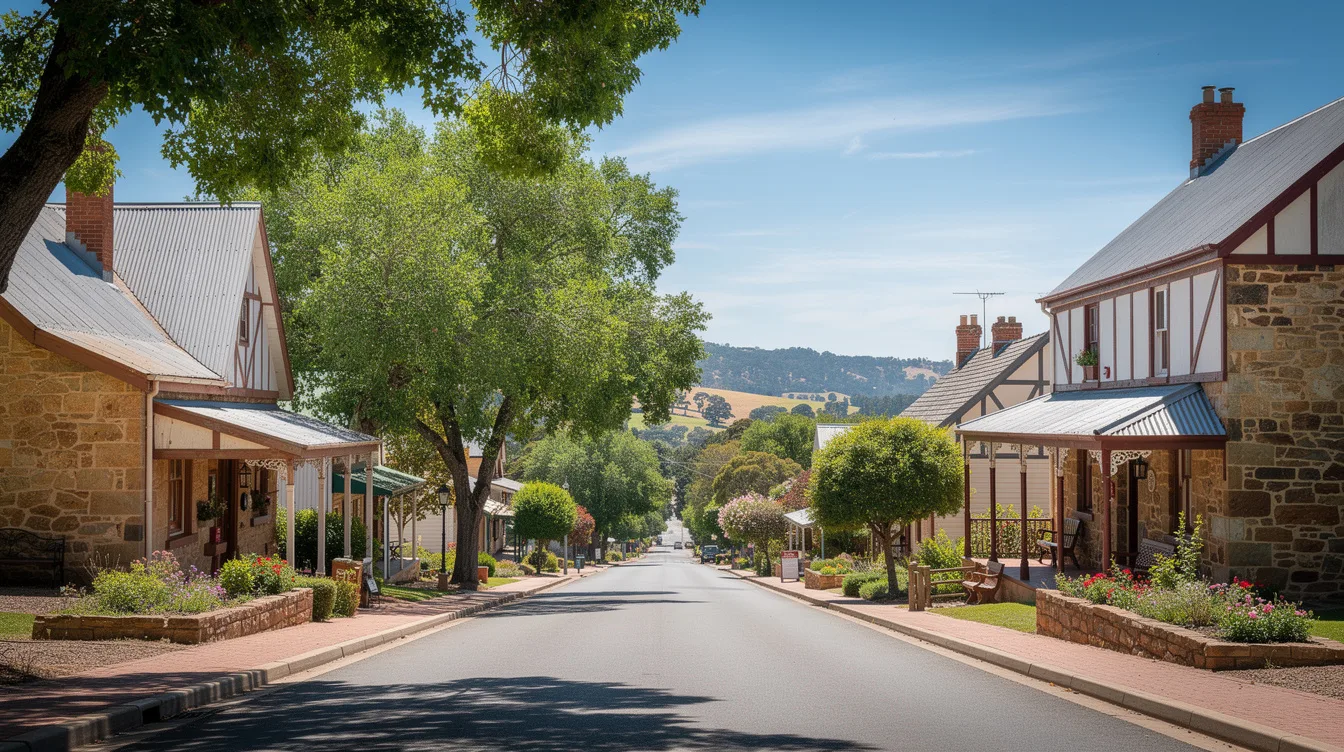
Hahndorf has kept its German settlement alive because its history remains built into daily life, not sealed behind museum glass. Founded in 1839 by Lutheran migrants from Prussia, it is Australia’s oldest surviving German settlement, and you feel that continuity on its long, leafy Main Street.
It’s an easy day trip from Adelaide, yet it doesn’t feel like a city suburb dressed for visitors. The Adelaide Hills cool the mood. Shop windows, timber-framed buildings, bakeries, pubs, and cafés keep the village’s German influence visible at street level.
A voyage, a village, and a name that returned
The story begins before Hahndorf existed. Many settlers arrived at Port Adelaide on December 28, 1838, aboard the Zebra, after leaving Prussia amid religious persecution. They were 38 Lutheran families, and the village formed the following year.
But survival here meant more than arrival. The settlers built a distinct village layout and early German-influenced buildings, features now protected within a State Heritage Area. If you want to understand why Hahndorf still reads as German, start by noticing that the physical fabric was protected.
The town’s name also tells a stubborn story. It honored the Zebra’s captain, although the name was replaced with Ambleside in 1917 during the First World War. On December 12, 1935, Hahndorf became Hahndorf again.
That reversal matters. You’ll still find references to Ambleside around town, which gives the place a little friction instead of a polished heritage script. Hahndorf’s identity endured, but it was not uninterrupted.
Main Street keeps history within reach
Main Street is where the settlement becomes useful to a traveler. Walk it slowly for the preserved heritage buildings, galleries, boutiques, bakeries, smallgoods shops, pubs, and cafés. The best pleasure is modest: warm food, a leafy street, and nowhere urgent to be.
And yes, it can feel touristy. Weekends and public holidays draw crowds, so arrive early or come on a weekday if you want room to look up at the timber-framed Fachwerk details. By midday, the village can feel more like an outing than a pause.
You can eat German-style food without making a production of it. Schnitzel, bratwurst, kransky, sauerkraut, and local beer are common choices. The appeal is familiar and direct, especially after a morning wandering between bakery counters and shopfronts.
But don’t treat the food as the whole point. Hahndorf works because German influence appears in architecture, place names, and heritage planning as well as lunch. That makes the village more convincing than a themed dining stop.
Art, wine, and a slower Adelaide Hills afternoon
For a quieter turn, visit The Cedars, a historic home, studio, and garden connected to an Australian artist who lived and worked in Hahndorf for more than 60 years. Guided tours add depth, especially if Main Street’s bustle has started to wear thin.
You can also take a break from Main Street. It’s a practical stop, not an obligation. The village is compact enough that you can decide on the day whether you want art, shopping, or simply another coffee.
Beyond town, Hahndorf makes a sensible base for the wider Adelaide Hills wine region. Local cellar doors and restaurants, including Sidewood Estate, give you an afternoon option without abandoning the village entirely. You’ll want a car if wine is central to the plan.
And autumn is the season with the strongest visual payoff. European deciduous trees take on their seasonal color, softening the roads and village edges. It’s a borrowed European mood in South Australia, but the setting never pretends to be elsewhere.
Getting there without overcomplicating it
Hahndorf sits about 17.4 miles southeast of Adelaide, usually a 25-30 minute drive via the South Eastern Freeway. That short approach is the village’s advantage. You can leave the city after breakfast and still have a full afternoon in the hills.
Public transport connects Adelaide and Hahndorf too, with routes including 861, 864, and 866 cited by local visitor information. Check Adelaide Metro close to departure because timetables can change. If your time is tight, driving gives you more freedom for wineries and nearby roads.
Staying overnight is worthwhile if you dislike rushing. You can take Main Street in the morning, linger over lunch, then choose The Cedars or a cellar door later. But for many visitors, one well-paced day is enough.
By the time the crowds thin, the leaves along Main Street catch the late light, and Hahndorf feels less like a stop on an itinerary than a village still holding onto its own name.