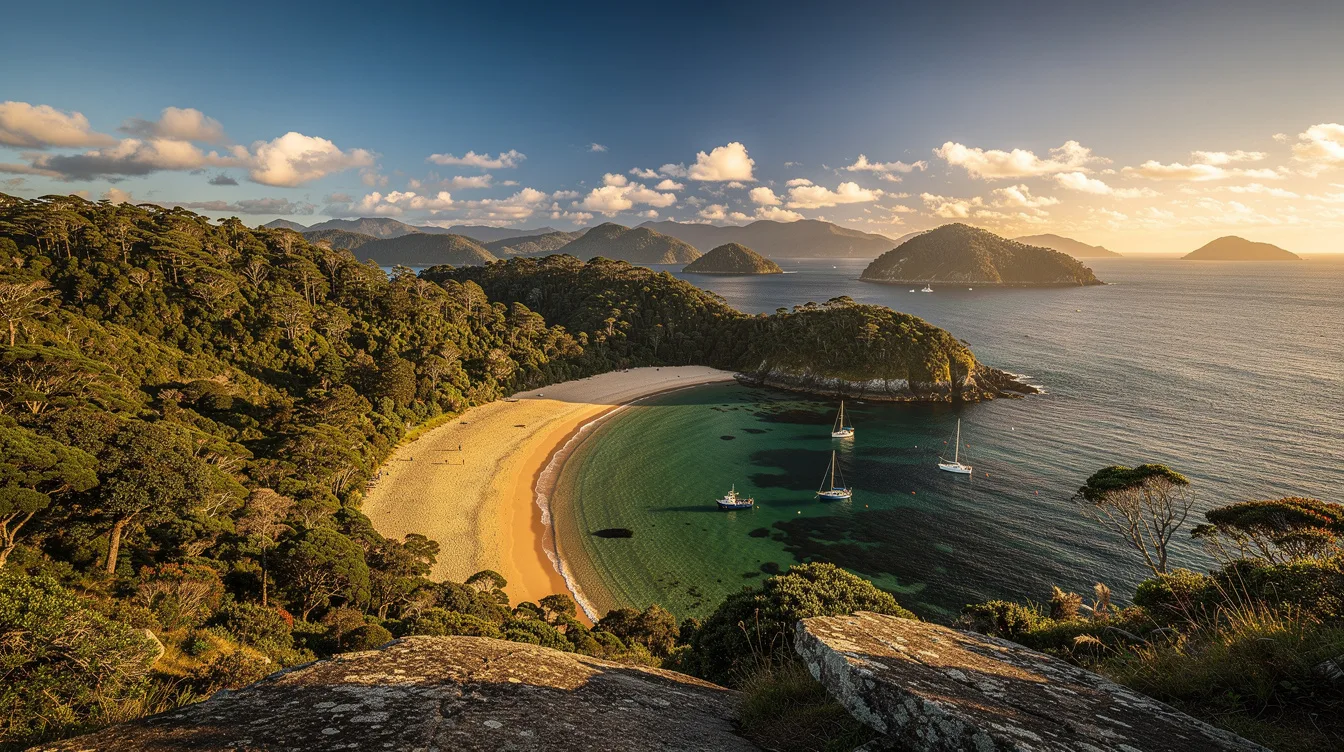
The ferry from Bluff takes about an hour, and by the time you dock at Oban, the mainland already feels like a rumor. Stewart Island / Rakiura holds 486 residents at the 2023 census. The wild kiwi population isn’t counted, but nobody here pretends the birds are outnumbered.
That’s the whole pitch. New Zealand’s third-largest island, 18.6 miles south of the South Island, and almost none of it belongs to people.
85% of the island is national park, and that number does the heavy lifting
Rakiura National Park opened on 9 March 2002 as New Zealand’s 14th national park. It covers close to 540 square miles, roughly 85% of the island. What’s left over is Oban, a few roads, and some private or Māori-owned land inland.
So the arithmetic is simple. One village, one harbor, and everything past the last streetlight is forest, granite, and coast. The island rises to 3,215 feet at Mount Anglem / Hananui, near the north coast.
Wild, but not remote in the punishing sense. You can be walking under rainforest canopy soon after stepping off the boat.
The name means glowing skies, and since 2019 it’s official
Rakiura is usually translated as “glowing skies,” a reference to the aurora australis. In 2019 the island was recognized as a Dark Sky Sanctuary, which is exactly what 486 people and no city glow will earn you.
Aim for moonless nights. Walk away from the lights of Oban, let your eyes adjust, and the Milky Way comes in hard overhead. And bring real protection against damp and wind if you’re shooting photos, because the air here is never dry for long.
Can you actually see kiwi in the wild?
Yes, and this is one of the few places on earth where that sentence is honest. The flightless Stewart Island kiwi lives free across the island, sometimes near tracks or certain bays. Glory Cove is a kiwi protection area.
Your odds go up sharply with a guided night outing. That said, nothing is promised. The birds don’t consult the ferry schedule.
Ulva Island is 660 acres with no introduced predators, and the birds know it
Ulva Island / Te Wharawhara sits in Paterson Inlet, a 267-hectare sanctuary kept free of introduced pests. Take a water taxi over and the birdsong hits you before the boat touches the jetty.
Kākā, weka, kākāriki, South Island saddlebacks, little blue penguins, and sometimes yellow-eyed penguins. Species wiped out on the mainland are still going about their business here.
Walk three days, or twelve
The Rakiura Track is a three-day Great Walk and the sane entry point: wet forest, coastline, beaches, boggy ground. It’s a Great Walk, so book huts early.
Beyond that, the commitment curves upward fast. The Northwest Circuit runs about 10 to 12 days. The Southern Circuit takes 6 to 8.
Both are mud, weather, and self-reliance in serious quantity.
How much time do you need on the island?
Two nights minimum for Oban and Ulva Island without rushing. Four or five if you’re adding the Rakiura Track or want weather margin, and you’ll want weather margin.
The strait that James Cook tried to erase
Cook saw the island’s insularity in 1770, then drew a revised chart attaching it to the mainland, turning an island into a peninsula. An offshore island was strategically useful to Britain’s rivals, so he hid it.
Foveaux Strait was properly charted later, and the English name honors the first officer of the Pegasus, who proved in 1809 that this was indeed an island.
What it costs you in comfort
Rain, mostly. Oban gets 63 to 71 inches a year, and one guide puts it plainly: boots and waterproof clothing are mandatory. DOC gives average temperatures around 59°F in summer and 48°F in winter.
Local authorities warn the weather turns fast and strong winds arrive with little notice. Build slack into any itinerary with a ferry or a flight in it, and pack something for seasickness if the strait and your stomach have history.
Getting there without the boat
A light plane from Invercargill takes about 20 minutes and is the scenic option. A helicopter from Bluff runs about 15. The ferry is still the one most people take, and the crossing can get lively.
Book crossings, flights, Oban beds, and Ulva water taxis early. Summer here is December to February, milder with long days, and busier for it.
Come off the boat in the dark, though, and none of that matters. The streetlights of Oban stop after a few hundred yards, and past them the sky does what the island was named for.