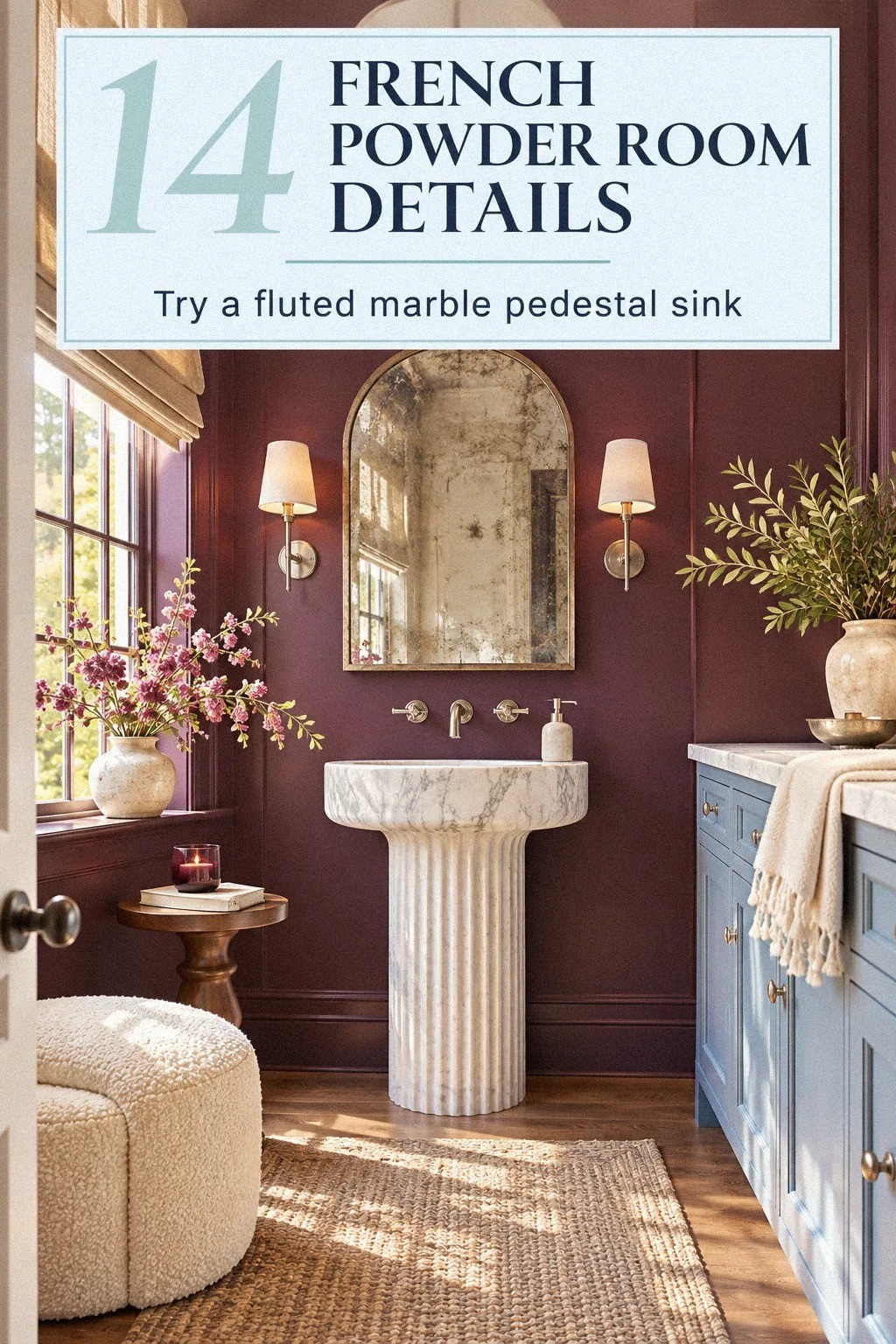
These 14 little French powder room details can add charm without demolition, plumbing changes, or a full weekend of dust. Paint, lighting, fabric, hardware, and carefully chosen surfaces do the heavy lifting when each detail has a clear job. Your powder room doesn’t need more objects. It needs sharper choices.
- Paint the vanity in soft chalky blue (The Chalky Blue Lift)
- Frame the mirror with antique brass (The Warm Outline Effect)
- Hang a pleated linen pendant overhead (The Soft-Cone Light Rule)
- Tile the backsplash in petite floral motifs (The Small-Scale Pattern Rule)
- Install a marble shelf above the sink: Is open storage worth it? (The Three-Object Shelf)
- Choose a scalloped basin skirt (The Curtain Hem Detail)
- Swap hardware for porcelain floral knobs (The Tiny-Jewel Principle)
- Layer a gilded mirror over patterned wallpaper instead of flat paint (The Wallpaper Halo)
- Display perfume bottles on a silver tray (The Vanity Still-Life Method)
- Add a petite picture light above artwork (The Three-Height Light Stack)
- Mount a swan-neck faucet in aged brass (The Curve-Against-Line Move)
- Style fresh flowers in a ceramic bud vase (The One-Stem Rule)
- Paint the ceiling a romantic blush (The Fifth-Wall Blush)
- Tuck a monogrammed hand towel beside the basin (The Finishing Fold)
1Paint the vanity in soft chalky blue (The Chalky Blue Lift)
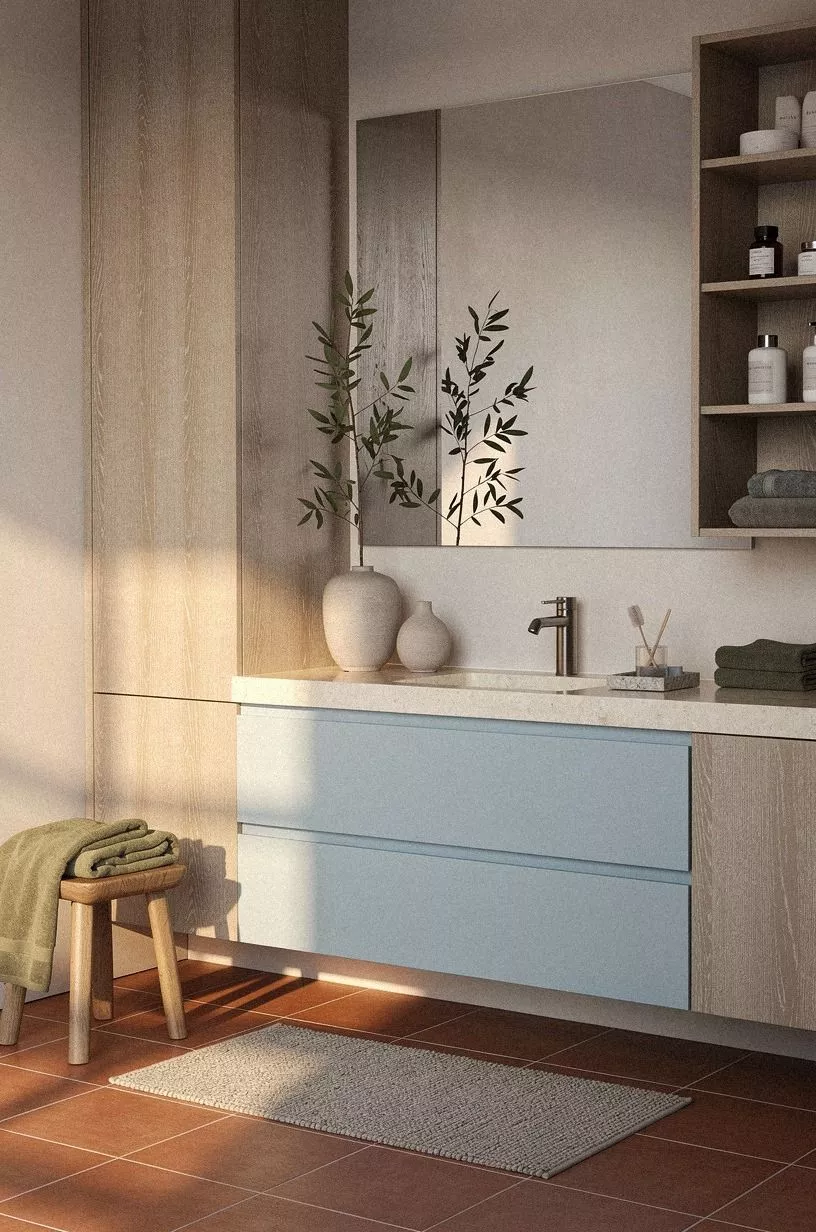
A soft blue vanity gives your powder room a gentle, elegant anchor without making the room feel sugary. Farrow & Ball Light Blue has enough grey to sit comfortably beside terracotta, stone, olive, and cerused white oak. If your vanity has flat doors, the color creates more depth than new handles alone.
Choose a satin finish for the cabinet. Keep the wall quieter with warm white or limewashed cream.
You’ll want the blue to look muted in morning light, not electric beneath a ceiling bulb. A 32- to 36-inch vanity height still works comfortably, so paint can change the mood without changing the proportions.
The clever part is restraint. Keep the counter nearly bare, with a small stone dish and one amber bottle. You don’t need a matching blue mirror.
That would make the room feel staged, while one painted vanity keeps it intimate and relaxed.
For a French color reference, browse this sun-softened Provence stone palette. Faded shutters and warm masonry offer better inspiration than a showroom chip.
2Frame the mirror with antique brass (The Warm Outline Effect)
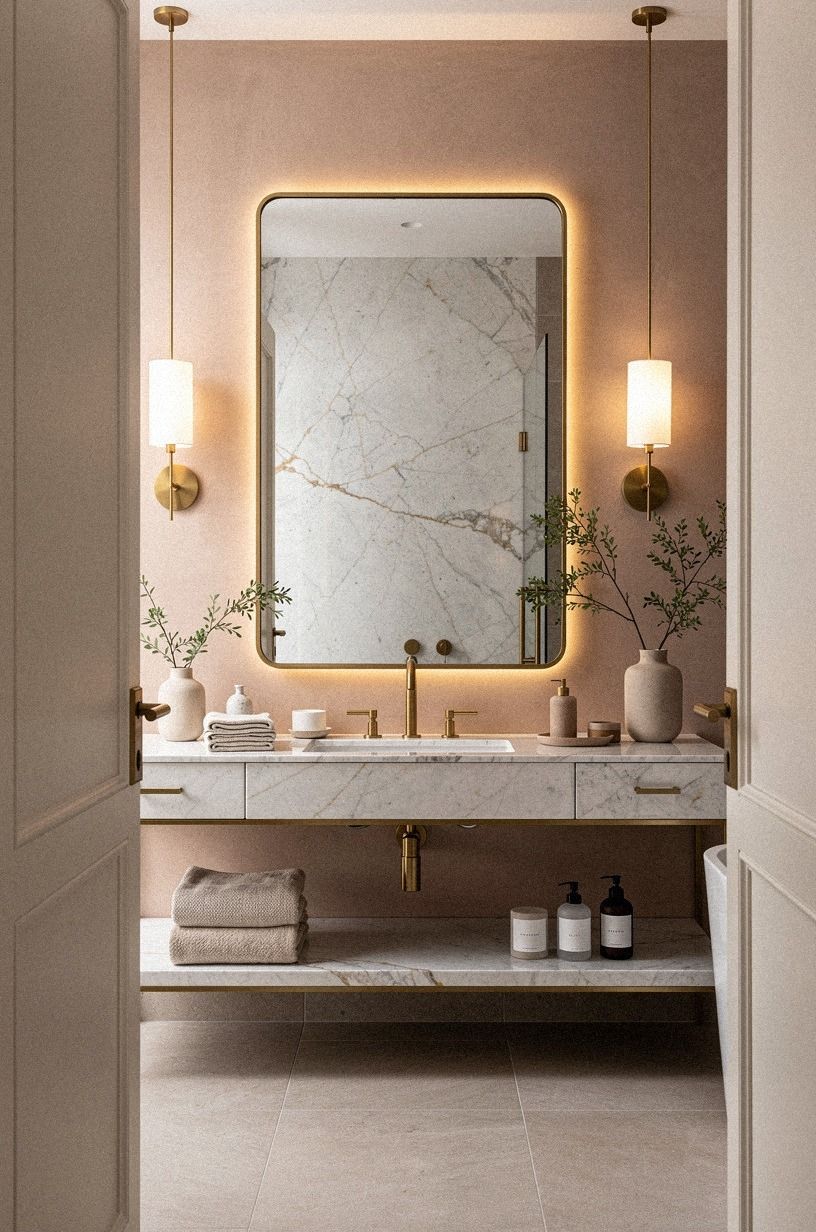
A mirror with a slim aged brass frame gives a small bathroom a polished edge without adding visual weight.
3Hang a pleated linen pendant overhead (The Soft-Cone Light Rule)
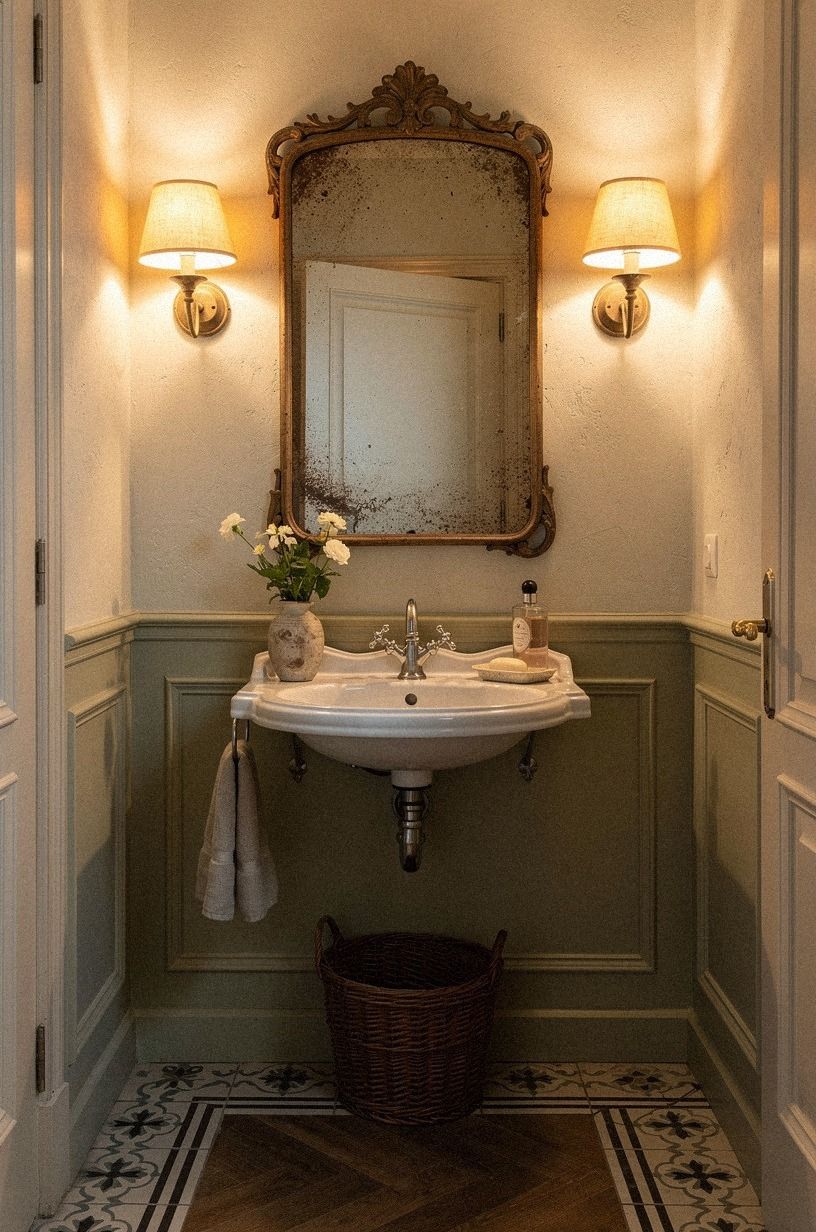
A pleated linen pendant turns overhead lighting into a warm architectural detail. Belgian flax linen diffuses the bulb, so the plum, grey, and rose gold palette feels softer once evening arrives. The pleats create small shadows across the ceiling and give a compact room more texture.
Choose a pendant that leaves comfortable clearance above the sink. A compact shade works better than an oversized drum because your powder room needs glow, not bulk. Warm bulbs are essential, and a dimmer lets you move from bright morning grooming to a quieter evening atmosphere.
Don’t place the pendant directly in front of the mirror if it creates a dark face shadow. Center it in the room or combine it with a small side light. Your lighting should flatter the space throughout the room, not create one harsh pool above the basin.
A pleated shade looks especially refined beside book-matched walnut, where the wood grain echoes the repeated folds. You’ll get a dreamy effect without adding another decorative object. The ceiling becomes part of the room’s story.
4Tile the backsplash in petite floral motifs (The Small-Scale Pattern Rule)
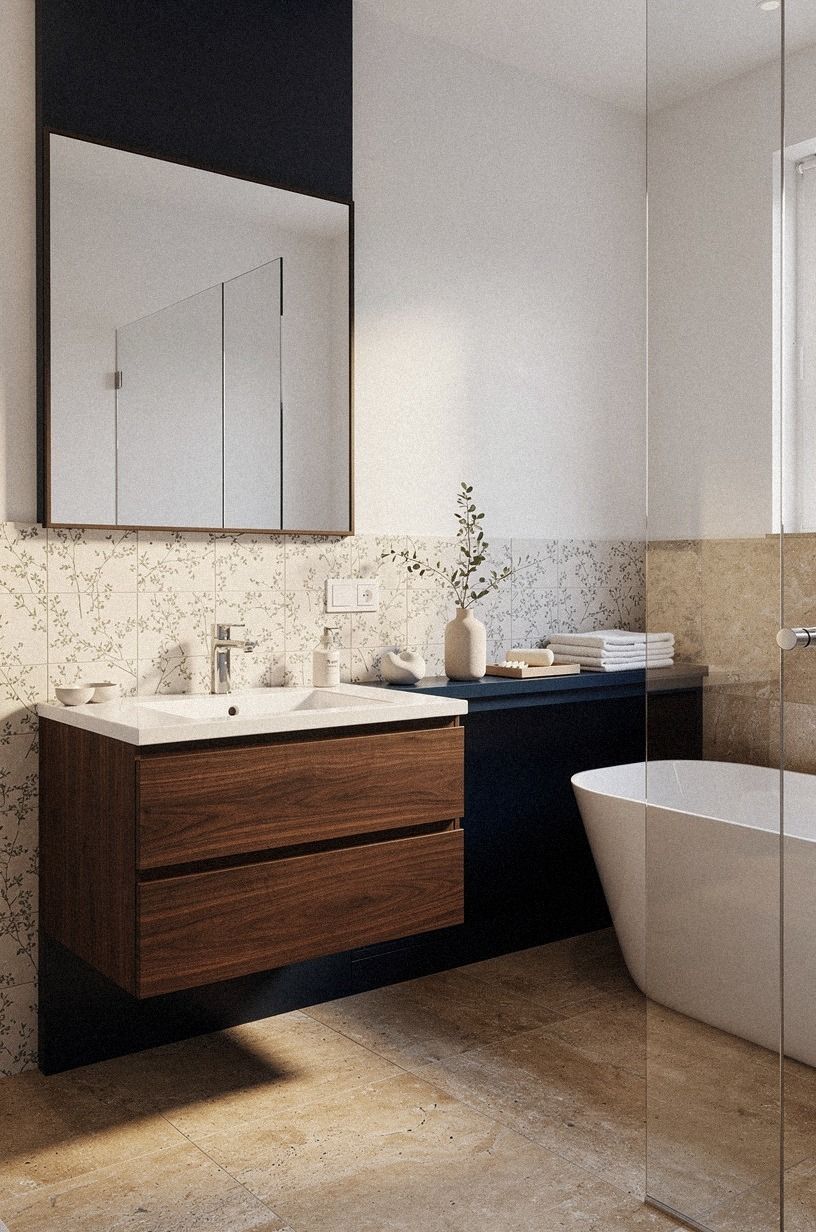
Petite floral tile gives a powder room personality at eye level, particularly when the rest of the room uses navy, white, walnut, and warm travertine. Hand-painted ceramic tile doesn’t need to cover every wall. A narrow backsplash behind the sink can deliver the same charming detail for less material and less visual noise.
Keep the pattern small enough to read at close range. Large flowers can overwhelm a compact basin, while tiny motifs create the feeling of a discovered detail. Your grout should stay close to the tile background so the floral shapes remain the focus.
A floral backsplash works best when one color repeats elsewhere. Pick up the navy in a towel, the walnut in a frame, or the cream in the wall paint.
Don’t repeat every shade. Two echoes are enough to make the room feel harmonious.
If your taste leans rustic, pair the tile with warm travertine rather than polished marble. The slight pitting keeps the room from looking too formal. These medieval stone textures from France offer a useful reference for balancing pattern with aged surfaces.
5Install a marble shelf above the sink: Is open storage worth it? (The Three-Object Shelf)
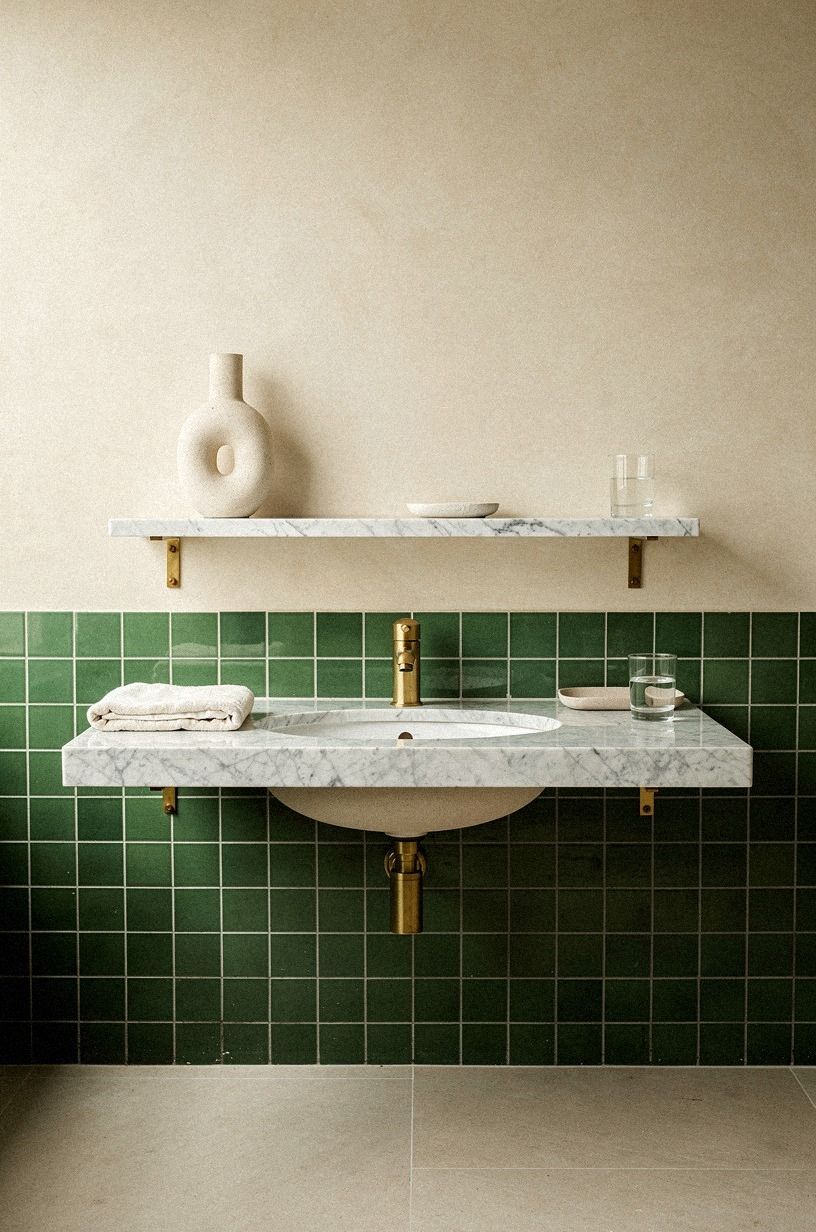
A marble shelf above the sink can replace a bulky cabinet while adding a clean horizontal line. Unlacquered brass developing a patina works beautifully beside emerald, cream, and gold, bringing warmth to the shelf arrangement without making the stone feel cold.
Keep the depth modest so elbows and shoulders still have room near the basin. One folded hand towel, a low soap dispenser, and a small ceramic vessel are enough. If you add six objects, the shelf becomes a display ledge instead of useful storage.
The Three-Object Shelf has a simple rule: one practical item, one soft item, and one organic item. You’ll get balance without arranging a miniature still life every morning. A trailing stem or clipped branch can soften the hard line, but it shouldn’t brush the mirror.
Choose a honed finish over high polish if your room already has reflective brass. Honed stone feels quiet and tactile, while glossy stone can compete with the metal. Your powder room will look more refined when every surface isn’t trying to sparkle.
6Choose a scalloped basin skirt (The Curtain Hem Detail)
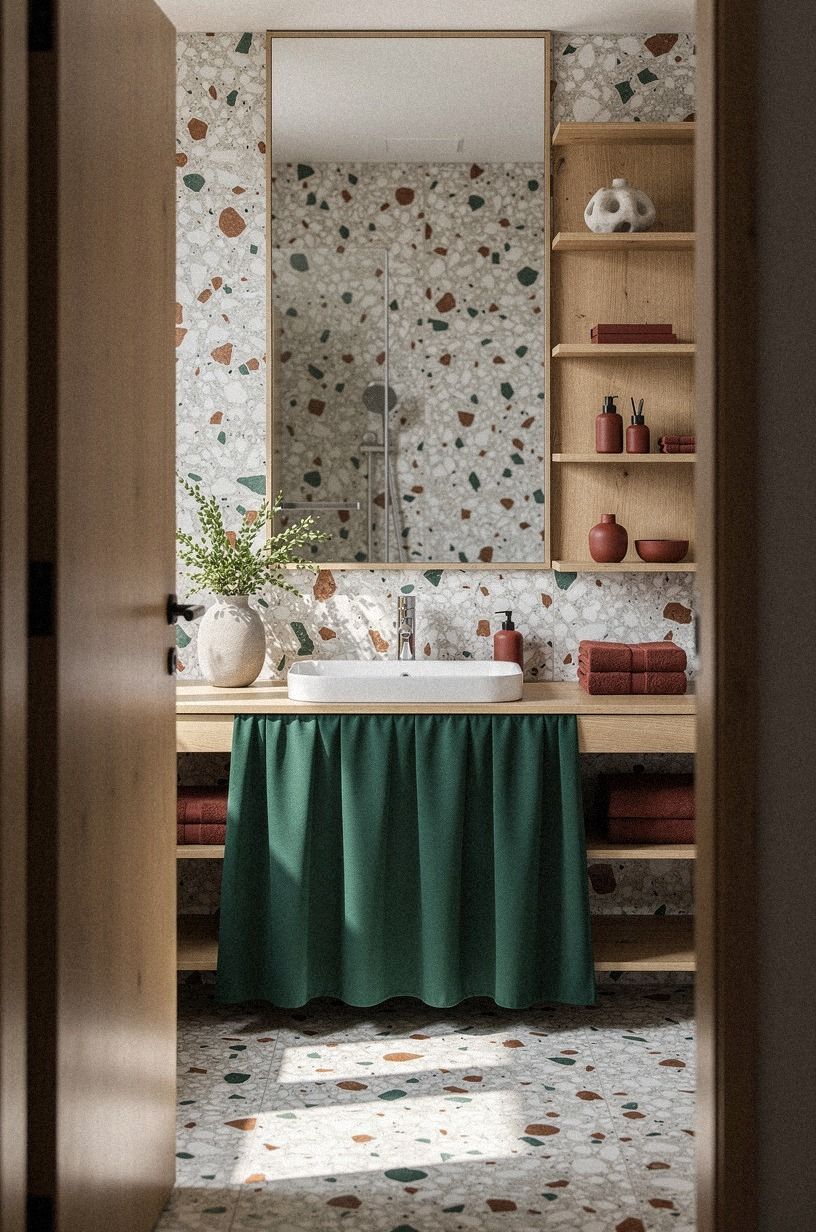
A scalloped basin skirt brings fabric into a room that usually relies on tile, plumbing, and painted wood.
7Swap hardware for porcelain floral knobs (The Tiny-Jewel Principle)
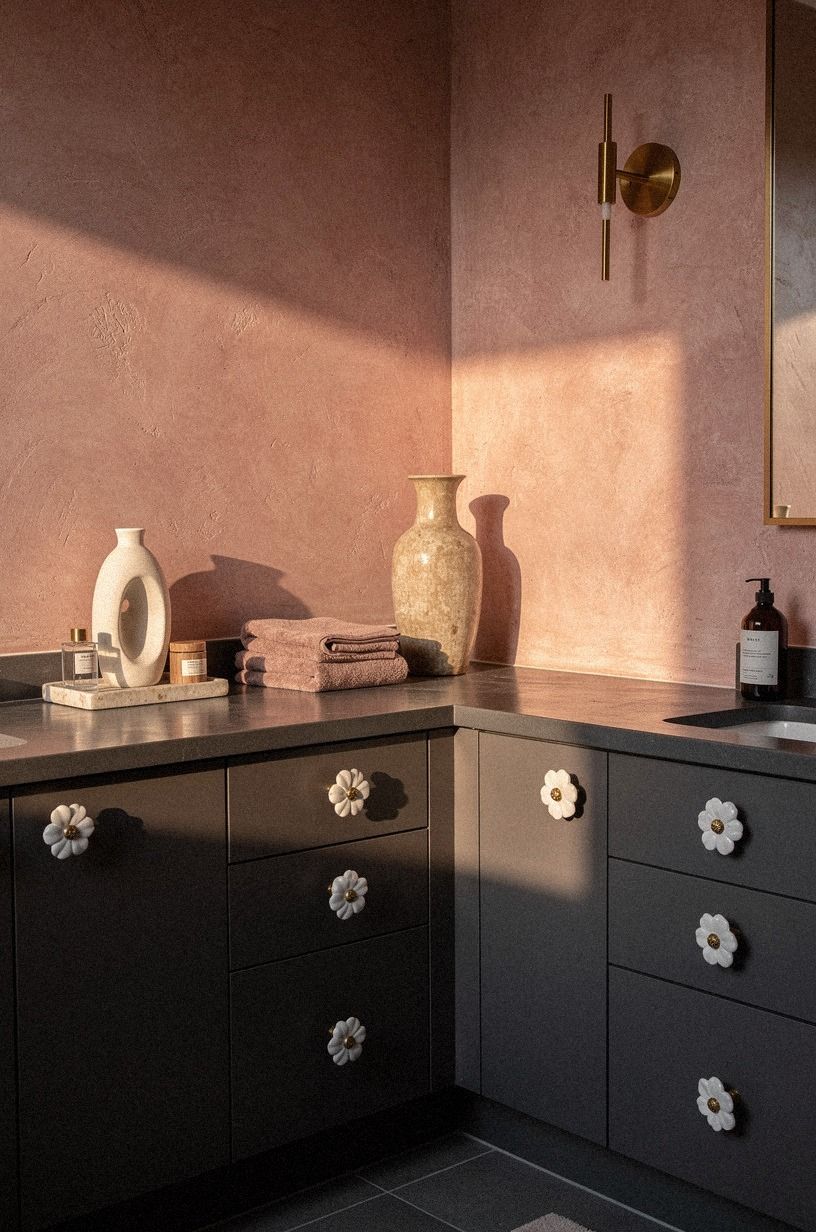
Porcelain floral knobs create a small flash of detail every time a cabinet opens. Hand-painted porcelain works with dusty rose, charcoal, brass, and hand-applied Venetian plaster because the surface brings pattern into an otherwise quiet composition.
Measure the existing hole spacing before ordering anything. A single-knob door is easy, but drawers may need a pull or a backplate.
Your new hardware should operate smoothly, not merely look decorative. If a knob feels sharp or loose, the charm disappears quickly.
Skip a full matching hardware set when the room already has several finishes. Porcelain knobs can be the singular decorative note, while the faucet remains aged brass and the towel ring stays simple. That contrast keeps the room inviting instead of overly themed.
A small floral motif doesn’t require floral wallpaper too. One pattern is enough for most powder rooms. Let the plaster, charcoal paint, and warm metal carry the rest of the visual weight.
8Layer a gilded mirror over patterned wallpaper instead of flat paint (The Wallpaper Halo)
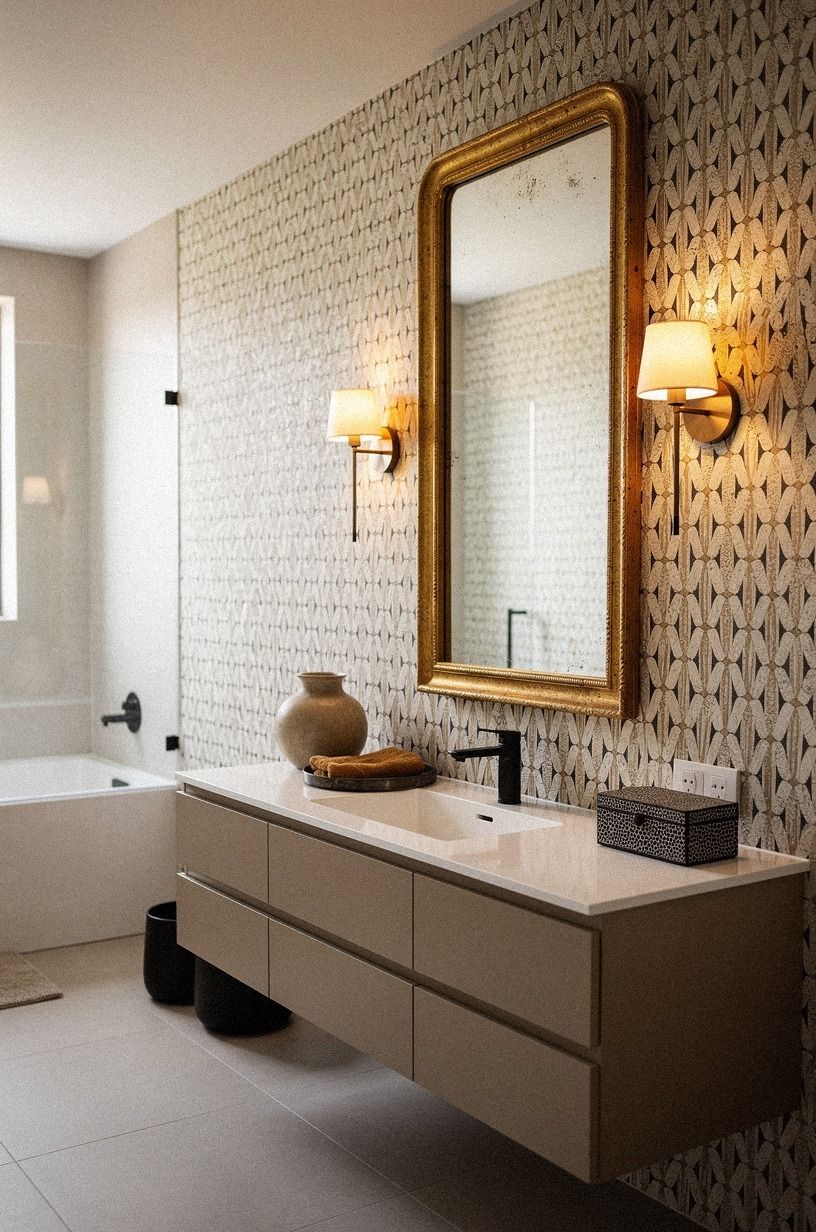
A gilded mirror over patterned wallpaper gives the room a strong focal point without construction. Wallpaper with shagreen accents in warm white and camel can add tactile interest, while black accents keep the palette grounded.
Choose a border with a gently irregular profile rather than a perfectly sharp rectangle. The old-world shape works especially well with a simple basin and matte black art border. If the wallpaper is busy, keep the mirror’s silhouette clear.
For rentals, removable wallpaper can offer the same visual change with less commitment. You’ll need a clean, smooth wall and careful alignment around outlets and corners. A removable option won’t hide major surface damage, so patching still matters.
The room should feel gathered over time, not decorated in one purchase. These layered neutrals from Giverny show why worn surfaces and one ornate detail work so well together.
9Display perfume bottles on a silver tray (The Vanity Still-Life Method)
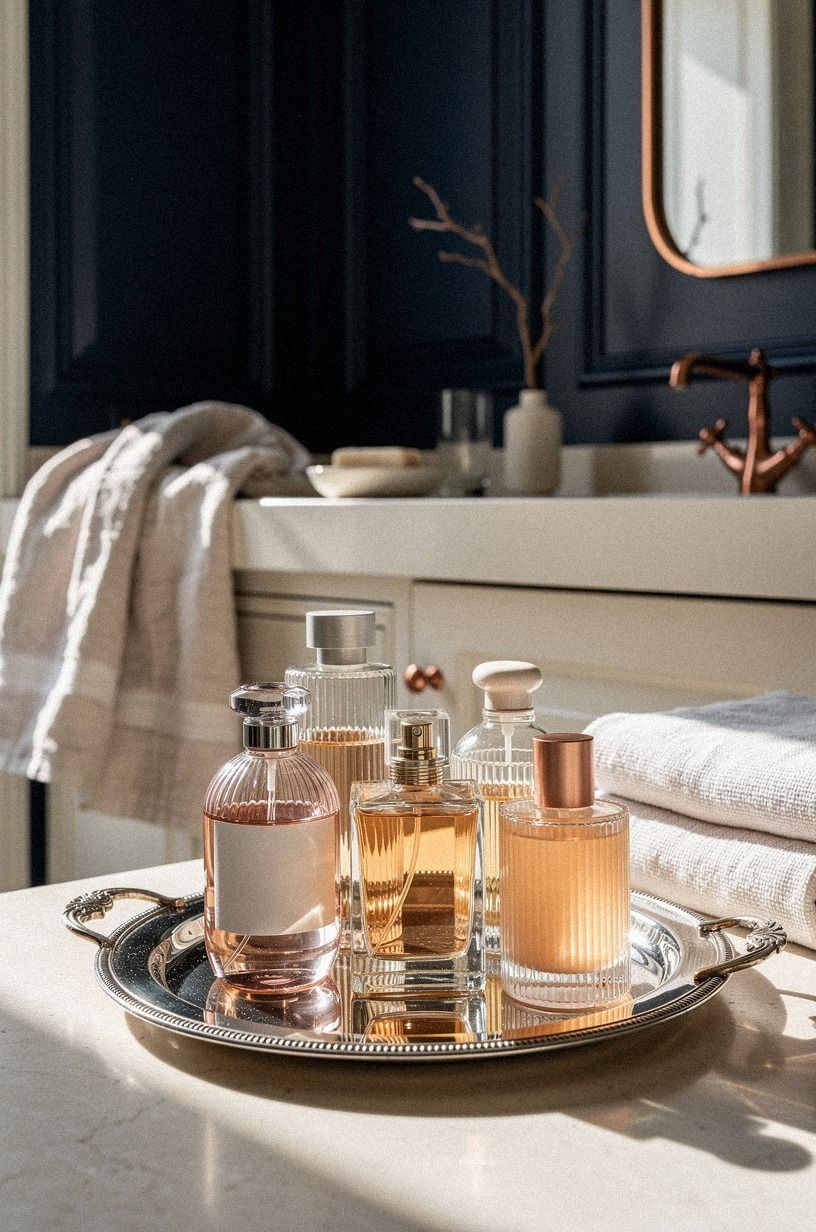
A silver tray turns perfume bottles into a useful arrangement instead of scattered clutter. Washed Belgian linen nearby softens the midnight blue, copper, and ivory palette, while the reflective tray catches a small amount of light without taking over the room.
Choose three bottles with different heights and silhouettes. A short glass bottle, a tall atomizer, and one amber container create a natural rhythm.
Your tray doesn’t need to hold every fragrance in the house. Keep daily-use items within reach and store the rest elsewhere.
A tarnished or lightly brushed tray is more elegant than mirror-bright silver in a powder room. The surface can show a little age, especially beside copper and dark blue. If the tray feels too formal, add a tiny folded cloth beneath one bottle for softness.
You’ll want enough space around the arrangement for cleaning. A tray that lifts easily is practical, and practical details keep decorative styling from becoming annoying. That’s the difference between a charming vignette and a surface nobody can use.
10Add a petite picture light above artwork (The Three-Height Light Stack)
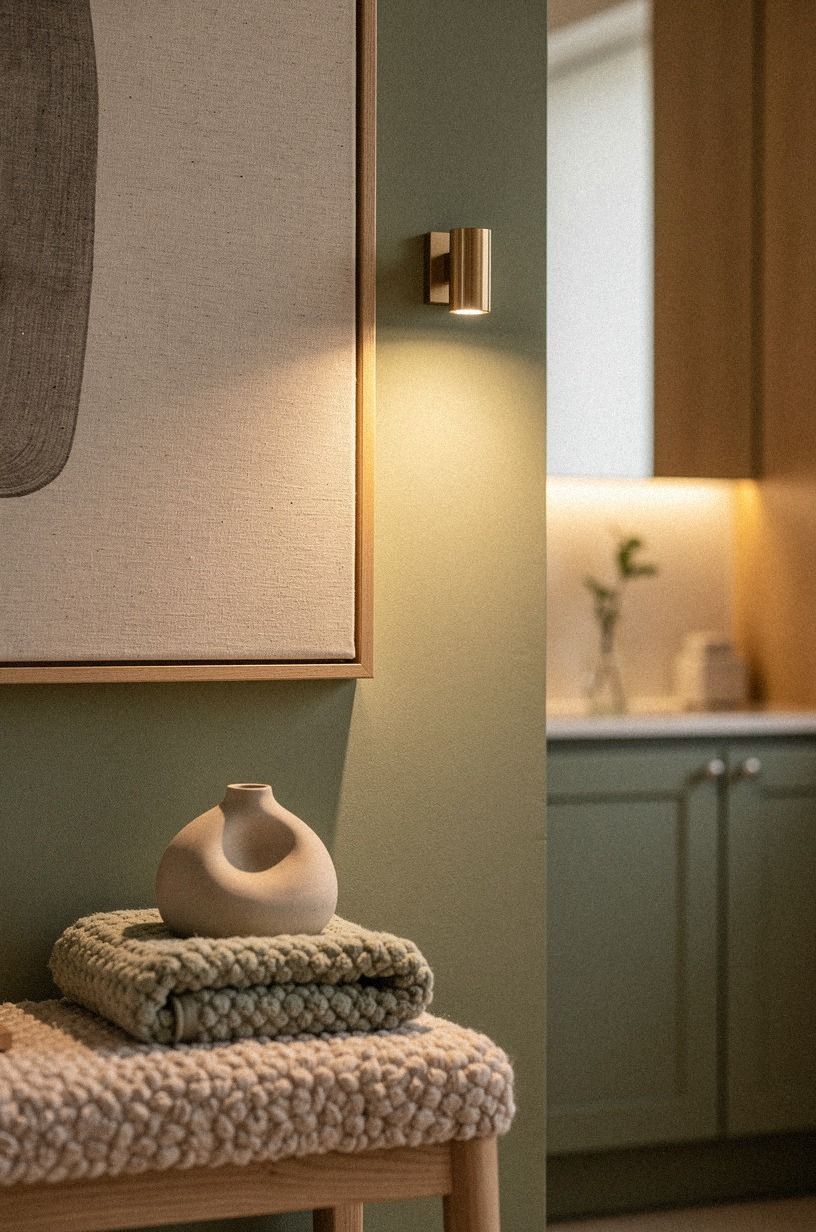
A petite picture light above artwork gives your powder room a gentle pool of illumination. Organic bouclé on a nearby stool or bench adds a tactile contrast to sage green, warm cream, and natural wood. The picture light should brighten the art, not glare into the mirror.
Think in three heights: the artwork, the light, and the basin accessories. When all three sit at the same level, the wall can feel flat. Your eye needs a small rise and fall, so the room reads as layered rather than lined up.
A narrow brass or aged bronze light works well when the art border is simple. If wiring is difficult, battery-powered picture lights can provide a temporary solution, though you’ll need to replace batteries regularly. Hide the control where your hand can reach it without moving the artwork.
This whitewashed Riviera masonry offers a useful lesson in pale surfaces and controlled contrast. Your room doesn’t need more brightness everywhere. It needs light in the right place.
11Mount a swan-neck faucet in aged brass (The Curve-Against-Line Move)
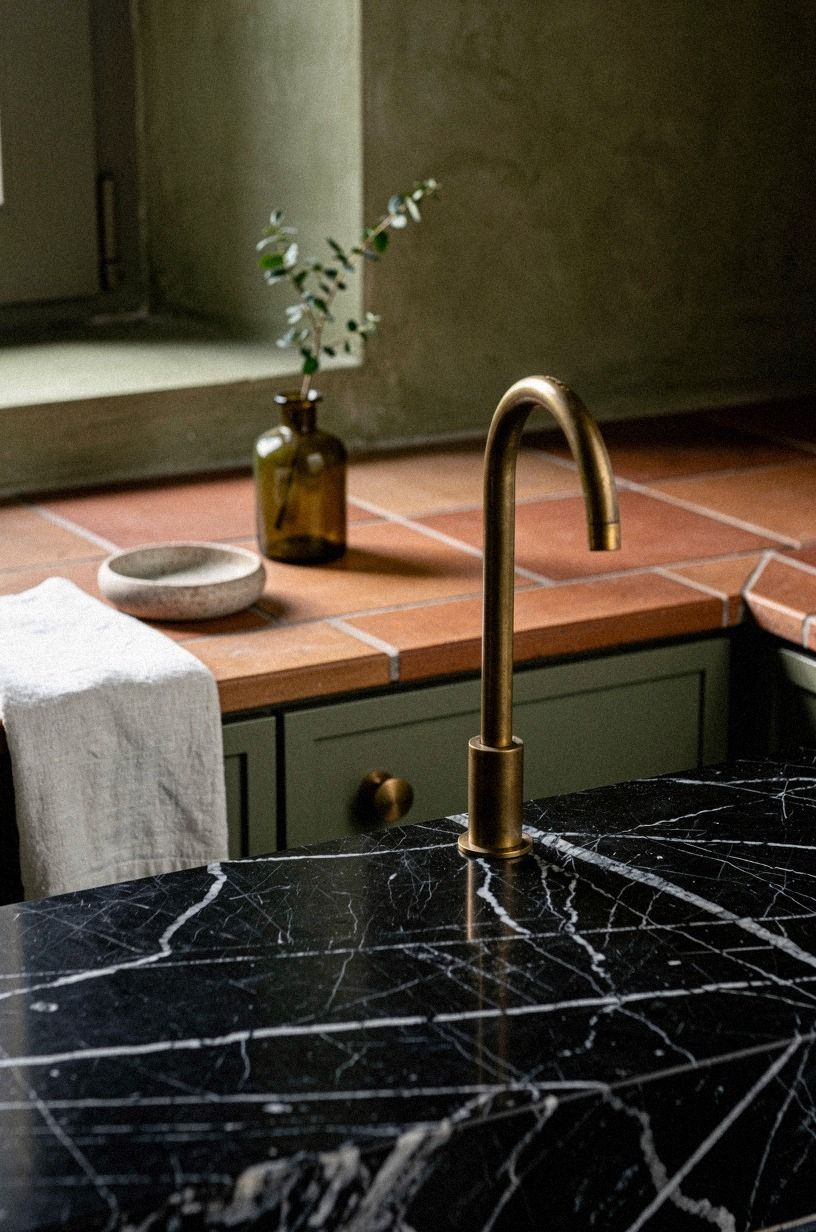
A swan-neck faucet introduces one graceful curve against the straight lines of a vanity, mirror, and backsplash. Nero Marquina black marble with white veining makes the aged brass feel richer, especially when terracotta, stone, and olive tones already warm the room.
Check the existing faucet configuration before choosing a replacement. A widespread faucet may require different holes from a centerset model, and a wall-mounted style can involve more complicated plumbing. Your easiest update is usually a compatible deck-mounted faucet in the same basin position.
A curved spout is worth choosing when the sink has a simple geometric shape. If both the basin and faucet are sculptural, the result can feel crowded. Skip an overly ornate handle and let the arc provide the character.
Standard vanity height remains 32 to 36 inches, so this detail changes the visual line without altering the room’s function. You’ll notice the faucet first because it sits at hand level, where finish and shape matter most.
12Style fresh flowers in a ceramic bud vase (The One-Stem Rule)
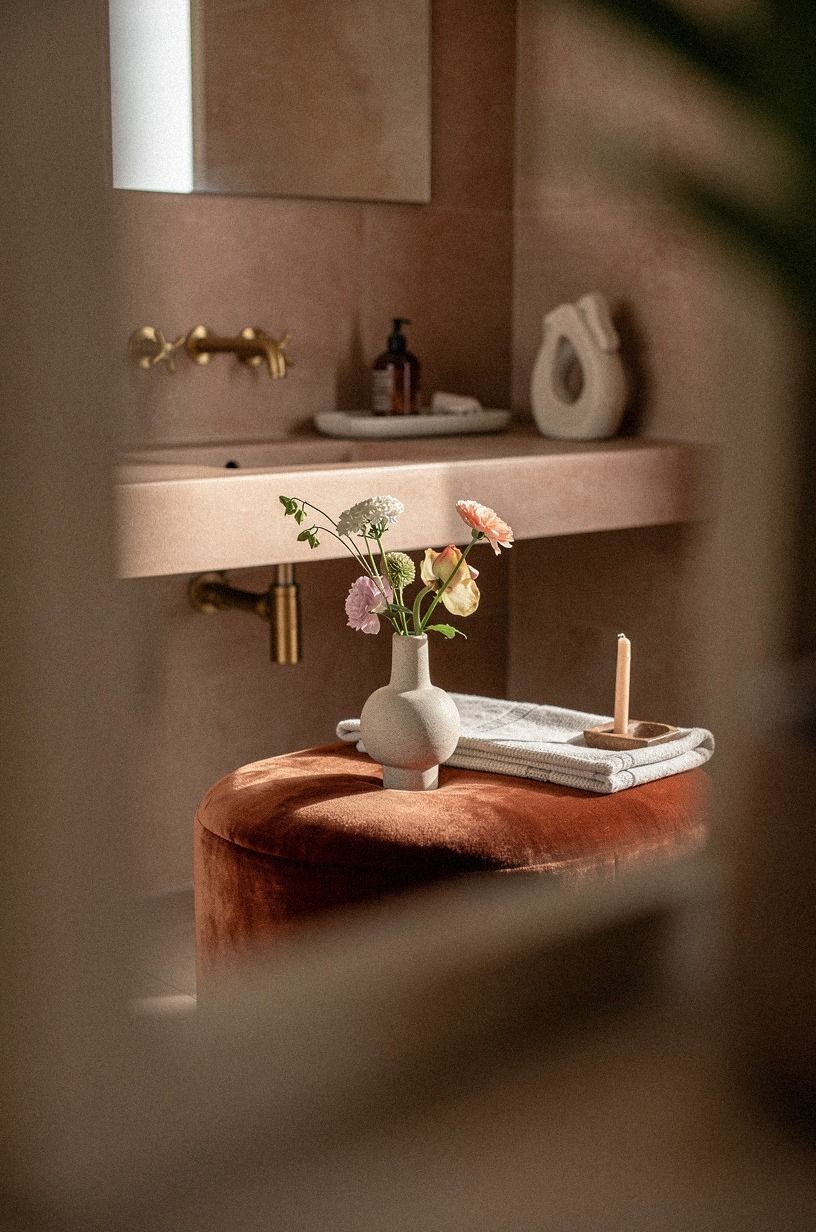
Fresh flowers beside deep-pile mohair velvet add a living detail without requiring a large bouquet.
13Paint the ceiling a romantic blush (The Fifth-Wall Blush)
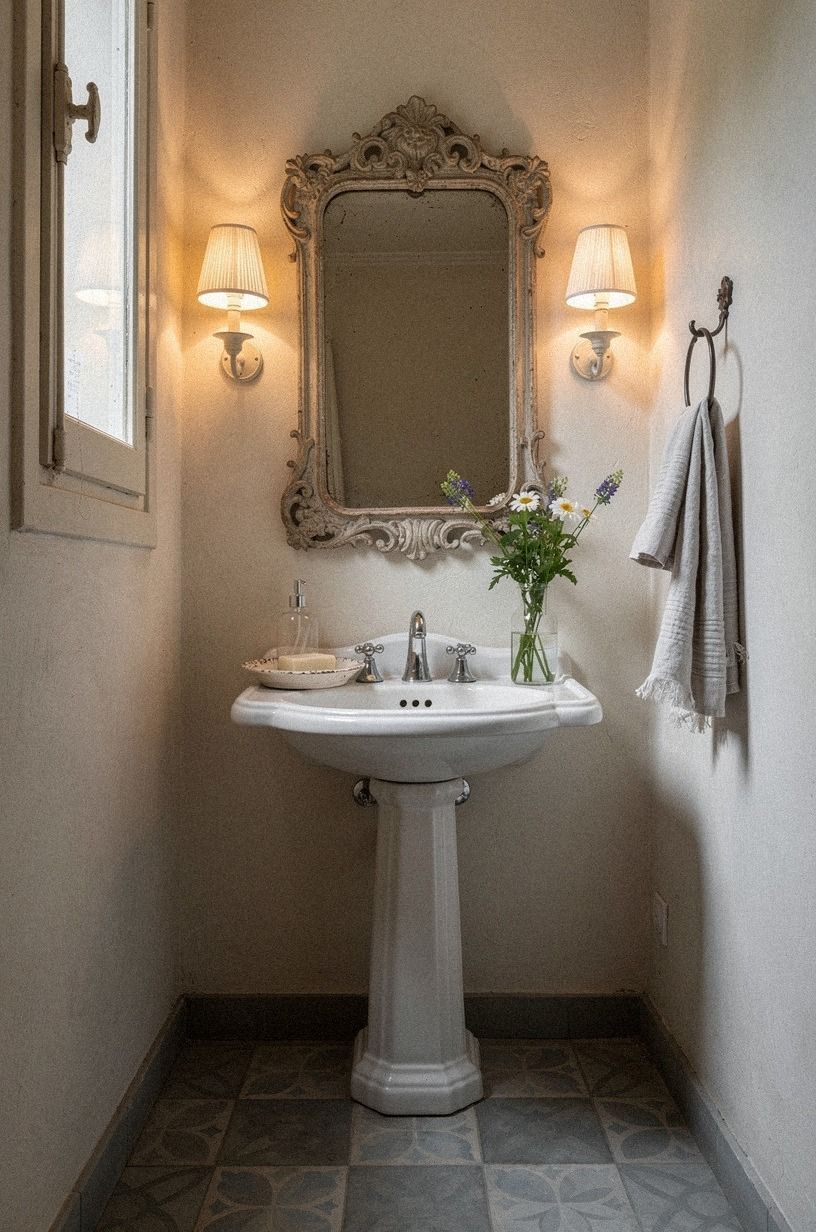
A blush ceiling gives a powder room an intimate, elegant finish while keeping the walls calm. Soft grey walls and Carrara marble with subtle grey veining can support a rose-toned ceiling with plum, grey, and rose gold accents. The effect is subtle from the doorway, then more noticeable once the room’s light shifts.
Use the ceiling color with a low-sheen finish so it doesn’t create distracting reflections. Your trim can remain warm white, but avoid a stark blue-white that makes the blush look disconnected. A soft cream trim creates a smoother transition around the room.
This detail works best when the ceiling is visually clear. Keep the pendant compact, and avoid a large vent cover or oversized fixture competing with the color. You don’t need a painted ceiling border; the change should feel like a wash of warmth overhead.
If blush feels too sweet, choose a dusty rose with grey beneath it. Farrow & Ball Pelt nearby can deepen the plum note, while aged brass keeps the room from becoming flat. The result is calming, not childish.
A painted fifth wall can change the atmosphere more than expected. That matters in a small room!
14Tuck a monogrammed hand towel beside the basin (The Finishing Fold)
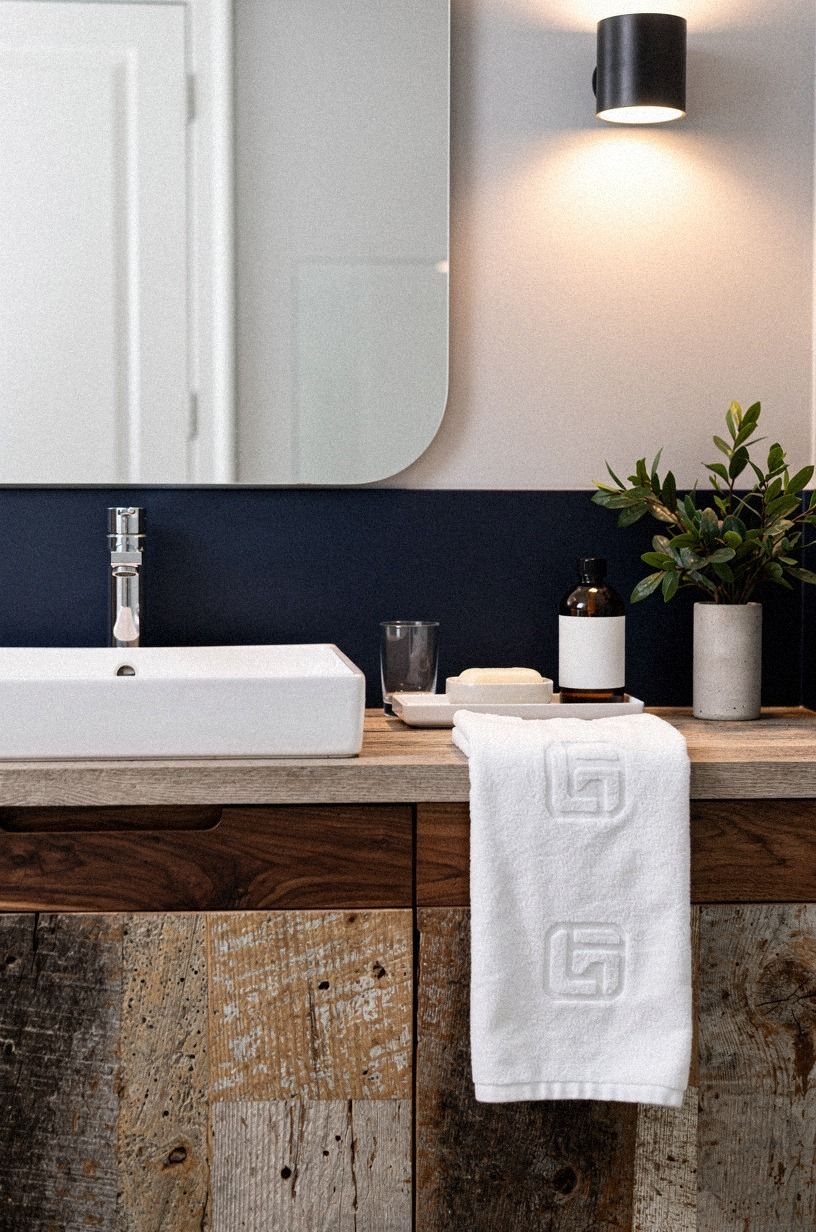
A monogrammed hand towel adds the final tactile note beside the basin. 600gsm Turkish cotton feels substantial without looking bulky, and navy embroidery works naturally with white, walnut, and reclaimed weathered teak.
Your towel should be easy to grab, not folded so precisely that nobody wants to touch it. Choose one monogram position and keep the rest plain. A small stitched initial near the edge feels personal without turning the room into a hotel display.
If embroidery isn’t practical, a woven stripe or simple hem gives the same finished quality. The towel should hang within comfortable reach and stay clear of the toilet clearance zone, which needs at least 21 inches in front.
You’ll get a more polished result when convenience directs the placement. Decorative details still need to behave like bathroom details!
For larger projects, use these typical US cost ranges as a reality check before changing surfaces:
The towel itself can remain a modest purchase. A neatly finished textile often adds more charm than an expensive object that has no daily use.
The French Powder Room Rule That Makes Small Changes Read Expensive
French-inspired powder rooms work because they allow contrast. Smooth paint sits beside worn metal.
Crisp porcelain meets uneven plaster. A tailored towel shares space with a branch in a handmade vase.
The room feels charming when every finish has a slightly different history, even when the changes happen in one afternoon.
The strongest approach begins with one anchor, such as the vanity color, wallpaper, mirror, or pendant. Your second choice should support that anchor, and the third should give the eye a quieter place to rest. Too many focal points make a small room feel busy.
One strong move and several restrained echoes feel far more polished.
There’s also a practical reason to favor details over renovation. A powder room has limited floor area, so every change is close to the viewer.
A new faucet can be seen from the doorway. A painted ceiling can alter the entire light quality.
A towel with good texture can make a basic basin feel more considered.
The losing strategy is buying a complete matching collection. Matching metal, mirror, light, faucet, and accessories may look tidy, but the room loses tension. Your goal isn’t to make every object agree perfectly.
It’s to let a few materials disagree gently, then connect them through color, scale, or texture.
Small rooms reward editing. Keep the practical objects accessible, let one decorative detail lead, and remove anything that makes the sink harder to use. A little restraint goes far!
For another color and texture reference, revisit these faded Provence shutters. The strongest palettes often begin with one softened color and a few natural companions.
The Questions Worth Answering First
What is the best little French powder room detail for a small bathroom?
A painted vanity is usually the strongest first move because color creates depth without taking floor space. Try a muted blue, warm cream, or olive shade with a simple mirror and one textured towel. Open cube storage can work nearby if your room has enough clearance, but don’t fill every shelf.
Where can you buy little French powder room pieces on a budget?
Target, Wayfair, thrift shops, and local resale marketplaces are useful starting points for affordable character. Look for silver trays, ceramic vases, small mirrors, and solid wood frames. Secondhand brass often has better patina than new metal, and fresh paint can make a basic vanity feel custom.
How much does a little French powder room makeover cost?
A small update can fall within the $200-$1,200 budget range when it focuses on paint, a mirror, a faucet, and textiles. Free changes matter too, including editing the counter, relocating artwork, folding towels differently, and grouping existing bottles on a tray.
Can you create a little French powder room on a budget?
Yes, and the best low-cost changes are paint, secondhand hardware, and fabric. Paint the vanity, reuse a frame, sew or hem a simple basin skirt, and style one ceramic vase. You won’t need new tile when a floral backsplash decal or a painted wall can provide pattern.
Is a little French powder room style worth it in a small space?
Yes, because a small room lets each detail work harder. Scale becomes an advantage when a petite pendant, narrow mirror, and compact vase remain visible from the doorway. Keep the center clear, respect the 21-inch toilet clearance, and choose one strong pattern instead of several competing prints.
Is a little French powder room style a good idea for a rental?
Yes. Removable wallpaper, tension-rod basin skirts, adhesive picture lights, and replacement cabinet knobs can create no-damage charm. Keep original hardware in a labeled bag, avoid drilling into tile, and test removable products in an unseen corner before covering the full wall.
For a final surface reference, compare the weathered French village masonry with the cleaner finishes in your own room. Contrast helps small spaces feel collected.
Where to Start First
If one detail deserves priority, start with the soft chalky blue vanity. Paint changes the largest visual block without stealing floor space, and every later choice can borrow from its muted color. Pin the vanity idea for later, then pair it with one aged-brass accent and stop before the room feels overworked.
A second option is the mirror, especially when the vanity already has a pleasing finish. Use a layered Giverny neutral palette for the surrounding colors, then let the gilded border provide the warmth.
Start with one change, live with it briefly, and let the next choice answer the first. That’s how a compact powder room gains personality without losing breathing space.