Dark green powder room and half bath ideas can feel bold without turning a small room gloomy. The balance comes from reflective surfaces, layered lighting, warm wood, and enough ivory to keep the eye moving. You’ll see dramatic color, but you won’t lose the room’s shape. That’s the difference.
- Paint the Ceiling Deep Green for Cocooning Drama
- Why Do Emerald Walls Work With Aged Brass?
- Tile the Sink Wall in Glossy Forest Green
- Frame a Tiny Mirror With Carved Dark Wood
- Wainscoting Below, Wallpaper Above
- Install a Jewel-Box Green Vanity With Fluted Doors
- Sherwin-Williams Evergreen Fog Sets a Softer Direction
- Hang a Botanical Print Over the Green Toilet
- Green and Ivory Checkerboard, Without the Noise
- Add a Velvet Stool Beneath the Pedestal Sink
- Backlight an Arched Mirror on Green Plaster
- Let Green Marble Lead Around a Compact Basin
- Create Gothic Contrast With Candle-Style Wall Lights
1Paint the Ceiling Deep Green for Cocooning Drama
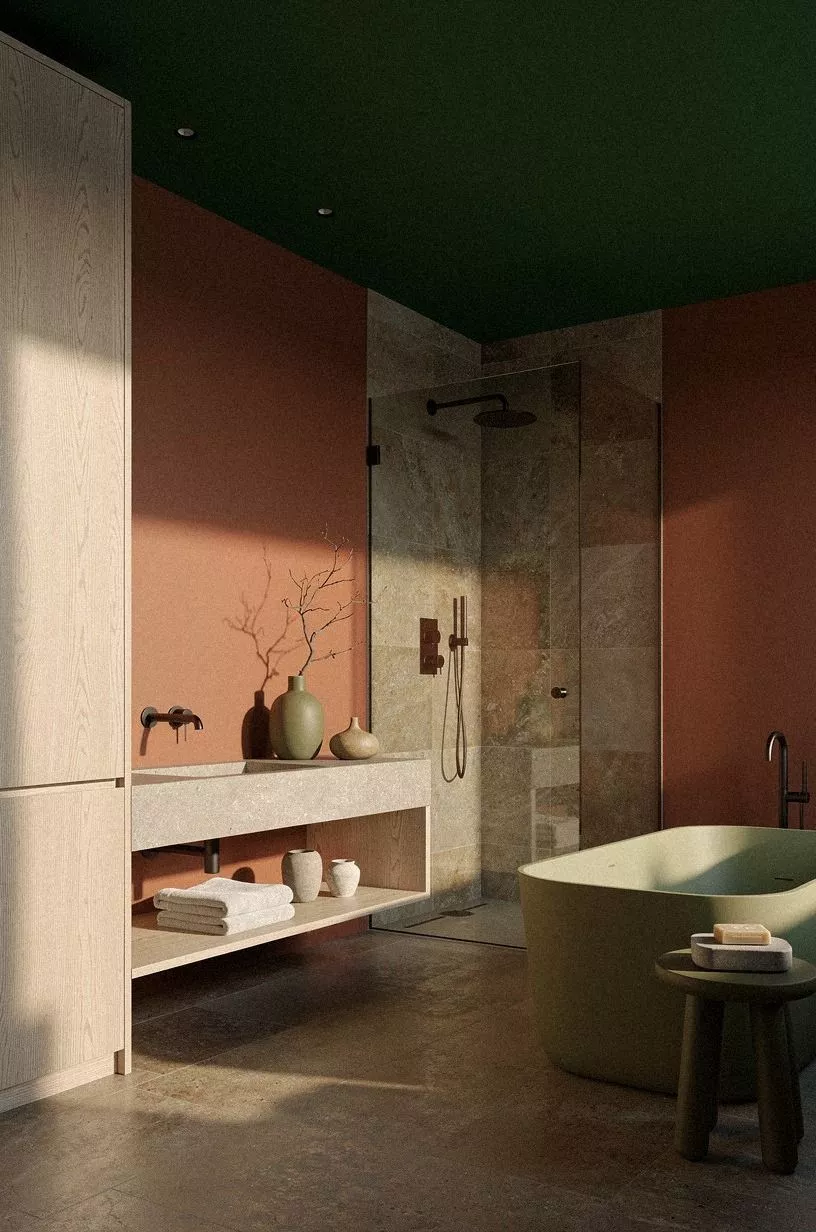
A deep green ceiling works best when the walls, trim, and upper fixtures share a related undertone. Farrow & Ball Studio Green creates a soft, leafy darkness that feels intimate beside cerused white oak and warm terracotta. If your powder room has a 9-foot ceiling, the color can make the room feel more grounded without visually lowering it too much.
Keep the floor lighter, such as honed travertine with natural pitting, and choose a mirror with a slim oak edge. You’ll want one ceiling fixture plus a pair of wall lights, because a single overhead bulb can flatten the green. If you’re working with a rental, removable ceiling-safe paint isn’t always practical, so a green fabric shade and matching wall art can echo the effect.
The strongest version doesn’t use five different greens. Choose one dominant shade, one warm neutral, and one wood tone.
A small IKEA TONSTAD oak-effect cabinet can bring in the needed warmth without competing with the ceiling. For a polished palette, these dark green powder room styling ideas offer useful material combinations.
2Why Do Emerald Walls Work With Aged Brass?
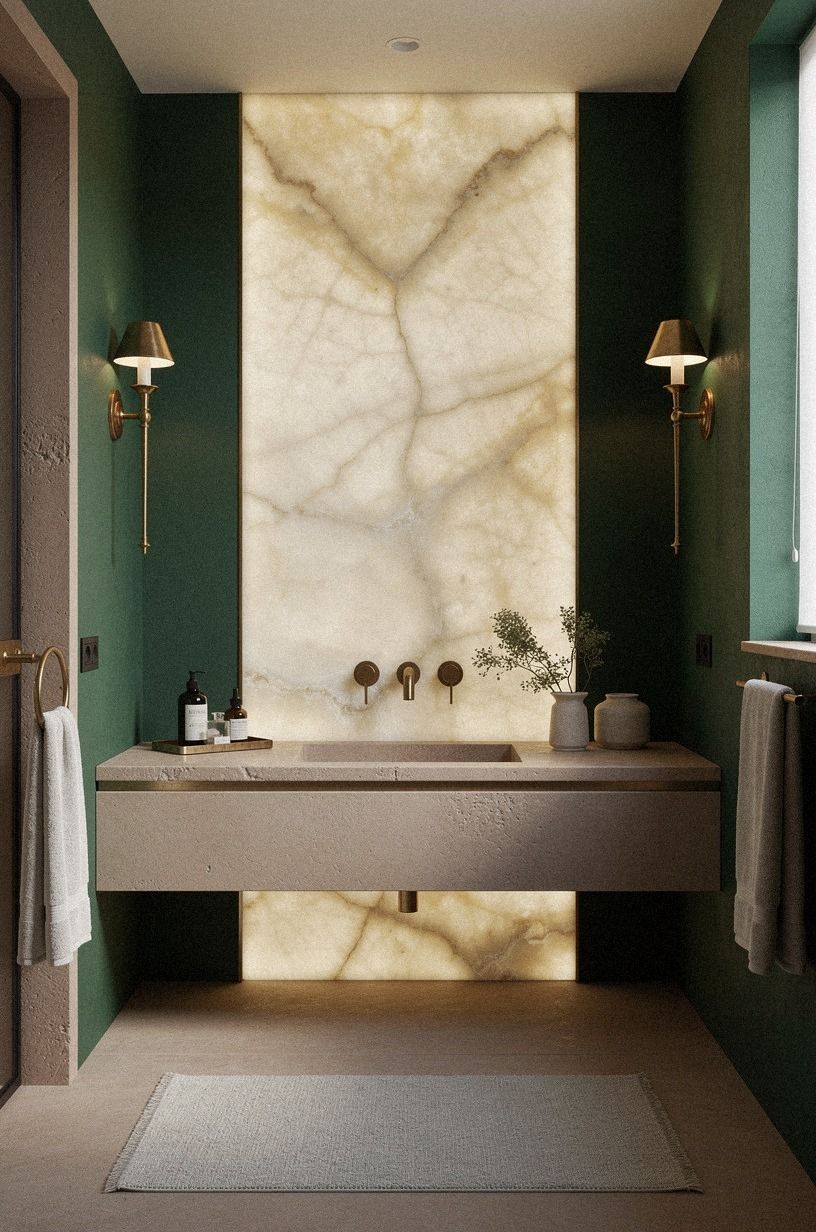
Emerald walls need light that skims across the surface. Aged brass sconces do that beautifully, especially when their shades point slightly upward and downward.
The finish catches a soft glow, while backlit translucent onyx adds a milky layer that keeps the room from feeling flat. You’ll notice the green looks richer at night, but it won’t become black around the vanity.
Keep the remaining palette restrained: clay-colored accessories, washed linen hand towels, and a pale stone basin. A vanity height between 32 and 36 inches usually feels comfortable, so the mirror and sconces should be positioned around that working zone.
Don’t crowd the wall with a gallery arrangement. One oversized print can give your eye a quiet place to rest.
If you’re comparing brass finishes, skip shiny yellow brass. It can look too sharp against emerald paint.
Unlacquered brass developing soft patina is the better choice because its muted surface works with both clay and linen. You’ll find more useful combinations among these dark green powder room finishes.
3Tile the Sink Wall in Glossy Forest Green
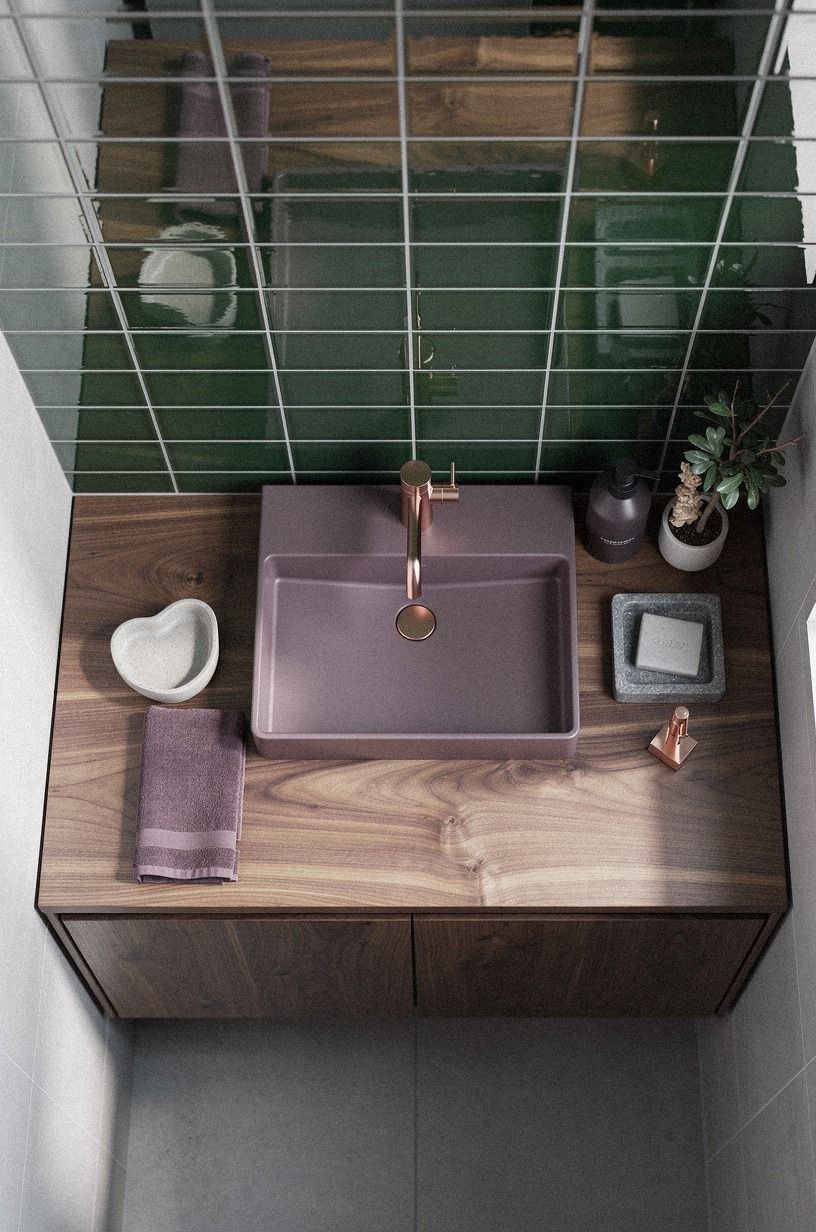
Glossy green tile turns the sink wall into the room’s main event. A vertical field of small-format tile reflects even a modest lamp, while book-matched walnut keeps the composition from becoming cold. Hand-glazed forest green tile is especially effective because slight variation in each tile creates movement without requiring a busy pattern.
Use the tile behind the basin and stop it at the mirror or ceiling line, depending on the room’s proportions. With a compact vanity, a full-height tiled wall can make the basin feel intentional rather than squeezed into a corner. A warm grey floor and plum-colored textile bring enough contrast to support rose gold hardware without making the palette sugary.
You’ll want grout that’s close in value to the tile. High-contrast white grout can break the wall into little squares and make the room feel restless.
A narrow CB2 Primitivo bouclé stool can soften the walnut and add a useful landing spot for a guest’s bag. These dark green bathroom paint colors can help you compare cooler and warmer undertones.
4Frame a Tiny Mirror With Carved Dark Wood
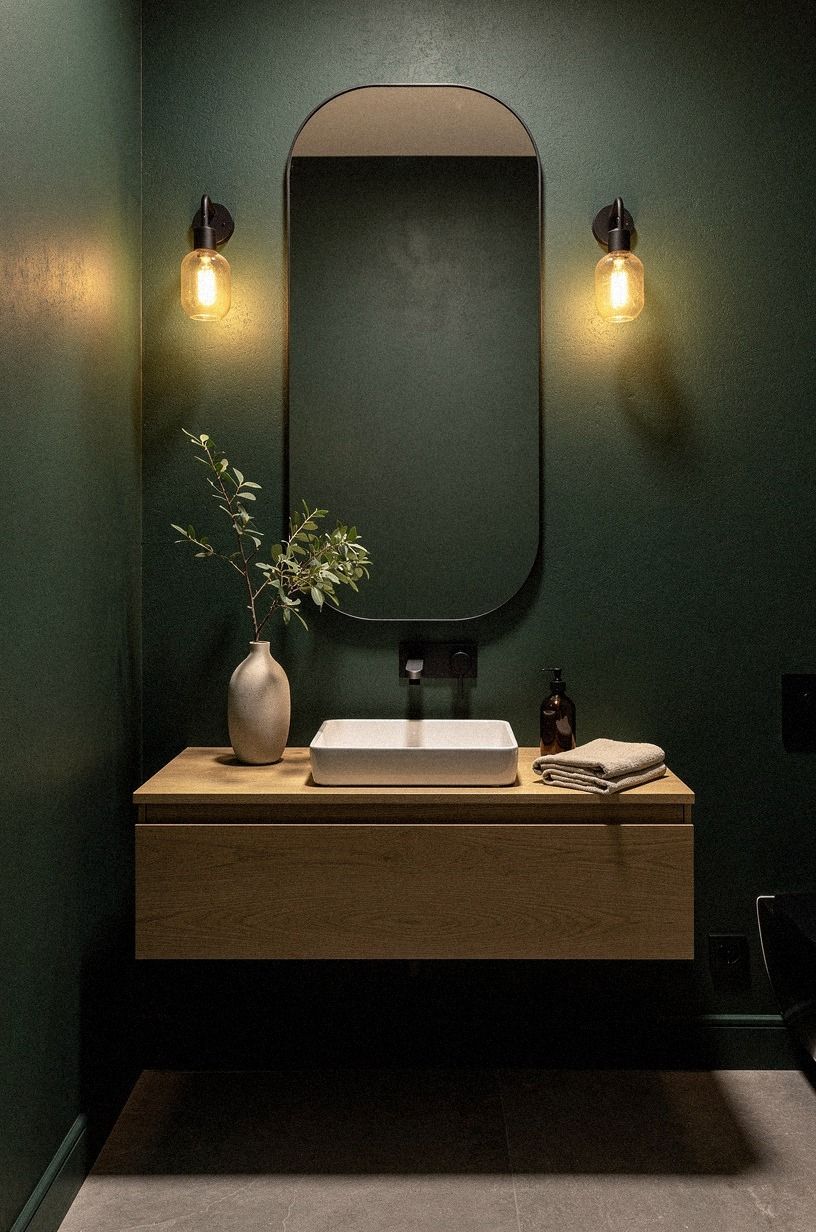
A small mirror doesn’t need to disappear. A carved dark wood frame can turn it into a compact architectural feature, especially above a pedestal sink with warm travertine underfoot. Carved walnut brings depth to a navy, white, and brown palette, while the irregular profile keeps the room from feeling too formal.
Choose a mirror that leaves visible wall space around the frame. That breathing room matters in a half bath, where an oversized mirror can make every fixture look crowded.
You’ll want a narrow wall sconce on each side if the electrical layout allows it. Soft bulbs will pick up the warm stone and make the carved details easier to see.
Skip a frameless mirror here. It’s practical, but it won’t provide enough visual weight beside a dark green wall.
A West Elm Anton solid wood console can also work as a slim vanity base when plumbing allows, though the basin must still leave a comfortable landing area. Add one white towel and one navy ceramic vessel.
Nothing more is needed.
A dark wood frame also gives you a natural bridge between green paint and warm flooring. If the room needs more earthy texture, these green wood bathroom combinations show how walnut, oak, and stone can share a compact palette.
5Wainscoting Below, Wallpaper Above
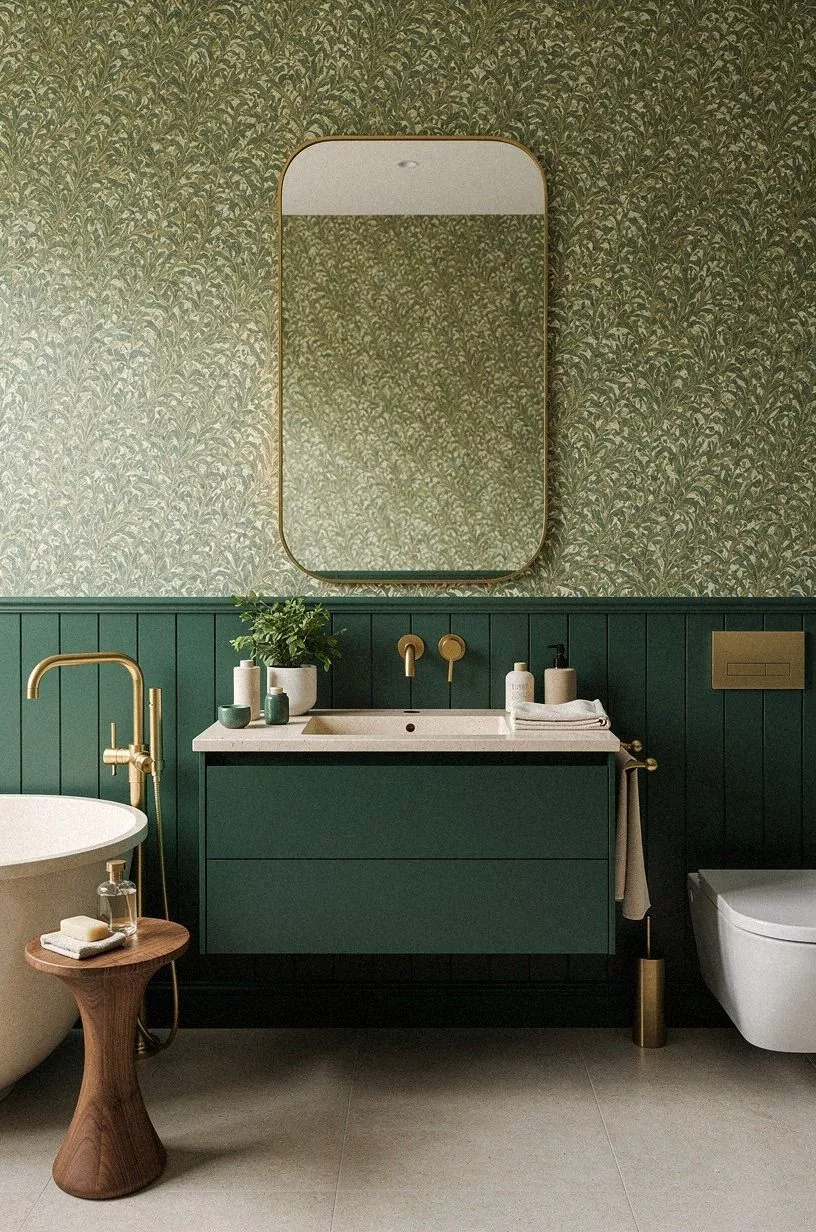
Green wainscoting gives the lower half of the room a solid architectural anchor. Above it, a small-scale botanical or geometric wallpaper introduces pattern without making the room feel busy. Choose a deep emerald paint for the paneling and pair it with cream, gold, and unlacquered brass developing soft patina.
The most successful version keeps the wallpaper background pale enough to reflect light. A 2-inch picture rail can separate the two surfaces cleanly, while a narrow stone shelf provides room for a small vase or folded hand towel. You’ll want the wainscoting height to relate to the basin, not simply land at an arbitrary midpoint.
If you’re choosing between a dense floral and a tiny geometric, the floral is more inviting in a windowless room because its curves soften the hard fixtures. Benjamin Moore Chestertown Buff HC-9 can serve as a warm cream reference for the upper wall or trim. If the wallpaper feels like too much commitment, use removable paper above painted paneling.
6Install a Jewel-Box Green Vanity With Fluted Doors
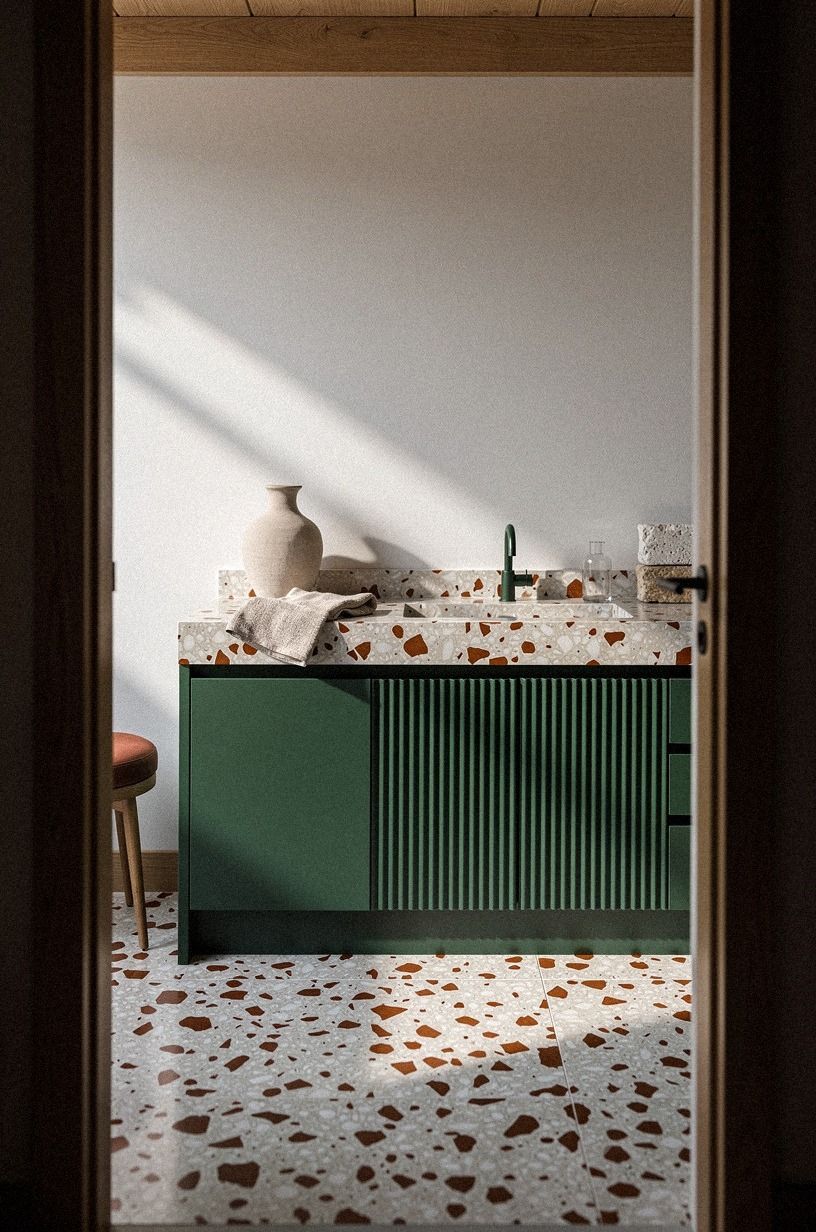
A fluted vanity gives a compact room texture at eye level. Choose a forest green cabinet with vertical grooves, an oversized-chip terrazzo top, and natural oak nearby so the finish feels layered rather than monochromatic. Fluted oak doors catch the light in narrow bands, which makes a small vanity look more substantial without adding visual bulk.
Keep the basin simple. A white undermount sink or a rounded ceramic vessel will let the cabinet lead.
Vanity height should generally sit between 32 and 36 inches, but the final choice depends on basin depth and the people using the room. You’ll want a drawer or cabinet for spare soap, guest towels, and cleaning supplies, because open storage can make a half bath look cluttered quickly.
Don’t pair fluted doors with a heavily veined countertop. The grooves already provide rhythm.
A restrained terrazzo surface, matte black faucet, and rust-colored hand towel will give your eye enough contrast. Article Sven tan leather nearby can add a warm seating note if the room has space, though a small oak stool is usually more practical.
7Sherwin-Williams Evergreen Fog Sets a Softer Direction
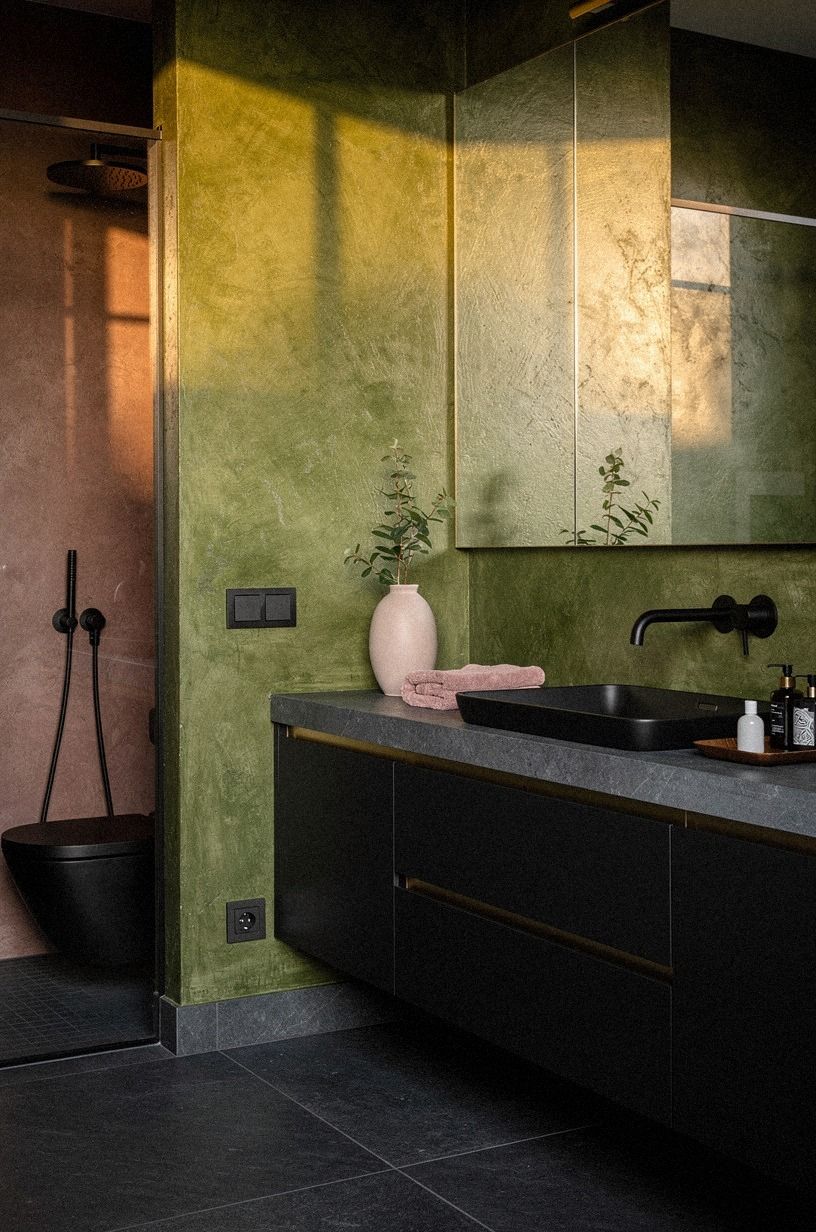
Moss-colored walls create a gentler version of the dark green powder room. Against them, matte black fixtures feel crisp and architectural.
The best finish combination includes dusty rose textiles, charcoal accents, and a small amount of aged brass so the room doesn’t become visually severe. Hand-applied Venetian plaster can add soft variation that painted drywall can’t match.
Use black for the faucet, mirror frame, towel ring, and light canopy, but avoid repeating it on every accessory. You’ll want at least one pale element, such as a warm ivory basin or linen hand towel, to keep the room comfortable. A small ceramic tray in dusty rose can bridge the wall color and the brass details.
Why choose matte black over polished chrome? Chrome would make the scheme colder and more reflective, while black gives the moss tone a grounded edge. Sherwin-Williams Evergreen Fog SW 9130 offers a useful reference for a muted green direction.
If you’re renting, peel-and-stick wall panels can suggest plaster texture without permanent construction.
Leave some wall visible. A moss room doesn’t need every surface covered with art, shelves, and hardware.
One botanical print, one lamp, and one tactile textile will feel more refined. These green bathroom undertone references can help you avoid a green that turns grey under artificial light.
8Hang a Botanical Print Over the Green Toilet
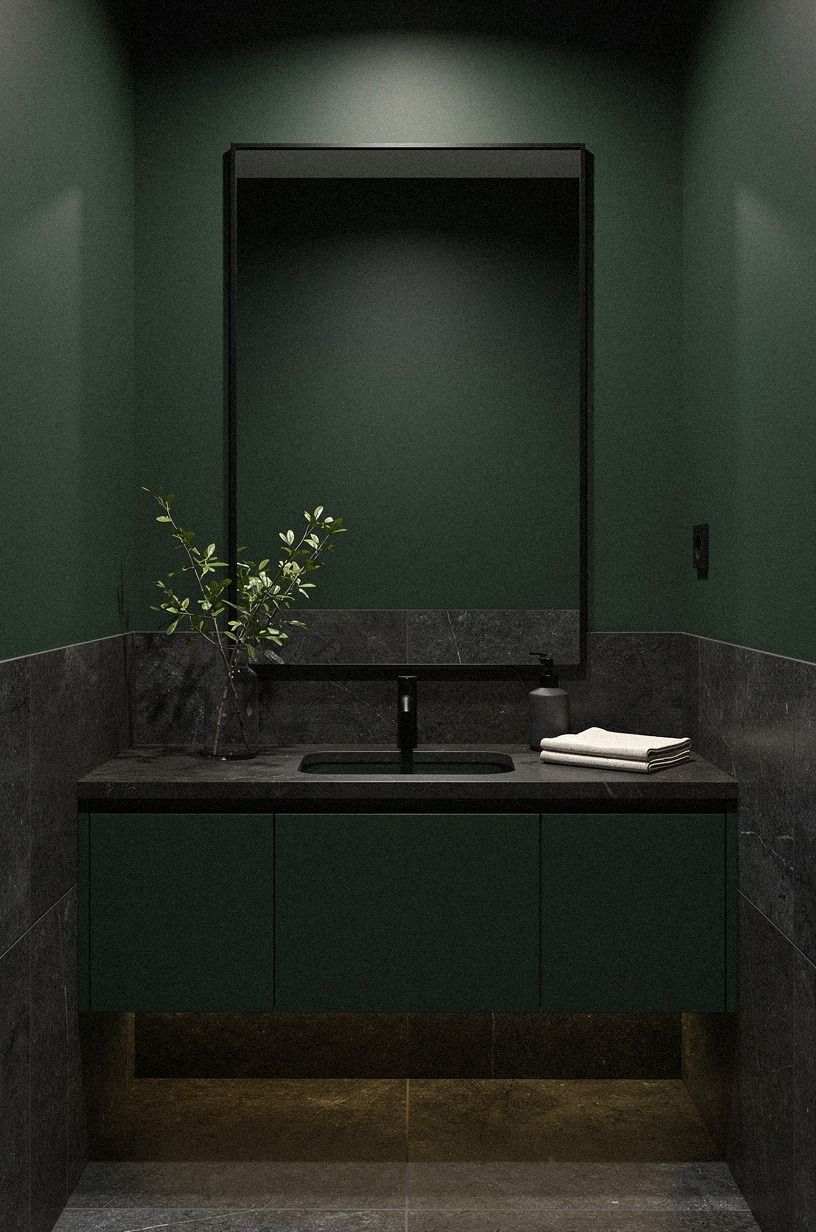
A botanical print can make the toilet wall feel considered without turning the fixture into the focal point. Choose a print with warm white paper, camel leaves, and black linework, then frame it in a slim dark wood or shagreen-style frame. The bathroom can remain slightly secondary in the composition while the artwork gives the eye a clear stopping point.
You’ll want the lower edge of the artwork high enough to avoid splashes but low enough to relate to the tank. A compact 18-by-24-inch proportion often suits a narrow wall, though the art should follow the available space rather than force a standard size. Keep the surrounding accessories quiet: one camel towel, one black hook, and perhaps a small oak shelf.
Skip a bright white frame. It may look disconnected from the green wall and warm accents. Target Threshold wood frame offers a simple budget direction, while a vintage frame from a thrift shop can bring more character.
These green wood and brass pairings offer a deeper material direction.
If you’re hanging art near a sink, use a sealed frame and avoid unprotected paper in areas with frequent splashes. The goal is relaxed, not fragile.
9Green and Ivory Checkerboard, Without the Noise
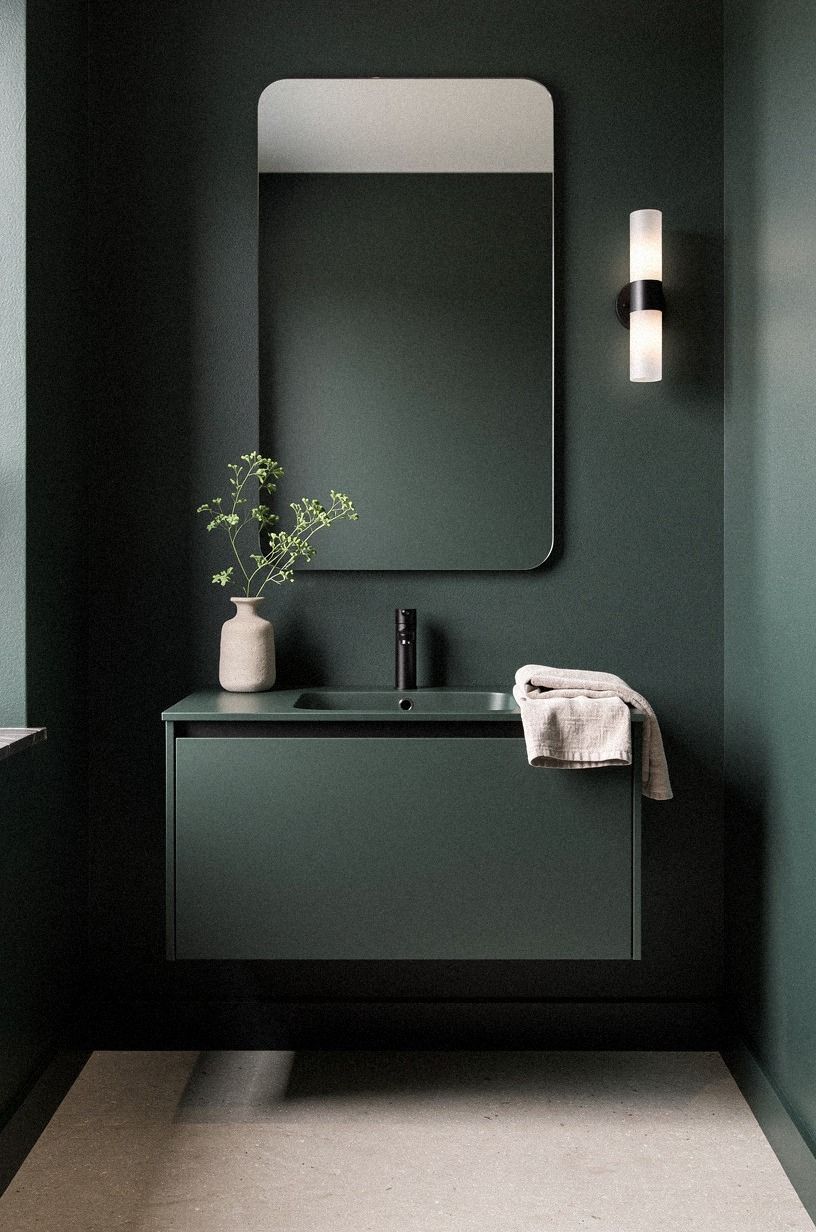
A midnight blue and ivory checkerboard floor brings pattern below eye level, while copper accents and washed Belgian linen add warmth without competing with the deep color.
10Add a Velvet Stool Beneath the Pedestal Sink
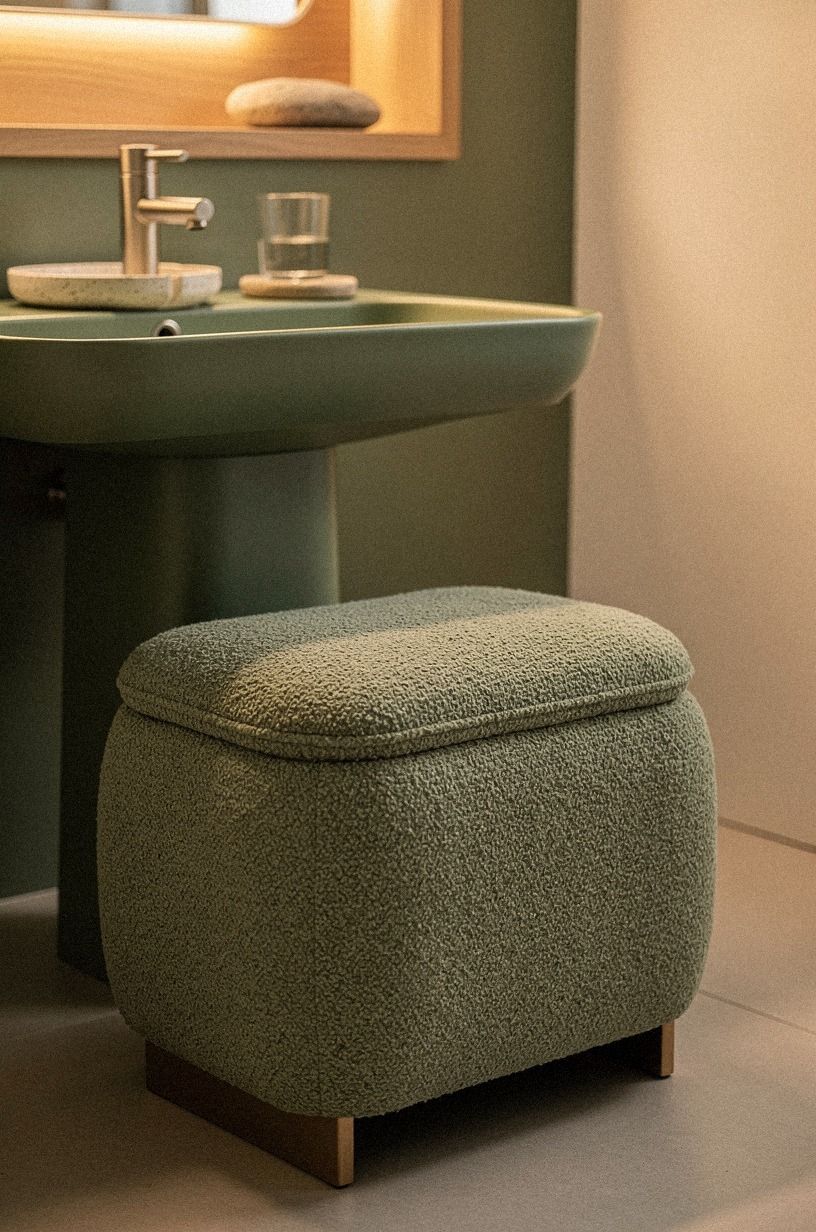
A stool upholstered in organic bouclé beneath a pedestal sink gives the room a small dose of softness without taking over the floor plan. Sage green, warm cream, and natural wood make the area feel calm, while the textured fabric brings tactile contrast. Sage green bouclé catches the light across its surface, so the stool can look richer than a flat painted accent.
Choose a stool with a narrow footprint and enough clearance for knees and feet. You’ll want the basin to remain easy to approach, especially when the toilet is nearby. A round stool can echo a curved sink, while a rectangular bench may work better beneath a long wall-mounted basin.
Skip a glossy acrylic seat in this setting. It would make the room feel more temporary and less collected.
IKEA MÄRIT textile can provide a budget color reference, but a thrifted wooden stool with new upholstery may offer better character. Keep the fabric away from direct splashes and choose a durable upholstery weight for regular use.
A small stool is also useful for guests, children, or anyone needing a place to set a toiletry bag. Practical details can still look elegant.
11Backlight an Arched Mirror on Green Plaster
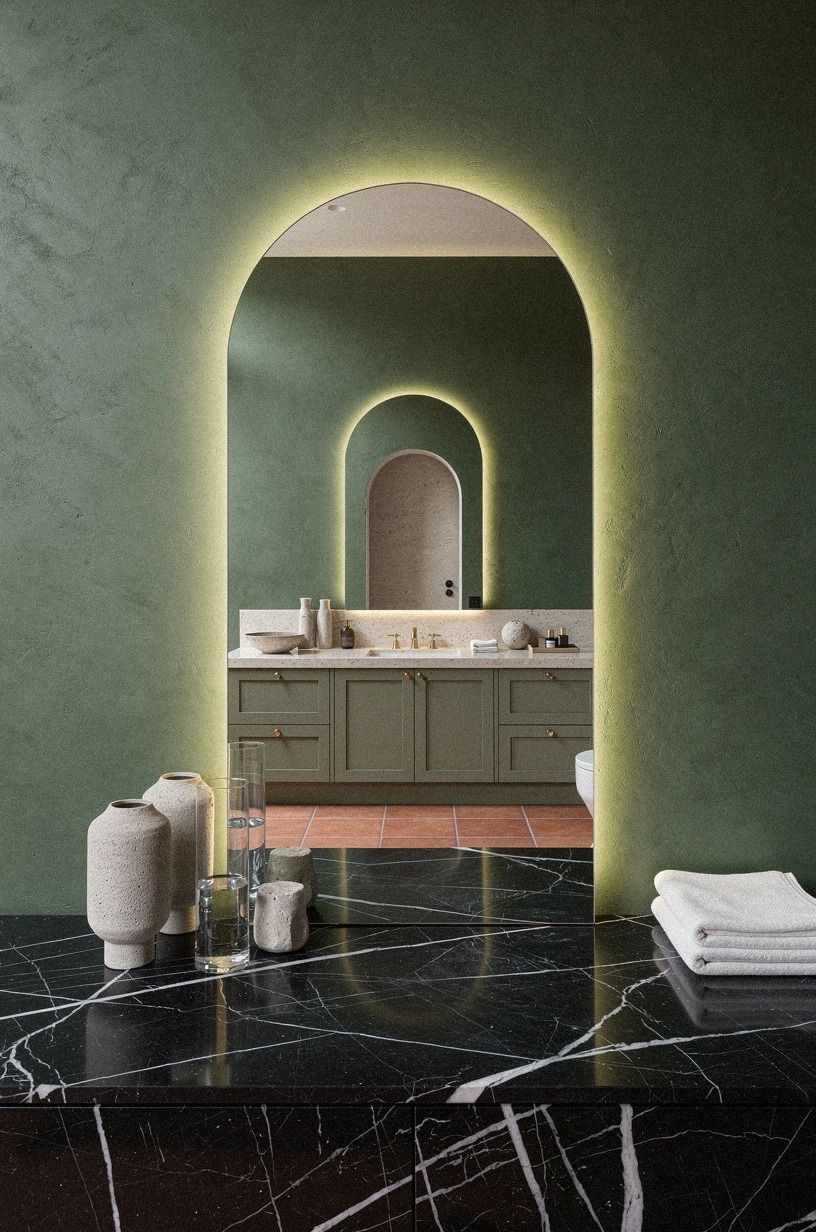
An arched mirror with concealed backlighting can soften the geometry of a green plaster wall. The light should glow around the outer edge rather than shine directly into the room, creating a quiet halo over Nero Marquina black marble with white veining. Terracotta, stone, and olive accents keep the composition earthy instead of theatrical.
You’ll want the mirror to be tall enough to reflect the face and shoulders, but not so wide that it competes with the basin. A narrow arch often suits a small powder room better than a broad capsule shape. Concealed wiring makes the installation cleaner, though a plug-in picture light can offer a simpler rental solution.
Why choose an arched shape instead of a rectangle? The curve interrupts the hard lines of the vanity, wall tile, and toilet, so the room feels less boxed in. A Pottery Barn Anton reclaimed wood shelf can repeat the warm material below the mirror without adding another strong silhouette.
Keep the backlight warm and dimmable. Cool light can make green plaster look grey, while a softer setting will preserve the olive undertone. If the wall texture is bold, avoid adding a patterned backsplash directly behind the basin.
12Let Green Marble Lead Around a Compact Basin
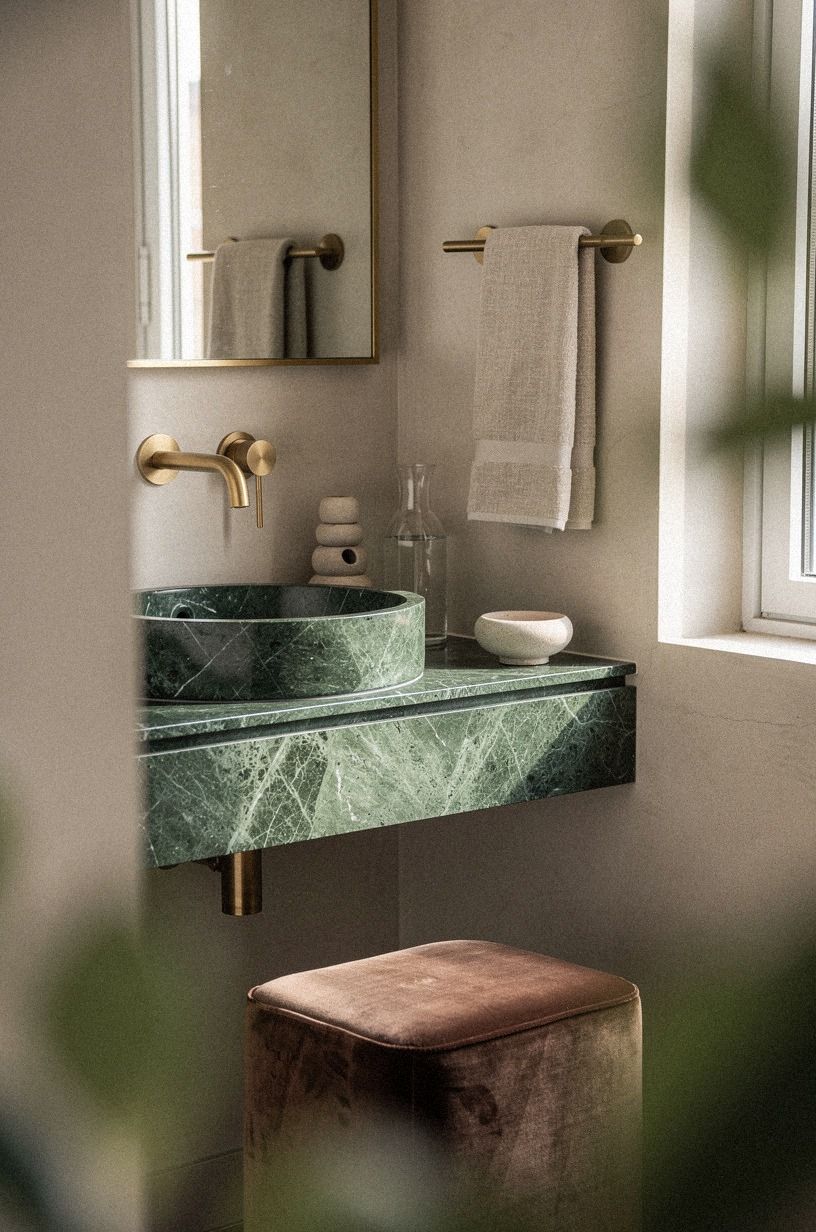
Green marble can give a compact basin the presence of a custom installation. Use it for the backsplash, narrow counter, or a shallow ledge, then balance the stone with clay-colored accessories, linen, and aged brass. Green marble with pale veining looks especially rich beside deep-pile mohair velvet, because the polished stone and soft fabric create a useful contrast.
A compact basin should still leave room for soap and hand towels. You’ll want to measure the wall, faucet projection, and door swing before choosing the slab. Toilet clearance should provide at least 21 inches in front, so a deeper counter can quickly make a small room uncomfortable.
Skip a full marble wrap if the budget is limited. A 4-inch backsplash or single vanity top can deliver the material’s color without covering every surface. Aged brass plumbing will warm the green more effectively than bright chrome, while a cream towel keeps the basin area from becoming too dark.
If the marble has strong veining, let it lead. Plain plaster, simple hardware, and one framed print will give the stone room to show its pattern. These moody green powder room palettes offer more ways to pair marble with warm neutrals.
13Create Gothic Contrast With Candle-Style Wall Lights
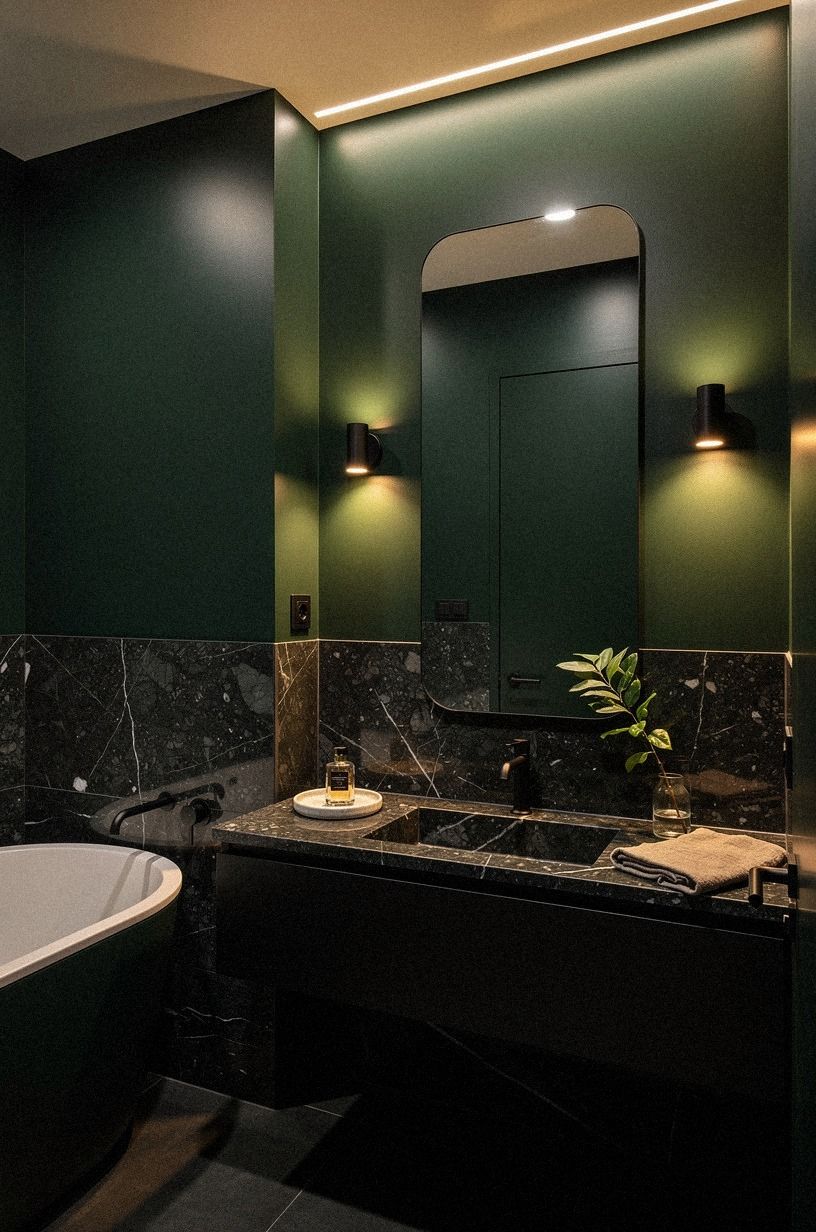
Candle-style wall lights can bring ornate vintage contrast to a dark green half bath. Plum, grey, and rose gold accents soften the drama, while Carrara marble with subtle grey veining adds a classic stone note around the basin or shelf.
What the Typical Powder Room Budget Covers
Dark green paint, a mirror, and better lighting can change a half bath without moving plumbing. A full vanity replacement costs more, while new floor and wall tile can shift the project into renovation territory. The ranges below are typical US reference points, so your room size, labor market, and selected materials will affect the final number.
Material selection changes the total quickly. Zellige tile may run $15-$35 per square foot, while subway tile may run $2-$10 per square foot. A marble top can range from $50-$100 per square foot, and a brushed brass faucet may cost $120-$450.
You’ll want to price the visible focal point first, then decide where a simpler finish can save money. A statement floor, custom stone basin, or decorative lighting can carry the design while the remaining surfaces stay practical.
Why Dark Green Is Having a Moment
Dark green works in a powder room because the space can support stronger color than a large living area. The room is used briefly, so a saturated wall, dramatic light, or patterned floor feels intentional rather than tiring. You’ll also see green pair easily with walnut, brass, terracotta, marble, and linen.
The current direction is less about matching every surface and more about contrast. A deep wall beside pale stone feels refined.
A moss cabinet beside warm plaster feels earthy. Benjamin Moore Black Forest Green HC-187 can guide a richer direction, while a softer olive works well when the room has limited natural light.
What makes the palette successful? Control. Choose one dark green, one light neutral, and one warm material.
Then add a small accent such as plum, rust, copper, or rose gold. Too many competing tones can make a compact room look unfinished, even when every item is attractive.
You don’t need a large renovation to create the effect. A painted ceiling, warmer bulbs, new hardware, or a better mirror can shift the room quickly. If you’re unsure about the undertone, test the color beside the floor, countertop, and brightest artificial light.
What People Always Want to Know
What is the best dark green powder room and half bath idea for a small bathroom?
A dark green vanity with a pale stone top is a strong choice because it adds color below eye level without closing in the walls. Reflective lighting and an arched mirror can keep your small room open. An IKEA cabinet base can also provide storage without overwhelming the floor plan.
Where can you buy dark green powder room and half bath pieces on a budget?
IKEA, Wayfair, and Target offer affordable mirrors, stools, lighting, and cabinet options. Facebook Marketplace and thrift shops can also provide solid wood frames or vintage furniture. You’ll want to check dimensions, electrical condition, and moisture exposure before bringing any second-hand item into your bathroom.
How much does a dark green powder room and half bath makeover cost?
A small cosmetic update may fall within the $200-$1,200 budget range for paint, a mirror, a faucet, and textiles. A mid-level project with a new vanity, partial tile, and lighting may reach $3,000-$9,000. Free changes include rearranging accessories, removing clutter, and improving bulb warmth.
Can you create a dark green powder room and half bath on a budget?
Yes, and paint is usually the largest visual change for the least money. Reuse the existing mirror, replace only the light fixture, and shop second-hand for a wood stool or frame. Warm layered lighting can make an inexpensive green wall feel far more finished.
Is a dark green powder room and half bath worth it in a small space?
Yes, because a small room can handle a concentrated color story without requiring gallons of paint or extensive furniture. Use a lighter floor, one reflective surface, and a slim vanity. You’ll want at least 21 inches of clearance in front of the toilet for comfortable movement.
Is a dark green powder room and half bath a good idea for a rental?
Yes, when the color comes from removable wallpaper, framed panels, or renter-safe accents rather than permanent renovation. Try a tension-rod linen curtain, peel-and-stick art panels, a removable mirror, and plug-in sconces. Your landlord’s rules should guide any adhesive or electrical change.
Where to Start First
If one upgrade deserves priority, start with the wall color. A deep green paint gives every later choice a clearer direction, while a cold wall can make brass, wood, and marble fight each other. Choose the shade, then save these green powder room color combinations for the lighting and hardware stage.
You’ll want to test the paint in morning, afternoon, and evening light. A shade that looks rich beside natural light can look nearly black beneath a cool bulb. Once the undertone feels right, choose the mirror, metal finish, and wood tone around it.
Start with one confident change, then build slowly. A dark green powder room works best when every material has room to register.