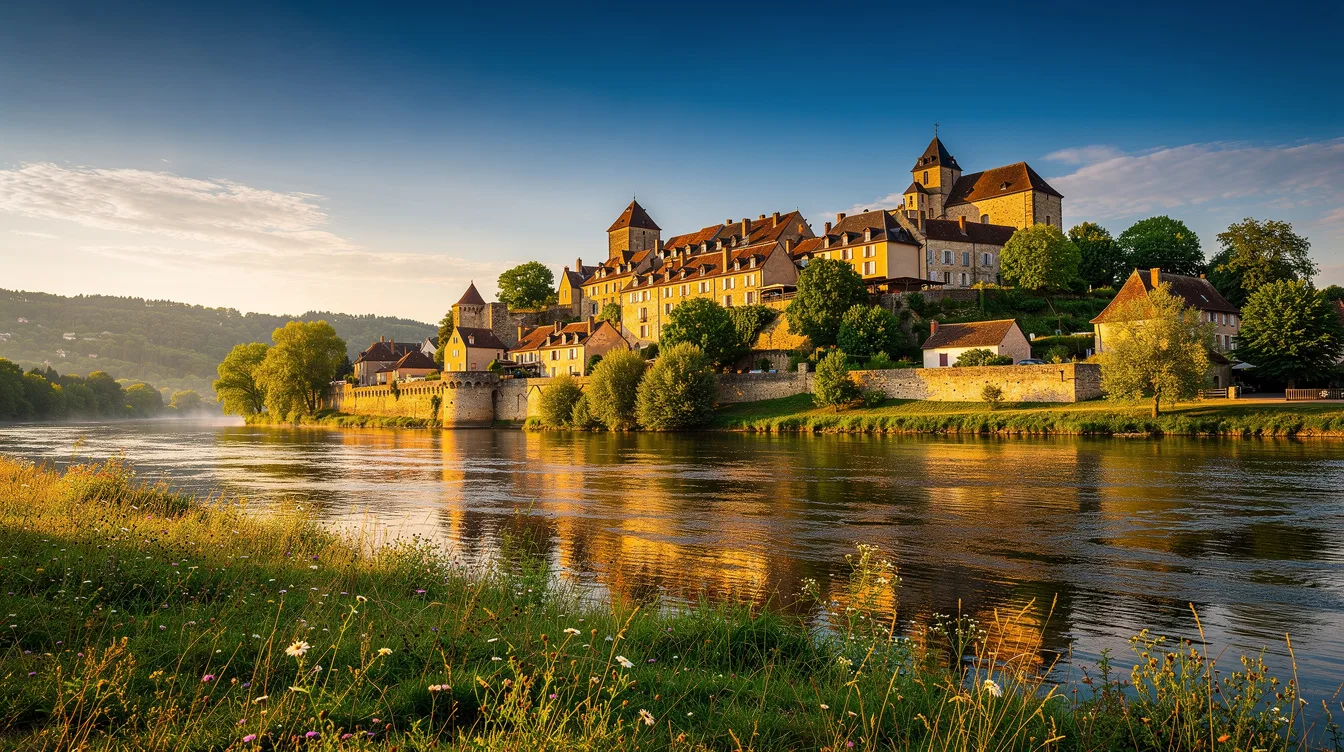
Pesmes is the kind of French village that rewards an unhurried afternoon. Set in Haute-Saône, between Gray and Dole, it takes about 2 to 3 hours to explore on foot. That’s enough time to see the main sights without turning a small historic center into a checklist.
And the village gives you a clear reason to slow down: Pesmes belongs to Les Plus Beaux Villages de France. The distinction doesn’t make the place feel polished into a theme park. Stone houses, old fortifications, and the sound of the Ognon keep the mood grounded.
A recognized village with room to wander
Pesmes sits at the southwestern edge of the department, along the Ognon. You can spend the first hour simply following the streets and noticing how the old buildings gather around the historic core.
But the village is more than a pretty label on a road map. Its heritage includes fortifications, towers, remains of the seigneurial castle, and older stone homes that give the streets a consistent feel. And because the area is compact, you won’t need to rush between sights.
The village has about 1,083 residents, according to the 2023 figure in the research notes. That scale matters. You’re visiting a lived-in commune, not a place emptied after the last tour group leaves.
Start with Saint-Hilaire, then follow the old defenses
Saint-Hilaire Church deserves an early stop. Its medieval origins and Comtois bell tower, covered with glazed tiles, give you one of Pesmes’s clearest architectural markers.
And the church works best as part of a walking visit, not as an isolated attraction. Afterward, you can continue toward the ramparts and the remains of the castle, where the village’s defensive past becomes easier to read.
But don’t expect a grand fortress with rooms open at every turn. What remains is more fragmentary, which is precisely why you’ll notice the relationship between the walls, the streets, and the views toward the Ognon.
The Maison Royale adds a sharper historical detail
Maison Royale, dating from the 17th century, gives the walk a different rhythm. Its presence shifts your attention from defense to domestic and civic architecture, with the kind of detail that rewards travelers who pause instead of merely passing through.
And you’ll find more evidence of older life in the château Rouillard and the hôtel Mairot. These buildings help explain why Pesmes feels coherent rather than assembled from unrelated sights.
That said, the village won’t fill an entire day with formal attractions. You should come for a measured walk, a few photographs, and the pleasure of seeing how the buildings sit together. The limit is also the appeal.
Follow the Ognon toward the Forges
Les anciennes Forges de Pesmes recall the village’s craft and industrial past. You can connect the historic center with the water, so the visit gradually opens beyond stone walls and narrow streets.
And the riverbanks bring a softer sensory break. The air feels more open beside the water, while the Île de la Sauvageonne adds space for a walk and seasonal outdoor activities.
But the sources don’t specify which activities operate during each season, so check locally before planning around water access. You’ll have a better visit if the river is treated as part of the setting rather than a guaranteed program.
Can you explore Pesmes without rushing?
Yes. A walking visit of 2 to 3 hours covers the village’s main heritage points and the route toward the river. And if you prefer slow travel, leave time to stop at the church, study the old stonework, and let the Ognon set the pace.
On a practical note, the research notes don’t confirm parking near the historic center, so don’t build your plan around that assumption. Pesmes is best approached as a half-day stop, with the walking route taking priority over a tightly timed itinerary.
By the end, the village has given you churches, walls, older houses, and river light without demanding a full day. But that restraint is what makes Pesmes work: the last part of the walk belongs to the Ognon, where the sound of water replaces the day’s sightseeing.