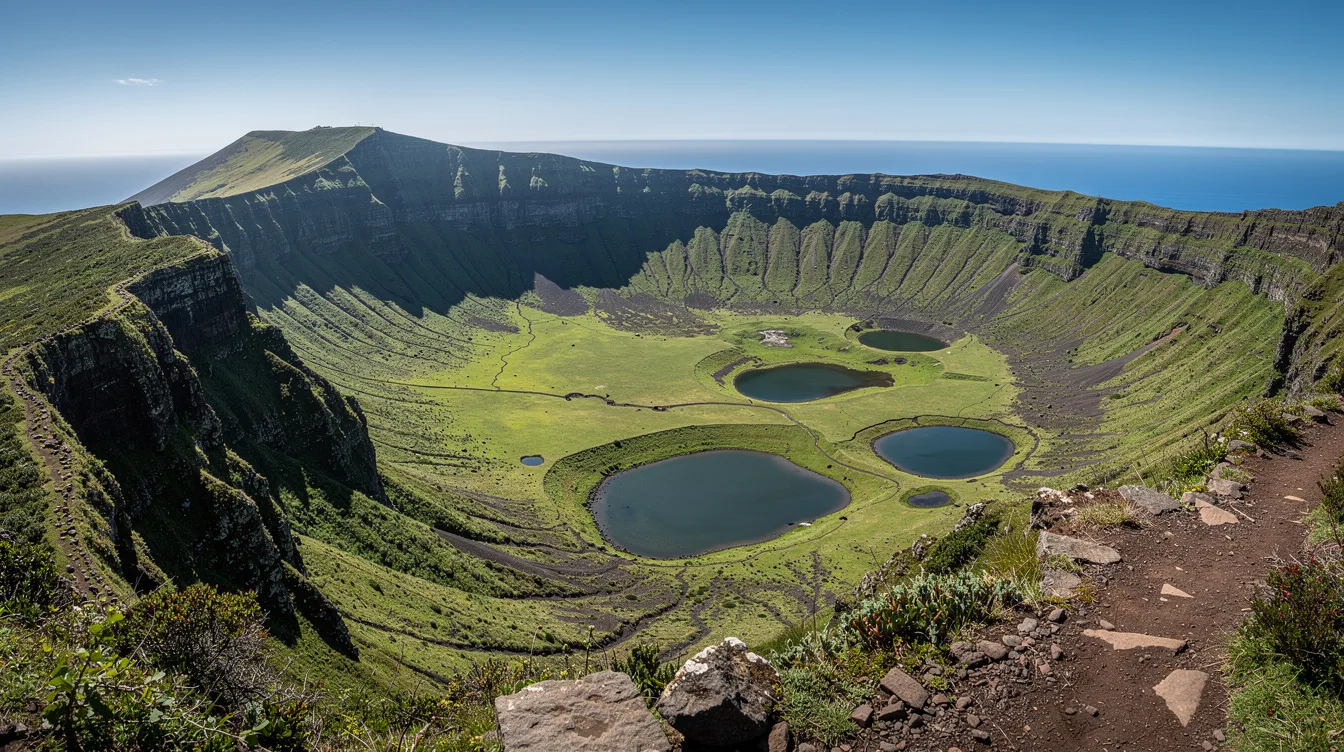
Le Caldeirão is the reason to come to Corvo. At this Portuguese island’s center, its collapsed volcanic caldera stretches about 2.3 miles across, a scale that feels startling on an island this small.
You arrive expecting a remote Atlantic stop. Then the crater rim opens onto green interior slopes, lakes, pasture, and dark volcanic forms. It’s the kind of view that makes you stop talking for a minute.
Corvo’s center is bigger than it first appears
Corvo sits in the western Azores, about 9.9 miles north of Flores. It is the smallest and northernmost of Portugal’s nine Azorean islands, so its central caldera takes on even more force: the island feels compact, but its volcanic heart does not.
And the Caldeirão is not a quick roadside flourish. From its rim, you look into a broad collapsed crater where pasture and water gather below. Clouds and fog can close the view fast, which makes a clear break in the weather feel genuinely earned.
The island’s geography explains the mood. Atlantic weather moves through quickly, so the same rim can feel hushed one moment and exposed the next. You should leave room in your plans for that uncertainty.
Can you see the whole caldera?
Yes, when visibility cooperates, the crater’s 3.7-kilometer width is the point. You can take in its rounded rim and the varied ground inside rather than merely glimpse one volcanic feature at a time.
But don’t promise yourself a perfect panorama on a fixed schedule. Fog is part of Corvo’s reality, and the weather can rewrite a day. That limitation is also why the view feels less packaged than many famous island lookouts.
Getting there is part of the filter
Most visitors reach Corvo from Flores, usually departing Santa Cruz das Flores on a seasonal boat. The crossing takes about 40 to 60 minutes, depending on the sea, and that short stretch of water makes the two islands feel much farther apart.
There are also limited SATA Air Açores flights between Flores and Corvo. They can be useful, but weather may cause delays or cancellations. If you need a trip that runs to the minute, this isn’t the island for it.
And that is precisely Corvo’s appeal. The sea crossing strips away the casual day-trip energy. By the time you reach the harbor, the pace has already changed.
Vila do Corvo keeps the island grounded
Vila do Corvo is the island’s only settlement, built on a lava fajã. Its white houses, narrow lanes, small harbor, stone-walled pasture, fishing activity, and livestock give the place a lived-in quality rather than a resort gloss.
You can visit the church of Nossa Senhora dos Milagres, walk around the port, and let the tight scale of the village sink in. Corvo has very little tourism infrastructure, so it feels calm, but it also asks you to plan ahead.
The island has about 435 residents. That number matters less as trivia than as context: accommodation and transport capacity are limited, especially in summer, and there isn’t a long menu of backup options when weather shifts.
June through September is easier, October has its own pull
For general travel, June to September usually brings more favorable conditions and more dependable sea connections. You’ll still need flexibility, because wind, fog, and the Atlantic don’t care about a tidy itinerary.
But October draws birdwatchers. Corvo is known internationally for migratory birds, including rare North American species pushed toward the island by Atlantic weather systems. That makes the island lively in a very specific way, though it can also be wetter and windier.
Should you stay overnight?
If you can, yes. Many people visit from Flores in a day, but an overnight stay takes pressure off the boat timetable and gives you a better chance to see the Caldeirão early or late, when the island feels quieter still.
Corvo is not for travelers who want endless restaurants or a packed activity list. Flores has more lodging, food, roads, and waterfalls, while Corvo offers the spare, weather-led experience.
A small island with a full-scale crater
Corvo is a UNESCO World Biosphere Reserve, but the designation is less memorable than the physical sensation of arriving here. The island is rural, volcanic, and exposed. Its fields meet stone walls, and its cliffs look toward Flores across restless water.
And the caldera is the payoff. You come for a crater about 2.3 miles wide, then stay alert for the clouds to lift. By the time the boat turns back toward Flores, the harbor is quiet again and the rim is often disappearing into mist.