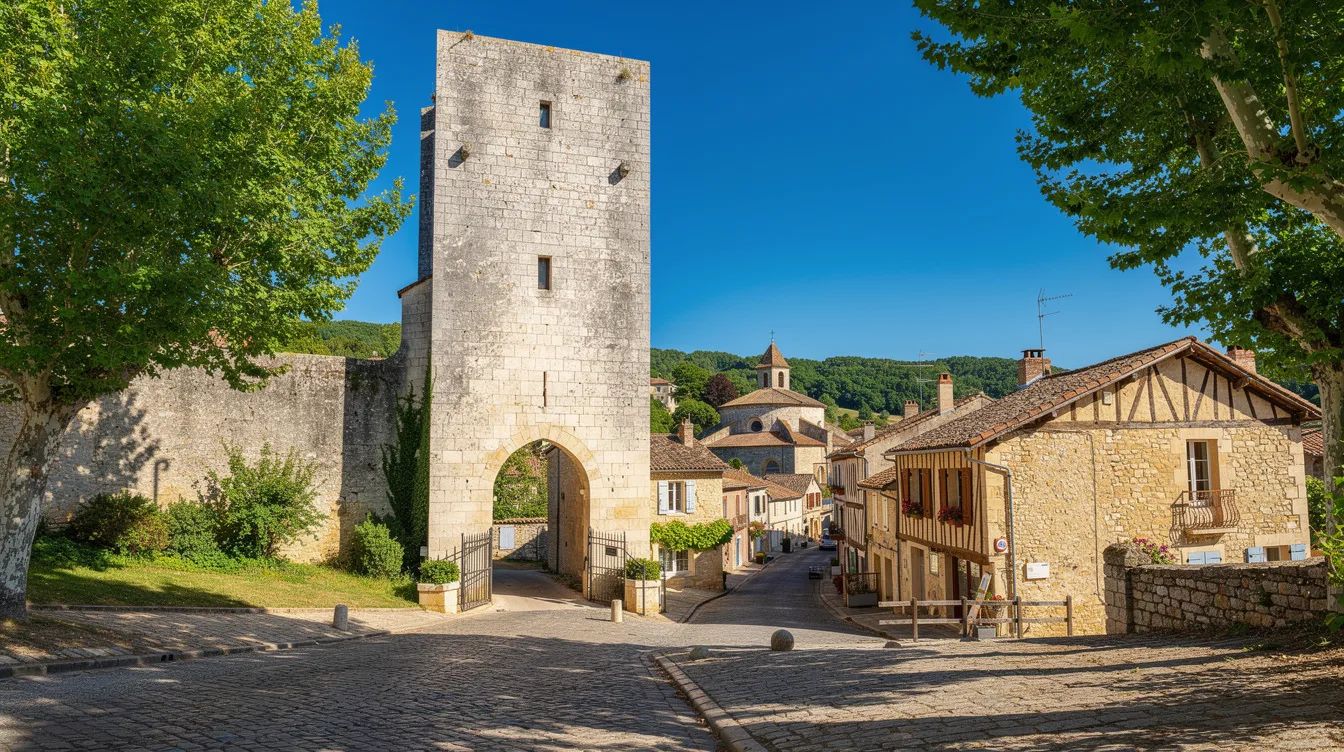
Sarrant makes its case at the gate. A square tower rises above the 14th-century town entrance, and the village closes around it in a near-circle of old houses. You can see the shape almost at once, which is why this tiny stop feels more deliberate than many larger French towns.
It sits in northeastern Gers, roughly 31.1 miles northwest of Toulouse and near Mauvezin. Come for a quiet walk, not a packed itinerary. But that compactness is the appeal: within a few narrow lanes, Sarrant explains a surprising chapter of medieval town planning.
A bastide that broke the usual rules
Sarrant’s houses form a ring around its central church, an unusual arrangement for a bastide. Most bastides put a market square at their center because commerce shaped the plan. Here, the church holds the middle, and the streets bend around it.
And that geometry changes the visit. You don’t march down one grand avenue toward a monument. You circle slowly through close-set medieval houses, some half-timbered, with tiled roofs catching the light above the lanes.
The village’s customs charter dates to 1265. It set out the rights and duties of residents and co-lords, while consuls led the royal fortified settlement. That civic framework gives the little circle of streets more weight than its calm appearance first suggests.
The square tower is the right place to begin
The fortified town gate, topped by its square tower, is Sarrant’s clearest visual anchor. It isn’t merely decorative. It recalls the village’s defensive past, then sends you directly into the tight medieval core.
But don’t expect a fortress complex with rooms to conquer. This is a small rural village, and that’s the point. The tower works best as an entrance frame, with the old streets beyond it doing the quieter work.
Look upward after passing through. The parish church has an octagonal spire added in the 19th century, so the skyline carries two different eras: the square mass at the gate, then a slimmer form above the rooftops.
Can you see Sarrant in an afternoon?
Yes, and you should resist treating that as a flaw. The historic center is made for walking rather than checklist tourism. You can take your time through the lanes, pause at the medieval garden, then let the village’s circular plan bring you back toward the church.
And if you’re driving through Lomagne, Sarrant is about 5 miles from Mauvezin and 9.9 miles from Beaumont-de-Lomagne. It fits naturally into a rural day out, though the reward is texture and shape rather than a long menu of attractions.
Why the slow pace suits this corner of Gers
Sarrant joined Les Plus Beaux Villages de France in 1999, a designation that makes sense once you understand how intact its center remains. The recognition may draw visitors, but the village still reads as a small place first.
You’ll find a medieval garden devoted to plants, vegetables, and older uses. That detail matters because it keeps the visit rooted in ordinary life, not only walls and dates. The lanes are narrow, and the roofs press close overhead.
But Sarrant won’t satisfy anyone seeking urban bustle. There is no reason to rush it, and no reason to invent one. The best approach is to arrive with a few open hours and leave room for the place to be quiet.
A practical stop, with one August caveat
The village traditionally holds a medieval festival in early August. That can add activity to streets that are otherwise calm, but you should check the current year’s program before making a special trip. Dates and details can change.
For local information, the town hall is on Place du Donjon. Published hours are Monday from 9 a. M.
To noon and 2 p. M. To 6 p.
M., plus Friday from 2 p. M. To 6 p.
M. Those limited hours are worth noting if you need assistance.
And when the walk is done, stand once more beneath the square tower. Behind you, the countryside opens toward Lomagne. Ahead, the houses curve around the church, holding their unusual circle in the late-day quiet.