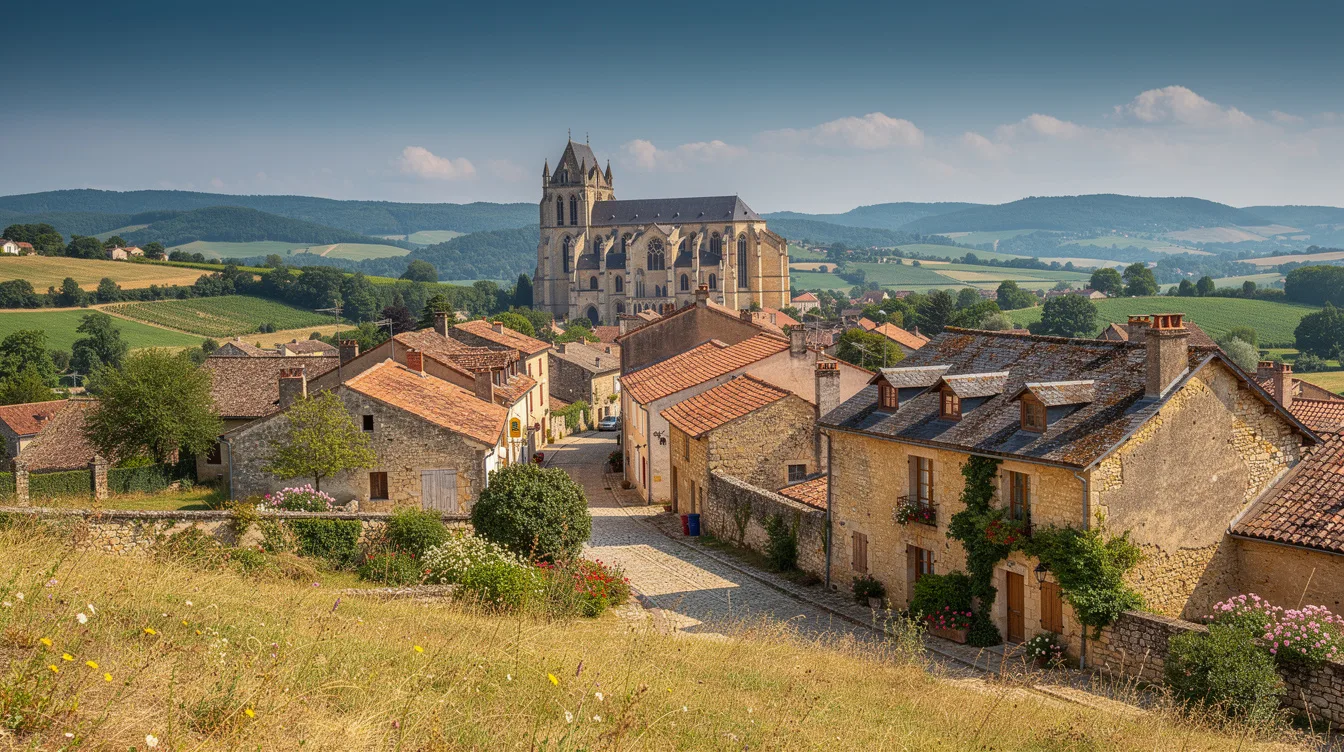
Saint-Antoine-l’Abbaye became France’s favorite village in 2025, and the surprise is how little it asks you to hurry. In western Isère, near Saint-Marcellin and between Grenoble, Valence, and the Vercors, its medieval center still feels made for feet rather than traffic.
That national distinction brought attention, of course. But the village’s appeal is quieter than a headline: paved lanes, old stone houses, vaulted passages, and an abbey that keeps pulling your eyes upward.
A 2025 winner with a medieval center
The title came through the annual France 2 series “Le Village préféré des Français.” It confirms what the village has long had, rather than changing it: a compact historic core where you can let the streets set the pace.
And that matters if you dislike destinations that turn every stop into a schedule. You can see the village and abbey in 1.5 to 2 hours, yet the place rewards a slower half-day if you add the museum and lunch.
Saint-Antoine-l’Abbaye has belonged to Les Plus Beaux Villages de France since 2009. That label can sometimes signal polished tourism, but here the strongest impression is still stone underfoot and the sudden silhouette of the church.
You won’t find a big-city rush built into the experience. The historic center is easy to cover on foot, so your attention can stay on carved facades and the dark openings of the covered passages.
The abbey explains why the village grew here
The Abbey of Saint-Antoine is the reason to come, even if you generally ration your church visits. Its Gothic church was built mainly between the 13th and 15th centuries by the Hospital Brothers of St. Anthony.
But its story begins earlier. In 1095, the original house of the Hospital Brothers of St. Anthony was founded here after cures from Saint Anthony’s Fire were attributed to relics of Saint Anthony the Great.
Saint Anthony’s Fire is now identified as ergotism. The Benedictine community cared for the shrine and relics, while the Brothers tended people afflicted by the illness, which made this village a major medieval pilgrimage destination.
The two religious groups did not always coexist easily. In 1297, the Antonines became an order of canons regular, and the Benedictine monks were removed from the shrine.
And you can feel that long religious history in the scale of the complex. The sculpted facade, the abbey church, and the convent buildings give a small village an unexpectedly weighty center.
Is the museum worth adding?
Yes, if you have the time. The Musée départemental de Saint-Antoine-l’Abbaye occupies part of the convent buildings and focuses on the site, the Antonines, and pilgrimage history.
It also changes the visit from a photogenic walk into a clearer story. That said, if your day is short, the church and surrounding lanes deliver the essential experience without requiring a museum stop.
Walk slowly, because the details are the point
The village’s old houses, medieval hall, cobbled streets, and arched passages are close together. You don’t need an ambitious route, which is precisely why it works so well for a short detour.
And this is where I have an opinion: don’t treat it as a quick backdrop before moving on. Pause beneath the vaulted passages, then look back toward the abbey when the pale stone catches changing light.
The main monuments use local molasse, a rock formed through Alpine mountain-building and suited to sculpture. That material gives the buildings a soft, worked texture rather than the hard, uniform look of newer stone.
But the village is not a theme park. Its historical importance is the real draw, and that can mean a visit feels contemplative rather than packed with constant activity.
Getting there without turning it into a marathon
Saint-Antoine-l’Abbaye sits in the Chambaran hills, north of the Isère Valley and near the Drôme boundary. It is particularly easy to visit by car, which makes it a sensible stop when traveling between Grenoble, Valence, and the Vercors.
The abbey is on Place de l’Abbaye, in the 38160 postal area. Once you arrive, leave the car behind for the historic center, because the best parts are close enough to absorb without a map.
You should plan a half-day if you want the museum and a meal. But a shorter visit is still satisfying, especially if what you want is one hour of quiet streets and a Gothic church that refuses to feel small.
By the time you step back onto the cobbles outside the abbey, the noise that lingers is your own footsteps.