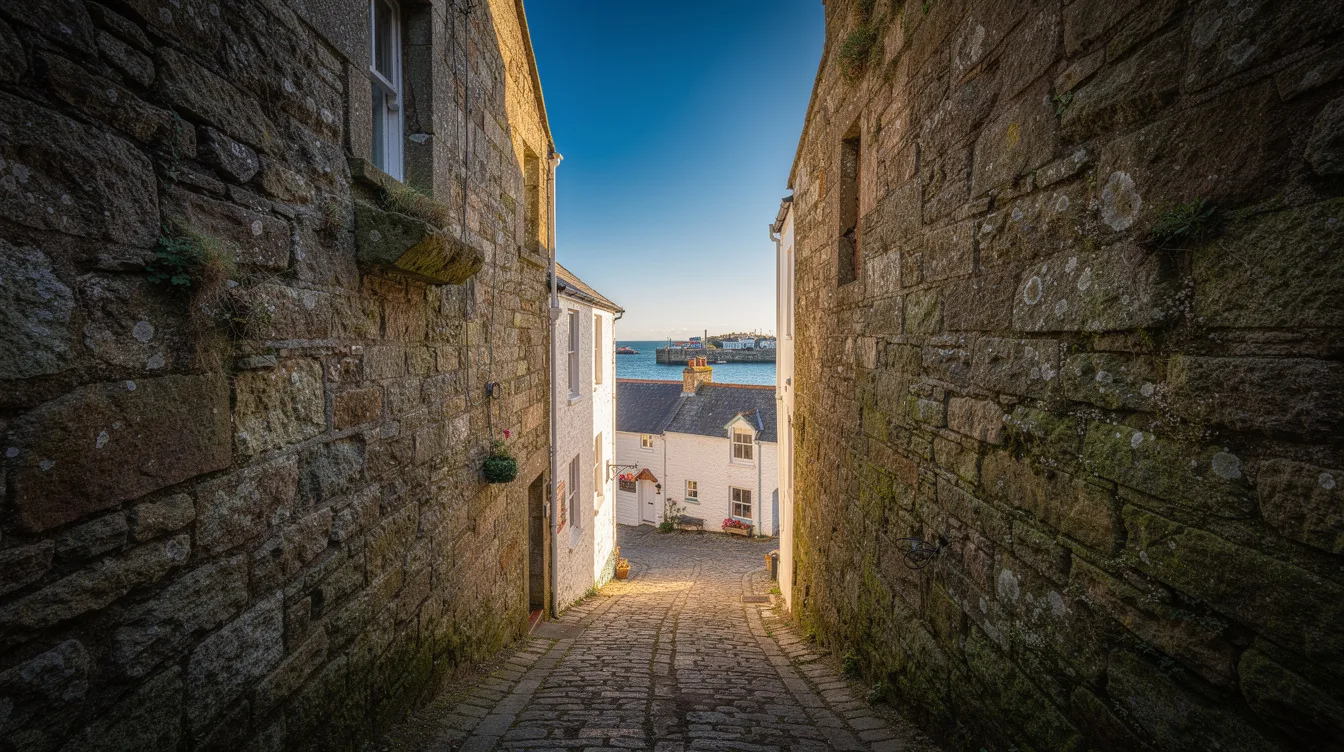
Temple Bar, known locally as Squeeze-belly Alley, is the reason many travelers come looking twice at Port Isaac’s lanes. The passage appeared in the 1978 Guinness Book of Records as the world’s narrowest thoroughfare. You can find it in this Cornish fishing village, where getting lost is half the pleasure.
Port Isaac drops through a narrow valley toward the Platt, its small working harbor. Whitewashed fishermen’s cottages press close to steep lanes, so the village feels made for walking rather than rushing. But bring patient shoes, because its slopes are part of the experience.
Squeeze-belly Alley is the point of the detour
Temple Bar is a real passage, not a marketing invention, and its nickname tells you what to expect. You’ll notice the walls closing in as you enter. It’s a tiny encounter, but it gives Port Isaac’s compact old core its most memorable detail.
And that is why the alley works better as a pause than a checklist item. Walk it, step back out into the light, then keep following the tight lanes around the harbor. The contrast is immediate, from close stone walls to open water and boats.
The village’s Cornish name, Porthysek, means “port abounding in corn,” a reminder that this place once connected inland trade to the coast. Later, fishing became central to local life. Today, fishermen still land fish, crab, and lobsters from the Platt.
You don’t need to turn the visit into a history lesson. Still, knowing that goods once moved through these narrow streets makes their scale more interesting. They weren’t designed for modern convenience, and that’s precisely why driving here feels like the wrong idea.
The Platt changes the village’s mood
The working harbor is known locally as the Platt, and it’s worth seeing at both low and high tide. Its appearance changes dramatically, so a second look can feel like a different stop. The water, stone, and clustered cottages make a convincing case for lingering.
But Port Isaac isn’t frozen in a postcard version of itself. Fishing continues here, with lobster and spider crab among the landings. That gives the harbor a purpose beyond photographs, even when visitors are studying every angle with their phones.
If television brought you here, the village was the fictional Portwenn in Doc Martin from 2004-2022. Fern Cottage appeared as the doctor’s house. You can look for filming locations while still treating the village as a place where people live and work.
The Fisherman’s Friends sea-shanty group is also closely tied to Port Isaac. That connection suits the setting. Sound carries differently between tight lanes and along the water, where the village’s maritime past feels less like a museum label than a lingering rhythm.
Can you explore Port Isaac without a car?
Yes, and you should. Port Isaac is compact and best experienced on foot, while its old lanes are narrow, steep, and congested in high season. Park at the Main Car Park or New Road Car Park, then walk downhill roughly 5-10 minutes to the harbor.
That downhill walk helps set expectations before you reach Temple Bar. You’ll be moving through a village built at a human pace. The return uphill asks more of you, but it also keeps the day from feeling like a drive-by coastal stop.
Make Port Isaac part of a longer Cornish walk
Port Isaac sits on the South West Coast Path, the 630-mile National Trail. Shorter local walks use portions of the route, including the walk toward nearby Port Gaverne. You can pair the alley with a coastal stretch, then return for seafood near the harbor.
And the location is manageable if you’re already exploring north Cornwall. Wadebridge and Camelford are nearby. The nearest rail station is Bodmin Parkway, about a 40-minute drive away, so this works best with transport arranged before arrival.
Summer brings a trade-off. Port Isaac can feel busy then, and accommodation, parking, and restaurant reservations are worth planning ahead. But the village still rewards a half-day or overnight stop if you prefer historic ports, coastal walking, and a harbor with real working life.
Leave Temple Bar without trying to make it bigger than it is. Its charm is that it stays small, a quick squeeze between old walls before the lanes open again toward the Platt.