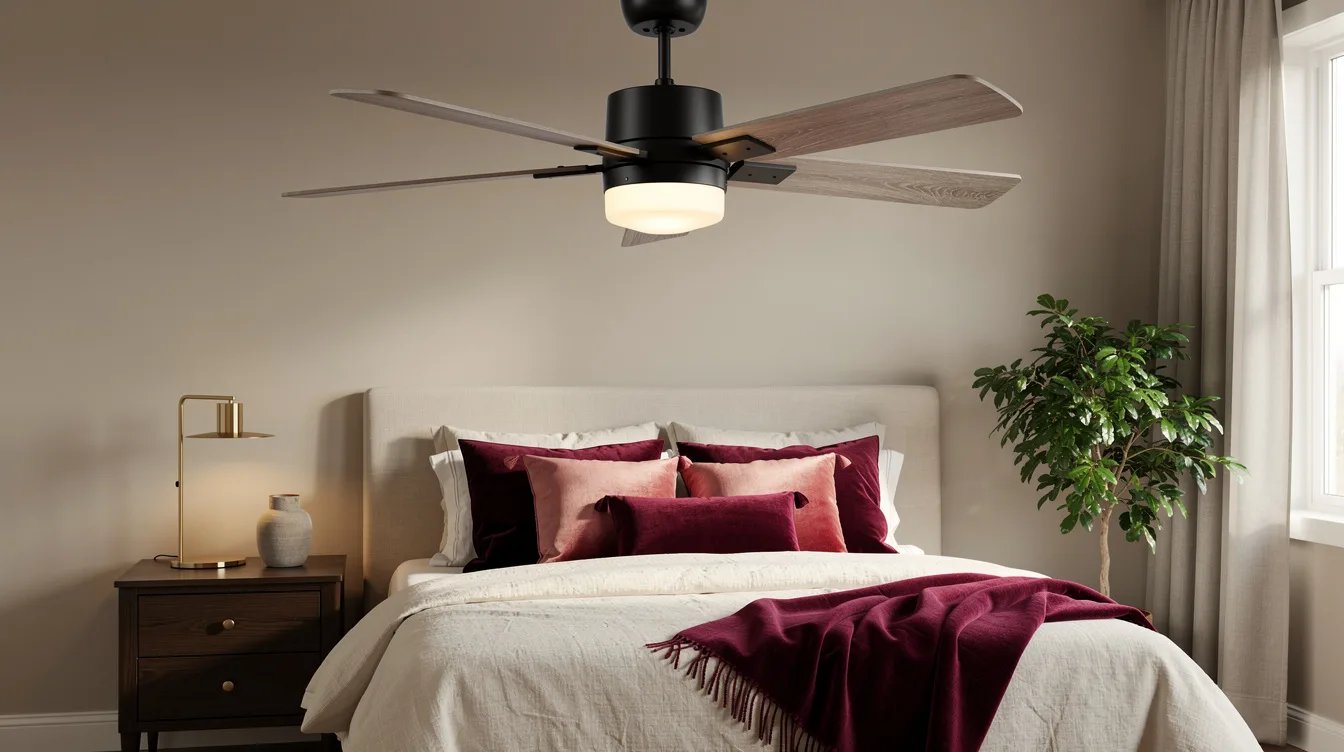
I spent about $240 on a bedroom fan that looked incredible in the listing photos and sounded like a mini fridge at night.
That’s the trap with ceiling fans: they’re the biggest object in most bedrooms, and they’re the one thing people shop by price instead of by design. A convincingly polished branded option typically runs $200 to $550, and the gap between that and the $90 lookalike shows up in the dark.
Here’s what designers keep flagging, and the fix for each.
Stop Buying a Fan With a Bulb Kit Bolted On
The fastest way to spot a cheap bedroom fan is the seam: motor housing on top, unrelated glass bowl hanging below, like two products introduced at checkout.
A designer-looking fan reads as one ceiling object. The Hunter Dempsey Low Profile does this well at about 8.1 inches tall, so the whole thing sits tight and looks architectural instead of dangling.
My rule: if you can mentally unscrew the light and get a different-looking fan, keep shopping.
Ditch the Exposed Five-Bulb Cluster
Multi-bulb clusters throw hard shadows on the ceiling and glare straight into your eyes when you’re lying down. In a bedroom, that’s the one angle that matters.
Diffused integrated LED wins here. Look for a concealed lens or an opal glass globe that softens output instead of broadcasting five bright dots.
Warm color temperature matters as much as the shape. Around 3,000K reads like lamplight; 4,000K reads like a dental office.
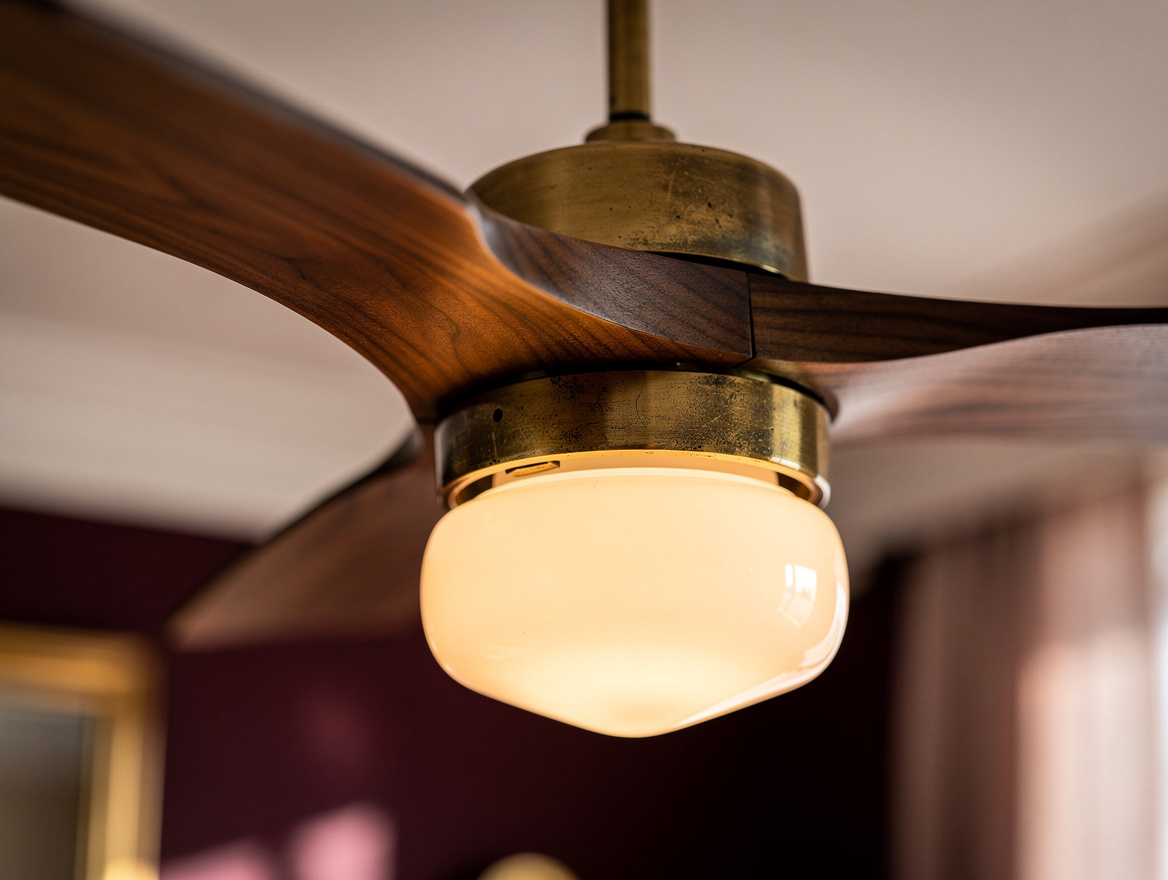
Cut the Blade Count Down to Three
Five blades were the default for decades, and that’s exactly why they look dated now. The eye reads a five-blade fan as an appliance.
Three broad, gently tapered blades read as sculpture. It’s the single cheapest-looking-to-best-looking swap available, and it costs nothing extra at the same price tier.
Airflow doesn’t suffer the way people assume. A 52-inch Dempsey moves roughly 4,010 CFM on high with a tidy profile.
Pair Wood Blades With One Metal, Not Three
Wood plus black. Wood plus brass. Wood plus brushed nickel.
Pick one and commit.
The mistake I see constantly is a walnut blade fan in a room that already has chrome hardware, brass lamps, and a bronze curtain rod. The fan stops being a design choice and becomes visual noise.
In a cream-and-dark-wood bedroom, matte black with washed oak blades is close to foolproof. It’s quiet enough to disappear and warm enough to belong.
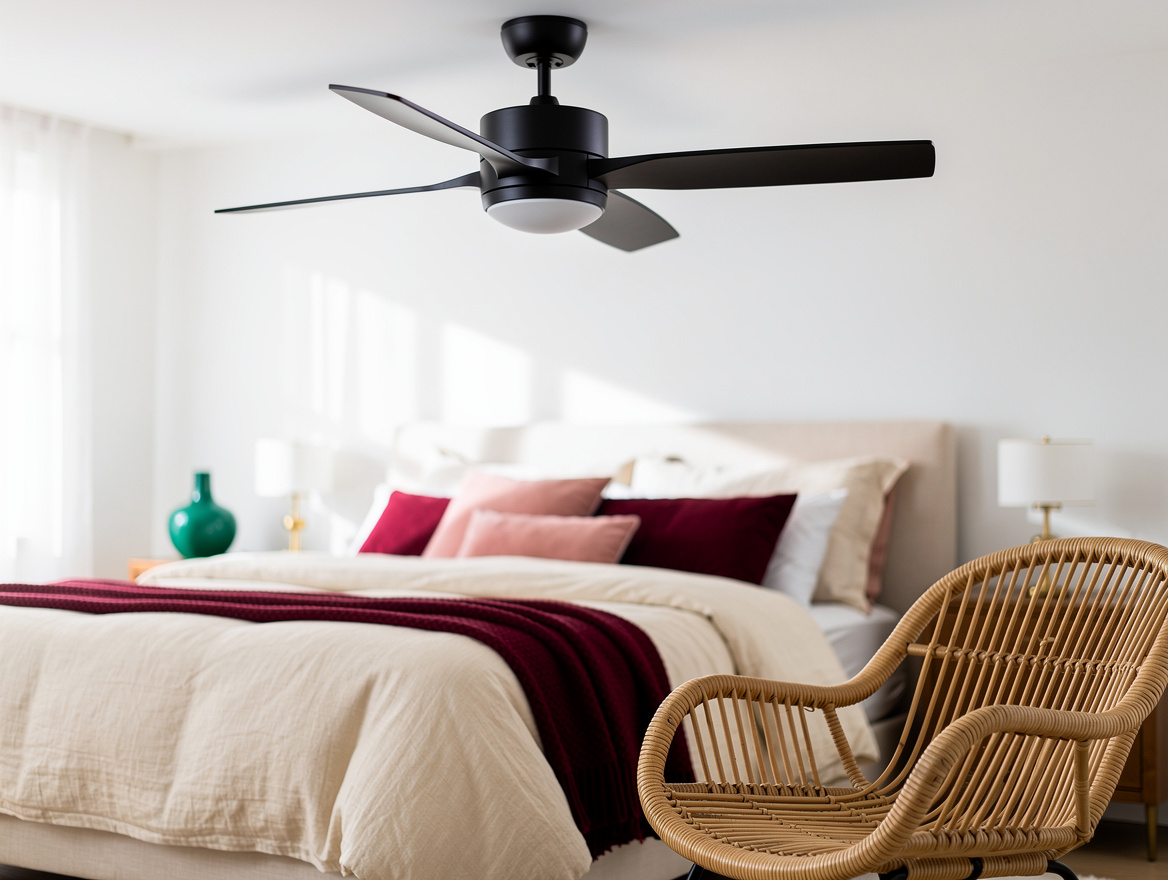
Skip the $90 Lookalike If the Motor Is Loud
Budget copies run roughly $80 to $180 and photograph beautifully. Then you turn them on at 2 a.m.
What typically gets cut at that price: motor noise, finish quality, and light rendering. A fan that hums or wobbles ruins a bedroom faster than an ugly one you never notice.
Expect around $200 to $550 for a genuinely polished branded option. Premium quiet motors and smart controls typically start near $650 and climb past $1,250.
Stop Hanging an Ultra-Flat LED Disc in a Warm Room
The flush LED disc fan is the current default at Home Depot and Lowe’s, and it’s genuinely great in a minimal, deliberately contemporary bedroom.
In a room with linen, curved furniture, and botanical green, it lands cold. The disc has no material story, so it fights everything soft around it.
Go the other direction there: a smoked or opal globe with restrained blade geometry, typically $250 to $600, in the boutique hotel vein of the Hunter Bennett.
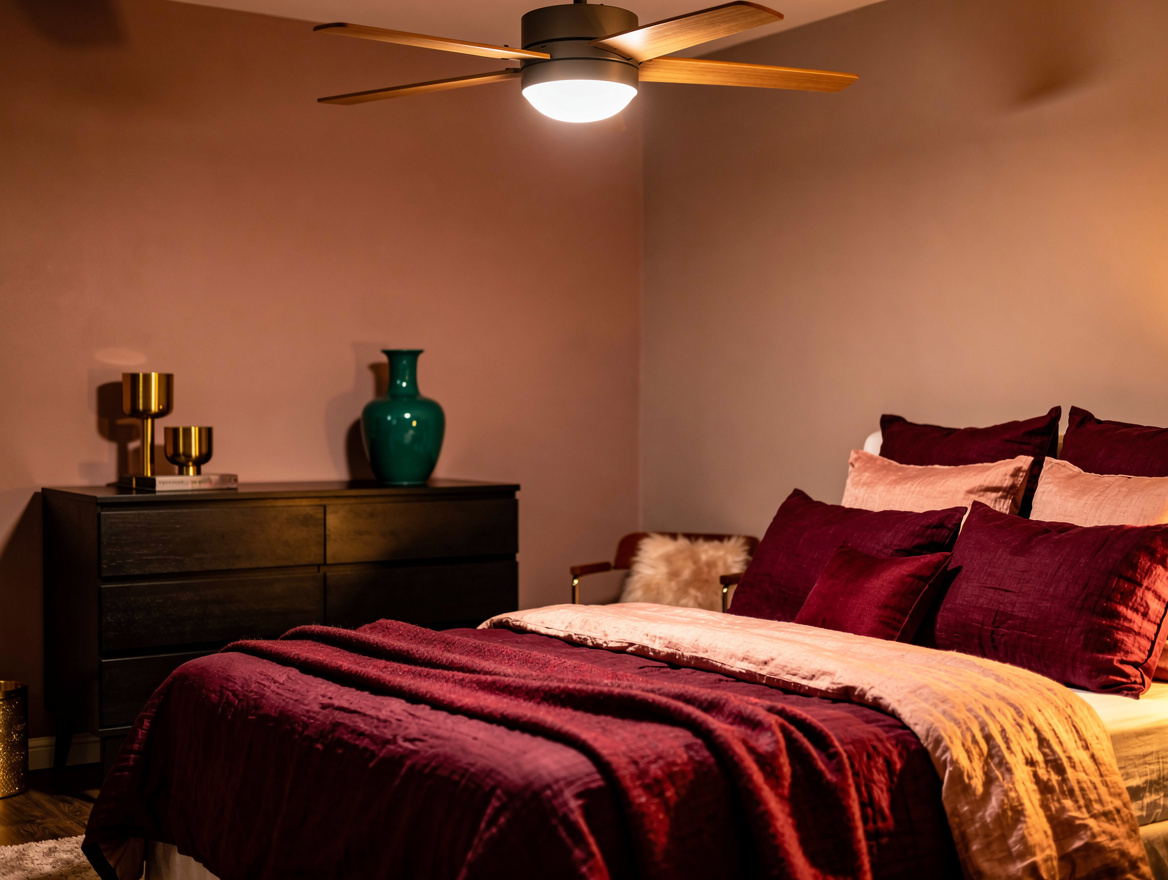
Quit Ignoring Ceiling Height Before You Click Buy
An 8-foot ceiling needs a low-profile or hugger mount, full stop. Anything with a downrod turns into a headroom problem you’ll resent every day.
Size to the room, too. A 44-inch fan typically runs about $200 and suits a small bedroom; the 52-inch version runs closer to $270 and covers rooms up to roughly 400 square feet.
Measure blade tip to nearest wall and give yourself at least 18 inches of clearance. Cramped looks cheap no matter what you spent.
Start with mounting height, because it eliminates half the catalog before you fall for anything. Then choose your metal, then your blade material, in that order.
Budget around $270 for a 52-inch low-profile fan that actually looks intentional, and you’ll spend less than most people waste on two failed attempts.
Mia Carter writes about small-space living and budget home makeovers. She has restyled three rentals and tests most ideas in her own 45 sqm flat.